Reviewed by Daniel M. · How we review
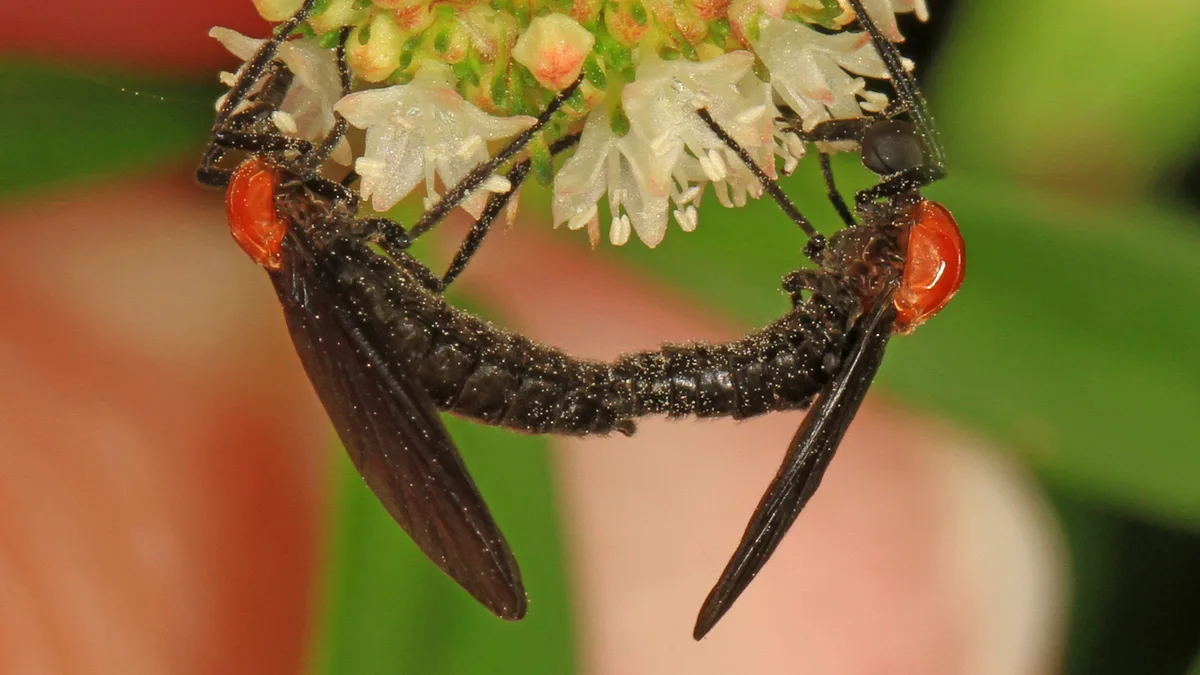
Lovebugs are small black flies with a red-orange thorax, March flies of the species Plecia nearctica, that swarm across the Gulf Coast and the Southeast for a few weeks each spring and late summer. They fly joined in pairs because they are mating. They do not bite, sting or spread disease, and their larvae help break down dead grass and leaves. Their only real harm is to cars, and only when splattered bugs are left to bake in the sun.
Below: how to identify them, why pairs stay stuck together, when each flight reaches your state (from our count of 9,314 iNaturalist records), the flowers they visit, and what extension specialists say about cars and control.
Key Takeaways
- Lovebugs are true flies in the family Bibionidae, related to gnats and mosquitoes, about 1/4 to 1/3 inch long (UF/IFAS).
- Pairs are mating: sperm transfer takes about 12.5 hours on average, but a pair can stay joined for several days (UF/IFAS).
- In US iNaturalist records, April and May hold 50.1% of sightings and August to October 44.4%. Texas leans to spring; Alabama and Mississippi lean heavily to fall.
- Adults feed on nectar and pollen, but no source we found has measured how well they pollinate.
- Sprays do not work, because new flies drift in as fast as old ones die. Wax the car before the flight and wash off remains within a day.
Table of Contents
- What Lovebugs Are and How to Identify Them
- Why Lovebugs Fly Stuck Together
- Lovebug Season: When and Where They Swarm
- Where Lovebugs Came From, and the University of Florida Myth
- Lovebugs on Flowers: Are They Pollinators?
- Lovebug Larvae in Lawns and Leaf Litter
- Lovebugs and Car Paint
- How to Get Rid of Lovebugs, and Why Sprays Fail
- Lovebug Look-Alikes
- Frequently Asked Questions
What Lovebugs Are and How to Identify Them
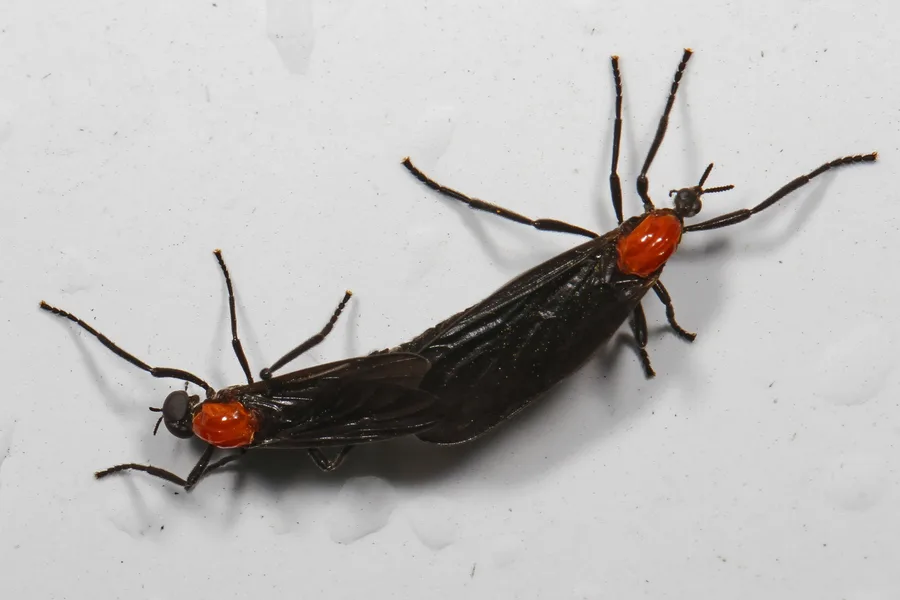
The lovebug (Plecia nearctica) is a March fly, family Bibionidae, in the same fly suborder as gnats, mosquitoes and crane flies. It is not a true bug; University of Florida entomologist Norman Leppla’s EDIS publication Living with Lovebugs notes nicknames such as honeymoon flies and double-headed bugs. The genus Plecia has more than 200 species worldwide, but only two live in the US.
Field marks, from the UF/IFAS Featured Creatures profile Lovebug, Plecia nearctica Hardy:
- Color: dull, somewhat velvety black, except the top of the thorax (the section behind the head), which is red.
- Size: males 6 to 7 mm (about 1/4 inch), females 6 to 9 mm (up to about 1/3 inch).
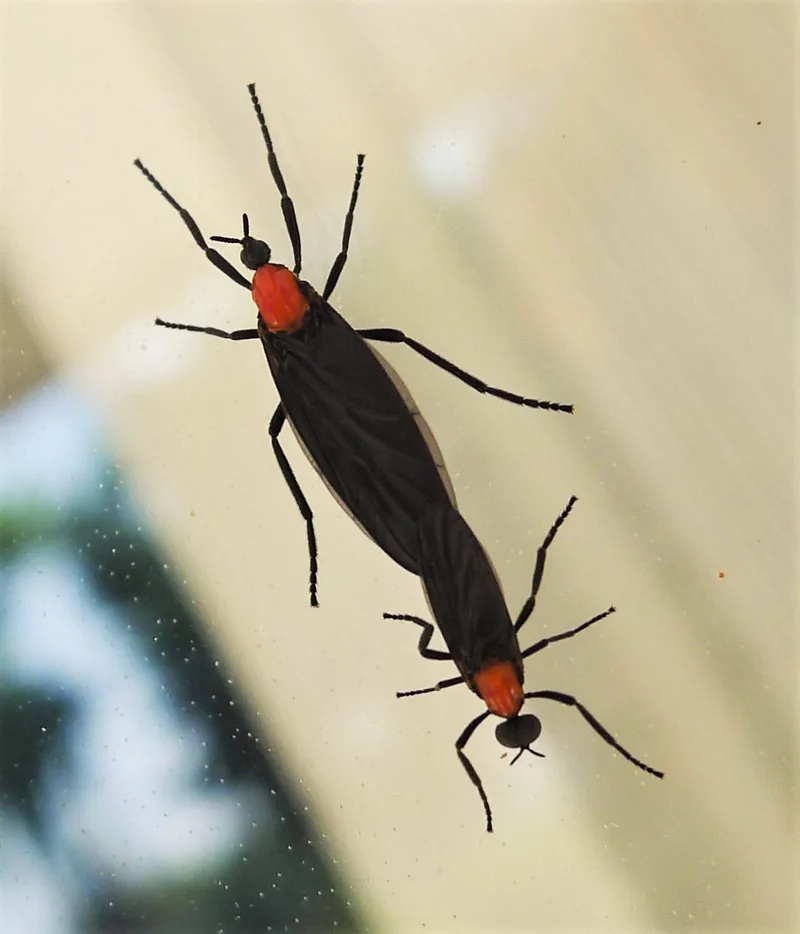
- Eyes: males have much larger eyes than females, so the male’s head looks like a dark ball.
- Behavior: slow fliers, often in joined pairs, active only in daylight.
Why Lovebugs Fly Stuck Together
A joined pair is a male and female mating. Leppla describes males swarming in groups of 40 or more above the grass where they emerged; a male grabs an incoming female almost at once, and the pair lands on vegetation. Within 1.5 to 10 minutes the male turns to face the opposite way, which is why a pair looks like one insect with a head at each end.
Leppla, citing Thornhill (1976), writes that sperm transfer takes an average of 12.5 hours, “but the pair can remain coupled for several days during which they feed and disperse.” The female does most of the flying. Pairs often separate and mate a second time; then the male dies, and the female lays her eggs under decaying leaves or grass before she dies too. In nature, adults live about 3 to 4 days.
Video: KQED’s Deep Look follows March flies, the family lovebugs belong to, from mass emergence to mating. It shows how the male’s large eyes help him spot a female, and why staying attached keeps rival males away. It covers the whole family, not only the Gulf Coast species.
Lovebug Season: When and Where They Swarm
UF/IFAS says each of the two Florida flights lasts about four weeks, in April to May and August to September, with a small December flight in south Florida. Texas A&M Forest Service gives May and September for Texas.
To see the national pattern, we pulled every research-grade US observation of Plecia nearctica from the iNaturalist API on November 22, 2026; a record is research grade when at least two people agree on the identification. There were 9,314.
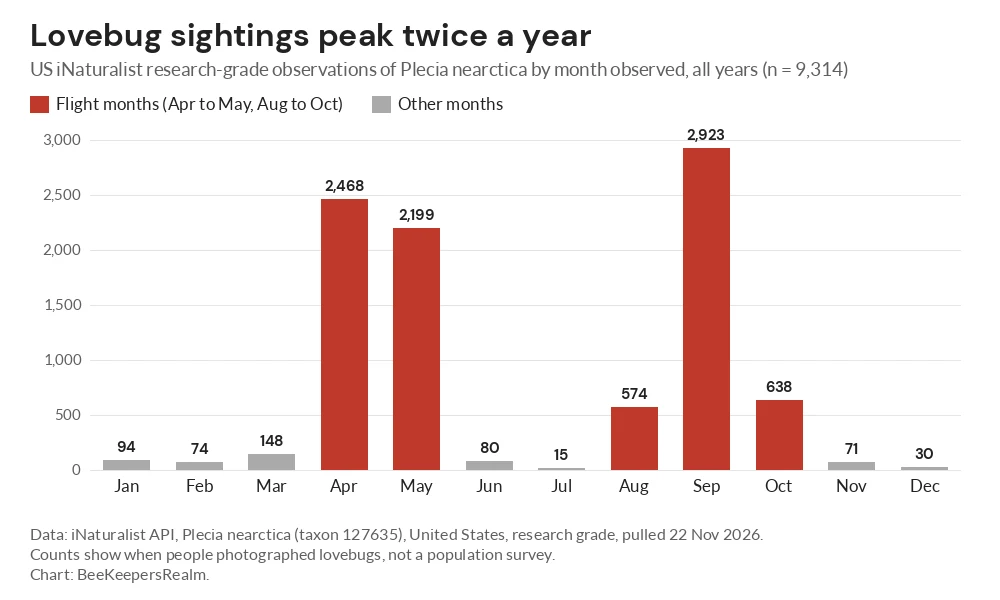
April (2,468 records) and May (2,199) make up the spring flight; September (2,923) is the busiest month of the year. Only 2.3% of records fall in December through February or in July. Each flight is concentrated in one or two months, matching the extension accounts.
Which states have the most lovebugs?
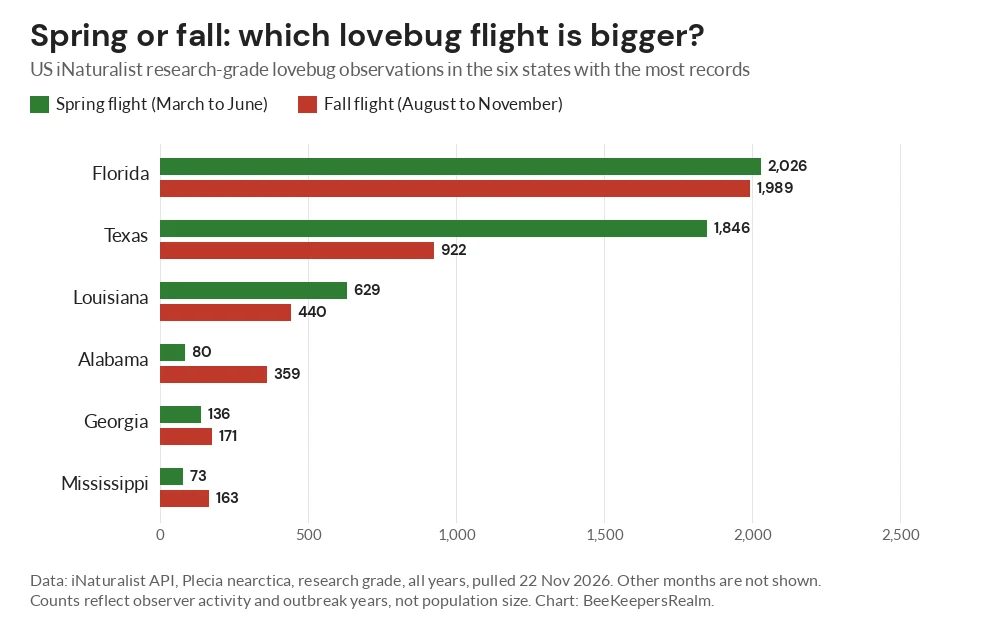
Florida has 4,187 records (45.0%), Texas 2,798 (30.0%) and Louisiana 1,074 (11.5%), followed by Alabama, Georgia, Mississippi and South Carolina. UF/IFAS cites a 2006 record as far north as Wilmington, North Carolina.
| State | Research-grade records | Spring flight (Mar to Jun) | Fall flight (Aug to Nov) |
|---|---|---|---|
| Florida | 4,187 | 48.4% | 47.5% |
| Texas | 2,798 | 66.0% | 33.0% |
| Louisiana | 1,074 | 58.6% | 41.0% |
| Alabama | 439 | 18.2% | 81.8% |
| Georgia | 309 | 44.0% | 55.3% |
| Mississippi | 239 | 30.5% | 68.2% |
Two patterns stand out. Texas records peak in April (1,195), a month before Florida’s spring peak in May (1,157). And in Alabama, Georgia and Mississippi the fall flight produces more records than the spring one, while Florida splits almost evenly. That fits Mississippi State University Extension entomologist Blake Layton’s note that in Mississippi “the fall flight is usually much larger than the spring flight.” These counts show when people photographed lovebugs, so an outbreak year or one busy observer can tilt a state.
Where Lovebugs Came From, and the University of Florida Myth
The lovebug ranges from Central America and Mexico into the southeastern US (UF/IFAS), and was described in 1940 from Galveston, Texas. Leppla writes that it is “not native to most of the southern United States” and spread from Louisiana and Mississippi across the Gulf States after 1940. The first Florida record was in 1949, in Escambia County in the far western Panhandle. (UF/IFAS Gardening Solutions gives 1947; Featured Creatures and Leppla both give 1949.)
The story that University of Florida scientists bred or released lovebugs, often to fight mosquitoes, is false: UF and USDA research on them began only after the fly was established in Florida (Featured Creatures).
“Its movement may have been accelerated by prevailing winds, vehicle traffic, sod transport, increased habitat along highways, and expansion of pastures, but not by UF researchers.”
Leppla adds that lovebugs could never control mosquitoes: they are slow plant feeders without the jaws, grasping legs or speed of predators such as dragonflies, and they fly by day while most mosquitoes are active at dusk or night.
Lovebugs on Flowers: Are They Pollinators?
Adult lovebugs eat nectar and pollen, alone or while coupled. Leppla describes their morning as “moving up onto the plants and feeding on nectar,” and UF/IFAS Gardening Solutions says they feed “particularly from sweet clover, goldenrod, and Brazilian pepper plants.” Goldenrod blooms from late summer into fall, so the fall flight overlaps it and other fall-blooming flowers for bees.
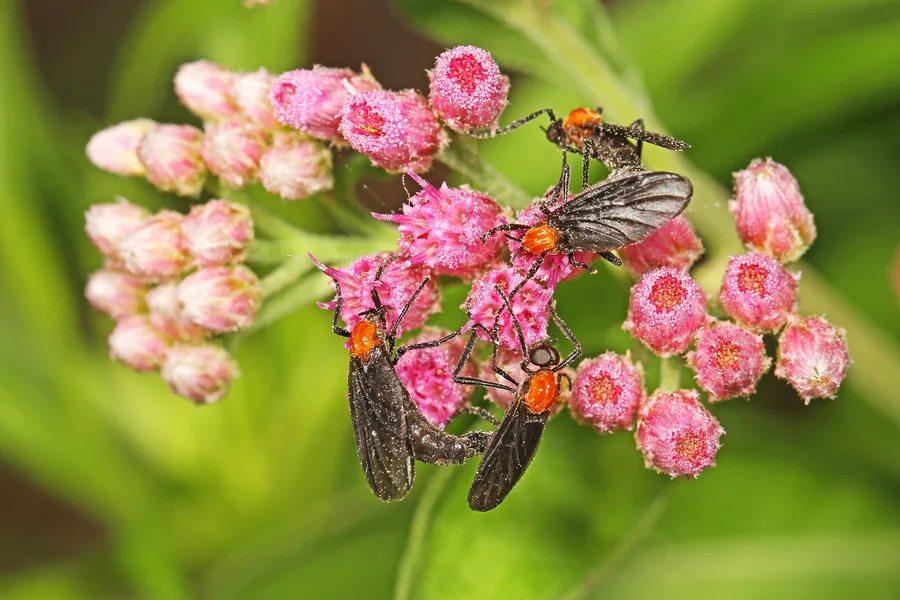
So are they pollinators? Texas A&M Forest Service says “the adults aid in pollination by feeding on the nectar and pollen of flowers,” and Deep Look says March flies in general pollinate cherries, apples and pears. That is plausible, but none of the extension sources we read cites a study measuring how much pollen Plecia nearctica moves. Treat lovebugs as flower visitors and minor pollinators, like the far better studied hover flies, not as a stand-in for bees.
Which flowers lovebugs were photographed on
iNaturalist users can tag a record with the plant the insect was visiting; 80 US lovebug records carry that tag. Twenty-five come from one observer on one day in Savannah, Georgia, all on chestnut flowers, so we set them aside. The other 55, from 28 observers, lean toward the daisy family:
| Plant group | Records | Plants named |
|---|---|---|
| Daisy family (Asteraceae) | 23 | White beggarticks (6), thistles (3), bonesets (3), goldenrods and goldentop (3), others |
| Dogbane and milkweed family (Apocynaceae) | 5 | Four milkweed species, hemp dogbane |
| Palms (Arecaceae) | 5 | Saw palmetto (4), cabbage palmetto (1) |
| Mint family (Lamiaceae) | 4 | Spotted horsemint (2), bog sage, longspurred mint |
| Other families | 18 | Ladies’ tresses orchids, sea grape, wild carrot, privets, others |
This is a small, opportunistic sample of what people happened to photograph, 41 of the 55 in Florida, not a feeding study. None were on sweet clover or Brazilian pepper. Several are bee plants, including saw palmetto, source of Florida’s saw palmetto honey. Leppla notes that beekeepers report, anecdotally, that honey bees do not visit flowers crowded with lovebugs; we found no study testing that.
Lovebug Larvae in Lawns and Leaf Litter
The useful part of the life cycle is the one people never see. A female lays an average of about 350 eggs under decaying vegetation in a moist, grassy spot (Leppla). The slate-gray larvae, about 1/2 inch long when grown, live in groups under the litter and eat dead plant material (UF/IFAS).
“Plecia nearctica is beneficial in the larval stages by helping to recycle decaying vegetative matter into organic matter (Hetrick 1970a).”
Layton says the larvae live in “the thatch of lawns, pastures, roadsides, and similar sites, causing no harm and going unnoticed.” Grassy roadsides and pastures hold large populations, which helps explain why so many adults emerge beside highways. Larvae do not damage lawns or garden plants, so there is no reason to treat a yard for them; Layton adds that they breed over too large an area for that to work.
Lovebugs and Car Paint
Lovebugs fly low and in huge numbers along highways. Featured Creatures reports they are drawn to sunlit car exhaust and to the heat and vibration of engines; Leppla suggests they may mistake exhaust for the smell of decaying plant matter where females lay eggs.
The paint risk is real but slower than many sites claim. Leppla reports that smashed lovebugs start near neutral, at pH 6.5, and turn acidic, at pH 4.25, within 24 hours, yet painted panels coated with them and kept in a humid indoor room for 21 days were not damaged. The damage comes when the remains, especially the eggs, bake in the sun. UF/IFAS adds that modern paint coatings have made this less of a problem.
| Step | What to do | Source |
|---|---|---|
| Before the flight | Wax the front of the car so remains come off easily | UF/IFAS (Leppla); Clemson HGIC |
| Protect the radiator | Fit a screen in front of the grill; clogged radiators can overheat engines (Layton) | UF/IFAS Featured Creatures; Clemson HGIC |
| Plan the drive | Drive in the evening or at night, and slow down | UF News (Leppla, 2026); Clemson HGIC |
| Afterwards | Soak with water about 5 minutes, then scrub within 15 to 20 minutes; a moist cloth or dryer sheet helps | UF/IFAS Featured Creatures; UF News (Leppla, 2026) |
| Deadline | Remove remains within a day or so | Clemson HGIC; UF/IFAS (Leppla) |
How to Get Rid of Lovebugs, and Why Sprays Fail
Leppla writes that household fly sprays will kill lovebug adults, but that “the lovebugs will return almost immediately.” Because the flies breed over huge areas and blow in on the wind, they “cannot be controlled effectively with poisons or repellents.”
“Spraying insecticides can only kill lovebugs that are present. Lovebug adults blow downwind and collect on buildings as more fly in.”
Spraying also costs pollinators. Clemson HGIC calls sprays impractical, “especially when the insecticides have a negative impact on other daytime flyers such as honeybees.” If you need an insecticide for another pest, our guide to pollinator-safe pest control products explains how to choose and time one to spare bees. What works instead:
- Moving air: lovebugs are weak fliers, so a fan keeps them off a patio, and an air conditioner’s positive pressure helps keep them out of a building (Leppla; UF News).
- Screens: screen windows and doors on the windward side, and decks or pool enclosures where flights are heavy (Leppla).
- Timing: postpone outdoor painting during flights, since lovebugs are drawn to light-colored, freshly painted surfaces (Layton; UF/IFAS).
- Patience: each flight lasts only a few weeks in any one place.
Citrus and mouthwash sprays are common online remedies, but none of the extension sources we read tested them. Natural enemies are few: Leppla says fire ants avoid lovebugs, while spiders, dragonflies and birds take some, and in Florida tests the fungus Beauveria bassiana killed 27 to 33% (Kish et al. 1977, cited by UF/IFAS).
Lovebug Look-Alikes
Two other small March flies are often mistaken for lovebugs (UF/IFAS descriptions):
| Fly | How it looks | When and where | Nuisance on roads? |
|---|---|---|---|
| Lovebug (Plecia nearctica) | Black with a red top of the thorax; sides of the thorax black | Spring and late summer flights; Texas to the Carolinas | Yes |
| American lovebug (Plecia americana) | Thorax almost completely red; very similar otherwise | Spring only (April to June); woodlands, North Carolina to Mexico | No |
| Dilophus sayi, another March fly | Smaller, all black, no red on the thorax | Late January through April in Florida (Featured Creatures); April to June (Leppla) | No |
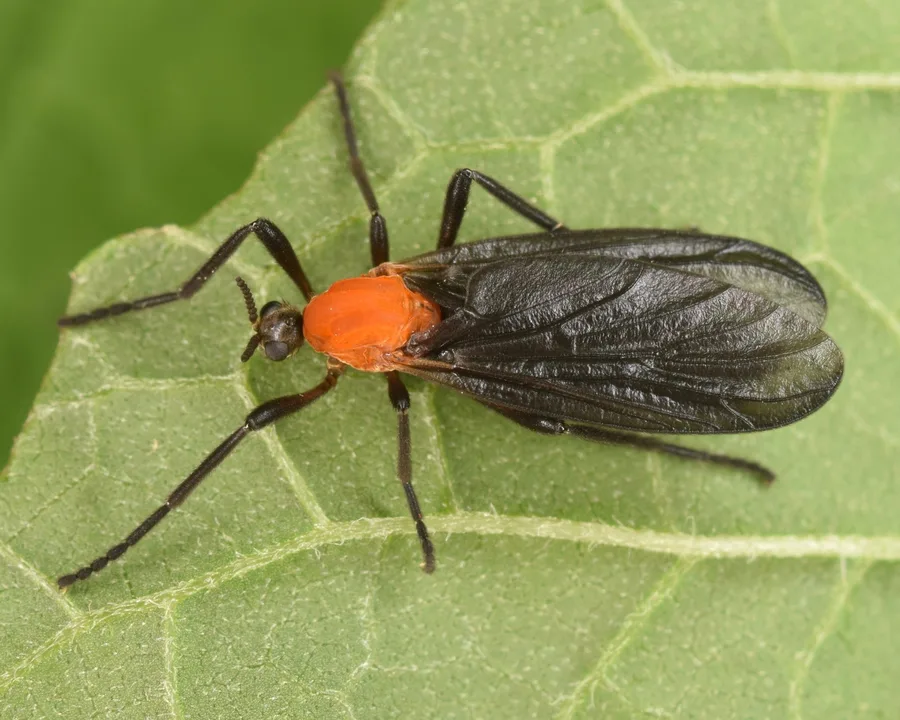
Any lovebug flying in late summer or fall is Plecia nearctica: Buschman found the American lovebug only in April, May and June. It is also far rarer in US iNaturalist data: 212 research-grade records against 9,314. For other small flies around the yard, see the rest of our garden and household insects.
Mayflies are another harmless insect that swarms in huge numbers for a few weeks a year, mostly near lakes and big rivers; see our mayfly guide.
Frequently Asked Questions
What do lovebugs do to humans?
Nothing harmful. Lovebugs do not bite, sting or transmit diseases, and they are not poisonous (UF/IFAS). They are a nuisance on windshields, buildings and patios.
Why are lovebugs stuck together?
They are mating, and the pair stays joined for many hours, up to several days.
What happens if you separate lovebugs?
No extension source we found reports what happens when a pair is pulled apart. Pairs do separate on their own and may mate again.
What was the purpose of lovebugs?
They were not created for a purpose; the story that UF made them to control mosquitoes is a myth. Their larvae recycle dead grass and leaves, and adults feed spiders, dragonflies and birds.
What state has the worst love bugs?
Florida, then Texas and Louisiana: 4,187, 2,798 and 1,074 of the 9,314 US research-grade iNaturalist records.
What smell do love bugs hate?
No smell has been shown to repel them, and UF/IFAS says repellents do not work. Studies it cites found some scents attract them instead, such as anethole, a plant oil.
When is lovebug season?
Two flights a year of about four weeks each: April to May and August to September in Florida, May and September in Texas. Adults live only 3 to 4 days.
The Bottom Line
Lovebugs are a few weeks of mess, twice a year, from a harmless fly that is useful as a decomposer. Skip the sprays, wax the car before the flight, wash it within a day, and use fans and screens.
Image credits: Featured image: mating lovebugs on a flower by Judy Gallagher, Wikimedia Commons, CC BY 2.0, cropped and resized. Lovebug pair, lovebugs on camphorweed: Judy Gallagher, CC BY 2.0. Male and female lovebugs: gailhampshire, CC BY 2.0. American lovebug: skitterbug, via iNaturalist, CC BY 4.0. All photos via Wikimedia Commons, resized; links to each file page and licence are in the captions. Charts: BeeKeepersRealm, from iNaturalist API data pulled November 22, 2026.