Reviewed by Thomas B. · How we review
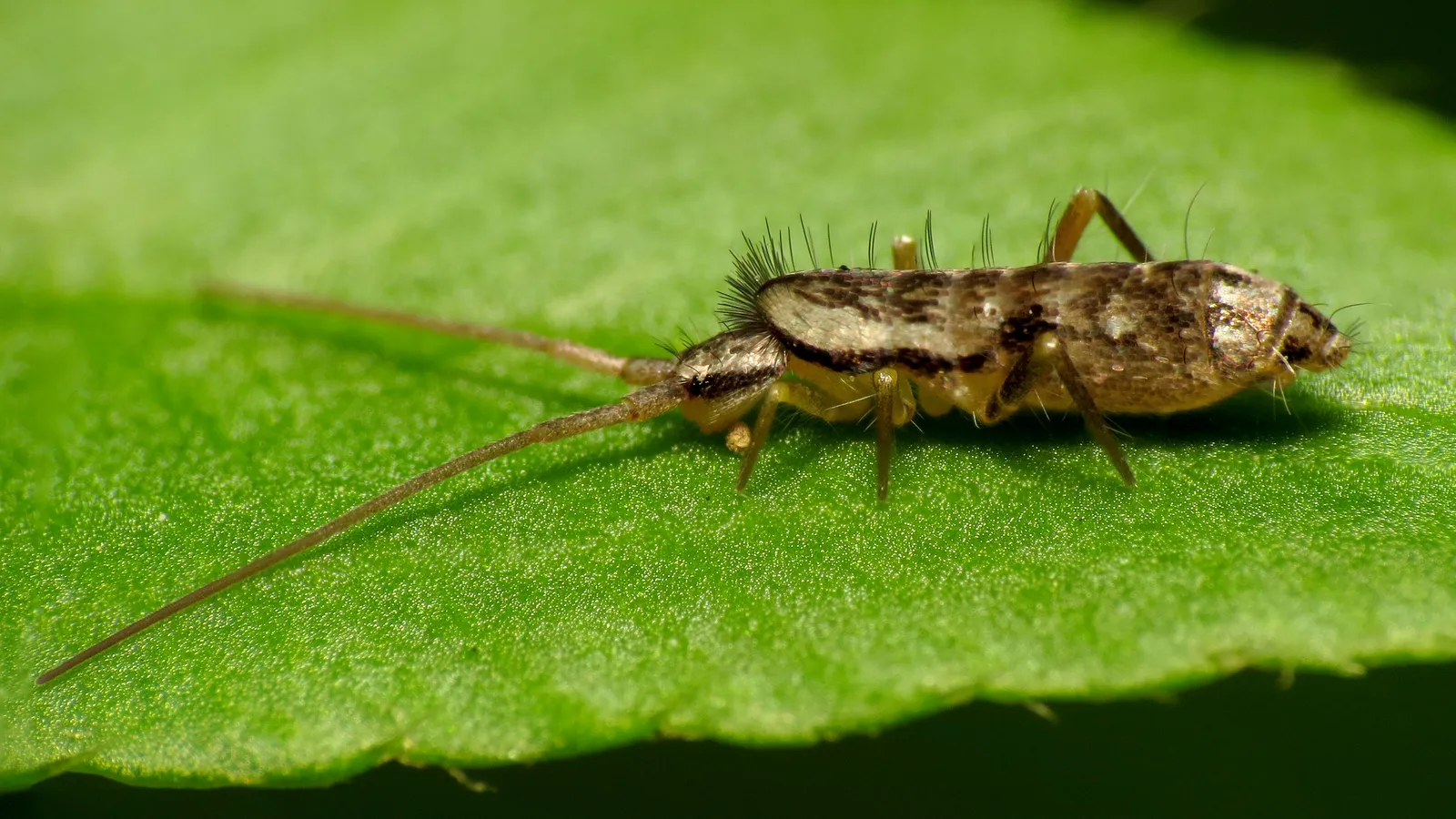
Springtails are tiny, wingless, six-legged animals, most 1 to 2 mm long, that live by the thousands in moist soil, leaf litter, compost and mulch, where they feed on fungi, molds and decaying plant matter. They are named for a forked “tail” folded under the body that flings them into the air. Springtails do not bite, sting or spread disease. In a garden they are part of healthy soil; in a house or a flower pot, they usually mean too much moisture.
Below: identification, what springtails do in soil, how to tell them from fungus gnats, snow fleas and moisture-first control, plus our count of 33,072 US iNaturalist records showing springtails are found mostly in winter and early spring.
Key Takeaways
- Springtails (Collembola) have six legs but are no longer classed as insects; about 700 species live in North America.
- They are soil recyclers: a cubic foot of soil may hold 10,000 of them, feeding on fungi, bacteria and dead plants.
- They do not bite people or pets, and mature plants are not significantly injured.
- In our iNaturalist count, 41.8% of US springtail records fall from December to March, two-thirds of them globular springtails.
- In pots and houses, dry things out: let potting mix dry, fix leaks, pull mulch back from the foundation. Sprays are generally not needed.
Table of Contents
- What Springtails Are
- How to Identify a Springtail
- What Springtails Do in Soil, Compost and Mulch
- When Springtails Are Most Active: Our iNaturalist Count
- Snow Fleas: Springtails on Winter Snow
- Springtails in Houseplants and Potting Mix
- Why Springtails Come Into the House
- Are Springtails Harmful? Bites, Skin and Pets
- How to Get Rid of Springtails, Moisture First
- Frequently Asked Questions
What Springtails Are
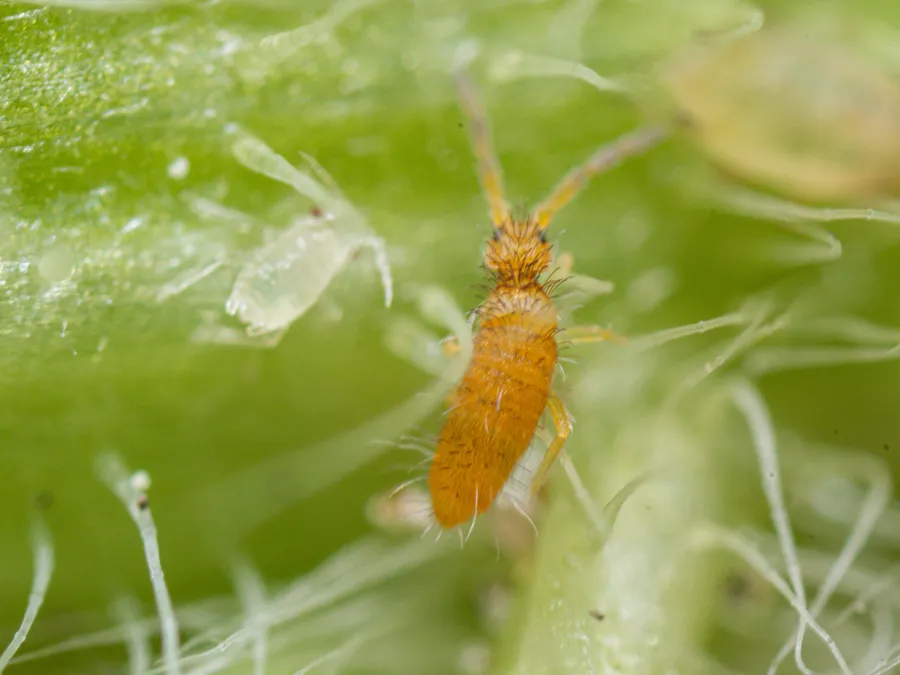
Springtails make up the group Collembola. They have six legs, like bees and other true insects, and were long classed as insects, but Colorado State University Extension says they have many features insects lack and are now usually grouped as entognathous hexapods, a sister group to the insects. The University of Kentucky puts it plainly: they are not members of the class Insecta.
The Missouri Department of Conservation (MDC) puts the world total at more than 8,000 species, and Texas A&M AgriLife Extension counts about 700 in North America.
How to Identify a Springtail
If it is very small and jumps, Texas A&M says, it is probably a springtail. The key features:
- Size: species range from 0.2 to 10 mm, but most that get into homes are 1 to 2 mm (Penn State).
- Color: white to black; some species are purple, red, orange, yellow or mottled (Penn State).
- Body: soft, wingless and either slender or round.
- The spring: a forked appendage called the furcula, tucked under the abdomen. Released, it lets the springtail jump up to several inches high (UC IPM). UConn notes that not all species have one.
- The collophore: a small tube under the abdomen; Collembola comes from the Greek for “glue” and “peg.”
| Group | Body shape | US examples | Where you see them |
|---|---|---|---|
| Elongate springtails (Entomobryomorpha) | Slim, with abdominal segments easy to see; often covered in scales that look iridescent | Entomobrya, belted springtail (Orchesella cincta), Willowsia | Leaf litter and bark; Willowsia in houseplant pots, sink drains and damp basements |
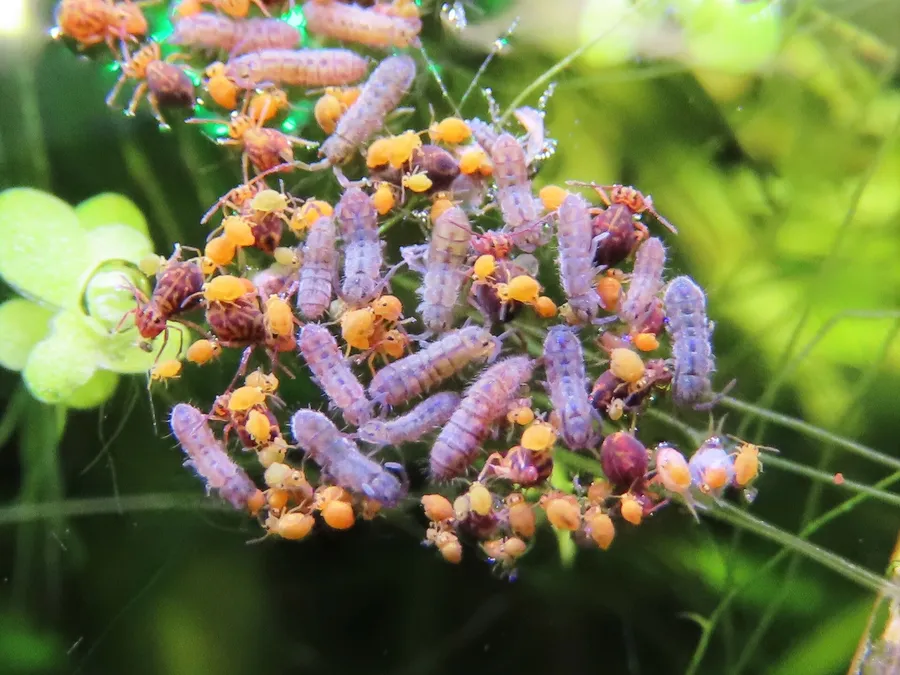
| Globular springtails (Symphypleona) | Round, almost ball-shaped, antennae longer than the head; often tan, yellow, mottled or striped | Dicyrtomina, Ptenothrix, garden springtail (Bourletiella hortensis) | Leaf litter and gardens; most of the winter records in our count |
| Plump springtails (Poduromorpha) | Oval and plump, short legs and antennae, often gray or black and velvety | Snow fleas (Hypogastrura nivicola, H. harveyi), water springtail (Podura aquatica) | Soil and bark; snow on mild winter days; the surface of ponds |
The three main orders, per the MDC field guide; examples from MDC and our iNaturalist count.
How the jump works
Jumping is a springtail’s escape from predators. In 2024, Adrian Smith of NC State University and the North Carolina Museum of Natural Sciences filmed globular springtails at 40,000 frames per second. They launched more than 60 times their own height and went mostly up and backward.
“It only takes a globular springtail one thousandth of a second to backflip off the ground and they can reach a peak rate of 368 rotations per second.”
Video: Smith’s Ant Lab channel shows the footage in slow motion, from takeoff to landing.
What Springtails Do in Soil, Compost and Mulch
UC IPM says springtails live in soil, especially soil amended with compost, in leaf litter and organic mulches, and under bark or decaying wood. Texas A&M lists their food as decaying plant material, fungi, bacteria, algae and lichens.
“Their presence is usually a sign of healthy, living soil.”
Texas A&M says a cubic foot of soil may harbor 10,000 springtails; Penn State cites estimates as high as 100,000 per cubic meter. Their jobs there:
- Recycling: Texas A&M describes them recycling dead plant material into nutrients for a lawn.
- Spreading helpful fungi: MDC says fungi ride on soil springtails to new places, which helps beneficial mycorrhizal fungi reach tree roots.
- Suppressing plant disease: MDC adds that springtails eat many fungi that can harm plants.
- Feeding the food web: MDC lists small flies, bugs, beetles, pseudoscorpions and small spiders among their predators, and soil centipedes hunt them too. Even chiggers eat them: Ohio State says older chigger nymphs and adults prey on small arthropods like springtails.
They share that work with bigger leaf-litter recyclers such as roly polies and millipedes. To see them, Texas A&M suggests leaf litter in a can with a 1/4-inch hardware-cloth bottom under a lamp; springtails move down out of the drying litter.
Do springtails damage garden plants?
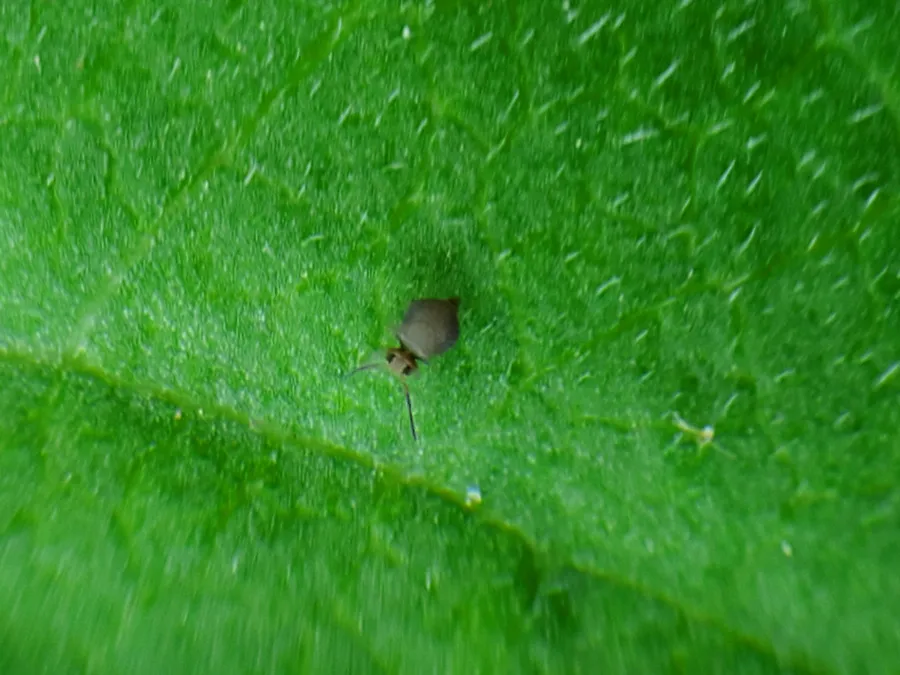
Rarely. UC IPM says some species chew the roots and leaves of seedlings, but mature plants are not significantly injured. UConn Extension says high populations of the garden springtail (Bourletiella hortensis) occasionally feed on tender seedlings, leaving tiny pits on the leaves, damage that resembles flea beetle feeding. Kentucky notes that no springtail is currently a major agricultural pest in the United States.
When Springtails Are Most Active: Our iNaturalist Count
To see when Americans actually find springtails, we pulled every research-grade US observation of Collembola from the iNaturalist API on November 22, 2026 (research grade means at least two people agreed on the identification): 33,072 records.
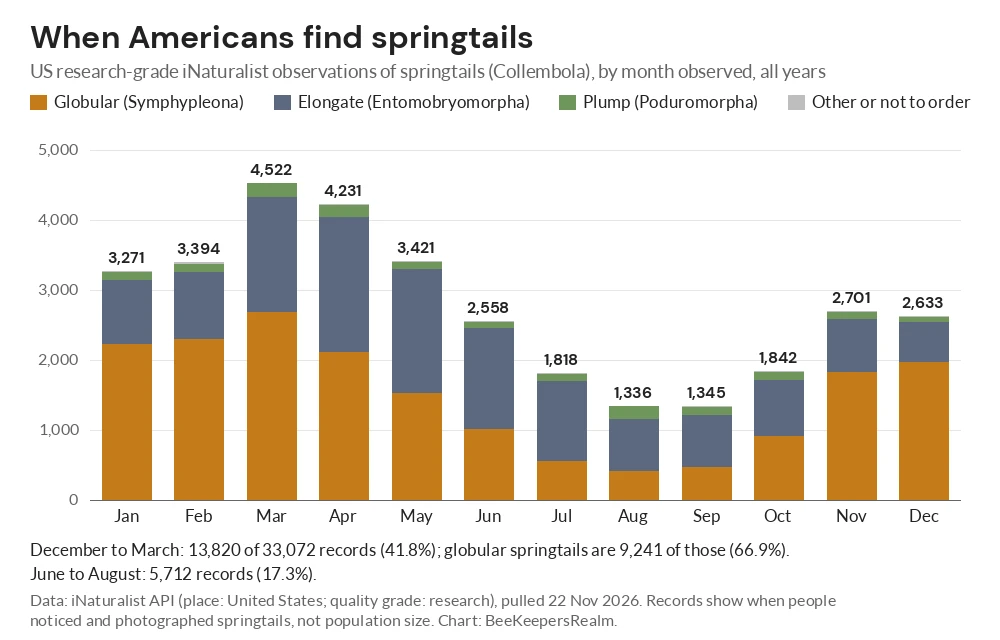
March has the most records (4,522) and August the fewest (1,336). December to March holds 13,820 records (41.8%), June to August only 5,712 (17.3%). Globular springtails drive the winter peak, with 9,241 (66.9%) of the December-to-March records, which fits NC State’s note that its globular springtails are usually out from December through March. The top species change with the season:
| Season | Most-recorded US species (research-grade records) |
|---|---|
| December to March | Dicyrtomina ornata 2,191; Ptenothrix maculosa 2,051; dimorphic springtail (Entomobrya atrocincta) 840; Homidia socia 622 |
| June to August | Paradoxical slender springtail (Lepidocyrtus paradoxus) 514; belted springtail (Orchesella cincta) 500; Homidia socia 396; Prorastriopes lippsoni 273 |
Two cautions. These counts show when people notice springtails, not how many exist, and records jumped recently (3,033 in 2024, 11,337 in 2025), so we combined all years. The wider set of 104,795 verifiable records, including unconfirmed photos, shows the same March peak (14,525) and August low (4,448).
Snow Fleas: Springtails on Winter Snow
Snow fleas are springtails, not fleas. Penn State names Hypogastrura nivicola, a black springtail sometimes seen on the snow surface on warm winter days. MDC adds a second snow flea, H. harveyi, and says their bodies make a kind of antifreeze; thousands can form patches on the snow and collect in foot tracks and other dips, making the low spots look black.
Colorado State says snow fleas are springtails that normally feed in leaf litter and soil and work their way up to the surface of thawing snow, and it suggests such migrations are triggered by overcrowding and lack of food.
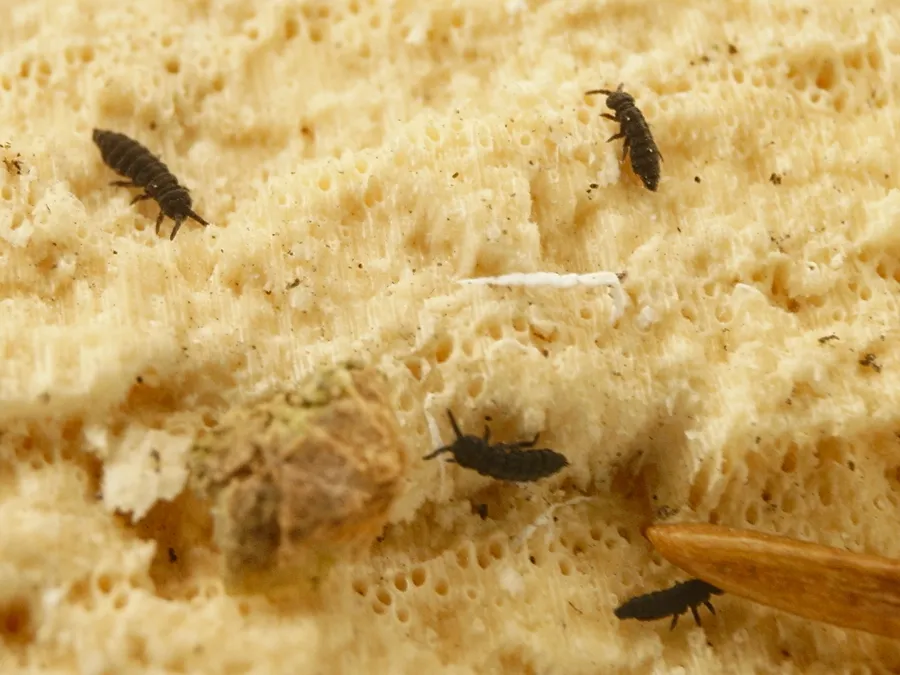
Snow fleas are a sliver of the iNaturalist data. Of 2,391 verifiable US records of the genus Hypogastrura, only 35 had reached research grade, and just 10 were confirmed as H. nivicola. The winter peak in our chart is mostly globular springtails in leaf litter, not swarms on snow.
Springtails in Houseplants and Potting Mix
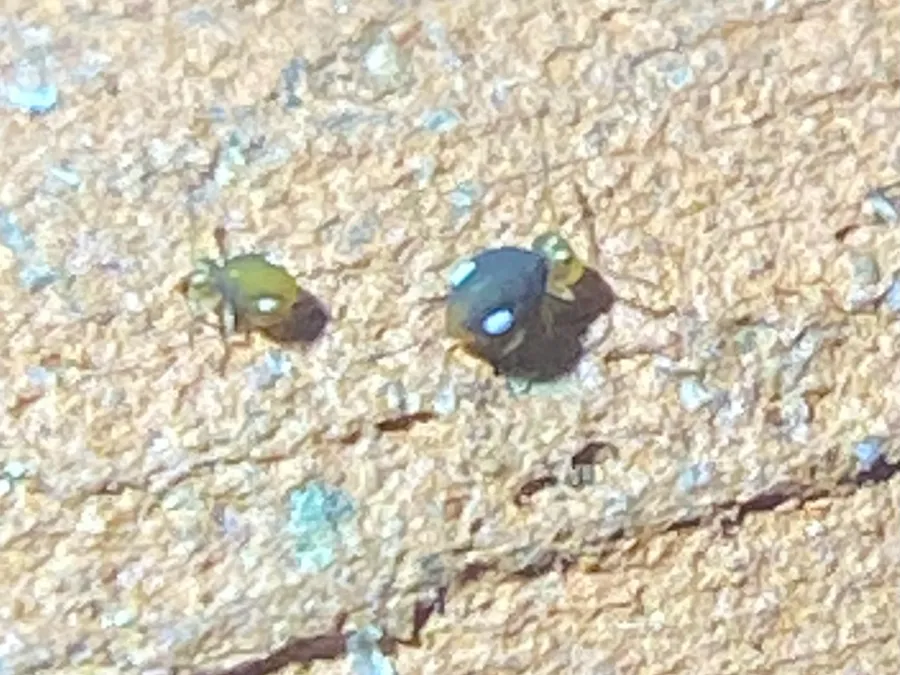
Colorado State says springtails in houseplant soil are most often noticed just after watering, when they leave the saturated soil, and that they do very little, if any, damage to the plant.
UConn Extension says springtails favor growing media high in organic matter or compost, especially when overwatered, and can arrive in unpasteurized potting soil. Texas A&M notes that a long-lasting indoor problem often means they are living in potted plants. Terrarium keepers, by contrast, buy springtails on purpose as a clean-up crew.
Springtails vs fungus gnats and other look-alikes
The quickest test: springtails jump, fungus gnats fly. UConn adds that growers sometimes confuse springtails with thrips larvae.
| Critter | Size and look | How it moves | Harm | Source |
|---|---|---|---|---|
| Springtail | 1 to 2 mm; soft, wingless; white, gray or dark; slender or round | Jumps with its furcula; crawls | None to people; seldom any to plants | Penn State, UC IPM, Colorado State |
| Fungus gnat (adult) | About 1/16 to 1/8 inch; dark, delicate fly like a tiny mosquito, long antennae | Weak flier; runs over soil and leaves | Adults do not damage plants or bite | UC IPM |
| Fungus gnat (larva) | Legless, whitish-to-clear body with a shiny black head | Wriggles in moist potting mix | Can damage roots of seedlings and young plants in large numbers | UC IPM |
| Flea | About 1/8 inch; dark reddish-brown, hard, flattened side to side | Jumps onto people and pets | Bites | University of Kentucky, Texas A&M |
| Booklouse | 1 to 2 mm; soft, flat, wingless, tan to gray | Crawls on damp paper, books and walls | Feeds on mold; a sign of high humidity | Penn State |
If the flyers are the problem, see our guide to gnats.
Fine webbing and pale, speckled leaves on a houseplant point to a different pest: see our spider mite guide.
Why Springtails Come Into the House
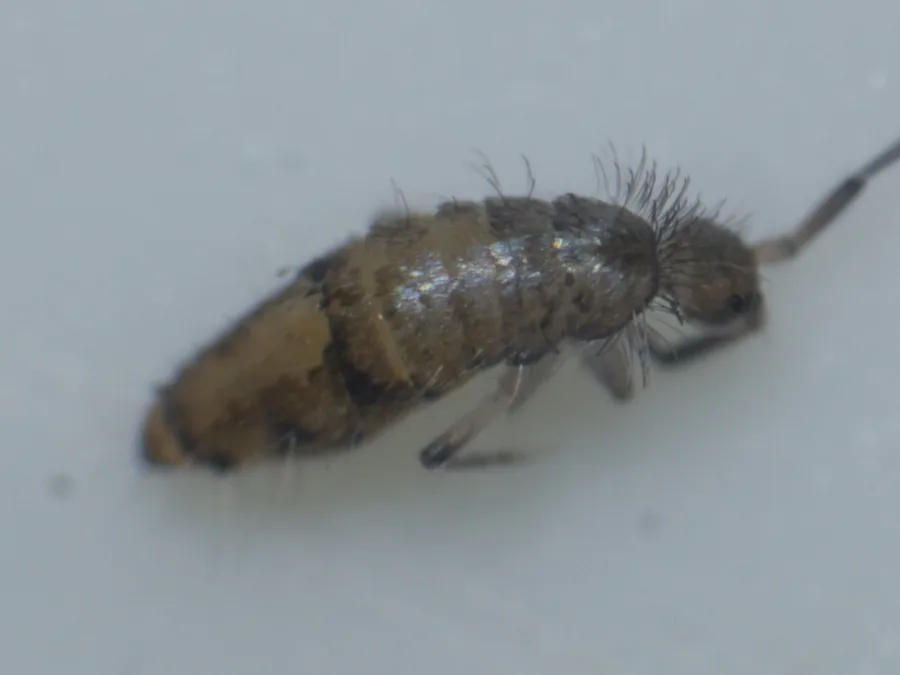
Penn State says springtails become a nuisance in homes usually during extended droughts or prolonged, saturating rains. UC IPM says that when their outdoor environment dries, they search for moisture; they are attracted to light and small enough to enter through cracks around doors, utility pipes and window screens, or ride in on potted plants.
Inside, they head for damp places such as sinks, tubs, drains, leaking pipes and damp basements. Most die quickly: UC IPM says they soon die indoors unless they find moisture, Texas A&M says they cannot be carried from house to house in boxes or on clothing, and Colorado State says migrations usually last less than a week. Penn State says high humidity and mold growth let them maintain an indoor population. Damp rooms draw other moisture lovers too, such as silverfish.
Are Springtails Harmful? Bites, Skin and Pets
No. UC IPM says springtails do not bite or otherwise harm people or pets, and WebMD’s medically reviewed guide says they do not spread disease or bite people. The University of Kentucky’s ENTFACT-420 says there have been no verified reports of springtails causing bodily harm to people or animals and no evidence that they form parasitic relationships, which answers online claims that springtails live in human skin. Kentucky notes a few reported cases of skin irritation from direct handling, and none from passive contact in the home.
This is educational information, not medical advice. If you have an unexplained rash or the feeling of something crawling on your skin, see a doctor; your county extension office can identify an insect sample.
How to Get Rid of Springtails, Moisture First
“The key to managing springtails is to reduce moisture and excess organic matter in gardens, plant pots, and around building foundations.”
The goal is a dry strip at the house and dry potting mix, not bare garden beds: springtails in mulch away from the house are doing useful work.
Around the foundation
- Remove excessive mulch and moist leaves around the foundation (UC IPM); Kentucky advises keeping mulch and wood piles at least a foot from the walls.
- Water less. Texas A&M suggests watering a lawn no more than once a week, deeply.
- Seal cracks around doors, utility pipes and window screens.
Inside the house
- Dry out damp areas, fix leaks and remove moldy items.
- Vacuum the ones you see. UC IPM warns never to pour or spray insecticides down drains.
In houseplants
- Water thoroughly, then let the soil dry before watering again (Penn State), and do not let drain water stand in saucers (UC IPM).
- Use a pasteurized, bagged mix for new pots, since UConn says springtails can arrive in unpasteurized soil.
Skip the spray
UC IPM says insecticide sprays are generally not recommended for springtail management, and Colorado State says springtails are fairly resistant to most insecticides. UC IPM notes pyrethroids are available for foundation walls but warns against run-off into storm drains. Pyrethroids are also toxic to bees, so keep them off flowering plants; our guide to pollinator-safe pest control explains why. More: our garden and household insects guides.
Turning garden soil in the West can also turn up a much bigger soil insect, the Jerusalem cricket, which is harmless unless handled.
Frequently Asked Questions
Is it normal to have springtails in your house?
A few, yes, especially after a drought or heavy rain; they usually die within days. A steady supply means a damp spot: a leak, a wet basement or overwatered plants.
Are springtails good or bad?
Mostly good. Outdoors they recycle organic matter, graze fungi and feed other soil animals. Indoors they are a harmless nuisance and a sign of moisture.
What kills springtails instantly?
Drying them out: indoors they soon die without moisture, and vacuuming removes the ones you see. Sprays are generally not recommended.
What could be mistaken for springtails?
Fleas, which are larger, brown and bite; fungus gnats, which fly; booklice, which crawl on damp paper and books; and, in greenhouses, thrips larvae.
Can springtails infest your bed?
Not in a normal, dry bedroom: springtails need moisture. Tiny jumping bugs that bite are more likely fleas.
Are springtails harmful to plants?
Rarely. A few species, such as the garden springtail, nibble tender seedlings; mature plants are not significantly injured.
The Bottom Line
Springtails are a normal, useful part of soil, compost and mulch. When they show up in a house or a flower pot, treat the moisture, not the springtails.
Image credits: Featured image: Katja Schulz, Wikimedia Commons, CC BY 2.0, cropped and resized (Pogonognathellus elongatus, Rock Creek Park, Washington, DC). Dimorphic springtail: Jeremiah Degenhardt, CC BY 4.0. Dicyrtomina ornata: geosesarma, CC BY 4.0. Garden springtail: Katie Kucera, CC BY 4.0. Snow flea: psweet, CC BY-SA 4.0. Springtails on a flower pot: Kirstie S, CC0. Willowsia in a sink: Jeff Clark, CC BY 4.0. All via iNaturalist except the featured image; links to each photo page and licence are in the captions. Chart: BeeKeepersRealm, from iNaturalist API data pulled November 2026.