Reviewed by Sofia T. · How we review
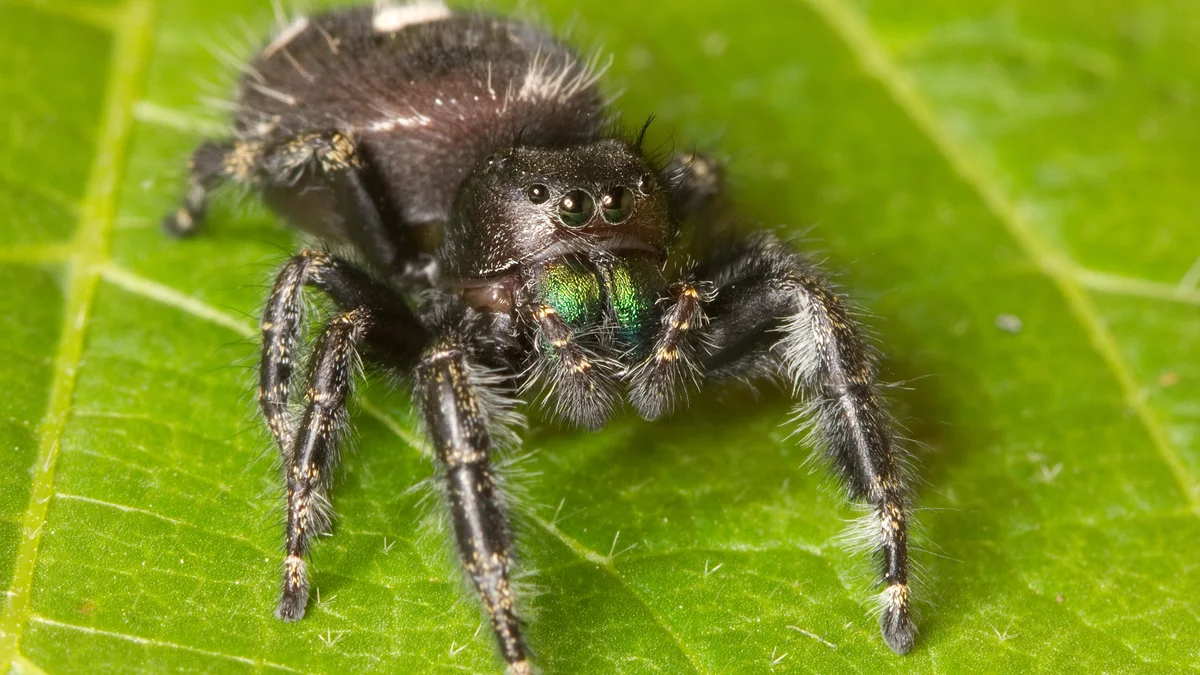
A jumping spider is a small, compact, fuzzy spider of the family Salticidae with two very large forward-facing eyes. It hunts by day by stalking its prey and pouncing instead of catching it in a web. Jumping spiders are not dangerous to people: they bite only when cornered or squeezed, and most US species eat garden insects such as flies, aphids and caterpillars. The bold jumper (Phidippus audax), a black spider with white or orange spots, is the one Americans photograph most often.
Below: how to identify a jumping spider, the species Americans actually find (with our count of 495,756 US iNaturalist records), what their eyes can do, what they eat, including flower nectar and the occasional bee, and what to do about one in the house.
Key Takeaways
- Jumping spiders (Salticidae) are the largest spider family, with around 7,000 described species worldwide. The giveaway is the face: eight eyes, with a huge middle pair in the front row.
- They are not a medical concern. Washington State University says they are unlikely to bite unless cornered or handled, and Utah State Extension says they are not known to be a health hazard.
- In our iNaturalist count, the bold jumper makes up 23.2% of 495,756 US research-grade records, and the genus Phidippus alone makes up 38.5%.
- Their front eyes see color and fine detail, and a 2012 study in Science found they judge distance by comparing sharp and blurred images inside the eye.
- They eat flies, aphids, caterpillars, bugs and other spiders. Lab tests found all 90 jumping spider species tested also drank from flowers, and field work has found them eating bees, although no source we reviewed lists them as a pest of honey bee hives.
- Indoors, Utah State Extension suggests sealing gaps and catching the spider in a jar and releasing it. Skip broad sprays, which also harm bees.
Table of Contents
- What a Jumping Spider Is
- How to Identify a Jumping Spider
- Common Jumping Spiders in the US
- When and Where Jumping Spiders Are Seen
- How Jumping Spiders See
- How Jumping Spiders Jump and Hunt
- What Jumping Spiders Eat
- Jumping Spiders, Flowers and Bees
- Are Jumping Spiders Dangerous? Bites and First Aid
- Life Cycle and Life Span
- Jumping Spiders in the House and Yard
- Frequently Asked Questions
What a Jumping Spider Is
Jumping spiders make up the family Salticidae, the largest family of spiders. Wikipedia’s summary of World Spider Catalog data puts it at almost 700 genera and around 7,000 described species, about 13% of all spider species. Counts differ by source and year: Live Science cited the World Spider Catalog at 6,380 species in 2021, PestWorld says more than 4,000 species with about 300 in the United States and Canada, and iNaturalist observers have logged 315 species-level jumping spiders in the US at research grade. The family name comes from the Latin salticus, “jump.”
Like all spiders, they are arachnids, not insects; our guide to why a bee is not a bug or a spider explains the difference. What sets this family apart is behavior. The National Park Service describes them as daytime predators that use their large eyes to hunt actively for small prey, which is why they generally do not spin webs.
How to Identify a Jumping Spider
You can usually tell a jumping spider from a few feet away by its face and its movement:
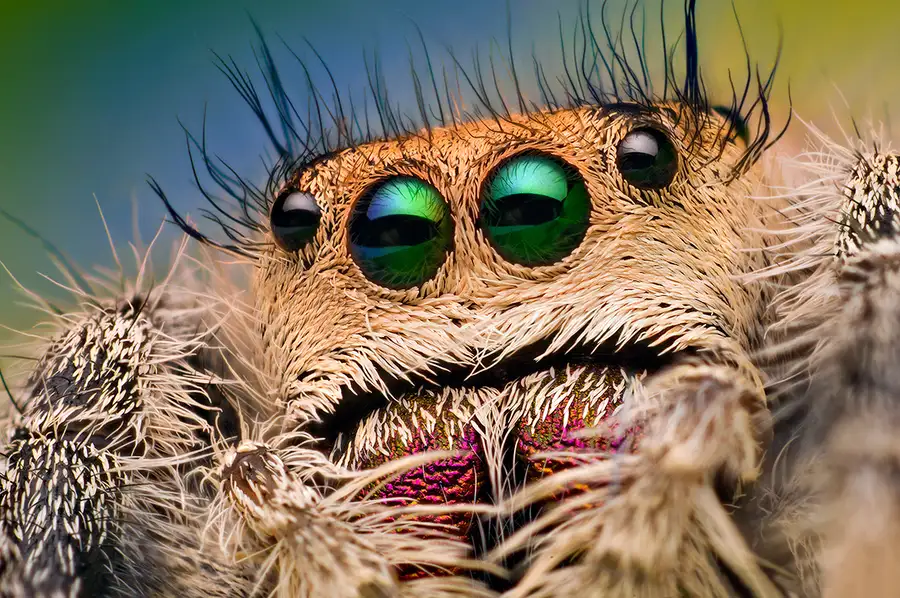
- Eyes: eight eyes in three rows. The front row has four, and its middle pair is very large (PestWorld). The National Park Service names the size and pattern of these front eyes as a distinguishing characteristic.
- Size: adults are about 1/8 to 3/4 inch (4 to 18 mm) long, not counting the legs (PestWorld).
- Body: compact and stocky with relatively short legs, covered in dense hairs or scales that can be bright or iridescent (PestWorld, NPS).
- Movement: the Missouri Department of Conservation describes a jerky walk, with long jumps when hunting.
- Web: none for catching prey. University of Florida’s entomology department says they do not construct webs, and Washington State University notes they put out a safety line of silk when they jump.
- Timing: active in daylight only, and best in sunny spots (WSU, PestWorld).
Look-alikes
PestWorld says jumping spiders are commonly mistaken for black widows because of their compact black bodies, but the front eyes settle it. Two other families get confused with them too. Wolf spiders have eight eyes in three rows too, but their two very large eyes sit in the middle row above four small ones (Wikipedia). Crab spiders (Thomisidae) hold their long, powerful front four legs out like arms, which jumping spiders do not; you may find one on a flower, as in our goldenrod guide. Wikipedia calls the eye pattern the clearest single identifying characteristic of the family, and adds that jumping spiders have squared-off, flat faces that other families lack.
Video: KQED’s Deep Look episode “This Jumping Spider Trains Itself to Kill” (4 minutes 47 seconds, April 2025) follows a female regal jumping spider. It explains that the large central pair of eyes gives crisp detail and vivid color and helps judge distance, while the three smaller pairs on the sides see motion, and shows a spiderling practicing its first hunts.
Common Jumping Spiders in the US
“Jumping spider” covers hundreds of species, but a handful account for most sightings. To see which ones Americans actually meet, we pulled every research-grade US observation of the family Salticidae from the iNaturalist API (“research grade” means at least two people agreed on the identification).
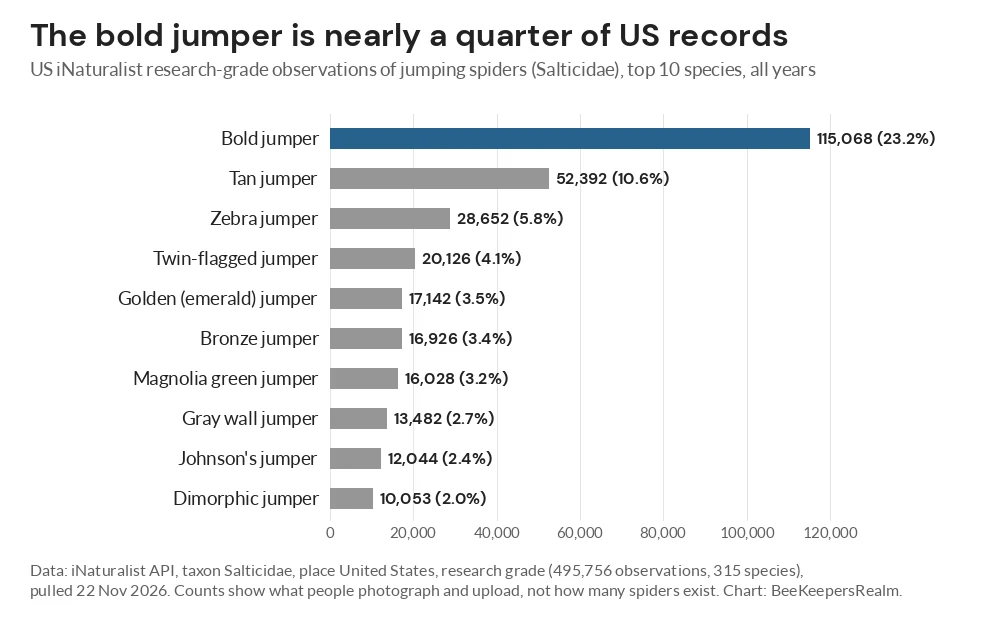
Of the 495,756 records, 115,068 (23.2%) are bold jumpers, 52,392 (10.6%) are tan jumpers and 28,652 (5.8%) are zebra jumpers. The five most common species together make up 47.1% of the total, and the whole genus Phidippus (bold, Johnson’s, Putnam’s, brilliant, regal and others) makes up 190,837 records, or 38.5%.
| Species | Adult size | What to look for | US records | Top three states (records) |
|---|---|---|---|---|
| Bold jumper (Phidippus audax) | Females 1/4 to 3/4 in; males usually under 1/2 in | Black and fuzzy, white, orange or red spots on the abdomen, iridescent green or blue jaws | 115,068 | Texas 18,886; California 14,289; Colorado 5,376 |
| Tan jumper (Platycryptus undatus) | Females 10 to 13 mm; males 8.5 to 9.5 mm | Mottled tan, thin and flat, chevron pattern on the abdomen; hides under bark | 52,392 | Texas 5,150; Ohio 4,011; Virginia 3,501 |
| Zebra jumper (Salticus scenicus) | Females 5 to 9 mm; males 5 to 6 mm | Dark brown to black with white stripes; walls, fences, windowsills | 28,652 | Washington 3,418; New York 2,960; Oregon 2,661 |
| Twin-flagged jumper (Anasaitis canosus) | About 5 to 6 mm | Two pennant-shaped marks on the head region; fences, exterior walls, leaf litter | 20,126 | Texas 8,048; Georgia 3,016; Florida 2,621 |
| Golden or emerald jumper (Paraphidippus aurantius) | Fairly large for a jumper | Green or black with white stripes down each side of the head and a white-bordered abdomen | 17,142 | Not tallied |
| Regal jumper (Phidippus regius) | Males average 12 mm; females average 15 mm, up to 22 mm | Males black with white markings; females brown, orange, tan or gray; the largest jumper in eastern North America | 3,532 | Not tallied (most abundant in Florida) |
Sizes and descriptions come from the Missouri Department of Conservation (bold jumper) and Wikipedia’s species entries (the rest). Records also reflect where iNaturalist users live: Texas and California top the bold jumper list partly because both states have many observers.
Bold jumper
The bold jumper is the species most people mean. The Missouri Department of Conservation says it lives across much of the United States and southeastern Canada, on broad-leafed plants in open areas and on tree trunks, fence posts and house or barn siding. The white or orange spot pattern varies, and juveniles often show reddish scales.
Tan jumper
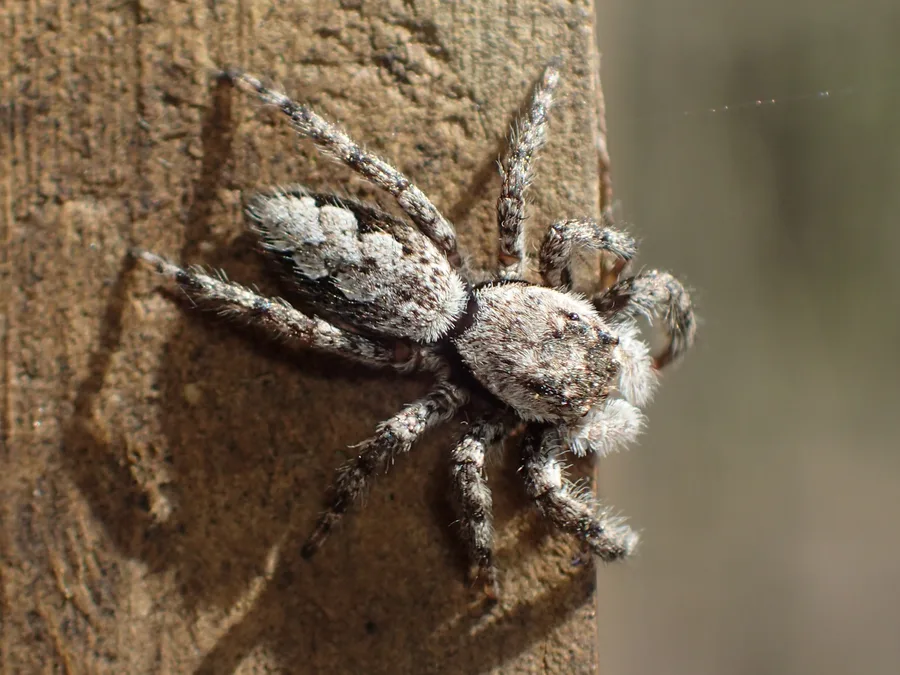
The tan jumper is built for bark: a thin, mottled body and a chevron pattern break up its outline against tree trunks and siding (Wikipedia).
Zebra jumper
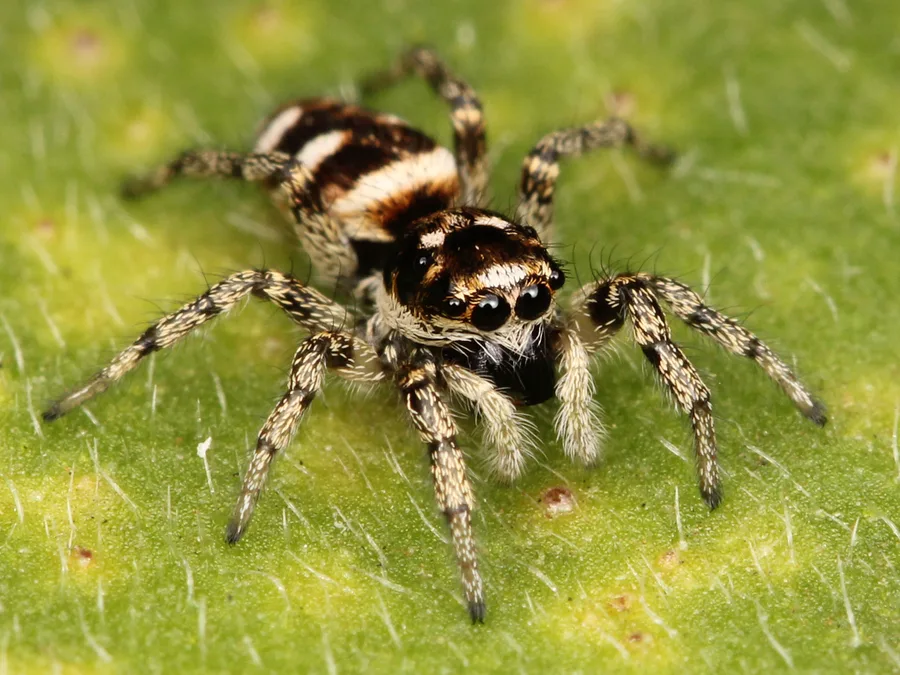
The zebra jumper is the small black-and-white spider on sunny walls and window frames. Wikipedia notes it lives near people on garden fences and building walls, sometimes enters houses and may be found in the corner of a windowsill.
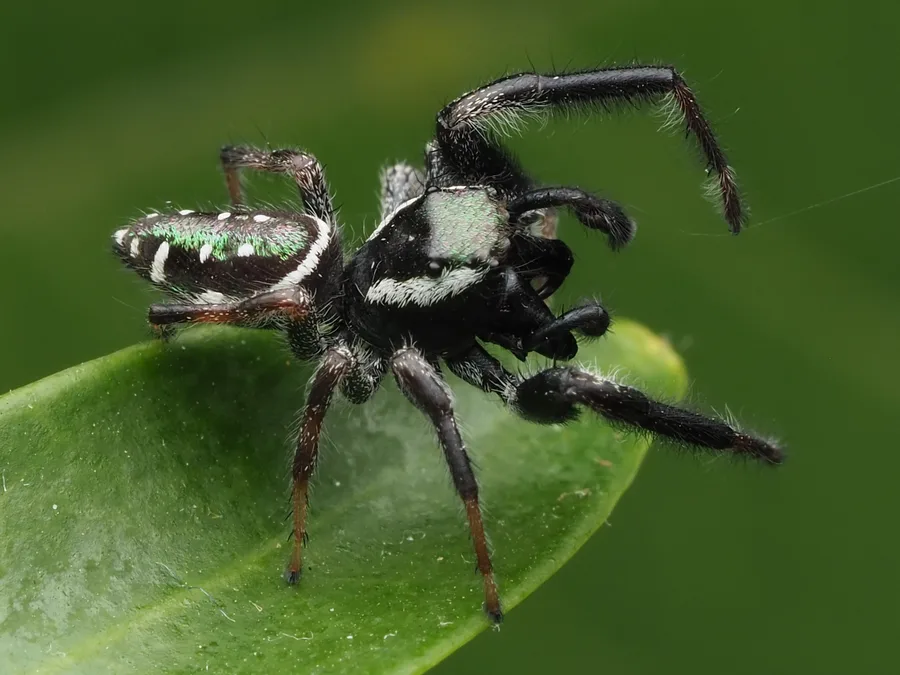
Golden jumper
The golden or emerald jumper is the colorful one: green or black with white side stripes.
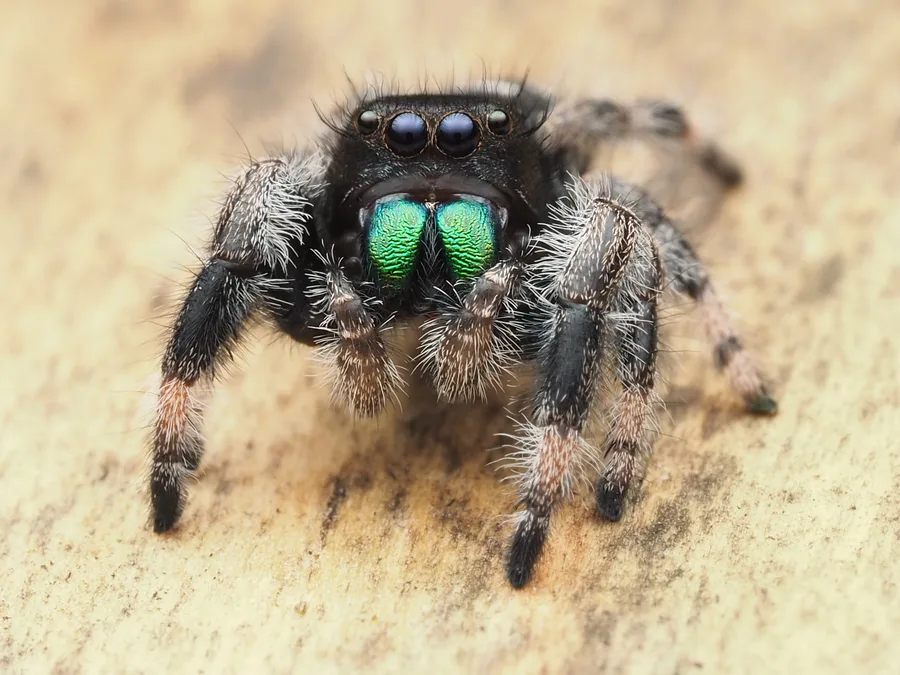
Regal jumper
The regal jumper is the largest jumping spider in eastern North America. It occurs through the southeastern US from southern Mississippi to the Carolinas and is most abundant in Florida (Wikipedia), which fits its small share of our national count.
When and Where Jumping Spiders Are Seen
Jumping spiders are most visible from spring to early fall. Of the 495,756 research-grade records, April to October hold 435,371 (87.8%). May has the most (82,280) and June is close behind (79,738); December and January together hold only 10,720 (2.2%).
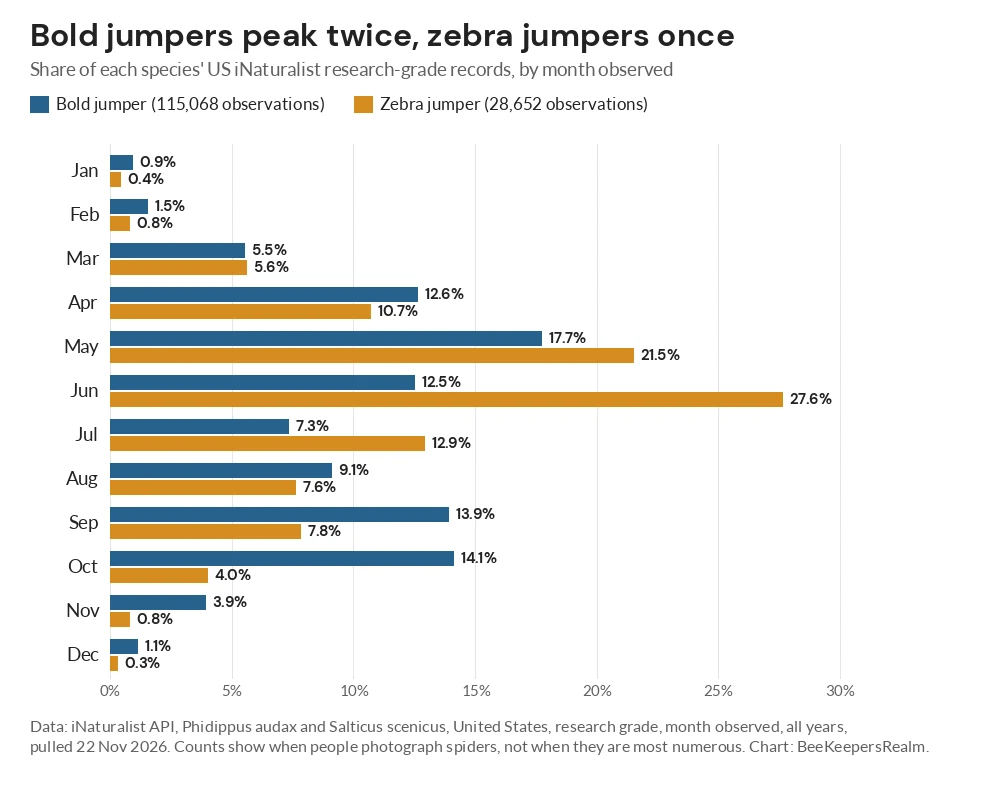
The species follow different calendars. Bold jumpers peak twice, in May (17.7% of their records) and again in October (14.1%), with September (13.9%) nearly as busy; zebra jumpers peak once, in June (27.6%), and fall to 4.0% by October. The tan jumper peaks later, in September (9,274 records), and the twin-flagged jumper earlier, in April. These counts show when people photograph spiders, not when they are most numerous.
Where you find them is less about region than about sun. PestWorld says they run over tree bark, under stones and boards, on bushes, fences, decks and the outside of buildings, especially in sunny areas, and indoors they hunt around windows and doors, where their vision works best and more insects arrive.
How Jumping Spiders See
Their eyes are the reason these spiders get so much attention. The eight eyes split the work:
- Principal eyes (the big front pair): crisp detail and vivid color, and a key part of judging distance (KQED Deep Look). Each is a tube with a narrow, layered retina that the spider moves to scan an object, because the sharp field of view is only a few degrees wide (Wikipedia).
- Three smaller pairs at the sides and top: they see motion, so a predator is hard to sneak up on, and together the eyes give a view of almost 360 degrees (NPS, Wikipedia).
Color vision varies by species. In an April 2026 interview in the Journal of Experimental Biology, University of Canterbury biologist Ximena Nelson described how species differ in whether they see orange or red, but all see green and ultraviolet, and noted that the scanning retina raises open questions about how a spider holds an image in memory while it decides whether a target is a fly or a wasp.
How they judge distance
Wikipedia notes that the two front eyes sit too close together to give depth by comparing left and right views the way human eyes do. Nagata and colleagues found another method. They showed that the deepest two retinal layers both contain a green-sensitive pigment, but the lens focuses green light on only the deepest layer, so the second layer always sees a blurred copy of the scene.
“Therefore, we propose a depth perception mechanism based on how much the retinal image is defocused.”
In behavioral tests in the same study, the wavelength of the light changed how well the spiders judged distance, as the defocus idea predicts.
Do jumping spiders sleep and dream?
Probably something like sleep. In a 2022 study in PNAS, Daniela Rößler and colleagues filmed juvenile jumping spiders (Evarcha arcuata) at night, when the young spiders’ translucent bodies let the retinas be seen moving. The spiders hang from a silk line to rest, and in all 135 observed leg curls the retinas were also moving. The paper’s own title says the movements “suggest” an REM sleep-like state, so read it as evidence for dreaming-like sleep in spiders, not proof.
How Jumping Spiders Jump and Hunt
A jumping spider does not run prey down or trap it. It sees it, creeps close and pounces. Wikipedia describes the sequence: the spider turns to bring its big front eyes to bear, may inspect the target, stalks slowly forward, attaches a silk dragline and springs. Prey is bitten and held, and the venom acts fast. Nelson says in the interview that the final pounce typically starts from about 2 to 3 cm away.
The jump itself is not driven by big leg muscles. Wikipedia explains that the spider extends its limbs by changing the pressure of its body fluid inside them, mainly using its third or fourth pair of legs, so it can leap without grasshopper-like legs. The dragline acts as a safety rope: if the jump fails, the spider climbs back up. Washington State University notes you can sometimes see one dangling from its silk after a missed leap.
How far? It depends on the species. Wikipedia says some jump two or three body lengths, while one individual Colonus puerperus was measured at 38 body lengths.
What Jumping Spiders Eat
Jumping spiders are generalist predators of small animals:
- Bold jumper: the Missouri Department of Conservation says true bugs, caterpillars and other spiders appear to be the preferred prey. The Animal Diversity Web notes that in cotton fields they were found eating boll weevils, tarnished plant bugs and bollworms, and that they approach flies and caterpillars differently.
- General list: University of Florida lists beetles, earwigs, flies, aphids, crickets, grasshoppers, mites and other spiders; PestWorld adds stink bugs, leafhoppers and mosquitoes.
- Specialists: some species hunt ants, and Wikipedia says the zebra spider has been seen taking mosquitoes almost twice its own length.
That makes them useful guests in a garden: they eat many of the same pests we cover in our guides to aphids, grasshoppers and earwigs. Female bold jumpers prefer larger prey and feed more often than males, which take smaller prey (Animal Diversity Web).
Nectar is on the menu too
Jumping spiders are not strictly carnivores. In 2001, Robert Jackson and colleagues tested nectar feeding in 90 jumping spider species. They watched 31 species drinking nectar from flowers in nature, then found in laboratory tests that all 90 fed from flowers.
“Our findings suggest that nectar feeding may be widespread, if not routine, in salticid spiders.”
A New Jersey field study by Ruhren and Handel (Oecologia, 1999) found the same on a native plant: jumping spiders drank extrafloral nectar and spent 86% of their time in a choice test on plants with active nectaries, and plants with spiders set more seed.
Jumping Spiders, Flowers and Bees
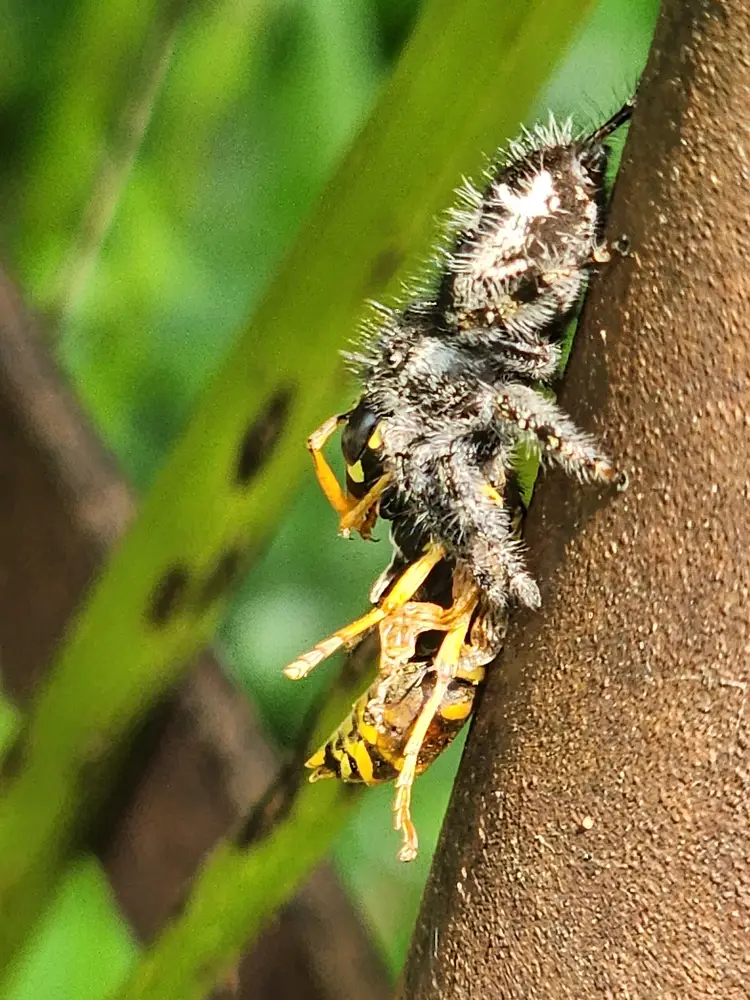
Because jumping spiders hunt in sunshine and sometimes sit on flowers, they sometimes meet bees. The same New Jersey study lists bees among the animals the spiders ate, alongside herbivores, ants and other spiders. A UC Davis Bug Squad post with photos by Kathy Keatley Garvey documented a female bold jumper, identified by Wade Spencer of the Bohart Museum of Entomology, on Spanish lavender: it climbed to the flower tips and waited, a honey bee passed within reach, and that day the spider went hungry.
That is one observation, not a measure of how many bees spiders take, and we found no study that counts it. None of the university, state and park sources we reviewed lists jumping spiders as a pest of honey bee hives, and our guide to bee pests and predators says spiders commonly shelter in and around hives without harming brood. Other flower-side hunters take far more notice, such as the praying mantis, the dragonfly and robber flies.
For a bee-friendly yard the practical point is the same as for any predator: leave them alone and do not spray. Insecticides that kill spiders on contact kill foraging bees too; see our pollinator-safe pest control buying guide.
Are Jumping Spiders Dangerous? Bites and First Aid
This is general educational information, not medical advice. If you are unsure what bit you, or symptoms are severe or spreading, contact a doctor or poison control.
“Like most spiders, jumping spiders are not considered harmful to humans and are unlikely to bite unless cornered or handled.”
The same WSU page adds that the bite is painful and can penetrate tough human skin. The National Park Service says they do bite when provoked, and that the bites are “painful, but not deadly.” PestWorld says bites are uncommon and may cause redness, itching, stinging and swelling, and that the venom is not considered medically significant to humans; Utah State Extension lists them as not known to be a health hazard. Jumping spiders are also far more likely to run than to attack.
If one does bite, PestWorld’s steps are to wash the area with soap and water, apply a cold compress and, for minor symptoms, take over-the-counter pain relievers or antihistamines. It advises seeking medical care if symptoms worsen for more than 24 hours, and bringing the spider along if you can.
Life Cycle and Life Span
| Stage | What sources report | Source |
|---|---|---|
| Courtship | Males wave their forelegs, display colorful mouthparts and drum the ground; each species has its own routine | Missouri Dept. of Conservation, KQED |
| Mating season (bold jumper) | Mature in spring, mate in late spring or early summer | Animal Diversity Web |
| Eggs | Up to 6 clutches of 30 to 170 eggs, about 200 per female on average; a regal jumper lays 50 to 200 in a silk nest | Animal Diversity Web, KQED |
| Spiderlings | Live off yolk for the first weeks, then leave the nest to find a first meal | KQED |
| Winter | Eggs, young and adults can overwinter in silk cocoons under bark, in curled leaves and in crevices | Missouri Dept. of Conservation |
| Life span | A little over a year for the bold jumper; about a year for Johnson’s jumping spider | Wikipedia, NPS |
The female guards her egg nest until the spiderlings hatch and disperse (Animal Diversity Web). The NPS adds that cannibalism of the male during mating has been observed in this family.
Jumping Spiders in the House and Yard
PestWorld says jumping spiders are unlikely to infest a home; they prefer sunny outdoor spots and usually get inside on clothing or plants. If one is in your house, it is a daytime hunter that will keep to windowsills, walls and door frames, and it will not build a web. Other indoor visitors such as house centipedes and silverfish have their own guides.
Utah State Extension’s IPM advice for indoor jumping spiders is practical and low-toxicity:
- Minimize nesting habitat around the property and seal exterior cracks and crevices.
- Install tight door sweeps and tight-fitting window screens, and keep windows closed.
- Vacuum individuals that enter, or catch them in a glass jar and release them outside.
- Change exterior lighting to sodium vapor bulbs.
Pesticides are not on that list. For more garden and household creatures, see our garden and household insects guides.
If a plain brown spider indoors worries you, our brown recluse spider guide shows how to rule a recluse out by its eyes.
Jumping spiders move their jaws sideways, while tarantulas move theirs forward and down; our tarantula guide explains the difference.
A compact black jumping spider is sometimes mistaken for a black widow; our black widow spider guide shows the hourglass, web and egg sac that tell them apart.
The big garden spiders that hang in wheel-shaped webs in late summer are orb weavers, not jumping spiders; our orb weaver spider guide covers the common US species.
The boll weevil cost US cotton producers more than $15 billion, by the National Cotton Council's estimate; our weevil guide tells how the eradication program nearly erased it.
Brown funnel weavers that turn up indoors in late summer in the West are often hobo spiders or giant house spiders; see our hobo spider guide.
Frequently Asked Questions
Do jumping spiders bite?
Rarely. They bite when cornered, squeezed or handled, and the bite is painful but not dangerous to most people, according to the National Park Service and Washington State University.
Are jumping spiders poisonous or venomous?
They are venomous, not poisonous: they inject venom to subdue prey. PestWorld says their venom is not considered medically significant to humans.
How far can a jumping spider jump?
It varies by species. Wikipedia says some manage two or three body lengths, while one Colonus puerperus was measured at 38 times its body length.
What do jumping spiders eat?
Flies, bugs, caterpillars, aphids, beetles and other spiders, plus flower nectar. Some species specialize in ants or mosquitoes.
Can jumping spiders see color?
Yes. Their large front eyes see color and detail, and per Ximena Nelson in the Journal of Experimental Biology, all species see green and ultraviolet; species differ on orange or red.
How long do jumping spiders live?
About a year in the species described: a little over a year for the bold jumper (Wikipedia) and about one year for Johnson’s jumping spider (NPS).
Are jumping spiders good to have around?
Yes. They eat many garden pests and are not a health hazard (Utah State Extension). The Missouri Department of Conservation says that, like all spiders, they help control the insect populations they feed on.
Do jumping spiders eat bees?
Sometimes. A New Jersey field study lists bees among their prey, and a UC Davis post documented a bold jumper lurking for bees on lavender. No source we reviewed measures how many bees they take.
Why does a jumping spider wave its front legs?
Usually courtship: males wave their forelegs and drum patterns to signal to females (Missouri Department of Conservation).
The Bottom Line
A jumping spider is a harmless, sharp-eyed garden predator. Leave the ones outdoors alone, catch the ones indoors in a jar, and skip the spray: it harms the bees along with the spiders.
Image credits: featured photo of a female bold jumper by Kaldari, via Wikimedia Commons, CC0 (public domain dedication), cropped. Other photos are credited in their captions: Kaldari, Zygy, spidereyes2020 and Butzodaddy (all CC0) and Thomas Shahan (CC BY 2.0). Charts by BeeKeepersRealm from iNaturalist API data pulled November 22, 2026.