Reviewed by Thomas B. · How we review
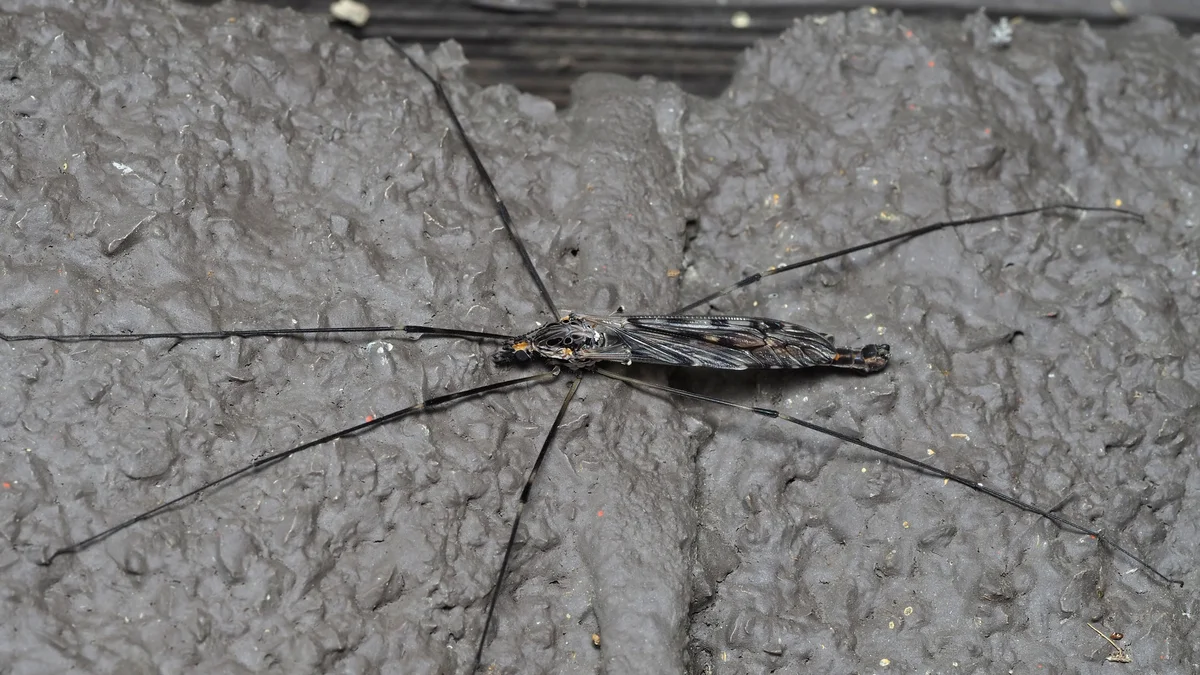
A crane fly is a slow, long-legged true fly (family Tipulidae) that looks like a giant mosquito but cannot bite, has no stinger and does not eat mosquitoes. Most adults live a few days to about two weeks and eat little or nothing. The larvae, called leatherjackets, mostly break down dead plant matter in damp soil and water; in the US only two invasive species, the European and marsh crane flies, are real lawn pests.
Below: how to tell a crane fly from a mosquito, the “mosquito hawk” myth, the life cycle, lawn damage and extension-recommended control, plus our count of 170,578 US iNaturalist crane fly records showing when they appear in each region.
Key Takeaways
- Crane flies do not bite or sting and are harmless to people and pets (Missouri Department of Conservation, University of Kentucky). The pointed tail on a female is an egg-laying tip.
- They do not eat mosquitoes: UC Davis entomologist Lynn Kimsey says adults “generally don’t eat at all.” The real “mosquito hawks” are dragonflies.
- Season depends on region. In our count, 48.8% of Southern records fall in February to April (80.2% in Texas), while the Northeast peaks in May to June and again in September.
- Only the invasive European crane fly (Tipula paludosa) and marsh crane fly (Tipula oleracea) damage US turf. Oregon State says to act only above 25 larvae per square foot in a well-kept lawn.
- Healthy turf, drainage and less irrigation around Labor Day come first; insecticides are a last resort, applied in winter and never on blooming lawn weeds.
Table of Contents
- What a Crane Fly Is
- How to Identify a Crane Fly
- Crane Fly vs Mosquito
- Do Crane Flies Eat Mosquitoes?
- Do Crane Flies Bite or Sting?
- When Crane Flies Appear: Our Count of US Records
- Crane Fly Life Cycle and Lifespan
- Which Crane Flies Americans See Most
- Leatherjackets and Lawn Damage
- How to Get Rid of Crane Flies
- Crane Flies, Bees and Wildlife
- Frequently Asked Questions
What a Crane Fly Is
Crane flies are true flies (order Diptera), like house flies and mosquitoes. The large crane flies form the family Tipulidae, which the Missouri Department of Conservation (MDC) puts at more than 500 species in North America north of Mexico. Counts change with how widely “crane fly” is drawn: the University of Maine Cooperative Extension gives more than 1,600 crane fly species for North America, and UC Davis says more than 15,500 have been described worldwide.
Folk names include mosquito hawk, skeeter eater, mosquito eater, daddy longlegs and, in the Ozarks, “gallynipper” (MDC). Gallinipper is also the name of a large biting mosquito, as our guide to US mosquitoes shows, and “daddy longlegs” is shared with cellar spiders and harvestmen. The University of Kentucky notes that none of these animals are closely related; only the crane fly has wings and six legs.
How to Identify a Crane Fly
MDC and the University of Kentucky’s Critter Files list these features:
- Body: slender and soft; about 1/2 inch (Colorado State) to 1 inch (Oregon State) in the lawn-pest species, up to about 1 1/2 inches in the largest (MDC).
- Legs: very long and easily shed, which helps them escape predators (Chesapeake Bay Program).
- Wings: one pair, often held out at a 45-degree angle. Bees and wasps have four wings, flies two; see why bees are insects for the basic body plan.
- Halteres: two small, antenna-like appendages behind the wings that work like gyroscopes in flight (MDC).
- Thorax: a V-shaped groove (MDC, University of Kentucky).
- Head: a short snout, not a long piercing tube.
- Tail end: females have a pointed, harmless egg-laying tip; males a blunt end with claspers (MDC).
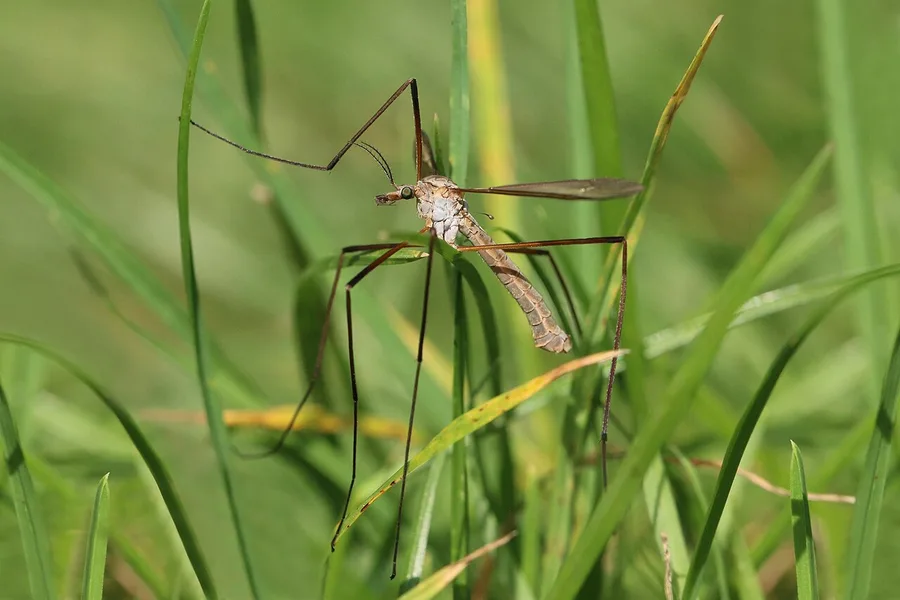
Hangingflies look similar but have four wings and no halteres (MDC). Night-flying Enicospilus ichneumon wasps are also mistaken for crane flies at porch lights; four wings give them away, as our ichneumon wasp guide explains.
Crane Fly vs Mosquito
| Feature | Crane fly | Mosquito | Source |
|---|---|---|---|
| Size | Usually far larger; body 1/2 to 1 1/2 inches, much longer legs | Much smaller | MDC, Colorado State, Oregon State |
| Mouthparts | Short snout; cannot pierce skin | Needle-like proboscis; females pierce skin for blood | MDC, NHM London; our mosquito guide |
| Wing veins | No scales | Scaled | MDC |
| Thorax | V-shaped groove | No V-shaped groove | MDC, University of Kentucky |
| Flight | Weak and wavering; bumps into walls and lights | Females seek out people and animals | MDC; our mosquito guide |
| Bites? | No | Females do | MDC, University of Kentucky |
| Adult food | Usually nothing; some nectar or water | Nectar and plant juices; females also blood | UC Davis, Oregon State; our mosquito guide |
| Larvae | Leatherjackets in damp soil, leaf litter or streams | Aquatic, in standing water | MDC, University of Maine; our mosquito guide |
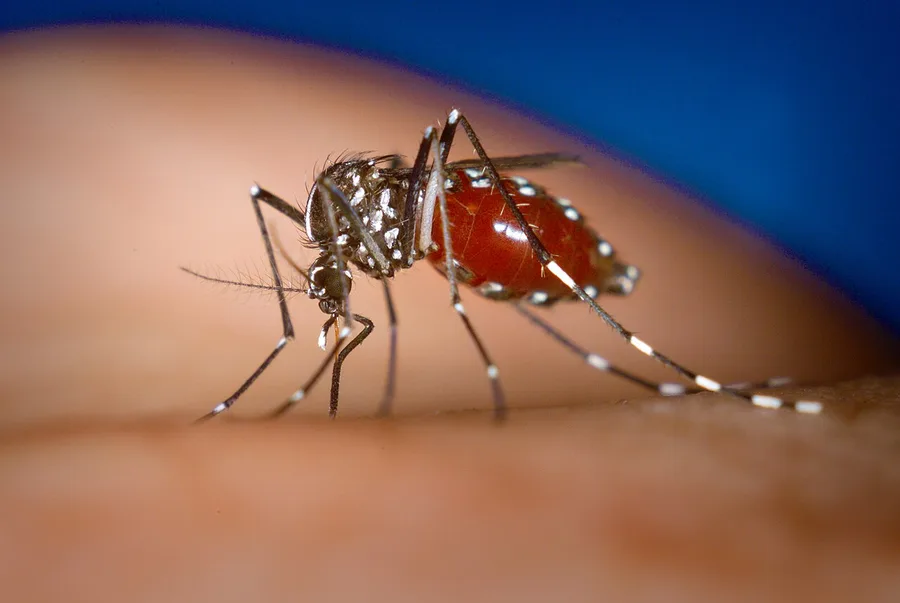
Crane flies are not “male mosquitoes” either; the University of Kentucky says that idea may come from knowing that male mosquitoes do not bite.
Do Crane Flies Eat Mosquitoes?
No. Oregon State Extension says the “mosquito hawk” and “skeeter eater” nicknames come from the insect’s size and shape, “but they do not consume mosquitoes.”
“In fact, adult crane flies generally don’t eat at all. Their entire brief adult lives are spent searching for mates and laying eggs.”
The University of Maine says “mosquito hawk” properly refers to dragonflies, which do eat mosquitoes, though our dragonfly guide explains why they still do not control them in a yard. The one grain of truth is underwater: some aquatic crane fly larvae eat other insects, including mosquito larvae (MDC, University of Kentucky).
Sources differ on what adults take in. Cornell calls the two lawn-pest species non-feeding; Oregon State says the European crane fly drinks water but does not feed; UC IPM says adults are believed to feed mainly on plant nectar, and MDC says those that eat tend to drink nectar. You may read that crane flies have no mouths, but MDC describes mouthparts that look like a snout, just none that can pierce skin.
Do Crane Flies Bite or Sting?
No. MDC calls crane flies completely harmless, and NC State’s TurfFiles says adults cannot bite and are not associated with transmitting human diseases. The Natural History Museum in London explains that, unlike mosquitoes, gnats and midges, crane flies do not feed on blood and their mouthparts cannot pierce human skin. The pointed tip on a female is for laying eggs, not stinging.
The legend that “daddy longlegs” are deadly venomous but cannot bite is false for crane flies: the Natural History Museum calls crane fly venom “a complete myth,” and the Kentucky Critter Files says they are not venomous. Indoors, they are a nuisance only, drawn in by lights at night (Texas A&M AgriLife).
When Crane Flies Appear: Our Count of US Records
Texas A&M AgriLife calls crane fly swarms one of the first signs of spring in Texas, while Cornell says European crane flies in New York emerge from late July to early September. To see the national pattern, on November 22, 2026, we pulled every verifiable US observation of the family Tipulidae from the iNaturalist API (each has a photo, date and place) and grouped them by month and US Census region.
We used verifiable rather than only research-grade records because most crane fly photos can be identified only to family: just 46,791 of the 170,578 US records (27.4%) were research grade, and in Texas only 434 of 11,935 (3.6%).
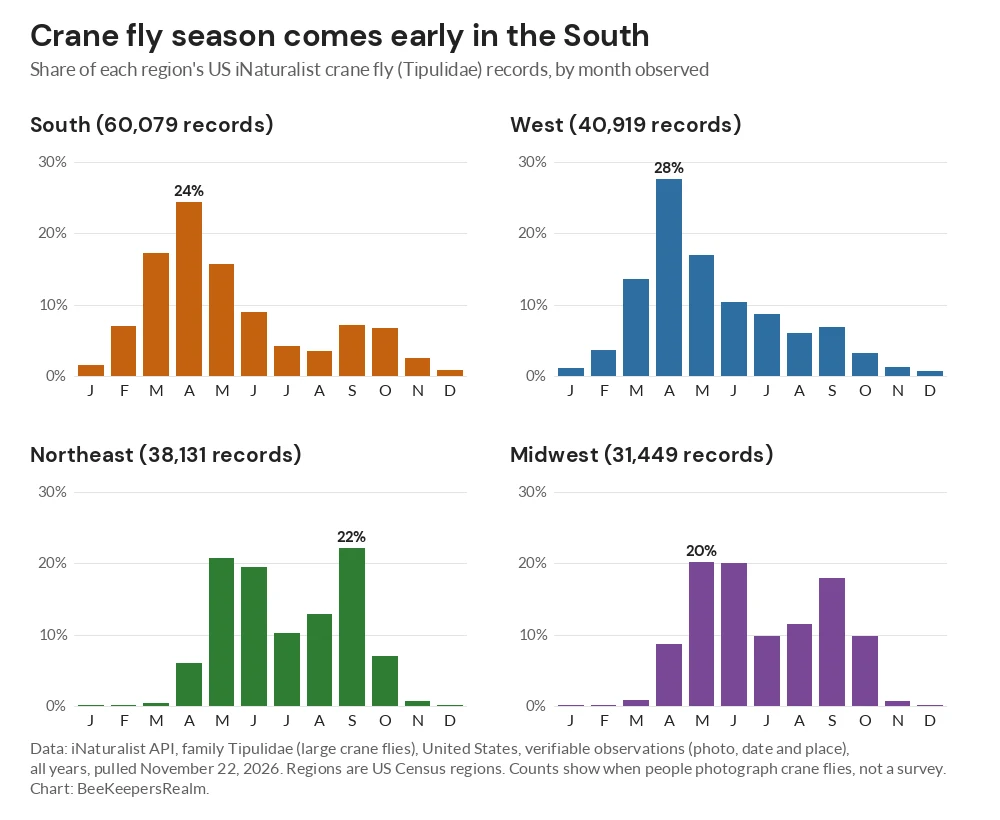
| Region | Records | Top months | Feb to Apr | Aug to Oct |
|---|---|---|---|---|
| South | 60,079 | April, March, May | 48.8% | 17.3% |
| West | 40,919 | April, May, March | 44.8% | 16.2% |
| Midwest | 31,449 | May, June, September | 9.8% | 39.1% |
| Northeast | 38,131 | September, May, June | 6.5% | 42.1% |
- The Gulf states fly first. Texas peaks in March (4,523 records), with 80.2% of its records in February to April; Louisiana peaks in February.
- The North has two waves, late spring and September. New York, Pennsylvania, Ohio and Maine all peak in September; Maine has 51.1% of its records in August to October and 0.7% in February to April.
- The West splits. California peaks in April (57.2% in February to April), while Washington peaks in May and keeps 34.4% of its records for August to October.
These counts show when people photographed crane flies, so they also reflect where iNaturalist users live and when they are outdoors.
Crane Fly Life Cycle and Lifespan
Crane flies go through egg, larva, pupa and adult, and spend almost all of their life as larvae. Figures differ by species, so each carries its source.
| Stage | What happens | Source |
|---|---|---|
| Eggs | Up to 300 per female, at or near the soil surface; they need damp conditions | Cornell, Colorado State |
| Hatch | About one week; 1.5 to 2 weeks for European crane fly | Colorado State, Cornell |
| Larva | About 11 months underground for European crane fly; upwards of three years in some species | Oregon State, Texas A&M AgriLife |
| Pupa | Non-feeding, just below the soil; the empty case often sticks out of the turf | UC IPM, Colorado State |
| Adult | A few days (UC Davis, Univ. of Kentucky); one to two weeks (Texas A&M AgriLife); 10 to 15 days for most UK species (NHM) | As listed |
| Generations | Most species one a year; marsh crane fly two in New York | MDC, Cornell |
Colorado State says the lawn-pest species mate and lay eggs within 24 hours of emerging, and Texas A&M AgriLife notes that late cold snaps can cut spring numbers.
Which Crane Flies Americans See Most
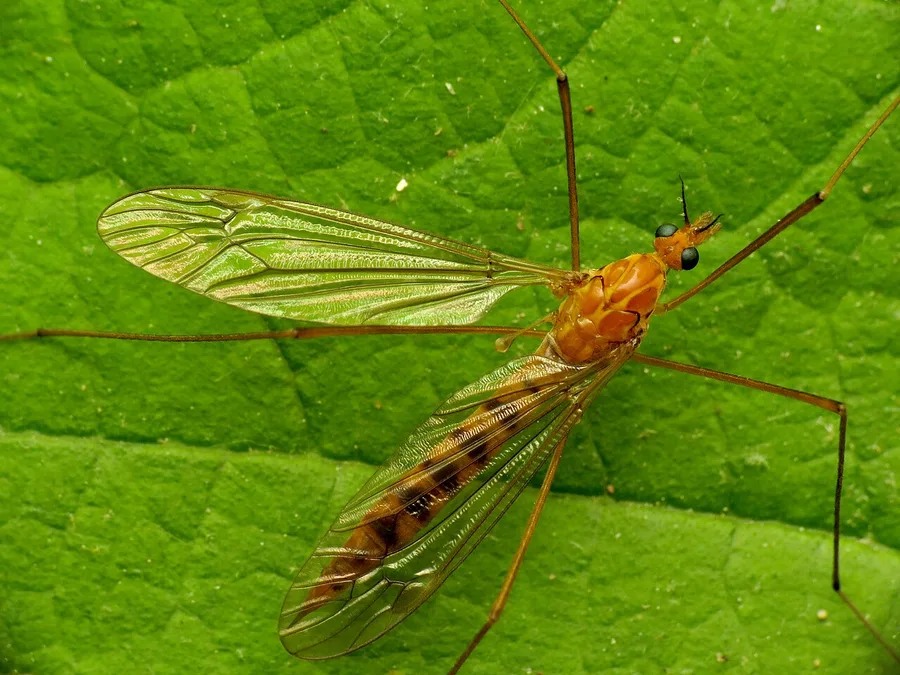
Research-grade US iNaturalist records, which need a species-level identification that other users agree on, include 132 species of large crane flies. The top ten account for 67.6% of the 46,791 records:
| Species | Common name | Records | Share |
|---|---|---|---|
| Nephrotoma ferruginea | Ferruginous tiger crane fly | 8,546 | 18.3% |
| Tipula abdominalis | Giant crane fly | 5,738 | 12.3% |
| Tipula oleracea | Marsh crane fly (invasive) | 4,470 | 9.6% |
| Nephrotoma wulpiana | Short-palped tiger crane fly | 2,759 | 5.9% |
| Holorusia hespera | Giant western crane fly | 2,252 | 4.8% |
| Nephrotoma suturalis | None listed | 2,165 | 4.6% |
| Tipula longiventris | None listed | 1,665 | 3.6% |
| Tipula sayi | None listed | 1,471 | 3.1% |
| Tipula dorsimacula | None listed | 1,385 | 3.0% |
| Tipula furca | None listed | 1,145 | 2.4% |
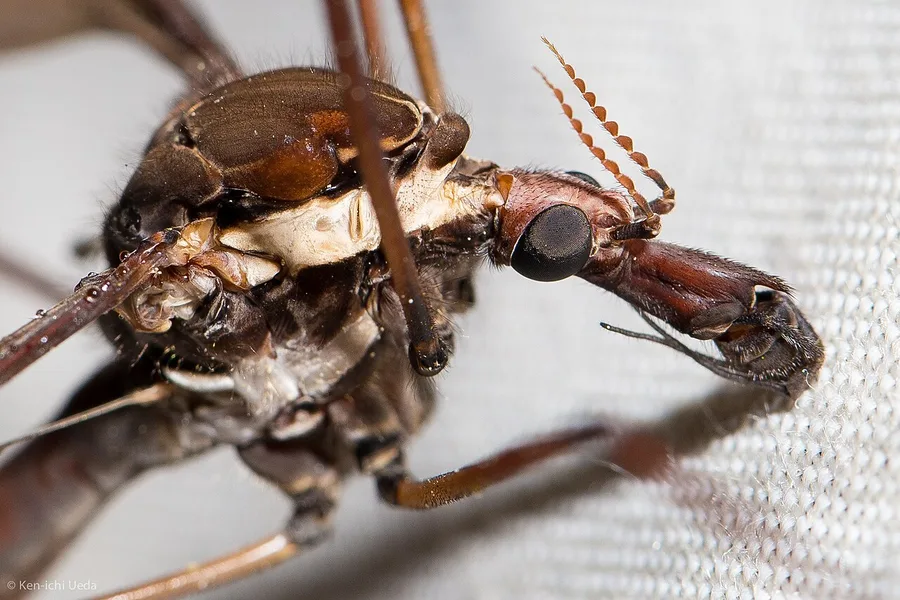
The European crane fly ranks 11th (1,076). Boldly patterned tiger crane flies are easier to name from a photo, so they are probably over-represented compared with plain gray-brown Tipula.
Leatherjackets and Lawn Damage
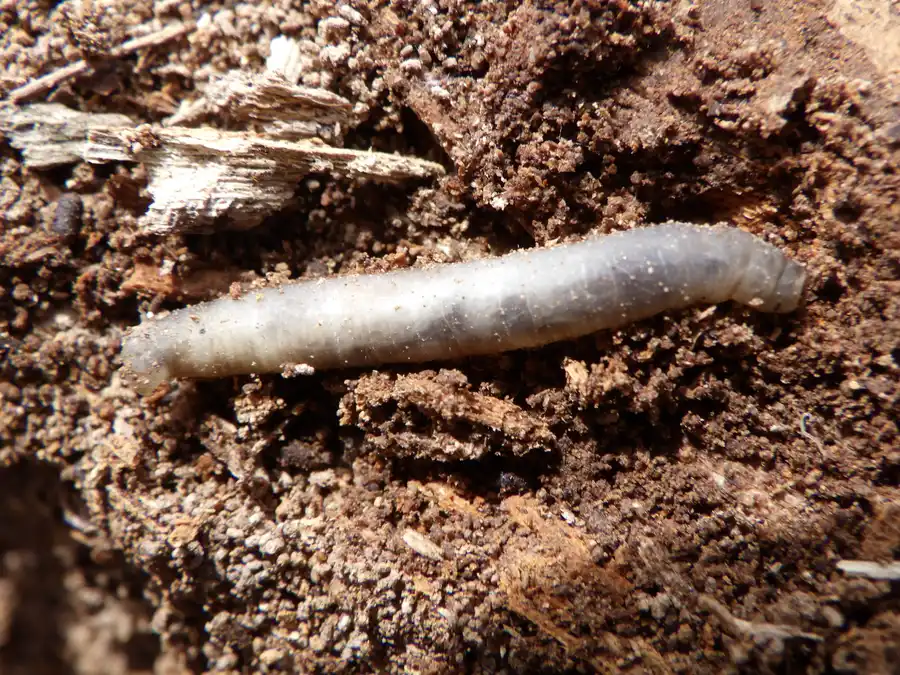
A leatherjacket is a legless, gray-brown, wormlike larva with tough skin and small finger-like projections at the rear (University of Maine). European crane fly larvae reach 1 to 1.5 inches by December and have no well-defined head (Oregon State). The bare patches they cause can resemble white grub damage, the University of Maine notes; our June bug and white grub guide covers the grub side.
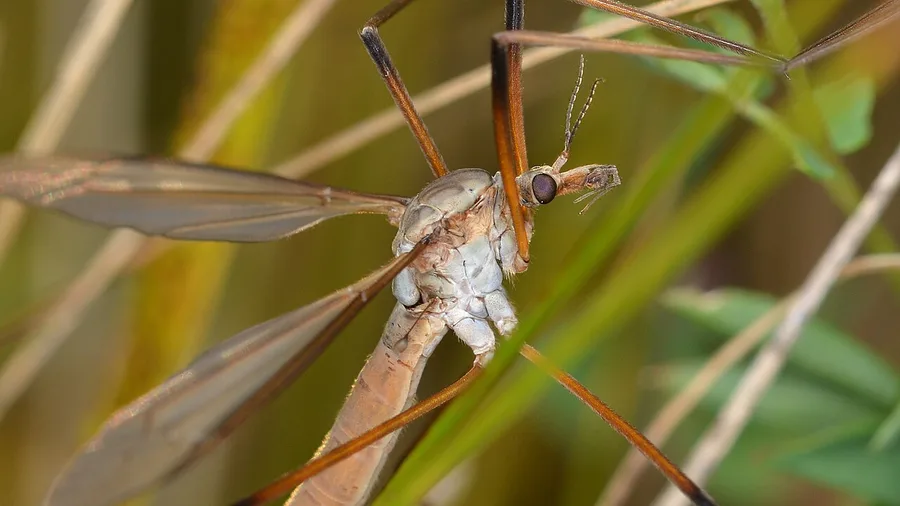
Most crane fly larvae are harmless decomposers. The US lawn pests are the European and marsh crane flies, both invasive from Europe (Oregon State, Colorado State). Oregon State says the European crane fly was first detected in western North America in 1965 and that both species now occur through British Columbia, Washington, Oregon and northern California; Cornell’s fact sheet dates their first detection as turf pests in New York to 2004.
In our count, research-grade T. paludosa records come from 17 states, led by New York (248), Washington (193), Vermont (140) and Oregon (120); marsh crane fly records come from 29, led by California (1,040), Massachusetts (506), New York (464) and Oregon (408). A record is not an infestation: UC IPM says damaging levels in California have mainly been found in Humboldt and Del Norte counties, and NC State says control is rarely needed in North Carolina.
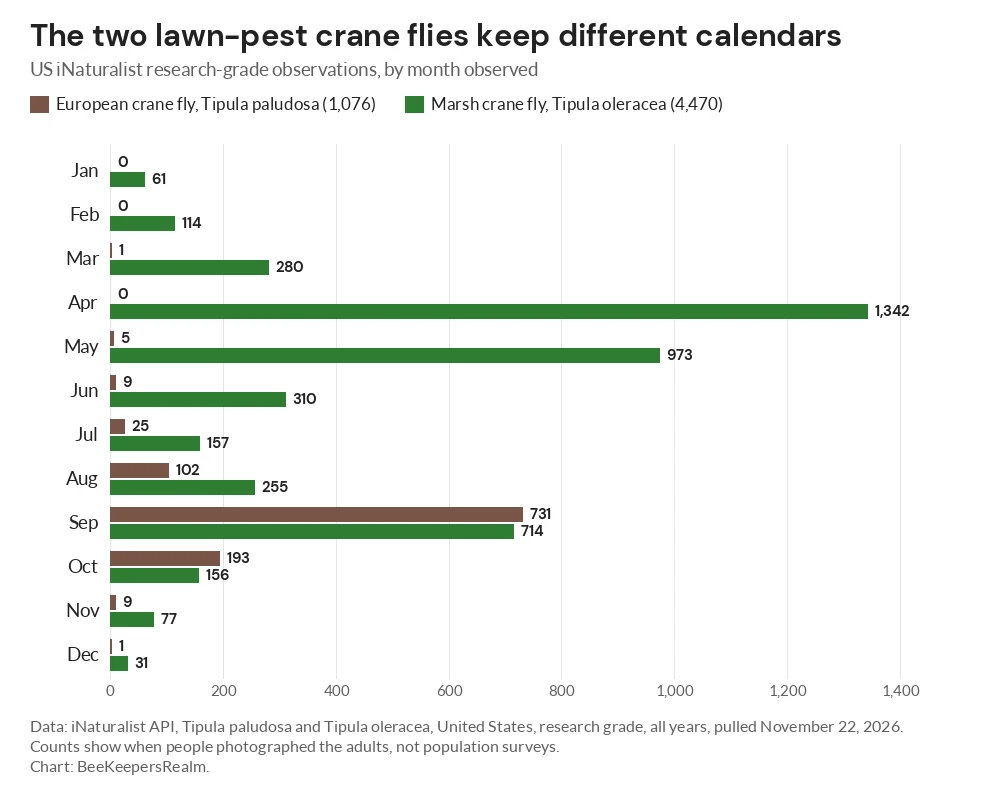
The two pests keep different calendars. Of 1,076 European crane fly records, 95.4% fall in August to October (67.9% in September), while the marsh crane fly has 58.1% of its 4,470 records in March to May plus a second peak in September, matching Cornell’s one generation versus two.
Signs of damage: thinning turf from February that worsens into April and May in wet, low spots (Oregon State); dying patches in March and April (Colorado State), or early to mid May in New York (Cornell); birds, skunks and raccoons digging for larvae (Oregon State); and empty pupal cases poking up from the grass (Colorado State).
How to Get Rid of Crane Flies
Crane flies in the house
Adults need no spray. Texas A&M AgriLife recommends repairing window screens, sealing gaps around windows and doors and keeping doors closed; a crane fly that gets in can be scooped up and put outside. With adult lives of days to a couple of weeks, they are soon gone.
Count larvae before treating the lawn
Oregon State says to scout from November to January: dig a 1-foot square of sod 1 inch deep, flip it and count the larvae. Colorado State and UC IPM describe spring sampling, and a soapy-water drench that brings larvae up. Thresholds differ:
| Source | Threshold |
|---|---|
| Oregon State Extension | More than 25 larvae per square foot in well-maintained turf |
| Colorado State University | 20 per square foot in healthy turf |
| Washington, cited by UC IPM | 25 to 50 per square foot |
| UC IPM | Well-kept turf withstood an average of 40; weak turf showed damage at 15 |
Fix lawn conditions first
“The key to managing crane fly is maintaining healthy turfgrass.”
- Mow and feed: mow weekly at 2 to 3 inches and fertilize in spring and fall (Oregon State).
- Dry the soil at egg-laying time: stop or cut back irrigation around Labor Day, when adults seek wet soil (Oregon State, Colorado State).
- Improve drainage in saturated spots, for example with French drains (Oregon State).
- Remove thatch and aerate; thatch is ideal larval habitat (UC IPM).
- Match grass to the site: sun-loving grass in shade grows weakly and helps larvae survive (UC IPM, Colorado State).
Biological control
The nematode Steinernema feltiae may give up to a 50% reduction (UC IPM, NC State); Colorado State also lists Steinernema carpocapsae and the fungus Beauveria bassiana. Birds, ground beetles and other causes can cut larval numbers by as much as 50% over winter and spring (UC IPM).
Insecticides as a last resort
Oregon State advises insecticides only after cultural fixes and only above 25 larvae per square foot, applied in winter before damage appears; spring treatments come too late, and winter timing lowers the risk to honey bees and butterflies. UC IPM’s treatment table marks two of its listed crane fly insecticides as toxic or highly toxic to bees. Follow the label, which, as Oregon State puts it, is the law.
Crane Flies, Bees and Wildlife
Crane flies are not important pollinators; some adults may sip nectar, but none of our sources credits them with pollination. They matter as food: the University of Kentucky lists spiders, praying mantids and birds as predators of adults, and crane flies are regular prey in garden webs, as our orb weaver spider guide notes. MDC adds that most aquatic crane fly larvae are sensitive to pollution.
For beekeepers the risk is the lawn insecticide, not the fly. Oregon State says not to apply bee-toxic products while weeds and flowers bloom in and around the lawn, so mow off flowering dandelions and clover first and see our guide to pollinator-safe pest control. More visitors are in our garden and household insects guides.
Lovebugs are another slow, harmless fly in the same broad group as crane flies; our lovebugs guide explains why they fly in joined pairs.
Two other animals share the daddy longlegs name; our daddy long legs guide shows how to tell harvestmen and cellar spiders from crane flies.
Mayflies are another harmless insect with aquatic young that turns up at outdoor lights near water; our mayfly guide explains their short adult life.
Frequently Asked Questions
Do crane flies bite?
No. Their short snout cannot pierce skin, they do not feed on blood, and they have no stinger or venom.
Do crane flies keep mosquitoes away?
No. Adults eat little or nothing and do not hunt mosquitoes. Dragonflies do; some aquatic crane fly larvae eat mosquito larvae.
How long do crane flies live?
Adults live a few days to about two weeks. Larvae live about 11 months in the European crane fly and up to three years in some species.
Why are there so many crane flies in my house?
Many adults emerge at once and fly to lights at night, slipping in through open doors and torn screens. Their larvae need damp soil or water, so they do not infest a house.
What attracts crane flies?
Lights at night, which is how they end up indoors, and grassy areas and water, where they look for mates and places to lay eggs (Texas A&M AgriLife).
Can I sleep with a crane fly in my room?
Yes. It cannot bite or sting and will not harm you; if it bothers you, cup it and put it outside.
Are crane flies harmful to dogs and cats?
No. The University of Kentucky says adults do not harm humans or animals.
Is a crane fly a daddy long legs?
It is one of three animals called that. Crane flies are winged insects; cellar spiders and harvestmen are eight-legged arachnids.
Are crane flies good or bad?
Mostly good. Most larvae are decomposers (University of Kentucky), and larvae and adults feed birds, fish, spiders and other predators. Only the European and marsh crane flies damage lawns.
The Bottom Line
A crane fly is a harmless, short-lived visitor, not a giant mosquito and not a mosquito hunter. Put indoor ones outside, and only treat a lawn if you live where European or marsh crane flies occur and a sod count finds more than about 25 larvae per square foot.
Image credits: Featured image: Kaldari, Wikimedia Commons, CC0, cropped and resized. Marsh crane fly: Charles J. Sharp, CC BY-SA 4.0. Asian tiger mosquito: James Gathany, CDC, public domain. Tiger crane fly: Katja Schulz, CC BY 2.0. Giant western crane fly: Ken-ichi Ueda, CC BY 4.0. European crane fly: Ryan Hodnett, CC BY-SA 4.0. All via Wikimedia Commons. Leatherjacket: Natalie Waddell-Rutter, via iNaturalist, CC BY 4.0. All photos resized; links to each file page and licence are in the captions. Charts: BeeKeepersRealm, from iNaturalist API data pulled November 22, 2026.