Reviewed by Thomas B. · How we review
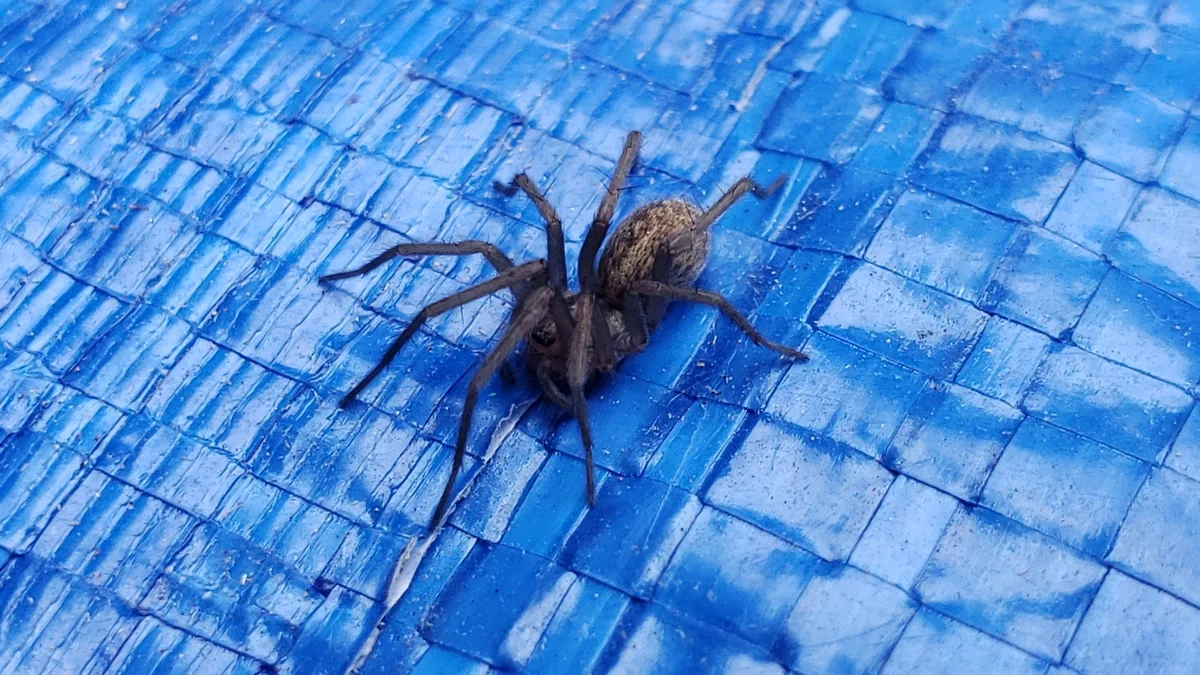
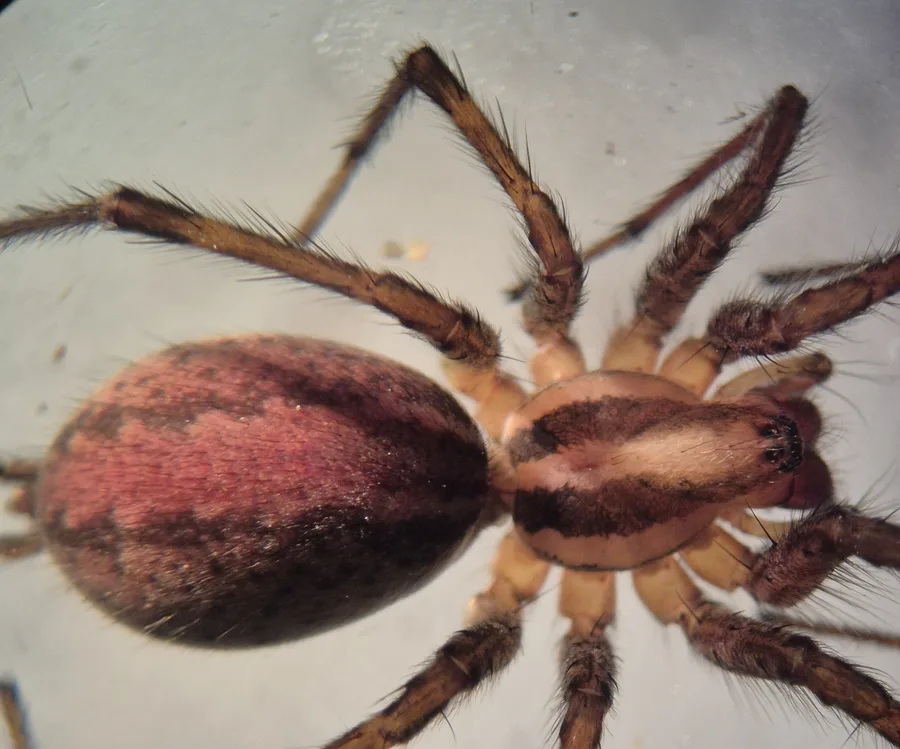
A hobo spider (Eratigena agrestis) is a brown European funnel-web spider that lives in the Pacific Northwest and the interior West, from Washington and Oregon east to Montana, Wyoming, Utah and Colorado. It is not considered dangerous: the research that once linked its bite to flesh wounds has not held up, and the CDC’s venomous spider page for US workers has listed only the black widow and brown recluse since 2015. You also cannot identify one by its markings; a reliable ID needs a microscope.
Below: how to tell it from the giant house spider, where it lives (from our count of 1,764 US iNaturalist records), why males wander indoors in late summer, what bite research found, and how to keep them out without sprays.
Key Takeaways
- Its old nickname, “aggressive house spider,” came from a misreading of agrestis, which means “of the field.” Since 2013 it has been Eratigena, not Tegenaria.
- Chevron markings, a funnel web and big male palps do not identify a hobo spider; the Burke Museum says about 200 other species in the same region look similar.
- In our iNaturalist count, 99.6% of US research-grade hobo spider records come from seven states: Washington, Utah, Colorado, Oregon, Idaho, Montana and Wyoming. There are none from Texas or Indiana.
- Records tagged male peak in August (69 of 132), the month mate-seeking males wander into houses; females peak in September and October.
- Of 33 verified spider bites in an Oregon study, the one hobo spider bite caused pain, redness and calf twitching that cleared in 12 hours. The CDC dropped the hobo spider from its venomous-spider page in 2015, not 2017 as often stated.
Table of Contents
- What a Hobo Spider Is
- How to Identify a Hobo Spider
- Hobo Spider vs Giant House Spider and Other Look-Alikes
- Where Hobo Spiders Live in the US
- Why Hobo Spiders Show Up Indoors in Late Summer
- Hobo Spider Webs
- Are Hobo Spiders Dangerous? What the Bite Research Shows
- Keeping Hobo Spiders Out Without Spraying
- Frequently Asked Questions
What a Hobo Spider Is
The hobo spider is a funnel weaver in the family Agelenidae, the same family as North American grass spiders. Like the wolf spiders and jumping spiders that also wander through houses, it is an arachnid, not an insect, as our guide to why bees are insects and spiders are not explains.
- Scientific name: described in 1802 and long known as Tegenaria agrestis. In 2013, Angelo Bolzern and colleagues split Tegenaria in the Zoological Journal of the Linnean Society, moving the hobo spider to the new genus Eratigena, an anagram of Tegenaria.
- “Aggressive house spider”: Utah State University Extension says this old name came from a misinterpretation of agrestis, which means “of the field,” and that hobo spiders are nonaggressive and unlikely to bite.
- “Hobo”: UC IPM links the name to the spider’s presumed spread to distant cities by railway.
It is native to Europe, where its venom is not considered toxic to humans (UC IPM), and Utah State says it was detected in the Pacific Northwest in 1936. It is unrelated to the dangerous Sydney funnel-web spider of Australia.
How to Identify a Hobo Spider
Every feature below is shared with harmless relatives, so these traits make a hobo spider possible, never certain.
- Size: females 3/8 to 5/8 inch (9.5 to 16.5 mm) in body length, males 9/32 to 9/16 inch (7 to 13.5 mm) (Utah State); 1 to 1 3/4 inches including legs (Washington State University).
- Color: brown front body and legs; gray abdomen with yellowish chevrons that are hard to see without a hand lens (Utah State).
- Legs: no dark bands, unlike many similar spiders (Utah State).
- Eyes: eight, in two straight rows of four. UC IPM says most other funnel weavers, including grass spiders, have rows so curved they look like a 2-4-2 pattern, so a hand lens rules many look-alikes out.
- Males: enlarged palps that look like boxing gloves. Every male spider has them, so they only tell you the sex.
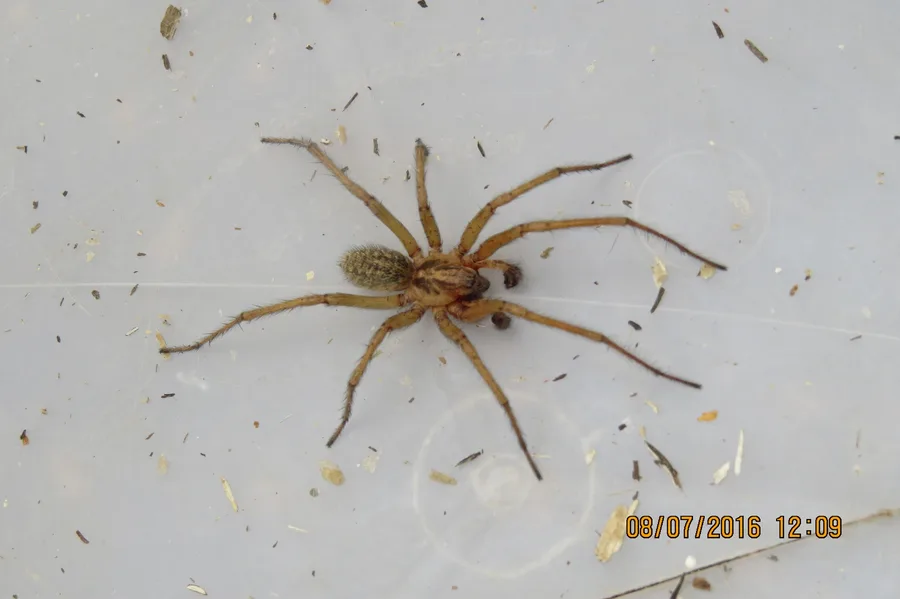
“As with most spiders, a naked-eye view is simply not enough to identify a hobo spider.”
The Burke Museum calls chevrons “worthless in identification,” since thousands of species have them and some hobo spiders lack them. Under a microscope, Utah State says experts check for feather-like hairs on the legs, six to eight teeth on the back edge of the jaws and, in males, a two-pronged palp where the giant house spider and domestic house spider have one prong. For a definite answer, catch the spider and take it to a local expert such as your county extension office.
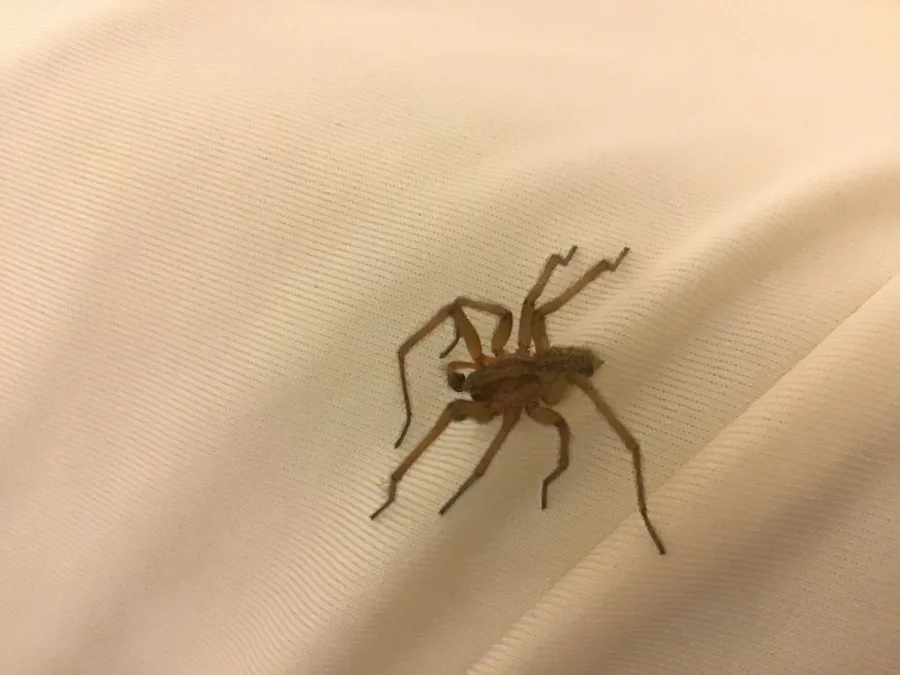
Hobo Spider vs Giant House Spider and Other Look-Alikes
The spider most often mistaken for a hobo spider is its close relative, the giant house spider. Washington State University says smaller giant house spider males are often taken for hobo spiders and that in the Puget Sound region giant house spiders are far more common. A 2003 survey in the Journal of Medical Entomology by Richard Vetter and seven co-authors found the same in large cities where both live. On iNaturalist, giant house spider records outnumber hobo spider records in the US by 5,801 to 1,764, and in Washington by 4,068 to 435.
Video: YouTube creator Travis McEnery compares the giant house spider, hobo spider and barn funnel weaver. Per its chapter list, part 1 covers how they are related, the genus Eratigena, identification, hunting, life cycle, the bite and Darwin Vest, the researcher behind the bite scare.
| Spider | Size and look | Where in the US | Quick tell | Source |
|---|---|---|---|---|
| Hobo spider (Eratigena agrestis) | Body 3/8 to 5/8 inch; brown, gray abdomen with faint chevrons; unbanded legs | WA, OR, ID, MT, UT, WY, CO | Eyes in two straight rows of four; male palp has two prongs (microscope) | Utah State, UC IPM |
| Giant house spider (Eratigena duellica, often listed as E. atrica) | Body 1/2 to 1 inch; leg span up to 4 inches; hairy, not shiny; color and markings vary widely | Mostly west of the Cascades, WA and OR; coastal British Columbia | Larger and longer-legged; male palp has one prong; not found east of the Cascades in WA | Washington State Univ., Utah State |
| Barn funnel weaver or domestic house spider (Tegenaria domestica) | Body 1/4 to 1/2 inch; coloring similar to the hobo spider | Widespread, often inside homes; carried worldwide by commerce | Smaller; found far outside the hobo range; one-pronged male palp | UC IPM, Utah State |
| Grass spiders (Agelenopsis) | Long-legged brown funnel weavers | Lawns, gardens and shrubs across North America | Eyes in a curved 2-4-2 pattern; obvious funnel webs in grass | UC IPM, Utah State |
| Wolf spiders (Lycosidae) | Typically larger | Nationwide | No web; two large forward-facing eyes | Utah State, our wolf spider guide |
| Brown recluse (Loxosceles reclusa) | Small, plain tan to brown; violin-shaped mark | Central and south-central US; not found in the Pacific Northwest | Six eyes in three pairs; no funnel web | Our brown recluse guide, CDC MMWR 1996 |
Some extension pages still call the giant house spider E. atrica; a 2018 study by Geoff Oxford and Bolzern revalidated E. duellica, the name iNaturalist uses. For the two spiders people most want to rule out, see our guides to the brown recluse spider and black widow spider; neither builds a funnel web.
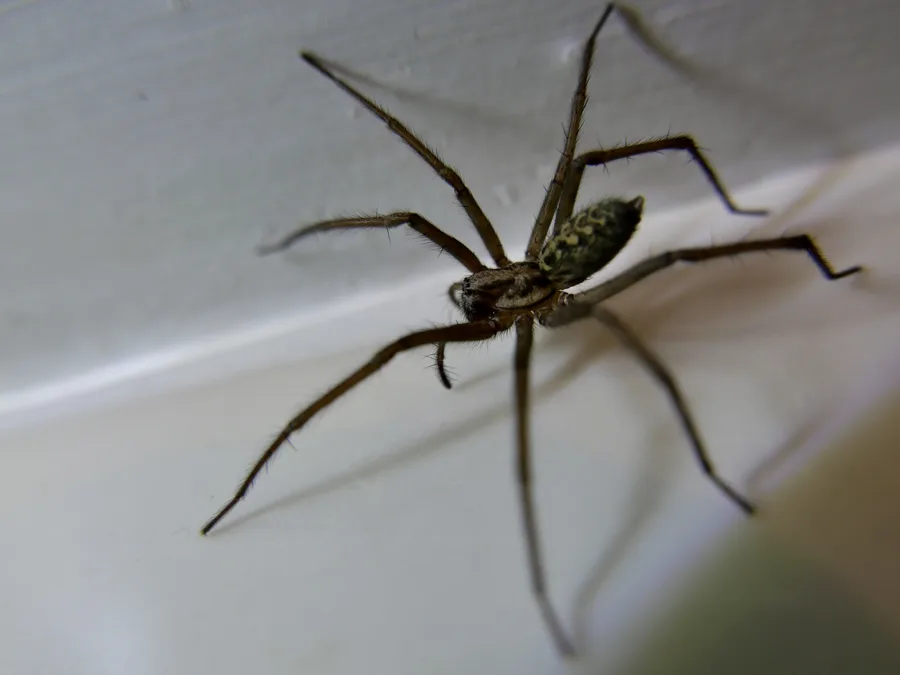
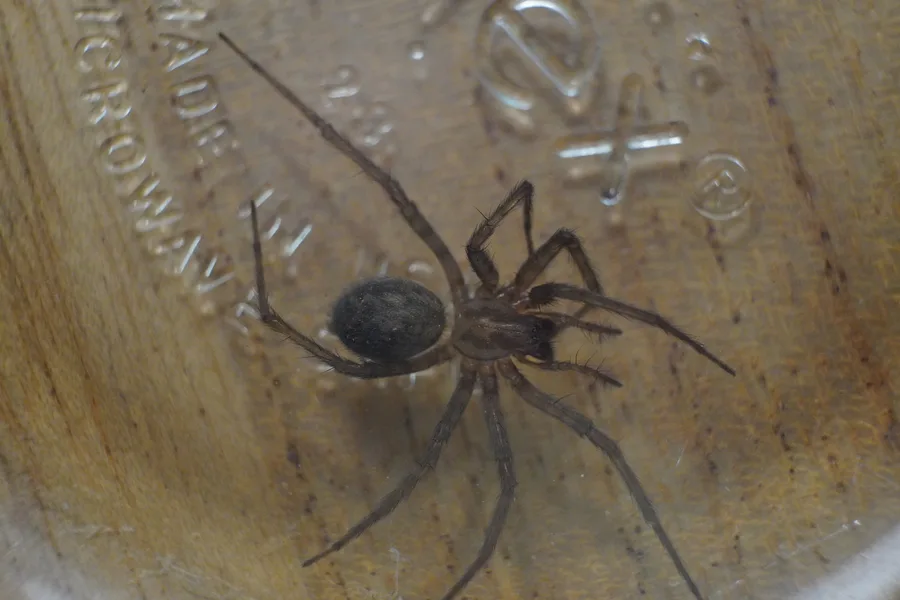
Where Hobo Spiders Live in the US
UC IPM puts the North American range in the Pacific Northwest, from British Columbia east to Montana, Wyoming and Colorado and south through Oregon and northern Utah, and says the spider does not live in California. Vetter’s 2003 survey, based on 1,232 hobo spiders, listed southern British Columbia, Washington, Oregon, Idaho, northern Utah, western Montana, western Wyoming and “two small, isolated populations in Colorado.”
On November 22, 2026, we pulled every US research-grade hobo spider observation from the iNaturalist API. “Research grade” means at least two users agreed on the species from photos, a community check, not a microscope check.
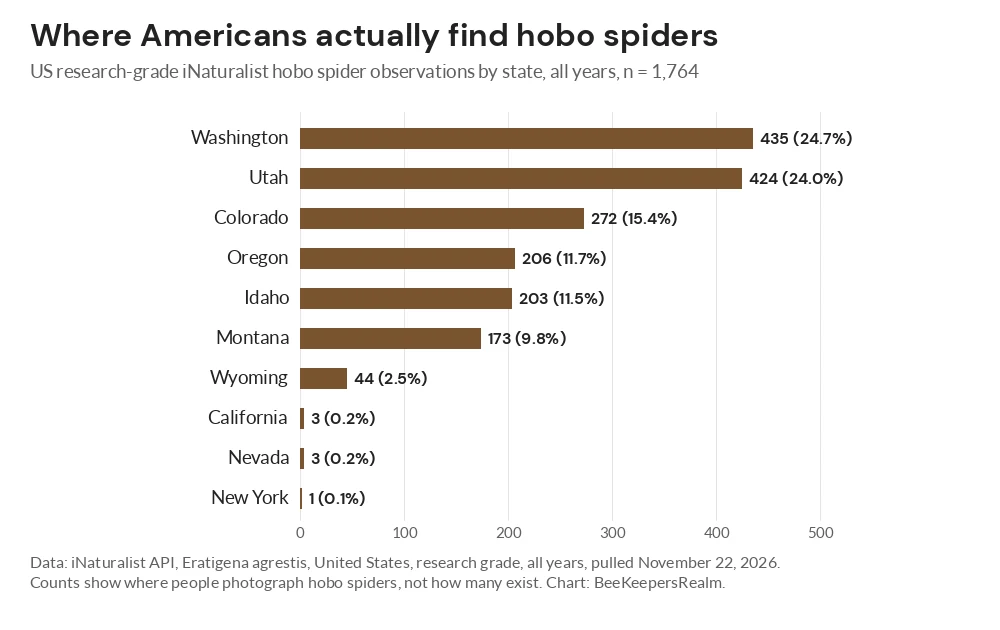
Of the 1,764 records, 1,757 (99.6%) are from seven states: Washington 435, Utah 424, Colorado 272, Oregon 206, Idaho 203, Montana 173 and Wyoming 44. The other seven are three from Mount Shasta in northern California, three from eastern Nevada and one from Gates, New York, in October 2026. We found no records at all, research grade or not, from Texas, Indiana, Minnesota or Alaska. In the East, South or Midwest, the brown funnel-web spider in your basement is almost certainly something else, most often a barn funnel weaver or a grass spider.
Colorado, two small pockets on Vetter’s 2003 map, now has the third-largest count, 250 records since 2020, and the Mount Shasta records sit in the “northernmost areas of California” where UC IPM wrote the range might conceivably extend. Rising counts partly reflect more iNaturalist users, and photo IDs carry the uncertainty described above. Spiders also travel: a 2022 Minneapolis case report in Dermatology Online Journal describes a microscope-confirmed male hobo spider the patient suspected had arrived in packages from Seattle.
Why Hobo Spiders Show Up Indoors in Late Summer
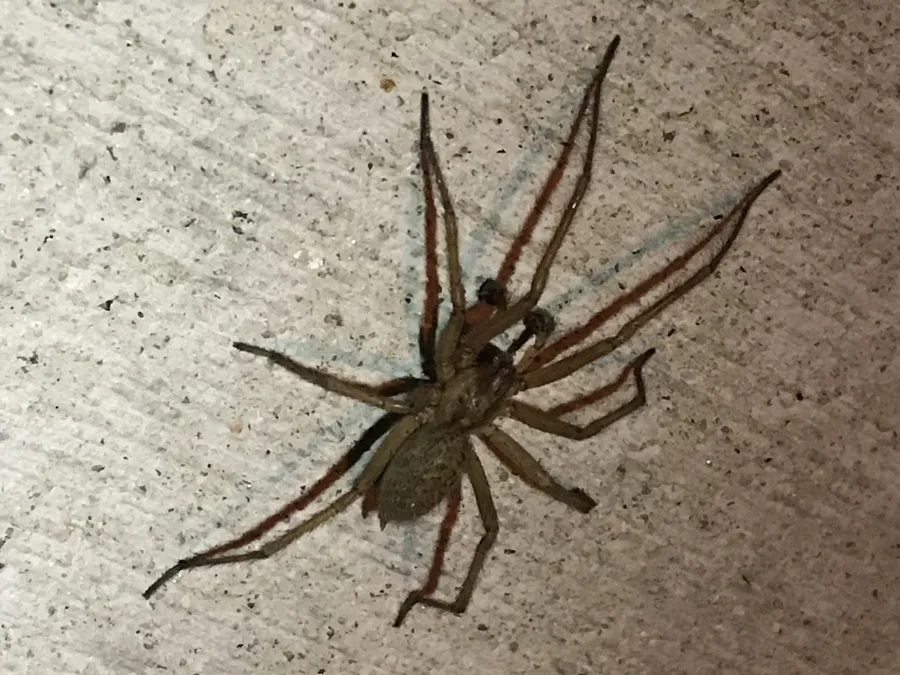
Most hobo spiders live outside, in wood and rock piles, retaining walls, tall grass and foundation cracks (Utah State). Utah State’s life cycle account explains the indoor season: development takes about two years, egg sacs laid in fall hatch in late spring, and juveniles overwinter before maturing. From August through October, adult males leave their webs to look for females, which is when they are most often found in homes. Mated females lay one to four egg sacs starting in September, and males die after mating.
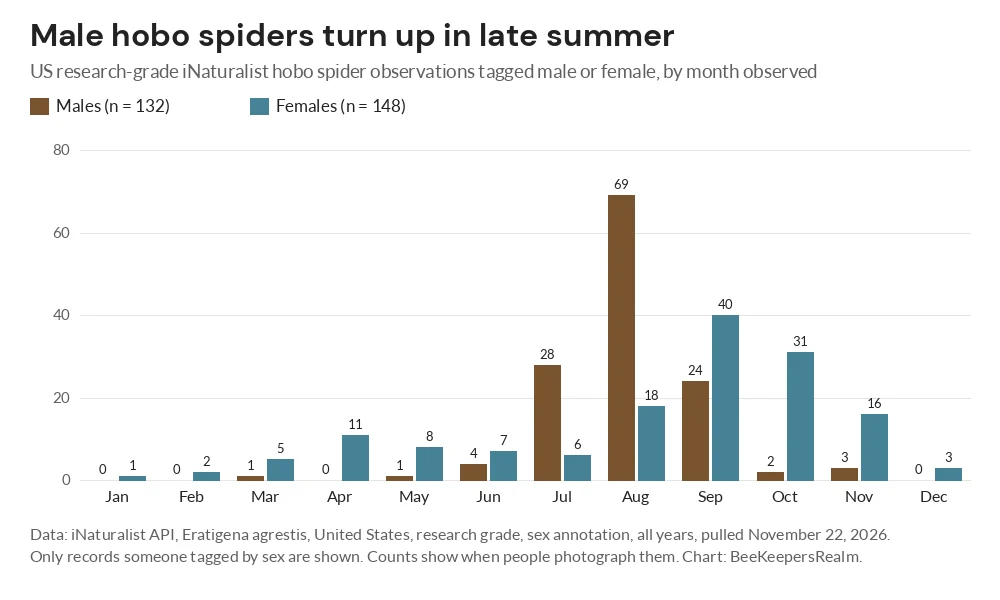
Our iNaturalist data shows the same pattern. Of 132 US research-grade records tagged male, 69 (52%) were made in August and 121 (92%) in July through September. The 148 records tagged female peak later, in September (40) and October (31), the months Utah State says egg-laying begins. Across all 1,764 records, August is the busiest month with 509. The giant house spider follows almost the same calendar: 401 of its 541 male-tagged US records (74%) are from August and September.
Utah State says large hobo spiders cannot climb painted walls or porcelain, so indoors they stay low, often in basements, tubs and sinks, but they can climb fabric and carpet.
Hobo Spider Webs
Funnel weavers build a flat silk sheet that narrows into a tube, where the spider waits for prey to land. Washington State University says hobo spiders build these webs in dark, moist places, often basements, while UC IPM says their webs are almost always hidden under objects and not noticeably funnel-like. Either way, a funnel web proves nothing: the Burke Museum says between 1,000 and 2,000 known spider species make them.
Are Hobo Spiders Dangerous? What the Bite Research Shows
This is educational information, not medical advice. For a bite with severe symptoms, call 911; for questions about any bite, call Poison Help at 1-800-222-1222 (MedlinePlus).
Current extension guidance says no. UC IPM says the hobo spider “is no longer considered of probable medical importance,” and Utah State says there is no significant scientific evidence of a necrotic bite, describing defensive bites as mildly painful and red. The table shows how the 1980s fear unraveled.
| Year | Study or source | What it found |
|---|---|---|
| 1987 | D.K. Vest, two papers in Toxicon | Linked necrotic wounds in Washington, Oregon and Idaho to T. agrestis, which was “almost invariably found” where more than 30 cases occurred; bites by male spiders on rabbits produced slowly developing skin lesions. |
| 1996 | CDC, MMWR, “Necrotic Arachnidism, Pacific Northwest, 1988-1996” | Described three cases attributed to hobo spiders in Idaho, Oregon and Washington; in only one was the spider caught and identified. |
| 2001 | G.J. Binford, Toxicon | US and European venoms were chemically similar, with no components unique to US spiders; Binford called the results “difficult to reconcile” with claims of US-only necrotic effects. |
| 2001 | Rabbit venom study described by UC IPM | Venom from Northwest and European spiders injected into the same rabbit strain used in the original research produced no necrotic wounds. |
| 2004 | R.S. Vetter and G.K. Isbister, Annals of Emergency Medicine | Found only one verified hobo spider bite with a necrotic lesion in the medical literature, in a person with a pre-existing condition that also causes such lesions (UC IPM’s summary). |
| 2011 | M.M. Gaver-Wainwright and colleagues, Washington State, Journal of Medical Entomology | Found only common bacteria on hobo spiders, no transfer of MRSA, and venom that did not damage vertebrate red blood cells. |
| 2014 | N. McKeown, R.S. Vetter and R.G. Hendrickson, Toxicon | Of 33 verified spider bites in Oregon, none caused significant symptoms or dermonecrosis; the single hobo spider bite caused pain, redness and calf twitching that resolved in 12 hours. |
| 2015 | CDC NIOSH “Venomous Spiders” page | A revision dated July 30, 2015 dropped the hobo spider, leaving the black widow and brown recluse. |
“Hobo spiders have not been reliably implicated in dermonecrosis.”
When the CDC removed the hobo spider
Many pages, including Wikipedia, say the CDC stopped listing the hobo spider “as of 2017.” We checked the Internet Archive’s captures of the CDC NIOSH page. The August 9, 2015 capture, “last reviewed February 24, 2012,” says venomous US spiders “include the black widow, brown recluse, and hobo spiders.” The next capture, on September 5, 2015, carries a “last reviewed” and “last updated” date of July 30, 2015 and names only “the black widow and the brown recluse.” So the change was made in mid-2015; 2017 is the year Wikipedia’s citation retrieved the page. The current CDC venomous spiders page, last reviewed September 28, 2026, still lists only those two.
What is still uncertain
Vetter himself did not declare the species proven harmless. In his UC IPM Pest Note he wrote:
“These studies demonstrate that definitive proof is still lacking as to whether or not the hobo spider is a dangerous spider.”
He adds that until proof is provided it is prudent to treat the species as of minor medical importance. Case reports still appear: the 2022 Minneapolis report diagnosed a leg vasculitis as secondary to a hobo spider bite, though the spider was found three days after the patient sought care. Montana State notes that the most common cause of necrotic, non-healing wounds in the West is MRSA infection.
After a bite, Utah State advises catching the spider if you can and taking it to an expert, since a spider found after a mystery bite does not prove it was the biter. Clean the bite with an antiseptic, cover it, watch it, and see a doctor if symptoms progress. Oddly, a 2025 study in Pest Management Science by Vestaron researchers describes an EPA-approved insecticide built from a stabilized hobo spider venom peptide that targets crop-eating caterpillars.
Keeping Hobo Spiders Out Without Spraying
Utah State says that small populations “are often better tolerated than treated.” Utah State and Washington State both class spiders as beneficial predators, much like the house centipede, which hunts insects and spiders in basements; spiders are also among the predators of the crickets that wander indoors, and spiders are themselves prey for mud dauber wasps. If you would rather not share the house, the extension steps are mostly mechanical:
- Monitor with sticky traps. Washington State says commercial spider traps work well on wandering spiders such as hobo spiders. Utah State suggests placing them against baseboards, out of reach of children and pets, up to two per room from August to October.
- Seal the gaps. Fit door sweeps, caulk foundation cracks, add weather stripping and repair window screens (Utah State).
- Cut clutter and hiding places inside and out, and vacuum regularly to remove the insects spiders feed on (Utah State).
- Handle firewood with gloves and check it before bringing it inside, since Washington State says many spiders come in on firewood.
- Protect the bed in peak season. From August to October, Utah State suggests removing bed skirts, moving the bed about 8 inches from the wall, and keeping clothes, toys and blankets off the floor.
- Remove single spiders by hand. A vacuum, broom or jar does the job; UC IPM notes that crushing a spider is just as easy as spraying it and much less toxic.
Sprays are a weak tool here. Washington State calls pesticides a temporary fix unless entry points are sealed and says outdoor spraying for these spiders is not usually advised. Utah State notes that non-residual aerosols only kill spiders they hit directly. Broad-spectrum perimeter sprays also kill beneficial insects, which our guide to pollinator-safe pest control covers. For other indoor and garden visitors, see our garden and household insects guides.
Frequently Asked Questions
Are hobo spiders poisonous or dangerous?
Like most spiders they have venom for subduing prey, but they are not considered dangerous to people. Repeated studies failed to confirm that their bite causes necrotic wounds, and the one verified bite in a 2014 Oregon study cleared within 12 hours.
What does a hobo spider look like?
A brown, long-legged spider with a body about 3/8 to 5/8 inch long, a gray abdomen with faint yellowish chevrons and legs without dark bands. Many harmless spiders look the same, so a microscope is needed to be sure.
How can you tell a hobo spider from a wolf spider?
Wolf spiders do not build webs and have two very large eyes facing forward. Hobo spiders live in funnel or sheet webs and have eight eyes of similar size in two rows.
Are hobo spiders aggressive?
No. Utah State calls them nonaggressive and unlikely to bite. The name “aggressive house spider” came from a misreading of agrestis, which means “of the field.”
Do hobo spiders live in Texas, California or the East?
Not as an established population. US records are concentrated in seven western states; iNaturalist has none from Texas, a handful from northern California and Nevada, and a single recent record from New York.
Are hobo spiders dangerous to dogs and cats?
No pet-specific studies were found. The Burke Museum notes that several people and dogs bitten by hobo spiders that were caught and identified developed no significant symptoms. Call your veterinarian if a pet has a reaction.
The Bottom Line
Outside seven western states, the spider in your house is almost certainly not a hobo spider, and inside them it is still more likely a giant house spider. Either way, sticky traps, door sweeps and sealed cracks keep wanderers out, and a bite that worsens is a reason to see a doctor and bring the spider along.
Image credits: Featured image: hobo spider in Washington state, August 30, 2021, by Gavin Slater, iNaturalist observation, CC BY 4.0, cropped to 16:9 and resized. Other photos: Steve Wells (CC0), Hunter Hickok, Joseph Rojas, Nick Chirico, Brendan O’Loughlin and Jared Shorma (each CC BY 4.0), all via iNaturalist research-grade observations and resized; links to each observation and licence are in the captions. Charts: BeeKeepersRealm, from iNaturalist API data pulled November 22, 2026.