Reviewed by Sofia T. · How we review
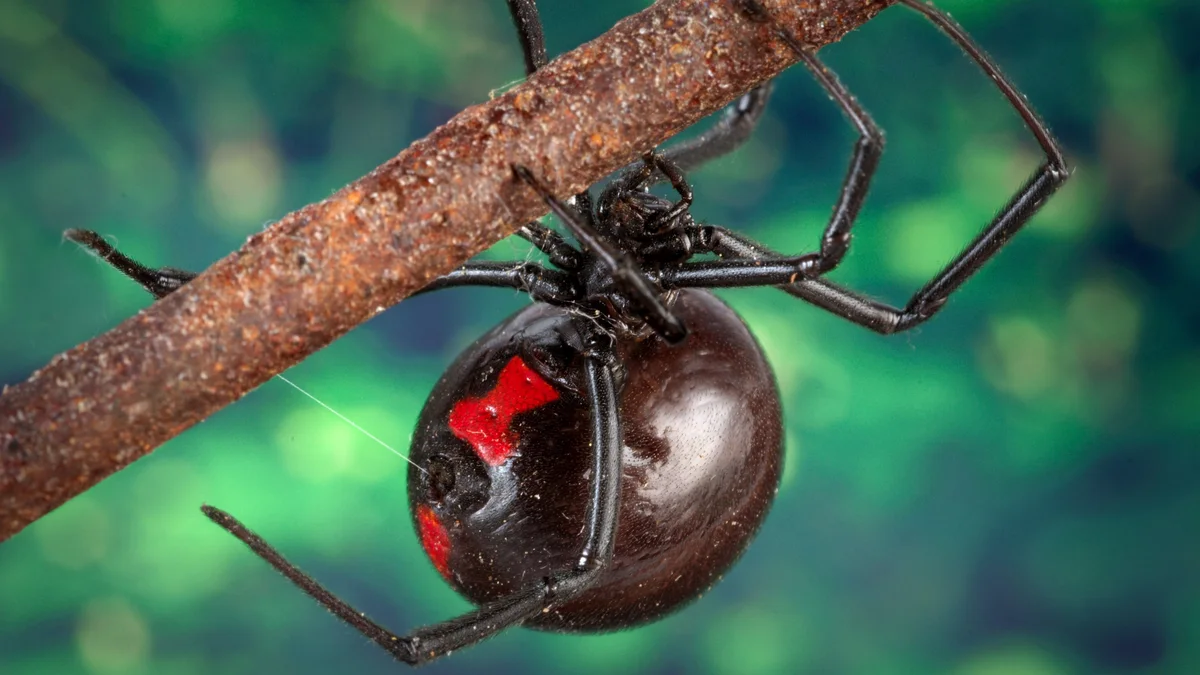
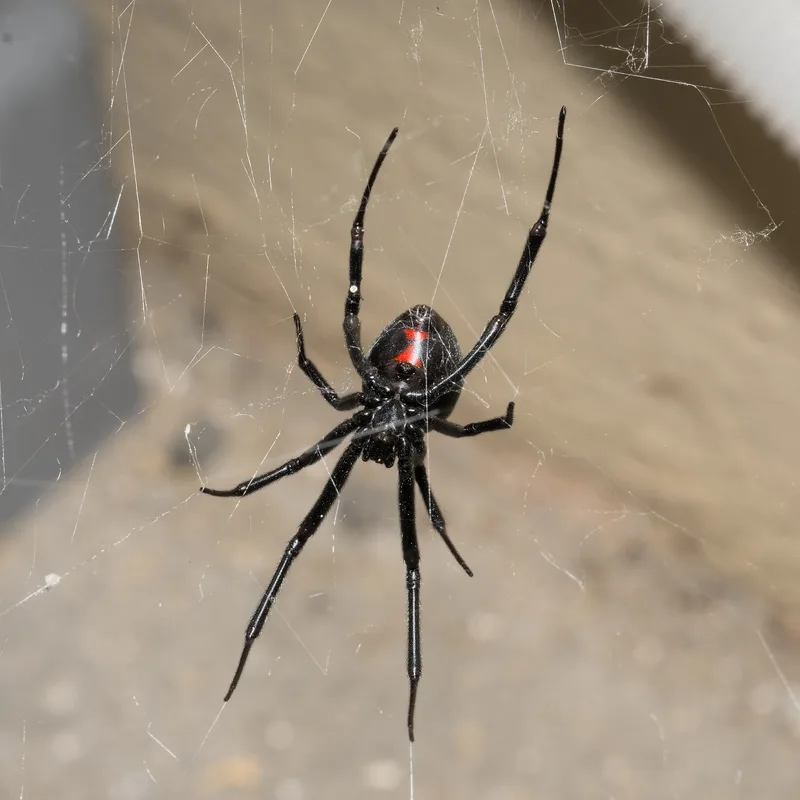
A black widow spider is a shiny black cobweb spider of the genus Latrodectus, about 1/2 inch long in the female, with a round abdomen and a red hourglass mark on its underside. Three black widow species live in the United States: the southern, northern and western black widows. Only the adult female’s bite is medically important. Bites are rare and almost never fatal, but they can cause severe muscle pain and cramps that need medical care.
Below: how to identify females, males and young spiders, how the three black widows and the invasive brown widow differ, where they hide around a house, whether females really eat males, what a bite does, and how to keep them away without spraying the yard, plus our count of 60,989 US iNaturalist records.
Key Takeaways
- Look for a glossy black female with a ball-shaped abdomen and a red mark on the belly. The hourglass can be complete, split in two, reduced to a bar or, rarely, missing (UC IPM).
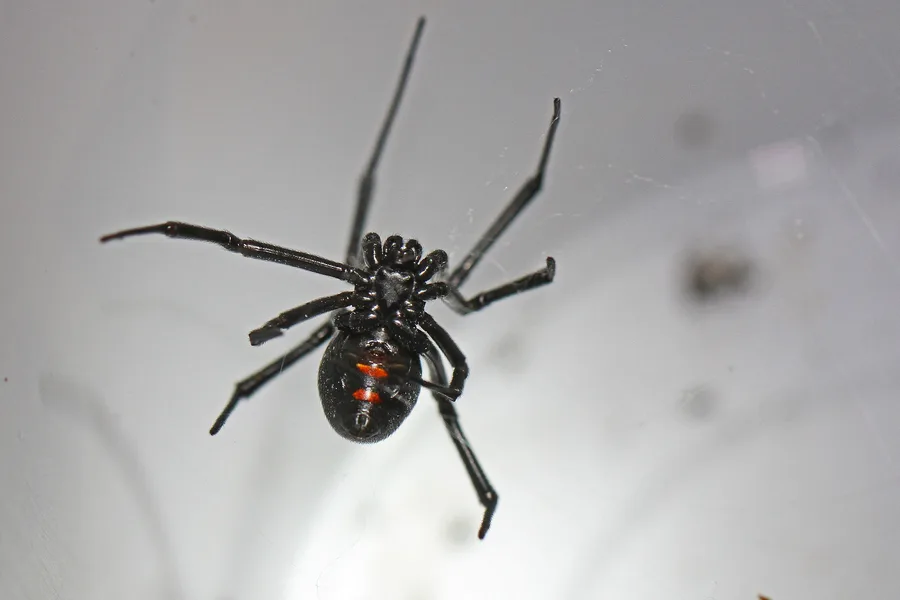
- The southern black widow’s hourglass is joined in the middle; the northern black widow’s is broken, and it usually has red spots down its back (Missouri Department of Conservation).
- In our iNaturalist count, western black widows lead with 26,332 US records, followed by the non-native brown widow (18,018), the southern black widow (11,175) and the northern black widow (5,173).
- A smooth, tough egg sac points to a black widow; a sac covered in silk spikes means a brown widow (UC IPM).
- Most males are not eaten: the Burke Museum says most southern black widow males survive mating.
- Of 15,299 US poison center cases from 2012 to 2022, 10% needed hospital admission and 3.4% received antivenom. If you are bitten, call Poison Control at 1-800-222-1222.
Table of Contents
- What a Black Widow Spider Is
- How to Identify a Black Widow
- Southern, Northern, Western and Brown Widows Compared
- Where Black Widows Live: Our Count of US Records
- Black Widow Egg Sacs and Brown Widow Egg Sacs
- Where Black Widows Hide Around a House
- Do Female Black Widows Really Eat the Males?
- Black Widow Bites: Symptoms, Risk and What to Do
- False Black Widow and Other Look-Alikes
- What Eats Black Widows
- How to Keep Black Widows Away Without Spraying the Yard
- Frequently Asked Questions
What a Black Widow Spider Is
Black widows are widow spiders (genus Latrodectus) in the cobweb spider family Theridiidae. Like all spiders, they are arachnids rather than insects, with eight legs and two body parts. Penn State Extension says the United States probably has five widow species: the southern black widow (L. mactans), northern black widow (L. variolus), western black widow (L. hesperus), the non-native brown widow (L. geometricus) and the red widow (L. bishopi). Only the first three are black widows, though people often use the name for all five. All share a small front body, a large round abdomen, long thin legs and a tangled, irregular cobweb rather than the neat wheel of an orb weaver.
How to Identify a Black Widow
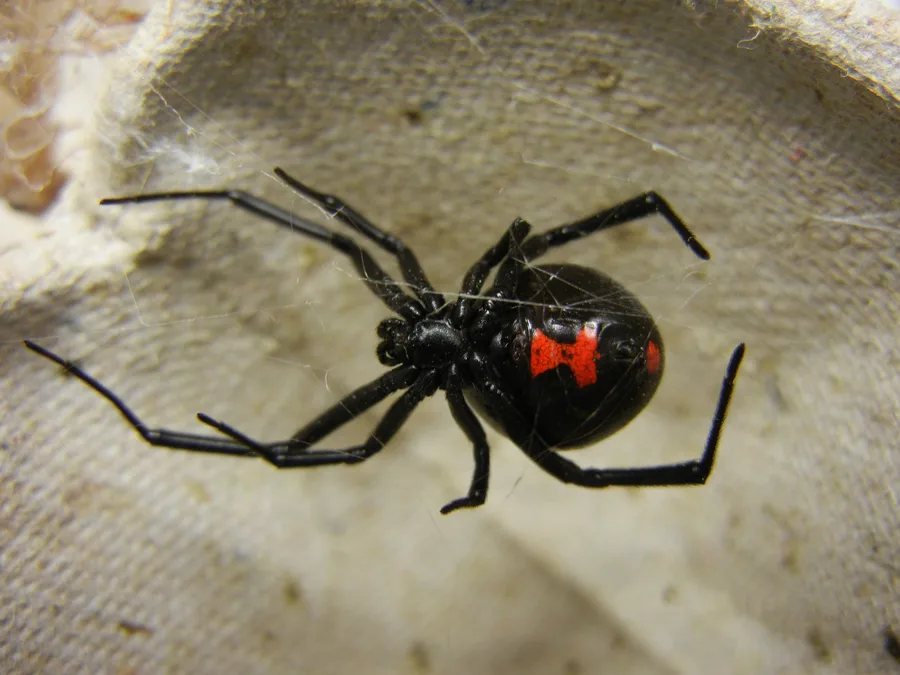
The spider people picture is the adult female. The UC IPM Pest Notes on widow spiders, written by R.S. Vetter of UC Riverside, and Penn State Extension describe her this way:
- Color: shiny jet black. A very well-fed female can look brownish or plum-colored because her stretched abdomen thins the pigment (UC IPM).
- Size: 8 to 13 millimeters in body length and 25 to 35 millimeters with legs spread for the southern black widow (Penn State); about 1/2 inch for the western black widow (UC IPM).
- The mark: orange to red, on the underside of the abdomen. UC IPM says it can be two triangles joined into a perfect hourglass, two triangles with a gap, a triangle and a small bar, barely visible, or on rare occasions absent.
- Web: messy, tangled and very strong. The Missouri Department of Conservation says that with a little experience you can recognize one just by touching it.
The mark is on the belly, but a female waiting in her web hangs with her underside facing up, so the hourglass faces you. UC IPM says widows come out at dusk to wait for prey.
What a male black widow looks like
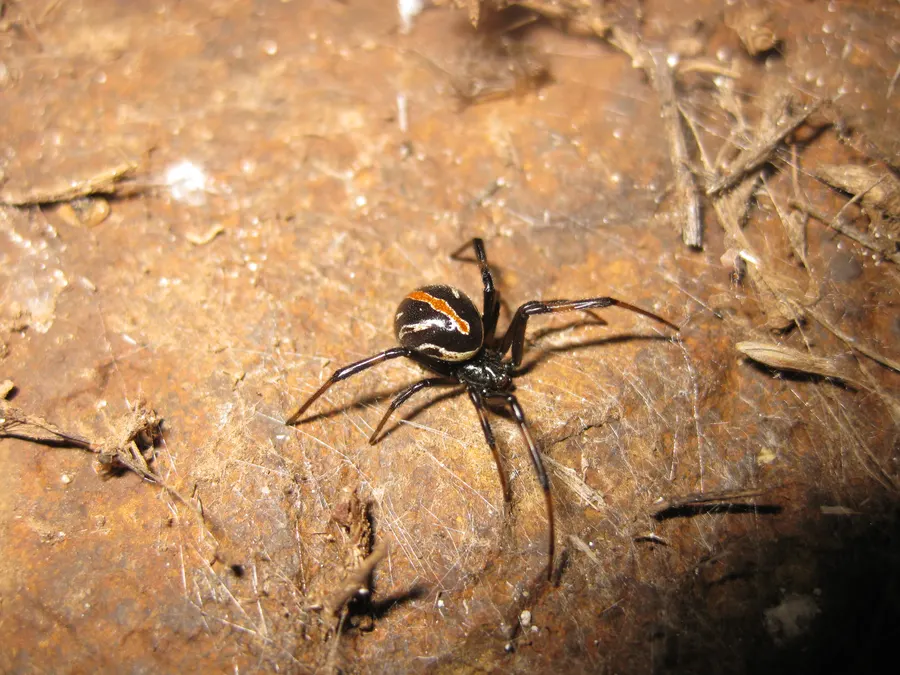
Males look so different that most people never connect them with the females. Penn State gives the male southern black widow a body length of only 4 to 6 millimeters, with white markings and red spots. UC IPM says males keep the striped coloring of young spiders and stop eating once mature; their legs can be nearly as long as a female’s. The Missouri Department of Conservation says males are seldom seen except when visiting a female’s web and are harmless, and Penn State explains why: males and immature spiders do not have fangs large enough to pierce human skin.
Of the 6,587 US research-grade iNaturalist widow records that observers tagged as female or male, 2,153 (32.7%) were males. Only about one record in nine carries a sex tag, so this reflects what photographers notice, not the true ratio.
Young black widows
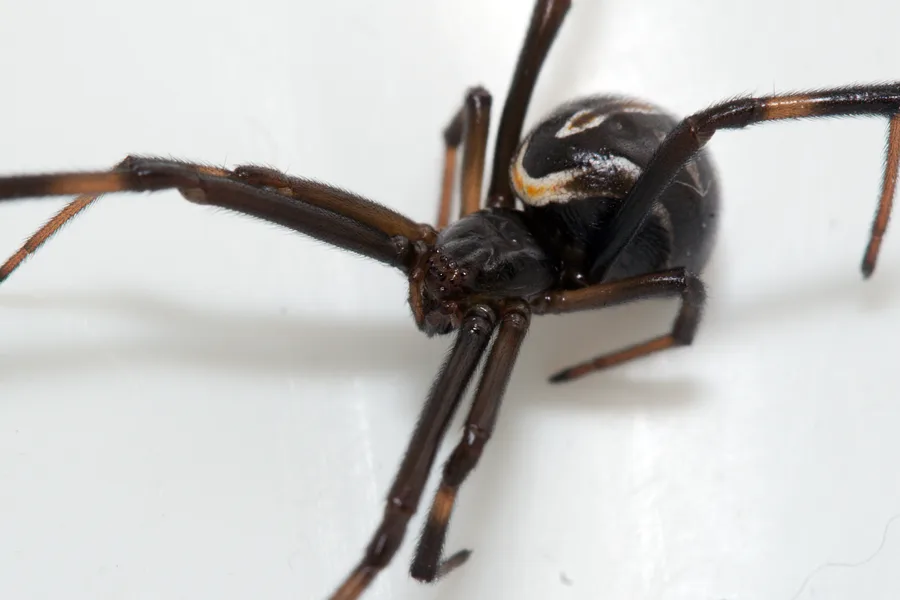
UC IPM says spiderlings leave the egg sac with tan legs and a mostly white abdomen with a few black spots. As they grow, the abdomen turns olive-gray or tan with a white stripe along the top and diagonal stripes on the sides, and young females darken toward black with each molt. Washington State University describes spiderlings as orange, brown and white. This striped stage is easy to mistake for the brown widow.
Southern, Northern, Western and Brown Widows Compared
This table brings together what extension and state sources say about each species, plus the states with the most US research-grade iNaturalist records in our count.
| Species | Female markings | Most US records (our count) | Typical spots | Bite |
|---|---|---|---|---|
| Southern black widow (L. mactans) | Shiny black; hourglass joined in the middle (Missouri); back plain or with up to four red dots (Penn State) | Texas 2,724, Oklahoma 1,023, North Carolina 994 | Under stones, in stumps and woodpiles, rodent holes, dark corners of barns and garages, outdoor privies (Penn State) | Medically important |
| Northern black widow (L. variolus) | Hourglass broken in two; usually a row of red spots down the back (Missouri) | Virginia 629, Maryland 469, Massachusetts 462 | Webs in open woods (Missouri) | Medically important |
| Western black widow (L. hesperus) | Shiny jet black; hourglass complete, split, reduced or rarely absent (UC IPM) | California 12,592, Arizona 2,580, Utah 2,143 | Holes, cracks and clutter around homes, barns, outbuildings and rock walls; garage doors and vents (UC IPM) | Medically important |
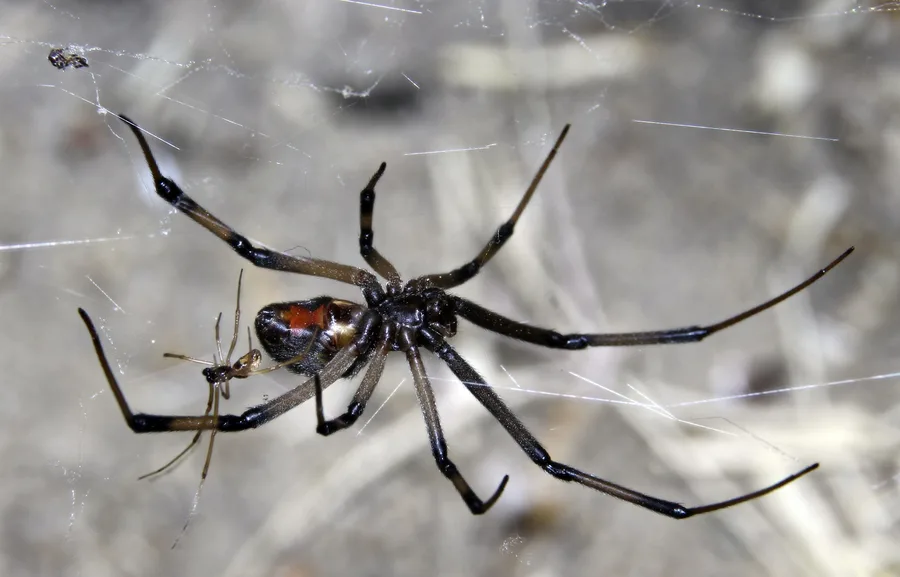
| Brown widow (L. geometricus), non-native | Mottled tan, brown and gray; hourglass usually orange (UC Riverside) | California 11,861, Florida 2,353, Texas 1,426 | More exposed spots: chain-link fences, under plastic patio furniture, buckets, pots, mailboxes (UC IPM, UC Riverside) | Much milder than a black widow’s (UC IPM) |
Counts: US research-grade iNaturalist observations, all years, pulled November 22, 2026. “Missouri” is the Missouri Department of Conservation; “UC Riverside” is its Center for Invasive Species Research. The red widow appears in our count only in Florida (291 records).
UC Riverside’s Center for Invasive Species Research says the brown widow was confined to the Florida peninsula for decades, began appearing in other Gulf Coast states around 2000 and is now known from Texas to Georgia and South Carolina; the first Southern California specimens were collected in Torrance in 2003. Adult brown widows look a lot like young western black widows, and UC IPM says the egg sac is the surer way to tell them apart.
Where Black Widows Live: Our Count of US Records
To see where Americans actually find widow spiders, we pulled every US research-grade observation of the genus Latrodectus from the iNaturalist API on November 22, 2026. “Research grade” means at least two people agreed on the identification from the photo. There were 61,034 records, 60,989 of them identified to species.
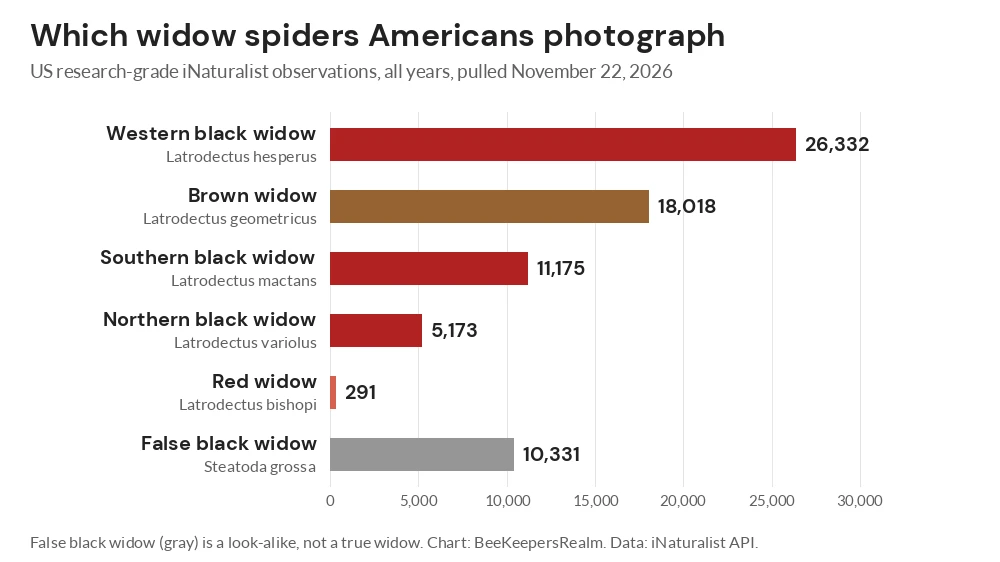
Western black widows make up 43.2% of species-level records, brown widows 29.5%, southern black widows 18.3%, northern black widows 8.5% and red widows 0.5%. Every state and Washington, D.C., has at least one record, though a single record in Alaska or Maine says little about an established population. Three patterns stand out:
- The brown widow is now a major presence. California has 11,861 brown widow records beside 12,592 western black widow records, and brown widow records outnumber southern black widow records in Florida (2,353 to 648), Georgia (657 to 450), Louisiana (291 to 223) and South Carolina (463 to 460). UC IPM cites a 2012 study in which brown widows outnumbered black widows in urban Southern California.
- The Midwest and Northeast mostly have northern black widows: 232 of 276 widow records in Ohio, 118 of 143 in Pennsylvania, 152 of 178 in Illinois, 119 of 127 in Michigan and 74 of 92 in New York.
- The West is western black widow country: all 2,104 of Colorado’s widow records, 2,143 of Utah’s 2,144 and 490 of Washington’s 495.
These numbers show where people photograph widows, which follows population and the number of iNaturalist users as well as spider numbers; that is partly why California ranks first for two species.
When black widows are most often seen
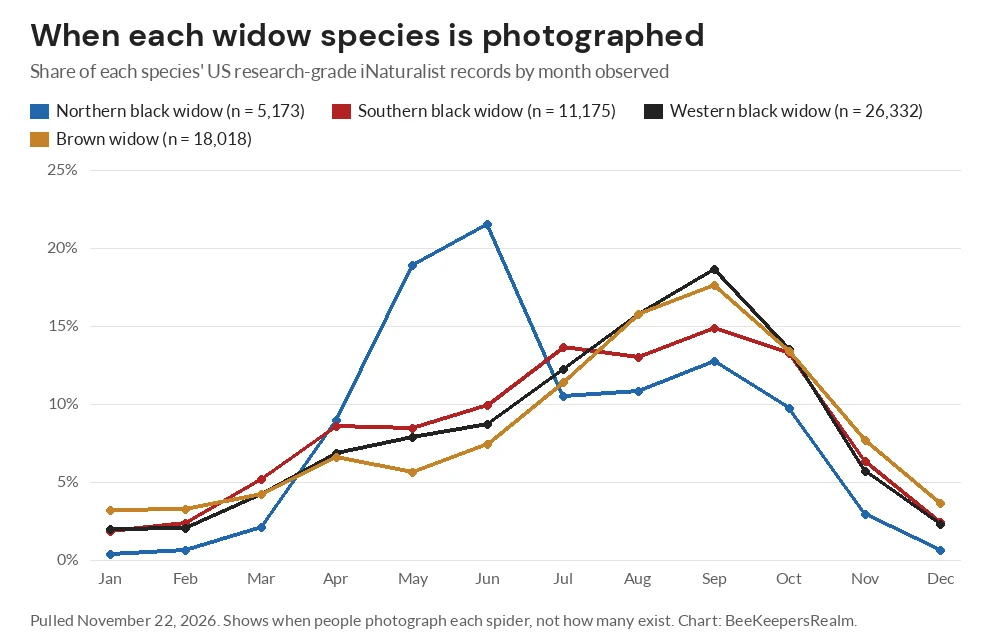
September is the peak month for western black widows (18.7% of their records), brown widows (17.6%) and southern black widows (14.8%). The northern black widow peaks earlier, in June (21.5%), with 40.4% of its records in May and June. December through February hold 1.7% of northern black widow records but 10.2% of brown widow records, which fits a species centered in Florida and Southern California. Bites follow the warm season too: a review of US poison center data found exposures were more frequent in warm-weather states and in summer months.
Black Widow Egg Sacs and Brown Widow Egg Sacs
An egg sac is often easier to find than the spider and is one of the best clues to which widow you have.
- Black widow: UC IPM describes the western black widow’s sac as yellowish and teardrop-shaped, tapered at the top and bulbous at the bottom, with well-defined edges and a very tough covering. Penn State gives southern black widow sacs as about 0.5 inch across.
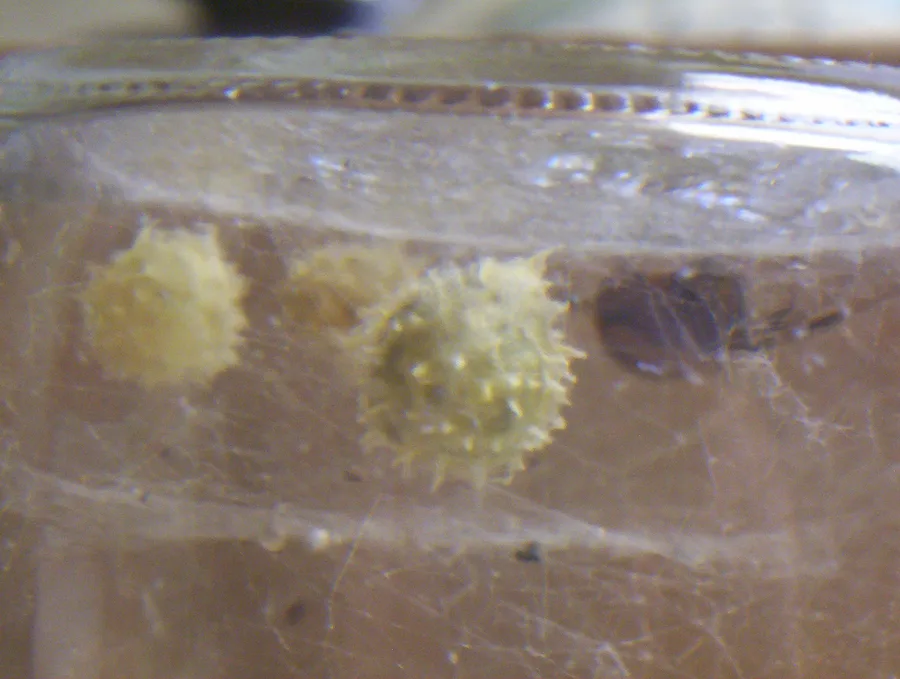
- Brown widow: covered with small spikes of silk, like a very large pollen grain. UC IPM says the sac alone can confirm brown widows even when no spider is seen.
- False black widow: like a cotton ball with indistinct edges (UC IPM).
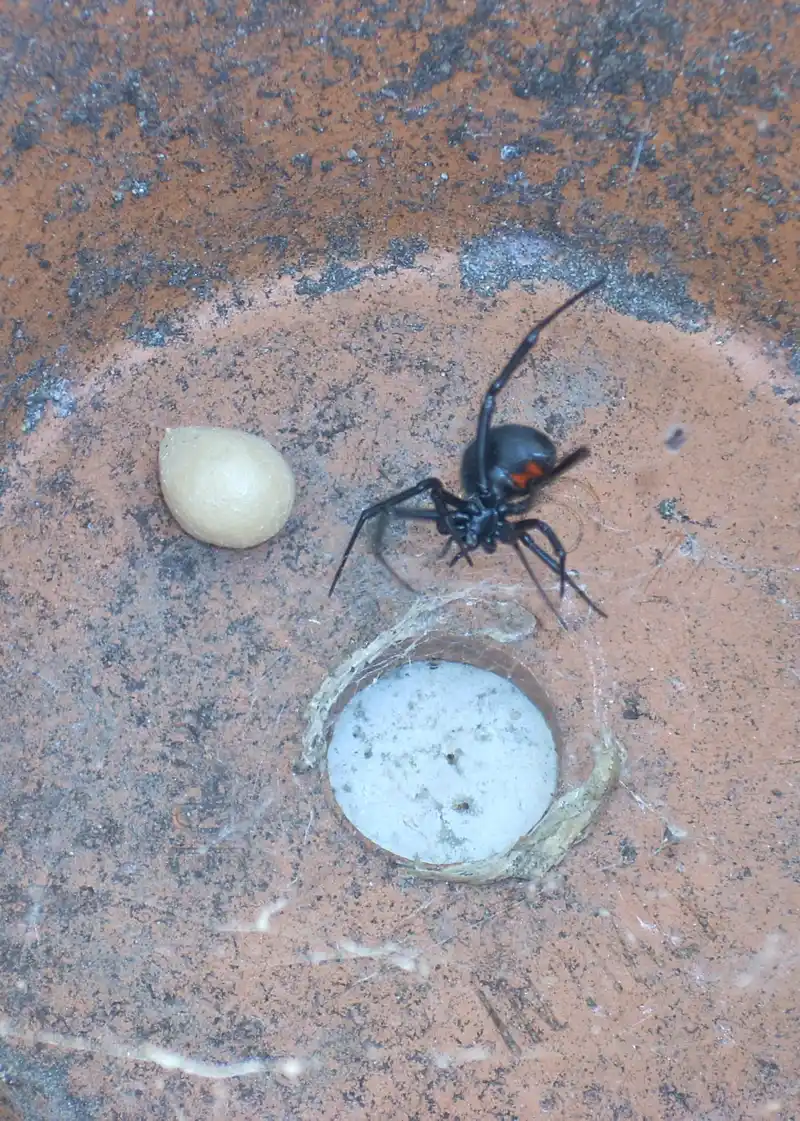
Penn State says a southern black widow female may produce up to nine egg sacs of 200 to 800 eggs each. UC IPM says a western black widow typically lays about 300 eggs per sac and can make more than 10 sacs from one mating, while brown widows lay about 130 eggs per sac but can make 20 or more. Penn State says the eggs hatch in about eight days, but the spiderlings stay in the sac about nine more days before dispersing, often by “ballooning” on wind-borne silk threads. UC IPM says ballooning is one reason widows keep reappearing on a property.
Where Black Widows Hide Around a House
Widows want dark, sheltered, undisturbed spots, and UC IPM says they usually hunt within three feet of the ground. The places the sources name most often:
- Woodpiles and stacked materials: Washington State University says woodpiles are common sources of bites on people carrying wood indoors. The CDC’s National Institute for Occupational Safety and Health (NIOSH) also lists eaves, fences and debris in its venomous spiders guidance for outdoor workers.
- Meter boxes and crawl spaces (Washington State).
- Garages and sheds: by doors, near vents and wherever insects pass (UC IPM).
- Outdoor furniture and containers: picnic tables, lawn chairs, trash can grips, plant pots with curled lips and molded plastic playhouses (UC IPM). Brown widows are extremely common under plastic patio furniture.
- Gloves and boots left outside (National Capital Poison Center).
UC IPM says both black and brown widows are almost never found inside homes, because living spaces have too few insects to feed them, and it warns against carrying spiders in on plants, firewood and boxes. Garages are the exception: UC IPM says black widows are common there.
Do Female Black Widows Really Eat the Males?
Sometimes, but far less often than the name suggests. Penn State and the Missouri Department of Conservation repeat the classic account that females often kill and eat males after mating. Rod Crawford’s Spider Myths series at the Burke Museum calls that a myth that is “not totally false, but very far from true.” It points out that most older observations came from laboratory cages, where males could not escape, and that western black widow females weigh 10 to 160 times as much as males.
“Of U.S. species, mate cannibalism occurs sometimes in Latrodectus mactans, the eastern (southern) black widow, but most males survive to mate another day.”
The same page says mate cannibalism has never been observed in the wild in the western black widow. Laboratory research points the same way: in a 2024 study in BMC Ecology and Evolution, L. Baruffaldi and M.C.B. Andrade of the University of Toronto compared five widow species under the same conditions and classed the southern and western black widows as species with rare cannibalism, and the brown widow among species with high cannibalism, in which males mate only once.
Black Widow Bites: Symptoms, Risk and What to Do
This is educational information, not medical advice. If you think a black widow has bitten you or someone else, call Poison Control at 1-800-222-1222 (free, confidential, 24 hours a day) and seek medical care. Call 911 for trouble breathing or other severe symptoms.
Black widows are not aggressive. The Missouri Department of Conservation calls them timid spiders that usually flee but will bite if provoked, and Penn State says bites come almost entirely from adult females, especially those guarding an egg sac.
“Bites from black widow spiders are quite rare, even where these spiders are very common.”
Symptoms and timing
The venom is a neurotoxin. NIOSH says it causes pain at the bite that spreads to the chest, abdomen or whole body, and UC IPM explains that it makes muscles contract repeatedly instead of relaxing. Sources differ on the bite itself: Penn State and UC IPM say it is at first almost painless or like a pinprick, while the National Capital Poison Center says it is usually painful right away. What can follow:
- Muscle cramps within 15 to 60 minutes, often spreading to the back, chest and abdomen (National Capital Poison Center).
- A rigid, painful abdomen that has been misdiagnosed as appendicitis (UC IPM).
- Sweating, nausea, vomiting and high blood pressure (National Capital Poison Center).
- Little at the bite site: perhaps two small fang marks or a red mark, and no tissue death (Penn State, UC IPM).
The National Capital Poison Center says recovery usually takes 24 to 48 hours but symptoms can last several days; Penn State says up to a week.
What to do after a bite
- Call Poison Control at 1-800-222-1222 or use the National Capital Poison Center’s black widow guidance and online tool.
- Wash the bite with soap and water. NIOSH and UC IPM add a cold cloth or cold pack; NIOSH says not to try to remove venom.
- Identify the spider if you can do so safely; NIOSH says this helps medical treatment.
- Check your tetanus protection: the National Capital Poison Center says to call a doctor or go to urgent care if you have not had a booster in the previous 5 years.
- Go to an emergency department if pain is not controlled by oral pain medicine (National Capital Poison Center).
Hospital treatment is mostly pain and muscle-spasm relief. An antivenom exists, but it is made from horse serum and can cause serious allergic reactions, so it is reserved for symptoms other treatment cannot control (National Capital Poison Center; Penn State).
How serious are black widow bites?
Most turn out minor. A.F. Kerns and colleagues at the University of Virginia reviewed the US National Poison Data System for 2012 to 2022:
“Poison center data indicate that most black widow spider exposures result in minor consequences.”
They counted 15,299 exposures. Almost half (48.6%) were managed outside a healthcare facility, 10.0% needed hospital admission and 3.4% (521 people) received antivenom. The National Capital Poison Center, citing a review of over 15,000 poison center cases, says there were no deaths, and Penn State cites an older poison control estimate of about 2,200 bites a year with no recorded US deaths since 1983. MedlinePlus says death in a healthy person is very rare, but young children, older people and people who are very ill may not survive a bite, so they need care quickly.
Not sure which spider it was? The wolf spider, a large, hairy hunting spider, is often blamed for bites, but its bites are not considered medically important. The kissing bug, which bites people and can carry the parasite that causes Chagas disease, is an insect, not a spider.
False Black Widow and Other Look-Alikes
The spider most often mistaken for a black widow is the false black widow (Steatoda grossa), a European cobweb spider in the same family. UC IPM says it is slightly smaller (about 3/8 inch), chocolate brown, and never has red on its belly. Unlike true widows it thrives indoors, in washrooms, cupboards and under appliances and furniture. UC IPM says its venom is mild and its bite is much like a yellowjacket sting. It has 10,331 US research-grade iNaturalist records, more than the northern black widow.
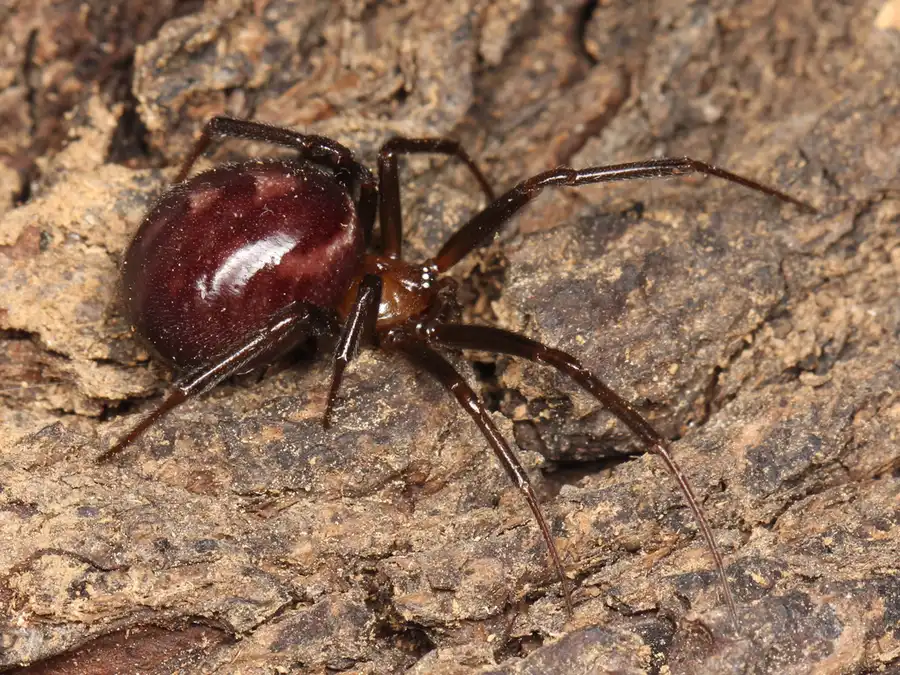
Black jumping spiders are compact and hairy, with two very large front eyes, and they hunt by stalking and pouncing instead of hanging in a tangled web. The hard cases are brown widows and young black widows; for those, look for the egg sac.
If the spider is plain brown with long legs and no hourglass at all, our brown recluse guide explains how to rule a recluse in or out.
What Eats Black Widows
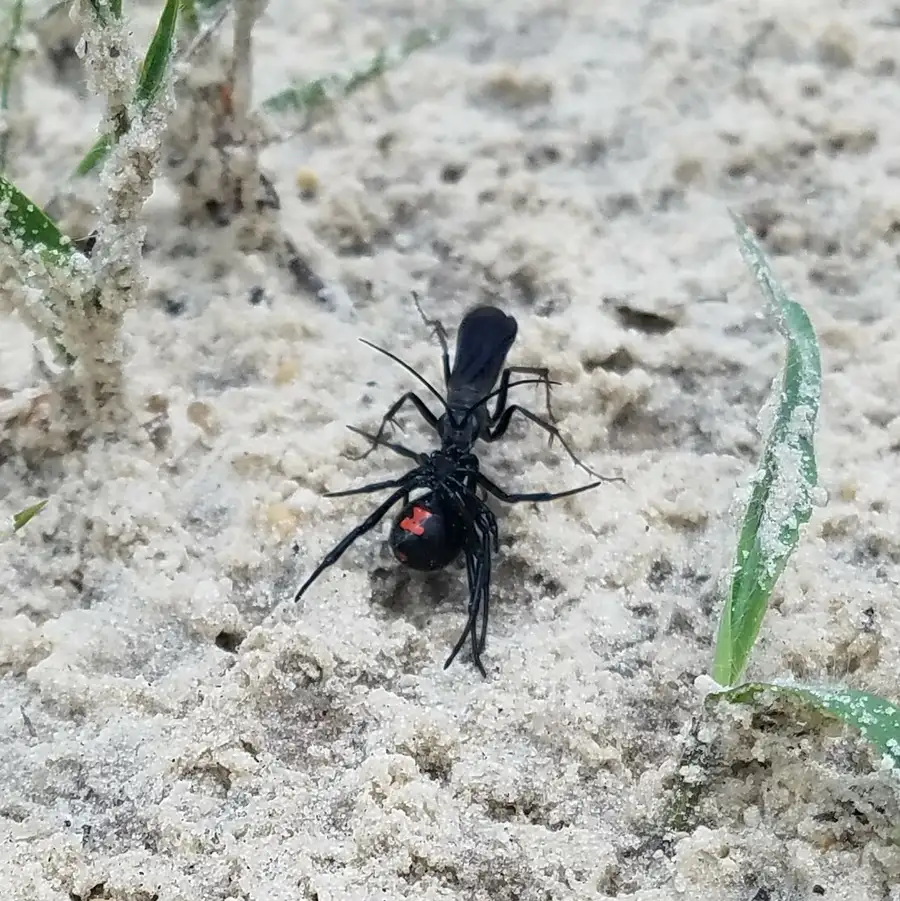
Black widows eat insects that blunder into the web, and the Missouri Department of Conservation says they have also caught small lizards and snakes. They are prey too. The same source says blue mud dauber wasps prefer to hunt young black widows and stock their nests with them. As our guide to mud dauber wasps explains, that habit is a main reason extension services suggest tolerating mud daubers where you can. The photo below shows another enemy: a spider wasp (family Pompilidae, the family of the tarantula hawk) dragging a southern black widow.
How to Keep Black Widows Away Without Spraying the Yard
The extension advice is mostly housekeeping, and none of it involves spraying flowering plants where bees forage. UC IPM says widows cannot be eliminated completely, because they re-infest treated areas, so the goal is fewer hiding places and fewer surprises:
- Clear clutter, trash, leaf litter and heavy ground cover near the foundation (UC IPM).
- Stack firewood away from the house and wear gloves to pick it up (UC IPM). The National Capital Poison Center also advises gloves for handling mulch and grabbing empty flowerpots.
- Bag and box what you store: gardening clothes and gloves in sealed bags, seasonal items in taped boxes off the floor and away from walls (UC IPM). NIOSH advises leaving less empty space between stacked materials.
- Shake out gloves, boots and shoes stored in garages, basements or sheds, and do not reach into places you cannot see (National Capital Poison Center).
- Vacuum or sweep webs regularly; UC IPM says spiders’ soft bodies usually do not survive vacuuming.
- Point outdoor lights away from doors and windows, since lights draw the insects widows eat (UC IPM).
Sprays are a weak tool. UC IPM says insecticides do not provide long-term control, notes that most products registered for spiders are water-based, and reports that in a 2016 study water-based insecticides sprayed on brown widow egg sacs had no significant effect on the eggs. If you treat, keep it to the cracks where the spider lives. The pyrethroids sold for spiders are broad-spectrum, which matters if bees visit your garden; our guide to pollinator-safe pest control explains the risk.
A note for beekeepers
Spare hive bodies, supers and lids stacked in a shed or garage are the kind of undisturbed, stacked material NIOSH and UC IPM describe as widow habitat. Wear gloves when you move stored equipment, look before you reach into a dark stack, and use sealed storage where you can, which also helps against wax moths in stored equipment. For more spiders and household pests, see our garden and household insects guides.
For the neat wheel-shaped webs that appear in yards each fall, see our orb weaver spider guide, which covers the common US species and their bites.
The CDC once listed the hobo spider alongside the black widow but dropped it in 2015, as our hobo spider guide explains.
Cellar spiders are among the spiders known to eat black widows, as our daddy long legs guide explains.
Frequently Asked Questions
Can a black widow bite kill you?
It is very unlikely. The National Capital Poison Center says a review of over 15,000 US poison center cases found no deaths. Young children, older people and the very ill are at higher risk, so call Poison Control at 1-800-222-1222 and get care after any suspected bite.
Are black widows aggressive?
No. They are timid and usually flee. Bites tend to happen when a female is pressed against skin, for example in a glove, a boot or an armload of firewood.
What does a male black widow look like?
Much smaller than the female, about 4 to 6 millimeters long in the southern species, with long legs and white and red markings instead of solid black. Males cannot bite through human skin.
Do black widows eat their mates?
Occasionally. The Burke Museum says most southern black widow males survive mating and western black widows have never been seen eating a mate in the wild.
Are there black widows in Ohio, Pennsylvania, Michigan and Illinois?
Yes, mostly northern black widows: our count found 232 northern black widow records in Ohio, 118 in Pennsylvania, 119 in Michigan and 152 in Illinois.
How long do black widows live?
Sources differ. Penn State says a female may live a year or more, and Washington State University says some females live more than 3 years. The Missouri Department of Conservation says adults there die at the first freezes and the egg sacs overwinter.
What is the difference between a black widow and a brown widow?
A brown widow is mottled tan, brown and gray with an orange hourglass, uses more exposed spots and makes a spiky egg sac. A female black widow is shiny black with a red mark and makes a smooth sac. UC IPM says the brown widow’s bite is much milder.
The Bottom Line
An adult female black widow is easy to recognize and easy to avoid: wear gloves around woodpiles and stored items, shake out shoes and keep clutter down. If you are bitten, call Poison Control at 1-800-222-1222 rather than waiting it out.
Image credits: Featured image: female southern black widow photographed in 2007 by James Gathany, CDC (Public Health Image Library), Wikimedia Commons, public domain (US government work), cropped and resized. Southern black widow showing its red hourglass: Shenrich91, CC BY-SA 3.0. Male southern black widow: Tanthalas39, CC BY 3.0. Immature female western black widow: Matthew Field, CC BY-SA 2.5. Northern black widow: Judy Gallagher, CC BY 2.0. Female western black widow: Dllu, CC BY-SA 4.0. Brown widow female and male: Davefoc, CC BY-SA 4.0. Western black widow with egg sac in a flower pot: Jengod, CC BY-SA 3.0. Brown widow with spiky egg sacs: SidShakal, CC BY-SA 3.0. False black widow, Steatoda grossa: Ryan Kaldari, CC0. Spider wasp dragging a black widow: supertiger, CC BY 4.0. All photos via Wikimedia Commons, resized; links to each file page and licence are in the captions. Charts: BeeKeepersRealm, from iNaturalist API data pulled November 22, 2026.