Reviewed by Thomas B. · How we review
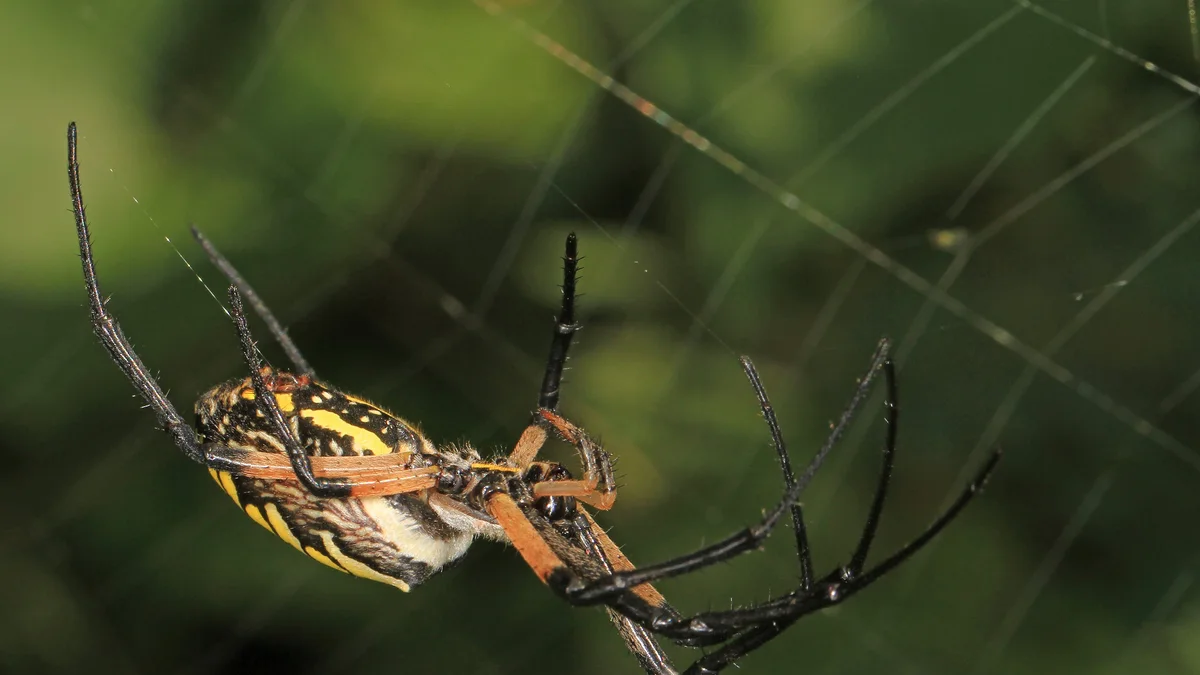
An orb weaver spider is any spider in the family Araneidae, the builders of the round, spoked webs strung across gardens, porches and trails. The ones Americans notice most, such as the yellow garden spider, the spotted orbweaver and the marbled orbweaver, are large, often colorful females that hang head-down in the middle of the web in late summer and fall. They are harmless to people: bites are rare and, by Penn State Extension’s account, no worse than a bee or wasp sting.
Below: how to recognize an orb weaver and the common US species, the invasive Joro spider, why they appear in late summer, how they rebuild their webs, what they catch (bees included), and what to do about one by the door, plus our count of 456,154 US iNaturalist records showing exactly when Americans find them.
Key Takeaways
- Orb weavers (family Araneidae) are web-building spiders, not insects. About 180 species live north of Mexico, according to the University of Wisconsin-Milwaukee Field Station.
- In our count of US iNaturalist research-grade records, 62.9% of orb weaver observations fall in August, September and October, and September alone holds 26.8%.
- Many orb weavers eat their web at dawn and spin a new one at dusk. The yellow garden spider stays at one site all season, and the golden silk orb-weaver keeps a semipermanent web that it repairs.
- They are not dangerous. Missouri’s Department of Conservation says they do not bite unless molested and their bites are not dangerous; the main exception is a person with a severe allergy to insect or spider bites (University of Kentucky).
- Their webs do catch bees: UF/IFAS lists wasps and bees among the yellow garden spider’s main prey. Leave them in place or move them; do not spray.
- The invasive Joro spider now has research-grade US records from 17 states, though most of its 18,520 records come from Georgia, the Carolinas and Tennessee.
Table of Contents
- What an Orb Weaver Spider Is
- How to Identify an Orb Weaver
- Common Orb Weavers in US Yards
- The Joro Spider: An Invasive Orb Weaver on the Move
- Why Orb Weavers Appear in Late Summer and Fall
- How Orb Weavers Build and Rebuild Their Webs
- What Orb Weavers Eat
- Orb Weavers, Bees and Pollinator Gardens
- Are Orb Weavers Dangerous? Bites and First Aid
- Orb Weavers Around the House: Leave, Move or Remove
- Frequently Asked Questions
What an Orb Weaver Spider Is
“Orb” means circle, and orb weavers are named for the wheel-shaped web: non-sticky spokes radiating from a hub, with a sticky spiral laid over them. Araneidae is one of the largest spider families. The University of Wisconsin-Milwaukee (UWM) Field Station counts more than 3,500 kinds worldwide and about 180 north of Mexico, and in the iNaturalist data we pulled, 131 species have research-grade records in the United States. Like all spiders they have eight legs and two body parts, which is why they are arachnids and not insects, a difference our guide to whether bees are insects explains.
Some large “orb weavers” sit near the edge of the family. The golden silk orb-weaver and the Joro spider (genus Trichonephila) are filed in Araneidae by some researchers, in Tetragnathidae by the UF/IFAS profile of the golden silk spider, and in a separate family, Nephilidae, by iNaturalist. We include them here because they build orb webs in the same yards and people search for them as orb weavers.
How to Identify an Orb Weaver
The web is the first clue. Then look at the spider:
- Position: a large female resting head-down at the center of a vertical, wheel-shaped web, or hiding in a curled leaf or crevice beside it with a “signal line” running to the hub (Penn State Extension, on the marbled orbweaver).
- Body: a small front section and a big, rounded or angular abdomen, often patterned or brightly colored. The University of Kentucky gives a body length of up to about 1/2 inch for most species; the yellow garden spider can span almost 3 inches from leg tip to leg tip.
- Legs: often banded and spiny. UWM notes that orb weavers have eight eyes but poor vision, and the University of Kentucky says they find prey by feeling vibrations in the web rather than by sight.
- Males: much smaller, rarely seen, and usually wandering in search of females rather than building webs (Missouri Department of Conservation, MDC).
What it is not: wolf spiders and jumping spiders hunt on foot and do not build capture webs. Cobweb and funnel-web spiders build tangled or sheet-shaped webs. Long-jawed orb weavers (family Tetragnathidae) also spin orb webs, often near water, but have slender, stretched-out bodies and long jaws.
Video: In this Deep Look episode from KQED and PBS, cross orb weavers spin and use their webs. Going by its chapter list and KQED’s companion article, it covers how the silk is produced, the engineering of the web, hunting and feeding, and the idea, still debated by researchers, that the web works as an extension of a nearly blind spider’s senses and memory, for example in finding wrapped prey stored for later.
Common Orb Weavers in US Yards
The table lists the orb weavers Americans photograph most, with the month their US iNaturalist research-grade records peak. Record counts show what people find and upload, not how many spiders exist.
| Spider | How to recognize it | Where you see it | US records (peak month) | Source |
|---|---|---|---|---|
| Yellow garden spider, writing spider (Argiope aurantia) | Female 3/4 to 1 inch; black and yellow abdomen; silvery head; zigzag silk band in the web | Gardens, tall grass and weedy edges, in sun | 101,686 (Aug, nearly tied with Sep) | MDC, UF/IFAS |
| Spotted orbweaver, barn spider (Neoscona crucifera) | About 1/2 inch; camouflage pattern; gray legs with brown rings | Eaves, barns, porches and trees; webs near lights at night | 43,530 (Sep) | MDC |
| Cross orbweaver (Araneus diadematus) | Mottled white markings on the abdomen, with larger spots forming a cross; introduced from Europe | Buildings, especially walls with outdoor lights | 35,233 (Sep) | UWM, Wikipedia |
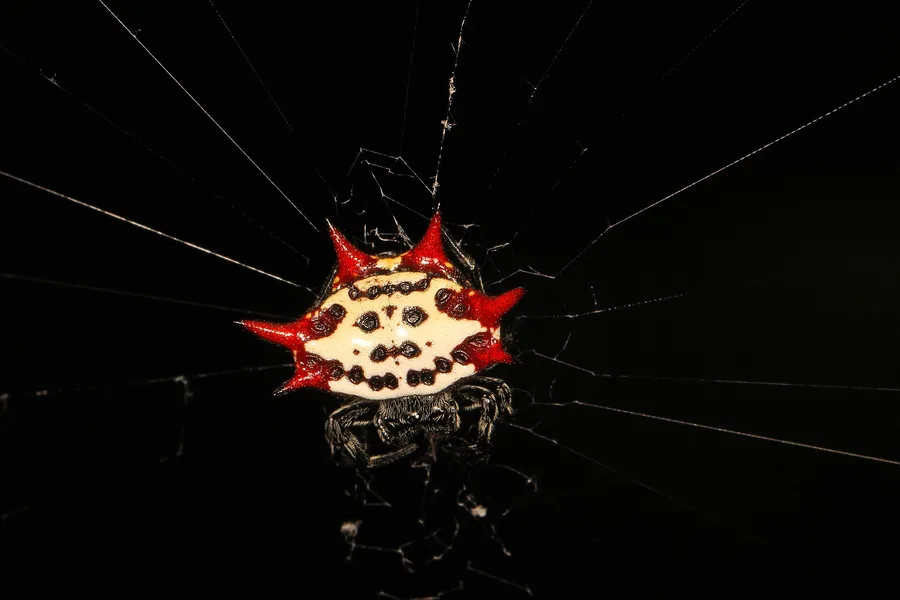
| Spinybacked orbweaver (Gasteracantha cancriformis) | Female 3/8 to 1/2 inch wide, wider than long; six spines; usually white with red spines in Florida | Woods and citrus groves across the South | 32,594 (Sep, but found all year) | UF/IFAS |
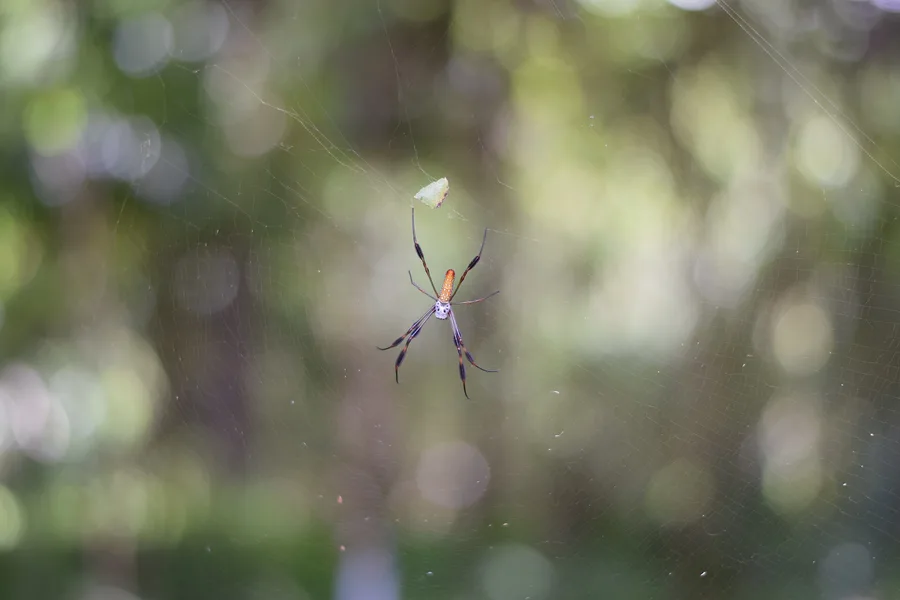
| Golden silk orb-weaver (Trichonephila clavipes) | Female 1 to 1.6 inches; tan to orange body; feathery tufts on the legs; golden silk | Southeast, north to North Carolina; webs often 1 to 2 meters (about 3 to 6.5 feet) across | 30,885 (Aug) | UF/IFAS |
| Banded garden spider (Argiope trifasciata) | Close relative of the yellow garden spider; web as large but may lack the zigzag | Sunny grasslands and gardens | 27,537 (Sep) | UWM |
| Marbled orbweaver, pumpkin spider (Araneus marmoreus) | 1/2 to 3/4 inch; round orange, yellow or white abdomen with dark marbling | Moist woods, thickets and stream banks | 20,521 (Oct) | MDC, Penn State |
| Joro spider (Trichonephila clavata, invasive) | Female body over 1 inch; yellow abdomen with teal bands; legs up to 3 inches | Georgia, the Carolinas and Tennessee, spreading; webs 10 feet or more | 18,520 (Sep) | UGA Extension |
| Furrow orbweaver (Larinioides cornutus) | About 1/2 inch; shiny abdomen with a dark, wavy-edged “furrow” pattern | Bridges, eaves, porches and porch lights, near water | 15,912 (Sep; genus 21,087) | MDC |
Data: iNaturalist API, United States, research-grade observations, all years, pulled November 22, 2026. Sizes are female body lengths without legs unless noted.
Yellow garden spider (writing spider)
The most-photographed orb weaver in the country, with almost 22% of all US research-grade orb weaver records. The UF/IFAS Featured Creatures profile of the yellow garden spider says it got the name writing spider from the vertical zigzag band it builds into its web, the stabilimentum. MDC lists corn spider and zipper spider as other names and describes webs about 2 feet across, built only by females, which tend to stay in one spot all season.
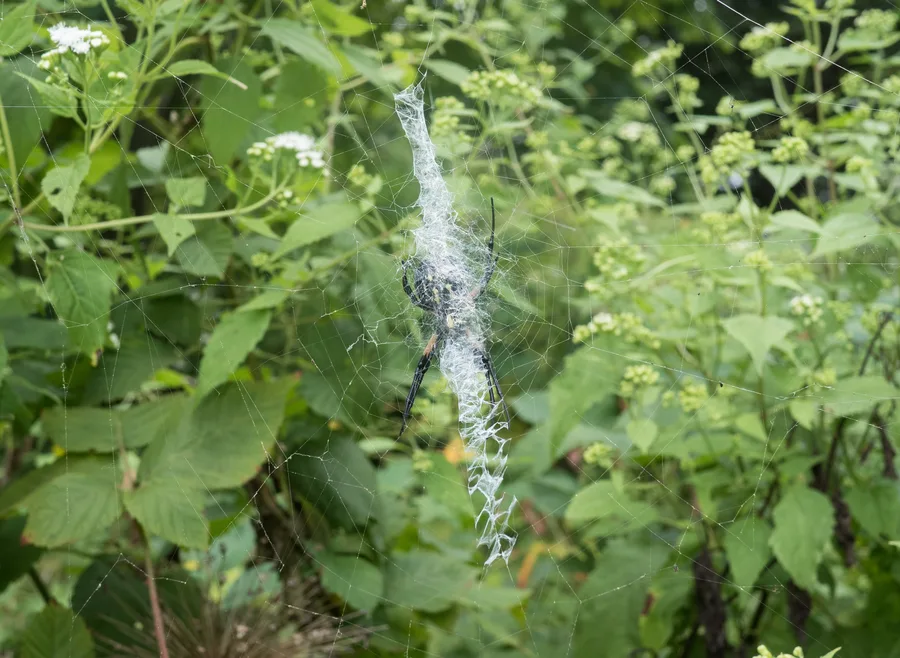
The banded garden spider (Argiope trifasciata) is its close relative. UWM notes that its web is as large but may lack the zigzag, and its records peak later, in September.
Spotted orbweaver (barn spider)
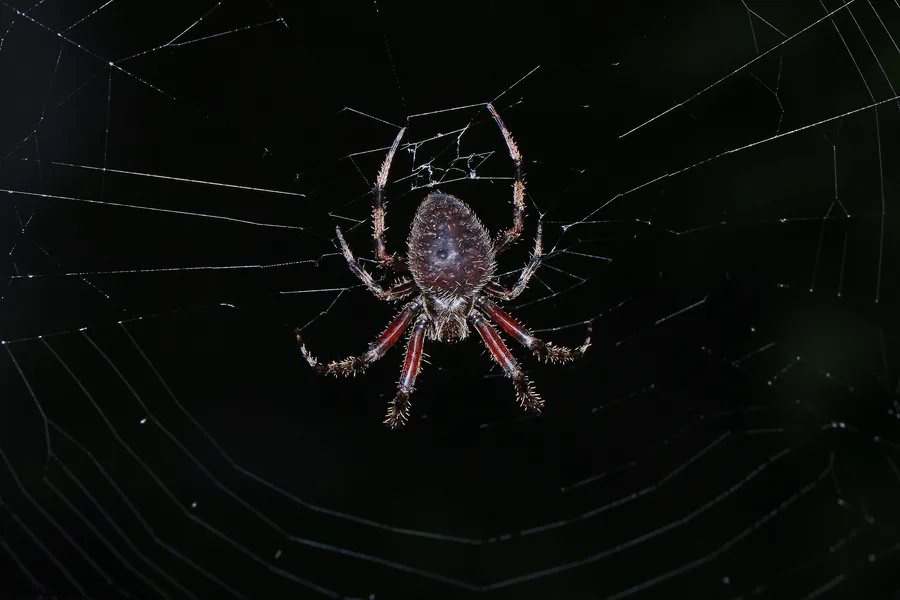
The MDC field guide to the spotted orbweaver calls it the most common Neoscona in Missouri and notes that the genus is hard to tell apart “even by specialists.” This is the brown, camouflaged spider that strings a big web from the eaves or a porch light at dusk and is gone by morning. It is also called the barn spider and Hentz orbweaver.
Marbled orbweaver (pumpkin spider)
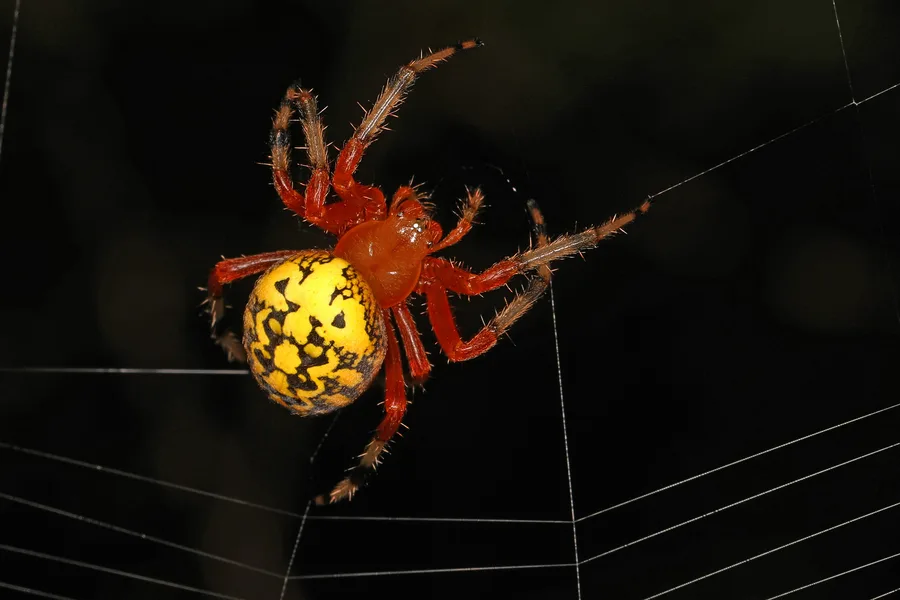
Round, orange and out in October, so MDC finds the nickname pumpkin spider “pretty appropriate.” Penn State Extension’s marbled orbweaver page says adults hide in a folded-leaf retreat beside the web, lay egg sacs of several hundred eggs, usually in October, and are seen from midsummer until the first hard freeze. UWM adds that the shamrock orbweaver (Araneus trifolium) is also called the pumpkin spider.
Furrow orbweaver and bridge spider
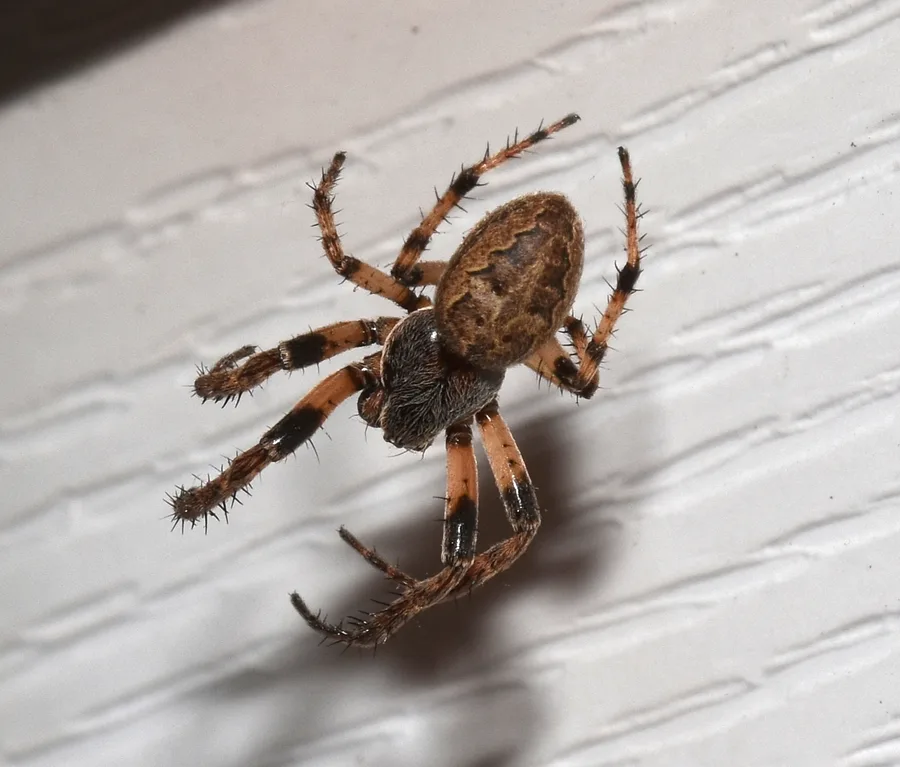
MDC describes three Larinioides species in North America, including the bridge orbweaver (gray cross spider). They build webs on or under bridges, under eaves and near porch lights, often parallel to a wall or window, and rebuild or repair them in the late evening. Unlike most orb weavers, the University of Kentucky notes, some furrow spiders overwinter as adults. That fits our count: 32.4% of US furrow orbweaver records come from March through June, twice the share for orb weavers as a whole (15.6%).
Spinybacked orbweaver
UF/IFAS says this small, crab-shaped spider “can be easily distinguished from all other spiders in Florida”: the female is wider than long and carries six pointed spines. It is a southern species, and our count shows it: 14.4% of its US records come from December through February, against 3.8% for orb weavers as a whole.
Golden silk orb-weaver (banana spider)
UF/IFAS describes the golden silk spider as perhaps the largest orb-weaver in the country, with females 24 to 40 mm (about 1 to 1.6 inches) long and webs often 1 to 2 meters across. It ranges from Florida and the Gulf States north to North Carolina. The webs are semipermanent: the spider repairs large sections instead of replacing the whole web.
The Joro Spider: An Invasive Orb Weaver on the Move
The Joro spider (Trichonephila clavata) is native to East Asia. UGA Extension’s circular Managing Joro Spiders in the Landscape (Circular 1289, published with full review on August 27, 2026) says it was first documented in the US in 2014 in northeast Georgia, around Braselton and Hoschton along I-85, and had spread about 75 miles in all directions by 2022. Females have a bright yellow abdomen with teal bands, legs up to 3 inches long, and golden webs that can span 10 feet or more.

To see where Joros are being recorded now, we counted research-grade iNaturalist observations by year and state.
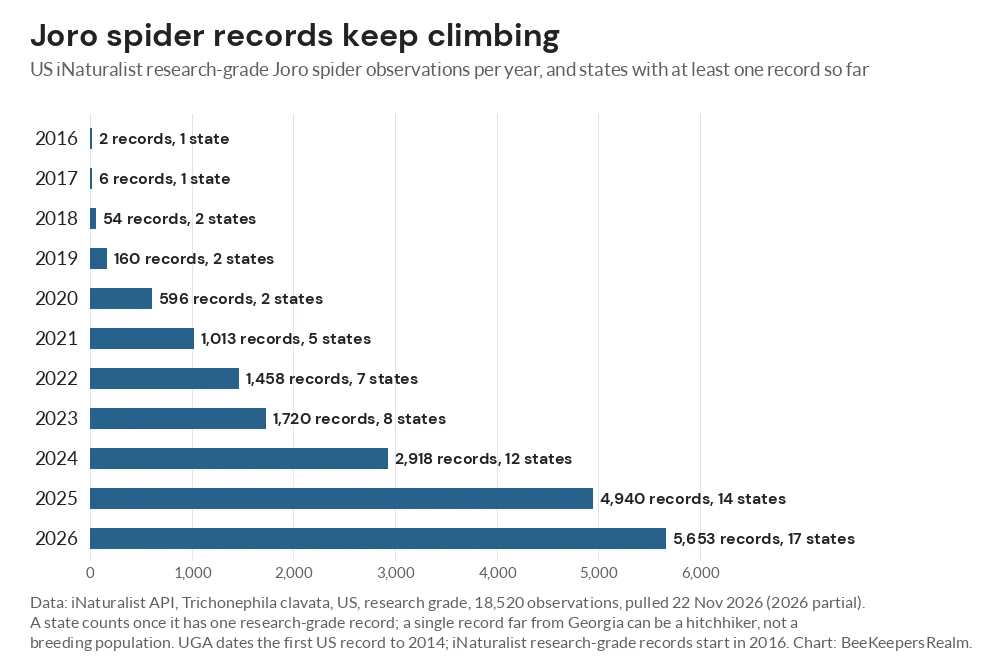
Records rose from 2 in 2016 to 4,940 in 2025 and 5,653 so far in 2026. Of 18,520 records, 18,324 (98.9%) come from four states:
| State | Research-grade records | First research-grade record |
|---|---|---|
| Georgia | 11,795 | August 2016 |
| South Carolina | 2,724 | August 2018 |
| Tennessee | 1,959 | October 2021 |
| North Carolina | 1,846 | September 2021 |
| Maryland | 100 | September 2022 |
| Alabama | 54 | October 2024 |
| Virginia | 18 | August 2024 |
| 10 other states* | 23 in total | 2021 to 2026 |
*Massachusetts 5; Kentucky, Ohio and Pennsylvania 3 each; California, Florida and Indiana 2 each; Illinois, Oklahoma and West Virginia 1 each. A single record far from the main range may be a spider that hitchhiked on a vehicle or cargo rather than a breeding population, so treat these as sightings, not an established range.
“Our results add evidence that T. clavata is an invasive species and deserves much more ecological scrutiny.”
That study’s models put the most suitable North American habitat north of the current range, found the spider spreading faster north than south, and found lower native orb weaver diversity closer to where the Joro was first found, though the authors note that human population density complicates that result. UGA describes Joros as timid; in its researchers’ experience they do not bite, even when handled roughly. Like the spotted lanternfly, it is a newcomer whose spread depends partly on public sightings, so a photo uploaded to iNaturalist from outside the Southeast is useful data.
Why Orb Weavers Appear in Late Summer and Fall
Orb weavers are not new arrivals in September; they have been growing all summer. MDC explains that spotted orbweavers hatch early in the growing season and reach full size by late summer and early fall, and that the adults die when it freezes while the young overwinter in egg cases. The University of Kentucky says many orb weavers live one year or less. The spiders are largest, and their webs biggest, at the end of their lives, which is exactly when people walk into them.
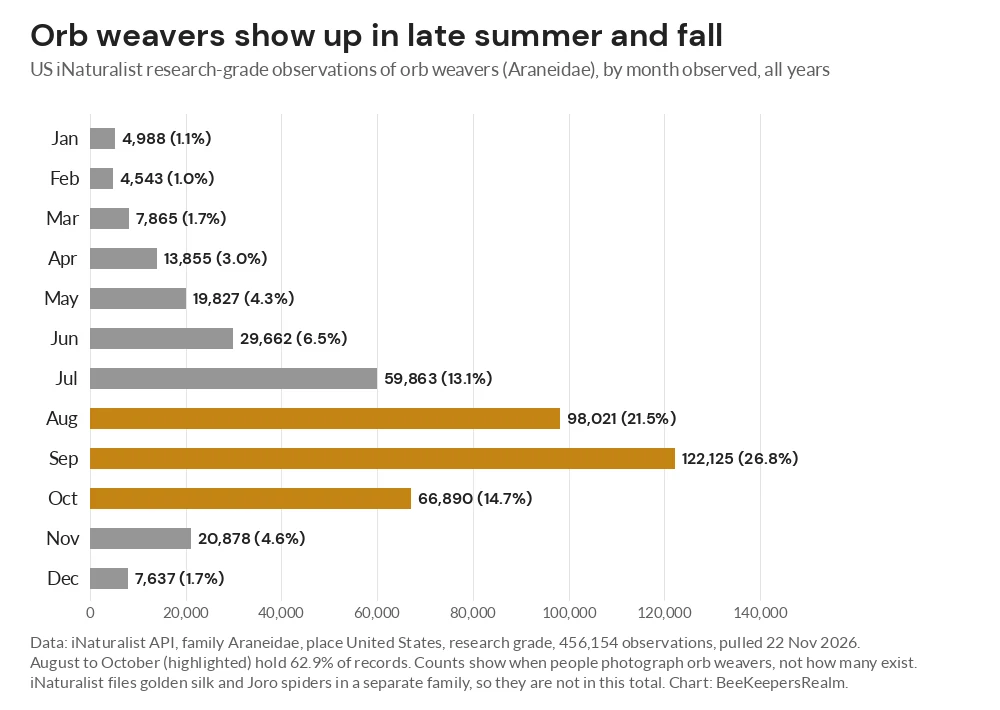
Of 456,154 US research-grade orb weaver records, 122,125 (26.8%) are from September and 62.9% fall between August and October. December through February together hold 3.8%. The species differ: yellow garden spiders peak in August and September, marbled orbweavers in October (80.2% of their records from September to November), and the southern spinybacked orbweaver stays visible all winter. These counts show when people photograph orb weavers, not how many exist, and the Joro and golden silk orb-weaver are not in this total because iNaturalist files them in another family.
How Orb Weavers Build and Rebuild Their Webs
A web starts with a line floated on the breeze. Once it snags, the spider builds a frame and spokes of non-sticky silk, then lays the sticky capture spiral; UWM puts the job at about an hour. Females do nearly all the building.
“The female dismantles her web at dawn each morning by eating it.”
MDC explains that the spider reingests the silk, along with the dew collected on it, and recycles the nutrients into the next web, spun at dusk. That is why a web across the porch steps can vanish by morning and reappear by evening. Not every orb weaver works this way:
- Yellow garden spider: stays in one area all season and often repairs damaged parts of its web before turning to its prey (MDC). It still renews the web: the author of Penn State Extension’s “Spider Webs in the Garden” writes that hers “often replaces her beautiful web overnight,” and UF/IFAS describes juveniles building at night like adults.
- Furrow orbweavers: rebuild or repair in the late evening (MDC).
- Golden silk orb-weaver: keeps a semipermanent web and repairs sections of it (UF/IFAS).
- Joro spider: UGA warns that knocking the web down does little, because the spider rebuilds it “in short order.”
The zigzag stabilimentum in garden spider webs is still debated. Penn State Extension suggests it may stabilize the web and warn birds away; UF/IFAS describes the spider flexing it to threaten an intruder.
What Orb Weavers Eat
The University of Kentucky says orb weavers “will eat almost anything small enough to get trapped in their webs,” mostly small insects, flies, mosquitoes, ants and other spiders. The species differ in what they catch most:
- Yellow garden spider: mostly dragonflies, damselflies, wasps and bees, with flies, beetles, true bugs, grasshoppers, moths and butterflies less often (UF/IFAS, citing Howell and Ellender, 1984). MDC adds grasshoppers and katydids.
- Spotted and marbled orbweavers: moths, crane flies and other flies (MDC).
- Furrow orbweavers: gnats, mosquitoes, damselflies and moths (MDC).
- Golden silk orb-weaver: small to medium flying insects, including flies, bees, wasps and small moths and butterflies (UF/IFAS).
Orb weavers are prey, too. UF/IFAS names mud daubers as common predators of yellow garden spiders, and MDC lists birds, snakes and praying mantises; in winter, chickadees and titmice eat the egg cases.
Orb Weavers, Bees and Pollinator Gardens
Orb weaver webs do catch bees. UF/IFAS lists wasps and bees among the yellow garden spider’s main prey, its golden silk spider profile includes bees, and Nelsen and colleagues report watching Joro spiders feed on bees, wasps, butterflies and other insects.
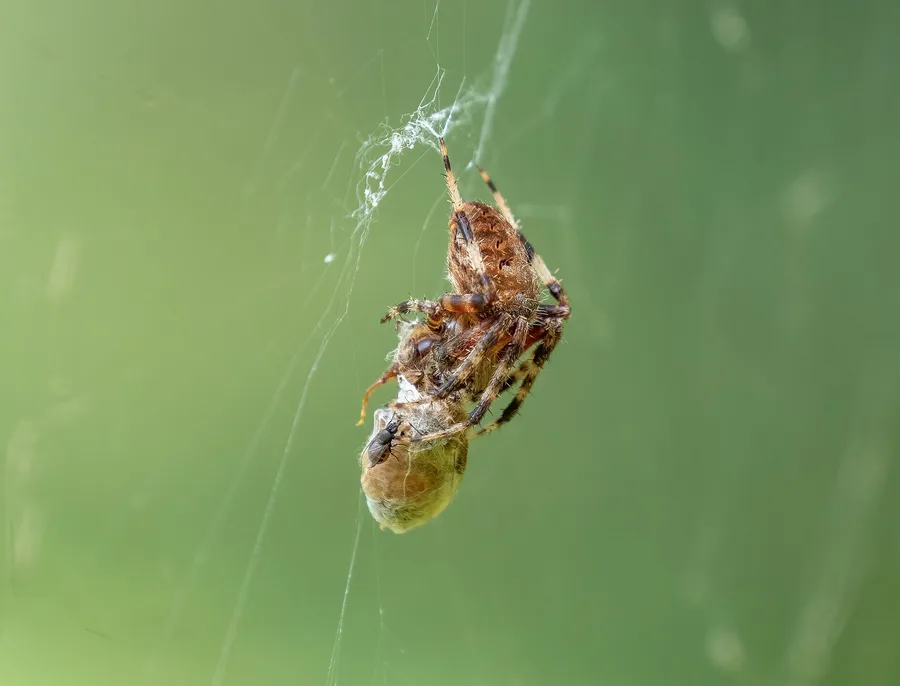
What that means for a pollinator garden is less clear. We found no study that measures how much backyard orb weavers reduce bee numbers, and the same webs also catch flies, mosquitoes, grasshoppers and other plant feeders. Extension services, including Utah State and MDC, treat orb weavers as beneficial. A practical approach:
- Leave most webs alone, especially in borders and beds. A spider that eats a bee now and then is part of the same food web as dragonflies and mantises.
- Move a spider that has set up in a busy spot, such as across a flower patch your bees work hard or near a hive entrance: lift it with a stick or a jar and release it farther away. UGA notes that relocated Joros come back unless they are moved a good distance.
- Do not spray. UGA points out that pyrethroid sprays are toxic to many animals besides spiders, and synthetic pyrethroids carry a high bee-hazard rating in our guide to pollinator-safe pest control. Other honey bee enemies are covered in our guide to bee pests and predators.
Late-blooming flowers draw bees right when orb weavers are biggest, so a few bees in webs in September is normal. Our list of fall-blooming flowers for bees shows what is in bloom then.
Are Orb Weavers Dangerous? Bites and First Aid
“It is unlikely that bites would occur unless people handled a female with an egg sac in the web.”
Every source we reviewed agrees that orb weavers are not dangerous to people:
- Penn State says a bitten person would likely feel no more discomfort than from a wasp or bee sting.
- MDC: orbweavers do not bite unless molested, and their bites are not dangerous.
- The University of Kentucky: many can give a painful bite, but no Kentucky orb weaver is considered dangerous, except to people with severe allergic reactions to insect and spider bites.
- UF/IFAS: the golden silk spider bites only if held or pinched, causing local pain and slight redness that quickly goes away, much less severe than a bee sting.
- UGA: Joro spiders run away and, in its researchers’ experience, do not bite.
If one does bite, wash the spot and watch it. PestWorld, run by the National Pest Management Association, advises medical attention if symptoms keep getting worse for more than 24 hours, and anyone with signs of an allergic reaction, such as trouble breathing or swelling of the face or throat, needs emergency care. The two US spiders that do call for caution, the black widow and the brown recluse, do not build orb webs.
This section is general educational information, not medical advice. For a bite with spreading redness, severe pain or any allergic symptoms, contact a doctor or Poison Control (1-800-222-1222).
Orb Weavers Around the House: Leave, Move or Remove
Orb weavers live outdoors. Around a house, Utah State University Extension says, they turn up in late summer and early fall under porches, overhangs and entryways, in ornamental plantings and near outdoor lights. It calls them a nuisance only because of their webs, considers them beneficial, and suggests these steps to cut down on webs near doors:
- Change outdoor lighting to sodium-vapor bulbs, which draw fewer of the night-flying insects the spiders feed on.
- Seal exterior cracks and crevices where spiders hide by day, and fit tight door sweeps and window screens.
- Vacuum webs off the house, and catch any spider that wanders indoors in a jar and release it outside.
UGA’s advice for Joro spiders is a sensible rule for any orb weaver: remove the ones on or next to porches, walkways, decks and doorways, where walking into a web is inevitable, and leave the ones at the edges of the yard and in shrub beds. For other creatures that turn up around the house, see our garden and household insects guides.
Crane flies often end up in spider webs near porch lights; our crane fly guide explains what they are and why they are harmless.
The messy cobwebs in basement corners belong to cellar spiders, not orb weavers; our daddy long legs guide shows how to identify them.
Frequently Asked Questions
Are orb weaver spiders poisonous?
They are venomous, as nearly all spiders are, but not dangerous to people. Their venom is used on insects, and extension sources describe bites as rare and no worse than a bee sting, except for people with severe allergies.
Do orb weavers bite?
Rarely, and only when pinched, held or pressed against skin. Penn State considers a bite unlikely unless someone handles a female with an egg sac.
What is the biggest orb weaver in the US?
UF/IFAS calls the female golden silk orb-weaver perhaps the largest, at 24 to 40 mm (about 1 to 1.6 inches) long, rivaled by the yellow garden spider and the largest Araneus. The invasive Joro is similar in size, with a body that can exceed 1 inch and legs up to 3 inches.
Why is it called a writing spider?
The yellow garden spider builds a vertical zigzag band of silk, the stabilimentum, into the center of its web, which looks like writing.
What is a pumpkin spider?
Usually the marbled orbweaver, a round, often orange spider seen mostly in fall. The shamrock orbweaver also goes by the name.
Do orb weavers rebuild their web every night?
Many do. Spotted orbweavers eat the web at dawn and spin a new one at dusk. Yellow garden spiders stay at one site and repair or replace their webs, while golden silk orb-weavers keep a semipermanent web and patch it.
How long do orb weavers live?
Most live one year or less. They hatch in spring, mature by late summer and die at the first hard freeze, leaving egg sacs to overwinter.
Where do orb weavers go in winter?
Most adults die in fall; the next generation spends the winter as eggs or tiny spiderlings in silk egg sacs. Some furrow orbweavers overwinter as adults, and southern species such as the spinybacked orbweaver stay active.
Is the banana spider dangerous?
No. A UF/IFAS photo guide notes that the golden silk orb-weaver is commonly called the banana spider because of its yellow body. UF/IFAS says it bites only if held or pinched and the bite is much less severe than a bee sting.
The Bottom Line
An orb weaver in the garden is a harmless, short-lived predator at the end of its single season. Leave it where it is, move it if its web is in the way, and skip the spray. If you find a Joro outside the Southeast, report it with a photo to iNaturalist or your state extension office.
Image credits: Featured image: yellow garden spider by Judy Gallagher, via Wikimedia Commons, CC BY 2.0, cropped and resized. Other photos are credited in their captions: Judy Gallagher and Christina Butler (CC BY 2.0), Rhododendrites and P,TO 19104 (CC BY-SA 4.0), and Chrissy McClarren and Andy Reago (CC0), all via Wikimedia Commons and resized. Charts by BeeKeepersRealm from iNaturalist API data pulled November 22, 2026.