Reviewed by Daniel M. · How we review
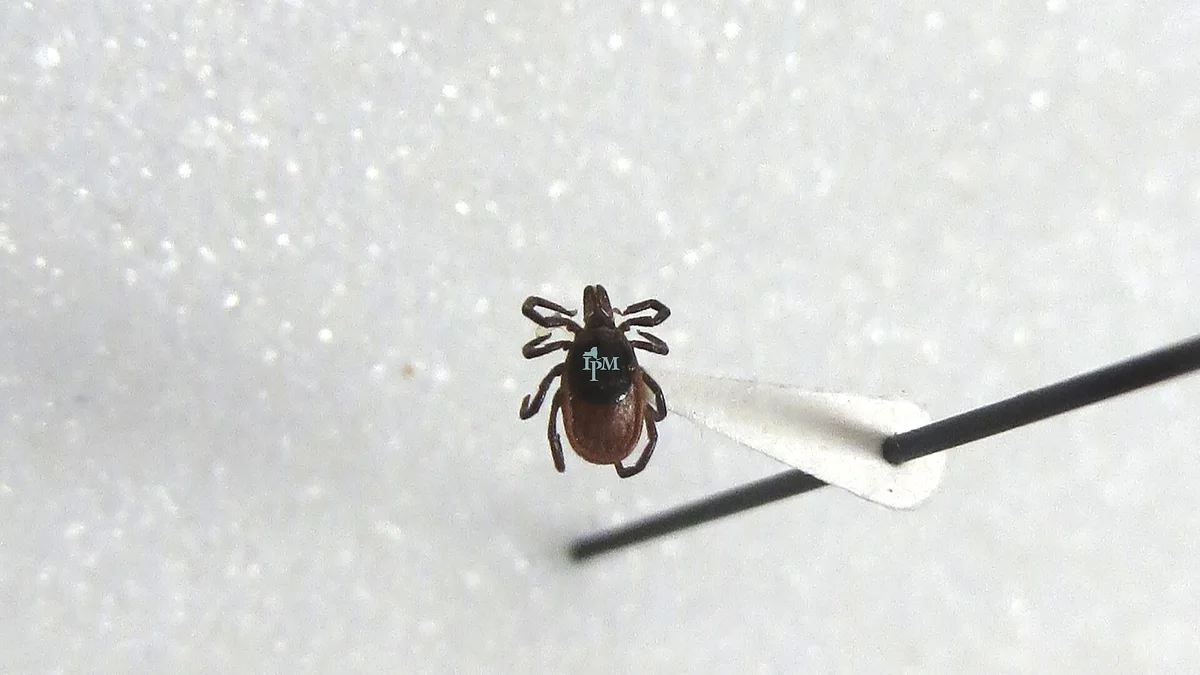
Ticks are small, blood-feeding arachnids, relatives of spiders and mites rather than insects. In the United States, eight kinds do most of the biting: the blacklegged (deer) tick, western blacklegged tick, lone star tick, American dog tick, Rocky Mountain wood tick, brown dog tick, Gulf Coast tick and the invasive Asian longhorned tick. If one is attached to you, remove it now with fine-tipped tweezers, pulling upward with steady, even pressure, and watch for a rash or fever over the next few weeks.
This guide shows how to tell those ticks apart, where and when each one waits for a host, how to remove a tick and when to call a doctor, using the CDC’s own advice. It also includes our count of 59,878 research-grade US tick records on iNaturalist, which shows which ticks Americans actually find and in which months.
Health note: this page is educational information, not medical advice. Disease, symptom and removal statements come from the CDC, MedlinePlus (U.S. National Library of Medicine) and state health departments, each named where we use it. We make no claim of personal experience with tick-borne illness. If you are worried about a bite, talk to a doctor.
Key Takeaways
- Ticks cannot fly or jump. They wait on grass and low shrubs with their front legs held out, a habit the CDC calls questing, and climb on when you brush past.
- To remove one, grasp it as close to the skin as possible with clean, fine-tipped tweezers and pull upward with steady, even pressure. The CDC says not to use petroleum jelly, nail polish or heat.
- See a healthcare provider if you develop a fever, chills, aches or a rash within a few weeks of a tick bite, and say when and where the bite happened.
- For Lyme disease, the CDC says a tick usually has to be attached for more than 24 hours before the bacterium can pass, so a daily tick check pays off.
- In our iNaturalist count, three species make up 79.9% of US tick records: the American dog tick (38.9%), the lone star tick (20.6%) and the blacklegged tick (20.5%).
- Seasons differ by tick. American dog tick and lone star tick records peak in May and almost vanish by October; blacklegged tick records peak in April and again in October and November.
Table of Contents
- Found a Tick on You? How to Remove It
- What Ticks Are and How Their Life Cycle Works
- How to Identify the Ticks That Bite People in the US
- How Big Ticks Are at Each Life Stage
- Which Ticks Americans Find, and When: Our iNaturalist Count
- Where Ticks Wait and How They Find You
- Tick Bite Symptoms and When to See a Doctor
- The Lone Star Tick and Alpha-Gal Syndrome
- How to Prevent Tick Bites
- Tick Checks After Working in the Apiary
- Frequently Asked Questions
Found a Tick on You? How to Remove It
Take it off as soon as you can. MedlinePlus says that if you catch a tick and remove it before it has filled up on your blood, you are less likely to get infected. The CDC’s steps for what to do after a tick bite are short:
- Grasp it low. Use clean, fine-tipped tweezers and take hold of the tick as close to the skin’s surface as possible. If you have no fine-tipped tweezers, regular tweezers or your fingers will do; try not to squeeze the tick’s body.
- Pull upward with steady, even pressure. Don’t twist or jerk, which can leave the mouthparts in the skin. If they break off, take them out with tweezers if that is easy; if not, leave them alone, and the skin usually pushes them out.
- Clean up. Wash the bite and your hands with soap and water, rubbing alcohol or hand sanitizer.
- Check for more. Do a careful tick check of the rest of your body, since there may be other ticks attached.
- Get rid of the tick. Put it in a sealed container, wrap it tightly in tape, flush it down the toilet or drop it in alcohol. Don’t crush it with your fingers.
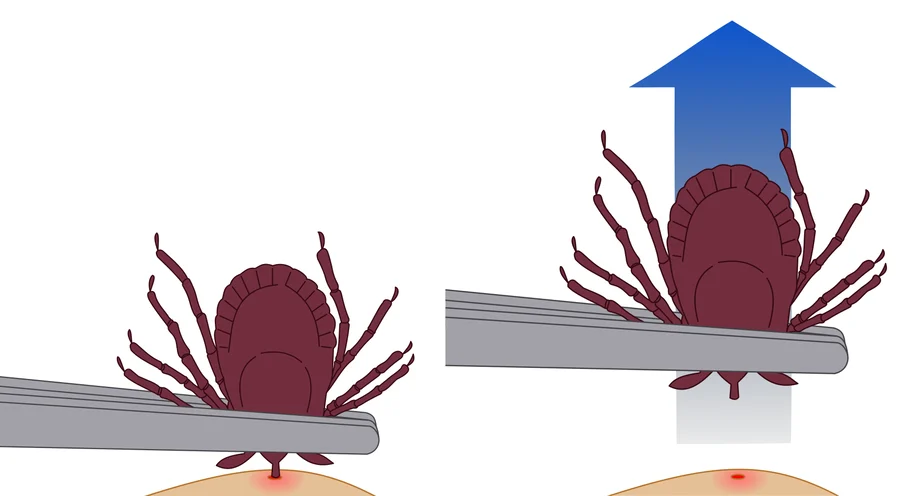
What not to do: the CDC says not to use petroleum jelly, heat, nail polish or other substances to try to make the tick detach. It also advises against relying on a lab test of the tick, because the results should not guide treatment and a negative result can give false reassurance.
Video: In this four-minute Penn State Extension video, entomologist Erika Machtinger shows how to remove an attached tick with fine-tipped tweezers or forceps, pulling straight up slowly and steadily without squeezing the tick’s body. She explains why heat, petroleum jelly and nail polish remover are discouraged, how to dispose of a tick, and what to keep in a small tick removal kit. This summary is from Penn State Extension’s page for the video, which includes its transcript.
To learn which tick it was, photograph it before you dispose of it and compare it with the table below.
What Ticks Are and How Their Life Cycle Works
Ticks belong to the arachnids, with spiders, scorpions and mites. The Illinois Department of Public Health (IDPH) puts the difference simply: adult arachnids have four pairs of legs and no antennae, while adult insects have three pairs of legs and one pair of antennae. Our page on why a bee is an insect and a spider is not walks through the same test, and chiggers, the biting larvae of a group of mites, are the ticks’ closest relatives among the biters we cover.
There are two groups. Hard ticks have a hard shield just behind the mouthparts and, unfed, are shaped like a flat seed; soft ticks lack the shield, look like a large raisin and mostly feed on birds or bats, according to IDPH. Every tick in the identification table below is a hard tick.
A hard tick has four life stages: egg, six-legged larva, eight-legged nymph and adult, and the larva, nymph and adult each take a blood meal (IDPH). Each meal is a chance to pick up a germ from one host and pass it to the next. The CDC says preparing to feed can take from 10 minutes to 2 hours, and a tick may then feed for minutes to days.
How to Identify the Ticks That Bite People in the US
Start with three questions: where were you, how big is the tick, and does it have a mark on its back? The table below combines the CDC’s list of the main human-biting ticks with the field marks given by a state health department and two university tick programs. Size alone is a poor guide, because a fed tick can be several times its unfed length.
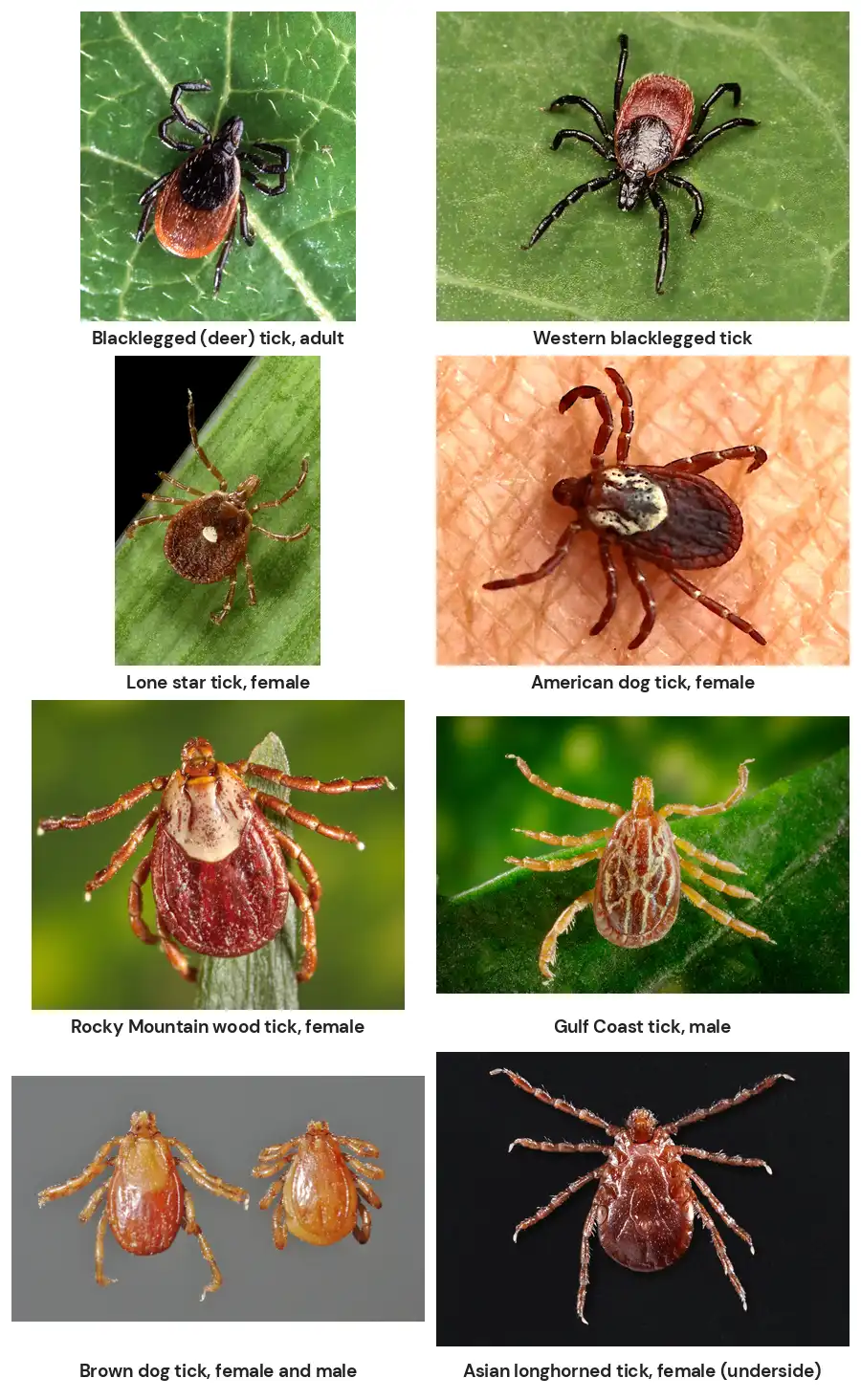
| Tick | Where in the US (CDC) | What to look for (unfed adult) | Germs and illnesses the CDC links to it |
|---|---|---|---|
| Blacklegged (deer) tick, Ixodes scapularis | Widely across the eastern US | About 1/8 inch and reddish-brown (IDPH); unfed females have an orange-red body around a black shield (URI TickEncounter) | Lyme disease, anaplasmosis, babesiosis, hard tick relapsing fever, ehrlichiosis (Ehrlichia muris eauclairensis), Powassan virus disease |
| Western blacklegged tick, Ixodes pacificus | Pacific coast, especially northern California | A close relative of the deer tick (URI TickEncounter) | Anaplasmosis, Lyme disease, hard tick relapsing fever |
| Lone star tick, Amblyomma americanum | Northeast, South and Midwest | About 1/8 inch and brown; the adult female has a white spot in the middle of her back (IDPH, CDC) | Ehrlichiosis, Heartland virus, Bourbon virus, tularemia, the STARI rash; linked to alpha-gal syndrome |
| American dog tick, Dermacentor variabilis (and D. similis) | East of the Rockies; D. similis west of them | About 3/16 inch and reddish-brown; females have a large silver-colored spot behind the head, males fine silver lines (IDPH) | Rocky Mountain spotted fever, tularemia |
| Rocky Mountain wood tick, Dermacentor andersoni | Rocky Mountain states, at about 4,000 to 10,500 feet | Looks much like the American dog tick; telling the two apart generally takes a microscope (URI TickEncounter) | Rocky Mountain spotted fever, Colorado tick fever, tularemia |
| Brown dog tick, Rhipicephalus sanguineus | Worldwide, including the whole US | About 1/8 inch and reddish-brown; feeds on dogs, rarely bites people and can develop indoors in kennels and homes (IDPH) | Rocky Mountain spotted fever in the Southwest and along the US-Mexico border |
| Gulf Coast tick, Amblyomma maculatum | Mainly the Southeast, with pockets in the Northeast, Midwest and Southwest | Can be confused with the American dog tick, but has long, slender mouthparts and a more angular shield (URI TickEncounter) | Rickettsia parkeri rickettsiosis, a form of spotted fever |
| Asian longhorned tick, Haemaphysalis longicornis | Invasive; first reported in the US in 2017 and found in 20 states as of April 2024 | Brown, about 0.1 inch long, with no markings (Penn State Extension); North American populations are all female | No confirmed spread of disease to people in the US so far |
Sources: regions and diseases from the CDC’s Where Ticks Live page (dated July 30, 2025); field marks from the Illinois Department of Public Health, the University of Rhode Island’s TickEncounter program and Penn State Extension. The CDC notes that finding a tick species in an area does not mean it spreads a given disease there.
Two mix-ups come up again and again. IDPH says the lone star tick is sometimes mistaken for the deer tick because the two are so similar in size; the female lone star tick’s single white spot settles it. Male American dog ticks look so different from the females that they are sometimes taken for another species. Ticks shorter than about 1/8 inch are usually immature and harder to identify, IDPH adds, so for those a clear photo sent to your state health department or county extension office is the reliable route.
One name causes its own confusion: deer flies have nothing to do with deer ticks. They are biting flies, covered in our horse fly and deer fly guide.
How Big Ticks Are at Each Life Stage
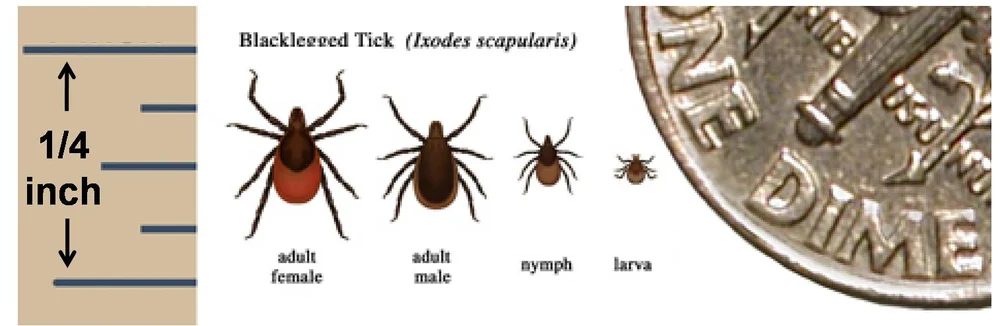
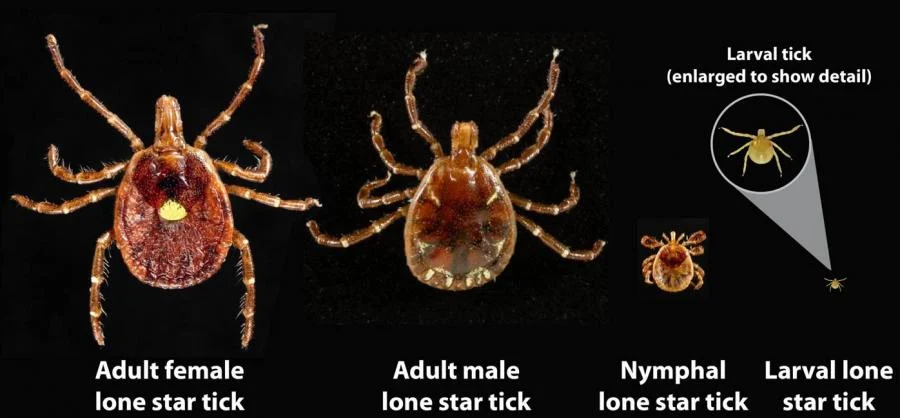
The stage that matters most is also the hardest to see. The CDC describes blacklegged tick nymphs as approximately the size of a poppy seed and says they pose a particularly high risk because of their abundance and small size; from April through July, nymphs are actively questing for hosts. IDPH calls lone star and deer tick nymphs pinhead-sized, and says the lone star larva is only a little larger than the period at the end of a sentence.
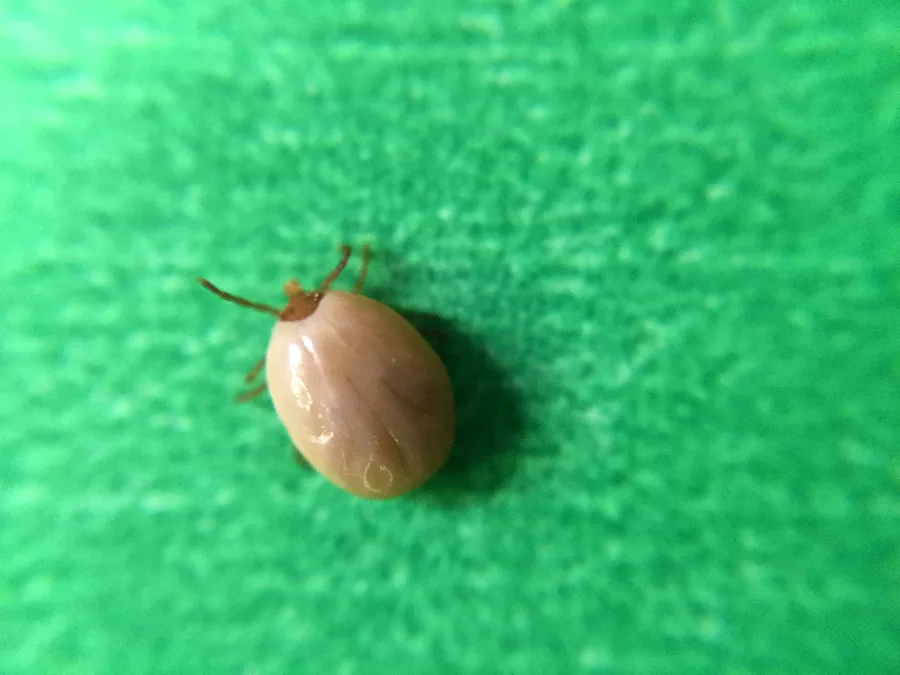
Feeding changes the picture. According to IDPH, an American dog tick female grows from about 3/16 inch to 1/2 inch after feeding, about the size of a small grape, and a fed brown dog tick female can also reach 1/2 inch. She then drops off the dog and crawls into a hiding place, where she may lay as many as 3,000 eggs, which is how this species comes to live inside homes.
Which Ticks Americans Find, and When: Our iNaturalist Count
Surveillance maps show where a species lives, but not which ticks people actually run into, or in which months. To get a picture of that, we pulled every research-grade tick observation in the United States from the iNaturalist API on November 22, 2026: 59,878 records of the order Ixodida, each a dated, located photo whose species the iNaturalist community agreed on.
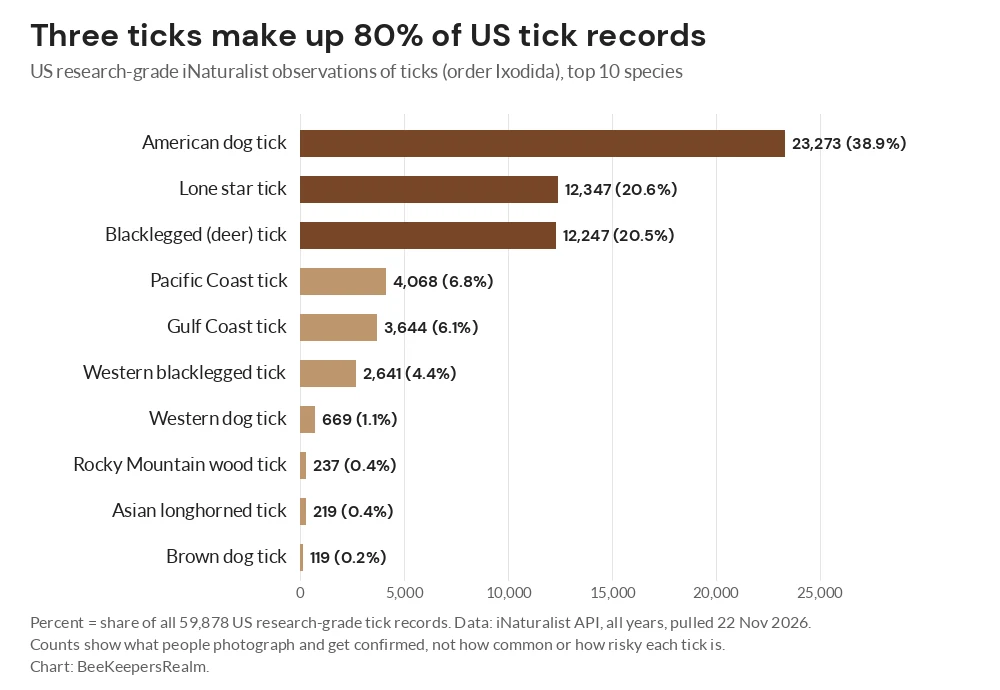
Three ticks account for 79.9% of the records: the American dog tick (23,273, or 38.9%), the lone star tick (12,347, or 20.6%) and the blacklegged tick (12,247, or 20.5%). Next come the Pacific Coast tick (4,068), a western species not on the CDC’s main list that the CDC says can spread Pacific Coast tick fever along the coast of California, Oregon and Washington; the Gulf Coast tick (3,644); and the western blacklegged tick (2,641). The invasive Asian longhorned tick has 219 research-grade records and the brown dog tick only 119, which fits a tick that lives mostly on dogs and indoors rather than out where people take photos.
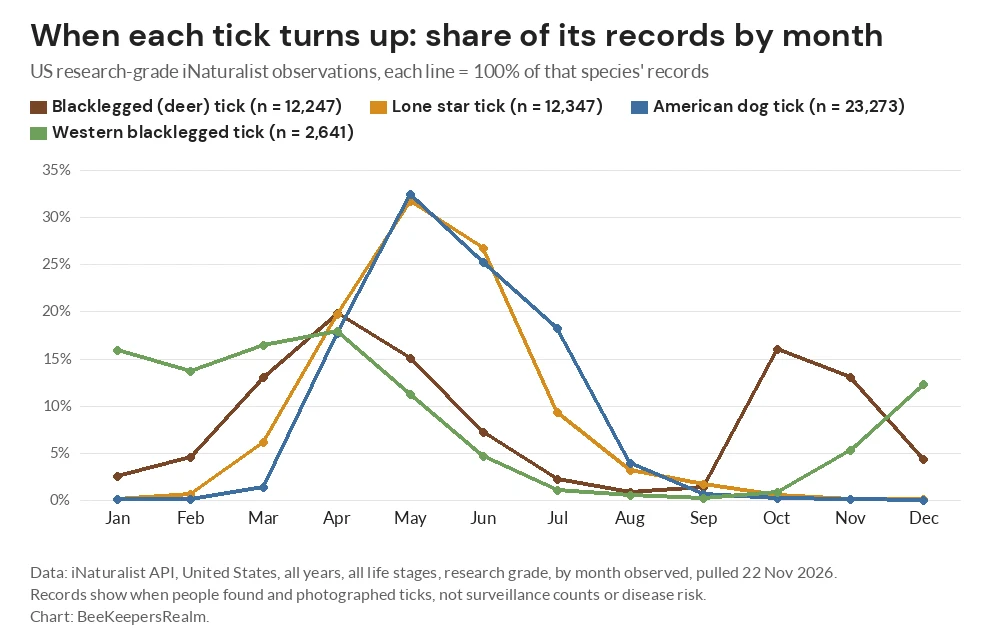
The monthly pattern is where the count earns its place. American dog tick records are concentrated from April through July (93.6% of them), with a May peak, and nearly vanish from October to February (0.5%). Lone star tick records peak in May and June, with 78.1% falling from April through June. The blacklegged tick behaves differently: its records peak in April, drop to a summer low (3.0% in July and August together) and rise again in October (16.0%) and November (13.0%). That fall rise matches the CDC, which says adult blacklegged ticks may look for hosts any time winter temperatures are above freezing, and the University of Rhode Island, which lists adults as active from October to May. The western blacklegged tick is a winter and spring tick: 81.4% of its records fall from November through April.
Two cautions. These are photos people chose to upload, not a survey, so they track when people are outdoors as well as tick activity. And nymphs are easy to miss, so the summer low for blacklegged ticks does not mean summer is safe: the CDC’s nymph season runs from April through July.
Where Ticks Wait and How They Find You
The CDC says ticks live in grassy, brushy or wooded areas, or even on animals, and that ticks can’t fly or jump. Instead, many species quest: they hold the first pair of legs outstretched and wait to climb on to a host. They find that host by detecting breath and body odors, or by sensing body heat, moisture and vibrations, and some species can even recognize a shadow, according to the CDC.
“Ticks wait for host animals from the tips of grasses and shrubs (not from trees).”
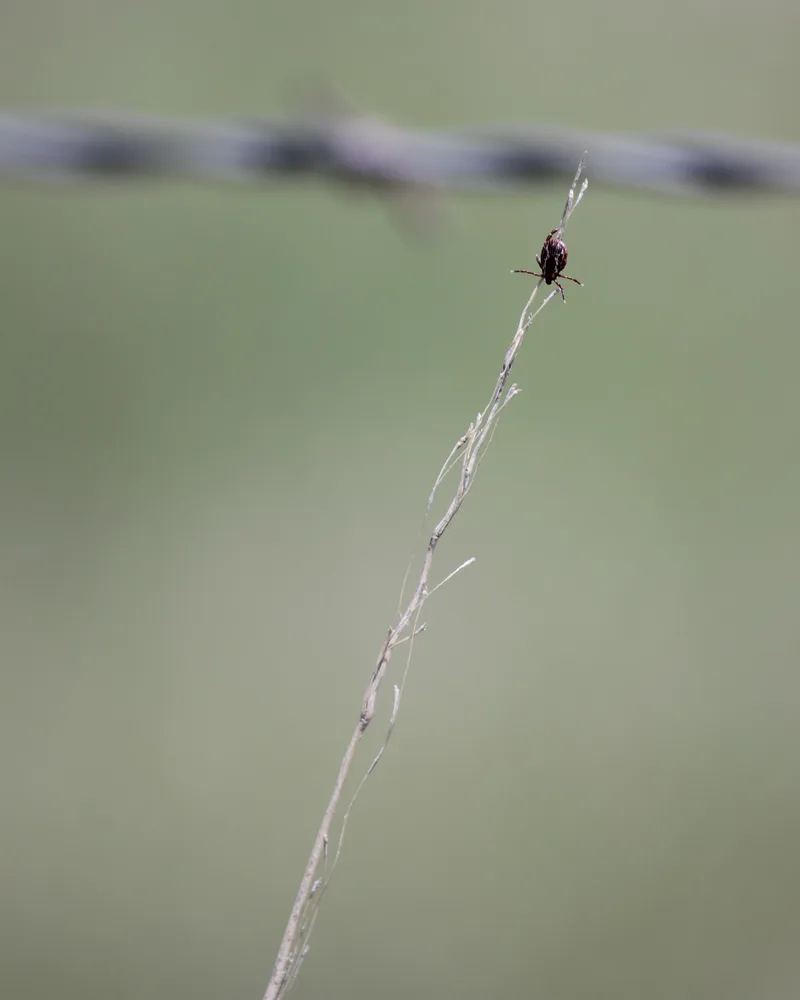
So a tick found on the scalp usually did not drop from a branch. IDPH says ticks on the scalp have usually crawled there from lower parts of the body, and the University of Rhode Island’s TickEncounter notes that adult American dog ticks commonly climb to the crown of the head. Adult blacklegged and Rocky Mountain wood ticks quest about knee-high on the tips of low vegetation, according to URI, and IDPH adds that ticks can be active on winter days when ground temperatures are about 45°F.
Tick Bite Symptoms and When to See a Doctor
A tick bite itself is easy to miss, because tick saliva has anesthetic properties and a tick in a sheltered spot can go unnoticed (CDC). The signs to watch for come later. The CDC lists fever and chills, which all tick-borne diseases can cause; aches and pains such as headache, fatigue and muscle aches, plus joint pain with Lyme disease; and rashes, which can be distinctive with Lyme disease, STARI, Rocky Mountain spotted fever, ehrlichiosis and tularemia.
“If you develop any of these symptoms within several weeks of removing a tick, contact your provider.”
The CDC adds that you should tell the doctor about the recent bite, when it happened and where you most likely picked up the tick, since the region shapes which illnesses are possible. Redness right at the bite is not always infection: the CDC notes that lone star tick saliva can be irritating, so redness at the site does not necessarily mean an infection.
Tick paralysis is a rare effect that shows up while the tick is still attached: the CDC says it is thought to come from a toxin in tick saliva, that weakness can spread upward through the body, and that patients typically regain movement within 24 hours of the tick being removed.
For Lyme disease, the CDC’s page on how Lyme disease spreads says that in most cases a tick must be attached for more than 24 hours before the bacterium can be transmitted. That window is specific to Lyme disease, so remove any tick promptly. Treatment is a decision for your doctor; this page gives no treatment or dosage advice.
Not every blood-feeder behaves like a tick. A kissing bug’s meal can take several minutes, but it does not attach the way a tick does, as our kissing bug guide explains, citing Texas A&M.
The Lone Star Tick and Alpha-Gal Syndrome
The CDC describes the lone star tick as very aggressive toward humans and says nymphs and adult females most often bite people. It also reports growing evidence that a lone star tick bite may trigger alpha-gal syndrome, a red meat allergy. Our separate lone star tick guide covers the species and alpha-gal syndrome in more depth.
How to Prevent Tick Bites
The CDC’s tick bite prevention steps apply wherever you live:
- Know where ticks are. Avoid wooded and brushy areas with high grass and leaf litter, and walk in the center of trails.
- Use an EPA-registered repellent. The CDC lists products containing DEET, picaridin, IR3535, oil of lemon eucalyptus (OLE), para-menthane-diol (PMD) or 2-undecanone. Look for the EPA registration number on the label and follow the product instructions.
- Treat clothing, not skin, with permethrin. The CDC recommends treating boots, clothing and gear with products containing 0.5% permethrin. NIOSH, the CDC’s workplace safety institute, says permethrin should not be used on skin.
- Check your body. Look under the arms, in and around the ears, inside the belly button, behind the knees, in and around the hair, between the legs and around the waist.
- Shower soon. Showering within two hours of coming indoors has been shown to reduce the risk of Lyme disease, the CDC says.
- Dry your clothes hot. Tumble dry clothes on high heat for 10 minutes to kill ticks on dry clothing; damp clothes may need longer, and a cold or medium-temperature wash will not kill ticks.
- Check pets and gear. Ticks can ride indoors on pets, coats and daypacks and attach to a person later.
Ask your veterinarian about tick prevention for dogs and cats. If you keep bees, our guide to bees and pets notes that scented flea and tick treatments can carry the same floral notes that draw bees to flowers. Many of the same repellents are also used against mosquitoes, which our mosquito guide covers.
Tick Checks After Working in the Apiary
Beekeepers spend a lot of time where ticks quest. Many apiaries sit at field edges, along fence lines or at the margin of woods, and mowing around hives, wading through uncut grass to reach an outyard or kneeling to lift a heavy box all put legs and knees at questing height. We found no source saying ticks harm honey bees; the risk here is to the beekeeper.
Protective clothing helps if it is worn the way health agencies describe. NIOSH advises outdoor workers to wear a hat and light-colored clothing, with long sleeves and long pants tucked into boots or socks, and IDPH notes that ticks are easier to spot on light-colored clothing. A pale bee suit or jacket with closed cuffs fits that advice; our bee suit vs jacket comparison covers the options.
One caution is specific to beekeepers. NPIC, the National Pesticide Information Center, says permethrin is highly toxic to bees. For that reason we would not treat a bee suit, veil, gloves or anything else that touches hives or bees with permethrin, and we suggest relying instead on tucked cuffs, light colors and the checks below. A routine built from CDC and NIOSH advice:
- Before you take your suit off, look over the outside for crawling ticks, especially the legs and cuffs.
- Put work clothes in the dryer on high heat when you get home.
- Shower within two hours and do a full tick check, including your hair, underarms and groin.
- Keep fine-tipped tweezers in the apiary kit; our list of what belongs in a beekeeper’s first aid kit is a good place to add them.
Tick checks fit into the wider routine in our guide to beekeeping safety for beginners.
Frequently Asked Questions
Are ticks harmful to humans?
They can be. In the US, ticks spread illnesses such as Lyme disease, anaplasmosis, babesiosis, ehrlichiosis, Rocky Mountain spotted fever and tularemia, and a lone star tick bite may trigger alpha-gal syndrome (CDC). Removing a tick promptly and watching for fever or a rash over the following weeks are the key steps.
What kills ticks immediately?
For clothing, the CDC says tumble drying on high heat for 10 minutes kills ticks on dry clothes. For a tick you have removed, the CDC’s disposal options include dropping it in alcohol or flushing it down the toilet. Don’t crush it with your fingers.
What attracts ticks to humans?
Breath, body odors, body heat, moisture and vibrations, according to the CDC; some species can even recognize a shadow.
What is the difference between a tick and a bed bug?
Bed bugs are insects, so adults have six legs, and they are an indoor pest of beds and furniture. Ticks are eight-legged arachnids usually picked up outdoors in grass and brush, and they stay attached while feeding, from minutes to days depending on the species (CDC).
Do ticks jump, fly or fall from trees?
None of the three. Ticks can only crawl, IDPH says, and they wait on the tips of grasses and shrubs, not trees.
How long does a tick stay attached?
It depends on the species and stage: the CDC says ticks feed for anywhere from minutes to days. URI TickEncounter reports that female Rocky Mountain wood ticks feed for 4 to 17 days before dropping off. Most ticks drop off after feeding to molt into the next stage.
Are ticks active in winter?
Some are. Adult blacklegged ticks may seek hosts any time winter temperatures are above freezing (CDC), and in our count 81.4% of western blacklegged tick records fall between November and April.
What does a tick bite look like?
Often there is little to see, because the bite is usually painless and the tick may still be attached. The CDC notes that redness at a lone star tick bite can come from irritating saliva rather than infection. A rash or fever in the days to weeks after a bite is the sign to see a doctor.
The Bottom Line
Learn the three ticks you are most likely to meet in your region, check yourself after every walk through tall grass, and keep fine-tipped tweezers where you can find them. If a fever or rash follows a bite, call your doctor and mention the tick.
Image credits: featured photo of a blacklegged tick by the NY State IPM Program at Cornell University, Wikimedia Commons, CC BY 2.0, cropped to 16:9 and resized. Other photos and diagrams are credited in their captions, with links to each file page and licence. Charts by BeeKeepersRealm from iNaturalist API data pulled November 2026.