Reviewed by Sofia T. · How we review
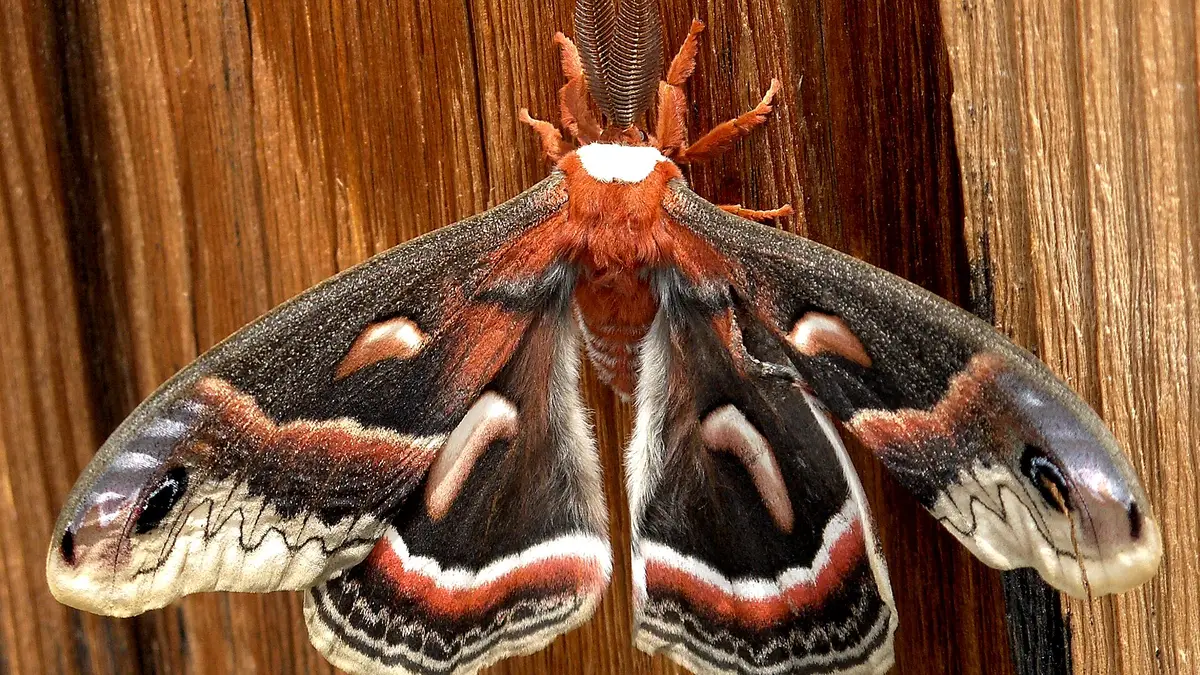
The cecropia moth (Hyalophora cecropia) is North America’s largest native moth, a giant silk moth with a wingspan of about 5 to 6 inches, dark brown wings with white and red crescent marks, and a red body with a white collar. Adults have no working mouthparts, never eat and live about two weeks. Its bluish green caterpillar grows to about 4 inches long, studded with red, yellow and blue knobs, then spins a large brown cocoon on a twig, where it spends the winter. It is harmless to people and does little harm to trees.
This guide covers identification, every life stage from egg to cocoon, what to do with a cocoon you find this winter, host trees, range, the parasitic fly linked to its decline, and look-alikes. It draws on extension, agency and peer-reviewed sources plus our own count of 12,959 US iNaturalist records. We make no claim of personal field experience with this moth.
Key Takeaways
- Size estimates differ by source, from 3¾ to 6 inches (Missouri Department of Conservation) to 5 to 7 inches (National Park Service). Either way it is the biggest native moth on the continent.
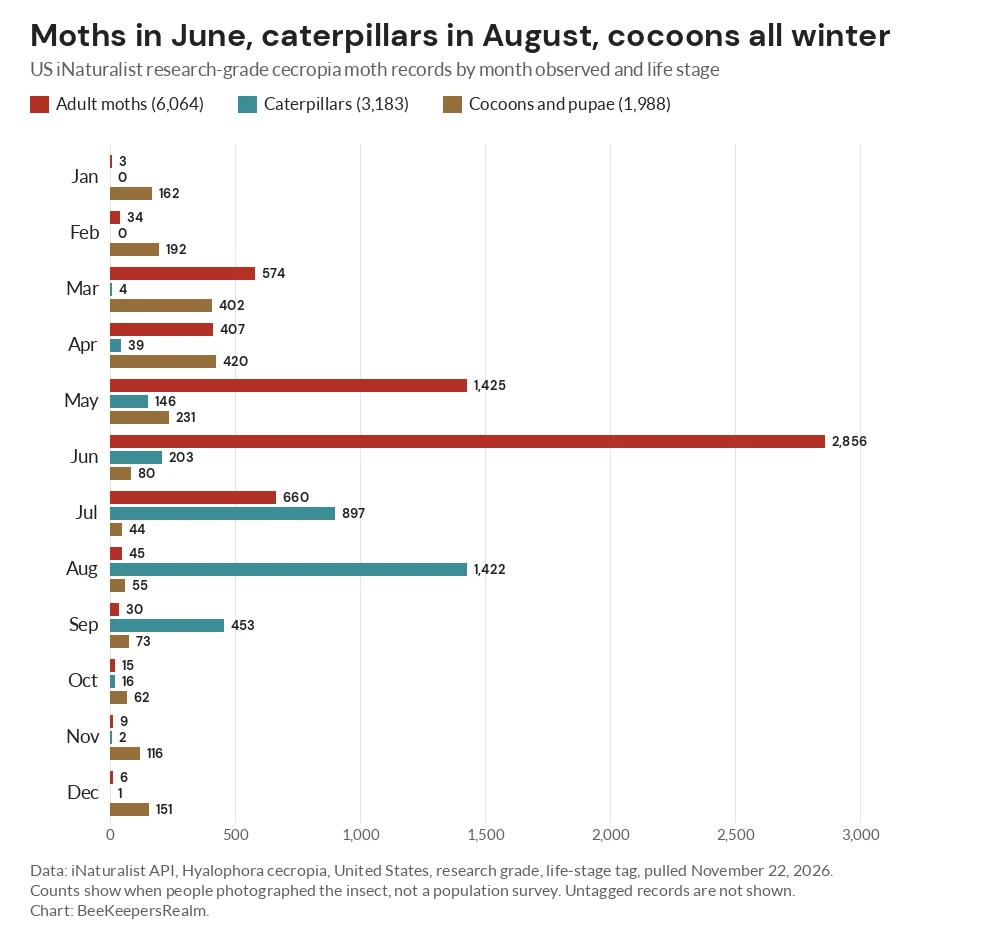
- There is one generation a year. In our iNaturalist count, 70.6% of adult sightings fall in May and June, 72.9% of caterpillar sightings in July and August, and 72.6% of cocoon sightings between November and April.
- If you find a cocoon on a bare twig, leave it outdoors. Iowa State University says cocoons belong in the winter environment until late April, not inside the house.
- A fly brought in to fight the spongy moth caused 81% of early caterpillar deaths in a 1990s Massachusetts study, but a 2017 to 2018 repeat at the same site found far less parasitism, 19% and then 3%.
- Cecropias do not pollinate, bite or sting, and the caterpillars rarely do noticeable damage. No spraying is needed.
Table of Contents
- How to Identify a Cecropia Moth
- Cecropia Life Cycle: Egg, Caterpillar, Cocoon and Moth
- When to See Each Stage: Our iNaturalist Count
- Found a Cecropia Cocoon? What to Do
- What Cecropia Caterpillars Eat
- Where Cecropia Moths Live
- Are Cecropia Moths Declining?
- Cecropia vs Columbia, Polyphemus and Other Silk Moths
- Porch Lights, Pollinators and Your Yard
- Frequently Asked Questions
How to Identify a Cecropia Moth
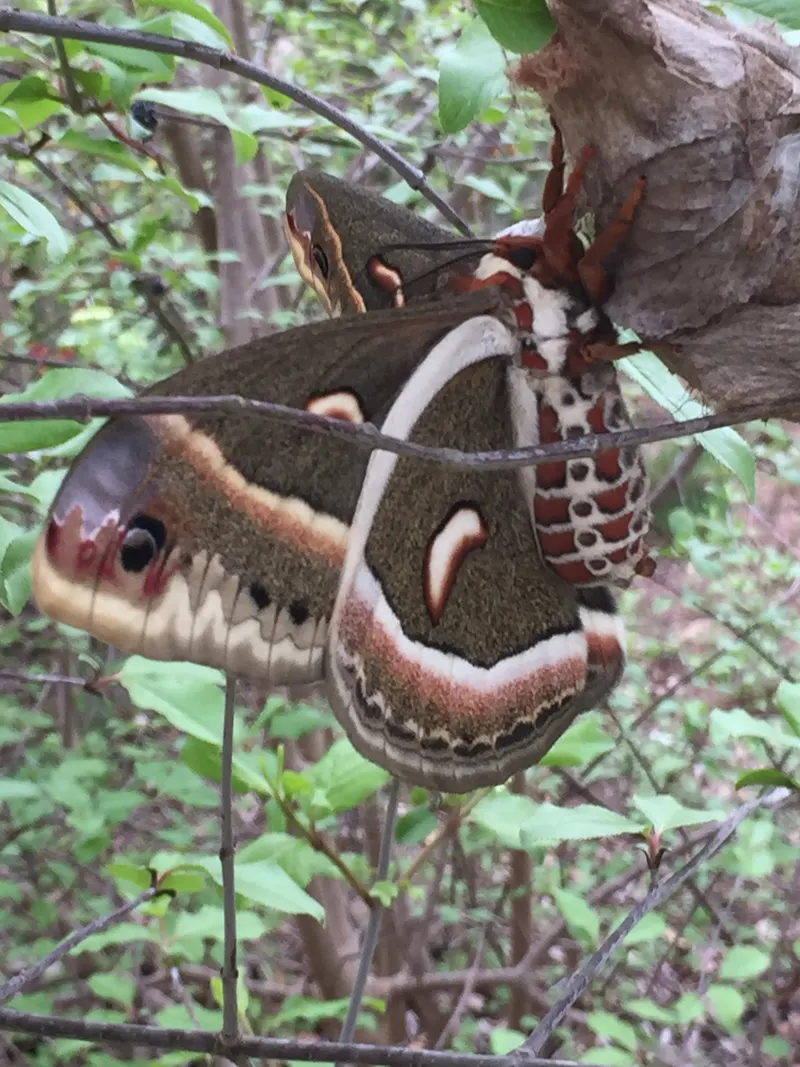
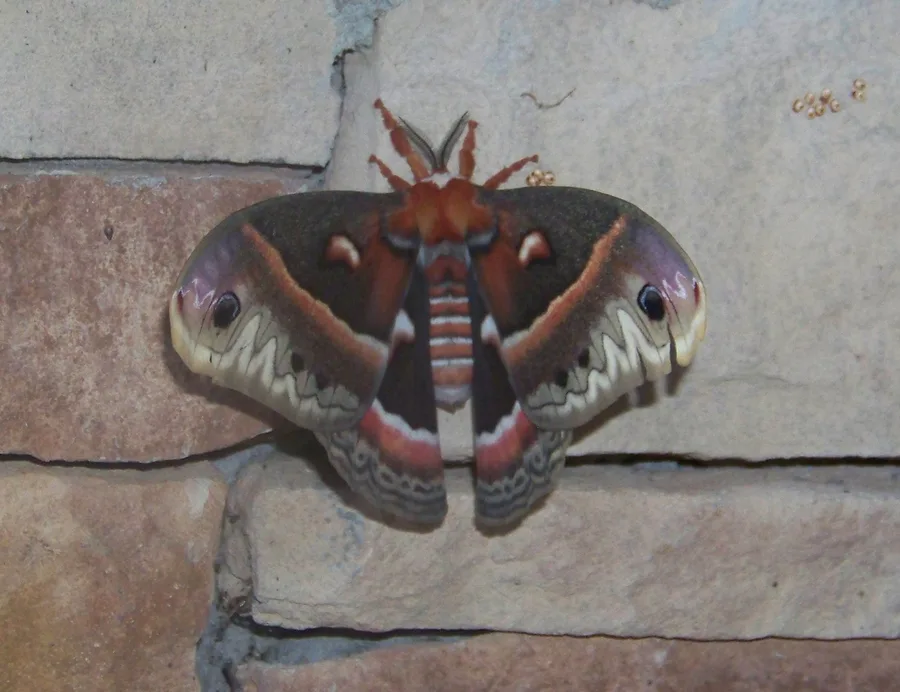
The cecropia belongs to Saturniidae, the giant silk moth family, and is also called the cecropia silk moth or robin moth. The Missouri Department of Conservation (MDC) describes adults as butterfly-like, with stout, hairy bodies and feathery antennae. Check four features:
- Body: red, with a white collar behind the head and white bands across the abdomen.
- Wings: dark brown or grey, frosted with pale scales, with a reddish patch at the base of each forewing.
- Crescents: a crescent-shaped spot in the middle of each of the four wings. MDC describes it as whitish and BAMONA as red, so expect white and red together.
- Bands and eyespots: a pale band crosses all four wings with red beyond it, and Iowa State University Extension notes black spots near the outer tips of the forewings. The National Park Service (NPS) says these wingtip eyespots resemble a snake’s head.
How big is a cecropia moth?
NPS, the University of Maine and other sources call it North America’s largest native moth, but the numbers vary. Females are the larger sex, and the figures below are ranges reported by each source, not one survey.
| Source | Wingspan given |
|---|---|
| Missouri Department of Conservation field guide | 3¾ to 6 inches |
| Butterflies and Moths of North America (BAMONA) | 4 5/16 to 5 7/8 inches (11 to 15 cm) |
| NC State Extension | Up to 6 inches |
| Mississippi State University Extension | Six inches or more |
| University of Maine Cooperative Extension | Over 6.2 inches documented |
| National Park Service | 5 to 7 inches |
The other stages are big too. Iowa State calls the caterpillar the largest larva found in Iowa, about 4 inches long and nearly ¾ inch thick, and the cocoon about 4 to 5 inches long.
Male vs female
Look at the antennae. Males have much broader, feathery antennae, which Mississippi State University Extension says they use to smell the female’s pheromones from more than a mile away. Females have narrower antennae.
Cecropia Life Cycle: Egg, Caterpillar, Cocoon and Moth
Cecropias go through complete metamorphosis, and every source we read agrees there is one generation a year. NC State Extension says they overwinter as pupae in cocoons attached to the twigs of the trees they fed on. The table gathers what each stage looks like and when you are likely to see it.
| Stage | When (most of the US) | What to look for | Source |
|---|---|---|---|
| Egg | Late spring to early summer; hatches in 10 to 14 days | Mottled brown, in rows of 2 to 6 on both sides of host leaves; about 100 per female | BAMONA, NC State, NPS |
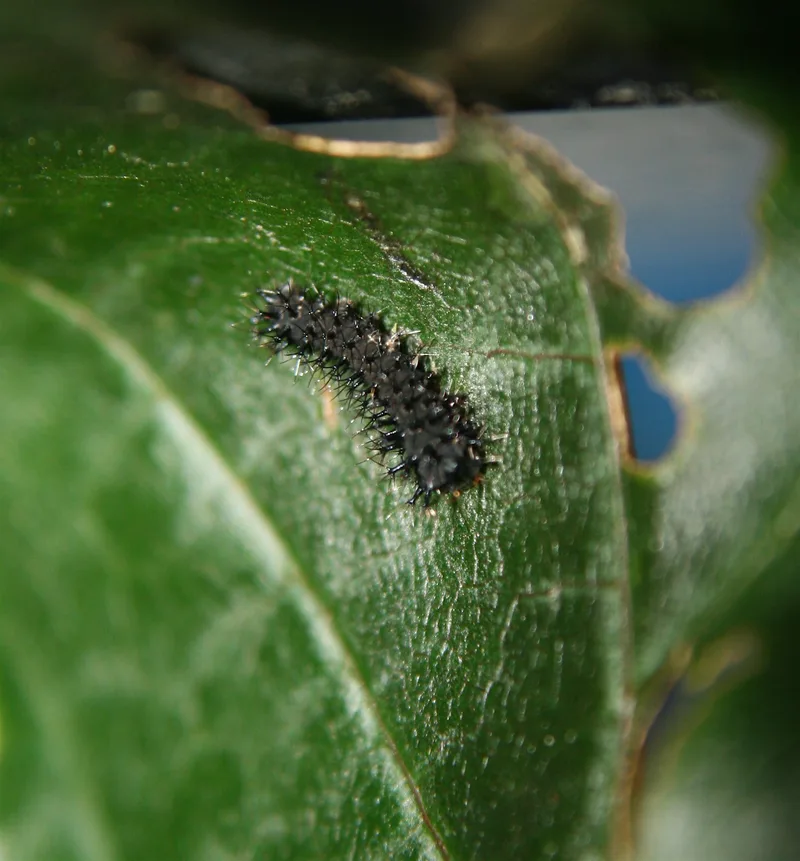
| Young caterpillar (first instar) | Early summer | Tiny, black and spiny; young caterpillars feed in groups | NC State, BAMONA |
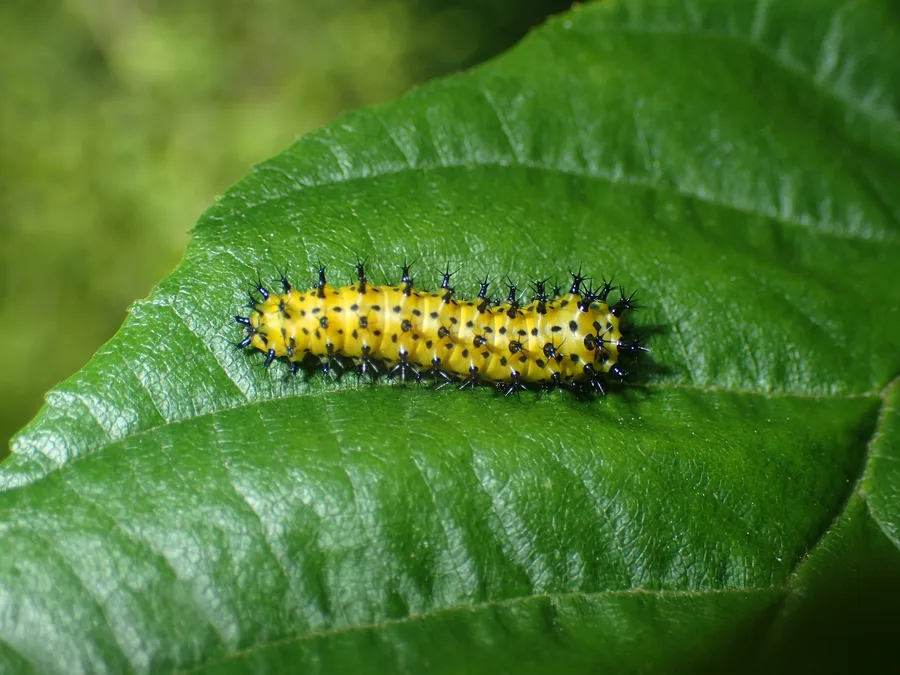
| Middle instars | Early to midsummer | Yellow to pale green with black-spined knobs; older caterpillars feed alone | NPS, BAMONA |
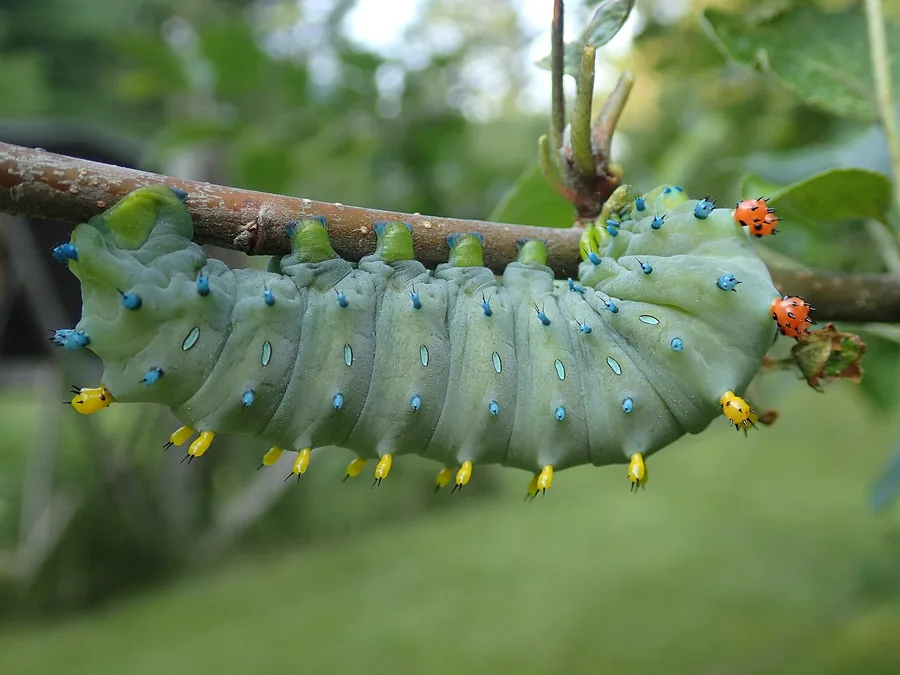
| Last instar | Late summer | Bluish green, about 4 inches; four red-orange knobs behind the head, yellow knobs along the back, blue knobs along the sides | MDC, Iowa State, NC State |
| Cocoon and pupa | Spun in August or early September; occupied all winter | Brown or grey, pointed at both ends, 4 to 5 inches long, fixed along its full length to a twig | NPS, Iowa State, BAMONA, Mississippi State |
| Adult | Emerges in spring or early summer; lives about 2 weeks | Red body, dark wings with red-rimmed white crescents; does not feed | MDC, NC State |
Sources count the caterpillar stages differently. NPS describes four instar stages that turn from black to yellow to green, while the Wikipedia article, citing a University of Florida fact sheet, describes five instars of about a week each. Mississippi State notes that body color shifts with age and with how recently the caterpillar has molted, so color alone will not tell you the exact instar. Either way, the caterpillar takes about two months to reach full size, according to Mississippi State and Iowa State.
Why adult cecropias never eat
The winged moth lives only on the fat it stored as a caterpillar. MDC says adult mouthparts are small or absent, and BAMONA lists the adult food simply as none.
“Adult moths don’t have a gut nor working mouthparts, and cannot eat.”
That leaves about two weeks to mate and lay eggs. Soon after emerging, a female releases a scent (pheromone), and NPS says males can detect it from over a mile and possibly as far as three miles away.
Watch a cecropia spin its cocoon
This time-lapse from The Caterpillar Lab in New Hampshire follows a cecropia caterpillar spinning its large, double-layered cocoon overnight. Near the end the caterpillar appears to coat the silk with a liquid that dries and stains the cocoon brown, and the Lab’s own description asks whether that color comes from the silk itself or from something else the caterpillar produces. This summary is from the video’s published description.
When to See Each Stage: Our iNaturalist Count
To check the seasons with fresh data, we pulled every research-grade cecropia moth observation in the United States from the iNaturalist API on November 22, 2026: 12,959 records. Of these, 6,064 were tagged as adults, 3,183 as caterpillars, 1,988 as cocoons or pupae and 27 as eggs.
- Adults: June alone holds 47.1% of adult sightings, and May and June together 70.6%.
- Caterpillars: August holds 44.7%, and July and August together 72.9%.
- Cocoons: 72.6% of cocoon and pupa records (1,443 of 1,988) fall between November and April. That is when leaves are off and cocoons stand out on bare twigs, so it says as much about when people can see them as about the insect.
A single generation still means different dates in different places. We split the adult records into three latitude bands across the eastern two thirds of the country and counted them by week. In the south band (30 to 36°N, 1,137 adults), the busiest week falls in the third week of March, and 80% of sightings run from about mid-March to early June. In the north band (41 to 49.5°N, 2,753 adults), the busiest week is the first week of June, and 80% of sightings fall between late May and early July. The middle band (36 to 41°N, 1,840 adults) runs from early May to early July, with its peak in late June.
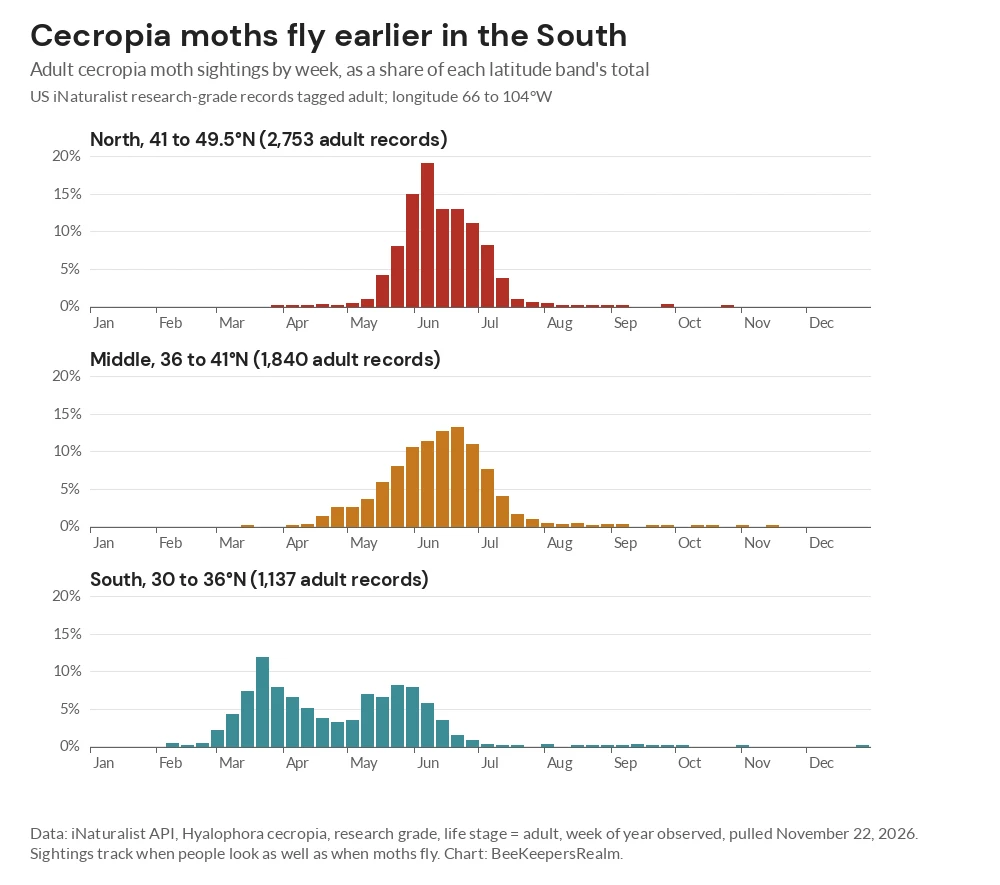
BAMONA describes one flight from March to July over most of the range and two flights in the Midwest a couple of weeks apart. Keep the limits in mind: iNaturalist counts when people photograph moths, and recent years dominate. 2026 added 2,263 US records, against 223 in 2017. Your own photos help; see our guide to citizen science programs for pollinators.
Found a Cecropia Cocoon? What to Do
Winter is the season to find one. Look for a brown or grey spindle about the length of your hand, wrapped lengthwise along a twig or small branch, on a shrub or young tree with its leaves gone. The Vermont Center for Ecostudies (VCE) says cocoons are often in dark, protected spots, and Mississippi State adds that some are built in grass and leaf litter at the base of host trees.
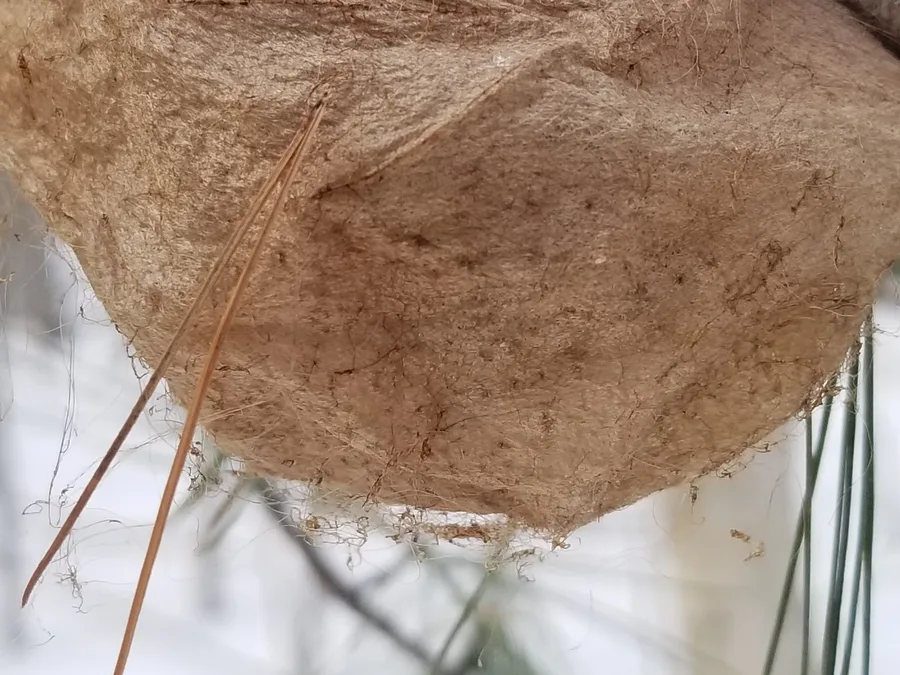
There are two kinds. A 2017 study in PLoS One by Patrick Guerra and Steven Reppert describes cocoons that are either large and fluffy (baggy) or much smaller and tightly woven (compact). In their Massachusetts sample, 58% were baggy, and they cite earlier work finding that over 99% of cocoons in Midwestern successional urban habitats were compact. VCE suggests where to search for the baggy kind: at the base of isolated cherry and apple trees along fences and roadsides.
The advice from extension entomologists is to leave it alone:
“Cocoons that are raised or discovered outside should be left in the winter environment until late April.”
- Leave it on the twig if it is safe where it is. The pupa inside needs winter cold.
- If you must move it, for example from a branch you are pruning, Iowa State says it can be stored in a garage or unheated porch but should not be kept in the house through the winter. Our suggestion: keep it on its twig.
- Do not expect every cocoon to hatch. Iowa State reports that often fewer than half of cecropia cocoons produce a moth, and Guerra and Reppert found 45% of the cocoons they collected were parasitized.
- Record it. A photo with the date and place on iNaturalist adds to the cocoon records in our chart.
Before winter pruning of fruit trees, maples or shrubs, check the bare branches. Wikipedia’s account of the species lists tree pruning among the things that can harm cecropias, and an overwintering cocoon is easy to cut off without noticing.
What Cecropia Caterpillars Eat
Cecropia caterpillars are generalists. MDC says they eat more than 20 Missouri tree and shrub species, and NC State says they have been found on plants in more than 20 families, mainly birch, cherry and maple.
- Most often named: maples including box elder, wild cherries and plums, apple and crabapple, birch, willow, dogwood and lilac (MDC, Iowa State, BAMONA).
- Also listed: walnut, elm, poplar (Iowa State); ash, beech, white oak, serviceberry, hawthorn, basswood, spruce and Virginia creeper in Vermont (VCE).
Mississippi State describes them as feeders on non-oak hardwoods, though NPS lists oaks among the hosts and VCE lists white oak in Vermont, so oak use seems to vary by region. Box elder also feeds the boxelder bug, and several cecropia hosts, such as red maple, willows and wild cherry, are early spring forage for bees, as our list of nectar trees for bees shows.
Damage is rarely an issue. Iowa State says no control is needed: the caterpillars usually occur in widely scattered, low numbers, and significant defoliation is very unlikely except on very small, newly transplanted plants. NC State agrees no control seems to be needed. If you treat a garden for other caterpillar pests, remember that caterpillar products such as Bt (Bacillus thuringiensis) cannot tell a pest from a silk moth; our pollinator-safe pest control guide explains how to target treatments. The caterpillars and moths are harmless to people and pets, Iowa State adds.
Where Cecropia Moths Live
BAMONA gives the range as Nova Scotia and Maine south to Florida, and west across southern Canada and the eastern United States to the Rocky Mountains. BAMONA lists its habitat as successional habitats in many areas, including urban and suburban environments.
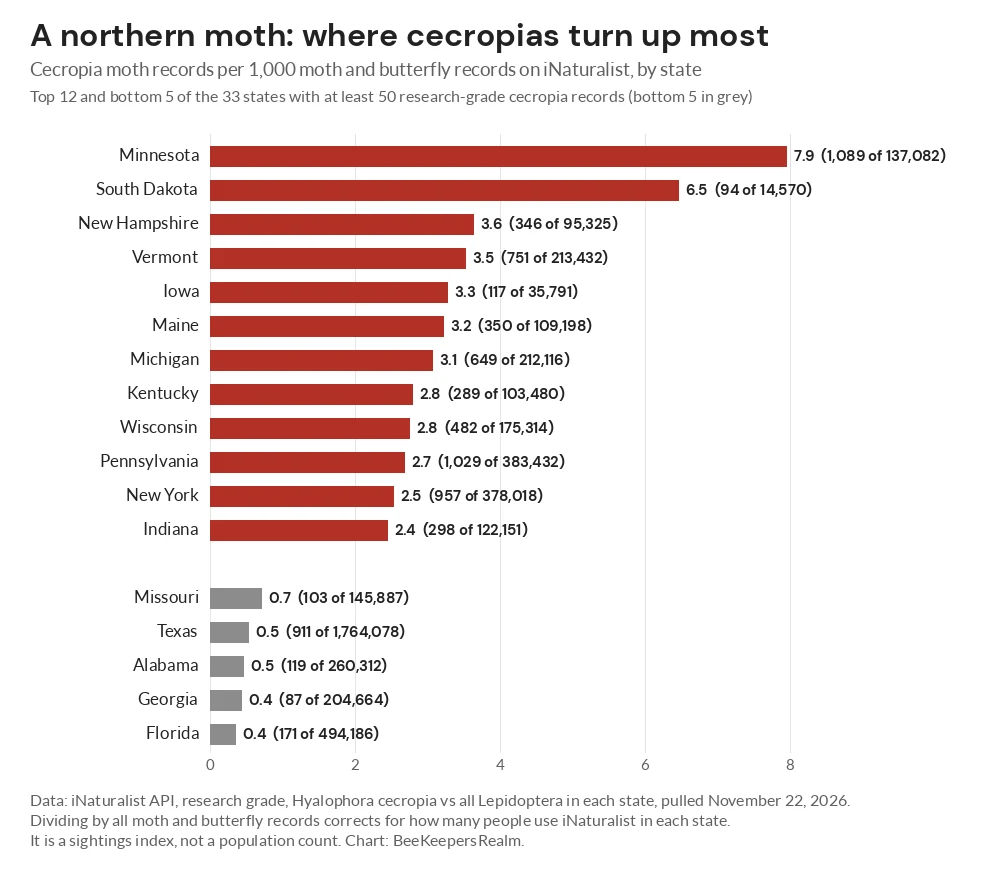
Raw iNaturalist counts mostly reflect how many people use the app in each state, so we divided each state’s cecropia records by all of its research-grade moth and butterfly records. Among the 33 states with at least 50 research-grade cecropia records, the moth turns up most often in the Upper Midwest and northern New England: Minnesota leads at 7.9 per 1,000 (1,089 records), followed by South Dakota (6.5), New Hampshire (3.6), Vermont (3.5) and Iowa (3.3). Deep South states sit at the bottom, with Florida lowest at 0.35 per 1,000.
The West is a different story. We found no research-grade US records at all from Washington, Oregon, California, Nevada, Utah, Idaho, Arizona, Alaska or Hawaii, and only a handful from Colorado, New Mexico and Wyoming. There, the related Ceanothus silk moth (Hyalophora euryalus) takes over; BAMONA gives its range as British Columbia to Baja California.
Are Cecropia Moths Declining?
The species as a whole is secure. BAMONA ranks it G5, demonstrably secure globally, though it may be quite rare in parts of its range. Locally the picture is weaker: VCE lists it as S3, vulnerable, in Vermont, and Mississippi State describes a notable decline in these and other large moths over past decades.
“The reasons for this decline are still being debated.”
The leading suspect is Compsilura concinnata, a tachinid fly released in North America from 1906 to 1986 to control the gypsy moth (now called the spongy moth) and other pests. It attacks many native caterpillars, not just its targets.
- The 1990s study: Boettner, Elkinton and Boettner (2000, Conservation Biology) placed 500 newly hatched cecropia caterpillars in a Massachusetts forest in 1997. None survived beyond the fifth instar, and the fly was responsible for 81% of deaths in the first three instars.
- The repeat: Baranowski and colleagues (2019, Agricultural and Forest Entomology) repeated the experiment with the same species, site and season. The fly parasitized 19% of cecropia caterpillars in 2017 and 3% in 2018, according to the published abstract.
Two field seasons at one site cannot show a national trend, but the newer numbers suggest the pressure from this fly has eased, at least in that Massachusetts forest. None of the top-ranking cecropia pages we read give either study’s figures.
Other pressures are well documented. Guerra and Reppert list habitat loss, pesticides, mercury-vapor lights and parasitism as causes of a substantial decrease in cecropia and other silk moths since the 1950s. MDC adds that several parasite species limit numbers and that squirrels eat the pupae, and Guerra and Reppert cite a study in which birds attacked more than 85% of compact cocoons on urban saplings. Parasitoid wasps play a part too; our guide to braconid wasps explains how these parasites use caterpillars as hosts.
Cecropia vs Columbia, Polyphemus and Other Silk Moths
The cecropia’s red body, red-rimmed crescents and size are distinctive. Its closest look-alikes are its own relatives in the genus Hyalophora.
| Species | Wingspan | How to tell it apart | Where (US) |
|---|---|---|---|
| Cecropia (Hyalophora cecropia) | 4 5/16 to 5 7/8 in | Crescent spots and the area outside the pale band are red on all wings | East of the Rockies |
| Columbia silk moth (Hyalophora columbia), including Glover’s silk moth | 3 1/8 to 3 15/16 in | Grey area outside the white band has no red; crescents white | Northern Great Lakes states (eastern form, on larch); Rocky Mountain states south to Texas (Glover’s) |
| Ceanothus silk moth (Hyalophora euryalus) | 3.5 to 5 in | Red to brownish red wings, red outside narrow white lines; comma-shaped hindwing spot | West Coast to western Montana |
| Polyphemus (Antheraea polyphemus) | 3 15/16 to 5 7/8 in | Tan to reddish brown; large clear eyespot ringed yellow, blue and black on each hindwing | Every state except Arizona and Nevada |
| Luna (Actias luna) | About 3 to 4½ in | Pale green with long hindwing tails | Eastern US |
Wingspans and markings are from BAMONA species pages, except luna, from the sources in our luna moth guide. BAMONA now treats Glover’s silk moth as a subspecies of the Columbia (H. c. gloveri), while iNaturalist still lists it as a separate species, Hyalophora gloveri. Where ranges meet the moths can interbreed: iNaturalist lists a handful of cecropia × Glover’s and cecropia × Columbia hybrid records.
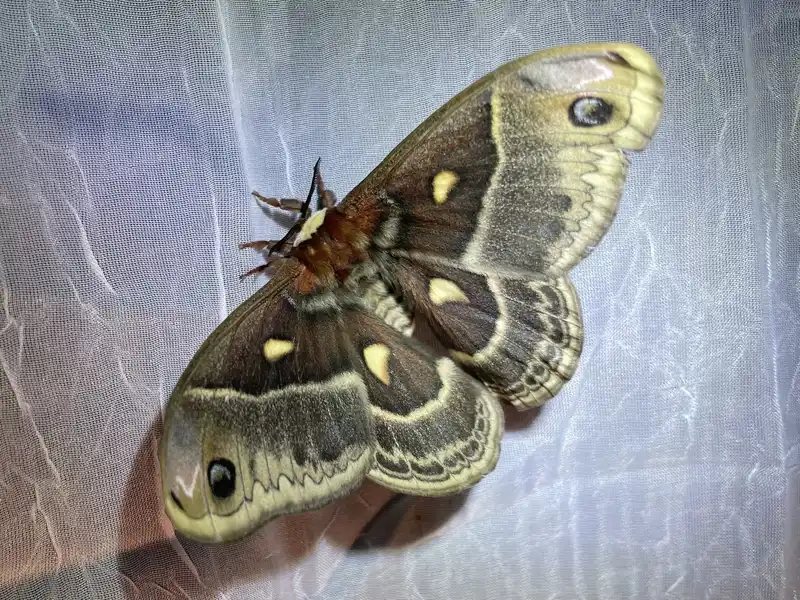
The giant silk moth family
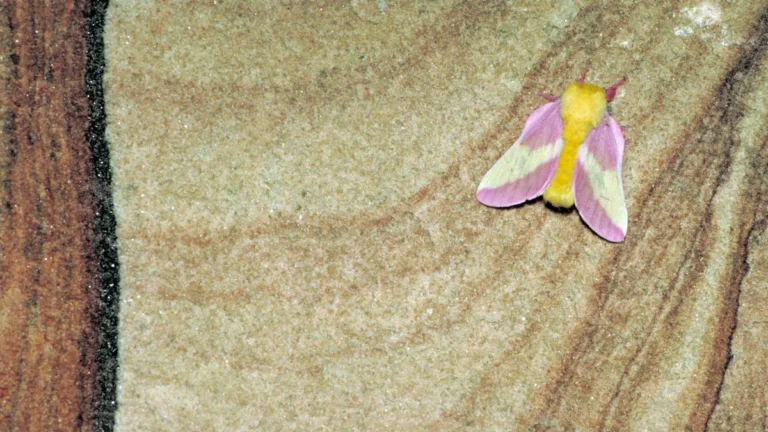
“Silk moth” usually means a member of Saturniidae, the family that includes the cecropia. In the US the best known are the pale green luna moth, the small pink and yellow rosy maple moth, the polyphemus, the promethea and the Io, whose caterpillar has stinging spines. Like the cecropia, luna and rosy maple moth adults do not feed, live only briefly and grow from caterpillars that eat tree leaves. They are not the domesticated silkworm, which belongs to a different family.
Porch Lights, Pollinators and Your Yard
Cecropias are not pollinators. Adults have no working mouthparts, so they never visit flowers. Many other moths do pollinate at night, and a moon garden for moths is the way to plant for them. For a moth you will see on flowers by day, see our hummingbird moth guide.
What helps cecropias is simpler:
- Keep host trees and shrubs, especially native cherries, maples, birches, willows and dogwoods.
- Turn off lights you do not need from April to July. Guerra and Reppert name mercury-vapor lights among the causes of decline, and Wikipedia notes that leaving outdoor lights on at night can harm cecropias. Our suggestion, not a tested rule: use shielded, warm-toned and motion-triggered lights near trees.
- Check before you prune in winter, and leave cocoons in place.
- Skip broad caterpillar sprays. The caterpillars are harmless, and Iowa State says no control is needed.
Beekeepers can relax about this one. A cecropia resting on a hive is just using a convenient wall, since the adults cannot eat. The moths that matter in an apiary are wax moths, covered in our guide to stopping wax moth infestations.
Another native moth winters very differently: the woolly bear caterpillar spends the cold months as a caterpillar that partly freezes and thaws again.
The polyphemus moth is the most widespread large silk moth in the lower 48 states; its tan to reddish brown wings have a clear, see-through eyespot in each hindwing.
Frequently Asked Questions
Is the cecropia moth rare?
Not globally. BAMONA ranks it G5, secure, and US iNaturalist users logged 2,263 research-grade records in 2026 alone. It can be uncommon locally: Vermont lists it as vulnerable (S3), and Mississippi State reports a decline in large moths over past decades.
Are cecropia moths poisonous or dangerous?
No. Iowa State says the caterpillars and moths are harmless to people and pets. Adults cannot bite, and no source we read describes the caterpillar’s knobs as stinging. Handle any insect gently and wash your hands afterward.
How long do cecropia moths live?
About two weeks as winged adults, according to MDC and NC State. The full cycle takes a year: roughly two weeks as an egg, about two months as a caterpillar, and the rest of the year, through winter, as a pupa in its cocoon.
What does a cecropia caterpillar turn into?
The big bluish green caterpillar with red, yellow and blue knobs becomes the cecropia moth. It spins a cocoon in late summer, spends the winter inside as a pupa and emerges as an adult the next spring or early summer.
Can I keep a cecropia cocoon inside over winter?
Iowa State advises against it. Keep cocoons outdoors, or in a garage or unheated porch if they must be moved, until late April.
Where does the name cecropia come from?
MDC says it comes from Cecrops, a king of Athens in Greek mythology. The species was named by Carl Linnaeus in 1758.
Why is the cecropia moth important to science?
MDC notes that the 1956 discovery of juvenile hormone, which controls insect development, was made using cecropia larvae, work Wikipedia credits to Carroll Williams. Cecropins, immune proteins found in most insects, were first isolated from this species and named after it.
How many generations do cecropia moths have?
One a year, according to NC State, MDC and Mississippi State. BAMONA notes two flights a couple of weeks apart in the Midwest, and our iNaturalist count shows southern moths flying weeks earlier than northern ones.
Next Step
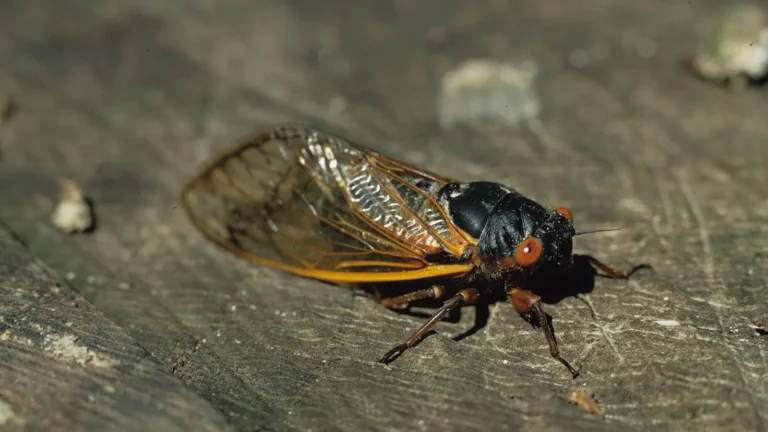
If you spot a cecropia cocoon on a bare twig this winter, photograph it, leave it in place and check back in late spring for the empty exit hole. For other insects US gardeners ask about, see our guides to the praying mantis and the cicada. This page is educational wildlife information, not pest-control advice.
Sources
- National Park Service, “Species Spotlight: Cecropia Moth” (last updated September 9, 2021)
- Iowa State University Extension and Outreach, Yard and Garden encyclopedia, “Cecropia Moth” (first published September 12, 2016)
- Butterflies and Moths of North America, Hyalophora cecropia species page, plus the Hyalophora columbia, Hyalophora euryalus and Antheraea polyphemus pages
- Blake Layton, Mississippi State University Extension, “Cecropia Moth Caterpillar,” Bug’s Eye View Vol. 5 No. 20 (2019)
- Baranowski AK, Conroy C, Boettner GH, Elkinton JS, Preisser EL, “Reduced Compsilura concinnata parasitism of New England saturniid larvae,” Agricultural and Forest Entomology 21(3): 346-349 (2019)
- Boettner GH, Elkinton JS, Boettner CJ, “Effects of a biological control introduction on three nontarget native species of saturniid moths,” Conservation Biology 14: 1798-1806 (2000), read via the Conservation Evidence study summary
- Guerra PA, Reppert SM, “Dimorphic cocoons of the cecropia moth (Hyalophora cecropia): morphological, behavioral, and biophysical differences,” PLoS One 12(3): e0174023 (2017)
- Missouri Department of Conservation, Cecropia Moth field guide; James Baker, NC State Extension, “Cecropia Moth” (revised 2019); University of Maine Cooperative Extension, Home and Garden IPM, “Cecropia Moth”; Vermont Center for Ecostudies, Vermont Atlas of Life, “Cecropia Silkmoth”; Geoffrey R. Gallice, University of Florida EENY 478 (2010) title page; The Caterpillar Lab, “Cecropia Caterpillar Spins its Cocoon” (YouTube, May 30, 2017); Wikipedia, “Hyalophora cecropia” (read November 22, 2026)
- iNaturalist research-grade observations of Hyalophora cecropia and of all Lepidoptera in the United States, via the iNaturalist API, pulled November 22, 2026
Image credits: featured photo of a cecropia moth on barn siding in New York by John Sweeney, via Wikimedia Commons, CC BY-SA 3.0, cropped to 16:9 and resized. Other photo credits are in each caption. Charts are by BeeKeepersRealm from iNaturalist data.