Reviewed by Sofia T. · How we review
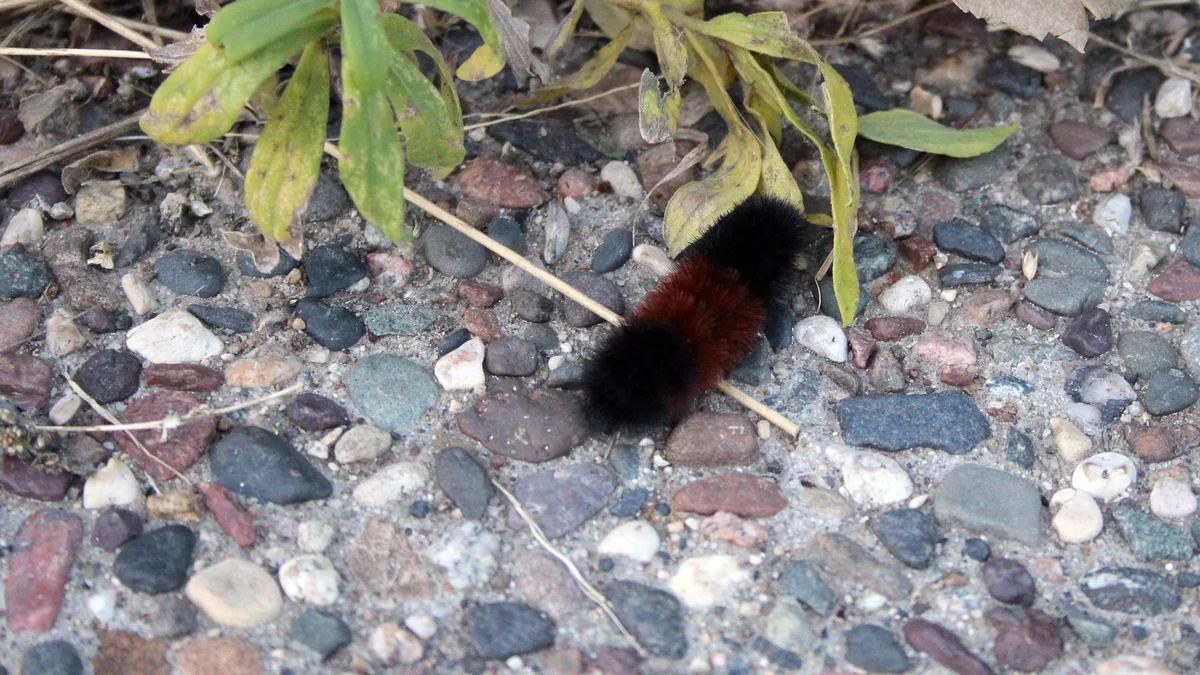
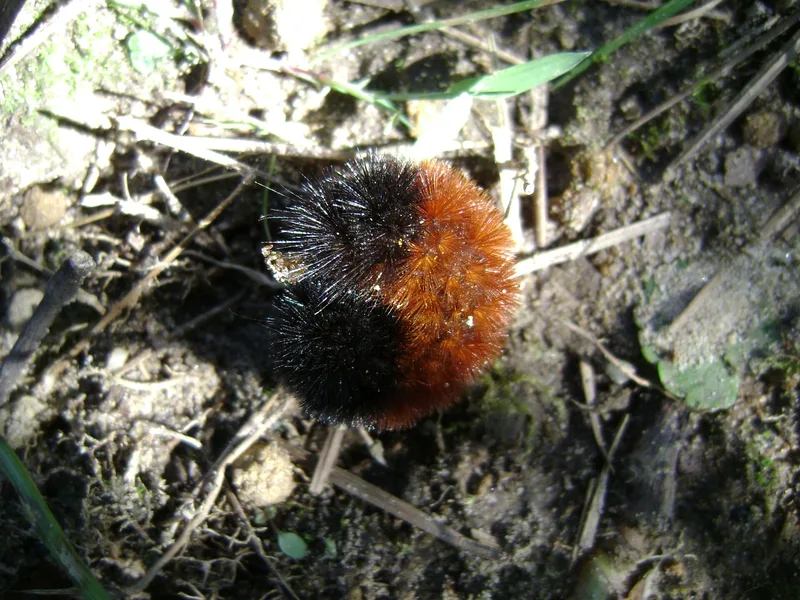
The woolly bear caterpillar is the fuzzy, black-ended, rust-banded larva of the Isabella tiger moth (Pyrrharctia isabella), a native moth found throughout North America except northern Canada and Alaska. It feeds on common weeds such as plantain and dandelion, spends the winter as a caterpillar that partly freezes and thaws again, and turns into a plain yellow-orange moth in spring. Its bands do not forecast the winter. They mostly show how old the caterpillar is and how well it grew.
This guide covers how to identify a woolly bear, what the bands really mean, what the famous 1948 “study” actually was, the life cycle, how it survives freezing, whether it is safe to touch and which fuzzy look-alikes do sting. It draws on extension, agency and peer-reviewed sources plus our own count of 82,960 US iNaturalist records. We make no claim of personal field experience with this caterpillar.
Key Takeaways
- The rust band widens as the caterpillar grows and molts, so a rustier woolly bear is usually an older one. Iowa State University ties band width to age and to moisture where it grew, not to the coming winter.
- The weather legend went national after one day at Bear Mountain, New York, in October 1948: Time magazine reported that 15 caterpillars averaged five and one-third brown segments.
- In our iNaturalist count, 73.3% of US woolly bear records fall in September to November (42.1% in October alone), while 86.8% of adult moth records fall in May to August.
- Woolly bears survive winter by letting part of their body water freeze outside their cells, protected by glycerol. Lab caterpillars survived a week frozen at -4°F (-20°C) after cold conditioning; the often-repeated “-90°F” figure could not be traced to a published measurement.
- The hairs do not sting or carry venom, but they can irritate skin, and doctors have reported two young children who needed hospital care after putting one in their mouths. The fuzzy puss caterpillar, by contrast, gives a severe sting.
Table of Contents
- How to Identify a Woolly Bear Caterpillar
- What the Bands Really Tell You
- The 1948 Bear Mountain “Study”
- Woolly Bear Life Cycle and Generations
- When to See Woolly Bears: Our iNaturalist Count
- How Woolly Bears Survive Being Frozen
- What Woolly Bears Eat
- Can You Touch a Woolly Bear?
- Woolly Bear Look-Alikes, Including Ones That Sting
- Woolly Bears in Your Yard
- Frequently Asked Questions
How to Identify a Woolly Bear Caterpillar
The banded woolly bear belongs to the tiger moth subfamily (Arctiinae) of the family Erebidae. The University of Arkansas Arthropod Museum describes its body as three thoracic and ten abdominal segments, each ringed by tufts of stiff, barbed hairs called setae. Look for four things:
- Color pattern: black at both ends and reddish brown in the middle. In mature caterpillars, typically four to six middle segments carry the rusty hairs, according to the Arthropod Museum.
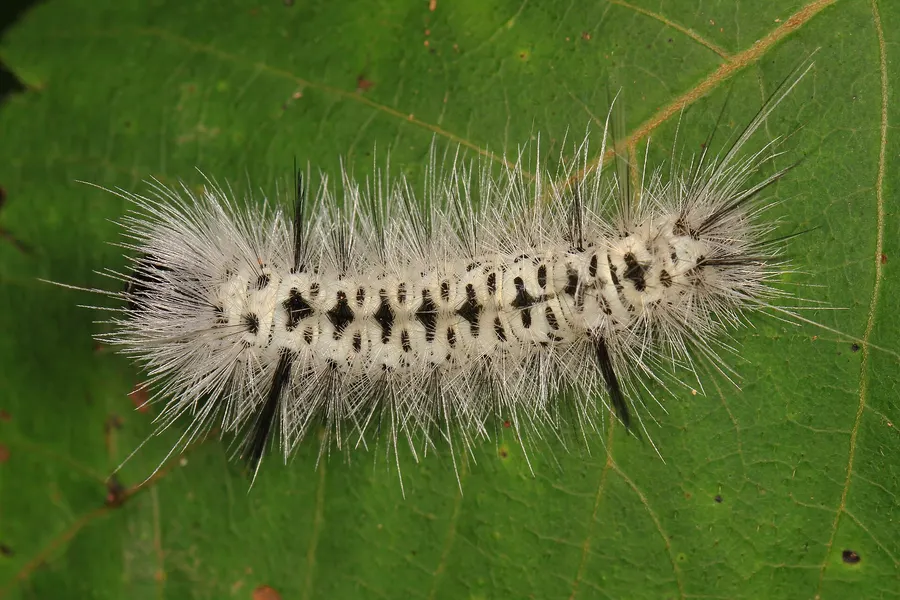
- Stiff, bristly coat: the hairs are stiff and spread evenly along the body, unlike the long tufts and “pencils” of the hickory tussock caterpillar or the soft, uneven hairs of the yellow woolly bear (see look-alikes).
- Size: a little over an inch (NC State Extension) to about 1½ inches (University of Arkansas) when full grown.
- Behavior: when picked up or disturbed, it curls into a tight bristly ball and plays dead, which is why the National Weather Service (NWS) notes another name, “hedgehog caterpillar.”
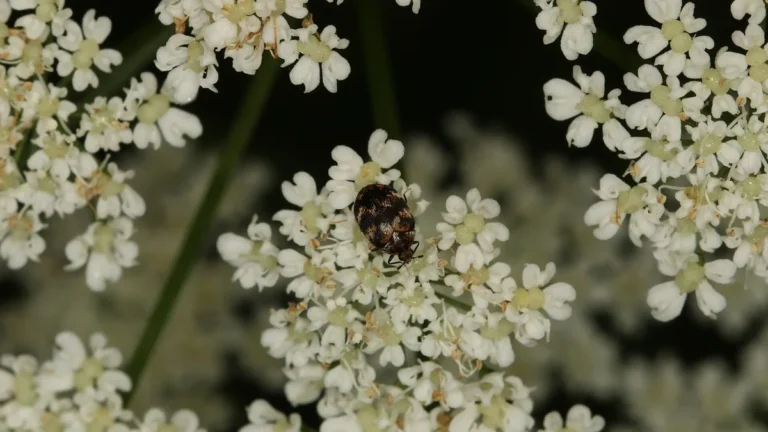
Banding varies a lot. The Arthropod Museum notes that some can appear entirely black or entirely rust colored. Iowa State University adds that 8 or more US species could fairly be called woolly bears because of their bristly coats, so not every fuzzy caterpillar is this one. The name is also used for the tiny larvae of carpet beetles that chew wool and fabric, which are a different insect altogether.
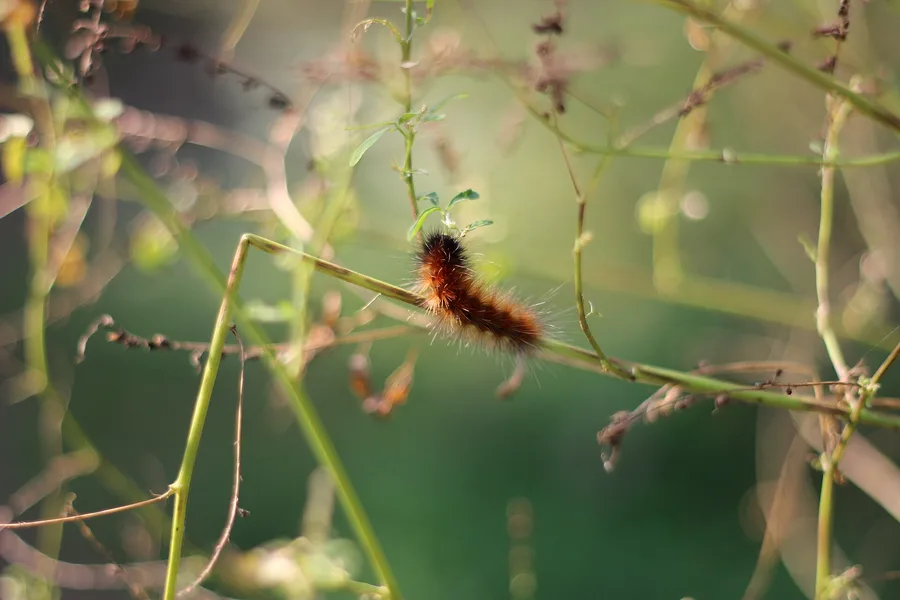
Woolly bear, woolly worm or wooly bear?
They are the same caterpillar. NWS says it is called the woolly worm in the southern United States, and NC State lists weatherworm, black-ended bear and fuzzy wuzzy as other folk names. Both “woolly” and “wooly” spellings are common. It is a caterpillar, not a worm.
What the Bands Really Tell You
The folklore, as NWS La Crosse summarizes it, says the more black a woolly bear shows in autumn, the longer and harsher the winter, and the wider the brown middle band, the milder the winter. Some versions read the 13 body segments as the 13 weeks of winter, treat a dark head end as a hard early winter and a dark tail end as a cold finish, or watch which way the caterpillar crawls.
The biology points elsewhere. Young woolly bears are mostly black, and each molt adds rust.
“As the caterpillars grow, black hairs are replaced with orange hairs so that the rusty red band is widest in mature banded woollybears.”
Other factors pile on. Iowa State entomologists link the amount of black to the caterpillar’s age and to moisture where it developed, and MDC notes that wetter than average weather tends to cause longer black bands. Ohio State University Extension adds food sources, and the Wikipedia species article notes that caterpillars hatched from a single clutch of eggs can already differ a lot in banding. NWS La Crosse puts it plainly: band width reflects the current or past season’s growth, not the severity of the winter ahead. A caterpillar with a wide rust band in October is usually telling you it is older or had a good summer.
No one has shown that the bands work as a forecast. National Geographic reports that scientists who looked failed to find any link between banding and the coming weather, though most of that work was more tongue-in-cheek than serious. Katie Marshall, a comparative physiologist at the University of British Columbia who studies cold tolerance, told National Geographic in 2023:
“I hate to be a spoilsport but there’s just never been a really clear set of data that says, ‘Yes, this is absolutely the case.'”
The 1948 Bear Mountain “Study”
The legend dates back to colonial American folklore, but one entomologist made it famous. Dr. C. Howard Curran was curator of insects and spiders at the American Museum of Natural History in New York. On October 27, 1948, according to Ohio State’s Joe Boggs, Curran, fellow museum entomologist Mont Cazier and their wives drove to Bear Mountain State Park, about 40 miles north of New York City, collected 15 banded woolly bears and measured their black and rust bands.
The results never went into a scientific paper. Reporter John O’Reilly announced Curran’s forecast on the front page of the New York Herald Tribune on October 28, 1948, and the national press picked it up. A Time magazine report from November 8, 1948 gives the only numbers we found: the 15 caterpillars “averaged five and one-third brown segments,” and Curran said the previous year’s caterpillars had averaged fewer than three, just before a winter of big snow and ice storms. By the folklore, wide brown bands meant a milder winter ahead, and that was the story the papers ran.
Curran repeated the outing for several more years (Iowa DNR and the UW-Milwaukee Field Station say eight in all), and he and his friends called themselves “The Original Society of the Friends of the Woolly Bear.” Boggs found reports that Curran knew his samples were always too small to mean anything scientifically, and he could find no record of how often the forecasts were right.
“However, Curran’s experimental controls were fuzzy at best.”
| Date | What happened | Source |
|---|---|---|
| Fall 1947 | Curran notices that woolly bears have narrow brown bands; a winter of big snow and ice storms follows | Time, Nov 8, 1948 |
| Oct 27, 1948 | Curran’s group collects 15 caterpillars at Bear Mountain State Park, New York | OSU Extension (BYGL) |
| Oct 28, 1948 | Front-page forecast in the New York Herald Tribune | OSU Extension (BYGL) |
| Nov 8, 1948 | Time reports an average of 5⅓ brown segments, up from fewer than 3 | Time |
| Following years | Annual counts continue for about seven more years; the park later revives the count | OSU Extension, Iowa DNR, UW-Milwaukee |
| 1973 | Vermilion, Ohio, holds its first Woollybear Festival | NWS La Crosse |
| Every October | Woolly Worm Festival in Banner Elk, North Carolina, on the third weekend of October | NWS La Crosse |
Watch: the myth of the woolly bear
This short Science Friday video by producer Luke Groskin, published in November 2013, looks at whether there is any truth to the band legend and explains that it was popularized by the 1948 count. It then shows what the bristles are really for: in his radio description of the piece, Groskin said the fur does not protect the caterpillar from the cold but actually helps it freeze. This summary is from the video’s published description and the producer’s own radio description of it.
Woolly Bear Life Cycle and Generations
Isabella tiger moths go through egg, caterpillar, pupa and adult stages, and in most of the US there are two generations a year. The Missouri Department of Conservation (MDC) reports two broods in Missouri, Ohio State reports two in Ohio, and NC State says one or two in North Carolina. Iowa State puts the two caterpillar generations in May and August and says the second is the one people see crossing roads in late fall.
That matters for a claim repeated in some search answers: that woolly bears hatch in the fall. Caterpillars of the summer brood feed in early summer and become moths the same year. The fall woolly bears come from eggs laid by those summer moths, and they are the ones that spend the winter as caterpillars.
| Stage | When (most of the US) | What to look for | Source |
|---|---|---|---|
| Egg | Late spring and summer | Batches, often of 100 or more, laid on weeds, trees and grasses | NC State |
| Summer caterpillars | Late spring to midsummer | Feed low on the lower leaves of weeds and turn into moths the same summer | Iowa State, U Arkansas |
| Fall caterpillars | August to November | Fully grown woolly bears wandering in search of shelter | Iowa State, MDC |
| Winter | November to March | Caterpillars hidden in leaf litter and dead plant debris; some stir and walk around on mild days | Yi and Lee 2016, Iowa State, UW-Milwaukee |
| Cocoon and pupa | April or May | Dark oval cocoon of silk woven with the caterpillar’s own black and red hairs | U Arkansas, MDC |
| Adult moth | Spring through September | Orange-yellow moth, often at lights at night; adults fly from early April through September in Missouri | MDC, NWS |
NC State adds that some woolly bears overwinter as pupae in flimsy cocoons instead of as caterpillars. NWS says the moth emerges in about two weeks.
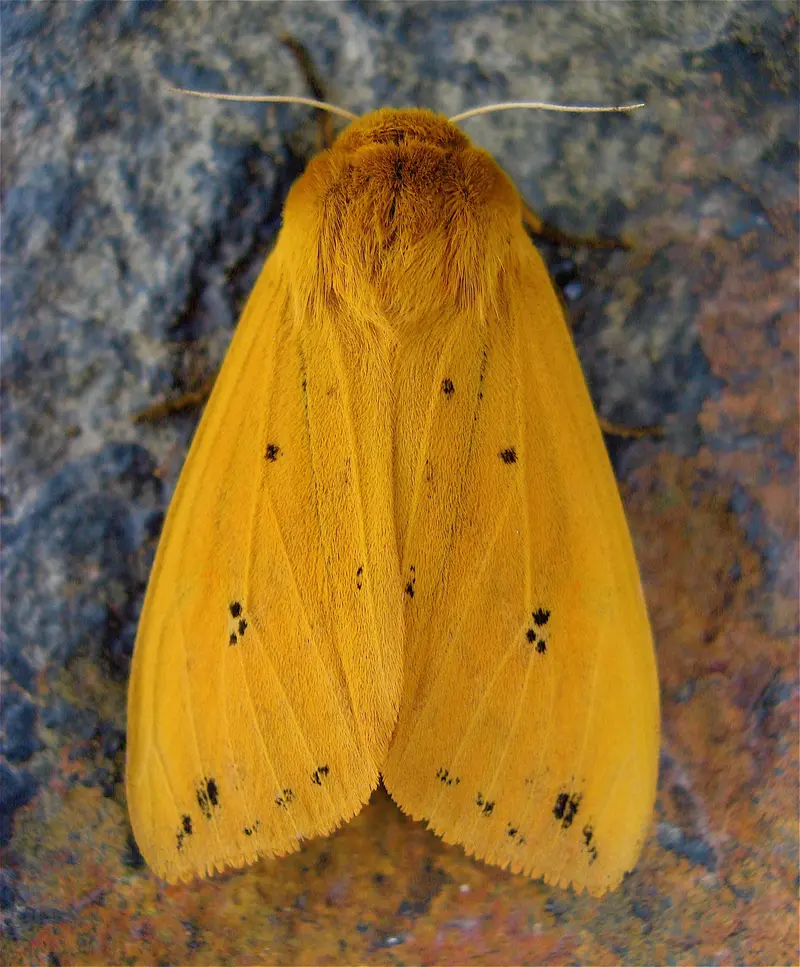
The Isabella tiger moth
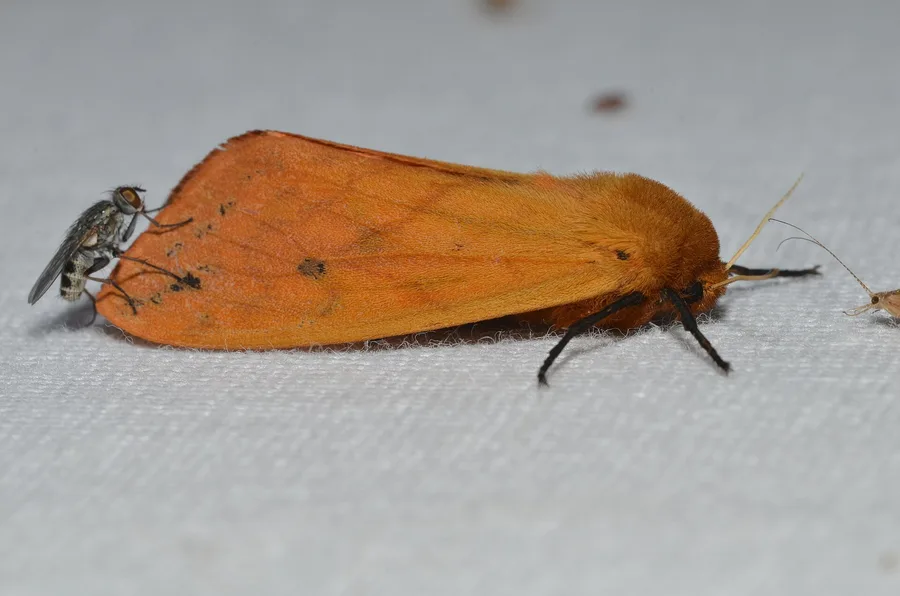
The adult is far less familiar than the caterpillar. MDC describes yellow or tan forewings with faint lines and small dark spots, lighter hindwings that are orange in females, and reddish-orange bases on the front legs. NWS notes three lengthwise rows of small black dots along the abdomen. MDC gives a wingspan of 1¾ to 2¼ inches; NWS and the University of Arkansas give 1½ to 2 inches. Adults fly at night and often come to porch lights, unlike the day-flying hummingbird moths that hover at garden flowers. One Iowa State page describes the adult as white with black spots, which does not match MDC, NWS or Butterflies and Moths of North America, so we follow those three.
Texas A&M AgriLife entomologist Wizzie Brown says there are far more pollinators than bees and butterflies, and counts woollybear moths among them because they feed on flower nectar. We found no study measuring how much pollinating Isabella tiger moths do, so treat that as a minor role, not a reason to plant for them the way you would for other night-flying moths people seek out.
When to See Woolly Bears: Our iNaturalist Count
To see when each stage actually turns up, we pulled every research-grade iNaturalist observation of Pyrrharctia isabella in the United States on November 22, 2026: 82,960 records. Of those, 64,696 were tagged as caterpillars, 14,326 as adult moths, 66 as pupae and 6 as eggs.
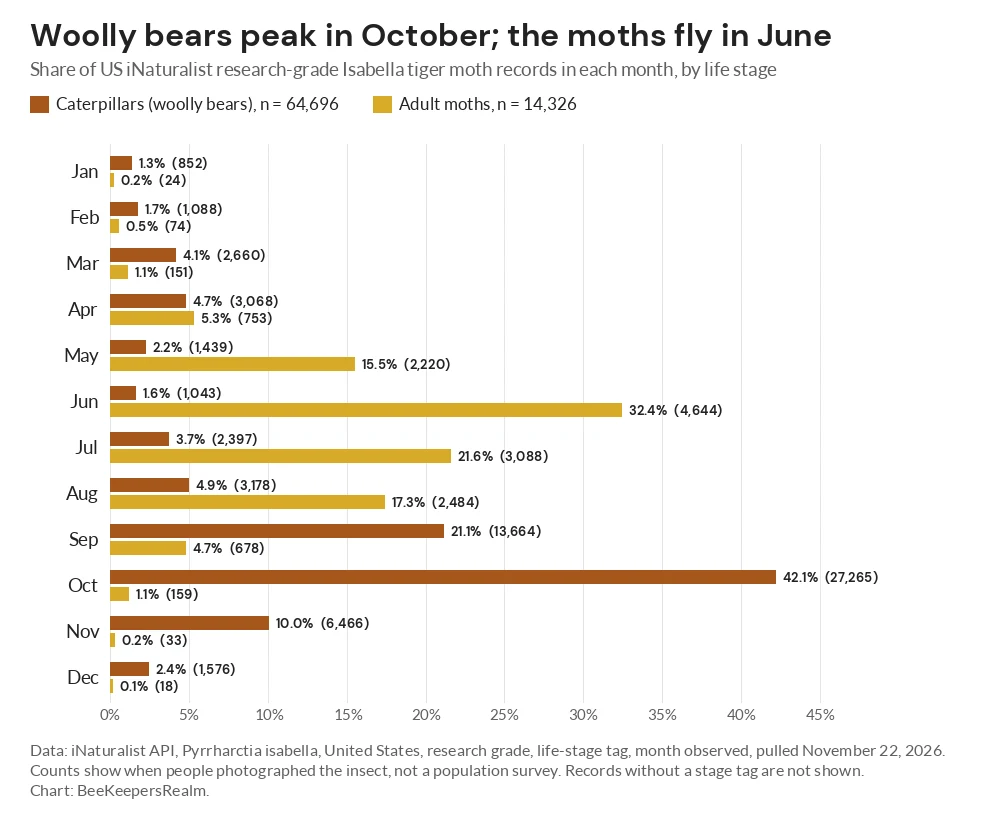
The fall wander dominates. September, October and November hold 73.3% of all caterpillar records, and October alone holds 42.1%. Smaller bumps show the rest of the year: 5,728 caterpillar records in March and April, when overwintered caterpillars wake and resume eating, and 3,516 from December through February, which fits the UW-Milwaukee Field Station’s note that woolly bears stir and walk around on mild winter days. Adult moths are mostly a summer sight: 86.8% of moth records fall between May and August, with June the busiest month at 32.4%.
Splitting the adult records by latitude shows the two generations. In the North (41 to 49.5°N), 72.1% of adult sightings come before the end of week 27 of the year, with a single sharp peak in week 26, in late June. In the middle band (36 to 41°N), the year splits almost evenly, 53.1% before and 46.9% after, with one flight peaking in late May and a second in late July and early August. In the South (24.5 to 36°N) the first flight starts earliest, peaking in week 17, in late April.
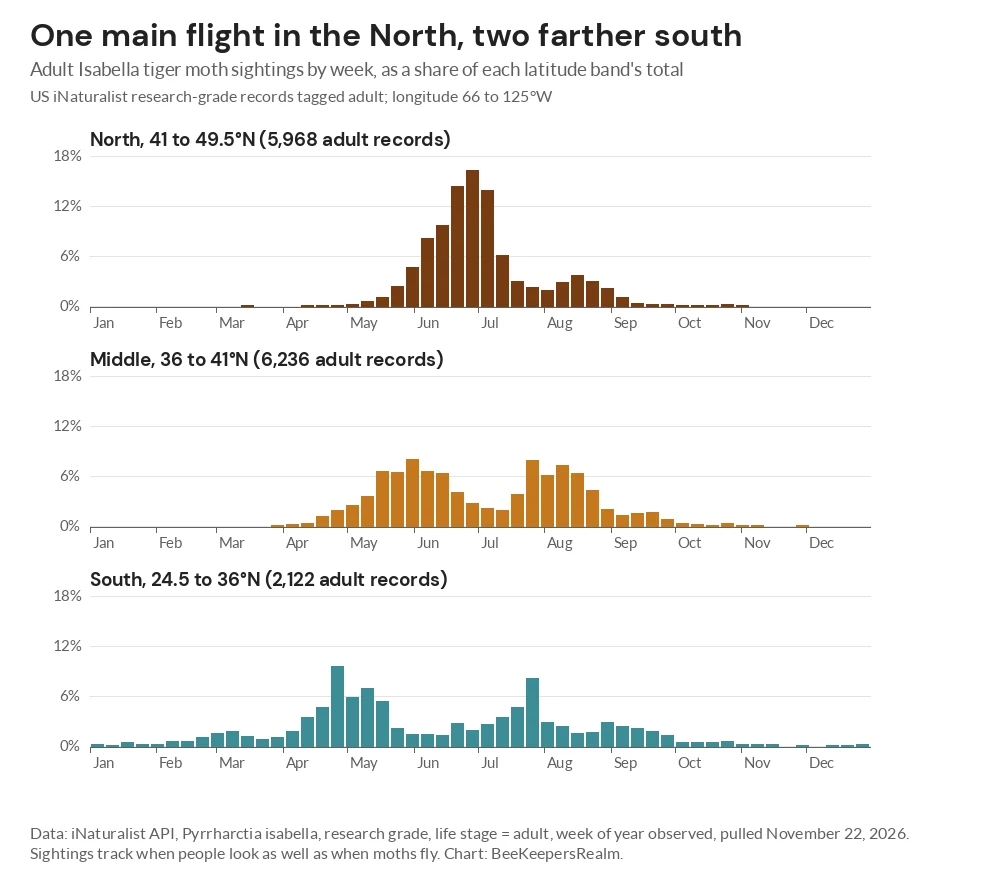
These are counts of when people photographed woolly bears, not a population survey, and US records have risen year by year with app use (15,769 research-grade records in 2025 against 1,334 in 2017). Use them for timing, not for trends in numbers. If you photograph a woolly bear yourself, our guide to citizen science for pollinators explains how iNaturalist observations reach research grade.
How Woolly Bears Survive Being Frozen
Most insects avoid freezing. Woolly bears are freeze tolerant: ice crystals form in the spaces between their cells while a natural antifreeze, glycerol, keeps the cell contents safe. National Geographic notes that they can survive freezing and thawing multiple times over a winter. It is the opposite strategy to a honey bee colony, which keeps itself warm through the winter instead of freezing.
They do not freeze solid, though. Lab studies give the numbers:
| Study | What was tested | Main result |
|---|---|---|
| Layne and Kuharsky, Journal of Experimental Zoology, 2000 | What triggers antifreeze production | Both cold conditioning and drying out quickly set off cryoprotectant production; late-October caterpillars responded within 4 days at 41°F (5°C) |
| Layne and Blakeley, Journal of Insect Physiology, 2002 | How much of the body freezes | Tissue ice was 24.4% at 27°F (-3°C), 40.2% at 21°F (-6°C) and 48.7% at 14°F (-10°C); hemolymph glycerol reached 200 to 300 mM |
| Layne and Peffer, Journal of Experimental Zoology A, 2006 | A 1-week freeze vs a 6-week freeze | 100% and 95% survived the thaw, but the 6-week group reached the pupal stage almost half as often |
| Marshall and Sinclair, Journal of Experimental Biology, 2011 | Repeated freezing and thawing | Repeated freeze-thaw cycles raised mortality to almost 30% and increased tissue damage |
| Yi and Lee, Journal of Experimental Biology, 2016 | Limits after 18 weeks of cold conditioning | All survived a week frozen at -4°F (-20°C) or seven freeze-thaw cycles; none survived -112°F (-80°C) |
Two popular claims do not hold up. NWS La Crosse, NC State’s factsheet and other pages say woolly bears survive -90°F. We could not trace that figure to a published measurement, and the one lab test we found at a colder temperature, -112°F, killed every caterpillar. The same NWS page says “Arctic woolly worms” take at least 14 years to mature. That is a different moth, Gynaephora groenlandica, and a 1998 study by Morewood and Ring in the Canadian Journal of Zoology revised its life cycle to about 7 years rather than 14.
Snow cover matters too. In a 2012 study by Marshall and Sinclair, caterpillars that wintered above the snow averaged 1.3°C (about 2.3°F) colder than those below it and used 18.36 mg less of a 68.97 mg fat reserve. Colder, in other words, was not automatically worse for a caterpillar that tolerates freezing.
What Woolly Bears Eat
Woolly bears are generalists that feed low on weedy plants. NC State lists plantain, dandelion, dock, aster, goldenrod and some grasses. MDC adds maple and elm trees, sunflowers and clovers, and the University of Arkansas lists campion as well. The Arthropod Museum notes that the caterpillars keep to the lower leaves near the ground, which keeps them inconspicuous and limits injury to their food plants. Iowa State says they rarely cause significant damage, and NC State says it would not make sense to apply an insecticide against them.
In fall the fully grown caterpillars stop feeding and travel. That is why so many are seen crossing roads and driveways: Iowa State says they are only scurrying to find a sheltered spot under dead plant debris.
Can You Touch a Woolly Bear?
For most people, yes, briefly. Ohio State Extension says woolly bear bristles are not stinging hairs and do not inject venom, but some people suffer severe local reactions if the hairs get into their skin. MDC says most people do not get a rash from handling this species, though some do. Wash your hands afterward and skip it if you have sensitive skin.
The bigger risk is a small child or pet putting one in its mouth. Two medical case reports describe it. In the Journal of Emergency Medicine (2015), an 8-month-old girl developed airway swelling after oral exposure to a woolly bear; she needed urgent care in an operating room by ear, nose and throat surgeons and close monitoring in a pediatric intensive care unit. In Wilderness and Environmental Medicine (2023), a 19-month-old boy who ate half a woolly bear came to the emergency department vomiting and inconsolable; he was treated without surgery and discharged in good condition after 48 hours. Those authors note that swallowing is less common than skin contact but more serious, because the hairs can lodge in the mouth, throat or esophagus and cause drooling, trouble swallowing, swelling and possible airway obstruction.
If a child has mouthed a fuzzy caterpillar and is drooling, vomiting or has trouble swallowing or breathing, get medical care. For advice, the free Poison Help line run by America’s Poison Centers is 1-800-222-1222. This section is general educational information, not medical advice.
Woolly Bear Look-Alikes, Including Ones That Sting
Several fuzzy caterpillars wander in late summer and fall, and two common ones can hurt. MDC’s rule is the safe one: if you are unsure of the identity, or of your own sensitivity, do not touch a fuzzy caterpillar with bare skin. The last column counts US research-grade iNaturalist records tagged as caterpillars from September through November, from the same November 22, 2026 pull, to show which ones people actually meet in fall.
| Caterpillar | How to tell it apart | Skin risk | Fall US records | Source |
|---|---|---|---|---|
| Banded woolly bear (Isabella tiger moth) | Black ends, rust middle, stiff bristles; rolls into a ball | Low; mild irritation in some people | 47,395 | NC State, OSU, MDC |
| Hickory tussock moth (Lophocampa caryae) | White with black tufts along the back and long black “pencils” front and back; up to 1.7 in | Localized itchy rash is typical | 15,214 | Penn State Extension |
| Yellow woolly bear (Virginian tiger moth, Spilosoma virginica) | Long, soft hairs that vary a lot in length over the whole body; hair color varies widely and includes a pale yellow form | Low | 12,580 | MDC, OSU |
| Salt marsh caterpillar (Estigmene acrea) | Hair color varies; noticeably longer hairs at the front and rear; walks fast | Low | 11,427 | MDC, Texas A&M AgriLife |
| Giant leopard moth (Hypercompe scribonia) | Mature caterpillars are black with red sections between the segments; the largest woolly bear in Missouri, up to 3 in | Low | 10,438 | MDC, OSU |
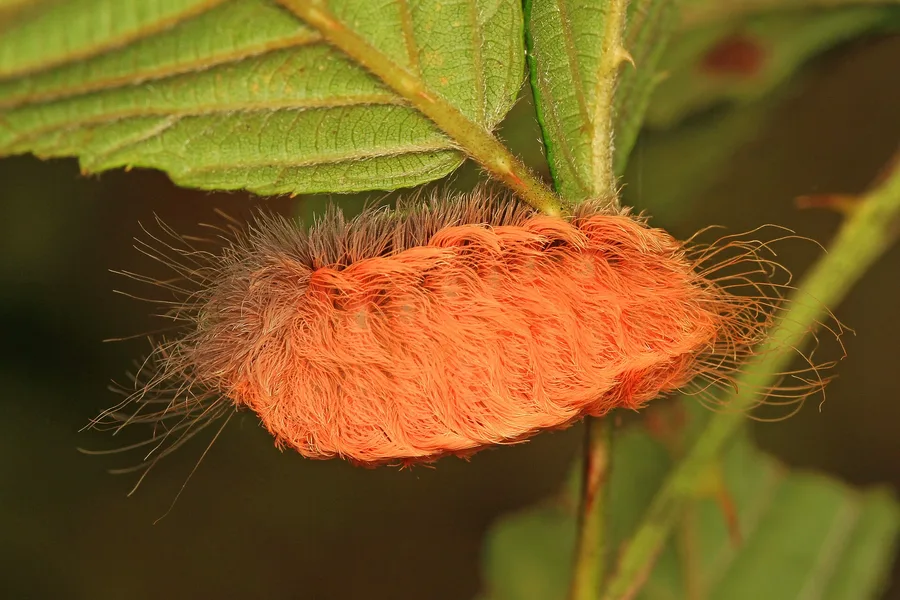
| Puss caterpillar (southern flannel moth, Megalopyge opercularis) | Soft-looking gray to brown hairs that hide the head and mouthparts; about 1 in (2.5 cm) | Severe sting from venomous spines under the hair | 3,445 | UF/IFAS |
Look-alikes also break the folklore. Ohio State’s Joe Boggs jokes that a forecaster who picked up the yellow form of the yellow woolly bear would predict no winter at all, while the all-black giant leopard moth caterpillar could cause mass panic. NWS La Crosse points out that each of these always looks the same, whatever the coming winter brings. The puss caterpillar is the one to teach children to avoid. UF/IFAS warns that its soft-looking coat hides stiff spines attached to poison glands that break off in the skin and cause severe pain. Penn State advises lifting embedded hickory tussock hairs off with tape and getting medical care if hairs reach the eyes or are swallowed.
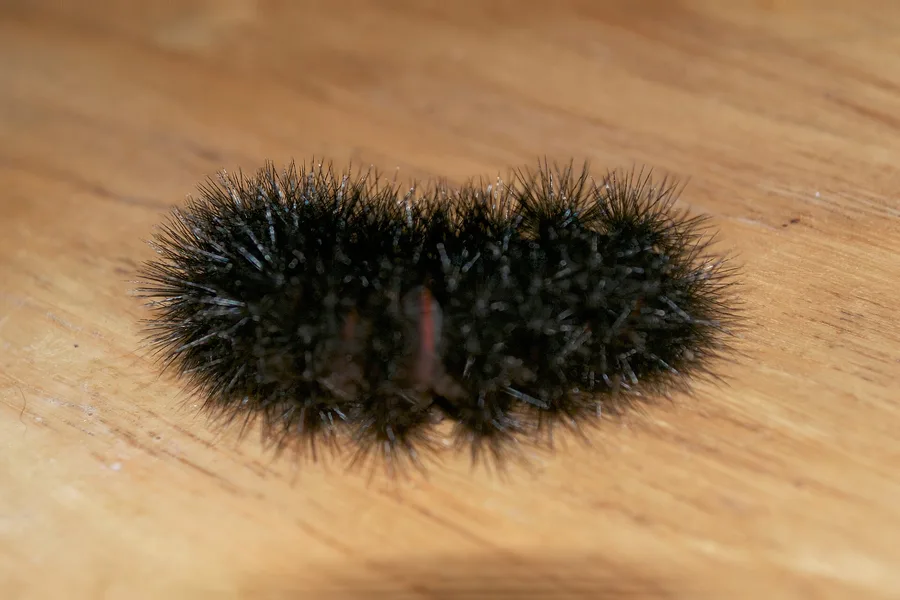
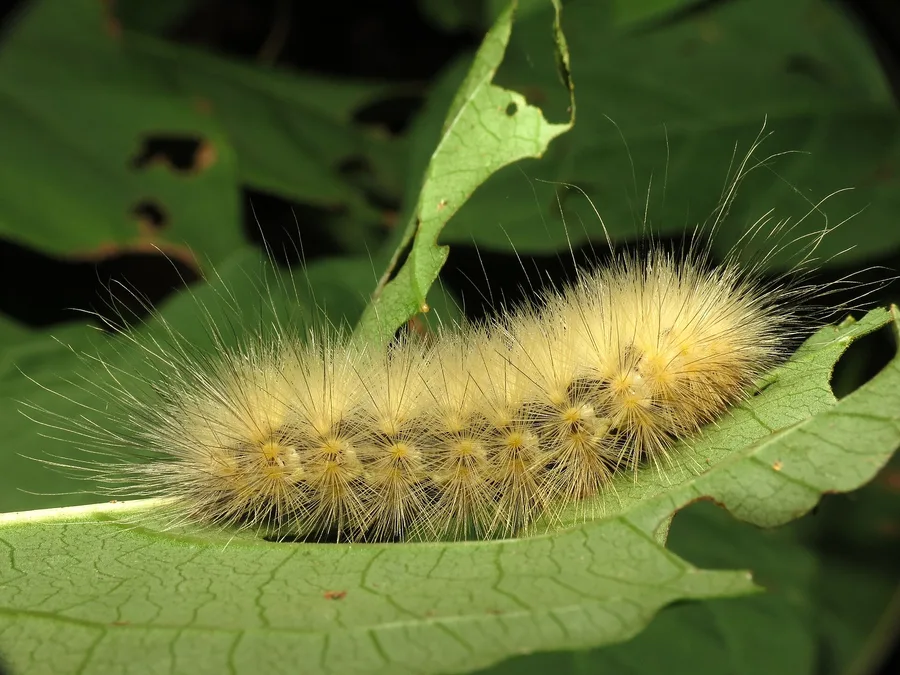
Woolly bears are moth caterpillars. If a “caterpillar” on your pine or rose has six or more pairs of fleshy prolegs on its abdomen, it is probably a sawfly larva instead.
Woolly Bears in Your Yard
There is nothing to control. Woolly bears eat weeds, rarely cause significant damage and are food for other wildlife: Ohio State notes the curl-up defense in response to wasps such as yellow jackets, which attack and feed on caterpillars (solitary thread-waisted wasps hunt caterpillars too, to stock their nests), and AgriLife’s Wizzie Brown says birds and bats take the adult moths. Three easy ways to help them:
- Leave some cover. Yi and Lee note that woolly bears overwinter in leaf litter; a few leaf piles or undisturbed edges give them somewhere to spend the winter.
- Dim the porch light. MDC notes that tiger moths come to lights at night, and National Geographic suggests reducing light pollution to help them. Our moon garden guide covers moth-friendly night planting.
- Raise one, then release it. NC State calls woolly bears “a barrel of fun to rear” on fresh plantain leaves. Ones collected in fall will not become moths until spring and probably have a chilling requirement, so NC State suggests leaving them outside, perhaps in a screened cage to keep rodents out.
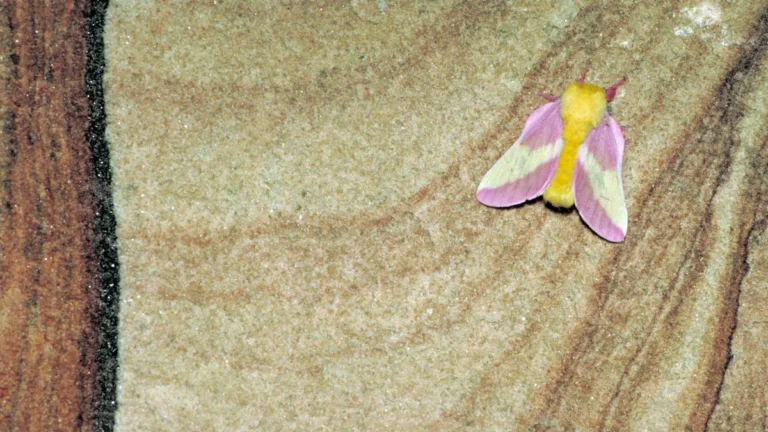
Other moths in our series include the cecropia moth, North America’s largest native moth, and the small pink and yellow rosy maple moth.
Another big garden caterpillar, the tomato hornworm, turns into a night-flying hawk moth that visits flowers for nectar.
Not every big caterpillar people find in late summer is fuzzy; the smooth, translucent green caterpillar of the polyphemus moth feeds on oaks, maples and birches.
Frequently Asked Questions
What does an all-black woolly bear mean?
Usually it is either a young banded woolly bear, since young caterpillars are mostly black and gain rust as they molt, or a different species. The giant leopard moth caterpillar is always black. Neither says anything about the winter.
What do woolly bear caterpillars turn into?
The Isabella tiger moth, a medium-sized yellow-orange to tan moth with small dark spots and a wingspan of about 1¾ to 2¼ inches. Fall caterpillars spin a cocoon of silk and their own hairs in spring, and NWS says the moth emerges in about two weeks.
Where do woolly bears go in winter?
Into leaf litter and under dead plant debris, where they partly freeze and wait out the cold. They can wake and move on mild winter days, which is why our count found 3,516 US caterpillar records between December and February.
Do woolly bears bite or sting?
No. They chew leaves, not skin, and their bristles carry no venom. The hairs can still irritate sensitive skin, and swallowing one is dangerous for small children.
Can I keep a woolly bear over winter?
Yes, but outdoors. NC State says fall-collected woolly bears will not produce moths until the following spring and probably need a chilling period, so keep them in a screened cage outside, with fresh plantain leaves if they are still feeding.
Why do woolly bears cross the road?
In fall the caterpillars have finished feeding and are looking for a sheltered spot to spend the winter. Roads and sidewalks are just where people notice them.
How many generations do woolly bears have?
Two in most of the US, according to MDC, Iowa State and Ohio State; NC State says one or two in North Carolina. Our iNaturalist count shows one main moth flight peaking in late June in the northern states (72.1% of adult sightings by early July) and two clear flights farther south.
Are woolly bears a sign of a hard winter if there are lots of them?
There is no evidence for that. Asked whether there were more woollybears one year, Texas A&M AgriLife’s Wizzie Brown said she did not think there were more than in any other year, and that most people do not look down for bugs, so it depends on who is paying attention. Woolly bears are simply most visible in fall, when the second brood is on the move.
Next Step
If you see a woolly bear this fall, look at its band, then let it go on its way to a sheltered spot, and keep fuzzy caterpillars you cannot name away from small children. This page is educational wildlife information, not medical or pest-control advice.
Sources
- James Baker, NC State Extension, “Banded Woollybear / Isabella Moth”, PDIC factsheet
- “Science: Wooly Weather Prophet,” Time, November 8, 1948
- Joe Boggs, Ohio State University Extension, “Woolly Bears and the Winter’s Tale,” Buckeye Yard and Garden onLine, October 26, 2021
- Iowa Department of Natural Resources, “Winter Is Coming: Can the Woolly Bear Predict It?” (October 20, 2015; from Iowa Outdoors, 2008)
- Jason Bittel, “Can woolly bear caterpillars really predict the weather?”, National Geographic, November 29, 2023
- Layne JR, Kuharsky DK, “Triggering of cryoprotectant synthesis in the woolly bear caterpillar,” J Exp Zool 286: 367-371 (2000); Layne JR, Blakeley DL, “Effect of freeze temperature on ice formation and long-term survival of the woolly bear caterpillar,” J Insect Physiol 48: 1133-1137 (2002); Layne JR, Peffer BJ, J Exp Zool A 305: 570-575 (2006)
- Marshall KE, Sinclair BJ, “The sub-lethal effects of repeated freezing in the woolly bear caterpillar,” J Exp Biol 214: 1205-1212 (2011), and Naturwissenschaften 99: 33-41 (2012); Yi SX, Lee RE, “Cold-hardening during long-term acclimation in a freeze-tolerant woolly bear caterpillar,” J Exp Biol 219: 17-25 (2016)
- Morewood WD, Ring RA, “Revision of the life history of the High Arctic moth Gynaephora groenlandica,” Canadian Journal of Zoology 76: 1371 (1998)
- MacKinnon JA et al., “Oropharyngeal edema in an 8-month-old girl after woolly bear caterpillar exposure,” J Emerg Med 49: e147-e149 (2015); Halmo LS et al., “A nonsurgical approach to management of lepidopterism due to woolly bear caterpillar ingestion,” Wilderness Environ Med 34: 214-217 (2023)
- Missouri Department of Conservation field guides: Isabella Tiger Moth, Giant Leopard Moth, Salt Marsh Moth, Tiger and Lichen Moths; Iowa State University Extension, Yard and Garden, “Woollybear Caterpillar”; University of Arkansas Arthropod Museum, “Woolly bear caterpillar”; National Weather Service La Crosse, “Woolly Bear Caterpillar: Winter Predictor or Not?”; UW-Milwaukee Field Station, Bug of the Week; Penn State Extension, “Hickory Tussock Moth Caterpillar”; UF/IFAS Gardening Solutions, “Stinging and Venomous Caterpillars”; Texas A&M AgriLife Today, “Woollybear caterpillar makes its seasonal journey to overwinter” (December 13, 2023); Butterflies and Moths of North America, Pyrrharctia isabella; Wikipedia, “Pyrrharctia isabella” (read November 22, 2026); Science Friday, “The Myth of the Woolly Bear” (video, November 7, 2013)
- iNaturalist research-grade observations of Pyrrharctia isabella and of six look-alike species in the United States, via the iNaturalist API, pulled November 22, 2026
Image credits: featured photo of a woolly bear crossing a path at Minnesota Valley National Wildlife Refuge on October 18, 2017, by Courtney Celley/USFWS, public domain, via Wikimedia Commons, cropped to 16:9 and resized. Other photo credits are in each caption. Charts are by BeeKeepersRealm from iNaturalist data.