Reviewed by Elena P. · How we review
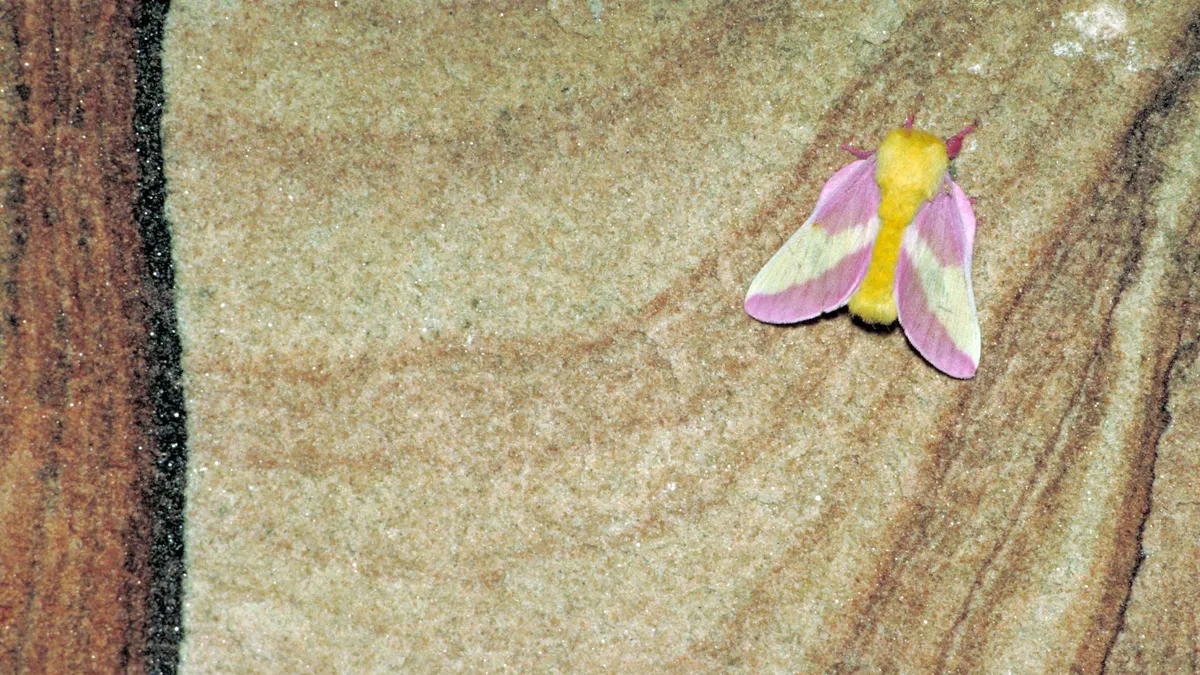
The rosy maple moth (Dryocampa rubicunda) is a small, woolly, pink and yellow silk moth native to eastern North America, and its caterpillar is the green-striped mapleworm that eats maple leaves. The adult has no working mouthparts, does not bite, sting or eat, and is not known to be toxic. The caterpillars can strip a maple in a heavy year, but healthy trees grow new leaves and extension services rarely advise spraying.
This guide covers identification and color forms, the caterpillar, the life cycle, look-alikes and what to do about a defoliated maple. It draws on extension and museum sources, a 1909 USDA circular and our own analysis of 27,785 US iNaturalist records. We make no claim of personal field experience with this moth.
Key Takeaways
- Adults are 1¼ to 2¼ inches across, with pink wing bases and edges around a yellow or cream band. A white form, alba, occurs in Missouri.
- Adults have no functional mouthparts, so they never feed or visit flowers.
- Neither stage is known to be poisonous. The caterpillar has short spines and two black horns, but no source we read lists it as a stinging species.
- In our iNaturalist count, nearly 98% of adult sightings north of 41°N fall in May to July, a single flight. Between 33° and 39°N a second, larger flight peaks in late July.
- Defoliation looks alarming but is usually cosmetic. Wiping off egg clusters or pruning one infested branch is often enough on a small tree.
Table of Contents
- How to Identify a Rosy Maple Moth
- The Caterpillar: Green-Striped Mapleworm
- Rosy Maple Moth Life Cycle
- When They Fly: One Brood North, Two or More South
- Where Rosy Maple Moths Live, and a 1909 Puzzle
- Is the Rosy Maple Moth Poisonous or Dangerous?
- Will Green-Striped Mapleworms Hurt Your Maple?
- Rosy Maple Moth Look-Alikes
- Porch Lights, Pollinators and Beekeepers
- Frequently Asked Questions
How to Identify a Rosy Maple Moth
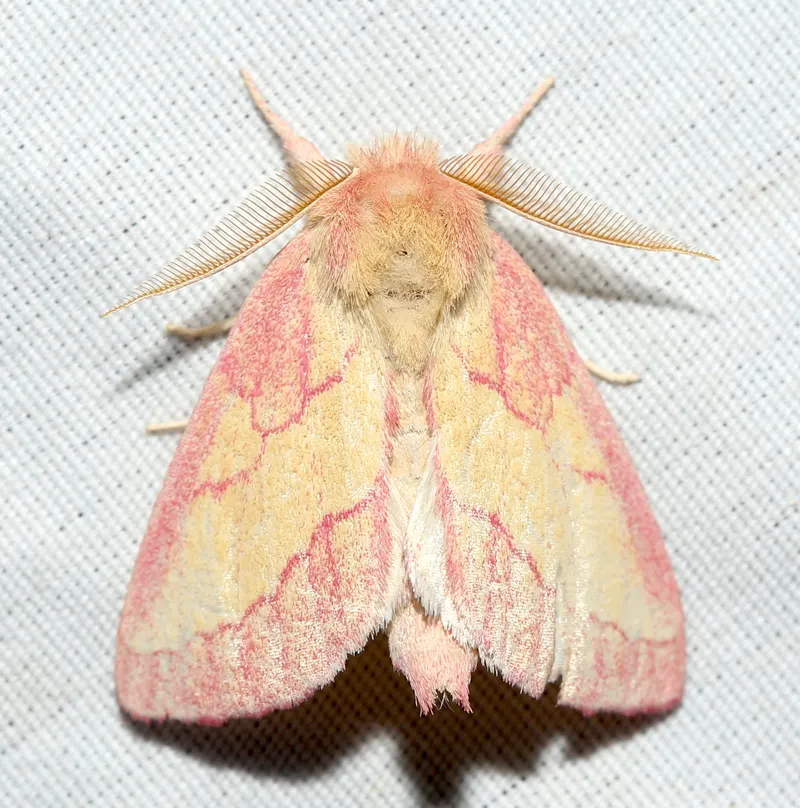
The rosy maple moth is a member of the giant silk moth family, Saturniidae, in the subfamily of royal moths (Ceratocampinae). It is small for that family: Clemson Cooperative Extension calls it the smallest of the silk moths. The Missouri Department of Conservation (MDC) gives a wingspan of 1¼ to 2¼ inches.
Look for four things together:
- Wings: pink at the base and along the outer edge, with a yellow, cream or white band across the middle. The hindwings are paler.
- Body: thick and woolly, usually bright yellow on top and pink underneath.
- Legs and antennae: pink. LSU AgCenter notes both are pink in typical moths.
- Where you see it: by day it rests still, often on the side of a building near a light that drew it in the night before, as Mississippi State Extension describes.
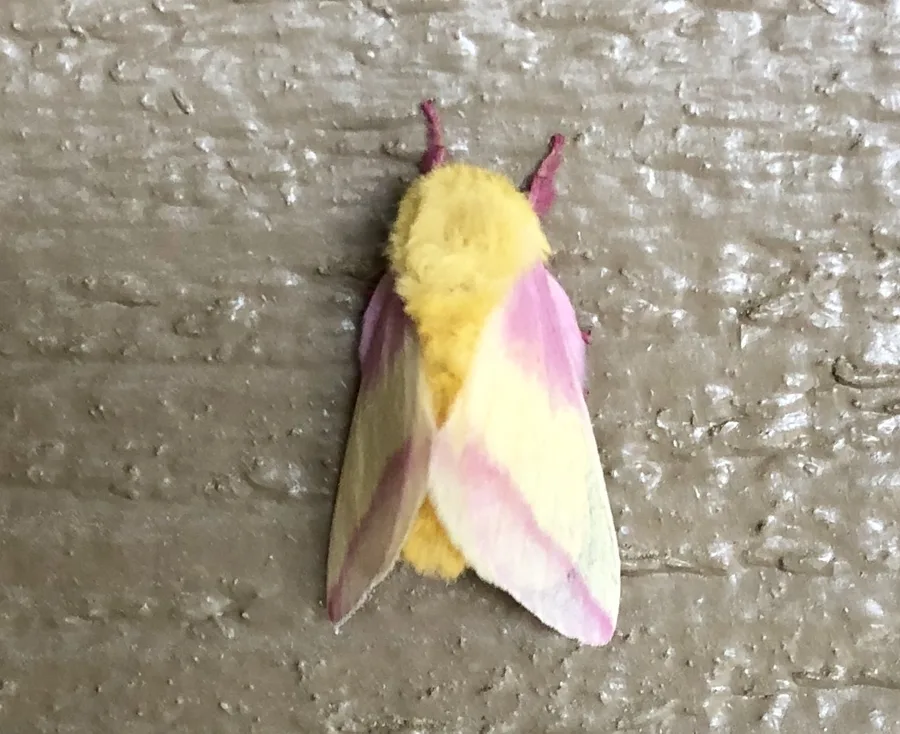
The colors struck early entomologists too. The USDA’s first circular on the species opened its description of the adult this way:
“The parent insect, or moth, is a beautiful creature of a pale yellow color shaded with a most delicate pink.”
Color forms, including the white moth
The amount of pink varies from most of the wing to almost none, according to Butterflies and Moths of North America (BAMONA). MDC’s field guide maps the variation within Missouri: a dark pink form is most common in the Ozarks, a lighter one in central and northeastern Missouri, and a very pale form, D. rubicunda alba, in western and most of northern Missouri. That form is all white, often with a hint of pink. The 1909 circular noticed the same east-west shift, describing eastern moths as more intensely rose and some western ones as nearly white.
On iNaturalist, only 8 US records are identified to form alba: four from Missouri and one each from Kansas, Iowa, Vermont and New Hampshire. Few observers tag forms, so treat this as a sample, not a map.
Male vs female
Males are smaller, with narrower wings and broad, feathery (bipectinate) antennae that pick up the female’s scent. Females are larger, with more rounded wings and slender antennae. Animal Diversity Web (ADW) gives a forewing length of 17 to 29 mm for males.
The Caterpillar: Green-Striped Mapleworm
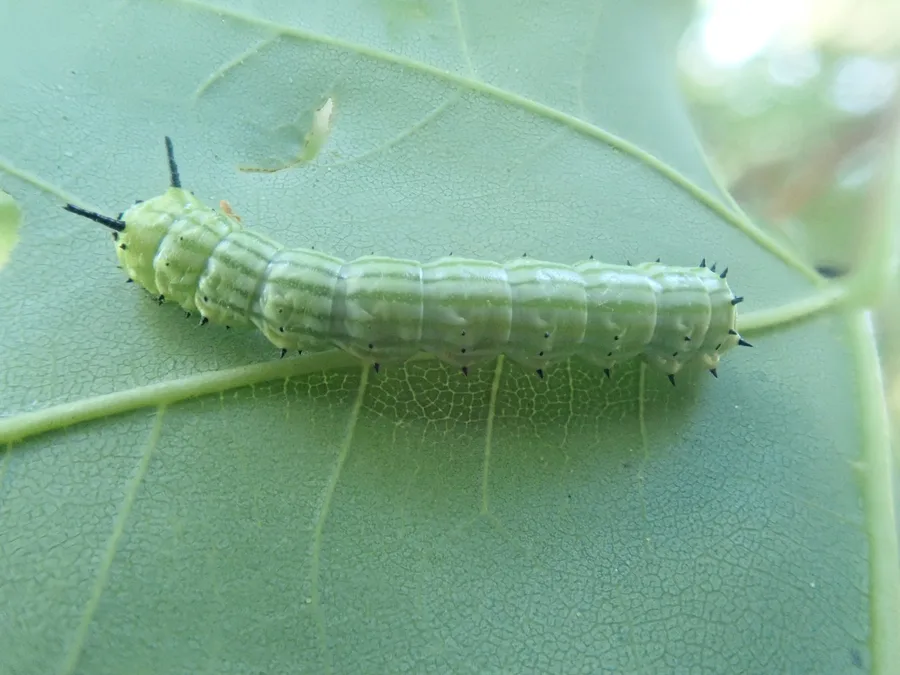
The larva goes by green-striped mapleworm (also spelled greenstriped mapleworm). A full-grown caterpillar is about 1½ to 2 inches long. NC State Extension describes it as pale green with seven dark-green stripes running the length of the body, a red or black head, two prominent black horns on the second segment behind the head, two rows of short spines along each side and four larger spines at the rear.
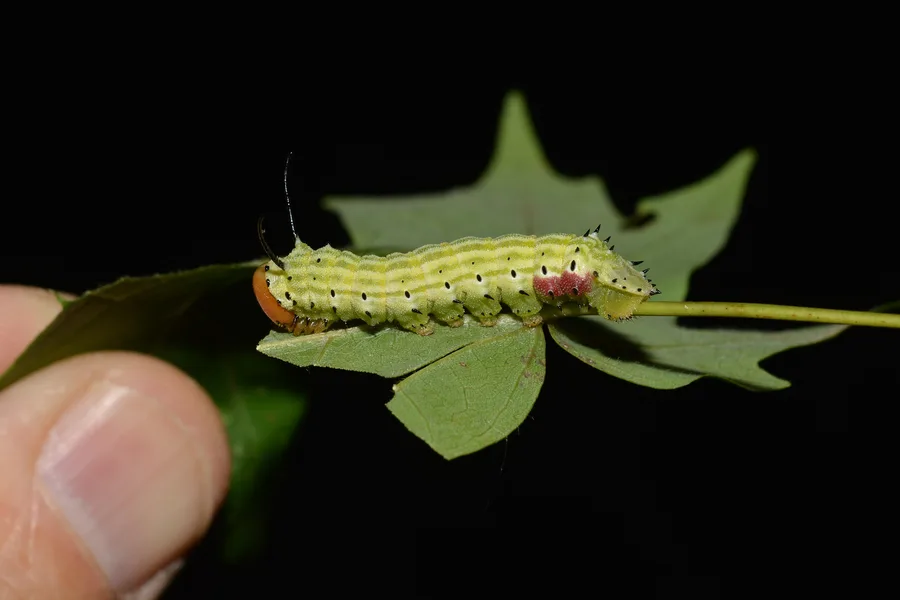
It changes as it grows. LSU AgCenter says young larvae are pale green with black heads and feed together, while older ones have red heads and feed alone from the fourth instar on. MDC adds that some caterpillars have a pinkish-red patch on each side near the rear end.
Maples are the main food, especially red, silver and sugar maple, and box elder. Caterpillars also turn up on oaks, especially turkey oak, and MDC lists sycamore and beech. The 1909 circular reported that the caterpillar avoided elm trees that touched infested maples. A caterpillar-like larva on a maple can also be a sawfly; our guide to sawfly larvae versus caterpillars shows how to tell them apart.
Rosy Maple Moth Life Cycle
Like all moths, the rosy maple moth goes through egg, larva, pupa and adult. Durations depend on temperature, so the table gives each source’s own figure.
| Stage | How long | What to look for | Source |
|---|---|---|---|
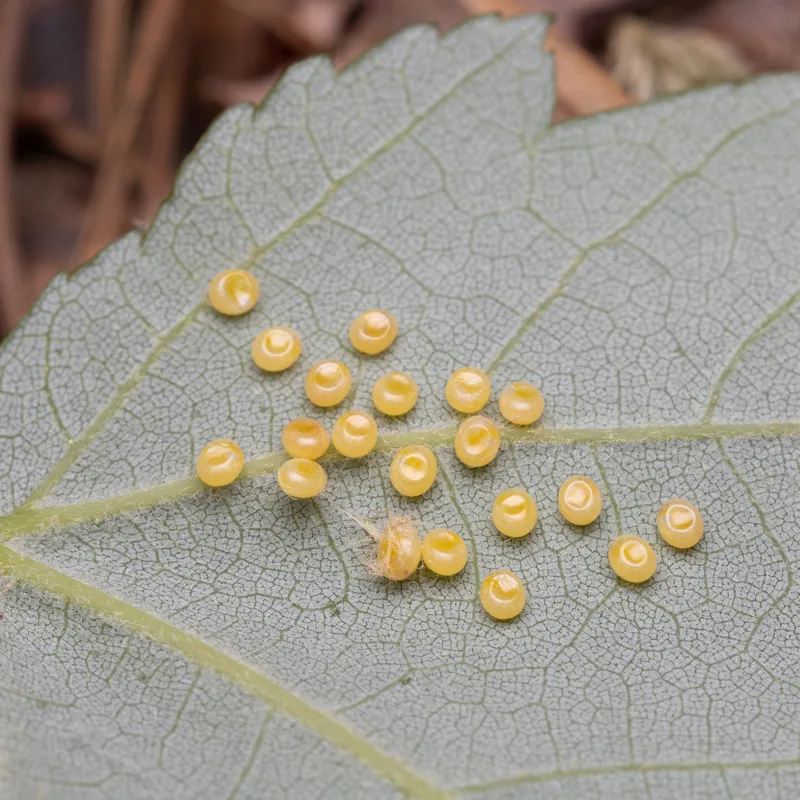
| Egg | About 2 weeks (MDC, BAMONA); 10 days (NC State); 8 to 10 days (USDA 1909) | Yellow, about 1.5 mm, in clusters of 10 to 30 (up to 50) on the underside of leaves; 150 to 200 per female | LSU AgCenter, MDC, ADW |
| Caterpillar | About a month, five instars | Groups on one leaf or branch at first, then single caterpillars eating whole leaf blades | NC State, LSU AgCenter, USDA 1909 |
| Wandering larva | 10 to 14 days | Full-grown caterpillars crawl down the trunk to find soft soil near the host tree | LSU AgCenter |
| Pupa | About 2 weeks in summer; the last brood of the year overwinters | Dark brown, spiny pupa in a shallow chamber in the soil under the tree | USDA 1909, Clemson, BAMONA |
| Adult | Up to a couple of weeks | Emerges in late afternoon, mates that evening, lays eggs at dusk the next day; never feeds | MDC, BAMONA, LSU AgCenter |
LSU AgCenter puts the full cycle at about two months in warm weather and up to nine months for the generation that spends the winter underground. The pupa has small spines, which the 1909 circular says help it work its way up to the surface before the moth emerges.
When They Fly: One Brood North, Two or More South
Every source agrees that the number of generations rises toward the South. BAMONA gives one brood in the north from May to August, two in the south from April to September and possibly three in the Deep South and Florida from March to October. Mississippi State Extension reports two to three a year there, and LSU AgCenter two or three in Louisiana. The USA National Phenology Network adds a caution: the number of generations is uncertain in most of the range.
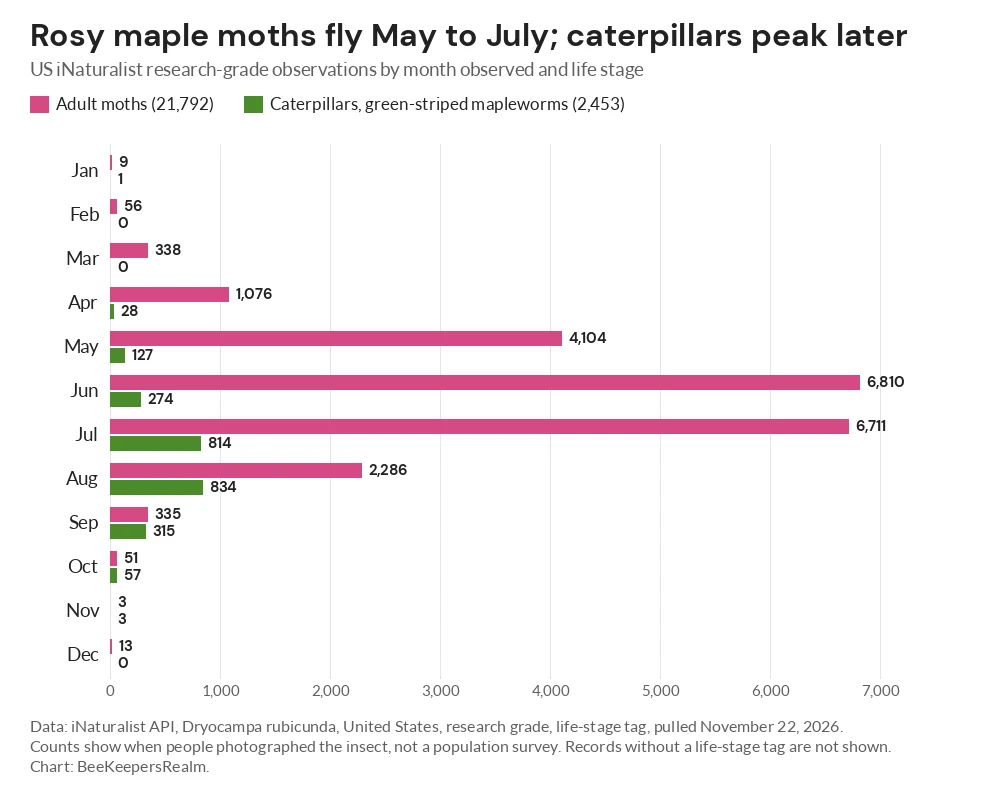
To see what the records show, we pulled every research-grade rosy maple moth observation in the United States from the iNaturalist API on November 22, 2026: 27,785 records, of which 21,792 were tagged as adults and 2,453 as caterpillars. Adults peak in June and July, while caterpillar records peak in July and August, about a month behind.
Then we split the adult records into three latitude bands across the eastern half of the country and counted them by week:
- North (41 to 49.5°N, 8,270 adults): one flight. May, June and July hold 97.7% of sightings, and the busiest week (around the turn of May and June) holds 16.7% of the band’s total. Caterpillars there were recorded almost only in July and August.
- Middle (33 to 39°N, 7,993 adults): a long spring flight from mid-April, then a second, sharper peak in late July, the busiest week of the year for that band at 13.3%. Caterpillar records run from June through September at a similar level each month, as overlapping broods would produce.
- South (25 to 33°N, 1,906 adults): moths from February to October, with a first peak in late March and another in late July. That spread fits two or three broods.
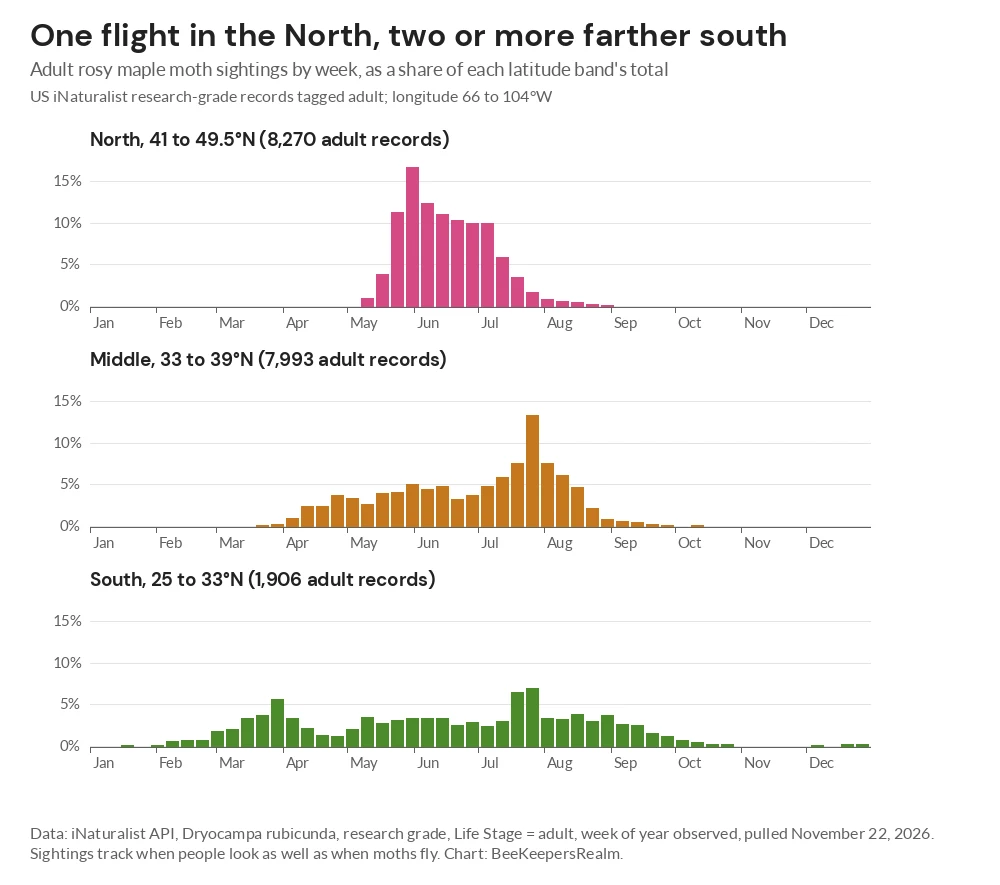
We left out 39 to 41°N so the bands would not blur together. iNaturalist counts reflect when people photograph moths as well as when moths fly, and recent years dominate: 2026 alone added 4,712 US records, against 549 in 2017. If you photograph one, adding it helps; see our guide to citizen science programs for pollinators.
Where Rosy Maple Moths Live, and a 1909 Puzzle
BAMONA gives the range as Nova Scotia west through Quebec and Ontario to Minnesota, and south to Dade County, Florida, the Gulf Coast and east Texas. MDC notes the moths stay in and near woodlands and parks with their food trees, and the USA-NPN adds that they are common in neighborhoods where silver maples are planted. It is absent from the West: iNaturalist has no research-grade US records from Nebraska, the Dakotas or any state farther west.
Raw counts mostly track how many people use iNaturalist, so we divided each state’s rosy maple moth records by all of its research-grade moth and butterfly records. By that measure the moth is most often recorded in northern New England and the southern Appalachians: New Hampshire (17.2 per 1,000), Maine (13.1), Vermont (9.1), West Virginia (8.5) and North Carolina (8.3). North Carolina also has the most records outright, 3,412.
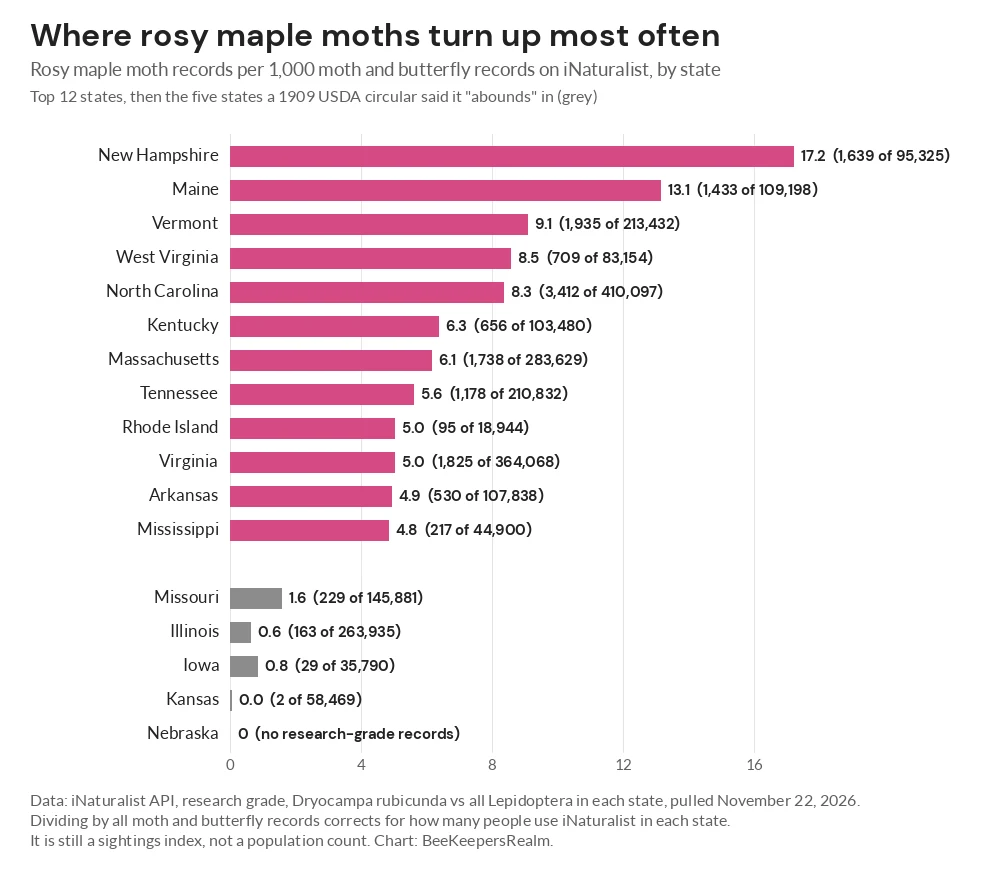
Here is the puzzle. The 1909 USDA circular called the green-striped maple worm “more abundant in the West than in the East” and said it abounded especially in Kansas, Nebraska, Missouri, Illinois and Iowa, where it stripped city shade maples twice a year in places such as Independence, Kansas. Today those five states sit at the bottom of our index: Kansas has 2 research-grade records against 58,469 moth and butterfly records, and Nebraska has none. Iowa State University Extension wrote in 2018 that it is not a common pest in Iowa, with a small handful of reported defoliations in 40 years.
Our data cannot say why. BAMONA notes that, like many silk moths, the species is declining across much of its range, possibly because of a tachinid fly, Compsilura concinnata, imported to fight other pests. Plains cities may also plant different shade trees than they did in 1909. Treat both as open questions, not findings.
Is the Rosy Maple Moth Poisonous or Dangerous?
No. Adults lack functional mouthparts, says MDC, so they cannot bite, and they have no stinger. None of the extension, museum or agency sources we read reports any toxin. The bright colors look like a warning, but the USA National Phenology Network says that is not what they are, as far as anyone knows:
“The function of the conspicuous pink and yellow coloration is completely unknown.”
The same profile adds that the moth is not known to be toxic and that no model for mimicry exists. ADW reports field studies finding that birds find the moth unappealing, though blue jays still eat it.
The caterpillar is not known to sting either. The 1909 circular called it a “naked or hairless caterpillar”, and its spines are short and sparse, unlike the dense stinging spines of the Io moth caterpillar described in our luna moth guide. As with any caterpillar, handle it gently, keep it away from your face and wash your hands afterward, and keep pets from eating insects.
Will Green-Striped Mapleworms Hurt Your Maple?
Usually not for long. Clemson notes a single tree can carry hundreds of caterpillars and end up partly or fully bare, which is mainly an aesthetic problem unless the tree is a sapling or already stressed. MDC says healthy trees can withstand occasional outbreaks and simply grow new leaves. NC State warns that growth loss and branch dieback can follow if the same tree is stripped several years in a row.
“Defoliation of deciduous trees is alarming but not fatal.”
Outbreaks are local and hard to predict. BAMONA says they are mostly unknown where the moth has a single brood, and Iowa State found its 2017 to 2018 outbreak along the Wapsipinicon River, noting that infestations are common along rivers. LSU AgCenter adds that heavy defoliation usually comes from several caterpillar species at once.
If you want to protect a small tree, the extension sources suggest, in order:
- Check leaf undersides in late spring. Clemson says egg clusters can be wiped off with a finger.
- Prune the branch. Young caterpillars from one egg mass feed together, so NC State suggests cutting off that branch. Fresh droppings under the tree are another clue.
- Spray only small trees, early, if at all. Mississippi State lists spinosad for young trees, and Iowa State says Bacillus thuringiensis works only on small caterpillars. Both note that large trees are hard or impractical to spray, and Clemson calls spraying very rarely advised. Spinosad is still highly toxic to bees while wet, as our pollinator-safe pest control guide explains, along with how to read the bee warnings on a label.
Iowa State adds that spraying does not help once a tree is bare and the full-grown caterpillars are wandering off to pupate. LSU AgCenter does not recommend chemical control at all, since predators and parasitoids keep outbreaks in check. Birds matter here: LSU says the spring caterpillars are valuable food for nesting birds and migrants.
This is educational information, not professional pest-control or tree-care advice. Follow every pesticide label and ask your county extension office or a certified arborist before treating a tree.
Maples feed other insects too. Box elder, itself a maple, feeds the boxelder bug, maples are among the hosts of the spotted lanternfly, and red maple is often the first tree honey bees work in spring, as our list of nectar trees for bees shows.
Rosy Maple Moth Look-Alikes
Few moths share this color scheme. The USA-NPN calls the adult almost unmistakable and names only one similar North American species, the uncommon pink prominent.
| Species | Size | How to tell it apart | Source |
|---|---|---|---|
| Rosy maple moth (Dryocampa rubicunda) | 1¼ to 2¼ in wingspan | Woolly yellow body; pink wing bases and edges around a yellow or cream band; pink legs | MDC, LSU AgCenter |
| Pink prominent (Hyparpax aurora) | A bit smaller | Unrelated; a small pink bar in the middle of the forewing, with hindwings and abdomen much whiter than the forewings | USA-NPN, MDC |
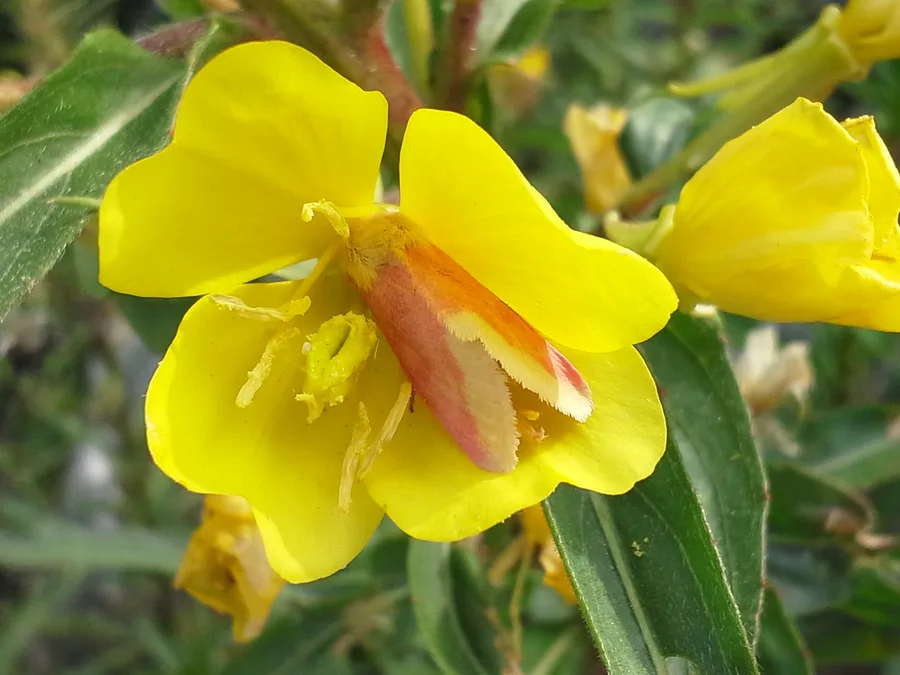
| Primrose moth (Schinia florida) | About 30 mm (1.2 in) | Slim, not woolly; pink forewings with pale yellow markings, creamy white hindwings; rests inside evening primrose flowers by day | Wikipedia |
| Elephant hawk-moth (Deilephila elpenor) | 60 to 70 mm in Europe | Streamlined sphinx moth with olive-brown forewings edged in pink; native to Europe and Asia, introduced in British Columbia | Wikipedia |
For other pink and green moths gardeners ask about, see our guides to the luna moth, a much larger green silk moth, and the day-flying hummingbird moth.
Porch Lights, Pollinators and Beekeepers
Rosy maple moths are not pollinators. Adults do not feed, so they have no reason to visit flowers. Many other moths do pollinate at night, especially pale, fragrant flowers that open in the evening, as our guide to pollination syndromes explains, and a moon garden for moths is the way to plant for them.
Lights are the bigger issue. MDC notes that rosy maple moths come to electric lights at night, and the 1909 circular reported that city lights once attracted and destroyed large numbers of them. Our suggestion: switch off porch lights you do not need, especially from May to August, so the moths stay in the trees where they mate.
Beekeepers can relax about this one. The moths that matter in an apiary are wax moths, covered in our guide to stopping wax moth infestations. A rosy maple moth resting on a hive is not after the comb: the adults do not feed at all.
At the other end of the silk moth family's size range is the cecropia moth, North America's largest native moth, with a wingspan of about 5 to 6 inches.
The famous woolly bear caterpillar belongs to a different family, the tiger moths, and is best known for the folklore that its bands forecast the winter.
At the large end of the same family is the polyphemus moth, a tan silk moth about 4 to 6 inches across that also comes to porch lights.
Frequently Asked Questions
Is the rosy maple moth real?
Yes. It is a native North American moth, described by Johan Christian Fabricius in 1793, and US iNaturalist users had logged 27,785 research-grade records by November 2026. Its colors are natural, not edited.
Are rosy maple moths rare?
No. BAMONA lists the species as G5, demonstrably secure, though it notes declines in much of the range and scarcity at the edges. MDC lists it as a breeding resident across Missouri.
Are rosy maple moths poisonous to touch?
Not as far as anyone knows. No source we read reports a toxin in the adult or the caterpillar, and the USA-NPN says the moth is not known to be toxic. Wash your hands after handling any insect.
Do rosy maple moths have mouths?
They lack functional mouthparts, like other giant silk moths, so adults never eat or drink. Only the caterpillars feed, on tree leaves.
How long do rosy maple moths live?
Adults live up to a couple of weeks. Counting all stages, one moth lives about two months in summer, or up to nine months if it spends the winter as a pupa, according to LSU AgCenter and ADW.
Do rosy maple moths make silk or cocoons?
The sources we read describe no silk cocoon. Full-grown caterpillars burrow into the soil under the host tree and pupate in a shallow chamber.
Where do rosy maple moths live?
In the eastern United States and southern Canada, from Nova Scotia to Minnesota and south to Florida and east Texas, wherever maples or their other host trees grow.
Are rosy maple moths invasive?
No. They are native to North America. The caterpillars occasionally defoliate maples, but that is a native outbreak, not an invasion.
Next Step
If a bare maple worries you, check whether new leaves appear within a few weeks, and call your county extension office if the same tree is stripped two years running. For other insects US gardeners ask about, see our guides to the Japanese beetle, the cicada and the stink bug.
Sources
- L. O. Howard and F. H. Chittenden, “The Green-Striped Maple Worm (Anisota rubicunda Fab.),” USDA Bureau of Entomology Circular 110 (1909)
- Clemson Cooperative Extension HGIC, “Rosy Maple Moth (Dryocampa rubicunda),” HGIC 2022, by Jamielee Adams and Dave Coyle (2021)
- Missouri Department of Conservation, Rosy Maple Moth field guide
- LSU AgCenter, “Dryocampa rubicunda, Rosy Maple Moth,” P4016, by Madeline Phillips, Andie Diaz Gonzales and Christopher E. Carlton (2025)
- Donald Lewis, Iowa State University Extension and Outreach, “Green-Striped Mapleworm ‘Outbreak’ in Buchanan County, 2018”
- Butterflies and Moths of North America, Dryocampa rubicunda species page; USA National Phenology Network, Nature’s Notebook species profile; Steven Frank and Lucy Bradley, NC State Extension (2020, 2024); Mississippi State University Extension, Bug’s Eye View Vol. 4 No. 10 (2018); Animal Diversity Web, by Alicia Damele; Barbara Mackay, Northern Woodlands (2018); Wikipedia articles on Dryocampa rubicunda, Schinia florida and Deilephila elpenor (read November 22, 2026)
- iNaturalist research-grade observations of Dryocampa rubicunda and of all Lepidoptera in the United States, via the iNaturalist API, pulled November 22, 2026
Image credits: featured photo of a rosy maple moth by Thomas G. Barnes, US Fish and Wildlife Service, public domain, via Wikimedia Commons, cropped to 16:9 and resized. Other photo credits are in each caption. Charts are by BeeKeepersRealm from iNaturalist data.