Reviewed by Thomas B. · How we review
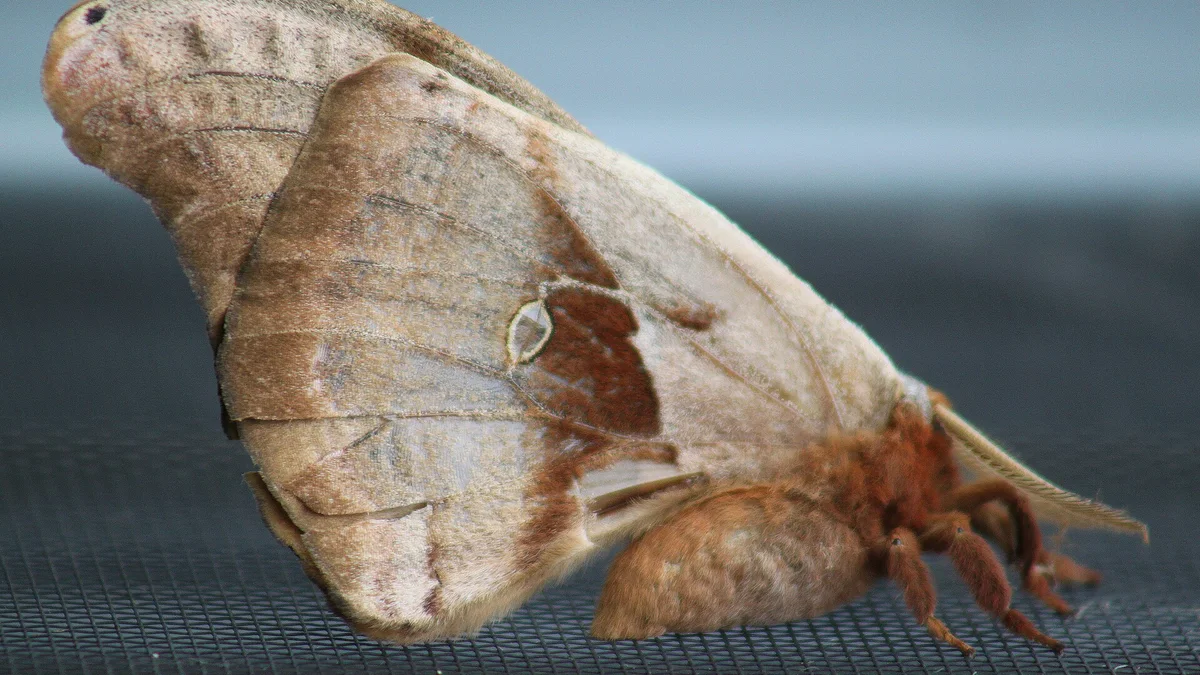
The polyphemus moth (Antheraea polyphemus) is a large tan to reddish brown giant silk moth, about 4 to 6 inches across, with a clear, yellow-ringed eyespot in the middle of each hindwing that gave it the name of the one-eyed Cyclops of Greek myth. It is the most widespread big silk moth in North America, found in all of the lower 48 states except Arizona and Nevada. Adults cannot eat and live only days. The plump, translucent green caterpillar grows to about 3 inches on oaks, maples, birches, willows and other trees, then spins a tough oval cocoon that usually falls to the ground with the leaves in autumn. It is harmless to people and gardens.
This guide covers identification, the caterpillar, every life stage and how long each lasts, what to do with a cocoon you find this winter, host trees, range, the separate western polyphemus of Arizona, why some populations are declining, and look-alikes. It draws on extension, agency, museum and peer-reviewed sources plus our own count of 67,355 US iNaturalist records. We make no claim of personal field experience with this moth.
Key Takeaways
- Look for the hindwing eyespot with a clear, see-through center. Males have much broader, feathery antennae than females, which is the easiest way to sex one.
- Adults have vestigial mouthparts and never feed. Sources give their lifespan as anything from a maximum of 4 days (Animal Diversity Web) to a few weeks at most (Missouri Department of Conservation).
- In our iNaturalist count, adults in the far north show one flight, peaking in late June, while moths from about 34 to 39°N show two peaks, in mid-May and mid-August. In the South they fly almost all year.
- If you find a cocoon, leave it outdoors. Many fall to the ground inside a leaf, so raking and shredding leaves in fall is a bigger risk to them than winter cold.
- Arizona has no polyphemus records in our count. Its big look-alike there is a separate species, the western polyphemus moth (Antheraea oculea).
Table of Contents
- How to Identify a Polyphemus Moth
- The Polyphemus Caterpillar
- Polyphemus Moth Life Cycle and Lifespan
- One Brood or Two? Our iNaturalist Count
- Found a Polyphemus Cocoon? What to Do
- What Polyphemus Caterpillars Eat
- Where Polyphemus Moths Live
- Is the Polyphemus Moth Rare or Declining?
- Polyphemus vs Luna, Cecropia and Other Silk Moths
- Porch Lights, Pollinators and Your Yard
- Frequently Asked Questions
How to Identify a Polyphemus Moth
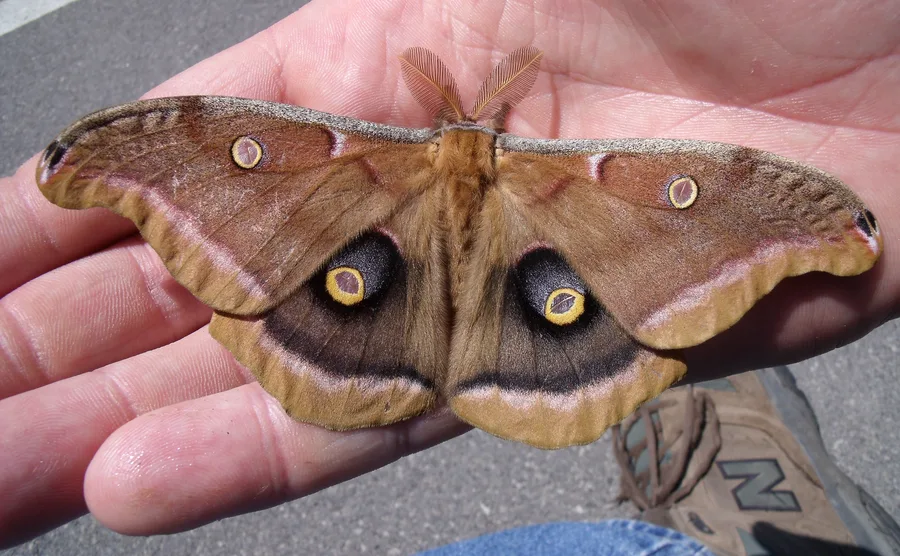
The polyphemus belongs to Saturniidae, the giant silk moth family, and was described by Cramer in 1776. The Missouri Department of Conservation (MDC) describes adults as large and butterfly-like, with a ground color that varies greatly, from brown or tan to bright reddish brown. Wikipedia also notes a surprising amount of color variation within the species, so check the pattern rather than the shade:
- Hindwing eyespots: one very large eyespot in the middle of each hindwing. The University of Florida’s Featured Creatures fact sheet by Donald W. Hall (EENY-531) describes yellow, partial white and black rings around it. The center is clear, so you can see through it.
- Forewing eyespots: a much smaller clear spot in the middle of each forewing.
- Lines: pink-edged white lines cross the forewings, and a black line edged in pinkish white crosses each hindwing, according to UF.
- Body: stout and furry, the same brown as the wings. That furry look is why a few websites call it the “tarantula moth,” a nickname with no scientific standing.
Butterflies and Moths of North America (BAMONA), the museum-backed species database, adds two details: the forewing margin is usually lighter than the base of the wing, and a thin pink line separates the hindwing eyespot from the base of the wing.
How big is a polyphemus moth?
Every source puts it among the largest moths in North America, but the figures differ slightly. Females are the bigger sex. The ranges below are what each source reports, not one survey.
| Source | Wingspan given |
|---|---|
| University of Florida EENY-531 (citing Covell 2005) | 10 to 15 cm (about 4 to 6 inches) |
| Butterflies and Moths of North America | 3 15/16 to 5 7/8 inches |
| Missouri Department of Conservation | 3½ to 5½ inches; the second largest moth in Missouri |
| Vermont Center for Ecostudies | Up to 5½ inches |
| Mississippi State University Extension | Approaching six inches |
Male vs female
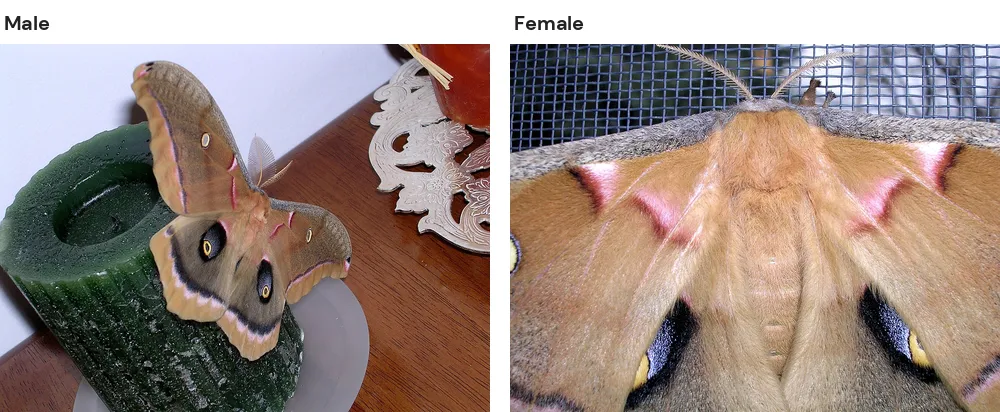
Look at the antennae. UF describes them as comb-like on four sides, with the male’s much larger. Males use those big antennae to follow the scent of a female, while females have narrower ones. MDC adds that males have smaller bodies, and Wikipedia notes the female’s abdomen is fuller because it carries eggs.
Why it is named after a cyclops
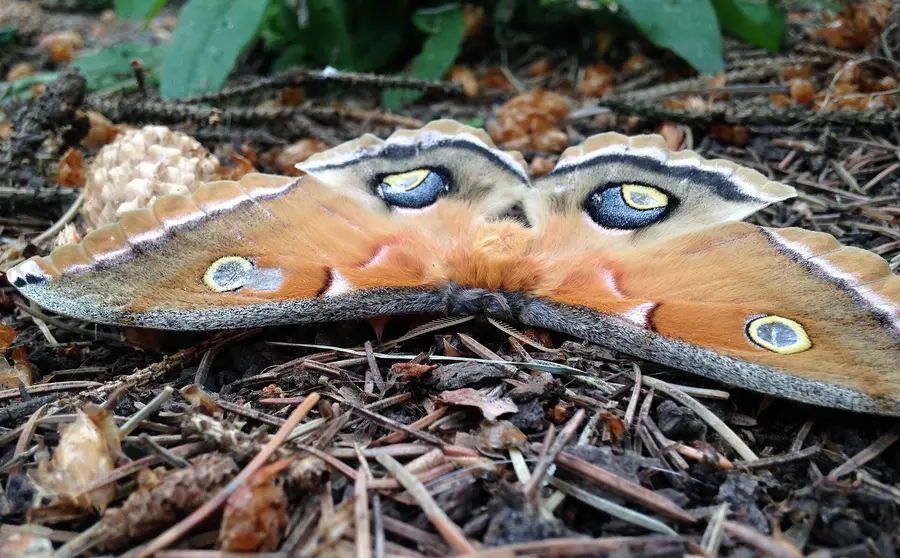
UF explains that the moth is named after Polyphemus, the giant cyclops of Greek mythology with a single large, round eye in the middle of his forehead, because of the big eyespots on the hindwings. MDC points to the cyclops of Homer’s Odyssey. The eyespots are a defense. Mississippi State says a resting moth keeps its hindwings hidden, but if disturbed it may move its forewings forward and expose the two big eyespots, which could startle a bird such as a blue jay into thinking it had met an owl.
The Polyphemus Caterpillar
The full-grown caterpillar is translucent yellowish green to green and about 2⅓ to 3 inches long, according to UF; MDC adds that the head is brown. Look for:
- Yellow lines across the middle of most body segments on the sides, running down past the breathing holes (spiracles).
- Small orange to red bumps (scoli) along the body. UF says the upper ones are partly silver, and MDC describes a metallic luster on top and calls the segments convex, or ballooned out.
- Younger caterpillars look different: UF says the first instar is white with two black bars across each segment, and later instars turn yellow-green.
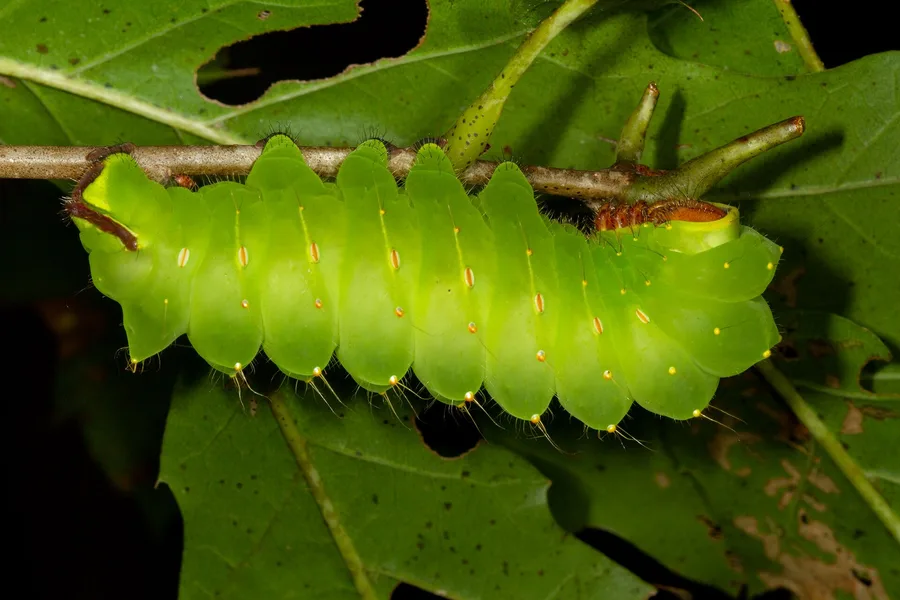
It is harmless. The bumps carry short bristles but no stinging spines, unlike the Io moth caterpillar. When poked, a polyphemus caterpillar may rear up the front of its body, click its jaws and spit up fluid. Mizzou IPM says caterpillars commonly click 50 to 55 times over more than a minute when attacked, and UF cites a 2007 study by Brown and colleagues in which the regurgitated fluid deterred ants and mice. If you see one doing this, it is defending itself, not threatening you.
The polyphemus caterpillar is easy to confuse with the luna moth caterpillar, which is also big and green. On the polyphemus, the yellow lines cross the middle of each segment; on the luna, our luna moth guide describes a narrow yellow band at the back edge of each segment. The cecropia moth caterpillar is bluish green with red, yellow and blue knobs, and the woolly bear caterpillar is fuzzy, not smooth.
Polyphemus Moth Life Cycle and Lifespan
The polyphemus goes through complete metamorphosis. The number of generations depends on latitude: UF says it has one brood a year from Pennsylvania northward and two from the Ohio Valley southward, and in Florida adults may be found in every month. The table gathers what each stage looks like and how long it lasts.
| Stage | How long | What to look for | Source |
|---|---|---|---|
| Egg | About 10 days | Slightly oval and flattened, white with two broad brown rings; laid singly or in twos and threes on host leaves | UF, BAMONA, ADW |
| Caterpillar | 5 to 6 weeks, five instars | White with black bars when tiny; translucent green with yellow lines across the segments when grown | ADW, UF |
| Cocoon and pupa | About 2 weeks in summer; all winter for the last brood | Oval, about 1½ inches long, usually wrapped in a leaf of the host plant | ADW, MDC, Mizzou IPM |
| Adult | Days, not weeks (see below) | Tan to reddish brown, huge clear eyespots; does not feed | UF, MDC |
Day length decides which path a pupa takes. UF cites research showing that caterpillars exposed to short days (8 to 12 hours of light) make overwintering (diapausing) pupae, while those exposed to long days (over 17 hours) make pupae that develop straight away. Adults usually emerge in the afternoon, and males often emerge several days before females from the same brood. Polyphemus and luna moths lack the escape valve that other big silk moths build into their cocoons, so UF says the moth releases an enzyme, cocoonase, to soften the silk at one end, then tears its way out with small spurs on its thorax.
How long do polyphemus moths live?
Not long as adults, because they cannot eat.
“Adults have vestigial mouthparts and do not feed. Therefore, they are short-lived.”
How short depends on whom you ask, and the top search results disagree:
| Source | Adult lifespan given |
|---|---|
| Animal Diversity Web (University of Michigan Museum of Zoology) | A maximum of only 4 days |
| Wikipedia | Less than one week |
| Missouri Department of Conservation | A few weeks at most |
| University of Florida EENY-531 | Short-lived (no number) |
No source we read cites a study that measured adult life in the wild, so treat “about a week, often less” as the honest summary. One popular identification site lists the adult lifespan as 3 months, which does not match any of these sources. It is closer to the length of the whole life cycle: Animal Diversity Web’s stage times (about 10 days as an egg, 5 to 6 weeks as a caterpillar, about 2 weeks as a pupa) add up to roughly two months for a summer generation. A moth from an overwintering cocoon has lived for months, but almost all of that time as a pupa.
Mating happens fast. BAMONA says adults emerge in the late afternoon and mate the same day, from late evening to early morning, and females lay eggs that evening. MDC says adults seek mates between about 11 p.m. and 1 a.m.
Watch a polyphemus raised from egg to moth
This video from the Bohart Museum of Entomology at UC Davis follows a polyphemus life cycle raised by Greg Kareofelas. According to the UC Agriculture and Natural Resources Bug Squad article that announced it, a moth came to his blacklight in Davis, California, on April 12, 2021, and laid eggs; the caterpillars fed on valley oak, and he reared and released nine moths that emerged in late June, less than two months from egg to adult. This summary is from that article; we could not read the video’s own description.
One Brood or Two? Our iNaturalist Count
To check the seasons with current data, we pulled every research-grade polyphemus moth observation in the United States from the iNaturalist API on November 22, 2026: 67,355 records. Of these, 39,209 were tagged as adults, 14,063 as caterpillars, 5,894 as cocoons or pupae and 192 as eggs.
- Adults: June (20.8%) and July (20.3%) are the busiest months, and May to August holds 70.8% of adult sightings.
- Caterpillars: September is the peak (28.8%), and August to October holds 71.0%. Caterpillars of the last brood are still feeding when the first leaves turn.
- Cocoons: 70.5% of cocoon and pupa records (4,156 of 5,894) fall between November and April, peaking in March. Leaves are off then, so this says as much about when people can see cocoons as about the insect.
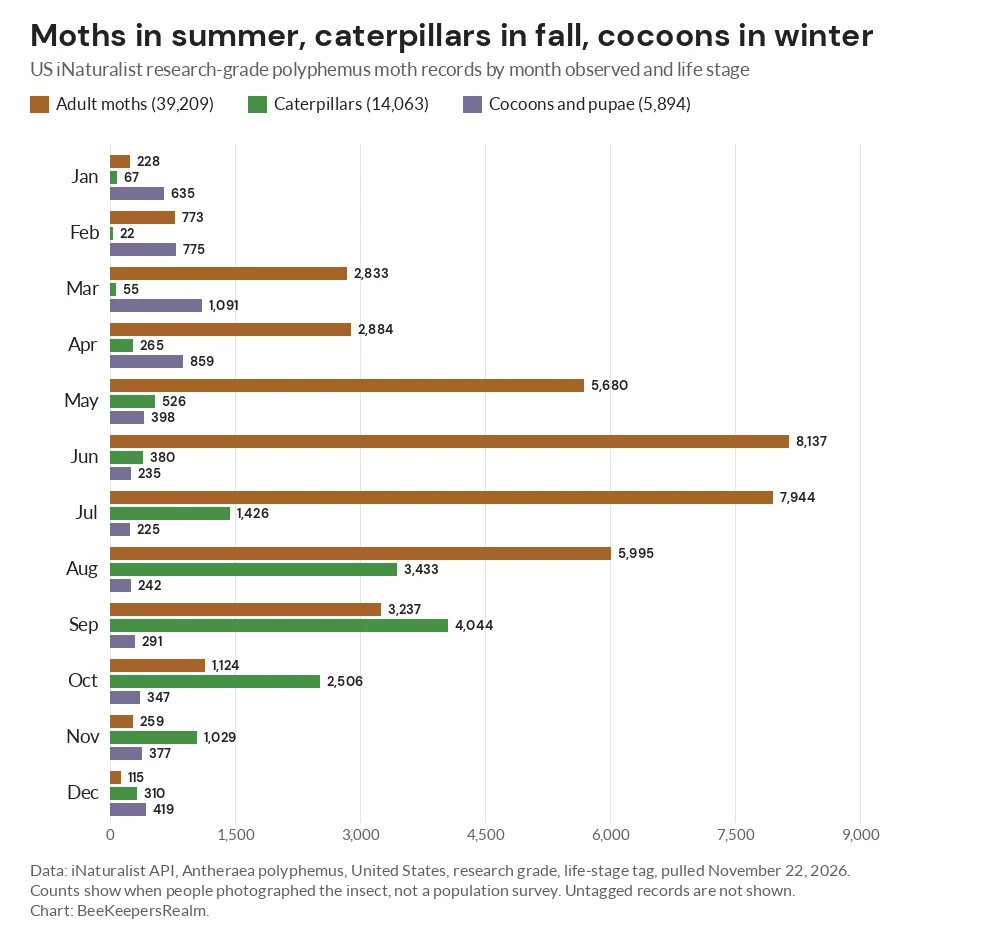
The national total hides a strong north to south pattern. We split adult records from the eastern two thirds of the country into four latitude bands and counted them by week.
- Far north (43 to 49.5°N, 3,532 adults): one hump. The busiest week is the last week of June, and 80% of sightings fall between about late May and late July. That is one generation a year, as UF and BAMONA describe for the North.
- North (39 to 43°N, 10,662 adults): one long hump from mid-May to mid-August with no clear gap, peaking in mid-July. This band straddles the line where UF says one brood gives way to two, so the records likely mix both patterns.
- Middle (34 to 39°N, 8,961 adults): two peaks, in mid-May and mid-August, with a dip in late June between them. That matches BAMONA’s two broods “from April-May and from July-August” in the Ohio Valley and southward.
- South (25 to 34°N, 13,112 adults): a peak in mid-March, a smaller one in mid-September and records in every week of the year. BAMONA describes several broods throughout most of the year in Florida, Texas and Louisiana, and Mississippi State says the moth completes two or three generations a year there.

Keep the limits in mind. iNaturalist counts when people photograph moths, and recent years dominate: 2026 added 11,964 US research-grade records, against 1,387 in 2017. Your own photos help; see our guide to citizen science programs for pollinators.
Found a Polyphemus Cocoon? What to Do
Polyphemus cocoons are tan to off-white, thick and egg-shaped, about 1½ inches long, and usually wrapped in one or more leaves of the tree the caterpillar fed on. UF says polyphemus caterpillars use the full range of cocoon placements known in their subfamily, as described by Wagner and Mayfield (1980):
- Fixed lengthwise along a twig, so the cocoon stays on the tree all winter.
- Hung from a twig by a short silk stalk. Mississippi State says these usually hang from a pencil-sized twig near the end of a limb, often with one or two dried leaves attached.
- Spun among leaves on the tree with no stalk, so most fall when the leaves do.
- Spun on the ground among fallen leaves, grass or other plants.
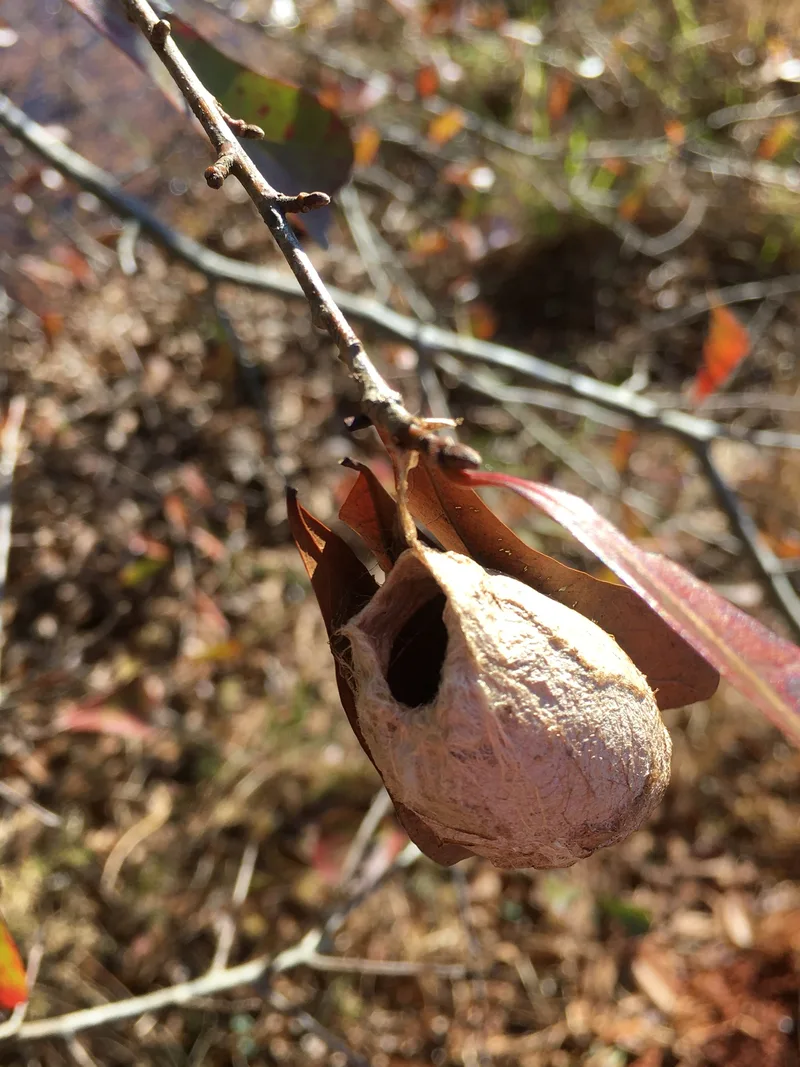
MDC says cocoons usually fall to the ground in autumn when the food plant drops its leaves, and NC State Extension says the same:
“While some cocoons remain attached to twigs over winter, many drop to the ground and sleep insulated within the fallen leaf layer.”
So the advice is to leave it alone, outdoors:
- Leave it where it is. The pupa inside needs winter conditions. For the related cecropia moth, Iowa State University Extension advises that cocoons discovered outside stay in the winter environment until late April and not be kept in the house through the winter. That advice is written for cecropia, but the reasoning fits a polyphemus cocoon too.
- Go easy on fall leaf cleanup under host trees. NC State suggests moving whole leaves into beds under trees and shrubs rather than shredding them, and says shredding destroys more than 90 percent of overwintering cocoons and chrysalises in the leaves.
- Read the hole. The Vermont Center for Ecostudies (VCE) says a small, circular exit hole at one end can mean a parasitic wasp emerged; the moth’s own exit hole is larger, and woodpeckers leave a ragged hole. An empty cocoon with a large opening means the moth is already gone.
- Expect the moth in spring. Mizzou IPM says the moth leaves the cocoon in late afternoon in April and May in Missouri. Farther south it can be earlier, farther north later.
- Record it. A dated photo on iNaturalist adds to the cocoon records in our chart.
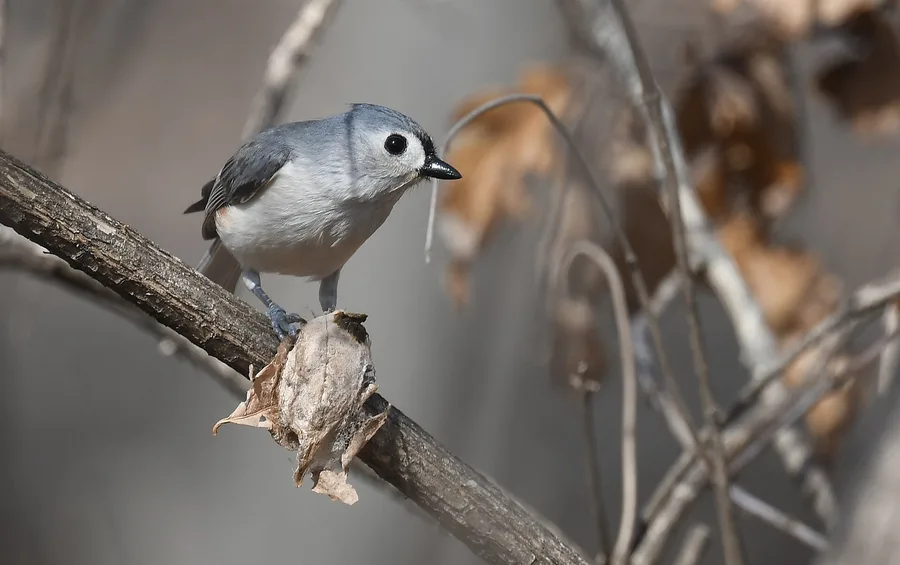
Cocoons have enemies besides rakes. UF lists squirrels and woodpeckers as predators of cocoons hanging in trees, and Animal Diversity Web says larvae and pupae are eaten by raccoons and squirrels.
What Polyphemus Caterpillars Eat
Polyphemus caterpillars are generalists. UF says they have been reported in nature from over 50 species of broad-leaved plants.
- Named most often: oaks, willows, maples and birches (BAMONA). MDC lists silver maple, birch, hazelnut and oak among the favorites of more than 20 Missouri trees and shrubs.
- Also listed: apple, dogwood, elm, hazel and hickory in Vermont (VCE); sweetgum, grape, hickory and members of the rose family (Animal Diversity Web); walnut, sycamore and elms in Missouri (Mizzou IPM, under trees where cocoons are found).
Several of these hosts, such as red maple, willows and oaks, also matter to bees in spring, as our list of nectar trees for bees shows, so a yard planted for pollinators is often already a polyphemus yard.
Damage is not a concern for home trees. UF says the caterpillars are never common enough to cause significant damage to their host trees, except occasionally in California where they may be pests of commercial plums. Mississippi State says they are not considered pests even when they feed on fruit trees, and Mizzou IPM says chemical control is unnecessary in most cases. Older caterpillars cut through the leaf stalk after eating a leaf, so the leaf stalk drops to the ground, a habit BAMONA suggests may be a defense that removes signs of feeding. UF adds that you can often detect large caterpillars overhead by their droppings (frass) on a driveway.
Where Polyphemus Moths Live
UF calls polyphemus moths “our most widely distributed large silk moths,” found from southern Canada into Mexico and in all of the lower 48 states except Arizona and Nevada. BAMONA words it as every state except Arizona and Nevada, and both BAMONA and Animal Diversity Web add every Canadian province except Newfoundland and Prince Edward Island. Both list the habitat as deciduous hardwood forests, urban areas, orchards and wetlands.
We checked that claim against iNaturalist on November 22, 2026:
- Arizona: 0 polyphemus records of any quality grade.
- Nevada: 2 research-grade records, one of them from the Mount Rose Wilderness above Lake Tahoe, near the California line, plus 2 casual records of captive moths in Reno.
- Alaska and Hawaii: 0, so “all of the lower 48 except Arizona and Nevada,” as UF puts it, is the more precise wording.
- The West is not empty: Washington (1,064 research-grade records), California (1,564) and Oregon (744) all have the species.
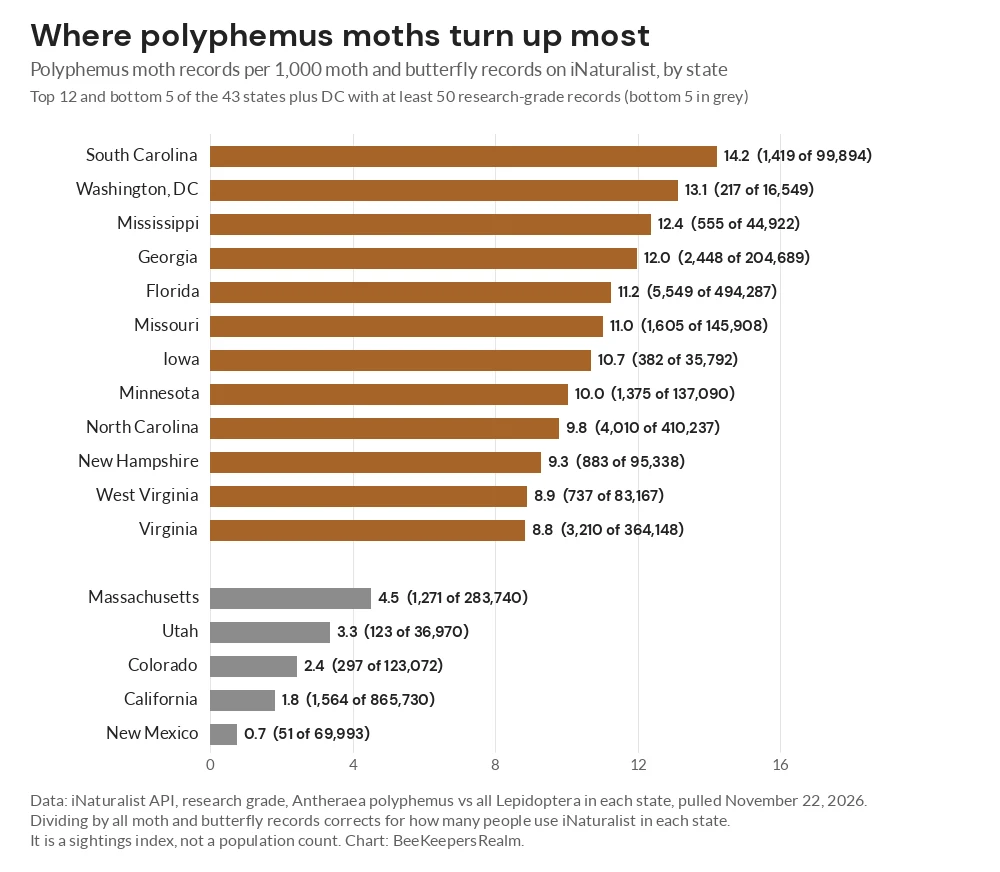
Raw counts mostly reflect how many people use iNaturalist, so we divided each state’s polyphemus records by all of its research-grade moth and butterfly records. Among the 43 states plus Washington, DC, with at least 50 records, the moth turns up most often in the Southeast and parts of the Midwest: South Carolina leads at 14.2 per 1,000, followed by Washington, DC (13.1), Mississippi (12.4), Georgia (12.0) and Florida (11.2). The lowest rates are in the West and Southwest, with New Mexico last at 0.7 and California at 1.8.
The western polyphemus moth of Arizona
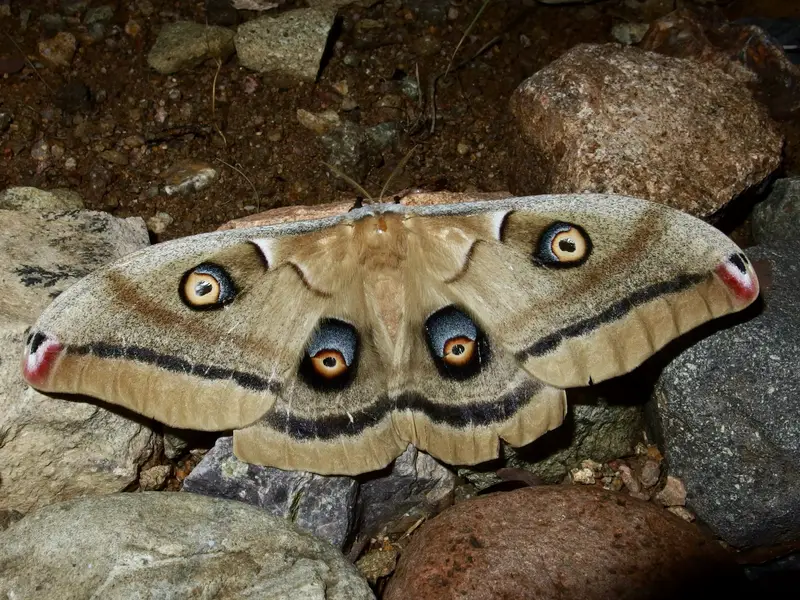
Arizona is not missing a big eyespot moth. It has its own: the western polyphemus moth, Antheraea oculea, which BAMONA treats as a separate species. BAMONA gives its range as the southwestern corner of New Mexico through the mountains of southern Arizona north to Flagstaff and the South Rim of the Grand Canyon, in oak woodland and mixed forest, with one brood from June to August on oaks and walnuts such as Emory oak and Arizona black walnut. BAMONA describes tan wings, sometimes tinted yellowish or reddish, a forewing margin the same color as the base, a black submarginal line, and rings around the eyespots that are orange, blue and black. iNaturalist lists 396 research-grade records of it in Arizona, 102 in New Mexico and 70 in Texas.
Is the Polyphemus Moth Rare or Declining?
Not rare overall. BAMONA calls it locally common in its broad range and ranks it G5, demonstrably secure globally, though it may be quite rare in parts of its range, especially at the edges. Illinois lists it as common. Vermont, near the northern edge, lists it as S3, uncommon. US iNaturalist users logged 11,964 research-grade records in 2026 alone.
Some populations are shrinking, though, and the suspect is a fly brought in to fight a pest.
“Populations of this and other giant silk moths are harmed by parasitic flies and wasps that were intentionally introduced into North America to prey on the invasive spongy moth.”
The best-known culprit is Compsilura concinnata, a tachinid fly introduced to North America again and again from 1906 to 1986 against 13 pest species, the spongy moth (formerly gypsy moth) among them, which also attacks native caterpillars. Two points are often blurred:
- The famous field data are not for polyphemus. The 1990s Massachusetts experiment by Boettner, Elkinton and Boettner (2000, Conservation Biology) measured the fly’s effect on cecropia and promethea caterpillars; the fly caused 81% of cecropia deaths in the first three instars and parasitized promethea heavily, according to the Conservation Evidence summary of that study. A 2017 to 2018 repeat at the same site found much less: 19% and 1% in 2017, then 3% and 0% in 2018, according to the published abstract by Baranowski and colleagues (2019).
- Polyphemus has many parasites of its own. UF cites a catalog by Tuskes and colleagues (1996) listing ten species of tachinid flies and several kinds of parasitic wasps that attack it. Wikipedia names Compsilura as one known threat to the polyphemus, but we found no field study measuring its effect on this species. Parasitic wasps are part of the story too; our guide to braconid wasps explains how these parasites use caterpillars as hosts.
Light is the other pressure. UF says adults are strongly attracted to light, particularly ultraviolet, and that there has been some concern that light pollution, especially mercury vapor street lights, may keep silk moths from mating in urban areas. Animal Diversity Web lists yellowjackets and ants among predators of the caterpillars; our guide to types of wasps covers the yellowjackets you are likely to see.
Polyphemus vs Luna, Cecropia and Other Silk Moths
No other common moth combines the polyphemus’s size, plain brown color and clear hindwing eyespots. Its look-alikes are mostly other silk moths seen at porch lights.
| Species | Wingspan | How to tell it apart | Where (US) |
|---|---|---|---|
| Polyphemus (Antheraea polyphemus) | 3 15/16 to 5 7/8 in | Reddish to yellowish brown; clear eyespots ringed yellow, blue and black; forewing margin usually lighter than the base | Lower 48 states except Arizona and Nevada |
| Western polyphemus (Antheraea oculea) | 3 15/16 to 5 7/8 in | Tan; forewing margin the same color as the base, black submarginal line, eyespot rings orange, blue and black | Southern Arizona, southwest New Mexico |
| Cecropia (Hyalophora cecropia) | 4 5/16 to 5 7/8 in | Dark wings with red-rimmed white crescents; red body with a white collar | East of the Rockies |
| Luna (Actias luna) | 2 15/16 to 4 1/8 in | Pale green with long hindwing tails | Eastern US |
| Io (Automeris io) | 2 to 3 1/8 in | Much smaller; each hindwing has a big black and blue eyespot with a white dash in the middle, not a clear window | Eastern and central US |
Wingspans and markings are from the BAMONA species pages; ranges are summarized from our own species guides. Another silk moth at the same lights is the small pink and yellow rosy maple moth. Silk moths are not the domesticated silkworm, which belongs to a different family.
Porch Lights, Pollinators and Your Yard
Polyphemus moths are not pollinators. Adults have vestigial mouthparts and never visit flowers. MDC’s field guide does say the adults serve a role in pollination, but that conflicts with its own statement on the same page that adults do not eat at all, and no source we read describes them feeding at flowers. Many other moths do pollinate at night, and a moon garden for moths is the way to plant for them. For a moth you will see on flowers by day, see our hummingbird moth guide.
What helps polyphemus moths is simple, and most of it also helps bees:
- Keep native host trees, especially oaks, maples, birches and willows.
- Leave some leaves under those trees in fall, as whole leaves rather than shredded.
- Turn off lights you do not need, especially in flight season. Our suggestion, not a tested rule: use shielded, warm-toned or motion-triggered lights near trees.
- Skip bug zappers. In a University of Delaware study summarized by Iowa State University Extension, only 31 of 13,789 insects killed by electric light traps in a suburban Newark, Delaware, black light trap over a summer (0.22%) were biting flies. UF says polyphemus adults are strongly attracted to light, particularly ultraviolet, which is what black light traps give off.
- Skip broad caterpillar sprays. The caterpillars do no real harm, and products such as Bt (Bacillus thuringiensis) cannot tell a pest from a silk moth. Our pollinator-safe pest control guide explains how to target treatments.
Beekeepers can relax about this one. A polyphemus resting on a hive is just using a convenient wall, since it cannot eat. The moths that matter in an apiary are wax moths, covered in our guide to stopping wax moth infestations.
Frequently Asked Questions
Is the polyphemus moth rare?
No. BAMONA ranks it G5, secure, and calls it locally common, and it is the most widespread large silk moth in the US. It is uncommon in some places, such as Vermont (S3), and seeing an adult is luck, since each one lives only days.
Are polyphemus moths poisonous or dangerous?
No. Adults cannot bite, and the caterpillar has no stinging spines. A caterpillar that is handled roughly may click its jaws and spit up fluid, which is unpleasant but harmless. Handle any insect gently and wash your hands afterward.
Do polyphemus moths eat?
Adults do not. UF says their mouthparts are vestigial, so they live on fat stored by the caterpillar. Only the caterpillar eats, mostly the leaves of oaks, maples, birches and willows.
How long do polyphemus moths live?
As winged adults, from a maximum of 4 days (Animal Diversity Web) to a few weeks at most (MDC); about a week is a fair summary. A summer generation takes roughly two months from egg to adult, while the last brood of the year spends the winter as a pupa.
What does a polyphemus caterpillar turn into?
The big translucent green caterpillar with yellow lines across its segments becomes the polyphemus moth. It spins an oval, leaf-wrapped cocoon and emerges as a moth after about 2 weeks in summer, or the next spring if it spends the winter there.
How long does a polyphemus cocoon take to hatch?
About 2 weeks for a summer pupa, according to Animal Diversity Web. Cocoons spun in late summer and fall usually wait until spring; Mizzou IPM says moths leave them in April and May in Missouri.
Where are polyphemus moths found?
In southern Canada, Mexico and all of the lower 48 states except Arizona and Nevada, according to UF. In southern Arizona and southwest New Mexico, the similar western polyphemus moth takes its place.
What is a tarantula moth?
It is a nickname some websites use for the polyphemus moth because of its large, furry body. It is not a separate species, and the moth is not related to tarantulas.
Next Step
If you find a polyphemus cocoon this winter, photograph it, leave it outdoors and check back in spring for the exit hole. For more insects US gardeners ask about, see our guides to the praying mantis, the cicada and the sawfly, whose larvae are often mistaken for caterpillars. This page is educational wildlife information, not pest-control advice.
Sources
- Donald W. Hall, University of Florida IFAS Extension, Featured Creatures EENY-531/IN945, “Polyphemus Moth” (2012)
- Butterflies and Moths of North America, Antheraea polyphemus species page and Antheraea oculea species page
- Missouri Department of Conservation, Field Guide, “Polyphemus Moth”
- Amanda Bratcher, N.C. Cooperative Extension, Lee County Center, “Lives in the Leaves” (November 14, 2022, updated November 10, 2026)
- Baranowski AK, Conroy C, Boettner GH, Elkinton JS, Preisser EL, “Reduced Compsilura concinnata parasitism of New England saturniid larvae,” Agricultural and Forest Entomology 21(3): 346-349 (2019)
- Boettner GH, Elkinton JS, Boettner CJ, “Effects of a biological control introduction on three nontarget native species of saturniid moths,” Conservation Biology 14: 1798-1806 (2000), read via the Conservation Evidence study summary
- Blake Layton, Mississippi State University Extension, “Polyphemus Moth,” Bug’s Eye View Vol. 3 No. 1 (2017); Michele Warmund, University of Missouri IPM, “Polyphemus and Cecropia Moths” (March 29, 2016); Vermont Center for Ecostudies, Vermont Atlas of Life, “Polyphemus Moth”; Rutika Kalola and Stevie Steffey, Animal Diversity Web, “Antheraea polyphemus“; Illinois Department of Natural Resources, “Polyphemus Moth”; Braelei Hardt, National Wildlife Federation blog, “Leaf Layer Safari” (September 29, 2025); Donald Lewis, Iowa State University Extension, “Bug Zappers are Harmful, Not Helpful” (June 14, 1996); Iowa State University Extension, Yard and Garden encyclopedia, “Cecropia Moth”; Kathy Keatley Garvey, UC ANR Bug Squad (July 22, 2021); Wikipedia, “Antheraea polyphemus” (read November 22, 2026)
- iNaturalist research-grade observations of Antheraea polyphemus, Antheraea oculea and all Lepidoptera in the United States, via the iNaturalist API, pulled November 22, 2026
Image credits: featured photo of a polyphemus moth at Missisquoi National Wildlife Refuge, Vermont, by Ken Sturm, U.S. Fish and Wildlife Service, public domain, via Wikimedia Commons, cropped to 16:9 and resized. Other photo credits are in each caption. Charts are by BeeKeepersRealm from iNaturalist data.