Reviewed by Daniel M. · How we review
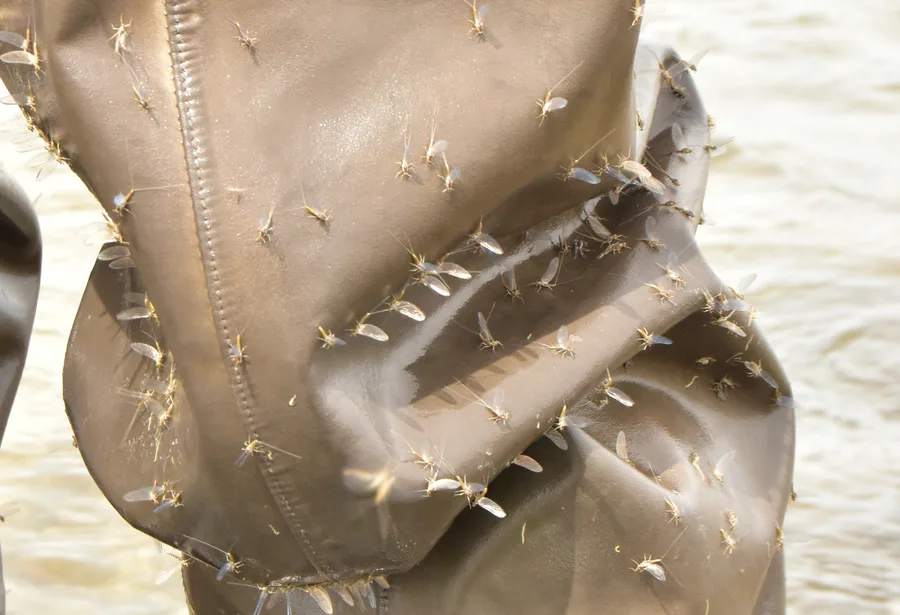
A mayfly is a soft-bodied aquatic insect of the order Ephemeroptera that spends months to a few years underwater as a nymph, then lives only hours to a few days as a winged adult that cannot eat, bite or sting. North America has more than 600 species. Their huge summer swarms along rivers and lakes are a nuisance for a few nights, but they are also a sign of clean water and a major food source for fish, birds and bats.
Below: how to recognize a mayfly, its unusual two-step final molt, when mayflies are out in the US (from our count of 7,170 research-grade iNaturalist records), why giant mayfly swarms show up on weather radar, what they tell you about a river or lake, and what to do when they cover your porch.
Key Takeaways
- Mayflies are not true flies. They belong to their own order, Ephemeroptera, with more than 600 species in North America north of Mexico (Missouri Department of Conservation).
- Adults have only vestigial mouthparts. They cannot eat, drink or bite, and most live a day or two, but the whole life cycle usually takes about a year (Mississippi State University Extension).
- Mayflies are the only insects that molt again after they have working wings: the dull, cloudy-winged subimago, or “dun,” becomes the shiny, clear-winged adult “spinner” (NC State University).
- In US iNaturalist research-grade records, June and July hold 43.5% of all mayfly sightings and 56.0% of giant mayfly (Hexagenia) sightings.
- Big hatches mean healthy water. Burrowing mayflies were nearly wiped out of western Lake Erie in the 1950s by pollution and came back after cleanup (USGS).
- Mayflies are not pollinators. Their value to a garden is as food for birds, bats and fish; at the house, dim or yellow outdoor lights work better than sprays.
Table of Contents
- What a Mayfly Is and How to Recognize One
- The Mayfly Life Cycle: Nymph, Dun and Spinner
- How Long Do Mayflies Live?
- Mayfly Season: When They Hatch in the US
- Mayfly Swarms, Weather Radar and Giant Mayflies
- Mayflies as a Sign of Clean Water
- Do Mayflies Bite or Carry Disease?
- What to Do When Mayflies Cover Your House
- Mayflies, Bees and the Backyard Food Web
- Frequently Asked Questions
What a Mayfly Is and How to Recognize One
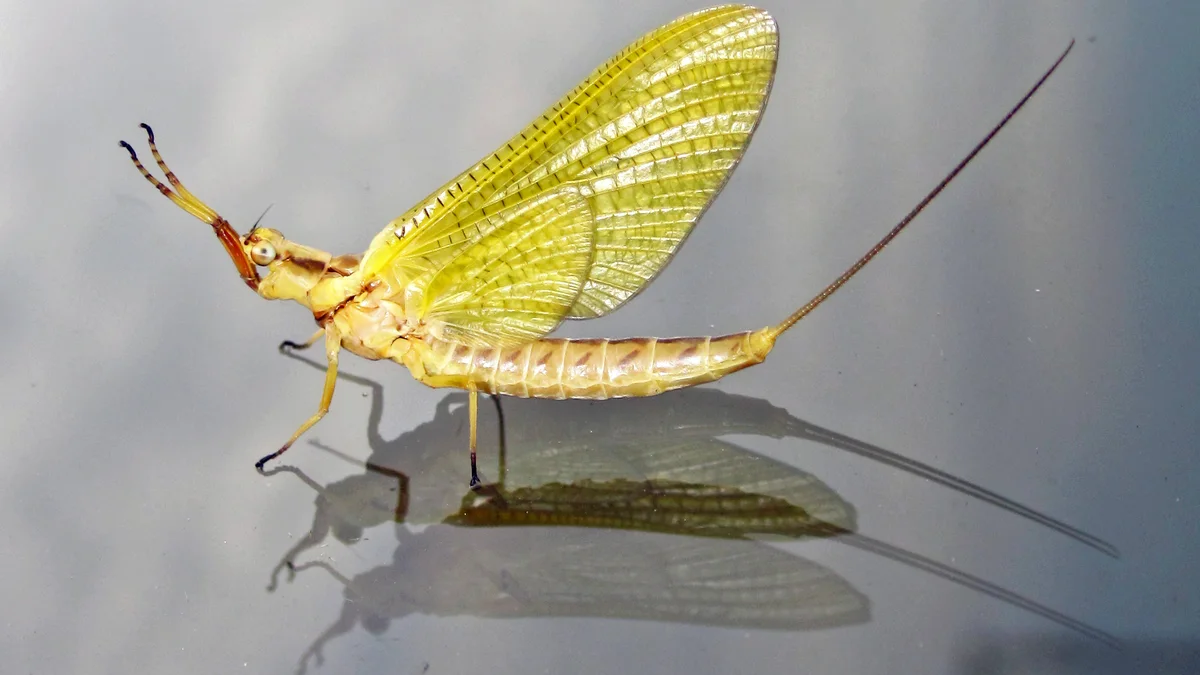
Mayflies make up the insect order Ephemeroptera, from Greek words for “short-lived” and “wing.” Despite the name, they are not related to house flies or other true flies. Counts of North American species differ by source and date: more than 600 in the Missouri Department of Conservation field guide, 611 in 21 families according to the University of Wisconsin-Milwaukee Field Station, and about 658 in NC State University’s insect identification guide. Worldwide there are more than 3,000. People also call them shadflies, lake flies, willowflies or fishflies, though the name fishfly also belongs to an unrelated insect in another order.
Field marks of an adult mayfly, from the Missouri guide and University of Minnesota Extension:
- Wings: four clear, heavily veined wings held upright and together over the back, like a butterfly at rest. The front pair is much larger than the hind pair, which is tiny or missing in some species.
- Tails: two or three long, threadlike filaments at the tip of a slender abdomen.
- Size: about 1/4 inch to 1 1/4 inches long.
- Head and legs: short antennae and large eyes. Males use enlarged front legs to grab and hold females (University of Kentucky).
- Where: near water, and often on walls, windows and screens under outdoor lights.
Mayfly look-alikes
The Wisconsin field station names the two common mix-ups. Caddisflies also have aquatic young and also fold their wings over the abdomen, but the wing shape is different. Stonefly nymphs look like mayfly nymphs, but mayfly nymphs almost always have three tails, while stonefly nymphs have two tails and gills on the thorax instead of along the abdomen. Long-legged crane flies are true flies with only one pair of wings. Clouds of tiny midges also rise from lakes on summer nights; see our guide to gnats for those.
The Mayfly Life Cycle: Nymph, Dun and Spinner
Mayflies have incomplete metamorphosis (University of Kentucky): the young grow in stages without a pupa. What makes them unique is the end of the cycle. The Missouri guide says mayflies are “the only insect to have two” adult molts, and NC State puts it as the only insects that molt when they already have wings.
| Stage | Where it lives | How long it lasts | What happens |
|---|---|---|---|
| Egg | Bottom of a stream, river, pond or lake | Up to a year, depending on water temperature and quality (UWM) | A female lays about 500 to 3,000 eggs on or under the water surface (UWM). |
| Nymph (naiad) | Under rocks, in silt or burrows, on plants | As little as four weeks to four years (NC State) | Grazes algae and debris, breathes with leaflike gills, molts as many as two dozen times (UWM). |
| Subimago (dun) | A leaf or stem near the water | Usually a few hours (University of Kentucky); rarely more than a day | The first winged stage: cloudy wings and a dull body, not yet able to mate (NC State). |
| Imago (spinner) | Air above the water, in mating swarms | Hours to a few days (MDC) | Clear wings, shiny body and longer tails; mates, lays eggs and dies without feeding. |
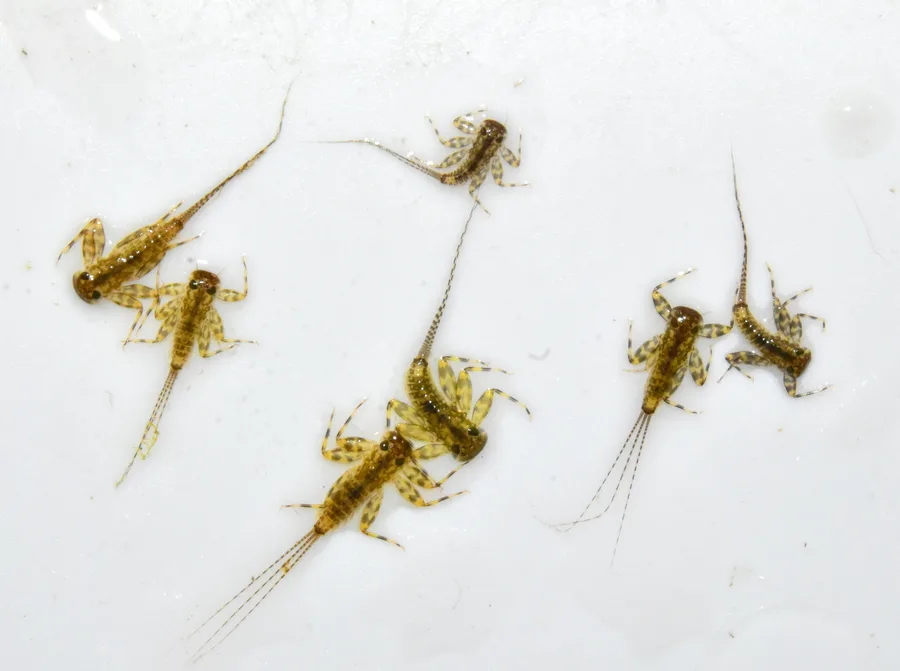
Most nymphs creep over submerged rocks and plants eating algae and small bits of plant matter (MDC). A few, NC State notes, are burrowers that dig U-shaped tunnels in sand or mud; the giant mayflies of the genus Hexagenia live this way in soft lake and river bottoms (USGS). When a nymph is grown it rises to the surface, molts into a winged subimago and flies to a nearby leaf or stem. Anglers have their own names for the two winged stages, NC State notes: the dun is the subimago and the spinner is the adult.
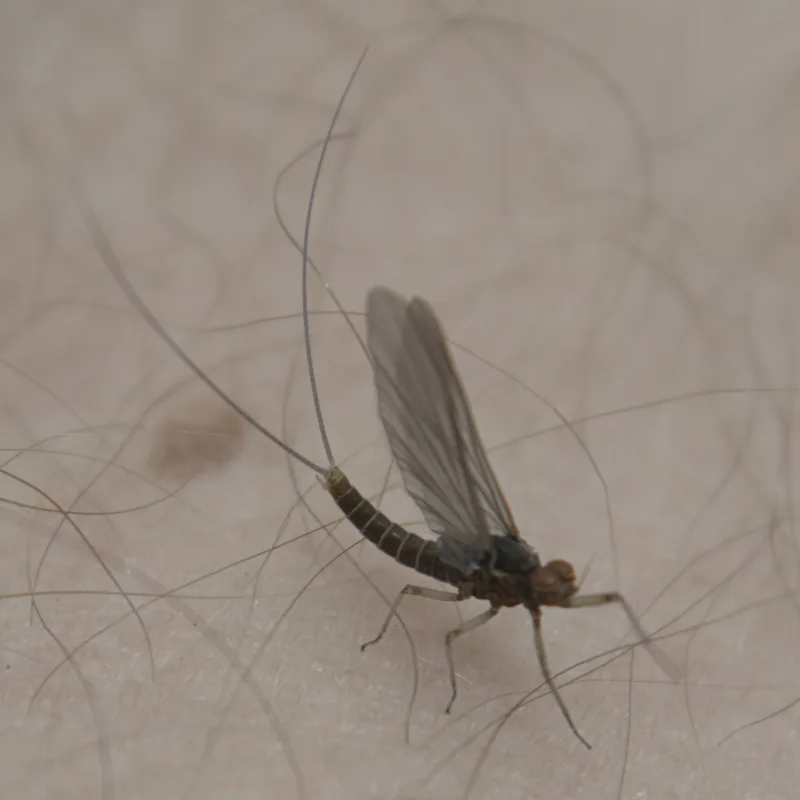
Within minutes to hours the dun molts once more. Then, the Wisconsin field station writes, males form “dense, dancing clouds” in calm air above the water, often at dawn or dusk; females fly in and pair up, and mating is brief. The female lays her eggs on or under the water, and the cycle starts again.
How Long Do Mayflies Live?
A mayfly is short-lived only as an adult. University of Kentucky entomologist Blake Newton writes that adults “only live for a day or two, just long enough to mate and lay eggs,” and the Wisconsin field station says most adults live three days at most. The reason is built into the body: once it reaches the winged stage a mayfly has only vestigial mouthparts and “cannot eat or drink” (MDC), so it runs on what it stored as a nymph.
Counted from the egg, mayflies are not short-lived at all. Mississippi State University Extension entomologist Blake Layton notes that most species have an annual life cycle, so most adult mayflies are about a year old when they die. NC State adds that some species need up to four years to complete development.
The record for the shortest adult life belongs to a US species. Field studies of the American sand-burrowing mayfly (Dolania americana) on Florida’s Blackwater River found that the female dies within about five minutes of emerging, after mating and laying her eggs. It is rarely seen: iNaturalist has only 4 research-grade US records of it.
Mayfly Season: When They Hatch in the US
Mayflies are not limited to May. University of Minnesota Extension lists adults from May into September, and different species emerge at different times, so a stream can have small hatches from early spring to fall.
To see the national pattern, we pulled every research-grade US mayfly observation from the iNaturalist API on November 22, 2026. A record is research grade when at least two people agree on the identification. There were 7,170, of which 2,666 (37.2%) are giant mayflies of the genus Hexagenia.
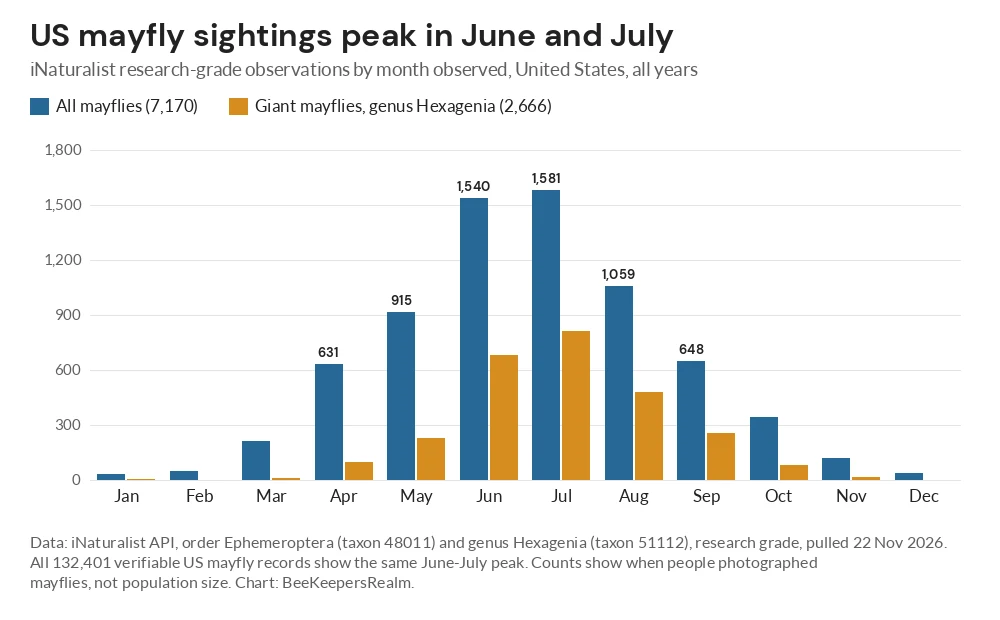
June (1,540 records) and July (1,581) are the busiest months, and May through August hold 71.1% of the year’s sightings. Giant mayflies are even more concentrated: 56.0% of their records fall in June and July, with July (811) the peak. Every month has some records, from 35 in January to 37 in December. Part of the reason is that nymphs live underwater all year: the 350 research-grade records tagged as nymphs are spread across all 12 months, while the 1,246 tagged as adults peak in June.
One caution about the data: mayflies are hard to identify from photos. Only 5.4% of the 132,401 verifiable US mayfly records on iNaturalist have reached research grade. The large, distinctive Hexagenia reach it far more often than small species, which inflates their share. The full 132,401-record set shows the same June and July peak (42.1% of records).
The most-recorded US mayflies
Research-grade records cover 194 species. The giant mayfly Hexagenia limbata leads with 2,234, followed by the dark cahill (Stenonema femoratum, 616), the river mayfly Pentagenia vittigera (497), the speckled dun Callibaetis pictus (443) and the emergent mayfly Hexagenia bilineata (330). Other mayfly groups on iNaturalist carry names familiar to trout anglers, such as green drakes, Hendricksons, sulphurs and blue-winged olives.
Mayfly Swarms, Weather Radar and Giant Mayflies
The swarms that make the news come mostly from burrowing mayflies such as Hexagenia, rising from the Upper Mississippi River, western Lake Erie and other big lakes and rivers with soft bottoms. Emergence is sudden and nearly simultaneous across a population (NC State), so millions come out at once. Layton compares it to periodical cicadas: fish, birds and other predators cannot eat them all before they mate and lay eggs. Our guide to cicadas covers that other famous mass emergence.
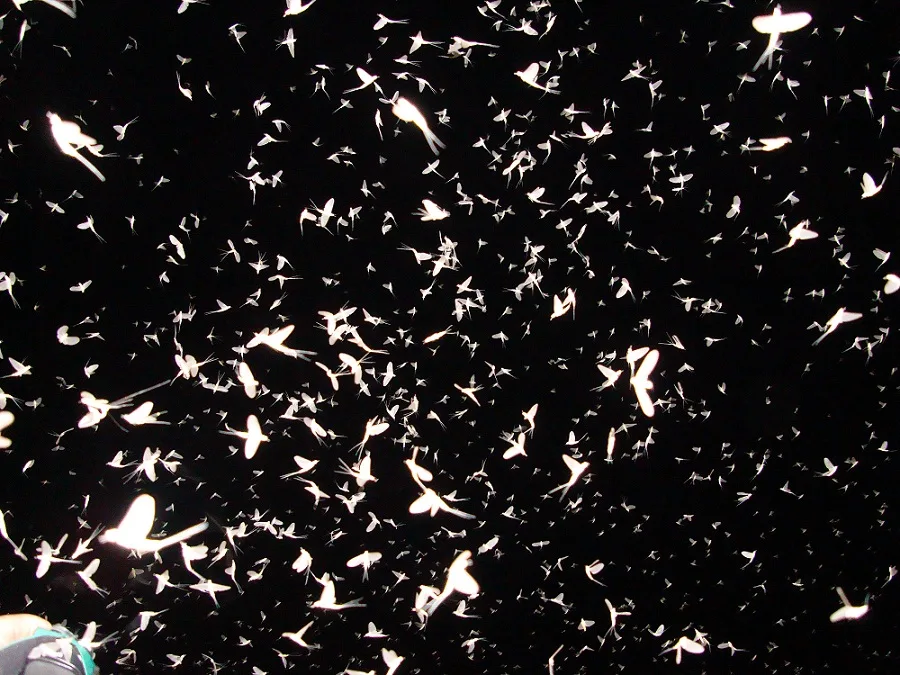
The clouds are big enough for weather radar. Layton writes that heavy emergences “show up clearly on weather radar,” looking like a light to moderate thunderstorm. The National Weather Service office in La Crosse, Wisconsin, posts radar loops of hatches off the Mississippi; its page on the first hatch of 2016, on July 2, describes blue and green reflectivity “coming off the Mississippi River.”
Researchers have turned that radar signal into counts. A team led by Phillip Stepanian, with the University of Oklahoma, Notre Dame, Virginia Tech and NOAA, used weather radar over the Upper Mississippi and western Lake Erie. Their 2020 study in PNAS recorded up to 87.9 billion mayflies in a single emergence, releasing more than 3,000 tons of biomass into the air within hours, according to the journal’s news release. The University of Oklahoma summary puts it at up to 88 billion mayflies per location each year.
That many insects cause real, if short, problems. The Wisconsin field station notes that some lakeside and river communities call in snowplows in summer, because the mayflies’ slippery bodies cover roads and bridge surfaces and impair visibility. Layton reports safety hazards from mayflies piling up on walkways, roads and buildings around Mississippi’s Ross Barnett Reservoir in heavy years, and the University of Kentucky notes the piles that form when they all die at once are foul-smelling. Because the adults live only a day or two, each emergence clears quickly.
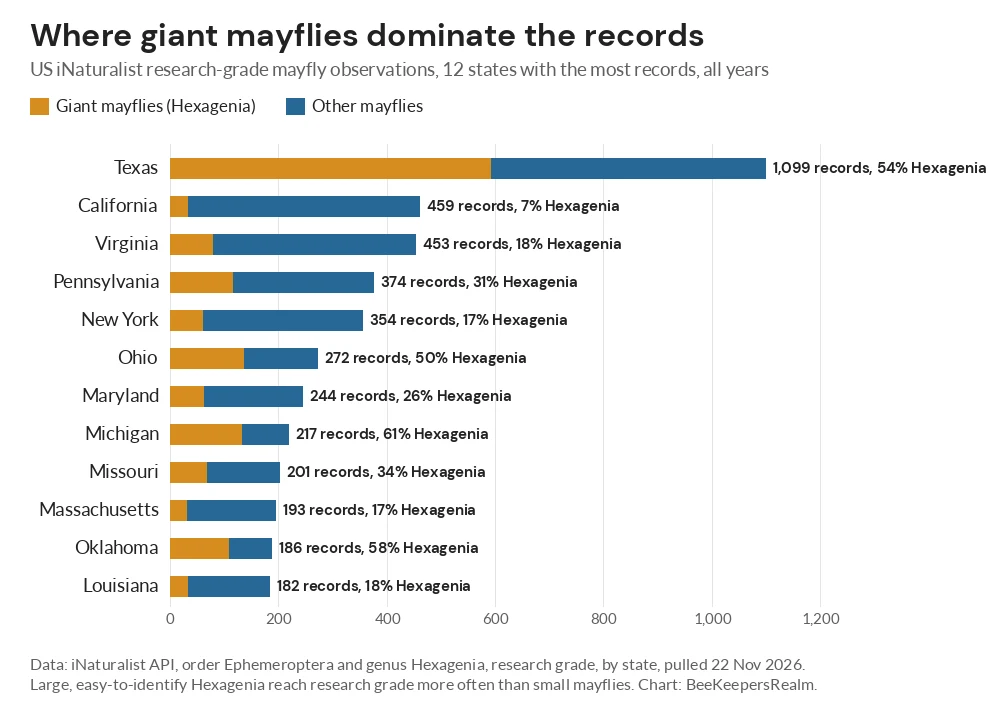
Where giant mayflies show up most
By state, Texas has the most research-grade mayfly records (1,099), and 54% of them are Hexagenia. Giant mayflies make up 61% of records in Michigan, 60% in Minnesota, 50% in Ohio and 74% in Georgia, but only 7% in California. Across 12 western states they are only 13.7% of 983 records. The eight Great Lakes states, from Minnesota to New York and Pennsylvania, sit near the national average at 39.1% (700 of 1,791). These shares reflect where people photograph mayflies and which ones are easy to identify, not a population survey.
Mayflies as a Sign of Clean Water
Most mayfly nymphs grow up in well-oxygenated, unpolluted streams and rivers (UWM), and the University of Kentucky notes they are especially sensitive to pollution. That is why biologists use them to grade streams. A standard EPA survey metric is the number of EPT taxa in a sample: mayflies (Ephemeroptera), stoneflies (Plecoptera) and caddisflies (Trichoptera). The US Environmental Protection Agency explains why bottom-dwelling insects work as a test:
“In fact, because they cannot escape pollution, macroinvertebrates have the capacity to integrate the effects of the stressors to which they are exposed, in combination and over time.”
Lake Erie is the classic case. A USGS study reports that in the 1950s burrowing mayflies (Hexagenia limbata and H. rigida) were “virtually eliminated” from the western basin of Lake Erie, an area of about 3,300 square kilometers, because of eutrophication and pollution. The same study warned that recovery of large ecosystems “may lag substantially behind remediation efforts.” They did come back: the radar study described above tracked annual mass emergences over the western basin from 2012 on. In a paper listed in the USGS Publications Warehouse, T.A. Edsall gave five reasons burrowing mayflies make a good Great Lakes health indicator: they were once abundant in unpolluted, soft-bottomed habitats, were wiped out by pollution in the 1940s and 1950s, recovered in one habitat after pollution was reduced, and link lake-bottom sediments directly to the fish that feed on them. The fifth is the one anyone can see:
“have highly visible mating flights, which carry the message directly to an informed public that the source water body is healthy.”
Big hatches are not guaranteed to last. The radar study found emergences fell 84% in western Lake Erie from 2015 to 2019 and 52% on the Upper Mississippi from 2012 to 2019. The study did not establish a cause; the journal release says the declines may reflect poorer water quality from a mix of warming water, nutrient-rich runoff and pesticides. A messy mayfly night on the porch is, in that light, good news.
Do Mayflies Bite or Carry Disease?
No. Adult mayflies have only vestigial mouthparts, so they cannot bite, and they have no stinger. PestWorld.org states that mayflies “do not sting nor bite,” and University of Minnesota Extension says they “do not harm people or property.” We found no extension or health source that lists mayflies as carriers of any human disease, and an adult that never feeds has no bite through which to pass one on.
The one health note is allergy. The Wisconsin field station writes that mayflies are harmless “but some people are allergic to large quantities of mayfly bits,” such as the dead bodies and shed skins that pile up after a big hatch. If you are sensitive, wear a dust mask for cleanup and sweep up remains promptly.
What to Do When Mayflies Cover Your House
Mayflies come to lights on summer nights when water is nearby (University of Kentucky), and PestWorld notes the result: swarms around buildings at night and piles of dead insects under lights and windows in the morning. The adults die on their own within days, so spraying adds little.
“Physical controls, such as light management, physical exclusion, leaf blowers, vacuums, and brooms and dust pans are usually more effective than insecticides for coping with these types of mass emergences.”
Layton’s separate Bug’s Eye View issue on light management gives the specifics:
| Step | What to do | Why it helps |
|---|---|---|
| Fewer, dimmer lights | Limit the number and brightness of outdoor lights; use timers or motion sensors | Less light means fewer night-flying insects drawn in |
| Change the bulb | Yellow “bug lights,” yellow LEDs or high-pressure sodium lights | These wavelengths attract fewer insects |
| Shield fixtures | Point light down where it is needed | Less light escapes “out into the night” |
| Light from a distance | Pole lights 50 feet or more from the building, aimed at entrances | Insects gather at the pole, not the door |
| Close blinds | Draw curtains at night | Keeps indoor light from pulling insects to windows |
| Clean up | Sweep, vacuum or use a leaf blower on steps, decks and walkways (Layton) | Prevents slippery walkways and foul-smelling piles |
If you live on a lake or river, expect a hatch every year; Layton notes emergences happen annually, with bigger populations in some years than others. Keep porch lights off on the June and July nights when they fly. If you are tempted to spray for other insects, check our guide to pollinator-safe pest control products first: pesticides are one of the suspected causes of recent mayfly declines.
Mayflies, Bees and the Backyard Food Web
Mayflies are not pollinators. Adults do not feed, so they have no reason to visit flowers, unlike lovebugs, which sip nectar. Like the luna moth, the adult mayfly lives only to mate.
Their value is as food. The Wisconsin field station lists the predators: eggs and nymphs feed aquatic insects, snails, crayfish, leeches and fish, and adults are eaten by birds, bats, dragonflies, spiders, frogs and shrews. Web-building spiders such as orb weavers also take insects drawn to lights, and Layton notes that insect buildup around outdoor lights brings more spider webs. The OU researchers describe the summer swarm as an important component in the food chain for birds, and Missouri’s guide says all life stages are favorite foods for trout, bass and other fish.
That food role is why anglers watch them. Trout fishermen tie flies that mimic each stage so they can “match the hatch,” and in Mississippi, Layton notes, bream anglers watch for mayfly hatches on the larger lakes.
For a yard near water, the honest tie to bees is shared habitat, not pollination. Honey bees drink from ponds and streams too (see why bees need a reliable water source), so keeping fertilizer and pesticide runoff out of the water helps both. And the light changes that keep mayflies off the porch also help moths, which Layton lists among the night fliers drawn to lights; our moon garden for moths guide covers lighting a yard for these night pollinators.
Frequently Asked Questions
Do mayflies live for only 5 minutes?
Only one known species comes close: the female American sand-burrowing mayfly dies within about five minutes of emerging. Most adult mayflies live one to three days, after spending months to years underwater as nymphs.
Do mayflies bite or sting?
No. Adults have only vestigial mouthparts and no stinger. They cannot feed at all, so they cannot bite people or pets.
Why is a mayfly’s lifespan so short?
The adult cannot eat or drink, so it survives only on reserves stored as a nymph. Its only job is to mate and lay eggs, and mass emergence in a few days helps enough survive predators to do that.
What is the purpose of mayflies?
They are food for fish, birds, bats, frogs and spiders, they recycle algae and plant debris as nymphs, and their presence tells scientists a stream or lake is healthy.
What is another name for a mayfly?
Shadfly, lake fly, fishfly and willowfly are common regional names. Anglers call the subimago a dun and the adult a spinner.
When is mayfly season?
In US iNaturalist records, mayflies peak in June and July, with adults present from about May into September. Exact hatch nights depend on the species and on water temperature.
How do you get rid of mayflies?
You do not need to. Turn off or dim outdoor lights during a hatch, switch to yellow bulbs, close blinds, and sweep up the remains. Insecticides are not needed, because the adults die within days.
Are mayflies attracted to light?
Yes. Near water they gather on lit walls, windows and doorways at night, which is why light management is the main fix.
The Bottom Line
A mayfly swarm is a few messy nights from an insect that cannot bite, does not feed and dies within days. Dim the porch lights during the June and July hatch, sweep up afterward, and take the swarm as evidence that the water nearby is doing well.
Image credits: Featured image: giant mayfly (Hexagenia limbata) in Mitchell, South Dakota, by James St. John, Wikimedia Commons, CC BY 2.0, cropped to 16:9 and resized. Adult mayfly and mayfly nymph: Tom Koerner/U.S. Fish and Wildlife Service, public domain, resized. Mayfly dun: JerryFriedman, CC BY-SA 3.0, resized. Mayfly swarm: National Park Service, public domain. All photos via Wikimedia Commons; links to each file page and licence are in the captions. Charts: BeeKeepersRealm, from iNaturalist API data pulled November 22, 2026.