Reviewed by Daniel M. · How we review
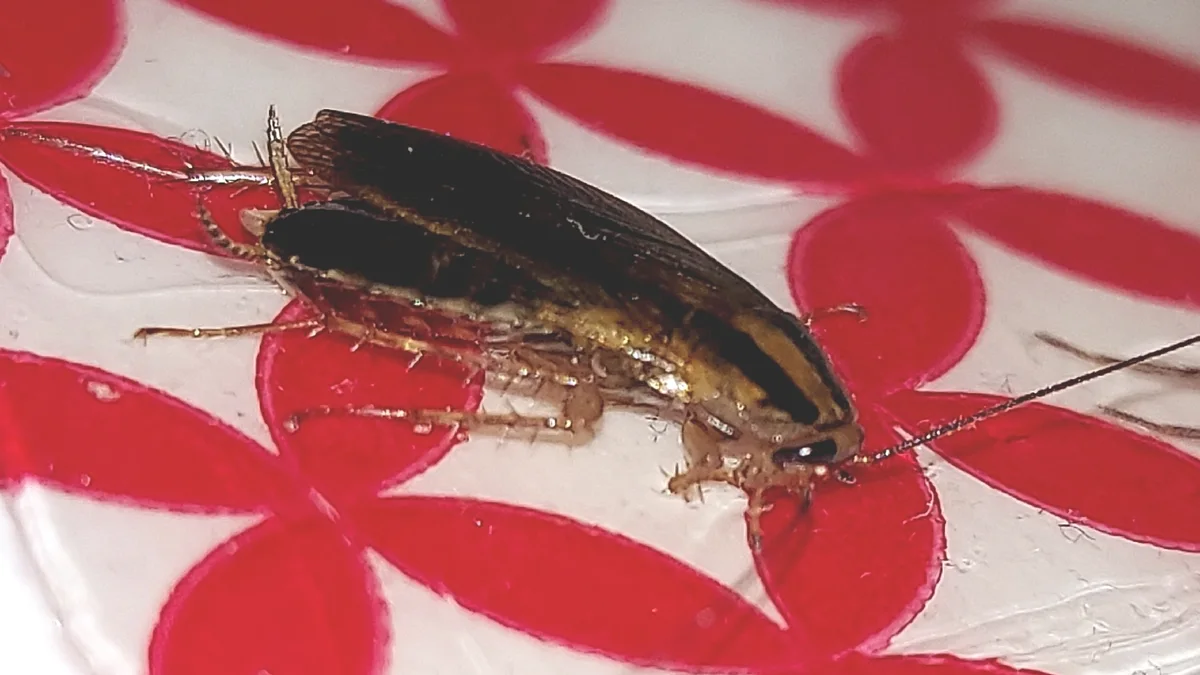
The German cockroach (Blattella germanica) is the small, tan cockroach that infests kitchens and bathrooms across the US. Adults are 1/2 to 5/8 inch long with two dark parallel stripes on the shield behind the head, and the species lives and breeds indoors. Females carry their egg case until the eggs are about to hatch, one reason infestations grow so fast. Baits placed where the roaches hide, not sprays or foggers, are the core of the fix.
Key Takeaways
- Look for two dark stripes behind the head on a 1/2- to 5/8-inch light brown body. Adults have wings but rarely fly (Rutgers, Texas A&M).
- A female makes 5 to 8 egg cases, 200 to 250 eggs in her life (NC State).
- The Asian cockroach looks the same but lives outdoors and flies to lights. In our iNaturalist count, 99.5% of its 1,139 US records come from the South.
- Bait in many small placements is the core of control; NC State, UC IPM and Rutgers all say foggers do not work.
- Proteins in cockroach droppings and saliva can trigger allergies and asthma symptoms (EPA).
Table of Contents
- What a German Cockroach Is
- How to Identify a German Cockroach
- German Cockroach vs Asian and Brown-Banded Cockroaches
- Why German Cockroaches Take Over a Building
- Signs of German Cockroaches and Where They Hide
- Are German Cockroaches Dangerous?
- How to Get Rid of German Cockroaches
- What Works and What Does Not
- When to Call a Professional
- Frequently Asked Questions
What a German Cockroach Is
Of the roughly 70 cockroach species in the US, the German cockroach is the most common, which Rutgers Cooperative Extension puts down to its small size, short life cycle and ability to develop insecticide resistance. For the other species found in US homes, see our guide to common US cockroaches.
The name misleads: NC State Extension says genetic research shows the species arose in Asia, although it was first recorded in central Europe. Texas A&M says it cannot tolerate cold, so in the US it is an indoor pest of homes, apartments and food businesses. Cockroaches share the order Blattodea with termites, as our termite guide explains.
How to Identify a German Cockroach
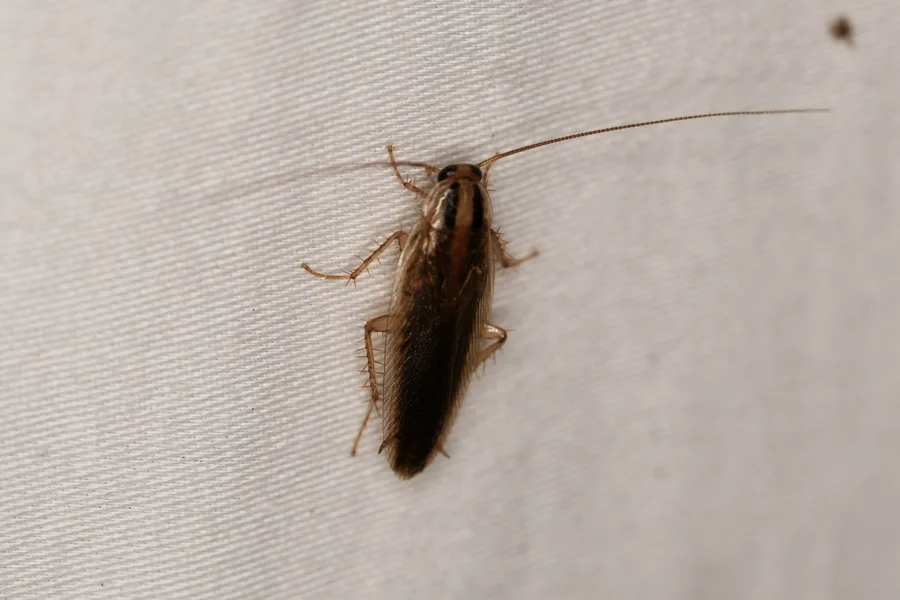
Rutgers’ German cockroach fact sheet and Texas A&M give the key features:
- Size: 1/2 to 5/8 inch (13 to 16 mm) long.
- Color: light brown to tan.
- Stripes: two dark parallel stripes on the pronotum, the shield just behind the head. This is the quickest check.
- Wings: full wings, but adults rarely fly.
- Male or female: males are slender with a tapered rear end; females are wider with a rounded one (Rutgers).
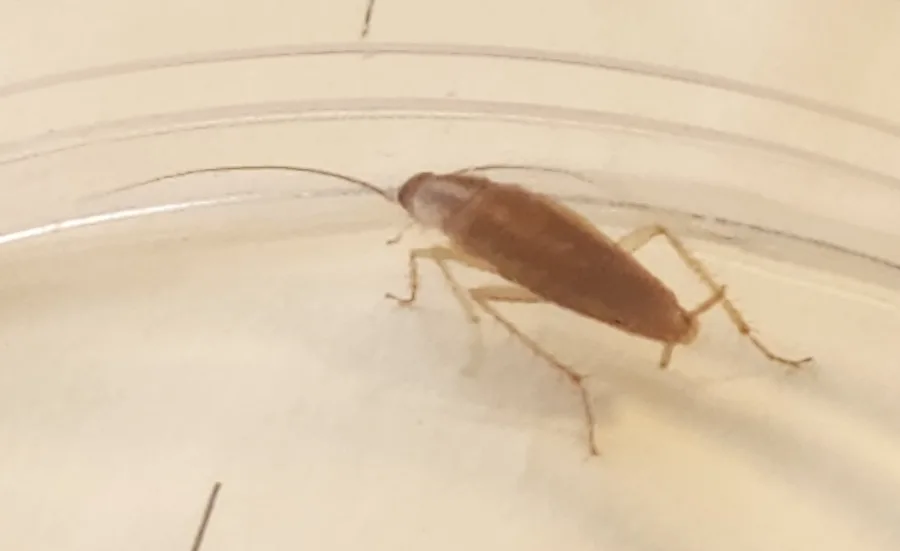
Nymphs
Nymphs, the young, have no wings, grow from 1/8 to 9/16 inch and molt 5 to 6 times (Rutgers). Rutgers says a growing population is about 80 percent nymphs.
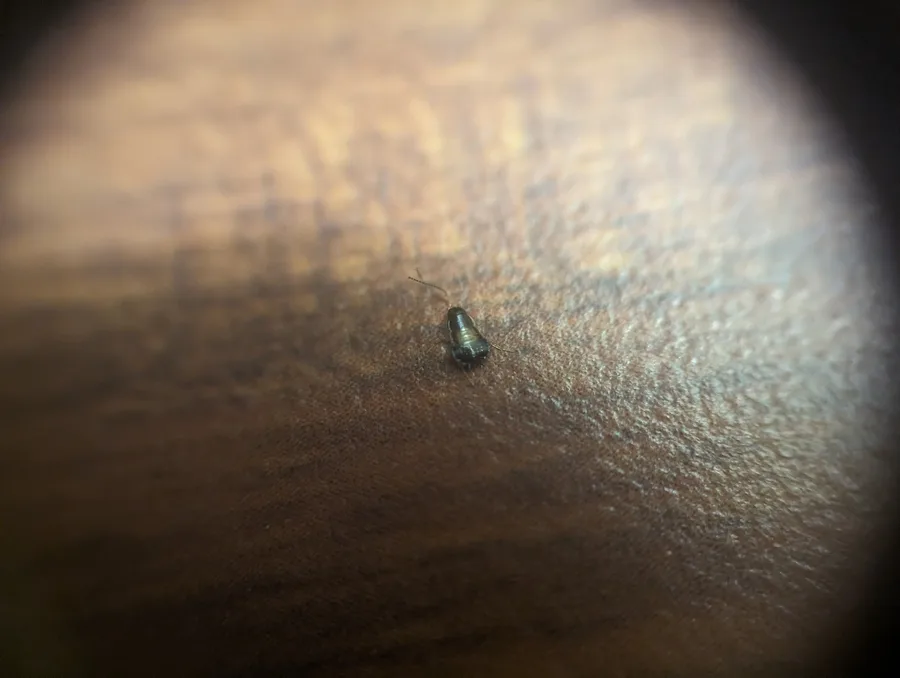
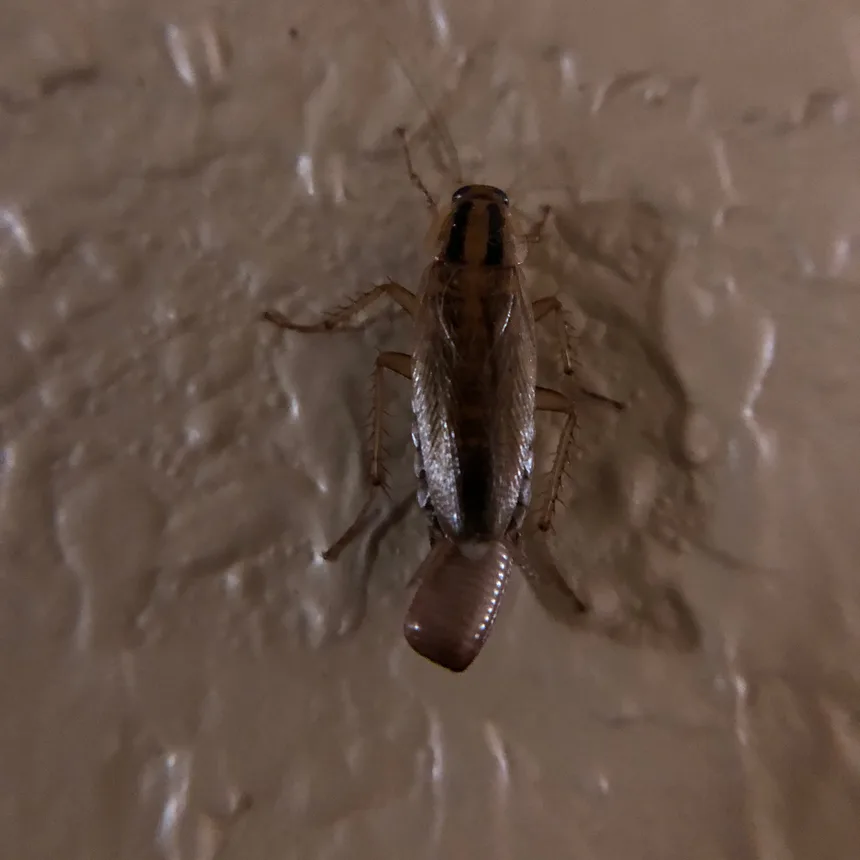
The egg case
The female carries her egg case (ootheca) at the tip of her abdomen until the eggs are nearly ready to hatch. Rutgers describes a case about 5/16 inch long holding about 40 eggs; Brown-banded females glue their cases to ceilings and furniture instead (UC IPM), so a small tan roach carrying a capsule is most likely a German female, or her Asian look-alike.
German Cockroach vs Asian and Brown-Banded Cockroaches
Two small cockroaches are the ones most easily mistaken for the German cockroach:
| Cockroach | Looks | Where it lives | Egg case | Source |
|---|---|---|---|---|
| German (Blattella germanica) | 1/2 to 5/8 inch; light brown; 2 dark parallel stripes on the pronotum; rarely flies | Indoors only, mostly kitchens and bathrooms | Carried by the female until 1 to 2 days before hatching | Rutgers, UC IPM, Texas A&M |
| Asian (Blattella asahinai) | 1/2 to 5/8 inch; the same 2 stripes; adults fly readily | Outdoors in lawns, leaf litter and mulch in the Southeast; flies to lit surfaces at dusk | Carried; smaller, averaging 38 eggs | UF/IFAS, Texas A&M |
| Brown-banded (Supella longipalpa) | About 1/2 inch; males golden tan, females darker brown; light bands on the abdomen, wings and sides of the pronotum | Indoors, in warmer spots (about 80°F) | Glued to ceilings, under furniture or in closets | UC IPM |
The Asian cockroach
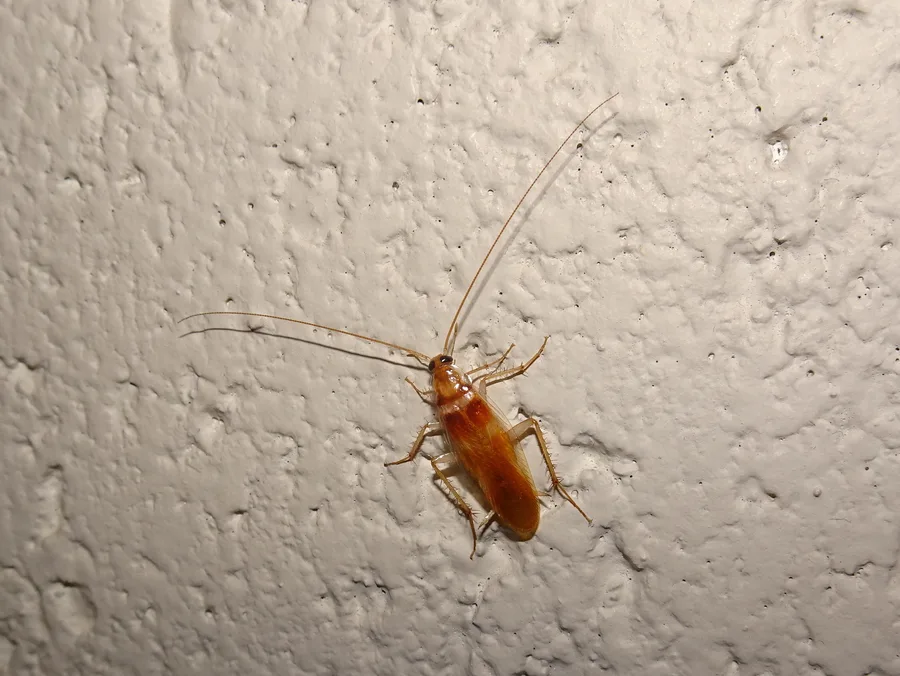
For practical purposes, the Asian cockroach is identical in appearance to the German cockroach.
Behavior separates them. Texas A&M says the Asian cockroach was first collected in North America in Kathleen, Florida, in 1986; UF/IFAS says it has spread as far north as South Carolina. It lives outdoors in leaf litter and grass and, at dusk, flies toward light reflected off light-colored walls and windows. Because the populations live outside, Texas A&M says indoor insecticide applications have been completely ineffective against it, while outdoor scatter baits have given successful control.
Where each one turns up: our iNaturalist count
We pulled every US research-grade iNaturalist observation of both species from the iNaturalist API on November 22, 2026 (“research grade” means at least two people agreed on the identification). German cockroaches had 2,255 records from 49 states. Asian cockroaches had 1,139 from only 10 states, 1,133 of them (99.5%) in the US Census Bureau’s South region.
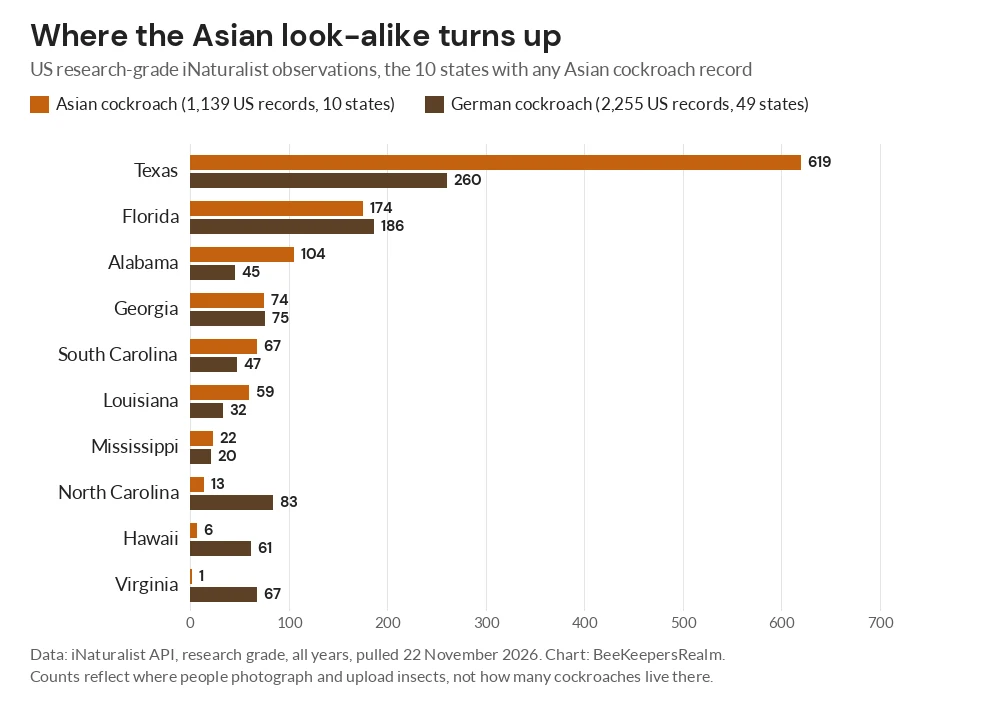
Texas has 619 Asian records against 260 German ones, still more Asian than German without its most active observer (213 records). Florida (174 Asian, 186 German) and Georgia (74 and 75) are about even, while North Carolina has 13 Asian and 83 German records.
By month, January holds 3.1% of US Asian cockroach records but 7.5% of German ones. That fits Texas A&M’s note that in Florida the Asian cockroach is a pest mainly during its peak adult numbers in early spring and summer.
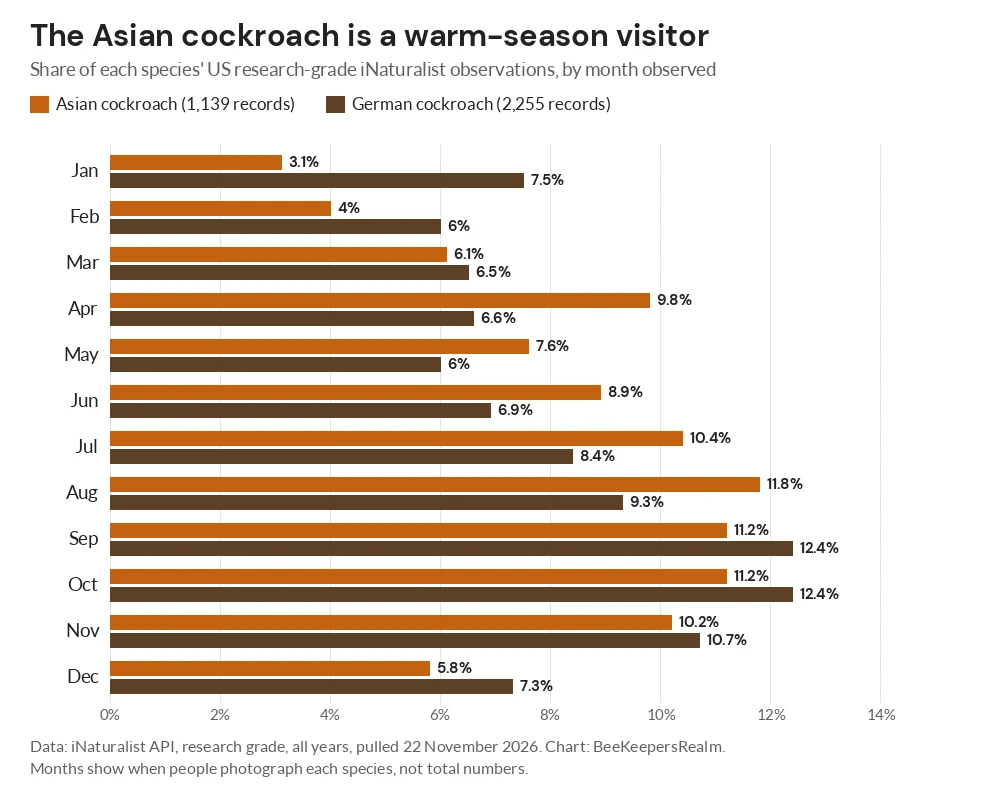
A caution: these counts show where people photograph and upload cockroaches, not how many live there. The big, often-outdoor American cockroach has 16,226 US research-grade records, seven times the German total.
The brown-banded cockroach
UC IPM says the brown-banded cockroach causes only about 1% of indoor infestations in California, prefers warmer spots than German cockroaches do and is especially hard to control with baits.
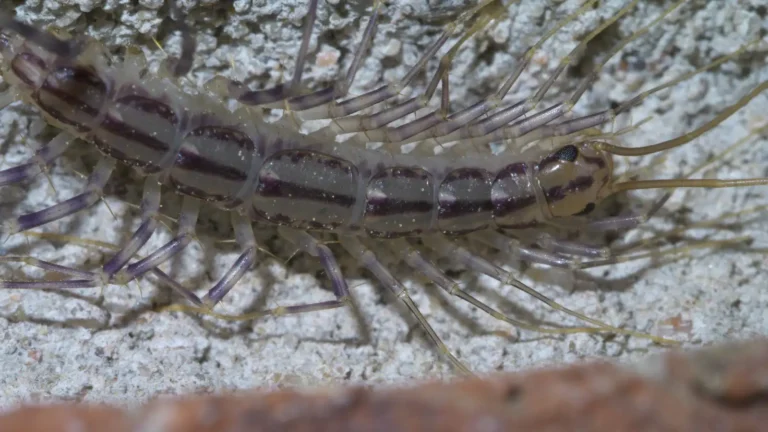
One indoor hunter is worth leaving alone: the house centipede eats cockroaches, as our centipede guide explains.
Why German Cockroaches Take Over a Building
| Trait | German cockroach | Source |
|---|---|---|
| Eggs per egg case | About 40 (UC IPM: about 30 young) | Rutgers, NC State, UC IPM |
| Egg cases per female | 5 to 8, for 200 to 250 eggs in a lifetime | Rutgers, NC State |
| Egg to adult | 70 to 100 days | NC State |
| Adult life span | Females 140 to 280 days; males 90 to 140 days | Rutgers, NC State |
| Temperature | Thrive at about 77 to 86°F; below 59°F nymphs survive but stop developing | NC State; Rutgers |
A claim from the trade magazine Pest Control Technology, widely repeated online, says one female and her offspring can “theoretically” produce hundreds of thousands of cockroaches a year. UC IPM’s figure is lower and still alarming: over 30,000 in a year, the fastest reproductive cycle of the common pest cockroaches.
NC State says chemical cues, mostly in droppings, draw German cockroaches to shared hiding places, and that they arrive by hitchhiking in furniture, groceries or goods, or through shared walls, which it calls doorways between apartments. Its authors are blunt about cleanliness:
The reality is that even with the most stringent cleaning regimen and despite regular pest management, German cockroaches can still find their way into your structure.
Signs of German Cockroaches and Where They Hide
- Droppings: clusters of tiny brown to black dots in hidden spots near food (NC State).
- Other traces: shed skins, empty egg cases and, in heavy infestations, a distinctive odor (NC State).
- Daytime sightings: a sign of a heavy population or of roaches stressed by lack of food, water or pesticides (Penn State).
Rutgers says the areas around the stove and refrigerator usually hold the most cockroaches. Sticky traps, which UC IPM calls the best way to detect and monitor cockroaches, show where they are: Rutgers suggests under the sink, next to the stove, near the refrigerator, beside garbage cans and behind the toilet. The same traps pick up silverfish, another nighttime kitchen and bathroom visitor.
Are German Cockroaches Dangerous?
This section is general educational information, not medical advice. Talk to a doctor about asthma or allergy symptoms.
German cockroaches do not sting; the risks are allergens and contaminated food. The EPA’s asthma triggers guidance says proteins in cockroach feces and saliva can cause allergic reactions or trigger asthma symptoms in some people. NC State says a single female can produce up to 1,000 units of the major cockroach allergen, Bla g 1, a day, and that German cockroaches can mechanically carry disease agents such as Salmonella.
Getting rid of them helps. In a Tulane University study of 102 families of children with asthma (The Journal of Allergy and Clinical Immunology, 2017), none of the homes treated with cockroach bait alone was infested after 12 months, against 22% of untreated homes, and children in treated homes had 47 fewer days with asthma symptoms.
How to Get Rid of German Cockroaches
Rutgers says the goal should be elimination, not just fewer roaches, and UC IPM’s cockroach Pest Notes say sprays should not be necessary if the steps below are followed.
1. Count them with sticky traps
Set traps in the spots above for a few nights. The count shows where to focus and, later, whether the plan works.
2. Cut off food and water
- Clean up crumbs and spills, do not leave dirty dishes out, and seal garbage and pet food (NC State).
- Store food in glass jars or resealable plastic containers (UC IPM), which also keeps out pantry weevils and sugar ants.
- Fix leaks and empty the drip pan under the refrigerator (NC State). Clearing damp residue from drains and trash also removes what fruit flies breed in.
- Vacuum cracks with a HEPA-filter vacuum to remove cockroaches, droppings and shed skins (Rutgers, UC IPM).
3. Bait where they hide
Rutgers says gel bait usually works better than bait stations because it can go closer to hiding places and is more palatable; tamper-resistant stations suit homes with children or pets (Texas A&M, UC IPM). NC State says to place small, pea-size dabs in many spots rather than large amounts in a few.
- Be patient: results may take 7 days or longer, and egg-carrying females feed very little (UC IPM).
- Do not spray near bait: sprays repel cockroaches from it (NC State).
- Follow up: repeat every 2 to 4 weeks until no cockroaches are found for 4 weeks (Rutgers).
4. Dust dry, hidden voids
Use boric acid dust only in dry voids under appliances, behind cabinets and around pipes, away from children and pets. NC State’s rule is “less is more”: a fine layer, because clumps make cockroaches avoid the area.
5. Seal gaps in apartments
NC State says sealing rarely helps a single-family home already infested but slows spread between units in multi-unit housing.
When the bait stops working
NC State says resistance has been recorded for every class of insecticide used against German cockroaches since the 1950s, and recommends rotating modes of action at least every 3 to 4 months. Some populations also develop glucose aversion: sugar tastes bitter to them, so they refuse sweet baits, and NC State’s remedy is a protein-based bait.
What Works and What Does Not
What the university sources we reviewed say about common methods:
| Method | Verdict | What the sources say | Source |
|---|---|---|---|
| Gel bait in cracks near hiding places | Works | Most effective formulation; small, pea-size placements in many spots | Rutgers, NC State |
| Bait stations | Works | Tamper-resistant; stay effective for many months | UC IPM |
| Sticky traps | Monitoring | Best way to detect and monitor populations | UC IPM |
| Boric acid dust in dry voids | Works | Long used and still effective | Rutgers |
| Diatomaceous earth | Weaker | Less effective than boric acid | Rutgers |
| Insect growth regulators | Helps with bait | Do not kill but stop reproduction | Rutgers |
| Total-release foggers (“bug bombs”) | Does not work | Do not reach the crevices where cockroaches hide; fire hazard with gas appliances when overused | NC State, UC IPM, Rutgers |
| Insecticide sprays | Often backfires | Quick knockdown, no long-term control; repel and scatter cockroaches; resistance is common | NC State, UC IPM, Rutgers |
| Essential-oil sprays | Weak | Work only on direct contact, with little or no residual effect | Rutgers |
| Electronic repellers | No evidence | No scientific evidence supports the claims | Rutgers |
Total-release foggers, commonly known as “bug bombs,” are ineffective for cockroach control because they fail to penetrate the crevices and hidden areas where cockroaches harbor and breed.
When to Call a Professional
UC IPM says serious indoor infestations often require professional pest control. Call one if traps still catch cockroaches after several weeks of correct baiting, if you see them in daylight, or if you rent: shared walls let them move between units, so involve the building manager.
Frequently Asked Questions
Are German roaches the hardest to get rid of?
UC IPM calls them the most persistent and troublesome cockroach in California: they breed indoors, hide in 1/16-inch cracks and resist many insecticides.
Does seeing one German roach mean an infestation?
Treat it as a warning. They hide by day, so set sticky traps near the stove, refrigerator and sink for a few nights; any catch confirms them.
How serious are German cockroaches?
Serious enough to treat promptly: their droppings and saliva carry allergens linked to asthma, and they can carry germs such as Salmonella onto food surfaces.
What kills German roaches fast?
Sprays kill on contact but give no lasting control and can scatter survivors. Gel bait takes about a week, but cockroaches spread it through droppings and dead bodies to the ones hiding.
Where do German cockroaches come from?
The species arose in Asia, not Germany. They ride into homes on groceries, boxes and furniture, or walk through shared walls.
Can German cockroaches live outside?
Not for long in most of the US. Texas A&M says they cannot tolerate cold, so outdoor spraying is unneeded.
The Bottom Line
Check for the two stripes, set traps, cut off food and water, and bait in many small spots. Skip the foggers. For other household pests, see our guides to bed bugs, drain flies and carpet beetles, or browse all our garden and household insects guides.
Image credits: Featured image: an adult German cockroach in Warrensburg, Missouri, November 2025, photo by florawhite, iNaturalist, CC BY 4.0, cropped and resized. Other photos: Rupert Clayton, Ryan Sorrells, Tobias Thrien, Brandon Johnson and Thomas Koffel, all via iNaturalist under CC BY 4.0, resized (the egg-case photo also cropped); links to each photo page and the licence are in the captions. Charts: BeeKeepersRealm, from iNaturalist API data pulled November 22, 2026.