Reviewed by Sofia T. · How we review
Cockroaches are flat, fast, mostly nocturnal insects with long antennae and a shield-like plate behind the head. About 69 species live in North America, but only a handful infest buildings: the German and brown-banded cockroaches breed indoors, while the American, Oriental, smokybrown and other large roaches mostly live outside and wander in. Their droppings and shed skins carry allergens that can trigger asthma. The fix that works is sanitation, sealing and targeted baits, not sprays or bug bombs.
Below: an ID table for the common US species, our state-by-state count of 69,874 iNaturalist records, egg cases and nymphs, signs of an infestation, the health facts and the control steps university extension services recommend.
Key Takeaways
- German and brown-banded cockroaches live and breed indoors; the American, Oriental and Turkestan cockroaches live outdoors and come inside (UC IPM). Identify the species first, because the fix differs.
- In our iNaturalist count, the American cockroach leads US records with 23.2%. The German cockroach, the most common one in homes according to the University of Kentucky, makes up only 3.2% of photographed records.
- Which roach you meet depends on where you live: smokybrown cockroaches lead the records in the Carolinas, Georgia and Alabama, Turkestan cockroaches in the desert Southwest, and small outdoor Ectobius species in New England and Michigan.
- The EPA says proteins in cockroach feces and saliva can cause allergic reactions or trigger asthma symptoms in some people.
- UC IPM says baits give better control than sprays and to avoid foggers, which can scatter cockroaches without killing them. Expect results in a week or more.
Table of Contents
- What Cockroaches Are
- How to Identify the Common US Cockroaches
- German Cockroach: The Indoor Breeder
- Which Cockroaches Americans Actually Find
- Cockroaches by State
- When Cockroaches Show Up
- Palmetto Bugs, Water Bugs and Other Names
- Baby Cockroaches and Egg Cases
- Signs of a Cockroach Infestation
- Are Cockroaches Dangerous? Allergens, Asthma and Germs
- How to Get Rid of Cockroaches
- Cockroach or Something Else?
- Frequently Asked Questions
What Cockroaches Are
Cockroaches are insects in the order Blattodea. UC IPM’s Pest Notes describe them as broad, flattened insects with long antennae and a prominent, shield-shaped plate behind the head called the pronotum, and note that termites are close relatives. Like the bees and other insects on this site, they have six legs and three body regions.
The University of Kentucky counts 69 cockroach species in North America, “but only a handful infest structures.” Rutgers adds that most US species live outdoors in the woods, and the National Institute of Environmental Health Sciences (NIEHS) says only about 30 of the thousands of species worldwide are considered pests.
Cockroaches grow by gradual metamorphosis: egg, nymph and adult. Nymphs look like small adults without full wings. Almost all species are active at night and scatter when disturbed, and they squeeze into tight gaps: UC IPM says an adult German cockroach can hide in a crack 1/16 inch wide.
How to Identify the Common US Cockroaches
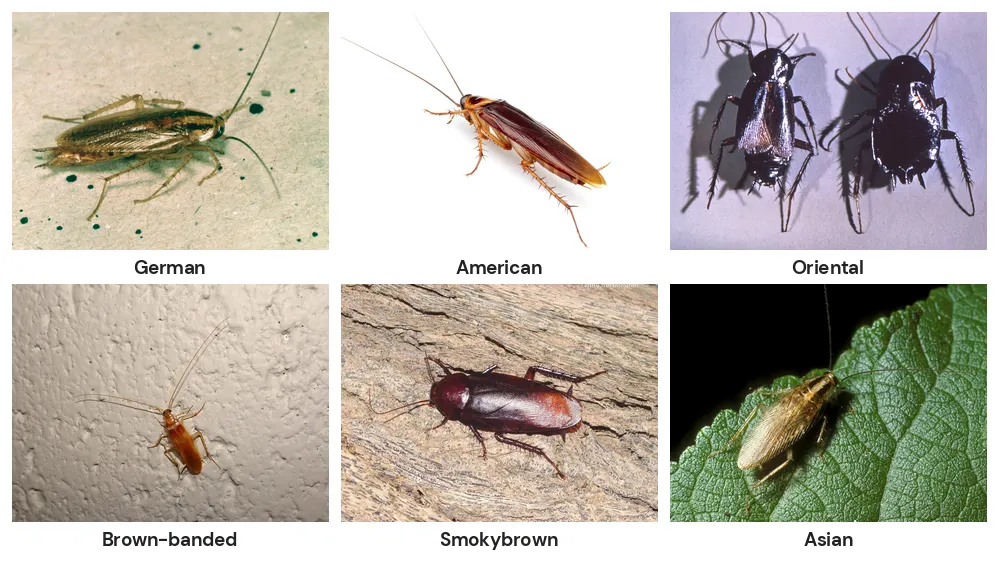
Size, color and the markings on the pronotum separate most species. The table draws on UC IPM’s Pest Notes: Cockroaches and the other extension sources listed below it; where they disagree on size, the range covers both.
| Species | Adult size | Color and key marks | Where you find it | Indoors or out |
|---|---|---|---|---|
| German (Blattella germanica) | 1/2 to 5/8 inch | Light brown or tan; two dark stripes on the pronotum; fully winged but rarely flies | Kitchens and bathrooms: under sinks, behind refrigerators and stoves, in cabinets and warm appliances | Lives and breeds indoors |
| Brown-banded (Supella longipalpa) | About 1/2 to 5/8 inch | Two light, yellowish bands across the wings and body; a dark bell-shaped mark behind the head instead of stripes; males can fly | Anywhere in the house, often high up: ceilings, behind pictures, in furniture and electronics | Lives and breeds indoors |
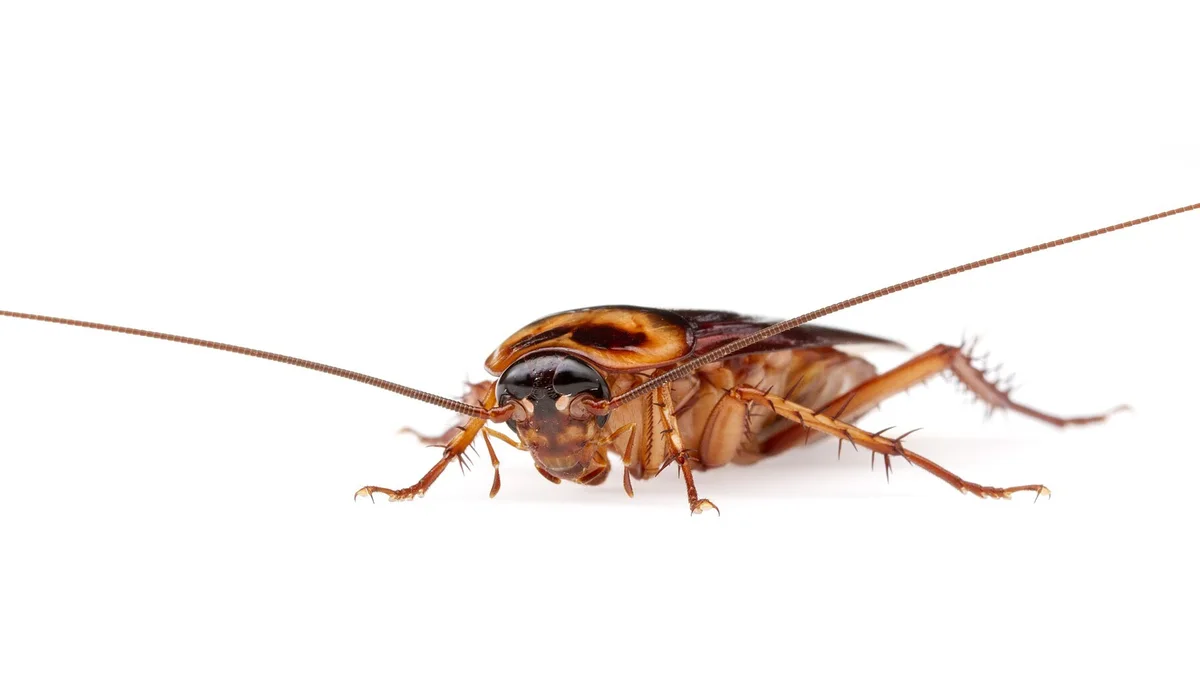
| American (Periplaneta americana) | About 1 1/2 to 2 inches | Reddish brown; pale yellow band around the edge of the pronotum; adults may fly on warm evenings | Sewers, basements, floor drains, boiler rooms, crawl spaces; outdoors in warm, humid areas | Mostly outdoors and in sewers; wanders in |
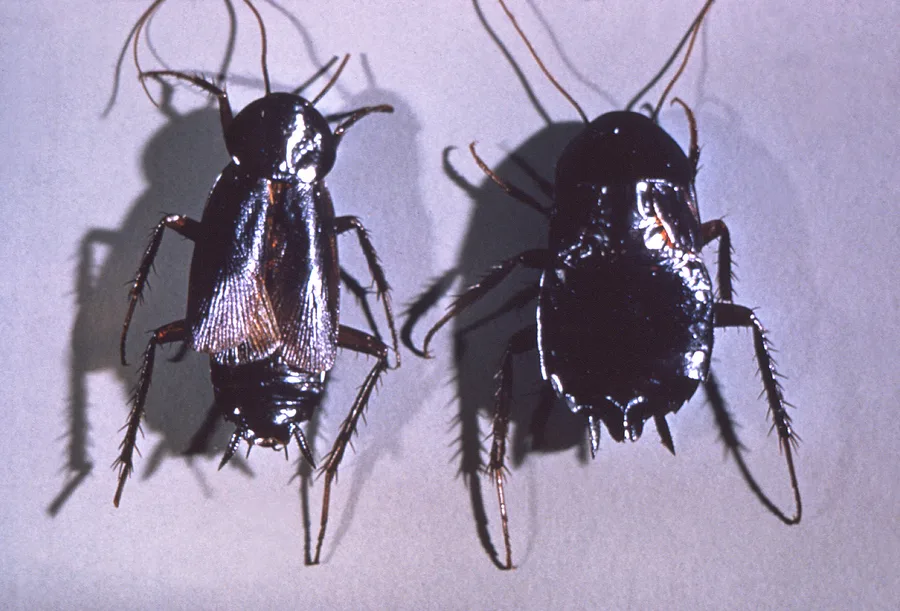
| Oriental (Blatta orientalis) | About 1 to 1 1/4 inches | Shiny black or dark brown; females have tiny wing pads, males wings over half to two-thirds of the body; neither sex flies | Cool, damp places: drains, water meter boxes, crawl spaces, basements, under debris | Outdoors; comes in at ground level |
| Smokybrown (Periplaneta fuliginosa) | About 1 to 1 1/2 inches | Dark brown to mahogany, almost-black pronotum; adults fly, especially on warm, humid evenings | Tree holes, mulch, woodpiles, gutters, attics; common across the Southeast | Outdoors; comes in, often from above |
| Asian (Blattella asahinai) | German-sized | For practical purposes identical to the German cockroach, but an accomplished flier drawn to lights | Leaf litter, mulch and grassy areas; established in Florida, where it was first collected in 1986 | Outdoors; flies in at dusk |
| Turkestan (Blatta lateralis) | Female about 1 inch; male smaller | Female resembles the Oriental cockroach but has cream marks behind the head and around the short wings; male has yellowish-tan wings edged in cream | Water meter boxes, concrete cracks, compost and leaf litter in warm, dry areas | Outdoors |
| Pennsylvania wood (Parcoblatta pensylvanica) | Male about 1 inch, female 3/4 inch | Brown; males fly and come to lights at night | Under loose bark, in woodpiles and hollow trees; arrives in firewood | Outdoors; cannot survive indoors |
| Surinam (Pycnoscelus surinamensis) | 3/4 to 1 inch | Stout, brown to black; only females are known, and they reproduce without mating | Burrows in loose soil; can be numerous in coastal Southern lawns; arrives indoors in potted plants | Outdoors; comes in with plants |
| Florida woods (Eurycotis floridana) | Up to 1 1/2 inches | Large, brown and black; possibly the roach that gave “palmetto bug” its name | Commonly found in palm trees | Outdoors |
Sources: UC IPM, University of Kentucky, Clemson HGIC, Rutgers FS1327, Texas A&M (Asian) and University of Georgia (Florida woods). iNaturalist currently files the Turkestan and smokybrown cockroaches as Periplaneta lateralis and Validiblatta fuliginosa.
Indoor breeders vs outdoor invaders
UC IPM splits the pest species into two groups, and the split decides your plan. German and brown-banded cockroaches “live and breed entirely indoors,” so finding them, especially small ones, means a population inside. American, Oriental and Turkestan cockroaches live outdoors but “can temporarily invade indoor spaces.” One big roach in the garage usually means a gap to seal, not an infestation to treat.
German Cockroach: The Indoor Breeder
The University of Kentucky calls the German cockroach “by far the most common cockroach infesting homes and buildings,” and says it does not occur outdoors. It is the light brown, 1/2-inch roach with two dark stripes behind the head, and UC IPM says one female and her offspring can produce over 30,000 roaches in a year. Our German cockroach guide covers its biology and control in detail; the general steps below still apply.
Which Cockroaches Americans Actually Find
Extension guides list the species that infest buildings, not the ones people actually run into. To find out, we counted every research-grade US cockroach observation on iNaturalist (termites excluded) through the iNaturalist API on November 22, 2026. “Research grade” means at least two people agreed on the identification.
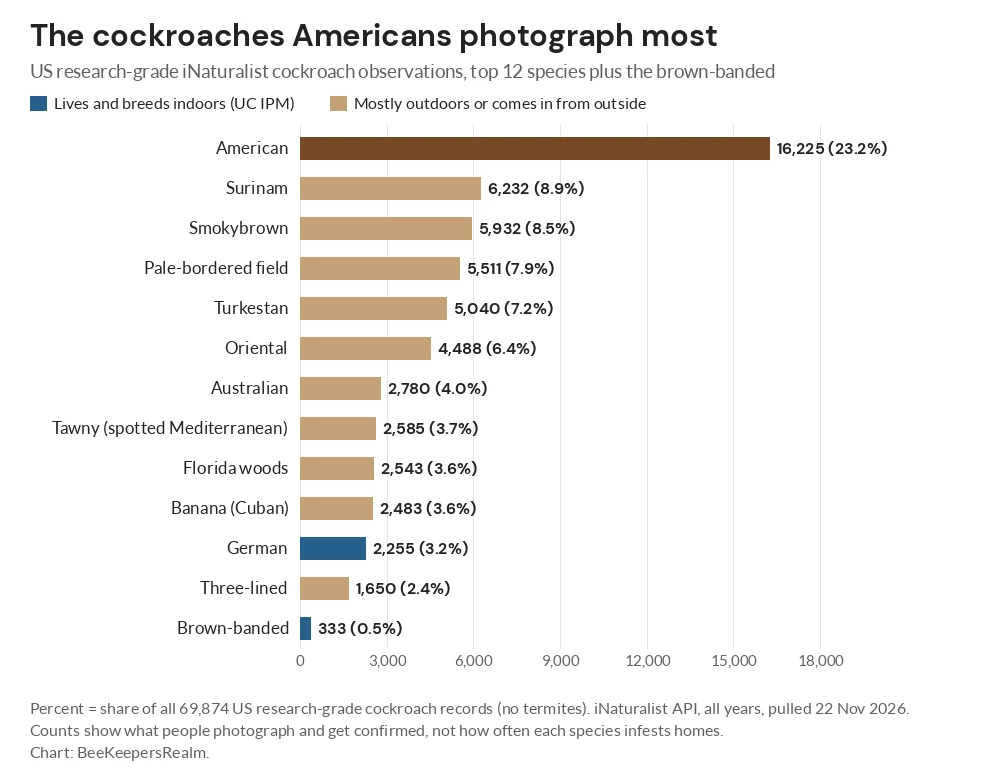
Of the 69,874 records, 16,225 (23.2%) are American cockroaches. Next come four species most homeowners have never heard of by name: the Surinam (6,232; 8.9%), smokybrown (5,932; 8.5%), pale-bordered field (5,511; 7.9%) and Turkestan (5,040; 7.2%) cockroaches. The Oriental has 4,488 records (6.4%), the German only 2,255 (3.2%) and the brown-banded 333 (0.5%).
That looks upside down next to the extension guides, but iNaturalist counts what people photograph and get confirmed, not what infests homes, and large roaches on patios and walls are easier to photograph than small ones in kitchen cracks. The pale-bordered field cockroach shows the gap: Mississippi State University Extension calls it “miniature wildlife,” an outdoor scavenger native to Mexico, and says “they do not establish indoor infestations.”
Cockroaches by State
We repeated the count for every state with at least 100 research-grade records.
| State | Records | Top three species (share of the state’s records) |
|---|---|---|
| Alabama | 2,263 | Smokybrown 548 (24%); Pale-bordered field 520 (23%); American 342 (15%) |
| Arizona | 1,584 | Turkestan 681 (43%); American 570 (36%); Surinam 134 (8%) |
| Arkansas | 437 | Pale-bordered field 186 (43%); Smokybrown 70 (16%); American 66 (15%) |
| California | 10,169 | Turkestan 2,815 (28%); American 2,788 (27%); Three-lined 1,648 (16%) |
| Colorado | 175 | Oriental 102 (58%); German 21 (12%); Australian 19 (11%) |
| Connecticut | 221 | Tawny (spotted Mediterranean) 62 (28%); Uhler’s wood 28 (13%); American 23 (10%) |
| District of Columbia | 452 | Oriental 224 (50%); American 157 (35%); German 43 (10%) |
| Florida | 10,781 | Surinam 2,474 (23%); Florida woods 2,325 (22%); Australian 1,703 (16%) |
| Georgia | 2,443 | Smokybrown 842 (34%); Pale-bordered field 529 (22%); American 351 (14%) |
| Hawaii | 1,750 | American 644 (37%); Pacific beetle 211 (12%); Surinam 160 (9%) |
| Illinois | 624 | Oriental 233 (37%); American 170 (27%); Pennsylvania wood 83 (13%) |
| Indiana | 464 | Oriental 140 (30%); American 116 (25%); Pennsylvania wood 107 (23%) |
| Iowa | 107 | American 33 (31%); Pennsylvania wood 23 (21%); Oriental 20 (19%) |
| Kansas | 327 | Oriental 111 (34%); American 65 (20%); Pennsylvania wood 45 (14%) |
| Kentucky | 301 | Oriental 112 (37%); American 68 (23%); Dark wood 34 (11%) |
| Louisiana | 1,651 | American 391 (24%); Banana (Cuban) 324 (20%); Pale-bordered field 303 (18%) |
| Maine | 470 | Dusky 331 (70%); Tawny (spotted Mediterranean) 97 (21%); American 17 (4%) |
| Maryland | 706 | Oriental 261 (37%); American 135 (19%); German 66 (9%) |
| Massachusetts | 1,633 | Tawny (spotted Mediterranean) 943 (58%); Dusky 219 (13%); American 181 (11%) |
| Michigan | 799 | Tawny (spotted Mediterranean) 550 (69%); American 77 (10%); Pennsylvania wood 44 (6%) |
| Minnesota | 148 | American 88 (59%); German 19 (13%); Australian 16 (11%) |
| Mississippi | 689 | American 147 (21%); Pale-bordered field 141 (20%); Smokybrown 140 (20%) |
| Missouri | 477 | Oriental 188 (39%); American 95 (20%); Pennsylvania wood 53 (11%) |
| Nebraska | 162 | Oriental 77 (48%); Pennsylvania wood 31 (19%); American 28 (17%) |
| Nevada | 247 | Turkestan 147 (60%); American 55 (22%); Western wood 14 (6%) |
| New Hampshire | 232 | Dusky 129 (56%); Tawny (spotted Mediterranean) 64 (28%); Virginia wood 7 (3%) |
| New Jersey | 607 | Tawny (spotted Mediterranean) 287 (47%); American 92 (15%); Oriental 83 (14%) |
| New Mexico | 621 | Turkestan 392 (63%); Oriental 119 (19%); American 67 (11%) |
| New York | 1,688 | American 569 (34%); Tawny (spotted Mediterranean) 410 (24%); German 210 (12%) |
| North Carolina | 3,039 | Smokybrown 1,525 (50%); American 808 (27%); Pale-bordered field 194 (6%) |
| Ohio | 553 | Oriental 146 (26%); American 132 (24%); Pennsylvania wood 127 (23%) |
| Oklahoma | 826 | Pale-bordered field 300 (36%); American 190 (23%); Oriental 118 (14%) |
| Oregon | 233 | Western wood 80 (34%); Oriental 78 (33%); Cleveland’s wood-feeding 30 (13%) |
| Pennsylvania | 828 | Oriental 256 (31%); American 217 (26%); Pennsylvania wood 120 (14%) |
| Rhode Island | 176 | Tawny (spotted Mediterranean) 112 (64%); American 16 (9%); Australian 7 (4%) |
| South Carolina | 1,146 | Smokybrown 537 (47%); American 235 (21%); Asian 67 (6%) |
| Tennessee | 1,010 | Pale-bordered field 284 (28%); American 160 (16%); Smokybrown 150 (15%) |
| Texas | 17,127 | American 5,074 (30%); Pale-bordered field 2,777 (16%); Surinam 2,619 (15%) |
| Utah | 343 | Oriental 186 (54%); Turkestan 134 (39%); German 14 (4%) |
| Vermont | 209 | Dusky 170 (81%); Tawny (spotted Mediterranean) 18 (9%); German 7 (3%) |
| Virginia | 1,561 | American 343 (22%); Brown-hooded 307 (20%); Smokybrown 246 (16%) |
| Washington | 106 | German 58 (55%); Australian 10 (9%); Oriental 9 (8%) |
| West Virginia | 255 | Brown-hooded 125 (49%); Oriental 50 (20%); Pennsylvania wood 32 (13%) |
Fewer than 100 records: Alaska, Delaware, Idaho, Montana, North Dakota, South Dakota, Wisconsin and Wyoming. Data: iNaturalist API, research grade, all years, pulled November 22, 2026. Records reflect where iNaturalist users live and look, so the top species is the one people photograph most, not proof that it is the most common.
- Southeast: the smokybrown leads in North Carolina, South Carolina, Georgia and Alabama. University of Georgia entomologist Dan Suiter calls it “very common throughout the Southeastern U.S.”
- Desert Southwest: the Turkestan cockroach leads in New Mexico, Nevada and Arizona; UC IPM says it is displacing the Oriental cockroach in warm, dry parts of California.
- New England and Michigan: small outdoor Ectobius species lead. The tawny (spotted Mediterranean) cockroach leads in Michigan, Massachusetts, Rhode Island and Connecticut; Rutgers says it is about 3/8 inch long, was accidentally introduced from Europe and was first found in Massachusetts in 1948. The dusky cockroach, which University of Maine Extension describes as a wood roach that lives outdoors, leads in Maine, New Hampshire and Vermont.
When Cockroaches Show Up
Nationally, June is the peak month, with 14.9% of all US cockroach records, and May through September account for 61.7%. The species differ, and the difference tracks indoor and outdoor life.
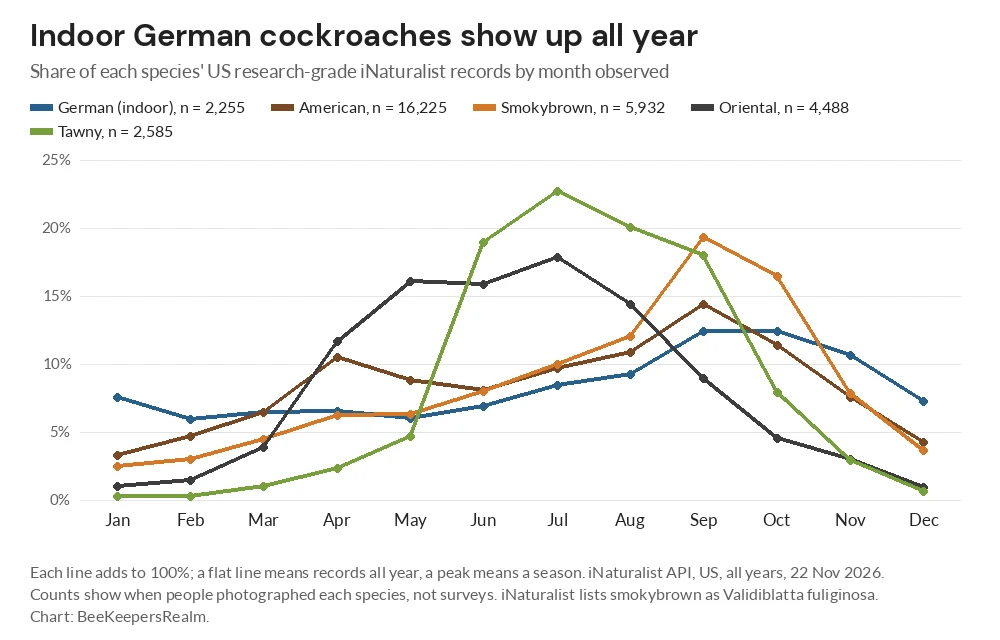
The tawny cockroach is a summer insect: 79.8% of its records fall in June through September and only 1.3% in December through February. The Oriental peaks in July, the American and smokybrown in September. The German cockroach has the flattest line, with no month below 6% or above 12.4% of its records and 20.8% of them in the three winter months. Outdoor species nearly vanish from the records in winter, while indoor German cockroaches keep turning up.
Palmetto Bugs, Water Bugs and Other Names
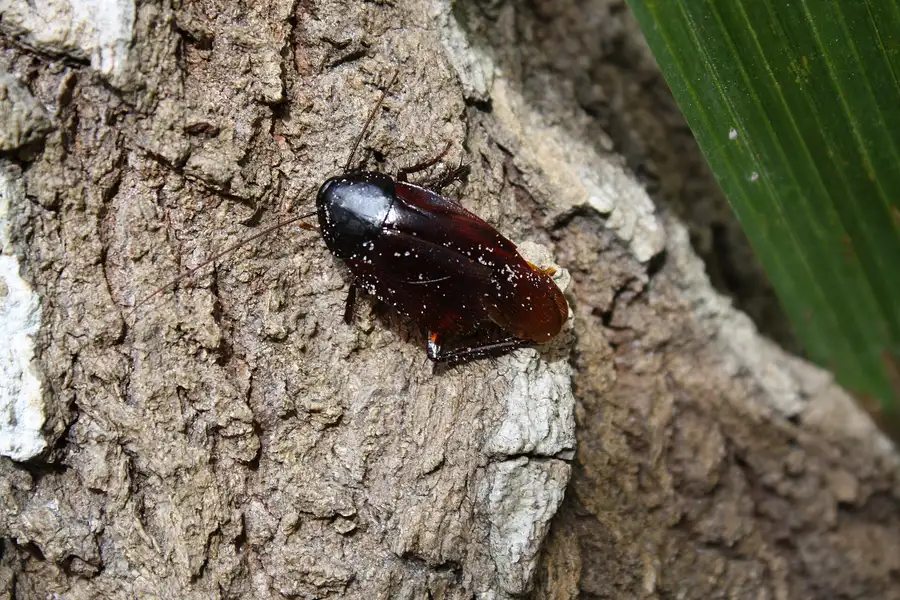
“Palmetto bug” is not a species. The University of Georgia describes it as a regional term for several winged cockroaches that grow to more than an inch, applied to the smokybrown, American and Oriental cockroaches. Suiter, the Orkin Distinguished Professor in Urban Entomology at UGA, says the name may have started with the Florida woods cockroach, which lives in palm trees.
“People will say they have palmetto bugs, but it’s just a nice way to say cockroach.”
“Water bug” usually means the Oriental cockroach; UC IPM says it is sometimes called a water bug or black beetle, and it lives in drains, water meter boxes and damp basements. It cannot climb smooth surfaces, which is why it turns up trapped in sinks and tubs. Drains can also breed tiny, fuzzy, moth-like flies, which our drain flies guide covers. “Wood roach” means the native Parcoblatta species, which Kentucky says cannot survive indoors.
Baby Cockroaches and Egg Cases
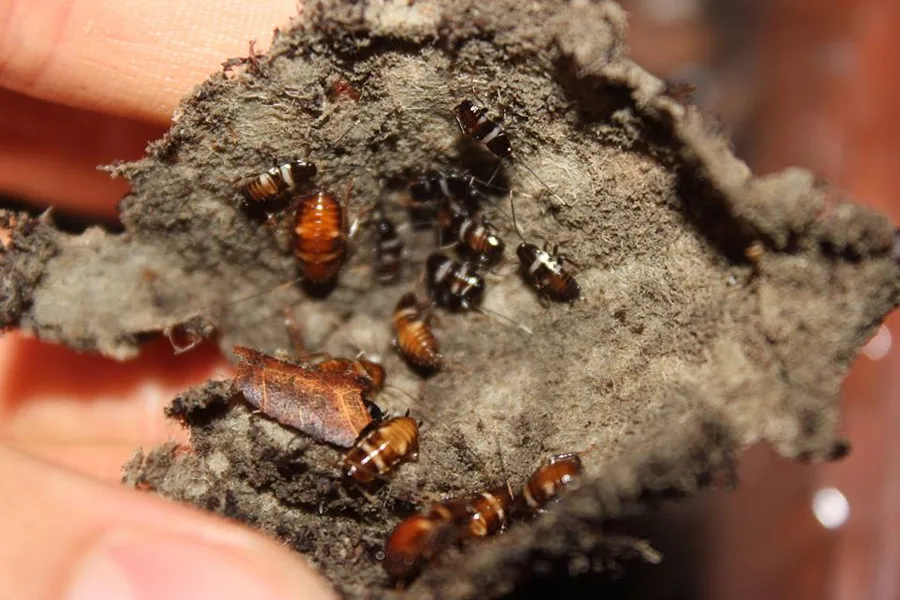
Baby cockroaches are nymphs: smaller, wingless versions of the adults (University of Kentucky). Right after each molt a cockroach is white, darkening within hours (UC IPM), so a pure white roach is usually one that has just molted. German cockroach nymphs are darker than adults, with a tan stripe down the back (Kentucky); young smokybrown nymphs are dark with white bands on the antennae and across the back (UC IPM).
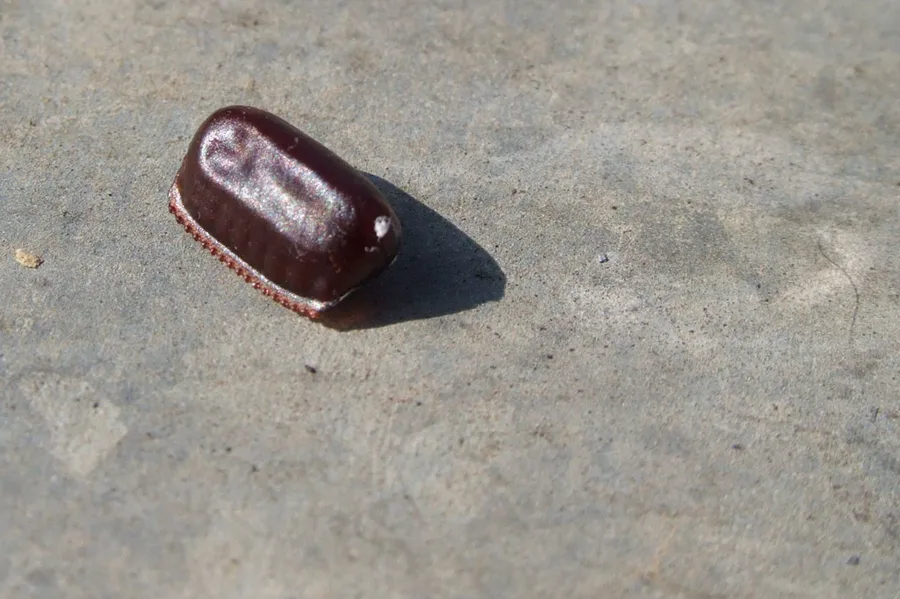
Females lay eggs in a purse-like case called an ootheca, the same word used for the egg cases of praying mantises. Each species handles it differently:
| Species | Egg case | Young per case | What the female does with it |
|---|---|---|---|
| German | Light beige, about 1/4 inch | About 30 to 40 | Carries it until 1 to 2 days before hatching |
| Brown-banded | Light brown, about 1/4 inch | Not given | Glues it to ceilings, under furniture or in closets, often in clusters |
| American | About 3/8 inch, brown turning black in 1 to 2 days | About 12 to 16 | Carries it about 6 days, then cements it to a protected surface; hatches in about 2 months |
| Oriental | Dark red-brown, about 3/8 inch | Not given | Drops it in debris or food in a sheltered spot |
| Smokybrown | Dark brown to black, about 3/8 inch | About 40 to 45 | Carries it about 1 day; hatches in 24 to 70 days depending on temperature |
Sources: UC IPM Pest Notes: Cockroaches; Rutgers FS1327 (German, about 40 eggs; American, 14 to 16 eggs).
Signs of a Cockroach Infestation
You rarely see the roaches first. The signs extension entomologists look for:
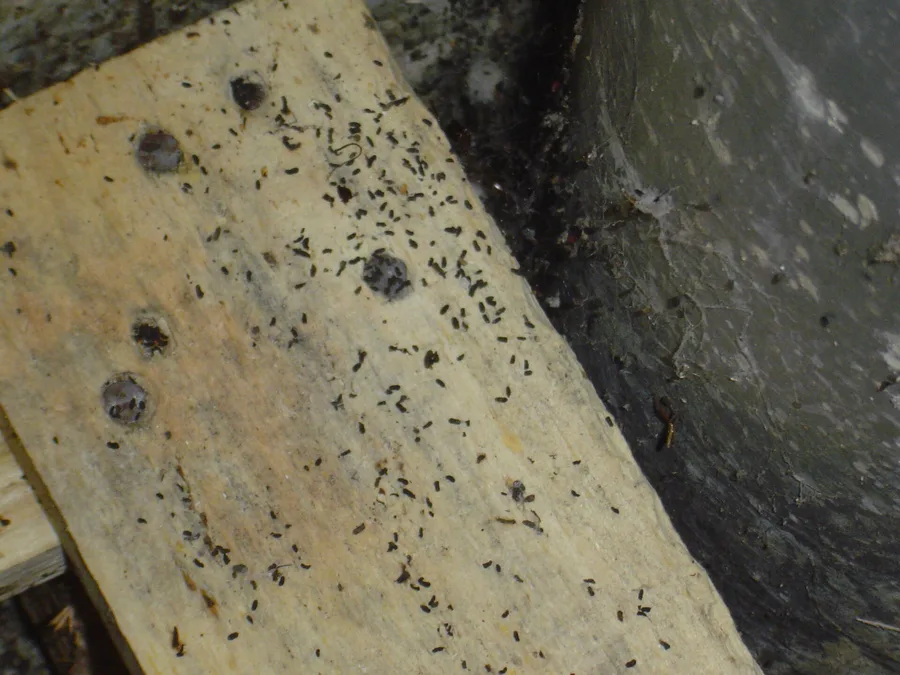
- Droppings: Kentucky describes them as pepper-like specks in areas of current or former activity. Roaches gather around them, because the droppings carry aggregation odors.
- Smears, cast skins and egg cases: dark spots or smears along edges, in cabinet corners and behind appliances, plus shed skins and egg cases that point to a breeding population (UC IPM).
- Odor: Kentucky notes that cockroaches leave an unpleasant odor.
- Roaches outside the kitchen: Kentucky says German cockroaches turn up in bedrooms, closets and other rooms when populations are large or food is scarce.
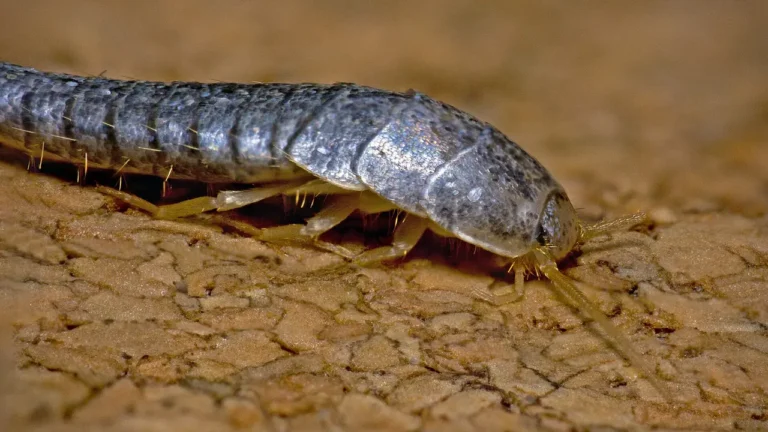
To confirm and map an infestation, UC IPM recommends sticky traps at floor-wall junctions, behind appliances and in cabinets, checked daily for several days; many roaches are caught within the first 24 hours. The same traps help with silverfish, which use the same damp corners.
Why cockroaches suddenly appear
Dirt is only part of the story. Kentucky says “even clean homes can become infested”: German cockroaches arrive in grocery bags, beverage cartons and furniture, and in apartments roaches travel between units through shared walls and pipes. Clemson adds boxes and firewood. Outdoor species come in on warm nights through gaps around doors, windows, vents and pipes, and flying species such as the Asian and wood cockroaches are drawn to lights (Texas A&M, Rutgers).
Are Cockroaches Dangerous? Allergens, Asthma and Germs
This is educational information, not medical advice. See the EPA’s asthma triggers page for home guidance, and talk to a doctor about allergy or asthma symptoms.
Cockroaches do not generally bite people, according to the National Pesticide Information Center (NPIC). The main health problem is allergens: the EPA says droppings or body parts of cockroaches can trigger asthma, and NIEHS lists cockroaches among the common indoor asthma triggers.
“Certain proteins are found in cockroach feces and saliva and can cause allergic reactions or trigger asthma symptoms in some individuals.”
- Children and crowded housing: UC IPM says indoor infestations have been identified as risk factors for asthma in children, especially in multi-unit housing, and that allergen levels track cockroach numbers.
- Allergen without roaches: the American Lung Association says one in five homes with no history of cockroach infestation has a significant level of cockroach allergen in dust and fabrics.
- Germs: UC IPM says American cockroaches can pick up bacteria that cause food poisoning (Salmonella and Shigella) in sewers and from pet droppings.
- Cleaning up: UC IPM recommends a vacuum with a HEPA filter, and the American Lung Association advises that people allergic to cockroaches stay out of the room during vacuuming.
How to Get Rid of Cockroaches
The extension guides agree on an order: identify, monitor, remove food and water, seal, then use baits or dusts in hiding places. UC IPM calls this integrated pest management (IPM).
1. Identify and monitor
Catch a few roaches on numbered sticky traps and compare them with the table above, or ask your county extension office, as NPIC suggests. Keep a tally to see where to focus and whether the plan is working (UC IPM).
2. Take away food, water and shelter
- Store food in sealed containers and keep garbage in bins with tight lids. Airtight storage also keeps out weevils and sugar ants.
- Clean crumbs and spills right away, don’t leave dishes or pet food out overnight, and clean behind the stove and refrigerator (UC IPM, Kentucky).
- Fix leaks and dripping faucets, and ventilate damp areas.
- Get rid of piles of paper bags, boxes and newspapers, and vacuum cracks to remove roaches, shed skins and egg cases (UC IPM, Clemson).
3. Seal the way in
Caulk cracks around cabinets, backsplashes, windows, doors and pipes, and fill pipe and wire openings with caulk, foam or copper mesh; NPIC says cracks 3/8 inch or smaller make good hiding places. Add door sweeps and weather stripping. Outside, Clemson suggests pulling mulch and debris back from the foundation, trimming shrubs away from the house and stacking firewood off the ground and away from the walls.
4. Baits and dusts, placed where roaches hide
UC IPM calls baits the primary pesticides for cockroaches. Gels, pastes, granules and bait stations act slowly and work only where roaches find them while foraging, so they go in cracks, in corners and along edges near hiding places. Removing other food makes them work better. UC IPM says it may take 7 days or longer to see fewer cockroaches, and that brown-banded cockroaches are especially hard to control with baits.
For hollow spaces, UC IPM and Kentucky describe boric acid dust applied as a thin, barely visible film under appliances and in wall voids, never on counters or food surfaces; it stays effective while dry. UC IPM says not to use it outdoors because it is toxic to plants. Read and follow every product label.
5. Skip the foggers and broadcast sprays
The University of Kentucky says total-release foggers, or “bug bombs,” seldom work against household pests: very little insecticide reaches the cracks where roaches spend their time, the ingredients tend to repel them deeper into walls, and foggers are flammable near pilot lights. Kentucky also advises against spraying open floors, walls and countertops, where roaches spend little time.
“Insecticide sprays alone will not eliminate cockroaches.”
Outdoor sprays have another cost. Suiter’s research found that about half the egg cases collected in Gainesville, Florida, were parasitized by wasps, and he warns that spraying kills those natural enemies too. NIEHS notes that centipedes and other animals also prey on cockroaches. Broad-spectrum insecticides are toxic to bees as well, as our guide to pollinator-safe pest control explains, so keep treatments in cracks, voids and bait stations.
6. When to call a professional
UC IPM recommends a licensed pest control professional for serious infestations. Kentucky says a correct treatment should not take a full year in a single-family home, and that a good technician treats cracks and hiding places rather than baseboards.
Cockroach or Something Else?
- Beetles: UC IPM says adult cockroaches have soft, membranous wings, while beetles have thick, hardened forewings. A small, round, patterned beetle on a windowsill is more likely one of the carpet beetles.
- Crickets: camel crickets also live in damp basements, but they jump; our crickets guide shows how to identify them.
- Earwigs: slender and reddish brown, with pincers at the tail end; see our earwig guide.
- Bed bugs: Kentucky says cockroach spotting looks like that of bed bugs, but cockroaches seldom gather on beds the way bed bugs do. Bed bugs also hide in tight cracks, but they stay near where people sleep; our bed bug guide shows the signs.
For more indoor and garden visitors, browse our garden and household insects section.
Frequently Asked Questions
Do cockroaches bite?
NPIC says cockroaches don’t generally bite people. The bigger health concern is the allergens in their droppings, saliva and shed skins.
Do cockroaches fly?
It depends on the species. Smokybrown and Asian cockroaches fly well, American cockroaches may fly on warm evenings, brown-banded and wood cockroach males can fly, German cockroaches have wings but rarely fly, and Oriental cockroaches cannot fly (UC IPM, Clemson, Kentucky, Texas A&M).
Why do cockroaches suddenly appear in my house?
Outdoor species wander in on warm nights through gaps around doors, windows, vents and pipes, and some fly to lights. German cockroaches arrive in grocery bags, boxes and furniture, or move in from neighboring apartments through shared walls (University of Kentucky).
What attracts cockroaches?
Food, water and tight, dark shelter: crumbs in cracks, spilled drinks, pet food, leaks, clutter and cardboard. UC IPM says even tiny crumbs or liquids can attract them.
How long can a cockroach live without food?
NIEHS says most can go up to a month without food but die within a week without water, which is why fixing leaks matters as much as cleaning.
What is the difference between a palmetto bug and a cockroach?
None: “palmetto bug” is a Southern nickname for several large cockroaches, mainly the smokybrown, American, Oriental and Florida woods cockroaches (University of Georgia).
Can cockroaches live in a clean house?
Yes. The University of Kentucky says even clean homes can become infested, especially apartments where roaches travel between units. Cleaning makes baits work better, but sealing and baiting are usually needed too.
One large roach that came in from outside is usually solved by sealing and outdoor cleanup. Small roaches in the kitchen, or roaches in every season, point to an indoor population: start the monitoring and baiting steps above, and call a licensed professional if numbers have not dropped within a few weeks.
Image credits: featured photo of an American cockroach collected indoors in Austin, Texas, by Insects Unlocked (University of Texas at Austin), Wikimedia Commons, CC0 1.0, cropped and resized. Other photos are credited in their captions, with links to each file page and licence. Charts and the state table by BeeKeepersRealm from research-grade iNaturalist observations, retrieved through the iNaturalist API on November 22, 2026.