Reviewed by Daniel M. · How we review
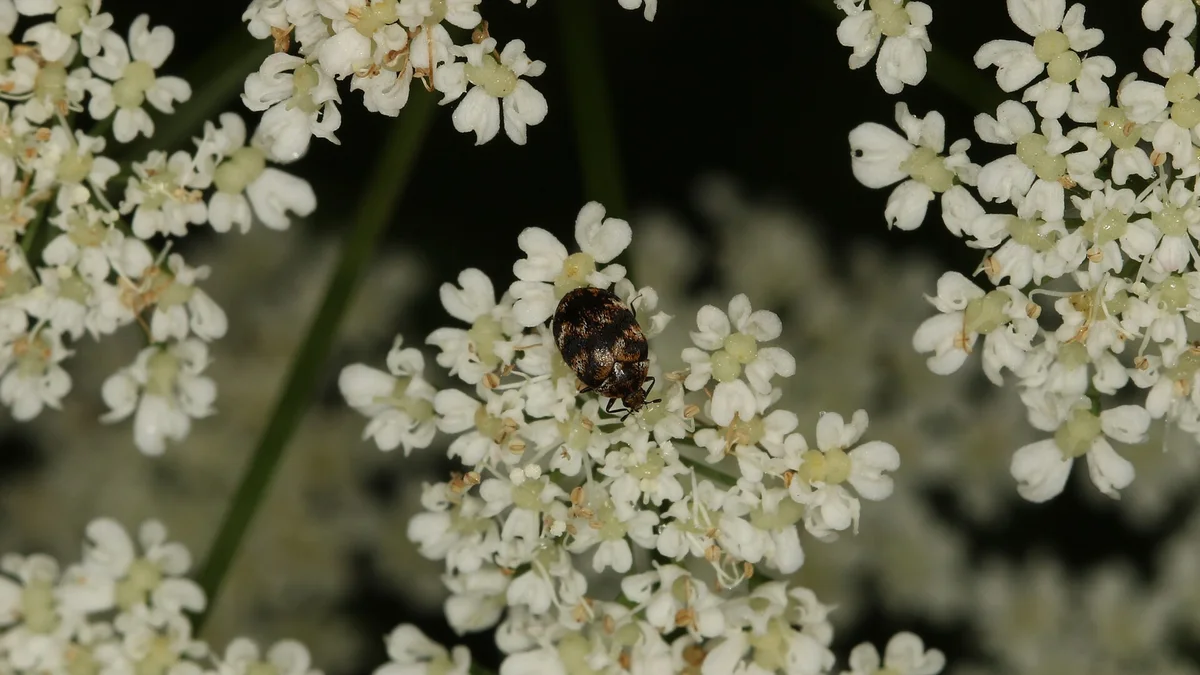
Carpet beetles are tiny, round beetles (family Dermestidae) whose hairy larvae eat wool, fur, feathers, silk, leather, pet hair and dead insects. The adults are harmless pollen feeders that fly in or ride in on cut flowers each spring; the larvae do the damage. The three common US species are the varied, furniture and black carpet beetle. Getting rid of them starts with finding the infested item, then vacuuming, laundering and freezing.
Below: how to tell the species apart as adults and larvae, why they gather at windows in spring, the rash some people get, and an extension-based removal plan, plus our count of 26,814 US iNaturalist records.
Key Takeaways
- Only the larvae, often called “woolly bears,” eat fabric. Adults feed on flower pollen and nectar (UC IPM, University of Kentucky).
- The varied carpet beetle is by far the most recorded: 16,106 of 26,814 US research-grade skin beetle observations (60.1%) in our iNaturalist count.
- 59.5% of those records fall in March and April, when adults gather at sunny windows.
- Carpet beetles do not bite, but their larval hairs can cause an itchy rash mistaken for bed bug or flea bites.
- Find the source, vacuum, launder, and freeze what you cannot wash. Insecticides come last, and bug bombs do not work (Colorado State).
Table of Contents
- What Carpet Beetles Are
- How to Identify Carpet Beetles and Their Larvae
- Which Carpet Beetles Americans Find
- Why They Appear at Windows in Spring
- Where an Infestation Starts
- Carpet Beetle Damage vs Clothes Moths
- Do Carpet Beetles Bite? The Larval-Hair Rash
- How to Get Rid of Carpet Beetles
- Frequently Asked Questions
What Carpet Beetles Are
Carpet beetles belong to the Dermestidae, or skin beetles, scavengers that recycle dried animal matter. UC IPM says adults are about 1/10 to 1/8 inch long, with round bodies and short antennae, like very small lady beetles. Outdoors they feed on pollen-rich flowers such as crape myrtle, spiraea and buckwheat (UC IPM), the same blooms bees use in a bee-friendly garden. Virginia Tech notes they occur “in both clean and cluttered dwellings.”
How to Identify Carpet Beetles and Their Larvae
UC IPM names three species as the serious fabric pests in California, and Virginia Tech lists the same three plus the common carpet beetle. Adults differ in pattern; larvae in shape and tail.
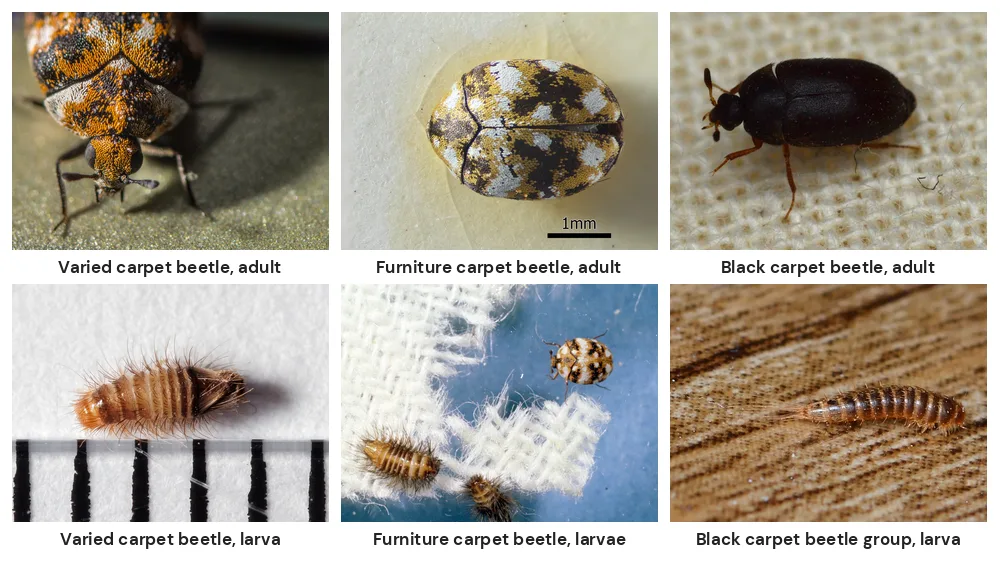
| Species | Adult | Larva | Larval stage |
|---|---|---|---|
| Varied carpet beetle (Anthrenus verbasci) | About 1/10 inch; black with an irregular pattern of white, brown and dark yellow scales | Striped light and dark brown, wider at the rear; raises its hair tufts into a round plume when disturbed | 220 to 630 days |
| Furniture carpet beetle (Anthrenus flavipes) | Slightly larger and rounder; mottled black, white and yellow to orange | White at first, darkening to chestnut brown; wider at the front | 70 to 94 days |
| Black carpet beetle (Attagenus unicolor) | 1/8 to 3/16 inch; shiny black to dark brown | Shiny, smooth and tapered, up to 5/16 inch, with a long tail tuft | 166 to 330 days |
Source: UC IPM Pest Notes: Carpet Beetles (Publication 7436). Virginia Tech warns that old cast skins are often mistaken for live larvae, making an infestation look bigger than it is. Colorado State adds that the tiny, hairy duff millipede can be confused with a larva but has many more legs than the larva’s three pairs; most millipedes found indoors are larger and smooth.
Which Carpet Beetles Americans Find
We pulled every research-grade US observation of the family Dermestidae from the iNaturalist API (“research grade” means at least two people agreed on the species).
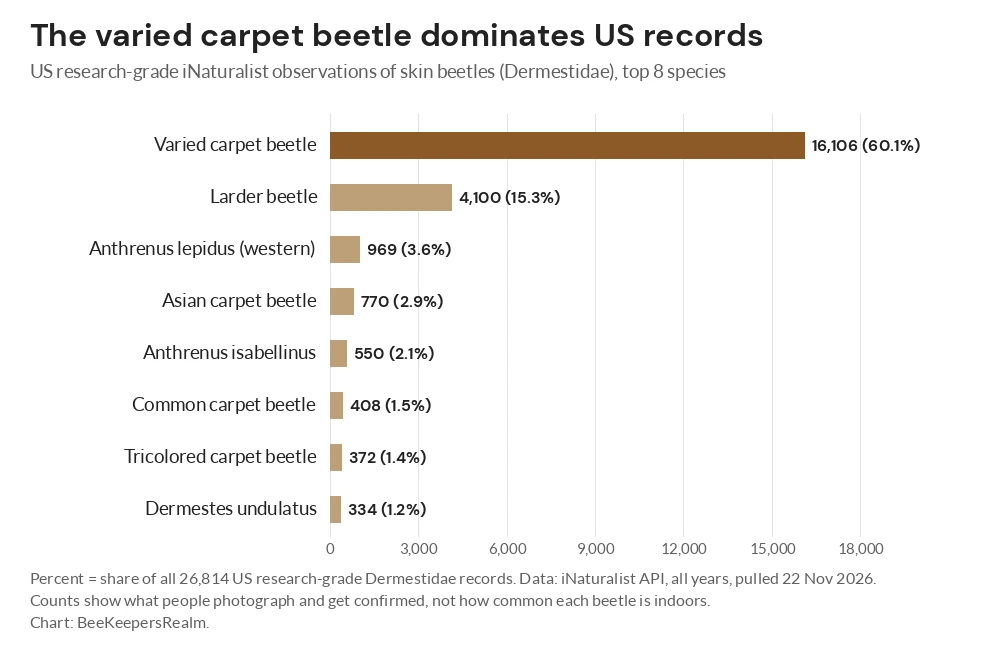
The varied carpet beetle accounts for 16,106 of 26,814 records (60.1%), ahead of the larder beetle (4,100). The furniture carpet beetle has just 39. Black carpet beetles are hard to confirm from photos: of 1,421 US records in their genus, Attagenus, 1,056 still await identification and only 3 are confirmed as Attagenus unicolor. A small black oval beetle with a long-tailed larva belongs to that group, and control is the same.
Why They Appear at Windows in Spring
Colorado State says adults and wandering larvae are most often seen indoors in late winter and early spring. UC IPM says adults are attracted to light, and the University of Kentucky says spring beetles on windowsills suggest an infestation inside the home.
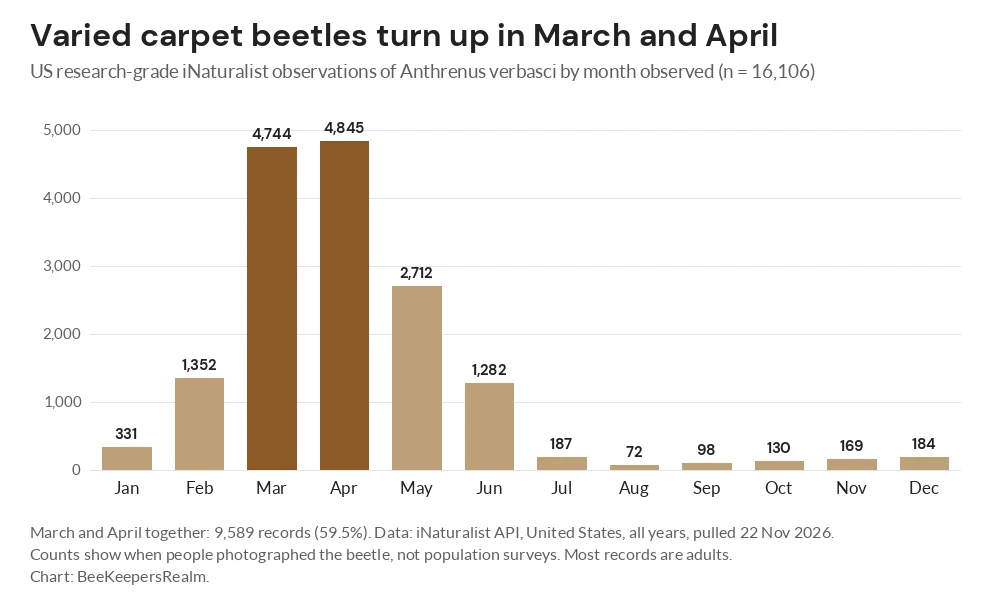
Our count agrees: March (4,744) and April (4,845) hold 59.5% of US varied carpet beetle records, while July to October hold 3.0%. Of the 241 records tagged as larvae, 63.9% fall between October and January.
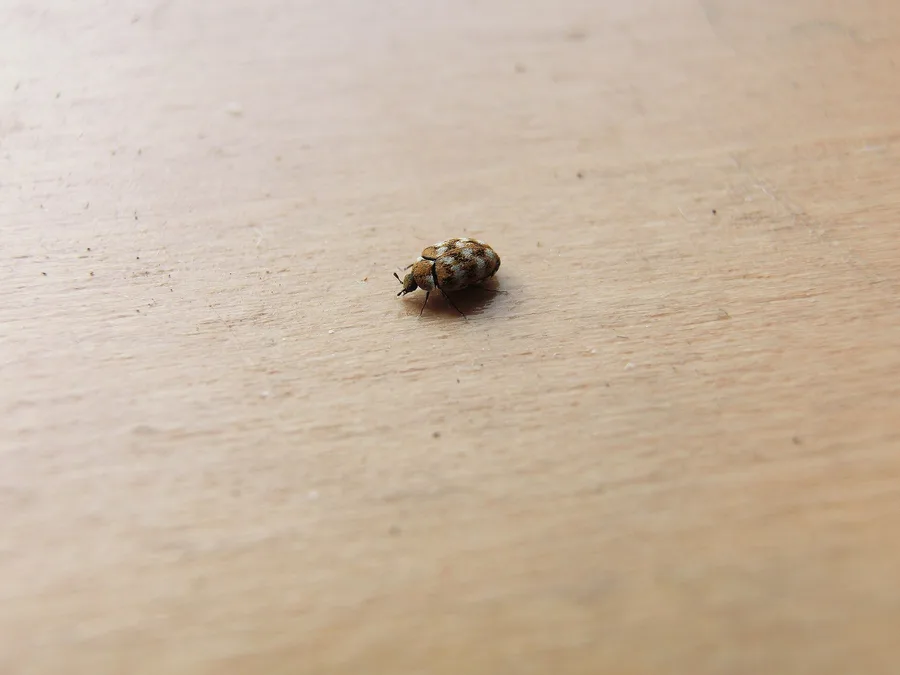
“People often bring carpet beetles into their homes on cut flowers from the garden.”
Check garden bouquets for beetles before bringing them in, as UC IPM advises.
Where an Infestation Starts
- Natural fibers: wool rugs and sweaters, felt, fur, feathers, silk and leather, especially in folds.
- Lint and pet hair: along baseboards, in vents and ducts, under furniture (University of Kentucky).
- Dead insects: Kentucky names cluster flies, lady beetles, stink bugs and wasps in attics, chimneys and light fixtures.
- Nests: females lay eggs in spider webs and bee, wasp or bird nests (UC IPM), and Colorado State says larvae “are common in abandoned bee and wasp nests.”
- Stored food: some species infest cereal, seeds, pet food and bird seed.
SARE’s Managing Alternative Pollinators lists carpet beetles among the beetles drawn to pollen provisions in leafcutter and mason bee nests and calls sanitation “a critical control factor,” which is why a mason bee house needs regular cleaning.
Carpet Beetle Damage vs Clothes Moths
UC IPM says carpet beetles tend to damage “a large area on one portion of a garment or carpet,” while clothes moths leave scattered holes. Look for bristly brown cast skins and no webbing. UC IPM says they do not eat synthetic fibers, and Virginia Tech says they eat cotton, linen and rayon if soiled with food, juice or animal waste. Holes in clean cotton or linen point more toward silverfish.
Do Carpet Beetles Bite? The Larval-Hair Rash
General educational information, not medical advice. See a doctor about any rash that persists or spreads.
Carpet beetles do not bite, but some people react to the larvae’s barbed hairs. In 2021, doctors in Nice, France, reported 11 patients from 7 families with itchy red bumps, mostly under clothing, traced to Anthrenus larvae after bed bugs and fleas were ruled out.
“These lesions mimic bites but are allergic reactions to larvae hairs pegged in the skin.”
The patients got antihistamines and steroid creams while their homes were vacuumed and their clothing washed and stored in airtight bags; no insecticides were used, and the lesions healed within 3 days. Penn State Extension says only people with years of exposure appear to become sensitized.
How to Get Rid of Carpet Beetles
“To eliminate carpet beetles, you must locate all infested items.”
1. Find the source
Check rug edges and undersides, stored woolens, closets, vents, attic nests, dead insects and pantry foods. Live larvae and fresh skins mark the spot.
2. Vacuum thoroughly
UC IPM calls frequent, thorough vacuuming an effective way to remove food, eggs, larvae and adults. Empty the canister or discard the bag promptly.
3. Launder or dry-clean
Hot-water washing or dry cleaning kills all stages (UC IPM). Bag heavily infested items before carrying them out.
4. Freeze or heat what you cannot wash
Seal items in plastic first, and let frozen items warm for about 24 hours before unwrapping (University of Kentucky). Sources differ, so use the longer time if unsure:
| Method | Setting that kills carpet beetles | Source |
|---|---|---|
| Freezer | Below 18°F for 2 weeks | UC IPM |
| Freezer | 0°F for at least 1 week; minus 20°F kills all stages in 72 hours | University of Kentucky |
| Deep freezer | Below 0°F for three days or more | Colorado State |
| Oven (heat-safe items) | 120°F or higher for at least 30 minutes | UC IPM |
| Infested food | 120°F for 1 hour | Virginia Tech |
5. Store airtight and seal entry points
Keep clean natural fibers in airtight containers; UC IPM says closets are not airtight and cedar chests “are not reliable or effective at repelling pests.” Seal cracks, vents and other openings (Colorado State), and remove old nests and spider webs (UC IPM).
6. Insecticides last, indoors only
UC IPM says insecticides are not required if exclusion and sanitation succeed; if needed, use a product labeled for carpet beetles on floor edges and cracks, never on clothing or bedding. Colorado State says household “bug bombs” will not work. Pyrethroid sprays are toxic to bees, so keep them indoors, as our guide to pollinator-safe pest control explains.
Because carpet beetle rashes are often blamed on bed bugs, our bed bug guide shows the signs that actually confirm an infestation.
If you are not sure whether a rash comes from carpet beetle hairs, our bed bug bites guide shows what real bed bug bites look like.
They are not the woolly bear caterpillar, the fuzzy black-and-rust larva of the Isabella tiger moth that crosses roads in fall and never eats fabric.
Frequently Asked Questions
Are carpet beetles harmful?
Not dangerous. They do not bite, sting or spread disease, but larvae damage natural fibers and their hairs can cause a rash in sensitized people.
What do carpet beetle larvae look like?
Slow, hairy grubs 1/8 to 1/4 inch long, tan to dark brown. Varied larvae are striped; black carpet beetle larvae have a long tail tuft.
What causes carpet beetles in the house?
Adults fly in or arrive on cut flowers in spring and lay eggs near wool, lint, pet hair, dead insects, old nests or stored food.
Why are there carpet beetles in my bed?
Wool blankets, down, pet hair and lint feed the larvae. Wash bedding hot, vacuum the mattress and floor, and look for the source nearby.
Are carpet beetles a sign of a dirty house?
No. They live in clean and cluttered homes alike, though lint and pet hair help them build up.
Will carpet beetles go away on their own?
Rarely. UC IPM puts the varied carpet beetle’s larval stage at 220 to 630 days, so the problem continues until the food source is removed.
The Bottom Line
A carpet beetle at the window in March means a larval food source somewhere: a forgotten wool item, pet hair, an old nest or dead insects in the attic. Clean, launder or freeze it, then store natural fibers airtight.
Image credits: featured photo of a varied carpet beetle on ground elder flowers in Søborg, Denmark, by Donald Hobern, Wikimedia Commons, CC BY 2.0, cropped and resized. Other photos are credited in their captions, with links to each file page and licence. Charts by BeeKeepersRealm from iNaturalist API data pulled November 2026.