Reviewed by Elena P. · How we review
A Hercules beetle is a large rhinoceros beetle in the genus Dynastes. Males carry long horns and females have none. The famous giant, Dynastes hercules, lives in Central and South American rainforests, but two smaller relatives live in the United States: the eastern Hercules beetle (Dynastes tityus) and the western Hercules beetle (Dynastes grantii). They do not sting, are not known to bite and are not pests; their grubs eat rotting wood.
Below: how to tell the three species apart, male vs female, the life cycle, the “strongest insect” claim checked against the studies, and our count of 12,933 US iNaturalist records showing when and where Americans find them.
Key Takeaways
- The tropical Hercules beetle reaches about 180 mm (7 inches) with its horn (Animal Diversity Web); the eastern Hercules beetle is 1 1/2 to 2 1/4 inches (University of Kentucky).
- Only males have horns, used to fight other males.
- In our count, 45.1% of 11,997 US eastern Hercules beetle records were made in July and 87.3% in June to August. Western Hercules beetles peak in August and September in Arizona, Utah and New Mexico.
- They are harmless to people; the spiny legs can scratch.
- We found no study behind the “850 times its weight” claim. Measured rhinoceros beetles carried more than 30 times their body mass (Kram, 1996).
Table of Contents
- What a Hercules Beetle Is
- Eastern, Western and Tropical Hercules Beetles Compared
- How to Identify an Eastern Hercules Beetle
- When and Where Americans Find Hercules Beetles
- Hercules Beetle Life Cycle: Grubs in Rotting Wood
- Are Hercules Beetles Dangerous?
- How Strong Is a Hercules Beetle?
- Rhinoceros Beetles in the United States
- Can You Keep a Hercules Beetle as a Pet?
- Frequently Asked Questions
What a Hercules Beetle Is
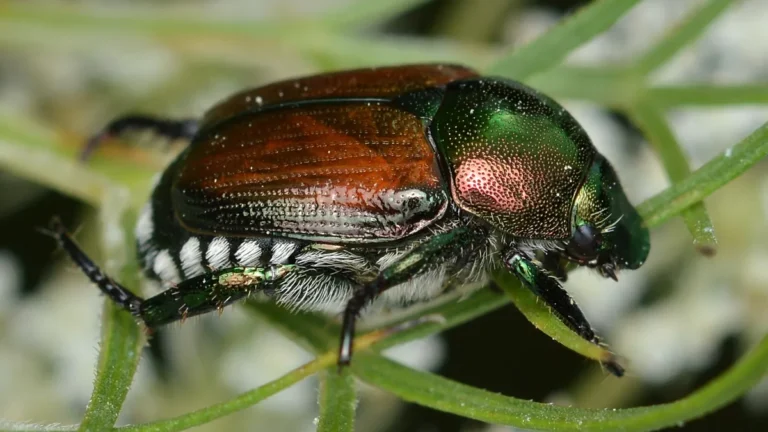
Hercules beetles belong to the scarab family, Scarabaeidae, and its rhinoceros beetle subfamily, Dynastinae, named for the horns on the males. Every Hercules beetle is a rhinoceros beetle, but most rhinoceros beetles are not Hercules beetles. Their familiar relatives in American yards are other scarabs, such as June bugs and masked chafers and the Japanese beetle, which share the same egg, grub, pupa and adult life cycle.
Only two of the eight Dynastes species occur in the US (Jen-Pan Huang, Molecular Ecology, 2016, cited on Wikipedia). “Hercules beetle” alone usually means the tropical Dynastes hercules, a beetle no American meets in the wild.
Eastern, Western and Tropical Hercules Beetles Compared
The table brings the three species together; the US season and state details come from our iNaturalist count below.
| Trait | Eastern Hercules beetle | Western Hercules beetle | Hercules beetle (tropical) |
|---|---|---|---|
| Scientific name | Dynastes tityus | Dynastes grantii | Dynastes hercules |
| Range | Eastern and southeastern US, west to Texas | Arizona, Utah, New Mexico, northern Mexico (University of Nebraska State Museum) | Southern Mexico to Bolivia, Lesser Antilles (Animal Diversity Web) |
| Size | 1 1/2 to 2 1/4 in (University of Kentucky); males almost 2 1/2 in with horns (Missouri Department of Conservation) | Largest scarab in the western US (University of Nebraska State Museum) | 44 to 180 mm (1.7 to 7.1 in) with the horn; males average 78 mm (Animal Diversity Web) |
| Color | Green, gray or tan with black spots (University of Kentucky) | Bluish-gray or pale olive (University of Nebraska State Museum) | Olive green to yellow when dry, black when humid (Animal Diversity Web) |
| Horns | Males only: head horn, long thoracic horn, two small side horns | Males only; thoracic horn longer than the thorax | Males only; very long thoracic horn |
| US adult peak (iNaturalist) | June to August, peak July | August and September | Not native to the US |
How to Identify an Eastern Hercules Beetle
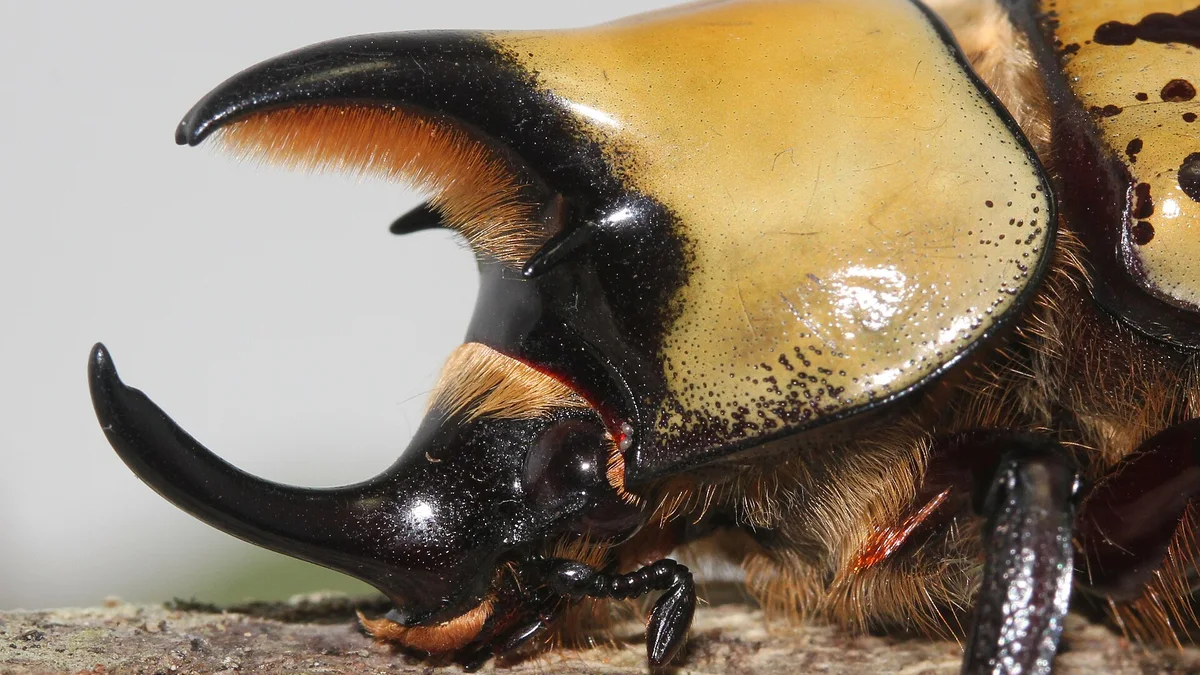
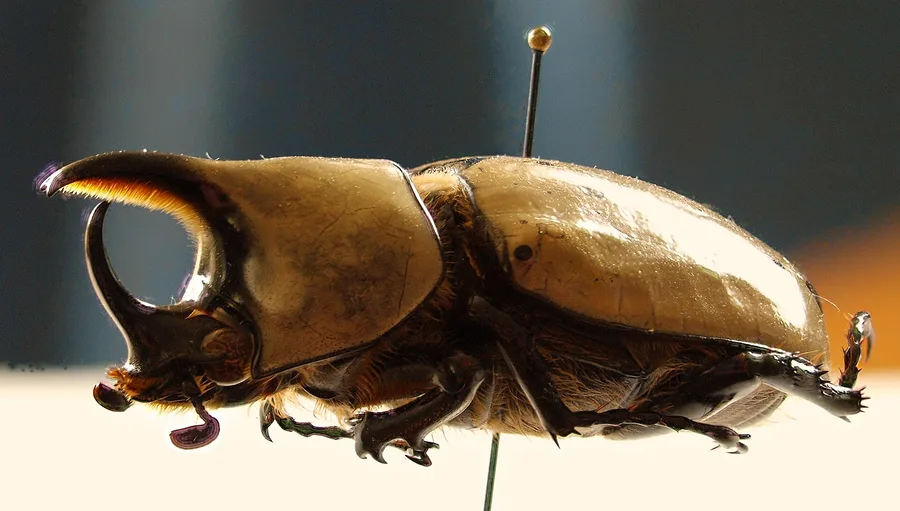
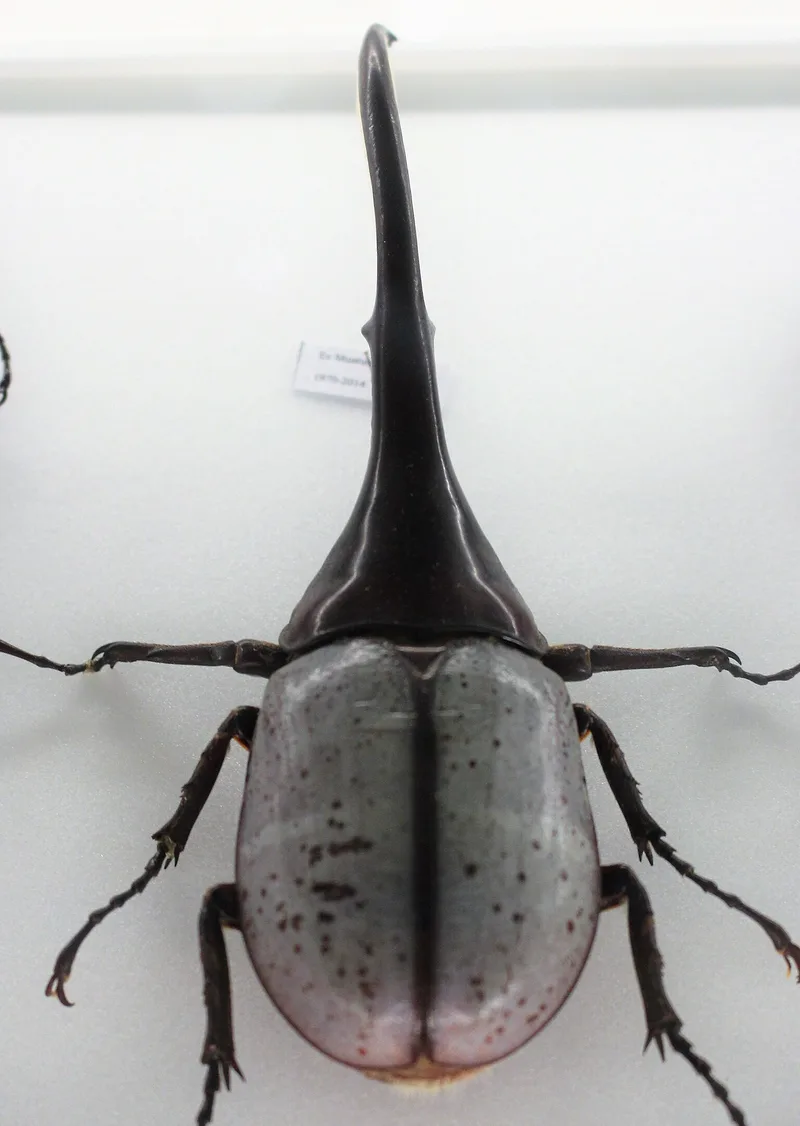
Clemson University’s Home and Garden Information Center calls the eastern Hercules beetle one of the largest and heaviest insects in the US. Look for a heavy, shiny, oval beetle with tan, gray or green wing covers blotched with black, 1 1/2 to 2 1/4 inches long (University of Kentucky Critter Files). The Missouri Department of Conservation says some are nearly all black or brown.
Male vs female
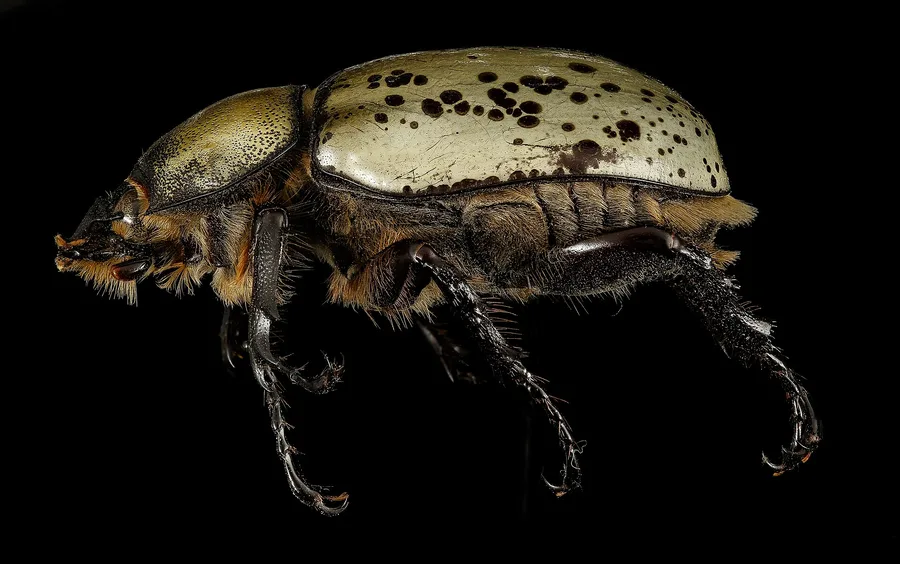
Males have a long horn curving forward from the thorax, a shorter upturned horn on the head and two small horns beside the thoracic one (University of Kentucky). Females have no horns, so a female is easy to mistake for an oversized June beetle. Clemson notes that males with bigger horns had better nutrition as larvae.
“The horns are used for male-male contests for the best breeding sites, much as deer and elk use their antlers.”
Why the color changes
Hercules beetle wing covers change color with humidity. Rassart and colleagues found that tropical Hercules beetle elytra look khaki-green in dry air and turn black in high humidity, because a porous layer in the cuticle fills with water (New Journal of Physics, 2008). A 2017 study by Jiyu Sun and colleagues in the Journal of Materials Science reported the eastern species shifting from yellow-green to deep brown as humidity rises.
When and Where Americans Find Hercules Beetles
The Missouri Department of Conservation says to look for eastern Hercules beetles in deciduous forests and around lights at night. To see when and where people actually find them, we pulled every research-grade US observation of both species from the iNaturalist API on November 22, 2026 (“research grade” means at least two people agreed on the identification): 11,997 eastern and 936 western Hercules beetle records.
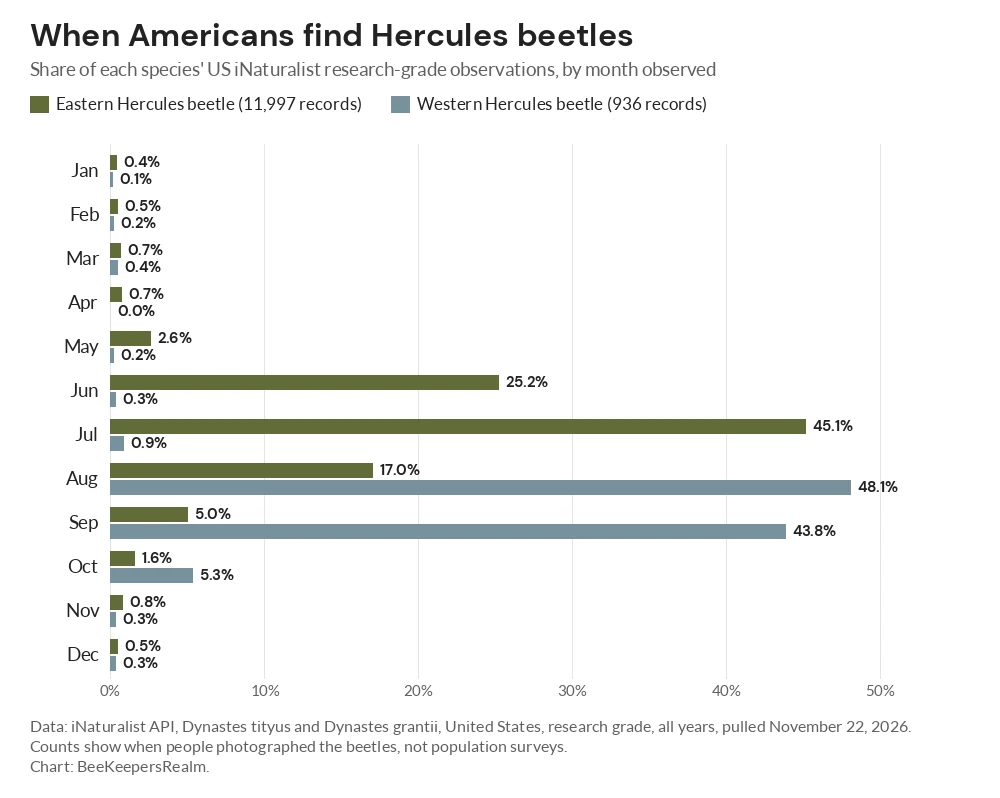
Eastern Hercules beetles have a sharp summer season: 3,024 records (25.2%) in June, 5,415 (45.1%) in July and 2,043 (17.0%) in August. Western Hercules beetles come out later: August (450, 48.1%) and September (410, 43.8%) hold 91.9% of records, matching the University of Nebraska State Museum’s note that adults are active from mid-August to October.
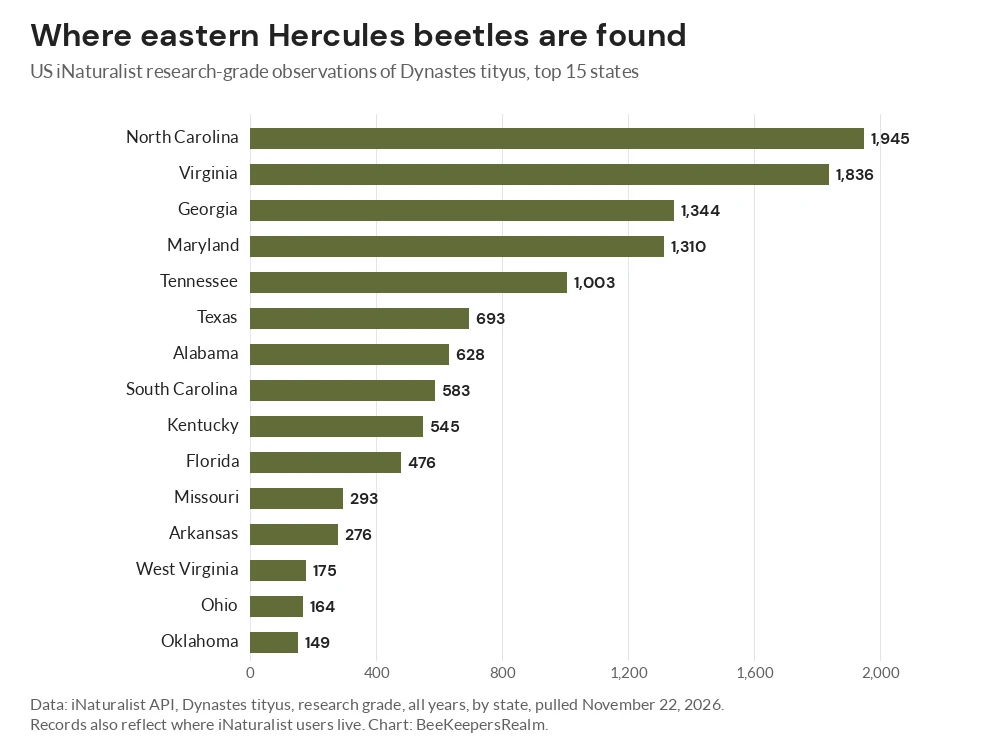
Eastern records came from 25 states and Washington, D.C. North Carolina (1,945), Virginia (1,836), Georgia (1,344), Maryland (1,310) and Tennessee (1,003) hold 62% of them. Texas (693) and Oklahoma (149) are the western edge, apart from one record in Colorado, and the north is thin: 27 records in New Jersey, 17 in Pennsylvania, 1 in New York. Western records came only from Arizona (737), Utah (121) and New Mexico (78). Records follow where iNaturalist users look, not only where beetles live.
Only 119 eastern records are tagged as grubs, against 2,998 tagged as adults, and females (1,609) outnumber males (1,311) among records tagged by sex. Most adults are found at lights: Kentucky’s entomologists say they come to ultraviolet lights on moonless, humid nights, like luna moths.
Hercules Beetle Life Cycle: Grubs in Rotting Wood
Hercules beetles go through complete metamorphosis. For the eastern species, the University of Kentucky describes:
- Eggs: laid in soil in the warm months; they hatch in about a month.
- Grubs: up to 4 1/2 inches long, feeding on decaying logs, stumps, dead leaves and rotten fruit for 6 months to a year, often tunneling up into a stump from the soil below.
- Pupae and adults: adults leave the pupal case after a few weeks but stay underground until spring.
In the wild, development may take up to three years, according to a 1976 Maryland study by John Glaser in The Coleopterists Bulletin, cited on Wikipedia. The Missouri Department of Conservation says decaying ash trees are a favored larval nursery, so the beetles may gain at first from ash killed by the invasive emerald ash borer, then decline once that wood is gone. Adults eat rotting fruit and tree sap.
Tropical Hercules beetles spend 12 to 18 months as larvae, growing past 15 cm and up to 140 g (Animal Diversity Web). Western adults strip velvet ash bark for the sap (University of Nebraska State Museum). Grub enemies include skunks, raccoons, centipedes and Mydas fly maggots (University of Kentucky); scoliid wasps hunt many scarab grubs, though no source we found names them as a Hercules beetle enemy.
Are Hercules Beetles Dangerous?
No. Kentucky’s entomologists write that Hercules beetles are not pests in Kentucky, their horns are not dangerous and they are not known to bite. The Missouri Department of Conservation calls them harmless to people.
“Despite their appearance, these beetles are not dangerous to people.”
Clemson and Kentucky both say the spiny legs and foot claws can scratch if you pick one up, and Animal Diversity Web says males hiss by rubbing the abdomen against the wing covers when disturbed. Unlike termites, they do not attack sound wood in houses, and they do not damage lawns or gardens. If one lands on your porch, move it to a tree trunk or woodpile, and leave old hardwood stumps where the grubs can grow.
How Strong Is a Hercules Beetle?
Many pages say a Hercules beetle can lift 850 times its own weight. We found no study that measured that. The published numbers:
- Rhinoceros beetles carrying loads: In “Inexpensive load carrying by rhinoceros beetles” (Journal of Experimental Biology, 1996), Rodger Kram’s eight Xylorctes thestalus beetles walked a treadmill with loads of more than 30 times their body mass. That is a different rhinoceros beetle.
- Dung beetles pulling: Rob Knell and Leigh Simmons found the strongest males of the dung beetle Onthophagus taurus could pull 1,141 times their body weight (Proceedings of the Royal Society B, 2010, via Queen Mary University of London).
- Hercules beetles: Animal Diversity Web reports that the muscle working the male’s thoracic horn exerts about 140 newtons (14.3 kg of force), enough to grip and throw a rival.
“It is well-named because you cannot easily contain a Hercules beetle in your hand without it forcing its way out.”
Rhinoceros Beetles in the United States
“Rhinoceros beetle” or “rhino beetle” covers the whole subfamily Dynastinae. The National Wildlife Federation says they grow up to 6 inches, adults eat fruit, nectar and sap, and larvae eat decaying plant matter. Our iNaturalist pull found 45,696 US research-grade rhinoceros beetle records, led by the eastern Hercules beetle (11,997, 26.3%).
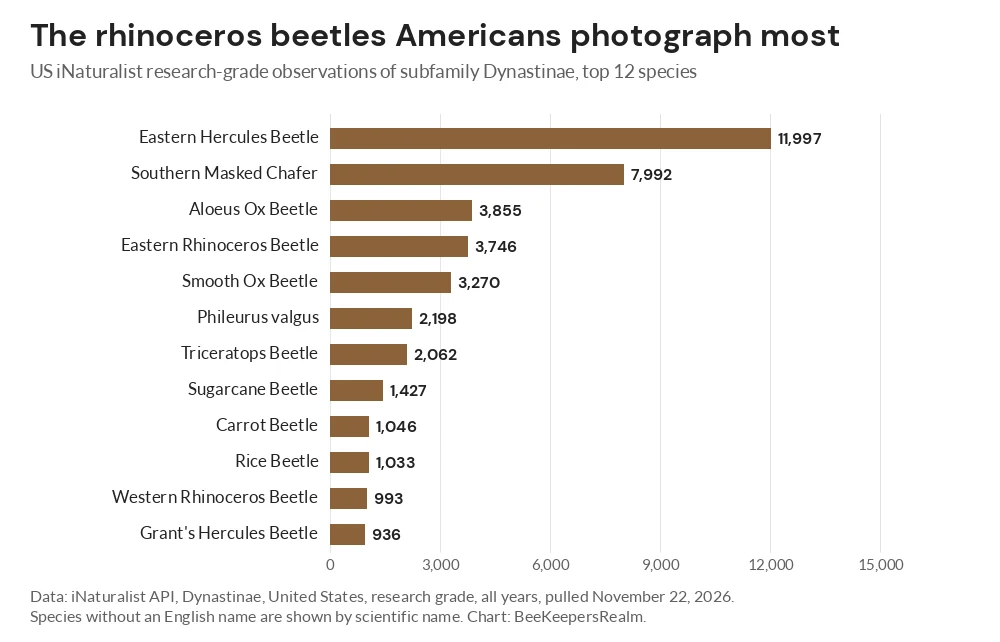
Second is the hornless southern masked chafer (Cyclocephala lurida, 7,992), a lawn-grub scarab. Then come horned species: two ox beetles (Strategus aloeus, 3,855; Strategus antaeus, 3,270), the eastern rhinoceros beetle (Xyloryctes jamaicensis, 3,746) and the triceratops beetle (Phileurus truncatus, 2,062).
The coconut rhinoceros beetle in Hawaii
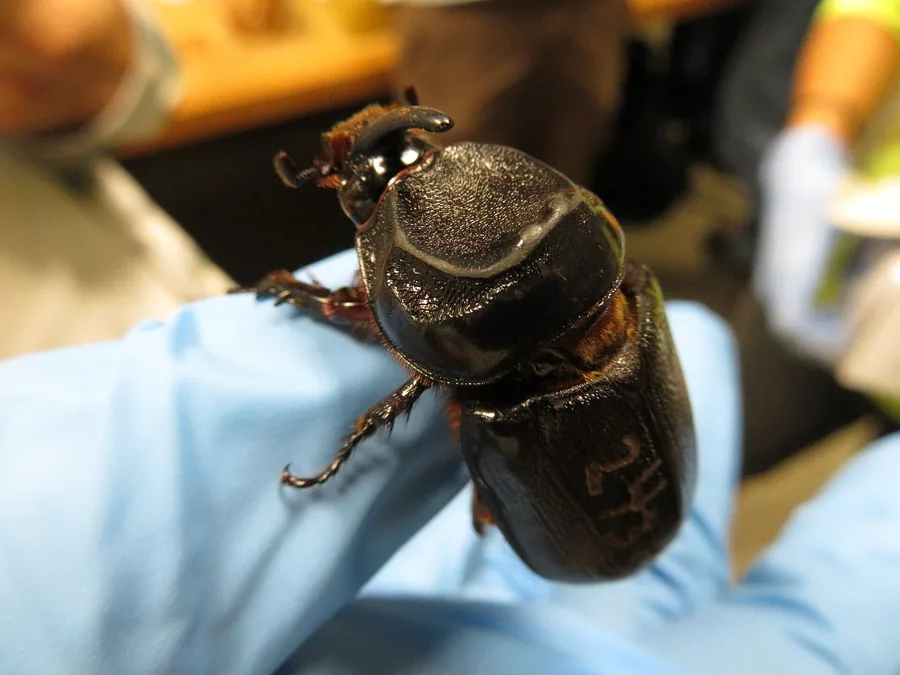
One US rhinoceros beetle is a real pest. The Hawaii Department of Agriculture says the invasive coconut rhinoceros beetle (Oryctes rhinoceros) was detected on December 23, 2013, on coconut trees at Joint Base Pearl Harbor-Hickam on Oahu, and on Kauai in 2023. Adults bore into palm crowns to feed on sap, leaving V-shaped cuts in the fronds. Report suspected beetles to the state pest hotline, 643-PEST (7378).
Can You Keep a Hercules Beetle as a Pet?
Kentucky’s entomologists call rearing Hercules beetles a challenging but rewarding hobby. Check the federal rules first: the USDA APHIS invertebrate pets page asks people to contact USDA Plant Protection and Quarantine before buying a land-dwelling invertebrate, and says the PPQ 526 permit covers importation and interstate movement of invertebrate animals. That matters most for the tropical species, which is not native to the US. This is general information, not legal advice.
Dung beetles are scarabs too; our dung beetle guide covers the rainbow scarab, tumblebugs and the bull-headed dung beetle behind the 1,141-times strength record.
A beetle with antler-like jaws instead of horns is a stag beetle, a different family whose grubs also grow up in rotting wood.
Frequently Asked Questions
Are Hercules beetles dangerous to humans?
No. They have no sting or venom and are not known to bite, though the spiny legs can scratch.
Do Hercules beetles live in the United States?
Two species do: the eastern Hercules beetle in the East and Southeast, and the western Hercules beetle in Arizona, Utah and New Mexico.
How big do Hercules beetles get?
The tropical species reaches about 180 mm (7 inches) with its horn. The eastern Hercules beetle is 1 1/2 to 2 1/4 inches.
Is a Hercules beetle a rhinoceros beetle?
Yes. The genus Dynastes belongs to the rhinoceros beetle subfamily, Dynastinae, of the scarab family.
How long do Hercules beetles live?
Mostly as grubs. Eastern grubs feed for 6 months to a year or longer; the tropical species can live about 34 months in total, 8 to 12 of them as an adult (Animal Diversity Web).
Are Hercules beetles rare or endangered?
Not in general. Animal Diversity Web gives the tropical species no special status (IUCN: not evaluated), and the eastern species is recorded thousands of times each summer, though Missouri warns it could decline as dead ash disappears.
The Bottom Line
A big horned beetle at your porch light in July is almost certainly an eastern Hercules beetle, and it is harmless. Put it back on a tree and leave the old stumps its grubs need. Beekeepers who find a beetle inside a hive should think of the small hive beetle instead. For more, see our garden and household insects guides.
Image credits: Featured image: male eastern Hercules beetle, South Carolina, by David Hill, Wikimedia Commons, CC BY 2.0, cropped and resized. Western Hercules beetle: JohnSka, CC BY-SA 3.0. Tropical Hercules beetle: Emőke Dénes, CC BY-SA 4.0, cropped. Female eastern Hercules beetle: USGS Bee Inventory and Monitoring Lab, public domain. Coconut rhinoceros beetle: Forest and Kim Starr, CC BY 2.0. All photos via Wikimedia Commons, resized; links to each file page and licence are in the captions. Charts: BeeKeepersRealm, from iNaturalist API data pulled November 22, 2026.