Reviewed by Michael R. · How we review
A blister beetle is a soft-bodied beetle in the family Meloidae whose body fluid contains cantharidin, a chemical that blisters skin and can kill horses that eat beetles baled into alfalfa hay. Blister beetles do not bite or sting. Their larvae are remarkable too: in most genera they ride wild bees into their nests, while the common hay-field species eat grasshopper eggs instead.
Key Takeaways
- Look for a narrow “neck,” a soft, long body and flexible wing covers. There are about 2,500 species worldwide and more than 400 north of Mexico.
- The blisters come from fluid oozing from the leg joints when a beetle is pressed, not from a bite. Brush it off and wash with soap and water.
- Horses are very sensitive to cantharidin. Crimped alfalfa cut in bloom is the main risk, and dead beetles stay toxic in stored hay.
- Larvae of most genera ride bees into their nests and eat the bee’s young and stored food. A 2026 study found European oil beetle larvae lure bees by smelling like flowers.
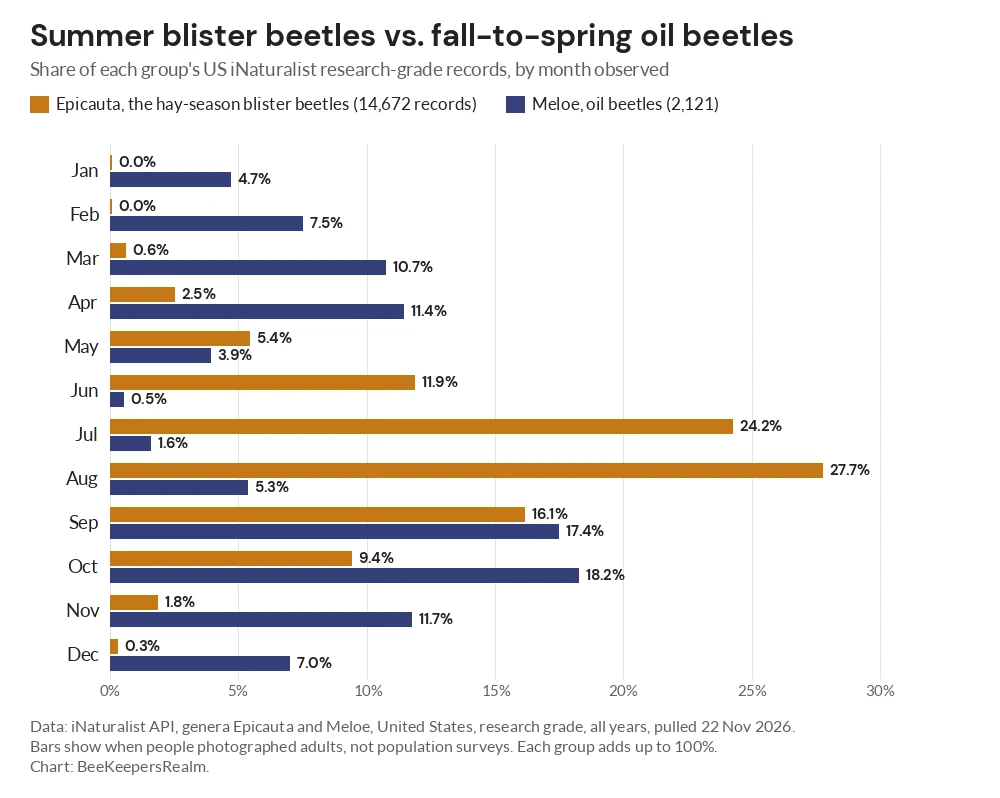
- In 45,810 US iNaturalist records we counted, 80% of Epicauta sightings fall in June to September, but 89% of oil beetle (Meloe) sightings fall in September to April.
Table of Contents
- What a Blister Beetle Is
- How to Identify Common US Blister Beetles
- How Blister Beetle Larvae Ride Bees Into Their Nests
- Blister Beetle Life Cycle and Season
- Blister Beetle “Bites” and Skin Blisters
- Blister Beetles in Hay: Why Horses Are at Risk
- Garden Damage and Bee-Safe Control
- Frequently Asked Questions
What a Blister Beetle Is
Blister beetles make up the family Meloidae. University of Florida entomologists Richard Selander and Thomas Fasulo put it at about 2,500 species in 120 genera, and the Missouri Department of Conservation counts more than 400 species north of Mexico. The name comes from cantharidin, an odorless compound in their body fluid that blisters skin. UF/IFAS says cantharidin occurs elsewhere only in the false blister beetles (Oedemeridae), a separate family often confused with this one.
Adults eat plants, mostly flowers, so they turn up on alfalfa, beans, potatoes, tomatoes and pigweed. The larvae are predators, and most of them depend on bees, as the bee section explains.
How to Identify Common US Blister Beetles
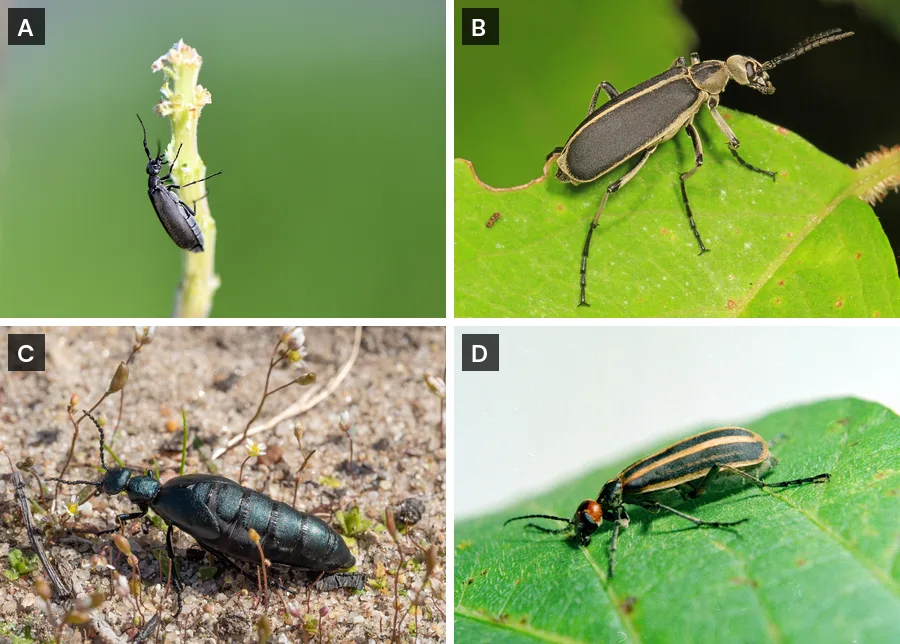
- A distinct neck: the head is wider than the narrow front of the thorax.
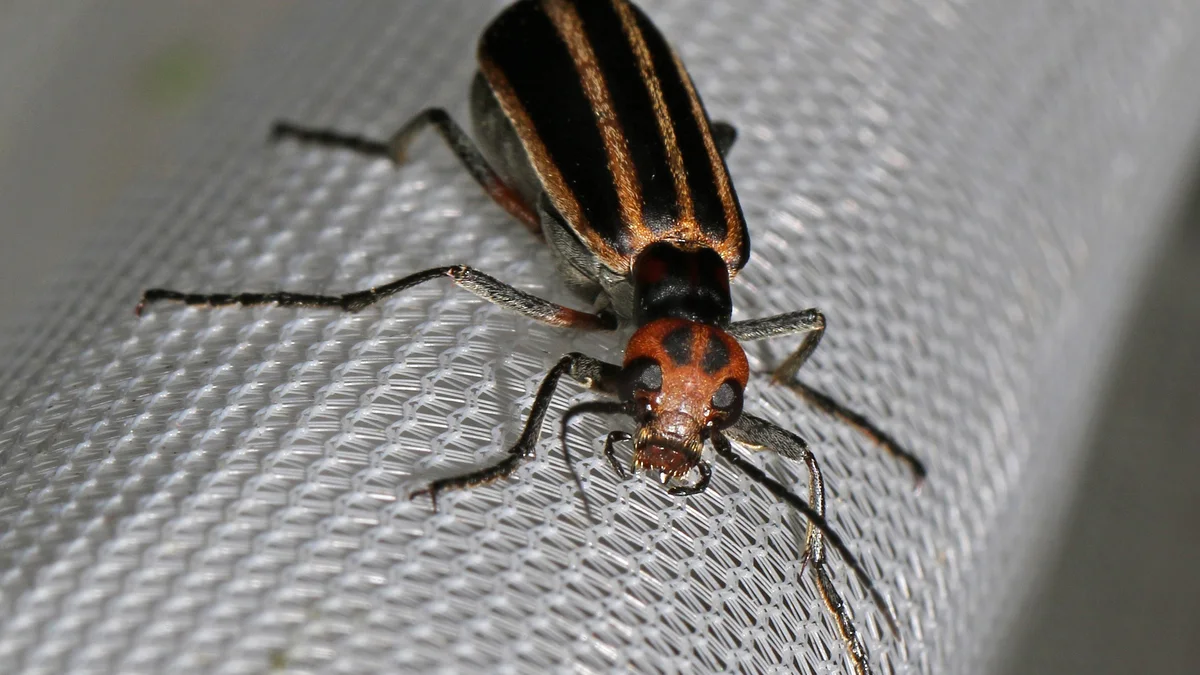
- A soft, long body with long legs; the common Epicauta below are 7 to 17 mm (1/4 to 2/3 inch).
- Soft wing covers; oil beetles (Meloe) have short ones, a swollen abdomen and no flight.
- Groups feeding or mating together, often at field edges.
| Beetle | Key marks | Where and when | Larvae eat |
|---|---|---|---|
| Striped blister beetle (Epicauta vittata) | 9 to 17 mm; black-and-yellow stripes running down each wing cover | Eastern states west to South Dakota, Nebraska, Kansas and Oklahoma; in Arkansas, adults late May to late October | Grasshopper eggs |
| Black blister beetle (Epicauta pensylvanica) | 7 to 15 mm; all black | Much of the US except the Pacific Coast states; often on goldenrod | Grasshopper eggs (genus pattern) |
| Margined blister beetle (Epicauta funebris) | Black with a thin pale line along the edge of each wing cover | Eastern US west to Texas and South Dakota | Grasshopper eggs (genus pattern) |
| Ashgray blister beetle (Epicauta fabricii) | 10 to 15 mm; gray | Eastern North America; on alfalfa, beans, peas and other legumes | Grasshopper eggs (genus pattern) |
| Oil beetles (Meloe, e.g. M. americanus) | Black or blue-black; short wing covers; swollen abdomen; flightless | Widespread; most US records fall in September to April, often on bare ground | Solitary bee eggs and nest stores, reached by riding bees |
| Nemognatha (e.g. N. piazata, N. nemorensis) | Variable; iNaturalist calls N. piazata the orange blister beetle | On thistles, black-eyed Susans and other members of the aster family; US records peak April to June | Bee nests, reached by riding bees |
Sources: UF/IFAS EENY-166 and EENY-280, Nebraska Extension G1645, Saul-Gershenz and Millar (2006) and our iNaturalist count. “Genus pattern”: UF/IFAS says most Epicauta larvae eat grasshopper eggs.
In our black-eyed Susan guide, Nemognatha nemorensis led the beetles recorded on the flowers, and UF/IFAS names Rudbeckia as its particular favorite.
Which ones do Americans actually see? We pulled all research-grade US records of the family from the iNaturalist API on November 22, 2026: 45,810 observations of 230 species.
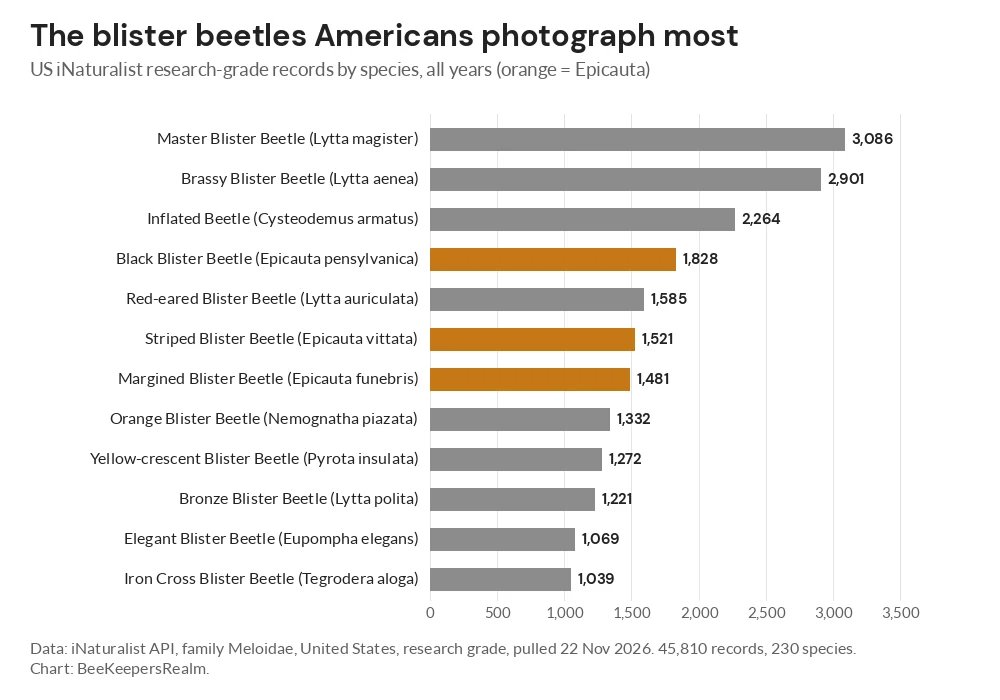
Western species top the list, led by the master blister beetle (Lytta magister, 3,086 records); the eastern hay-field species follow with 1,481 to 1,828 each.
Video: University of Maryland Extension horticulturist Joyce Browning handles oil beetles on a Maryland trail in May (with gloves), shows the reflex bleeding that causes blisters, and explains how to tell the sexes and why hay is a risk. Two corrections: the larvae in the study she describes ride a solitary bee, not honey bees, and UF/IFAS says they eat the bees’ young, so they are parasitic.
How Blister Beetle Larvae Ride Bees Into Their Nests
“Larvae of most genera enter the nests of wild bees, where they consume both immature bees and the provisions of one or more nest cells.”
The first larval stage, the triungulin, is tiny, fast and long-legged. UF/IFAS explains that in most of the subfamily Meloinae, which includes Epicauta, it reaches its food on its own, searching the soil for grasshopper egg pods, but in the oil beetle tribe (Meloini) and the subfamily Nemognathinae it attaches to an adult bee and is carried to the nest. UF entomologist John Capinera adds that the larvae of genera other than Epicauta seem to feed mainly on ground-nesting bees such as mining bees (Andrenidae) and sweat bees (Halictidae), which is why these beetles turn up where ground bees nest in a yard.
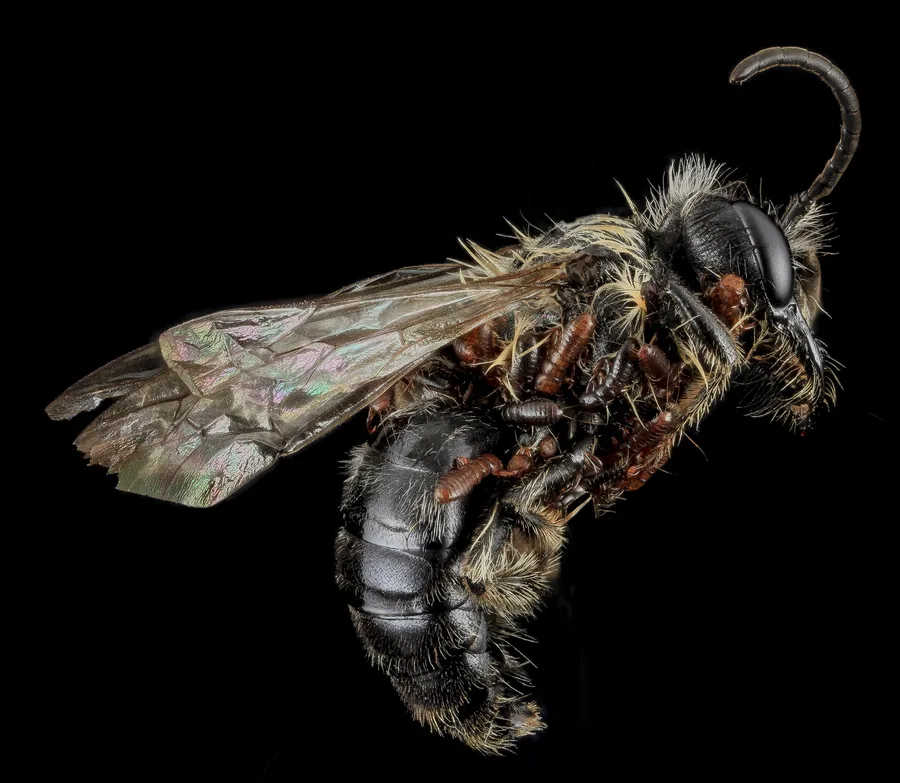
The California oil beetle that fakes a female bee
At Kelso Dunes in California’s Mojave National Preserve, Leslie Saul-Gershenz and Jocelyn Millar showed that larvae of the oil beetle Meloe franciscanus gather on plant tips in clumps of 120 to more than 2,000 and give off a chemical cue that mimics the sex pheromone of a female digger bee, Habropoda pallida (PNAS, 2006). The whole clump jumps onto a visiting male within 0.13 to 2 seconds and moves to a female when he tries to mate; she carries the larvae home, where they eat her pollen, nectar and egg. Riding on other insects is believed to have evolved at least seven times in the family.
The European oil beetle that smells like flowers
In July 2026, a Max Planck Institute for Chemical Ecology team reported that larvae of the European oil beetle Meloe proscarabaeus release 17 monoterpenoids, scents similar to plum and cherry blossoms. Bees preferred that scent in lab tests even when the larvae were hidden, wild Andrena sand bees flew to cotton swabs dabbed with it, and the team identified two enzymes the larvae use to make it.
“By mimicking a resource that attracts many different species of wild bees, the larvae are able to reach a broader range of potential hosts.”
Hitchhiking beetle larvae are ancient, too: one of the oldest known bees, in amber about 99 million years old, carries 21 of them, as our bee fossil record article describes. Bee flies have a similar active first-stage larva that seeks out host nests.
Do blister beetles harm honey bees?
Rarely. None of the US extension sources we read lists them as a honey bee pest. The one honey bee report we found is from Europe: Rădoi and colleagues (Romanian Biotechnological Letters, 2020) found Meloe triungulins in 8 of 35 Romanian apiaries, with 173 of 550 colonies affected and 54 suffering massive losses.
For US beekeepers, the bigger risk is spraying. New Mexico State University notes that carbaryl, an insecticide it lists for blister beetles in alfalfa, is highly toxic to honey bees and tells growers to warn beekeepers first. If your hives sit near alfalfa, registering them with DriftWatch and BeeCheck helps applicators find you.
What this means for native-bee gardens
The Missouri Department of Conservation notes that blister beetle larvae parasitize bees, “limiting populations of pollinators.” That is natural predation, like cuckoo bees taking over another bee’s nest, not a reason to kill oil beetles. If you see oil beetles near a mining bee nest site in spring, leave both alone; the solitary bee life cycle already absorbs losses like these.
Blister Beetle Life Cycle and Season
Blister beetles go through hypermetamorphosis: the larva changes form several times, from a running hunter to a legless resting stage. UF/IFAS describes four larval phases, and its striped blister beetle profile gives stage lengths:
| Stage | What it does | Striped blister beetle timing |
|---|---|---|
| Egg | Laid in masses in soil or under stones (most species) or on the adults’ food plants (bee-nest species) | Clusters of 100 to 200, 3 to 4 cm deep; hatch in 10 to 16 days |
| Triungulin (first instar) | Active, long-legged; finds grasshopper eggs or rides a bee to a nest | About 3.4 days at warm temperatures, feeding on the egg pod it finds |
| First grub phase | Grub-like; eats fast | Instars 2 to 5 take about 1 to 11 days each at warm temperatures |
| Coarctate phase | Hard, immobile resting larva | Overwinters; a sixth instar can last about 230 days |
| Second grub phase and pupa | Short active stage, then pupation in soil | Pupa lasts 9 to 13 days |
| Adult | Feeds on flowers and leaves, mates and lays eggs | Adults commonly live three months or more; 1 to 2 generations a year |
Sources: UF/IFAS EENY-166 and EENY-280.
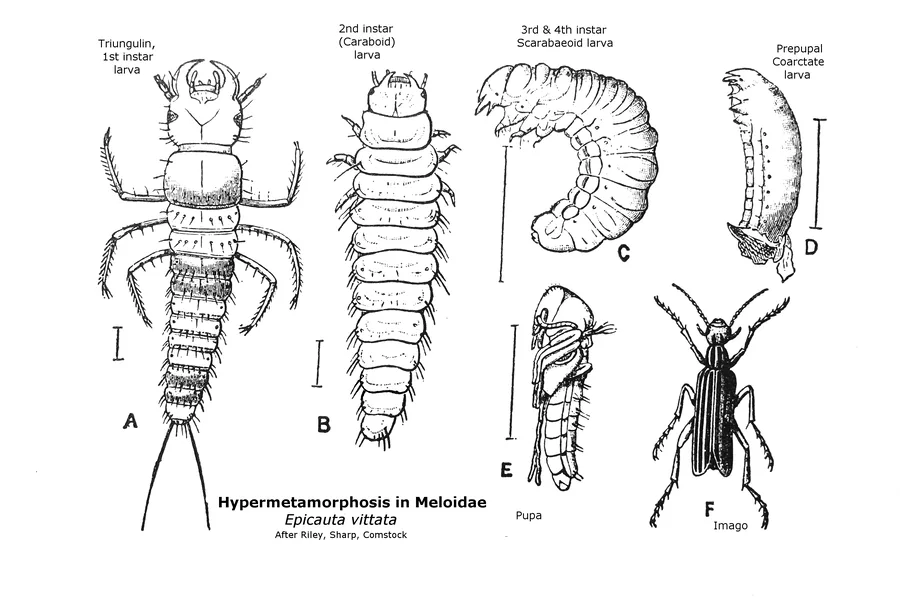
Because Epicauta larvae eat grasshopper eggs, Nebraska Extension says blister beetle numbers are often higher the year after high grasshopper numbers; see our grasshopper guide.
The two lifestyles run on different calendars. In US iNaturalist records, Epicauta adults peak in July and August, matching Nebraska’s finding that they occupy alfalfa through the second and third cuttings. Oil beetles show up mostly from September to April, overlapping the early spring flight of mining bees.
Blister Beetle “Bites” and Skin Blisters
A blister beetle “bite” is a chemical burn: a pressed beetle releases fluid from its leg joints, and the cantharidin raises a blister. UF/IFAS says blisters are most common on the neck and arms, from beetles drawn to outdoor lights at night, and that unless blistering is extensive, first aid is probably all that is needed.
Poison Control advises:
- Do not slap or crush a beetle on your skin. Gently blow it away or remove the clothing it landed on.
- Wash exposed skin with soap and water, and do not touch your eyes first.
- Wear gloves, long sleeves and long pants when gardening where blister beetles have been seen.
- Get medical help for eye exposure or swallowing. Poison Control describes a 10-month-old who vomited an insect and a little blood; she fully recovered after hospital care.
Swallowed cantharidin is dangerous to pets as well: the University of Wisconsin puts its estimated lethal dose at 1.0 to 1.5 mg per kg for cats and dogs. For another garden creature with skin-burning defenses, see our millipede guide.
This is educational information, not medical or veterinary advice. For exposures, call Poison Control at 1-800-222-1222; for animals, call your veterinarian.
Blister Beetles in Hay: Why Horses Are at Risk
Adult blister beetles are strongly attracted to alfalfa and broadleaf weeds in bloom, and some species move in swarms. When hay is cut and crimped (crushed to dry faster) while beetles are in the field, the beetles die and end up in the bales; Nebraska Extension says beetles can leave hay that is cut but not crimped. Wisconsin Extension says cantharidin stays in a dead beetle for months, and the Merck Veterinary Manual says its toxicity does not decrease in stored hay.
How many beetles does it take? Nebraska Extension estimates a minimum lethal dose of 1 mg of cantharidin per 2.2 pounds of horse and reports these averages from University of Minnesota testing:
| Species | Males, mg per beetle (range) | Females, mg per beetle (range) |
|---|---|---|
| Black blister beetle | 0.40 (0.03 to 0.70) | 0.08 (0.07 to 0.30) |
| Ashgray blister beetle | 1.25 (0.06 to 3.38) | 0.49 (0.14 to 0.75) |
| Striped blister beetle | 5.21 (1.43 to 11.13) | 4.52 (2.18 to 8.50) |
Source: Nebraska Extension NebGuide G1645 (2022), Table 1, from Hutchison, Murphy and Tufte, University of Minnesota.
New Mexico State University says reported lethal doses range from a few beetles to 200, and calculates 81 to 128 beetles for a 1,000-pound horse for one common small gray Epicauta. Beetles cluster, so most hay may be clean: Merck notes one flake can hold several hundred beetles while a flake from the other end of the same bale has none.
Nebraska Extension lists mouth blisters and ulcers, colic, diarrhea, frequent urinating with little urine, blood in the urine, and dipping the muzzle in water without drinking. Animals can die within 72 hours, so call a veterinarian at once.
How horse owners and growers reduce the risk
- Cut early: Nebraska recommends cutting before 5% bloom; NMSU says 10% or less.
- Favor first cuttings: in Nebraska these are usually harvested before adults appear.
- Do not crimp where beetles are swarming; wait until they leave the field.
- Do not spray the field itself right before cutting: Nebraska notes dead beetles stay toxic and can be baled.
- Know your source and check flakes as you feed, especially alfalfa shipped from other states.
Alfalfa is also the crop the managed alfalfa leafcutter bee is named for, one more reason to keep sprays off blooming fields.
Garden Damage and Bee-Safe Control
In gardens, adults chew tomatoes, potatoes, beans, beets, spinach, peppers and melons. Capinera calls the striped blister beetle one of the most damaging to vegetables because it arrives in sudden swarms, and UF/IFAS says such attacks can be “locally catastrophic.” Damage is often patchy, so check whether it is spreading before acting.
- Handpick with gloves into soapy water, as Virginia Tech advises. UF/IFAS says this may be enough in a small garden.
- Pull pigweed, which Capinera says adults strongly prefer.
- Leave the larvae alone. Epicauta larvae destroy grasshopper eggs; Capinera cites a survey in which 8.8% of egg pods were damaged by them.
- If you spray, spray nothing in bloom, since blister beetles sit on the flowers bees visit. Our pollinator-safe pest control guide explains label bee warnings, the same rule as for Japanese beetles.
Frequently Asked Questions
What happens if you get bit by a blister beetle?
They do not bite. Contact with a crushed beetle’s fluid raises a blister that usually needs only first aid. Wash the area with soap and water and keep it clean.
Are blister beetles harmless?
Not completely. They are harmless if left alone, but crushing one can blister skin, and swallowing one is dangerous to people, pets and especially horses.
Where are blister beetles most common?
Across most of the US, in fields, meadows, gardens and field edges. Eastern hay-field species peak in midsummer; several of the most-photographed species live in the Southwest.
What kills a blister beetle?
Handpicking into soapy water works in gardens. Natural enemies include robber flies and birds such as meadowlarks and bluebirds, according to UF/IFAS. Never spray plants in bloom.
Can a blister beetle hurt my dog?
Yes, if eaten. Cantharidin’s estimated lethal dose for cats and dogs is 1.0 to 1.5 mg per kg, so call a veterinarian if your pet eats one.
Do blister beetles get into beehives?
Not as a hive pest in the US sources we read; their larvae target solitary, ground-nesting bees. The beetle beekeepers fight inside hives is the small hive beetle.
The Bottom Line
Treat a blister beetle like a hot stove: brush it off, do not crush it, and wash your skin. If you keep horses, buy hay cut before bloom from a grower who watches for swarms. And if you see one on your flowers, remember its larvae may be riding a native bee home.
Image credits: Featured image: striped blister beetle in Cambridge, Maryland, by Judy Gallagher, Wikimedia Commons, CC BY 2.0, cropped and resized. Photo panel: Courtney Celley/USFWS (public domain), Judy Gallagher (CC BY 2.0), Rhododendrites (CC BY-SA 4.0), Clemson University USDA Cooperative Extension Slide Series, Bugwood.org (CC BY 3.0); panel shared under CC BY-SA 4.0. Mining bee with triungulins: Sam Droege (CC BY 2.0). Life cycle drawing: after C. V. Riley, in Comstock (1920), public domain. File-page and licence links are in each caption. Charts: BeeKeepersRealm, from iNaturalist API data pulled November 2026.