Reviewed by Sofia T. · How we review
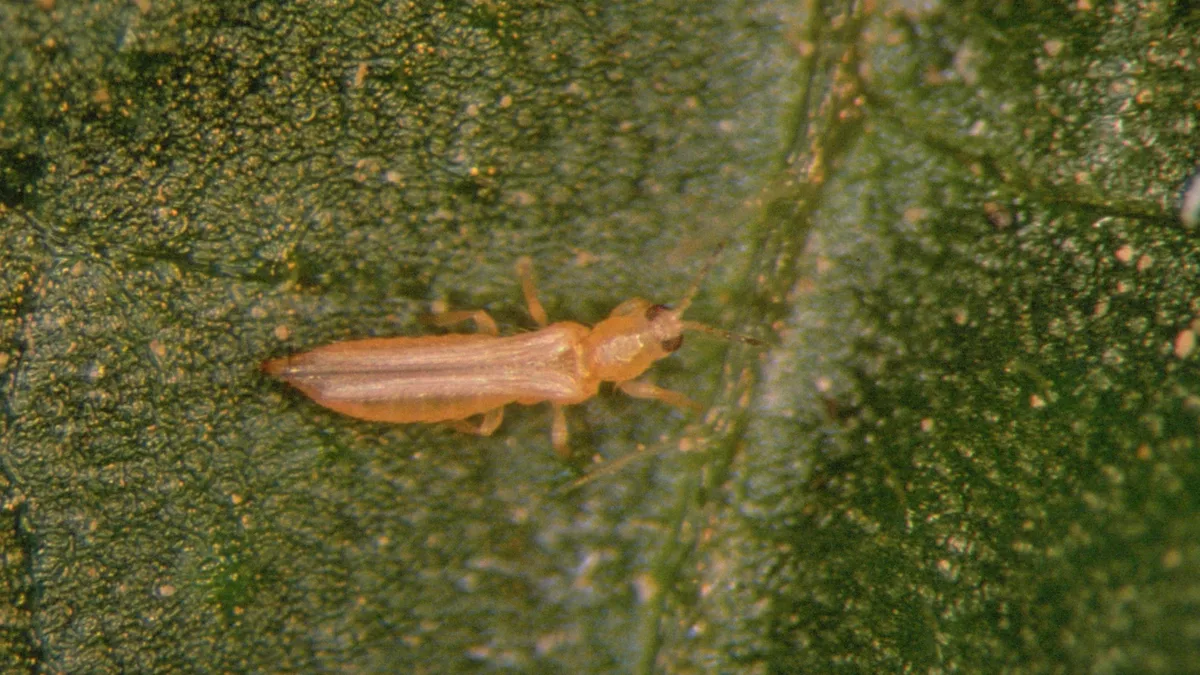
Thrips are tiny, slender insects, most under 1/20 inch long, with narrow wings edged in long fringes. Pest species rasp open plant cells and suck out the contents, leaving silvery, stippled leaves, streaked or deformed flowers and tiny black specks of excrement. A few species also spread plant viruses such as tomato spotted wilt. They hide in buds and drop into the soil to pupate, so sprays often miss them; extension services recommend monitoring, cleanup, natural enemies and carefully timed soft sprays.
Below: identification, look-alikes, the species and viruses that matter, bites, and extension-recommended control, including how to treat thrips without harming the bees that visit the same flowers, plus our count of 17,887 US iNaturalist thrips records. Sources are university extension services and federal agencies, linked where used. This is educational information, not professional pest-control advice.
Key Takeaways
- Thrips are the insect order Thysanoptera, with about 7,700 described species. Most pest thrips are under 1/20 inch long, so the damage is usually noticed before the insect (UC IPM).
- Signs: stippling, silvering and papery leaves, dark varnish-like specks of excrement, and petals that are streaked, browned or fail to open.
- Western flower, onion and tobacco thrips spread tomato spotted wilt virus; infected plants cannot be cured, so prevention matters most (UF/IFAS, Virginia Tech).
- In our count of 17,887 US iNaturalist thrips observations, April and May hold 32.2% of records, and only 9.0% reached research grade, a measure of how hard thrips are to identify from a photo.
- Start with monitoring, pruning, watering and natural enemies such as minute pirate bugs. If you spray, never spray open flowers bees are visiting; UC IPM says not to apply spinosad to plants that are flowering.
Table of Contents
- What Thrips Are
- How to Identify Thrips and Thrips Damage
- Thrips vs Spider Mites, Aphids, Fungus Gnats and Whiteflies
- Thrips Species US Gardeners Meet
- Thrips Life Cycle and Why Sprays Miss Them
- When Thrips Turn Up: Our iNaturalist Count
- Thrips and Tomato Spotted Wilt Virus
- Do Thrips Bite People?
- How to Get Rid of Thrips
- Treating Thrips Without Harming Bees
- Not Every Thrips Is a Pest
- Frequently Asked Questions
What Thrips Are
Thrips make up the insect order Thysanoptera, a name built from the Greek for “fringe” and “wing.” Entomologists have described about 7,700 species worldwide. The word thrips is both singular and plural: one thrips, many thrips. Older and regional names include thunderflies and thunderbugs.
The order splits into two groups that Alabama Cooperative Extension calls saw-tailed and tube-tailed thrips. Saw-tailed thrips (suborder Terebrantia) cut into plant tissue with a serrated egg-laying organ, and Auburn entomologists David Held and Jeremy Pickens write that the common plant pests “are all saw-tailed thrips.” Tube-tailed thrips (Tubulifera) end in a small tube and mostly feed on fungi or other insects; only a few are pests.
Their feathery wings are too flimsy for ordinary insect flight, so thrips generate lift with a “clap and fling” stroke, and they fly only weakly. Wind does the rest: Wikipedia’s thrips article records wind-aided dispersal over 1,600 km (about 990 miles) of sea between Australia and New Zealand’s South Island.
How to Identify Thrips and Thrips Damage
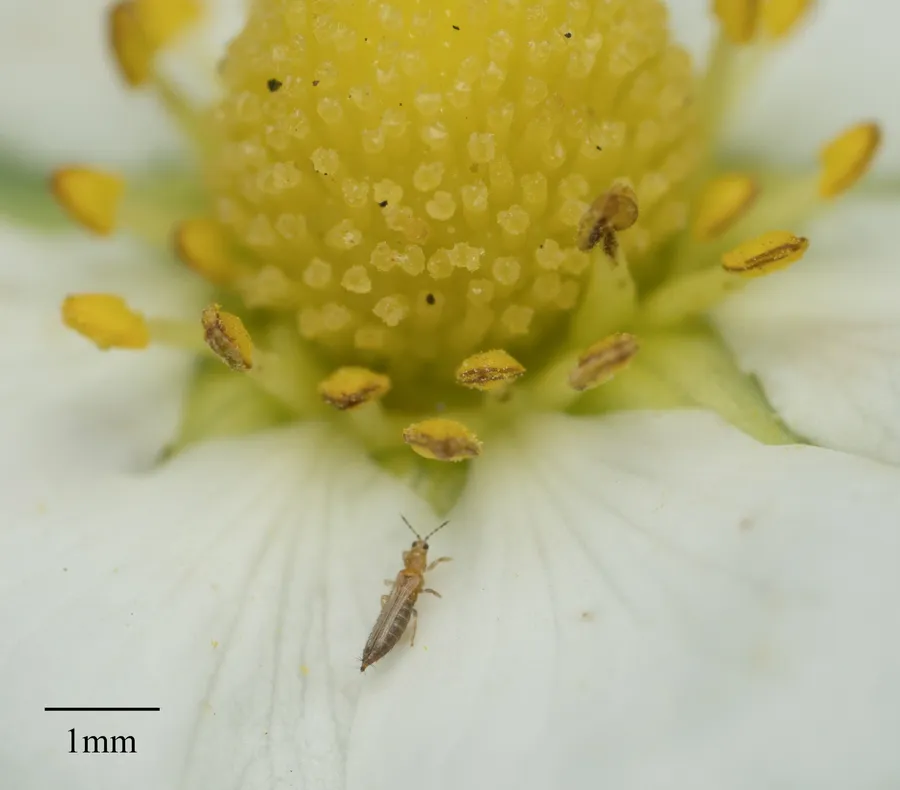
UC IPM’s Pest Notes on thrips and Virginia Tech’s thrips fact sheet give the features to look for:
- Size: most adults are less than 1/20 inch long (UC IPM); the University of Georgia puts the upper end at about 1/10 inch (2 mm). UF/IFAS gives a range of 0.5 to 5 mm across all species.
- Shape: slender and elongate, like a dark or pale sliver.
- Wings: two pairs of long, narrow wings with long fringes along the edges (Virginia Tech).
- Color: adults range from translucent white or yellowish to dark brown or black; western flower thrips are usually pale yellow.
- Young: larvae are wingless and oblong or slender (UC IPM).
Because they are so small, the damage is the usual first clue. Thrips puncture the outer layer of a leaf or petal and suck out the cell contents. UC IPM describes the results as stippling, discolored flecking or silvering of the leaf surface, often with “black varnishlike flecks of frass (excrement).” Heavily fed leaves turn papery and distorted and can drop early. On flowers, petals show pale or dark discolored patches where thrips fed before the buds opened, and rose buds can deform and fail to open. UC IPM adds that western flower thrips more often damages fragrant, light-colored or white roses.
To confirm, hold a sheet of white paper under a flower or shoot and tap it. UC IPM and Alabama Extension both use this beat method; Alabama calls it the fastest and least expensive way to sample, at about 2 minutes per sample. Thrips show up as tiny moving slivers. A 10x hand lens helps.
Thrips vs Spider Mites, Aphids, Fungus Gnats and Whiteflies
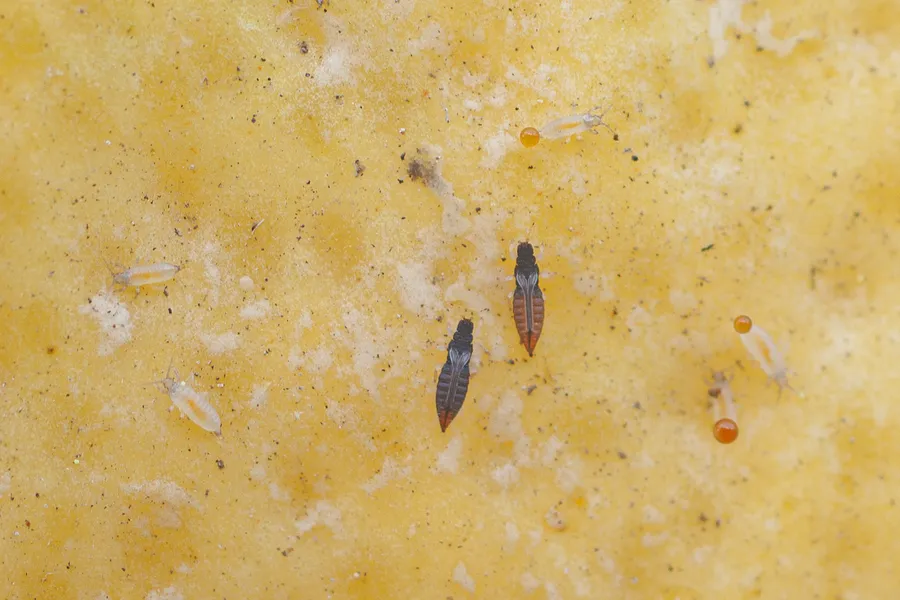
Several small pests leave similar marks. UC IPM warns that various true bugs and mites also stipple foliage, and some true bugs leave dark fecal specks, so find the insect before you treat. The table sets the common confusions side by side.
| Pest | What you see | Where to look | Telltale sign | Source |
|---|---|---|---|---|
| Thrips | Slender slivers under 1/20 inch; fringed wings on adults | Inside flowers and buds, on shoot tips and leaf surfaces | Silvering and stippling with black varnish-like specks | UC IPM |
| Spider mites | “Tiny, moving dots” to the naked eye; eight legs under a lens | Leaf undersides | White-dotted stippling plus fine webbing when numbers are high | UC IPM |
| Aphids | Soft, pear-shaped bodies; green, yellow, brown, red or black | New growth, stems, leaf undersides | Two tube-like cornicles at the rear; sticky honeydew and curled leaves | UC IPM |
| Fungus gnats | Dark, delicate flies that look like small mosquitoes | Resting on houseplant soil, windows and walls | Larvae live in moist potting soil, feeding on fungi and chewing roots | UC IPM |
| Whiteflies | White winged adults; oval, legless nymphs that do not move | Leaf undersides | Sticky honeydew and black sooty mold | UC IPM |
If the small flying insects around a houseplant are dark and gnat-like rather than sliver-shaped, our guide to gnats covers fungus gnats and how to dry out the soil they breed in.
For two other common houseplant pests, see our guides to spider mites and mealybugs.
Thrips Species US Gardeners Meet
Virginia Tech says it is “virtually impossible” to tell flower thrips from western flower thrips in the field, and the University of Georgia says correct identification to species “can be made only under magnification or with the help of an expert.” Host plant and damage pattern narrow it down:
| Thrips | Typical hosts | Why it matters | Source |
|---|---|---|---|
| Western flower thrips (Frankliniella occidentalis) | Hosts in 65 plant families: flowers, vegetables, fruit, greenhouse crops | Native to western North America and spread worldwide with the plant trade; main vector of tomato spotted wilt and impatiens necrotic spot viruses; resistant to many insecticides | UF/IFAS, UC IPM, Alabama Extension |
| Onion thrips (Thrips tabaci) | Onions, potatoes, tobacco, cotton | Spreads tomato spotted wilt virus, as does the tobacco thrips (Frankliniella fusca) | UF/IFAS, Virginia Tech, Wikipedia |
| Greenhouse thrips (Heliothrips haemorrhoidalis) | Mainly evergreen, broadleaved perennials; fruit clusters | Feeds openly on leaf undersides and pupates there, so contact sprays reach it | UC IPM |
| Chilli thrips (Scirtothrips dorsalis) | Peppers | An introduced (adventive) saw-tailed species found in Florida | UF/IFAS, Alabama Extension |
| Cuban laurel and weeping fig thrips (Gynaikothrips) | Ficus | Tube-tailed thrips that cause leaf galls; Cuban laurel thrips also bites people | Alabama Extension, UF/IFAS |
| Gladiolus thrips | Gladiolus, iris, lily, chrysanthemum, begonia, snapdragon | Cannot survive below 50°F (10°C) | Virginia Tech |
| Myoporum thrips (Klambothrips myopori) | Myoporum shrubs and ground covers | Invasive tube-tailed thrips damaging Myoporum along the California coast | UC IPM |
Thrips Life Cycle and Why Sprays Miss Them
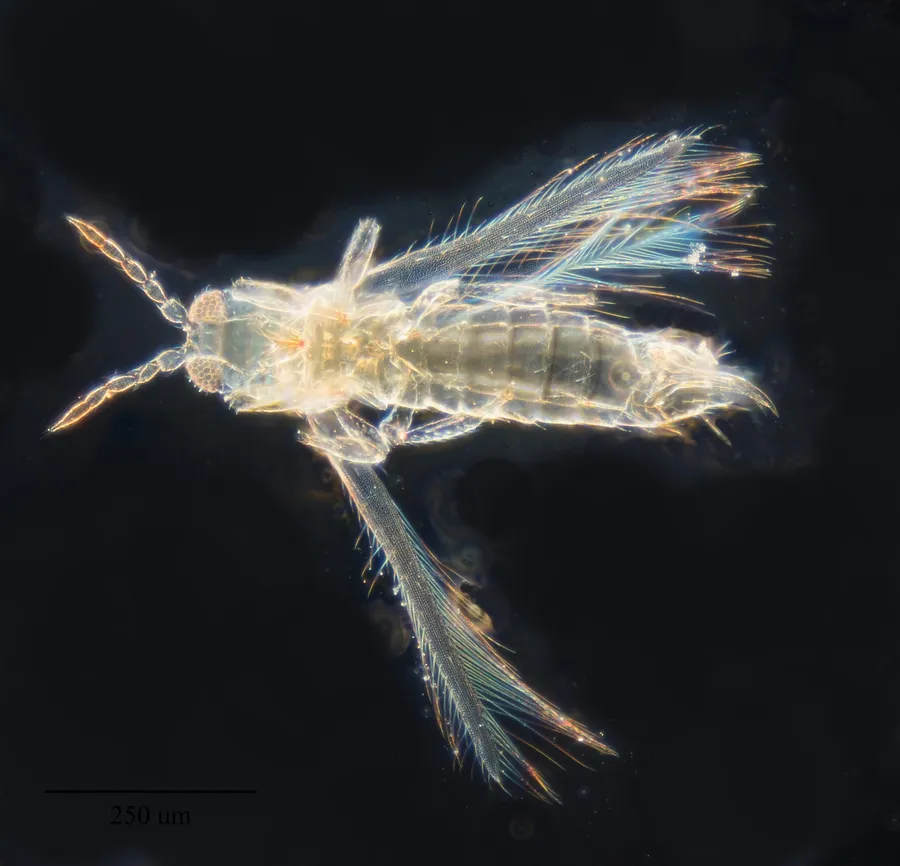
A saw-tailed thrips female inserts her eggs into soft plant tissue. Two active larval stages feed on the plant, then come two non-feeding stages, the prepupa and pupa, before the winged adult. UC IPM says the prepupae and pupae of most species drop to the soil or leaf litter or lodge in plant crevices, and UF/IFAS adds that western flower thrips can also pupate inside complex flowers such as chrysanthemums.
Development is fast. UF/IFAS measured 10.2 days from egg to adult for western flower thrips on cabbage leaves at 27°C (81°F); Virginia Tech gives about 10 days at 80°F. UC IPM says thrips have several generations a year, up to about eight outdoors, and the cycle can take as little as 2 weeks in warm weather.
At any moment part of the population is out of reach: eggs sealed inside leaves, larvae deep in buds, pupae in the soil.
“Thrips can be difficult to control effectively with insecticides, partly because of their mobility, feeding behavior, and protected egg and pupal stages.”
Alabama Extension puts it more bluntly: because of their size and cryptic habits, thrips are “one of the most difficult insects to control.”
When Thrips Turn Up: Our iNaturalist Count
To see when Americans actually notice thrips, we pulled every US observation of the order Thysanoptera from the iNaturalist API on November 22, 2026: 17,887 verifiable records (observations with a photo, a date and a location).
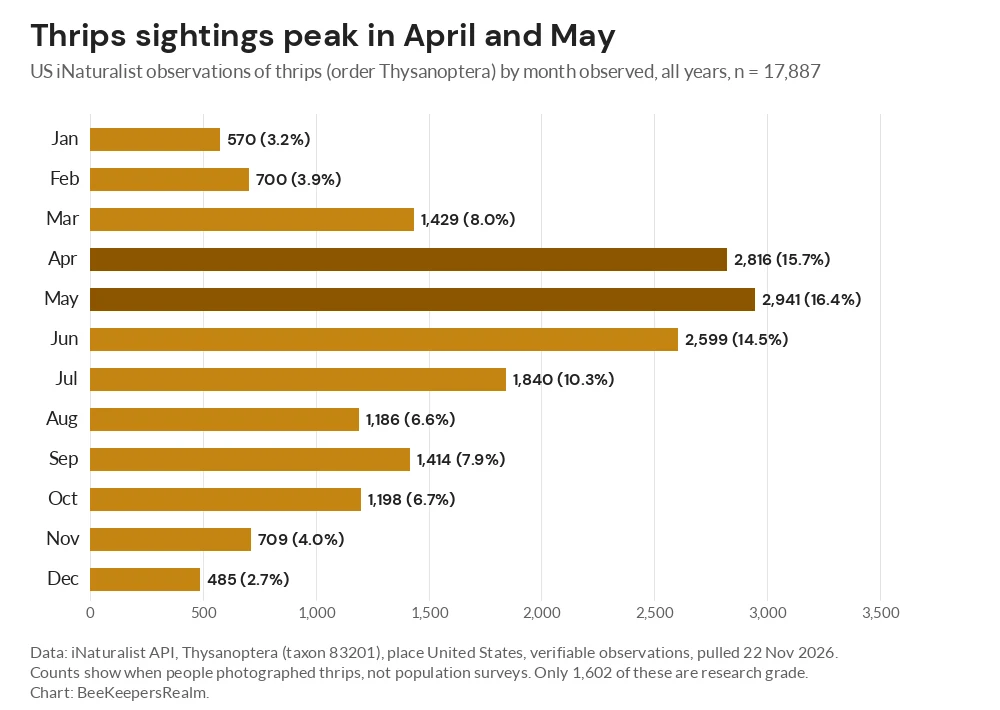
May has the most records (2,941) and April is close behind (2,816); together they hold 32.2% of the year. March through June hold 54.7%, while November through February hold only 13.8%, with December the low point at 485. These counts show when people photograph thrips, not how many exist, but they are a fair guide to when to start checking flowers.
The more revealing number is how few could be named. Only 1,602 of the 17,887 records (9.0%) had reached research grade, meaning at least two identifiers agreed on the identification. Thrips are simply too small to identify from most phone photos, which is why the University of Georgia advises bagging samples of affected plant parts and sending them for identification.
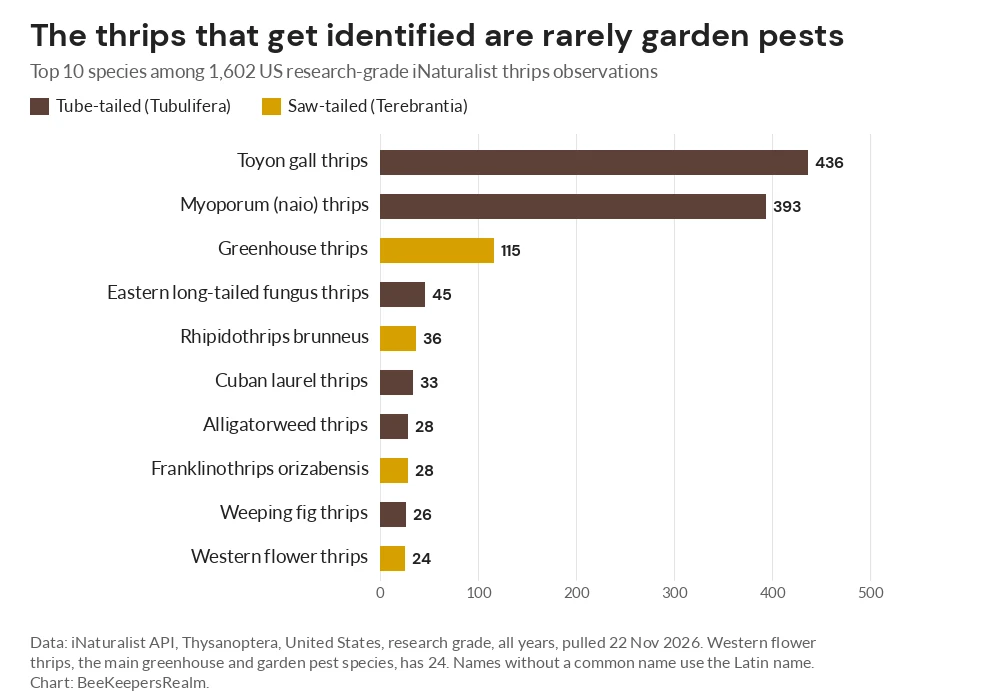
The research-grade records are dominated by the wrong thrips, from a gardener’s point of view. Tube-tailed thrips account for 1,051 of the 1,602 (65.6%), even though Alabama Extension says the common plant pests are all saw-tailed. The leaders are toyon gall thrips (436 records, every one from California) and myoporum thrips (393). Western flower thrips, the best-known pest species, has just 24 research-grade records out of 96 photographed. Big, dark, gall-making thrips are easy to photograph and identify; the pale specks that silver your roses mostly are not. California supplies 1,088 of the research-grade records, which reflects where active identifiers live as much as where thrips are. If you want to add records yourself, our guide to citizen science for pollinators explains how iNaturalist works.
Thrips and Tomato Spotted Wilt Virus
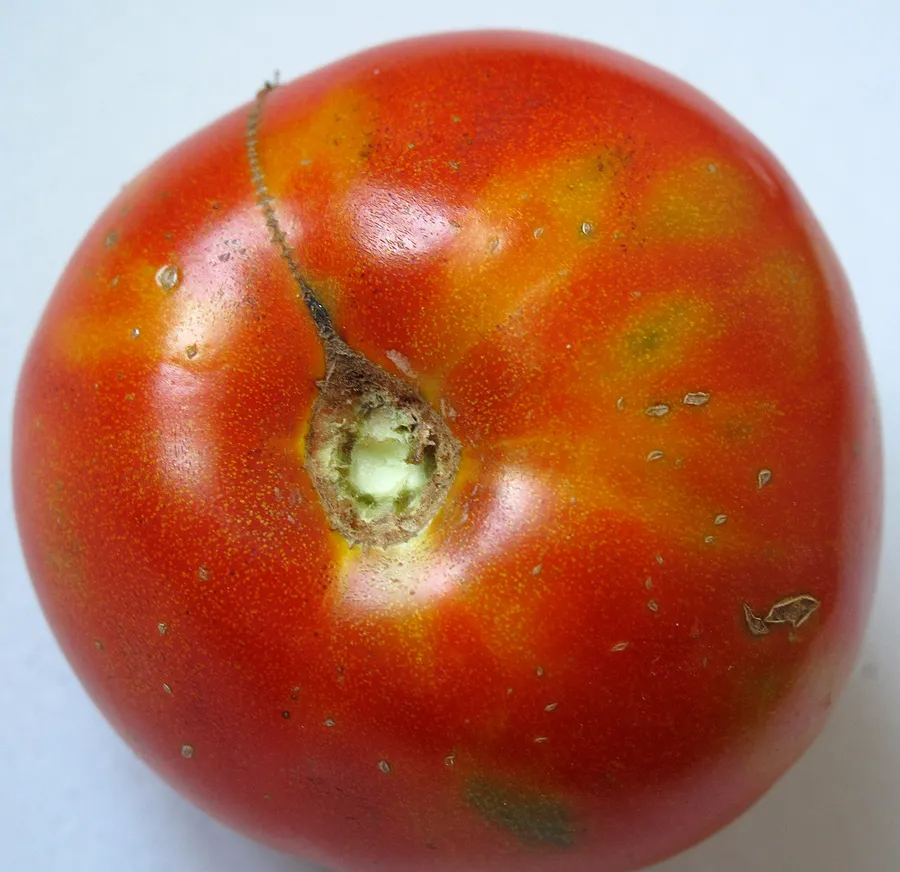
The worst thing most thrips do to a garden is not the feeding but the viruses. UF/IFAS lists tomato spotted wilt virus (TSWV), impatiens necrotic spot virus (INSV), tomato chlorotic spot virus and groundnut ringspot virus among the viruses western flower thrips transmits, and says western flower, tobacco and onion thrips all spread TSWV. UC IPM says these viruses can severely damage or kill certain vegetable crops and herbaceous ornamentals.
Virginia Tech lists the symptoms as dead (necrotic) lesions, wilting, yellowing, leaf distortion and ring spots. It is clear about the outcome: “Infected plants cannot be cured.” Remove them promptly. Weeds can harbor both thrips and tospoviruses, so control weeds around vegetable beds and greenhouses, and Virginia Tech notes that fava beans and certain petunia varieties can serve as early-warning indicator plants. UC IPM says row covers or other methods that keep thrips off young plants are the most effective way to prevent thrips-spread viruses.
Do Thrips Bite People?
Sometimes, yes. Several popular pages say flatly that thrips do not bite, but extension entomologists say some species do. The University of Florida’s Mid-Florida Research and Education Center says flower thrips “bite people, causing a noticeable stinging sensation,” and that the Cuban laurel thrips bites people too. University of Minnesota Extension says thrips “have been reported to inflict prick-like bites, which may itch or cause a rash.”
They are not after blood. Wikipedia’s summary of the scientific literature names flower-feeding species such as the eastern flower thrips among those that “bite” people, notes that no thrips feeds on blood and that no animal disease is known to be transmitted by thrips, though some skin irritation has been described. A bite is a minor nuisance; see a doctor if a rash spreads or looks infected. If you are being bitten in the garden, check nearby flowers for thrips before blaming mosquitoes or chiggers.
How to Get Rid of Thrips
Virginia Tech says total eradication is usually not possible, so aim to keep damage tolerable: monitor, fix growing conditions, exclude, protect natural enemies, and spray last.
1. Confirm and monitor
Tap flowers and shoots over white paper. Hang blue or bright yellow sticky traps in or near the plants (UC IPM); Virginia Tech places blue cards near greenhouse vents and doors. Treat traps as a monitoring tool, not a cure: UC IPM says that large numbers of thrips in traps, or adults feeding on pollen in flowers, “do not necessarily indicate that control action is needed.”
2. Prune, water and go easy on fertilizer
On a few small plants, UC IPM advises pruning and destroying injured and infested shoot tips. Avoid shearing hedges, because the flush of new growth it triggers is what thrips prefer; cut just above branch crotches and nodes instead. Keep plants well watered, and avoid excess nitrogen fertilizer, which UC IPM says can increase thrips populations. Control weeds, which Virginia Tech says can harbor both thrips and the viruses they carry. UC IPM is cautious about removing old flowers: the benefit in landscapes is unknown, and old blossoms also shelter predators of thrips.
3. Keep them off young plants
Fine-mesh row covers exclude thrips from vegetable seedlings; put them on before crops emerge or right after planting pest-free transplants. Silver or gray reflective mulch can delay infestation of young plants, but UC IPM says it stops working once the plants cover about half of the soil surface.
4. Let natural enemies work
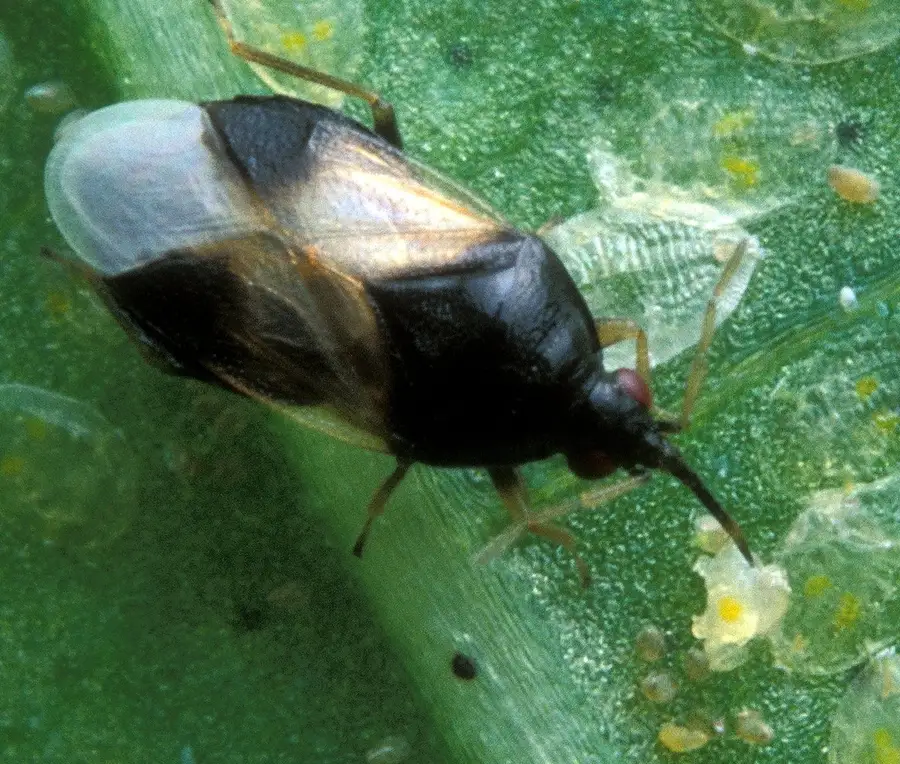
UC IPM lists predatory thrips, green lacewings, minute pirate bugs, predatory mites and certain parasitic wasps among the natural enemies of plant-feeding thrips. UF/IFAS calls minute pirate bugs (Orius species) among the most important: in field peppers, about one pirate bug per 180 thrips suppresses them, and one per 50 controls them. Predatory mites such as Amblyseius swirskii and Neoseiulus cucumeris also eat thrips, and Virginia Tech describes releasing pirate bugs and predatory mites in greenhouses, where releases work best while thrips numbers are low. Outdoors, UC IPM cautions that releasing purchased natural enemies is, in most situations, unlikely to control thrips satisfactorily in a garden. Conserve the ones already there: avoid broad-spectrum sprays and grow flowers that feed them, such as black-eyed Susan (Clemson notes it draws minute pirate bugs) and yarrow, which Oregon State Extension lists for them. Ladybugs are another garden predator to protect from broad-spectrum sprays.
5. Spray only if needed, and choose carefully
UC IPM sorts thrips insecticides into tiers. The table summarizes it alongside Alabama Extension’s resistance advice.
| Option | How well it works on thrips | Risk to bees and natural enemies | Source |
|---|---|---|---|
| Insecticidal soap, horticultural (narrow-range) oil, neem oil, azadirachtin, pyrethrins | Temporary control; best on species that feed in the open, such as greenhouse thrips. Must thoroughly cover buds, shoot tips and leaf undersides | Contact only, no persistent residue; still kills insects it hits, so keep off open flowers | UC IPM |
| Spinosad | UC IPM says it “may be more effective”; lasts a week or more and moves a short way into leaves to reach hidden thrips | Toxic to bees and some natural enemies when sprayed and for about 1 day after; do not apply to flowering plants | UC IPM |
| Neonicotinoids (soil or trunk systemics) | Variable; imidacloprid commonly fails and is generally not recommended for thrips | Can move into flowers and harm insects that feed on nectar and pollen; delay until after flowering | UC IPM |
| Acephate, other organophosphates, carbamates, pyrethroids | Not particularly effective against most thrips | Highly toxic to natural enemies and pollinators; acephate can trigger spider mite outbreaks | UC IPM |
| Any product, repeated | Western flower thrips are documented resistant to at least 20 active ingredients from seven chemical classes | Rotate modes of action; never use products with the same IRAC number back to back | Alabama Extension |
Because eggs and pupae escape contact sprays, one application rarely finishes the job; follow the label’s repeat interval and keep checking. Our pollinator-safe pest control guide compares lower-risk products.
Thrips on houseplants
University of Minnesota Extension notes that thrips also feed on houseplants indoors. Isolate the plant, cut off damaged leaves and flowers, and use an insecticidal soap or oil labeled for houseplants, covering leaf undersides and buds. Recheck with a sticky card, since new adults can keep emerging from pupae in the potting soil.
Treating Thrips Without Harming Bees
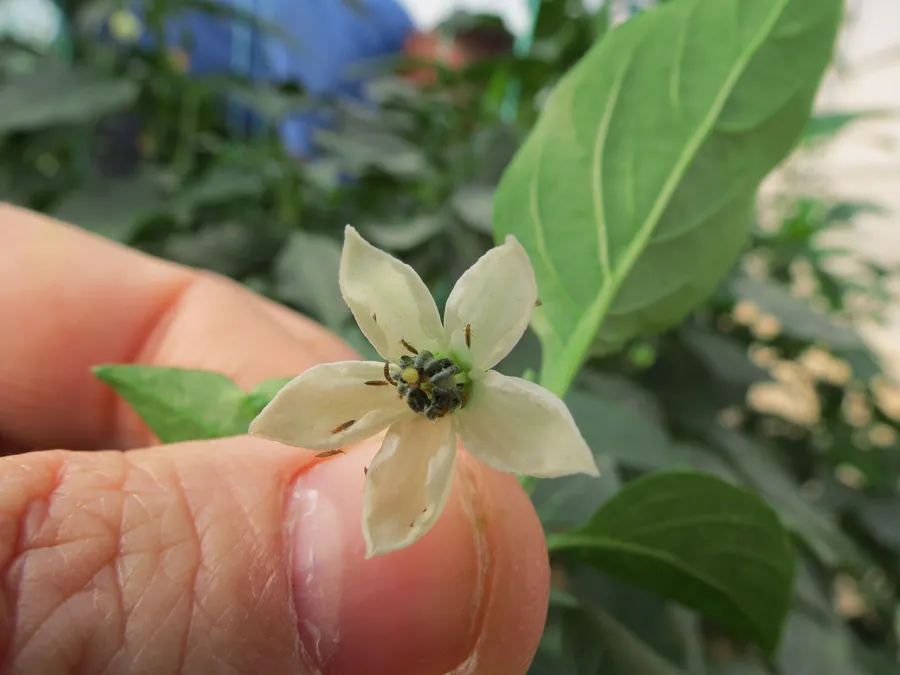
Here is the catch for anyone who keeps bees or plants for pollinators: many pest thrips feed inside flowers, the very blooms bees, hover flies and other pollinators visit. A spray aimed at thrips in open flowers lands where bees forage. These steps come from the National Pesticide Information Center (NPIC), the EPA and UC IPM:
- Do not spray open flowers. NPIC says plainly: “Do not spray flowers directly.” Prune off infested blooms instead, or wait until petals fall.
- Spray in the evening. If a spray is truly needed on a plant bees visit, apply it after foragers have gone home.
- Read the label’s Environmental Hazards section. EPA’s bee-protection labels include limits such as “Do not apply this product while bees are foraging.” NPIC: “Always follow the label directions when applying a pesticide product.”
- Skip spinosad on flowering plants and delay any systemic insecticide until after the plant and its neighbors finish flowering (UC IPM).
- Avoid pyrethroids and organophosphates, which UC IPM says are highly toxic to pollinators and natural enemies and not particularly effective on most thrips anyway.
- Remember the hover flies. UC IPM lists syrphid fly larvae among the beneficials spinosad can kill; our hoverfly guide explains why they are worth protecting.
“Spraying in the evening, after bees have returned to their hives, allows for spray residues to dry overnight.”
Our aphid guide applies the same bee-safe approach to the other sap-sucker most gardeners fight.
Not Every Thrips Is a Pest
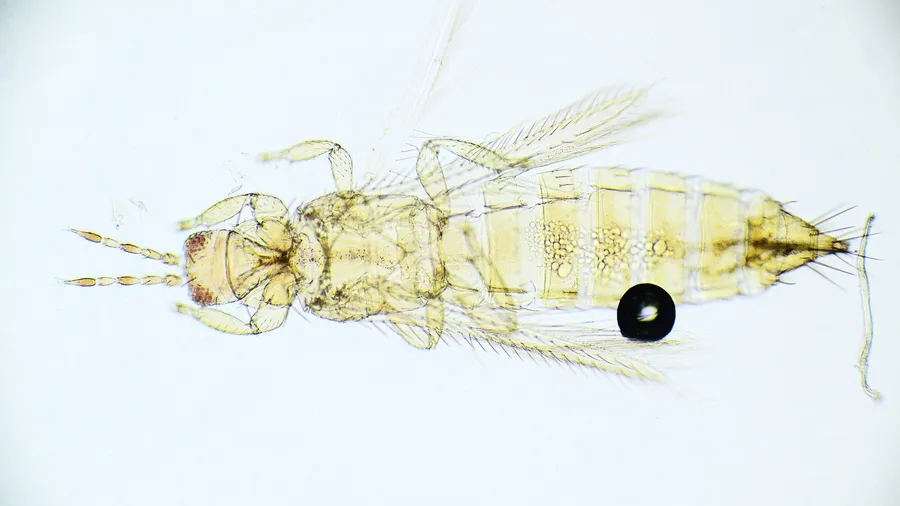
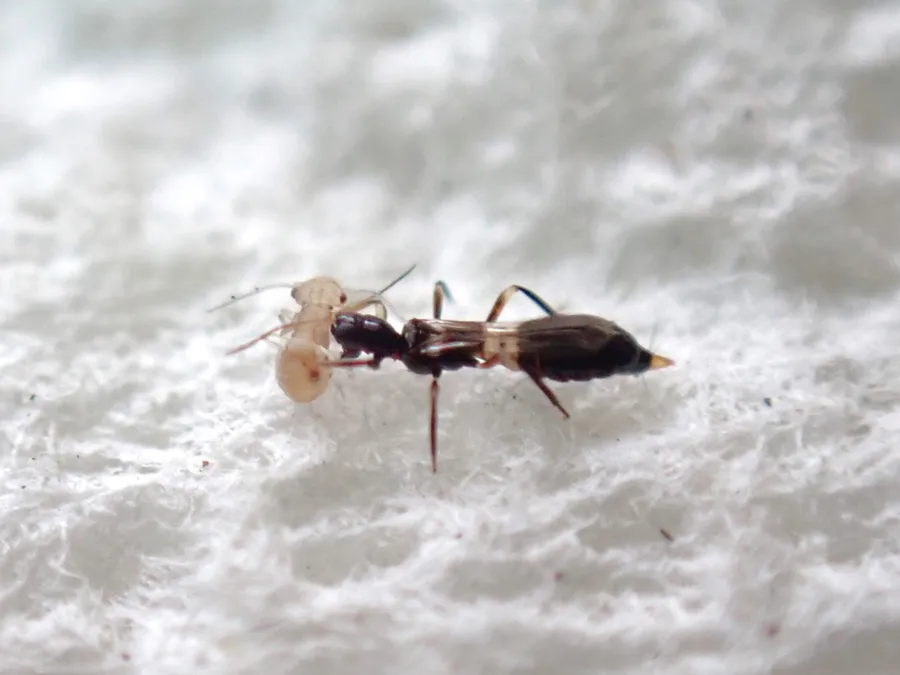
UC IPM notes that many thrips feed on fungal spores and pollen and are often harmless, and that certain thrips are beneficial predators of other insects and mites. UC IPM names Franklinothrips orizabensis, pictured below, as a predatory thrips with distinctive reddish-orange larvae. A few thrips are even pollinators. In Australia, Cycadothrips thrips are specialist pollinators of Macrozamia cycads, and a 2007 study in Science led by Irene Terry of the University of Utah showed how the cones heat up and release a strong odor that drives pollen-covered thrips out of male cones, then a milder scent that draws them back, some into female cones. Our guide to pollination syndromes covers how other flowers match their pollinators.
People think of plants as just sitting there and looking pretty and sending out some odors to attract pollinators, but these cycads have a specific sexual behavior tuned to repel, attract and deceive the thrips [small flying insects] that pollinate them.
Frequently Asked Questions
Are thrips harmful to humans?
Not seriously. Some flower thrips bite, causing a brief sting, itching or a rash, but no thrips feeds on blood and none is known to spread disease to people. The harm is to plants.
Do thrips bite humans?
Occasionally. UF/IFAS and University of Minnesota Extension both report bites, usually from flower thrips in summer. They are incidental, not a search for blood.
Do thrips live in soil?
For part of their life, yes. The prepupae and pupae of most species drop into the soil or leaf litter, which is one reason foliage sprays miss them.
Can thrips fly?
Yes. Adults have two pairs of fringed wings. They fly weakly but are carried long distances by wind.
What kills thrips instantly?
Contact sprays such as insecticidal soap, horticultural oil or pyrethrins kill the thrips they wet, but they miss eggs inside leaves and pupae in soil, so the problem returns unless you repeat and fix the conditions behind it.
Why do thrips keep coming back?
Their eggs and pupae survive most sprays, they breed in as little as 2 weeks, and western flower thrips resists many insecticides. Steady monitoring, pruning and natural enemies work better than repeated spraying.
What is the difference between thrips and fungus gnats?
Thrips are tiny slivers that feed on leaves and flowers and leave silvery damage. Fungus gnats are dark, mosquito-like flies whose larvae live in moist potting soil.
The Bottom Line
Thrips are hard to see and harder to spray. Tap flowers over paper, prune and water well, let pirate bugs help, and keep any spray off open flowers. More pests are in our garden and household insects guides.
Image credits: Featured image: Frank Peairs, Colorado State University, Bugwood.org, Wikimedia Commons, CC BY 3.0, cropped and resized. Western flower thrips: Jesse Rorabaugh, CC0. Greenhouse thrips: Petr Kosina, CC BY 4.0. Chilli thrips: Jesse Rorabaugh, CC0. Tomato spotted wilt: Downtowngal, CC0. Eastern flower thrips: Timothy Lindsey, CC BY 4.0. Minute pirate bug: Jack Dykinga, USDA ARS, public domain. Thrips in a pepper flower: Metin Güleşci, CC BY 4.0. Predatory thrips: nmoorhatch, CC BY 4.0. Photos resized; links to each file page and licence are in the captions. Charts: BeeKeepersRealm, from iNaturalist API data pulled November 22, 2026.