Reviewed by Michael R. · How we review
Yarrow (Achillea millefolium) is a tough perennial in the aster family with soft, feathery leaves and flat-topped clusters of tiny white or pale pink flower heads. It grows wild in every US state, where native and introduced forms grow side by side, and it blooms mostly in June and July. Many insects visit it, and small native bees lead the bee visitors: in our count of US iNaturalist records, sweat bees made up two-thirds of the bees seen on yarrow. It spreads by underground rhizomes, the ASPCA lists it as toxic to dogs, cats and horses, and its white flower clusters are easy to confuse with deadly poison hemlock.
The bloom and flower-visitor figures below are our own counts of US iNaturalist observations, pulled in November 2026.
Key Takeaways
- Common yarrow is one variable species. The USDA Forest Service says North America has both native and introduced forms, which differ mainly in chromosome number and are hard to tell apart by eye.
- Yarrow has finely divided, feather-like leaves, hairy stems, a sweet, chrysanthemum-like smell and flat clusters of tiny daisy-like heads with about five rays each.
- Poison hemlock, water hemlock and Queen Anne’s lace are carrot-family plants with umbrella-shaped flower clusters. Hemlock stems are smooth and often purple-spotted. Never eat or handle a white-flowered plant you cannot identify.
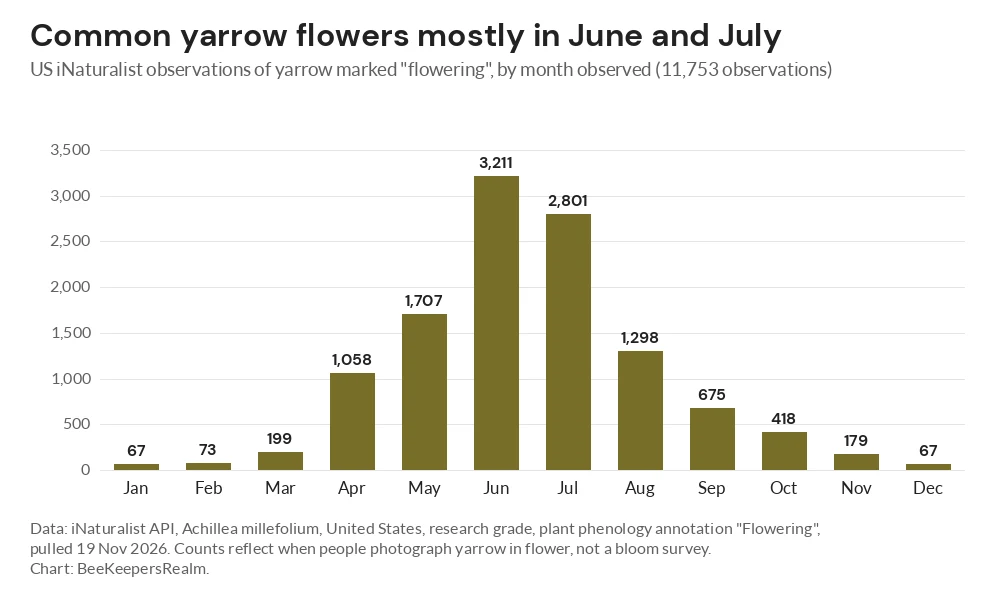
- Of 11,753 research-grade US iNaturalist records of yarrow in flower, 51% were made in June or July.
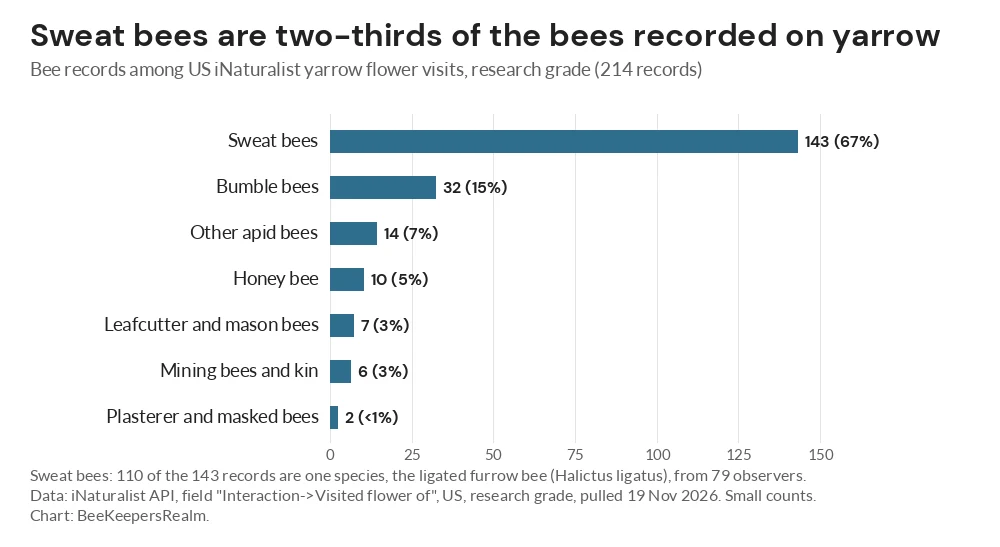
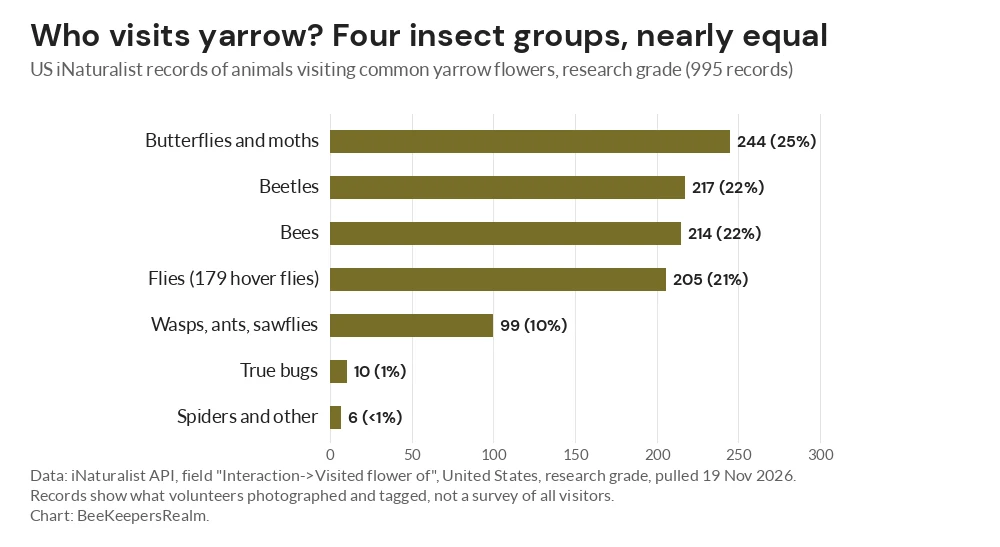
- Of 995 research-grade records of animals visiting yarrow, butterflies and moths, beetles, bees and flies each made up roughly a fifth to a quarter. Sweat bees were 143 of the 214 bee records; honey bees were 10.
- Yarrow is very drought tolerant and can be mowed as a lawn alternative, but it spreads by rhizomes and seed and can crowd out border plants.
- The ASPCA lists yarrow as toxic to dogs, cats and horses, with signs such as vomiting, diarrhea, drooling and skin irritation.
Table of Contents
- What Is Yarrow?
- How to Identify Yarrow
- Yarrow vs Queen Anne’s Lace vs Poison Hemlock
- When Does Yarrow Bloom?
- Do Bees Like Yarrow?
- Yarrow Colors and Cultivars
- How to Grow Yarrow
- Is Yarrow Toxic to Dogs, Cats and Horses?
- A Short History of Yarrow
- Frequently Asked Questions
- The Bottom Line
What Is Yarrow?
Yarrow is the common name for Achillea millefolium, a perennial wildflower in the aster family (Asteraceae). The USDA Forest Service Fire Effects Information System (FEIS) describes it as a perennial forb 11 to 40 inches tall with extensive rhizomes, found in every US state, every Canadian province and Mexico. Its basal leaves can stay green through the winter.
- Other names: common yarrow, western yarrow, milfoil, thousandleaf, soldier’s woundwort and devil’s nettle, among others listed by NC State Extension and the ASPCA.
- Where the name comes from: the Missouri Department of Conservation (MDC) notes that Achillea refers to the Greek hero Achilles, who supposedly treated his soldiers’ wounds with it, and millefolium is Latin for “thousand leaves.” “Yarrow” comes from the Old English gearwe.
- Relatives: yarrow shares a tribe of the aster family with chamomile, tansy, ox-eye daisy and chrysanthemums.
Is yarrow native to the US?
Both. FEIS explains that North America has native and introduced “phases” of common yarrow. They differ mainly in chromosome number, are difficult to tell apart by their looks, and hybridize with each other. Native forms are mostly tetraploid, with narrow leaf segments held in several planes so the leaf looks three-dimensional. Typical European plants are hexaploid with flatter leaves.
Botanists have split the North American plants in many ways. FEIS notes that most authorities do not recognize varieties at all, while the Kartesz checklist it cites names eight, including western yarrow (A. millefolium var. occidentalis, old synonym Achillea lanulosa) and boreal yarrow (var. borealis). iNaturalist treats boreal yarrow as a separate species, Achillea borealis. The USDA native-status codes shown by the Lady Bird Johnson Wildflower Center are “native and introduced” for the lower 48 states, native for Alaska and introduced for Hawaii. In practice, a wild white yarrow in a US meadow may be native, European or a hybrid, and you cannot tell which by looking. That is why yarrow appears on lists of native plants for pollinators even though some of the plants sold or growing wild came from Europe.
How to Identify Yarrow
Leaves
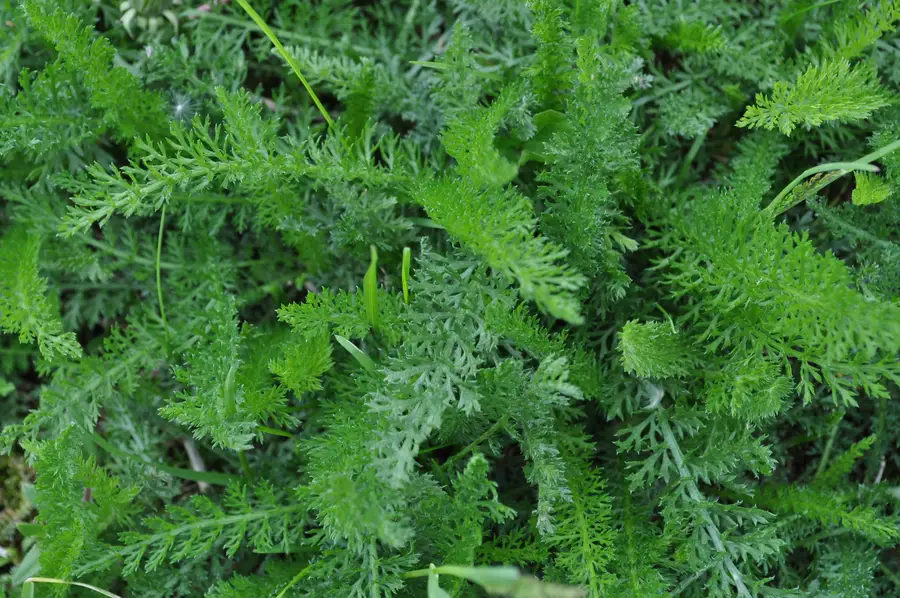
Oregon State University Extension describes the leaves as pinnate or tripinnate, finely dissected into leaflets, 4 to 8 inches long and alternate on the stem. MDC adds that they are hairy, narrow-oblong and up to 10 inches long. Crushed, they have what MDC calls a “distinctively sweet and rather soapy” odor, like chrysanthemums.
Flower clusters
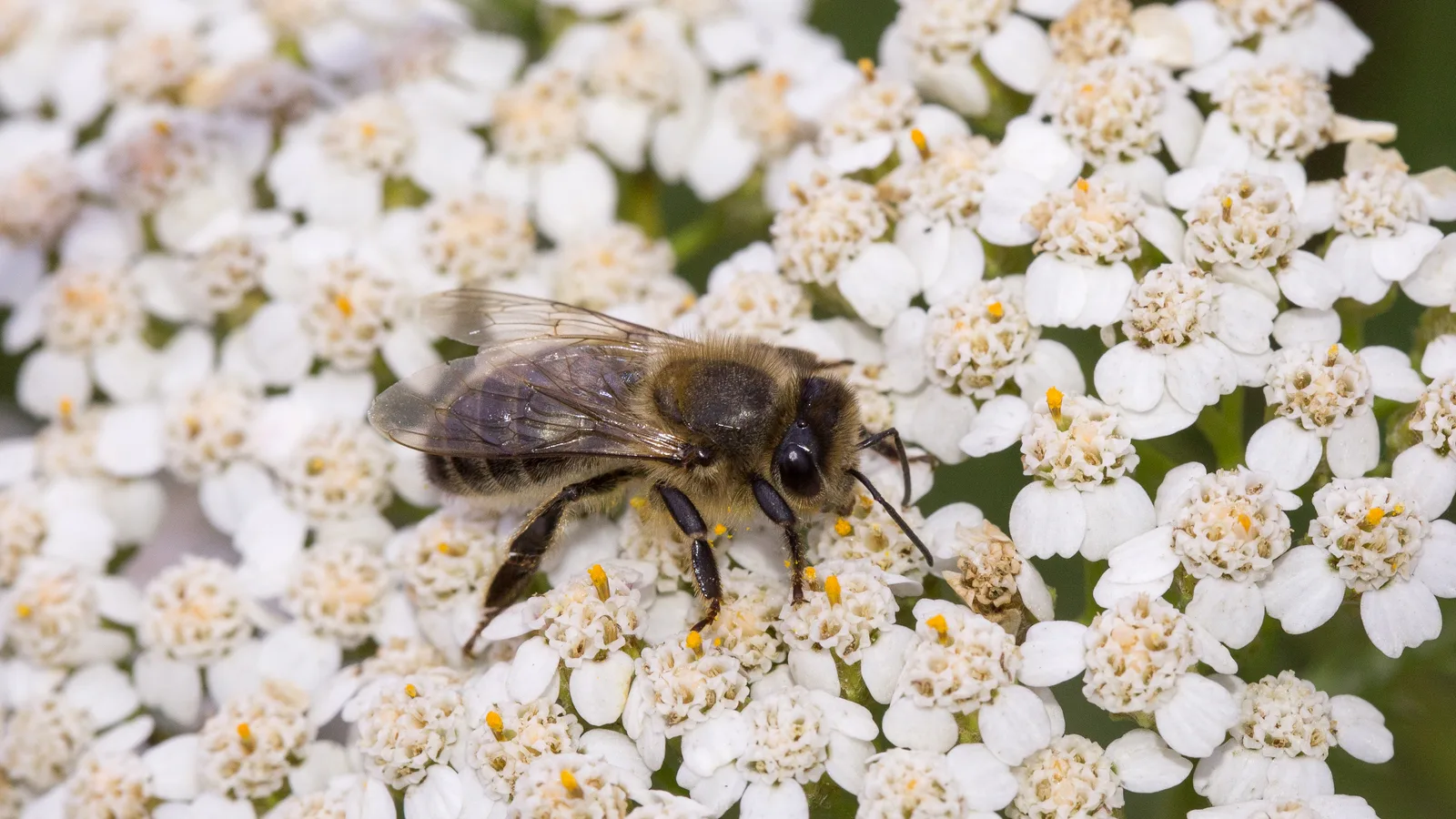
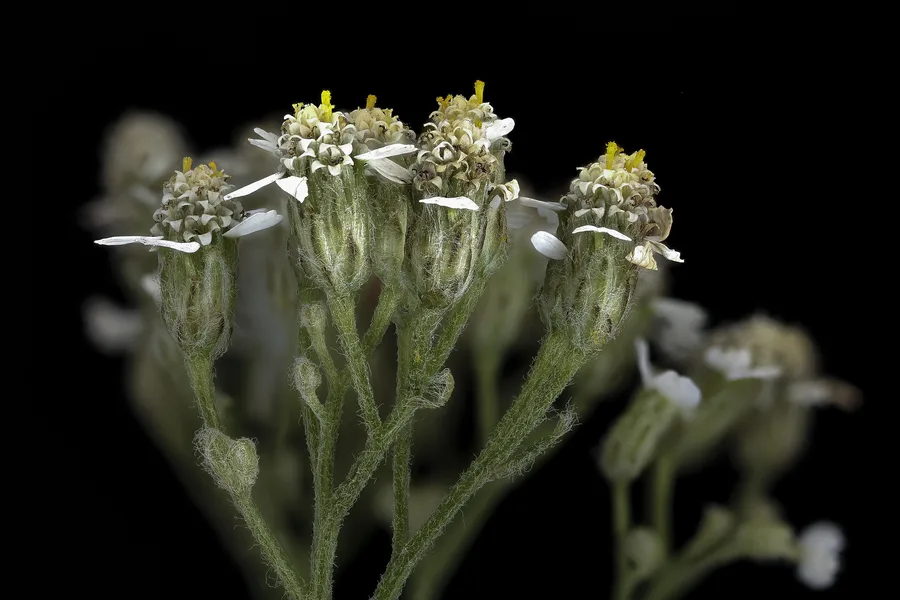
Each “flower” on a yarrow plant is really a tiny flower head. MDC describes them as miniature daisies, usually with about 5 white (sometimes pink) ray florets around 10 to 20 light yellow or whitish disk florets, packed into dense, flat-topped clusters at the stem tips. NC State Extension calls these clusters corymbs. That detail matters: carrot-family look-alikes carry true umbels, in which many separate five-petaled flowers sit on spokes that radiate from one point like an umbrella.
Stem and height
NC State Extension lists the stem as hairy and straight, with one or more flower heads per stem. The plant usually stands 1 to 3 feet tall in flower and spreads into patches from its rhizomes.
Yarrow vs Queen Anne’s Lace vs Poison Hemlock
Several white-flowered plants of roadsides and fields look like yarrow from a distance. Two of them, poison hemlock and water hemlock, can kill if eaten. The safest rule is simple: never eat, chew or handle bare-handed a white, flat-topped or umbrella-shaped flower you cannot identify with certainty.
“If you are inexperienced with plant identification, it is best to consider all wild members of the carrot family as potentially fatally toxic.”
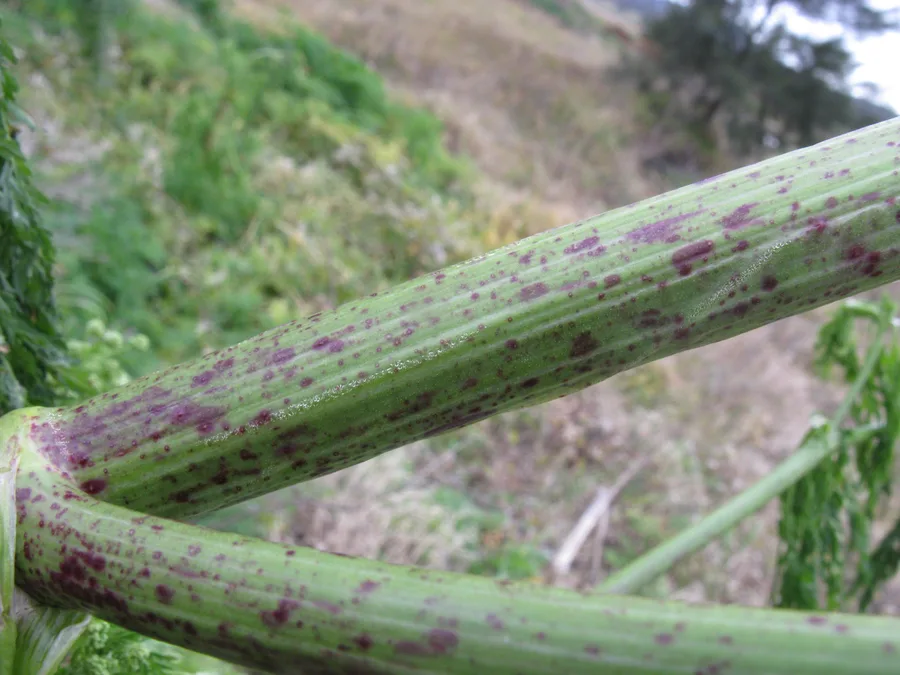
Video: in this two-minute Penn State Extension video, Liz Bosak, then a Penn State Extension educator, shows how to tell poison hemlock from its common look-alike, wild carrot. She points to the red or purplish spots on hemlock stems, which can merge until the stem looks purple, and to wild carrot’s densely hairy stems on plants that rarely top two feet. She advises gloves for handling hemlock and a call to your local Extension office if you are unsure. This summary is from the transcript on Penn State Extension’s page for the video.
| Plant | Leaves | Flower head | Stem | Smell | Height | Danger | Source |
|---|---|---|---|---|---|---|---|
| Yarrow (Achillea millefolium) | Feather-like, finely divided, hairy, up to 10 in long | Flat-topped clusters of tiny daisy-like heads, about 5 rays each | Hairy, not spotted | Sweet and soapy, like chrysanthemums | 11 to 40 in | Low for people (skin rash in some); ASPCA lists it as toxic to pets | MDC; FEIS; NC State Extension; ASPCA |
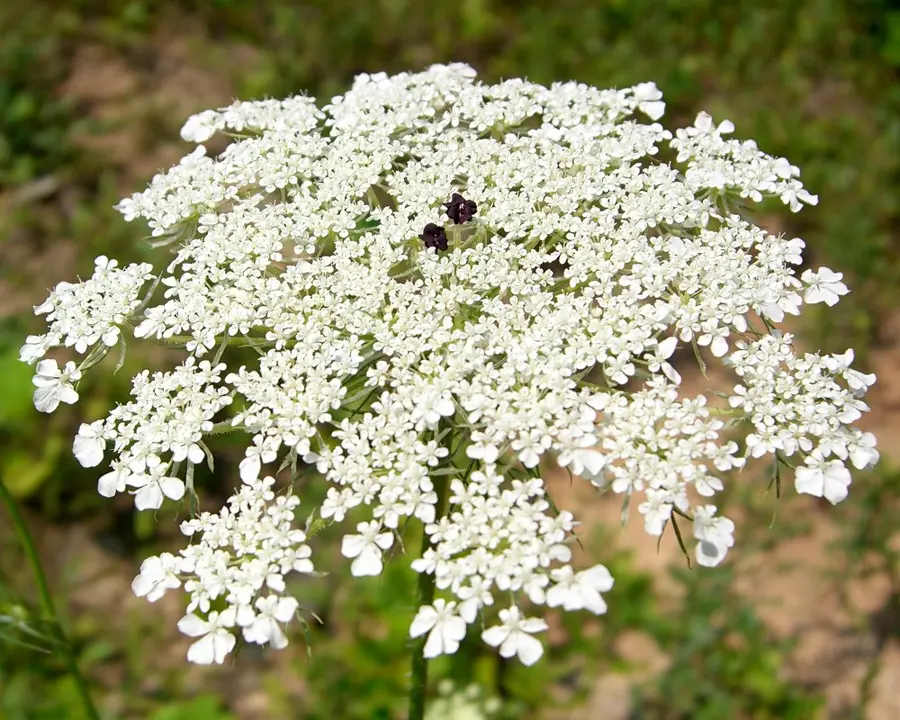
| Queen Anne’s lace, wild carrot (Daucus carota) | Twice-compound with narrow, linear leaflets, like carrot tops | Large compound umbel of tiny 5-petaled flowers; central floret usually dark purple; old heads curl into a “bird’s nest” | Covered in stiff hairs, no purple spots | Carrot-like when leaves or root are crushed | Usually about 2 ft | Sap can cause a rash in sensitive people | MDC; Penn State Extension; Ontario weed guide; Cornell |
| Poison hemlock (Conium maculatum) | Fern-like, 2 to 4 times divided, triangular outline | Loose umbrella-shaped umbels of small white flowers; no purple center | Smooth, hairless, with red or purple spots or streaks | Musty, described as parsnip-like | 3 to 6 ft in flower; up to almost 10 ft | All parts highly toxic to people and animals if eaten | Penn State Extension; UC IPM; MDC |
| Water hemlock (Cicuta maculata) | 2 to 3 times compound; leaflets ¾ to 4 in, toothed; side veins end in the notches between teeth | Compound umbels 2 to 5 in across | Smooth, hairless, sometimes purple-mottled near the base, may have a white waxy coating | Not a safe test; do not crush or taste | To 6 ft or more | MDC calls it the most toxic plant in North America; all parts deadly | MDC |
Check the stem first. A hairy, unspotted stem with feathery leaves and daisy-like heads is yarrow. A hairy stem with an umbrella-shaped cluster and a purple dot in the middle points to Queen Anne’s lace. A smooth stem with purple blotches means hemlock: leave it alone. Bloom time is no shortcut, because UC IPM gives poison hemlock’s bloom as April through July, which overlaps yarrow’s June peak.
When Does Yarrow Bloom?
Yarrow has a long season. Oregon State University Extension says it blooms as early as March and into September, and the Lady Bird Johnson Wildflower Center gives late April to early July in the South and mid-July to mid-September in the North. In five Rocky Mountain states, FEIS records the earliest flowering in April or May and the most frequent flowering month as May, or June in Wyoming.
US iNaturalist records give a national picture. Of 11,753 research-grade observations tagged as flowering, 27.3% were made in June and 23.8% in July. April through September held 91% of records, and December through February only 207. That makes yarrow a summer flower that fills the gap after spring bloomers such as dandelions and alongside summer natives like black-eyed Susan.
Do Bees Like Yarrow?
Yes, especially small native bees, though yarrow is a generalist flower that feeds many kinds of insects. Its open, shallow florets sit side by side on a flat cluster, so short-tongued insects can reach them and walk from head to head. In a three-year Oregon State University field study of 27 plants, which collected 57 bee species in all, yarrow made the final list of 10 Native Plant Picks for Bees.
“Common yarrow is visited by a variety of bees, butterflies and other beneficial insects, including parasitoid wasps in the family Eulophidae and predatory bugs in the family Anthocoridae, especially minute pirate bugs (Orius insidiousus).”
Which bees visit yarrow?
The Oregon State study found two bees strongly associated with yarrow, both mining bees: the cherry plum miner bee (Andrena cerasifolii) and the bright miner bee (Andrena candida). The authors note that many more bee species visit a plant than the few that show up as strong associations. The Xerces Society’s pollinator program, quoted by the Lady Bird Johnson Wildflower Center, rates yarrow as having special value to native bees.
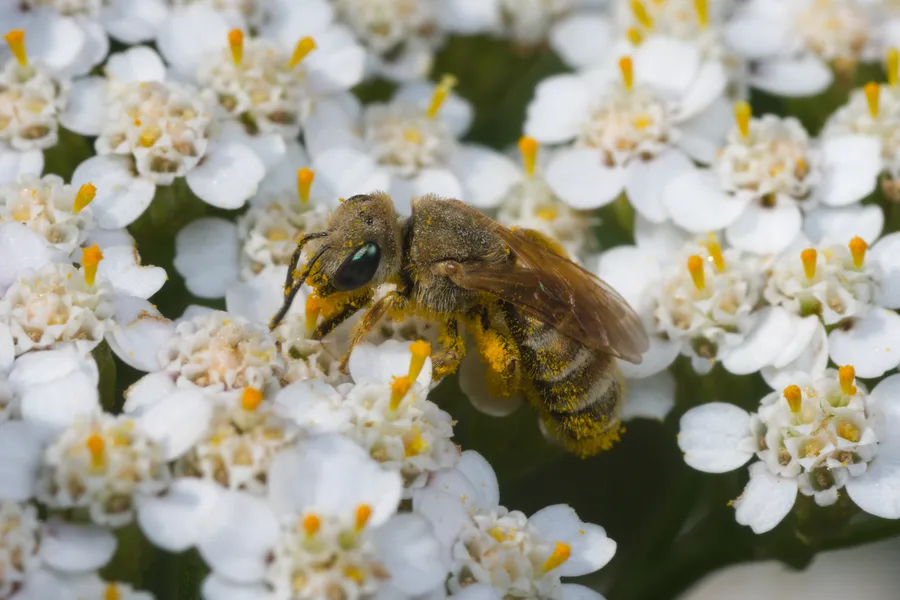
Our pull of iNaturalist records points the same way. Of 214 research-grade bee records on yarrow across the US, 143 were sweat bees (family Halictidae), and 110 of those were a single species, the ligated furrow bee (Halictus ligatus). Those 110 records came from 79 different observers, so they do not reflect one enthusiastic photographer. Bumble bees added 32 records, led by the common eastern bumble bee. The honey bee accounted for just 10.
Not every bee watcher sees yarrow as a magnet. The USGS Bee Inventory and Monitoring Lab, which photographs bees and plants in Maryland, added this note to one of its public-domain yarrow photos:
“In the Mid-Atlantic I have noticed that it isn’t that attractive a plant for bees, yes there are some, but largely it is ignored.”
The lab’s note goes on to say that other collectors report plenty of bee visits, and it suggests that observer skill, local conditions or where the plants came from could explain the difference. With native and European yarrows mixed across the country, both observations can be true.
Hover flies, beetles, butterflies and wasps
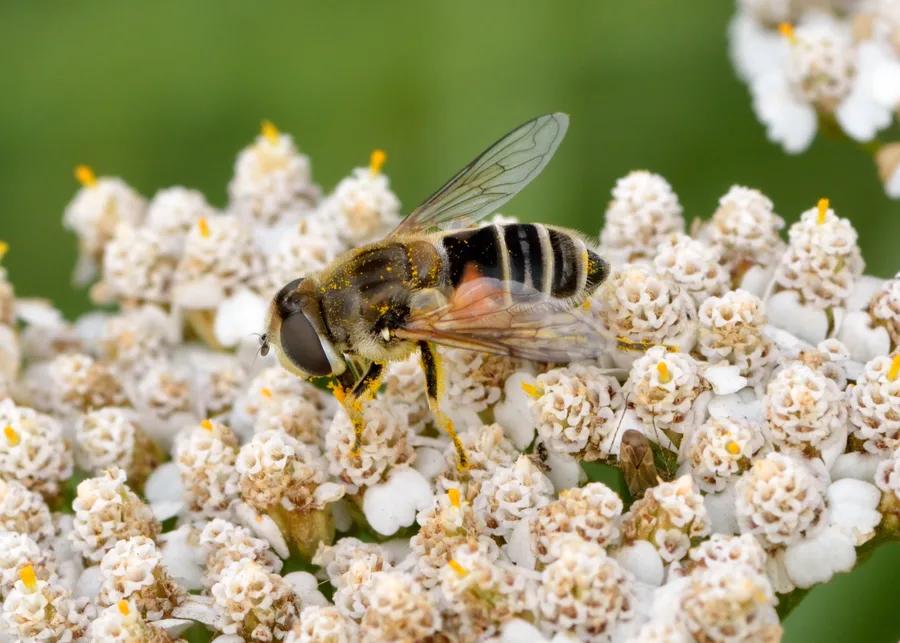
Bees are only part of the crowd. Of 995 research-grade records of animals visiting yarrow flowers, butterflies and moths made up 244, beetles 217, bees 214 and flies 205, of which 179 were hover flies. The most-recorded hover fly was the margined calligrapher (Toxomerus marginatus), and the most-recorded butterfly was the American copper. Wasps, ants and sawflies added 99 records, including beewolves (Philanthus), which hunt bees. If you want to know which of those visitors move pollen, see our look at whether wasps are pollinators.
What these counts can and cannot tell you
The records come from 471 iNaturalist observers who photographed an insect on yarrow and tagged the flower it was visiting, and each record’s insect was confirmed to research grade by the community. That makes them good at showing which insects use yarrow across the US, and weak at showing how many. Large, slow or colorful insects are easier to photograph than tiny dark bees, and 80% of the records were made in June and July, when yarrow is in peak bloom. We found no US source that measures yarrow’s nectar or pollen output, so we do not rate it as a honey plant.
Yarrow Colors and Cultivars
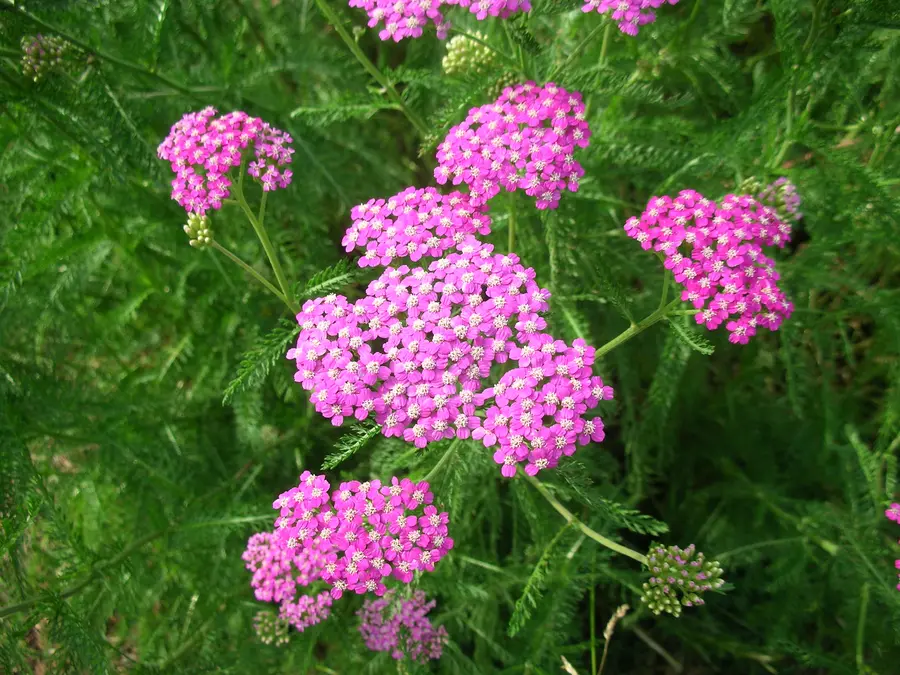
Wild common yarrow is white or occasionally pale pink. Garden selections stretch that range: NC State Extension lists cultivars in shades of red, pink, yellow, orange, salmon, lilac, purple and white, including ‘Apricot Delight’, ‘Cerise Queen’, ‘Paprika’, ‘Red Velvet’, ‘Strawberry Seduction’, ‘Summer Pastels’ and the Galaxy series, a cross with another yarrow species. NC State notes that the wild species “may be too weedy for flower bed borders and a cultivar is a better choice,” and MDC says many horticultural varieties are easier to manage than the wild forms.
Not every yarrow at a garden center is A. millefolium. Fern-leaf yarrow (Achillea filipendulina), a tall yellow species, has 1,049 research-grade US iNaturalist records. The sources we used do not compare bee visits on cultivars with the wild species, so if feeding bees is the main goal, the white wild type is the form the research above describes.
How to Grow Yarrow
- Sun: full sun, meaning 6 or more hours a day (NC State Extension). Oregon State says it also grows in partial sun or shade.
- Soil: almost any well-drained soil, from pH 4 to 8, but not wet spots (Oregon State). NC State warns of root rot in soils that stay too wet and notes moderate salt tolerance.
- Water: “very drought tolerant, requires little to no irrigation,” according to Oregon State, which adds that some summer water keeps it looking better. That puts it among the best drought-resistant flowers for bees.
- Hardiness: USDA zones 3 to 9 (NC State Extension), which covers most of the US.
- Planting: nursery starts transplant well. Seed can be sown in early spring, ¼ to ½ inch deep and 12 inches apart, though Oregon State calls establishment from direct seeding somewhat difficult.
- Care: deadhead to prolong bloom and cut down on self-seeding (NC State). Oregon State suggests cutting plants down after the first flush to encourage more flowers and dividing them every other year to control spread.
- Problems: occasional stem rot, powdery mildew and rust (Oregon State). NC State lists yarrow as resistant to deer and rabbits.
Is yarrow invasive or just aggressive?
Aggressive, not invasive. FEIS rates common yarrow as native and noninvasive, but every source agrees it spreads. NC State says plants “can spread aggressively by rhizomes and seeds,” MDC says it “often becomes an aggressive plant that is difficult to control,” and Oregon State warns it may be too aggressive for a border. FEIS explains why it is hard to remove: in disturbed soil, broken rhizome pieces can send up shoots from as deep as 12 inches, each flowering stem can make several thousand seeds, and stored seed still germinated at 41% after 9 years. Digging or tilling a patch can therefore multiply it. Deadhead before seed sets and pull stray shoots early.
Yarrow lawns and groundcover
Yarrow’s low leaf mat makes it one of the few flowering plants that can be mowed. Oregon State suggests mowing occasionally to keep it low when it is used as a groundcover or lawn. The UC Master Gardener Program of Contra Costa County says native yarrow can serve as a turf substitute that handles light foot traffic and mowing; near the coast it is “completely drought resistant once established,” while inland it benefits from watering about once a month. NC State recommends it as a lawn alternative only for low-traffic areas. Mowed yarrow will not flower much, so leave some of it unmowed in summer if you want bees on it. For more ideas, see how to turn a lawn into pollinator habitat and which clovers feed bees. Skip a yarrow lawn where pets graze on plants.
Is Yarrow Toxic to Dogs, Cats and Horses?
The ASPCA lists yarrow as toxic to dogs, cats and horses. Its toxic principles are glycoalkaloids (achillein), monoterpenes and sesquiterpene lactones (achillin), and the clinical signs it lists are vomiting, diarrhea, colic, drooling, loss of appetite, dermatitis and depression. NC State Extension also flags yarrow as a problem for cats, dogs and horses and advises planting it away from pets.
- If your pet eats yarrow: call your veterinarian or the ASPCA Animal Poison Control Center at (888) 426-4435 (a consultation fee may apply).
- Livestock: FEIS says cattle and horses usually do not graze yarrow and it is “not generally considered a toxic plant because it is so seldom consumed by livestock.” Milk from cows that eat it has a disagreeable flavor.
- People: MDC notes that yarrow can cause skin rashes in some people, and NC State recommends gloves to prevent contact dermatitis.
This is general safety information, not veterinary or medical advice.
A Short History of Yarrow
Few garden plants carry as much history. According to MDC, ancient Greek soldiers used yarrow to stanch bleeding from battle wounds, a use that continued up to the US Civil War, where it was called “soldier’s woundwort.” MDC also reports yarrow found at a Neanderthal burial site in northern Iraq, and dried yarrow stalks used for fortune-telling with the I Ching in China. The US Forest Service notes that many North American tribes applied the crushed plant to wounds and burns and used tea from dried leaves for colds, fever and headache, and that the Lewis and Clark Expedition collected yarrow near Kamiah, Idaho, in May 1806.
These are historical uses, not health advice. Yarrow can irritate skin, and anyone thinking of using it as an herb should ask a doctor or pharmacist first, especially if they take medication.
Frequently Asked Questions
Do bees like yarrow?
Yes. Small native bees are the main bee visitors. In research-grade US iNaturalist records, sweat bees made up 143 of 214 bee records on yarrow, and an Oregon State study linked two mining bees to it. Honey bees visit too, but less often.
What is yarrow used for?
Today it is mostly grown as a drought-tolerant garden perennial, pollinator plant, mowable groundcover and cut or dried flower. Historically it was used on wounds and in teas by many cultures, which is history rather than a recommendation.
What is the common name for yarrow?
Common yarrow is the usual name for Achillea millefolium. Others include milfoil, western yarrow, thousandleaf, soldier’s woundwort and devil’s nettle.
How do you tell poison hemlock from yarrow?
Look at the stem and the flowers. Yarrow has a hairy, unspotted stem, feathery leaves and flat clusters of tiny daisy-like heads. Poison hemlock has a smooth stem with purple spots or streaks, triangular fern-like leaves and umbrella-shaped clusters of five-petaled flowers, and it grows 3 to 6 feet tall or more. If in doubt, do not touch it and ask your local Extension office.
Is common yarrow safe to touch?
For most people, yes, but it can cause skin rashes in some. NC State Extension recommends gloves to prevent contact dermatitis.
What not to plant near yarrow?
Avoid pairing it with plants that need rich, wet soil, since yarrow rots in soil that stays too wet. Also keep it away from small or delicate border plants that its rhizomes could crowd out, and out of areas where pets or horses graze.
What are the pros and cons of a yarrow lawn?
Pros: it needs little water once established, tolerates mowing and light foot traffic, and feeds pollinators where it is allowed to flower. Cons: it is not as tough as turf under heavy use, it flowers little when mowed short, it spreads into beds, and the ASPCA lists it as toxic to dogs, cats and horses.
What did Native Americans use yarrow for?
The US Forest Service says many tribes applied the crushed plant to wounds and burns and drank tea from the dried leaves for colds, fever and headache. FEIS adds that Native Americans used yarrow tea for earaches and toothaches, as an eyewash and to reduce swelling.
The Bottom Line
Yarrow is an easy, drought-tolerant summer flower that feeds a wide mix of insects, with small sweat bees and mining bees among its most regular bee visitors. Plant it where it can spread or where you can divide it every other year, keep it away from pets that chew plants, and never confuse its daisy-like clusters with the smooth, purple-spotted stems of poison hemlock. For more plants that feed bees through the season, browse our pollinator gardening and native bees section.
Image credits: featured photo of a honey bee on common yarrow by Hélène Rival, via Wikimedia Commons, CC BY-SA 4.0, cropped. Other photos are credited in their captions. Charts by BeeKeepersRealm from iNaturalist data.