Reviewed by Thomas B. · How we review
A catalpa is a fast-growing North American tree with huge heart-shaped leaves, big clusters of white trumpet flowers in late spring and early summer, and long, thin bean-like pods that hang on into winter. The US has two native species, northern catalpa (Catalpa speciosa) and southern catalpa (C. bignonioides). Bees and other insects visit the flowers, and the leaves feed the catalpa sphinx moth, whose caterpillars, called “catalpa worms”, are a prized fishing bait. Don’t confuse it with paulownia, an invasive Chinese tree with lavender flowers.
The bloom, caterpillar and bee figures below include our own counts of US iNaturalist observations, pulled in November 2026.
Key Takeaways
- Northern catalpa is the bigger tree with larger, earlier flowers; southern catalpa is smaller and its crushed leaves smell bad.
- Paulownia (princess tree) has similar leaves but lavender flowers that open before the leaves, and short egg-shaped capsules instead of long beans.
- In US iNaturalist records, 66% of flowering catalpa observations were made in June, and paulownia flowers about a month earlier.
- Catalpa flowers have nectar guides for bees, and the leaves have nectar glands that recruit ants and other insects that guard the tree.
- Catalpa worms are native caterpillars that feed only on catalpa. A healthy tree usually regrows its leaves, and a braconid wasp, Cotesia congregata, is their most common natural enemy.
- Catalpa is tough and showy but messy: it drops flowers, big leaves, pods and storm-broken branches.
Table of Contents
- What Is a Catalpa Tree?
- How to Identify Catalpa
- Catalpa, Paulownia and Desert Willow Compared
- When Does Catalpa Bloom?
- Do Bees Like Catalpa?
- Catalpa Worms (Catalpa Sphinx)
- Catalpa Pods, Seeds and Wood
- Is Catalpa Native or Invasive?
- Is Catalpa a Good Yard Tree?
- Frequently Asked Questions
- The Bottom Line
What Is a Catalpa Tree?
Catalpa is a genus of trees in the trumpet-creeper family (Bignoniaceae), native to warm temperate and subtropical parts of North America, the Caribbean and East Asia. Two species are native to the US, and both have been planted far outside their home ranges:
- Northern catalpa (Catalpa speciosa), also called hardy catalpa, western catalpa or cigar tree.
- Southern catalpa (C. bignonioides), also called Indian bean tree, catawba or, as University of Georgia Extension puts it, the South’s “fish bait tree”.
The name comes from the Muscogee word kutuhlpa, “winged head”, and is unrelated to the Catawba people. Chinese catalpa (C. ovata) is planted now and then, but iNaturalist has just 16 research-grade US records of it, against 10,780 for northern and 1,166 for southern catalpa.
How to Identify Catalpa
Look for oversized heart-shaped leaves in pairs or whorls of three, showy white flower clusters in late spring, and long pods that hang through winter.
Leaves, flowers and pods
- Leaves: opposite or whorled (often three at a node), heart-shaped, without teeth and 7 to 12 inches long on northern catalpa, according to the USDA Forest Service. University of Kentucky Extension describes them as smooth and dark green above, downy and pale green below.
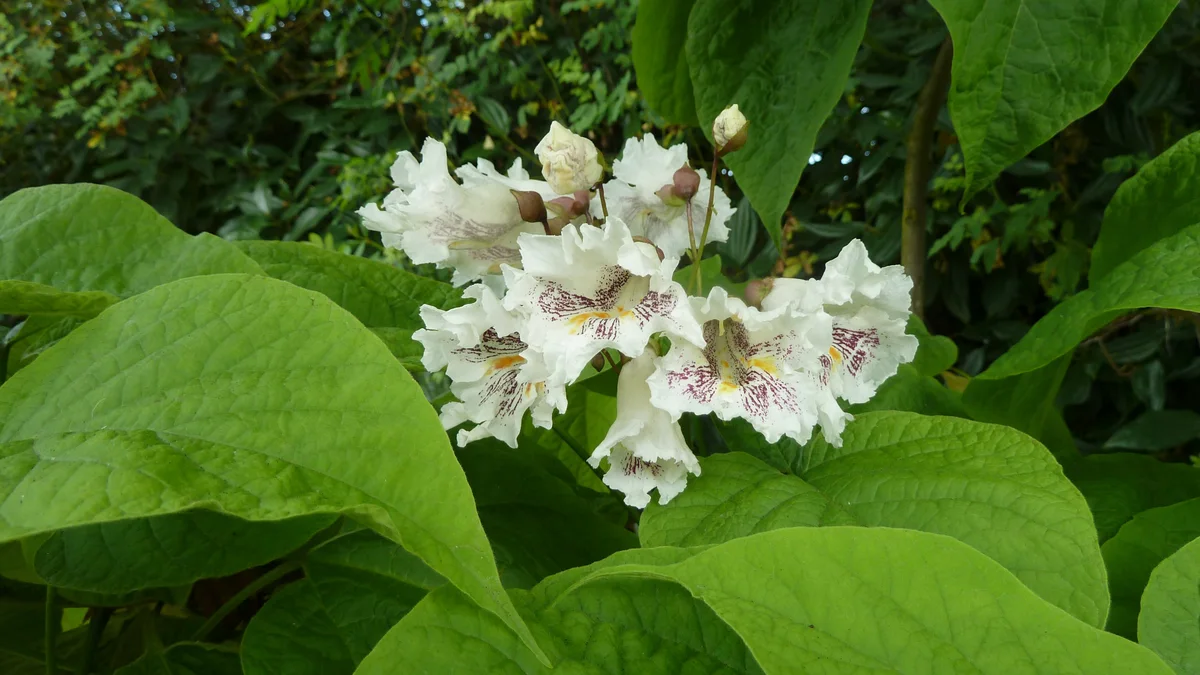
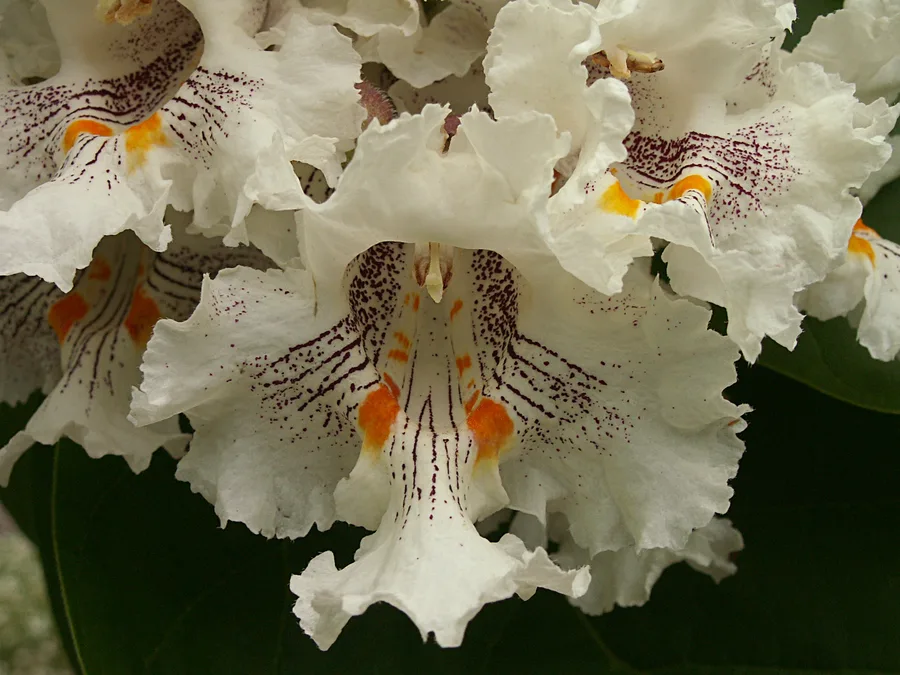
- Flowers: white, two-lipped trumpets up to 2¼ inches, marked inside with yellow stripes and purple spots, in clusters up to 7¾ inches long, per the Forest Service.
- Pods: long, slender capsules, green in summer and brown by fall. The Missouri Department of Conservation gives 8 to 20 inches for northern catalpa; the Forest Service says each holds over 100 flat, winged seeds.
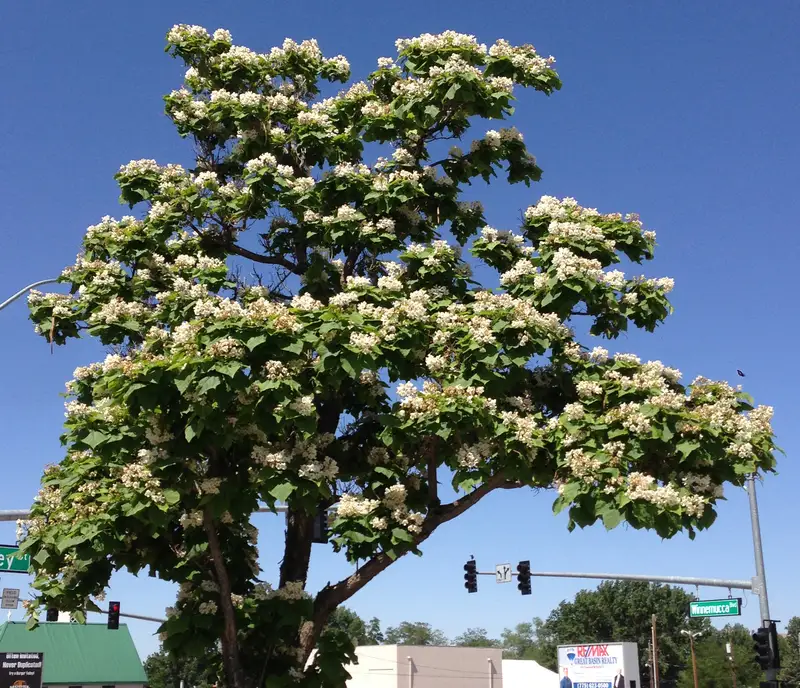
- Bark and size: on older northern catalpas, the bark is reddish-brown and broken into thick, scaly plates. Northern catalpa grows 40 to 60 feet tall in landscapes, according to the Morton Arboretum, and forest trees can be much taller.
Northern vs southern catalpa
The two natives are easy to mix up. The Missouri Department of Conservation and the Lady Bird Johnson Wildflower Center list these differences:
- Flowers: northern catalpa’s are bigger (1½ to 2 inches long) and open earlier; southern catalpa’s are smaller.
- Leaf smell: crushed southern catalpa leaves give off an unpleasant odor; northern catalpa leaves do not.
- Pods: northern catalpa pods are thick-walled; southern catalpa pods are narrower and thin-walled.
- Bark: older northern catalpas have thick, scaly plates; southern catalpa bark breaks into thin plates.
- Size and shape: northern catalpa is the larger tree, with a broadly columnar crown according to Kentucky Extension; the Wildflower Center gives southern catalpa as up to 40 feet with a broadly rounded crown.
Catalpa vs paulownia
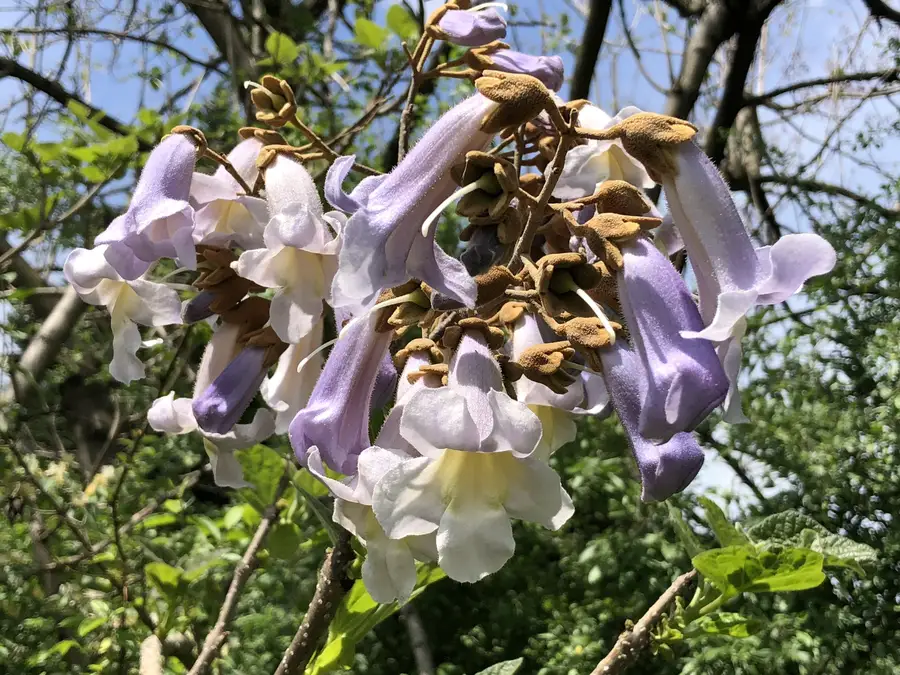
Vermont’s invasive species program notes that paulownia, or princess tree (Paulownia tomentosa), is commonly mistaken for northern catalpa; both have big heart-shaped leaves. The giveaways: paulownia leaves are fuzzy, its pale violet flowers open in spring before the leaves, and it carries clusters of egg-shaped capsules 1 to 2 inches long instead of long beans. The Wisconsin DNR says each capsule can hold up to 2,000 tiny winged seeds.
What the video covers: In this episode of Purdue Extension’s ID That Tree series, Purdue Extension forester Lenny Farlee introduces northern catalpa, which is native to southern Indiana along the Ohio River bottoms. Purdue’s description says the episode covers its rot-resistant wood, early-summer flower clusters, huge heart-shaped leaves in whorls and long, bean-like pods.
Catalpa, Paulownia and Desert Willow Compared
Desert willow (Chilopsis linearis), also called willowleaf catalpa, is a Southwestern relative. Bloom months are typical US figures and shift with latitude.
| Tree | Native range | Leaves | Flowers | Bloom time | Pods/fruit | Height | Source |
|---|---|---|---|---|---|---|---|
| Northern catalpa (Catalpa speciosa) | Western Tennessee and northeastern Arkansas to southwestern Indiana and eastern Missouri; naturalized widely | Opposite or whorled, heart-shaped, 7 to 12 in; no smell when crushed | White with yellow stripes and purple spots, 1½ to 2¼ in | May to June; Wildflower Center gives April to June | Thick-walled pod, 8 to 20 in | 40 to 60 ft in yards; up to about 100 ft | USDA Forest Service; Missouri Dept. of Conservation; Wildflower Center; Morton Arboretum |
| Southern catalpa (C. bignonioides) | Gulf Coast from northern Florida to eastern Mississippi; naturalized widely | Opposite or whorled, up to 8 in; smell bad when crushed | White with yellow and purple markings; smaller than northern catalpa | May to June, a little after northern catalpa | Thin-walled pod, up to 18 in long and ½ in wide | Up to 40 ft | Wildflower Center; Missouri Dept. of Conservation |
| Paulownia, princess tree (Paulownia tomentosa) | China; invasive in parts of the eastern US | Opposite, fuzzy, heart-shaped, 6 to 12 in | Pale violet, fragrant; open before the leaves | April to May | Egg-shaped capsule, 1 to 2 in; up to 2,000 seeds | 30 to 60 ft | Vermont Invasives; Wisconsin DNR |
| Desert willow (Chilopsis linearis) | South-central Texas to southern California and northern Mexico | Narrow and willow-like, 4 to 12 in | White, pink or purple, 1 to 1½ in | April to October, heaviest May to June | Slender pod, 4 to 12 in | 15 to 40 ft | Wildflower Center |
When Does Catalpa Bloom?
The Forest Service gives May to June for northern catalpa, and the Lady Bird Johnson Wildflower Center lists April to June for northern catalpa and May to June for southern catalpa. That overlaps the June bloom of basswood.
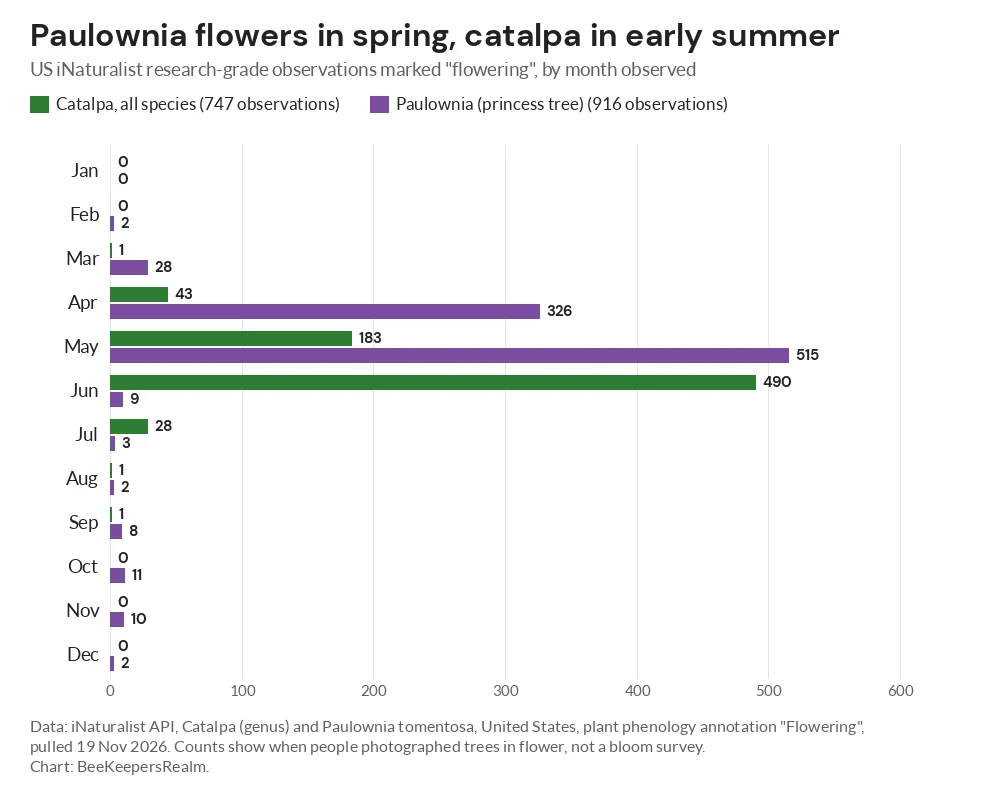
Our own count of iNaturalist records shows the same pattern. Of 747 research-grade US catalpa observations that volunteers tagged as flowering, 490 (66%) were made in June and 183 (25%) in May. Paulownia ran about a month ahead: 515 of its 916 flowering records (56%) were in May, and 326 (36%) in April. These counts reflect when people photographed trees in flower, not a bloom survey.
Northern catalpa’s 651 flowering records peak in June (479). Southern catalpa’s 93 records peak in May (48), earlier than the sources suggest, but that is a small sample and we would not read much into it.
Do Bees Like Catalpa?
Yes, though catalpa is a modest bee tree rather than a major honey source. The Lady Bird Johnson Wildflower Center, which uses Xerces Society pollinator data, marks both native catalpas as being of special value to honey bees.
“This species flowers in May to June with fruit ripening in September to October depending on the part of the country in which it is found. Bees, wasps and flies visit the flowers.”
How the flowers work
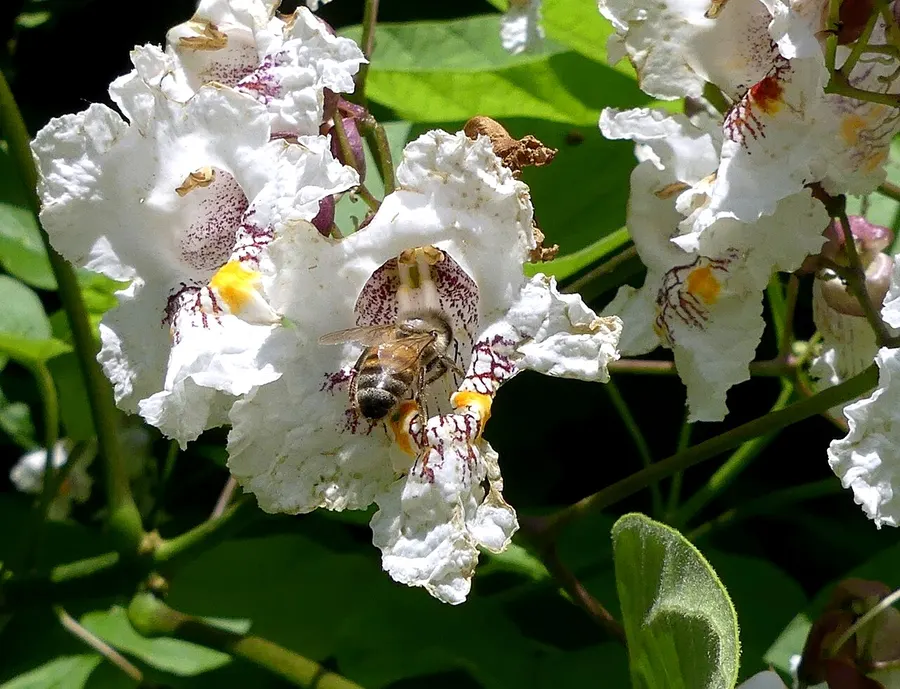
The yellow stripes and purple spots inside each flower are nectar guides. University of Kentucky Extension describes the flowers’ two lips as landing pads, with yellow bands that direct pollinators to the nectaries. It adds that, although each flower is bisexual, catalpa avoids pollinating itself by releasing a flower’s pollen before or after that same flower’s egg is ready. Our guide to pollination syndromes explains traits like these.
Catalpa also guards its nectar. In a 1982 study in the Journal of Chemical Ecology, Penn State biologist Andrew G. Stephenson found unpalatable iridoid glycosides in northern catalpa’s floral nectar. They deterred nectar thieves but did not affect the legitimate daytime pollinators.
Which insects visit catalpa flowers
We counted US iNaturalist observations in which volunteers recorded an insect visiting a catalpa flower. There are very few: 12 research-grade records, too few to say which visitors matter most. Seven were bees, led by the eastern carpenter bee; none were honey bees.
| Visitor recorded on catalpa flowers | Group | Research-grade US records |
|---|---|---|
| Eastern carpenter bee (Xylocopa virginica) | Bee | 5 |
| Perplexing bumble bee (Bombus perplexus) | Bee | 1 |
| Spurred ceratina, a small carpenter bee (Ceratina calcarata) | Bee | 1 |
| Margined leatherwing, a soldier beetle (Chauliognathus marginatus) | Beetle | 3 |
| Spotted cucumber beetle (Diabrotica undecimpunctata) | Beetle | 1 |
| Canadian petrophila, a moth (Petrophila canadensis) | Moth | 1 |
Large bees crawl deep into the wide flower throat; see our guides to carpenter bees and bumblebees. These are volunteer photos, not a survey, so the mix shows what people chose to photograph.
Extrafloral nectaries: nectar on the leaves
Catalpa leaves have small nectar glands of their own, known as extrafloral nectaries. In a 1982 study in Ecology, Stephenson found that northern catalpa’s leaf nectaries are active from early June to September, peaking in late June and early July, when the first generation of catalpa sphinx eggs and young caterpillars appear. Damaged leaves secreted more nectar. Ants, lady beetles and a parasitoid came to drink. Branches kept free of ants suffered more leaf damage and set fewer fruits. Lady beetles that patrol the leaves are covered in our ladybug guide.
On southern catalpa, a 2003 study by J. Ness in Oecologia found that leaf-gland sugars rose two- to threefold within 36 hours of caterpillars feeding on a leaf, and visits by the ant Forelius pruinosus rose as much within 24 hours.
Is there catalpa honey?
Rarely. John H. Lovell’s 1926 Honey Plants of North America noted that honey bees can easily reach the nectar and said catalpa was “reported to be a good honey plant in localities.” Harvey B. Lovell’s 1956 manual was more cautious:
“Bees have to creep into the large flowers to reach the nectar. The honey is described as thin and watery, but it is rarely obtained pure.”
Treat catalpa as a useful June extra for bees, not a varietal honey source. For trees with big flows, see our guide to the best nectar-producing trees for bees.
Catalpa Worms (Catalpa Sphinx)
Catalpa worms (also catawba worms) are the caterpillars of the catalpa sphinx moth, Ceratomia catalpae, a native hawk moth in the same family as the hummingbird moth. According to Penn State Extension, it is the only sphinx moth whose caterpillars feed on catalpa, and catalpa is all they eat. They feed on northern, southern and Chinese catalpa.
How to identify catalpa worms
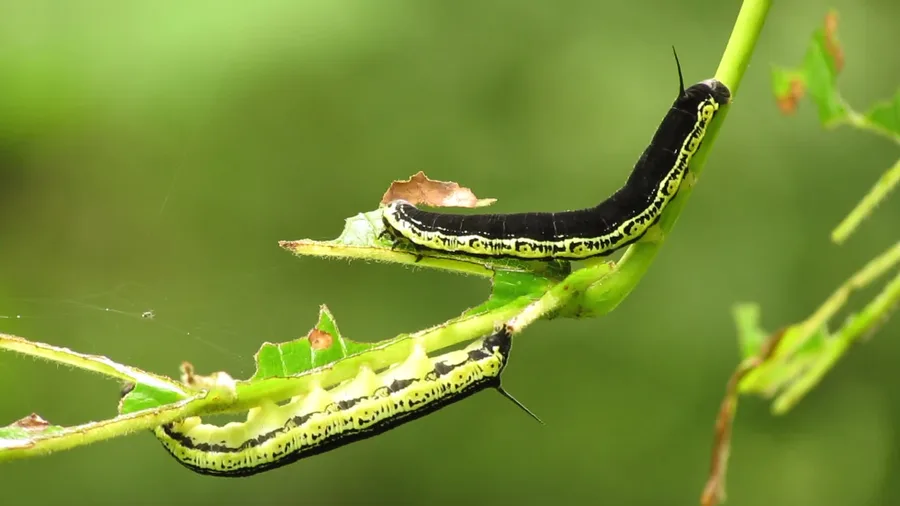
- Young caterpillars are white with small black spots and feed side by side in groups. Penn State says no other sphinx caterpillar feeds in groups like this through its third, and sometimes fourth, instar.
- Older caterpillars range from yellow with black markings to almost entirely black, and reach about 3 inches long. Like other sphinx caterpillars, they have a stiff horn near the rear; on catalpa worms it is long, straight and black.
- Adult moths are brown, with a black-rimmed gray spot on each forewing. Kansas State University entomologist Raymond Cloyd gives a wingspan of 2½ to 3.7 inches.
Life cycle
Pupae spend the winter in the soil under the host tree. Penn State says adults emerge from April and fly until October. Females lay masses of 100 to 1,000 eggs on the undersides of leaves, and caterpillars can be found from May to November. Caterpillars go through five instars, then crawl down the trunk and pupate 2 to 3 inches deep in the soil.
There is one generation a year in Pennsylvania, up to three in Kansas and up to five in Louisiana. Populations boom and bust: caterpillars can be absent for a few years, then strip trees for a year or two.
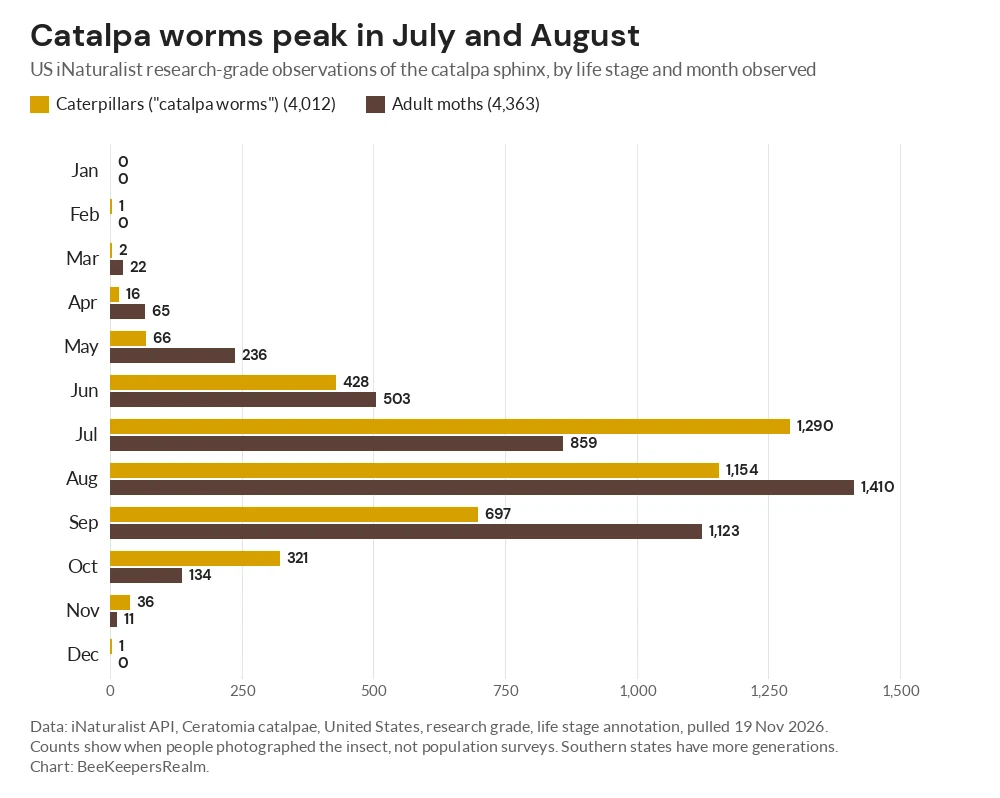
US iNaturalist records follow the life cycle. Of 4,012 research-grade observations tagged as caterpillars, 2,444 (61%) were made in July and August, with July the busiest month (1,290). Adult moth records peaked in August (1,410 of 4,363).
Cloyd notes that catalpa leaves contain iridoid glycosides (catalposides), which repel most leaf-eating insects but attract this specialist; the caterpillars store them in their body fluid.
Cotesia wasps: the natural brake
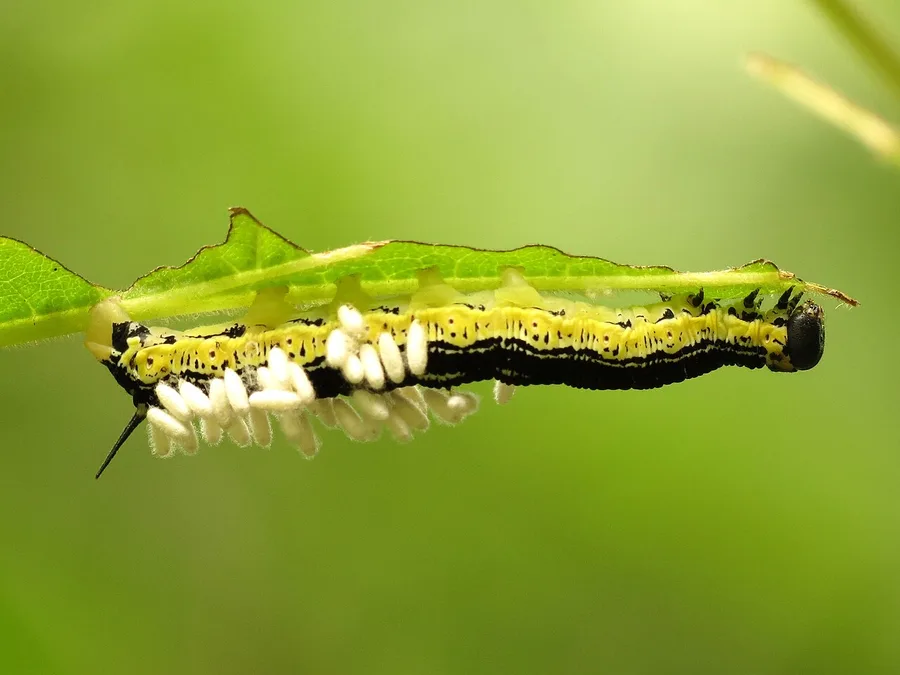
Penn State names a tiny braconid wasp, Cotesia congregata, as the most common parasitoid of catalpa worms. The wasp larvae feed inside the caterpillar, then emerge and spin white cocoons on its skin; Penn State says a heavily infested caterpillar can carry dozens. The same wasp attacks tomato and tobacco hornworms, but Penn State notes that there is apparently little gene flow between the populations on catalpa worms and those on tomato hornworms, so they may be splitting into separate species.
Should you control catalpa worms?
Usually not. Penn State says natural enemies often keep catalpa worms in check, and spraying can backfire by killing those enemies, which can make later outbreaks worse.
“Healthy catalpa trees can withstand complete defoliation by catalpa worms and will often push out a second set of leaves if defoliation happens early in the season.”
Repeated defoliation can kill an already weakened tree. For a small tree, Penn State suggests removing egg masses from the undersides of leaves, trimming out or handpicking groups of young caterpillars, and leaving parasitized caterpillars with white cocoons in place. Cloyd adds that keeping trees watered during dry spells helps them recover.
Catalpa worms as fishing bait
Penn State calls catalpa worms excellent bait for largemouth bass and catfish, and some anglers plant small catalpa groves for a supply. University of Georgia Extension adds bream, says anglers value the worms’ tough skin, and recommends gloves because they release a yellow-green fluid when handled. UGA also passes on an Arkansas Game and Fish Commission way to keep them: blanch for about a minute, dry, bag with about a cup of cornmeal, and freeze.
Catalpa Pods, Seeds and Wood
The pods are what give catalpa its nicknames “cigar tree” and “Indian bean tree”. They ripen from green to dark brown in September and October, then split to release flat seeds with two papery, hair-tipped wings, and many stay on the tree into winter. Despite the “bean” name, they are not a food; plant references such as Gardenia.net describe the fruit as inedible. Another native tree with long seed pods is the honey locust, whose pods are flat and twisted.
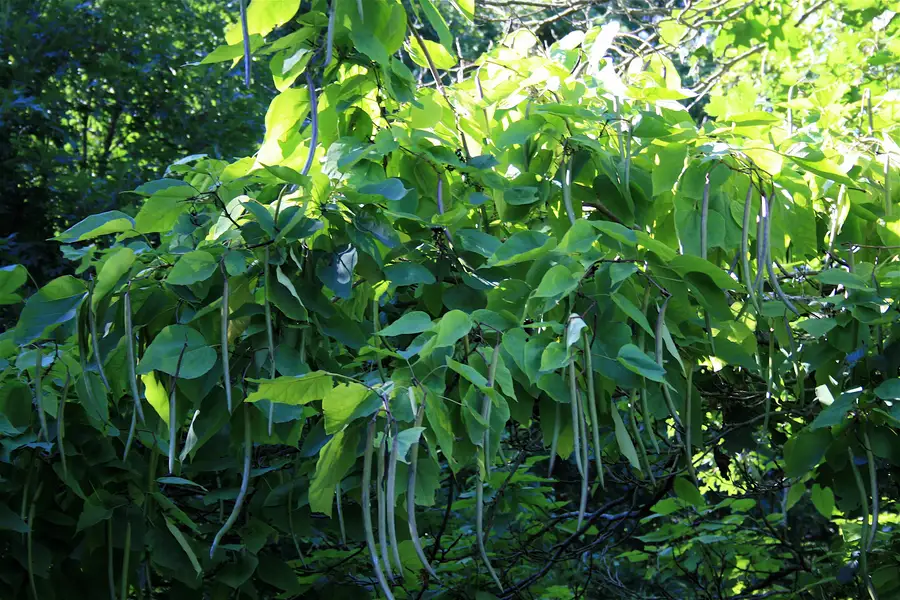
Catalpa wood is soft but very rot-resistant. University of Kentucky Extension says catalpa fence posts last more than 50 years and railroad ties lasted twice as long as other wood. Around 1935, the federal government encouraged western farmers to grow catalpa to supply railroad ties. The Missouri Department of Conservation adds windbreaks to its uses, and the Forest Service notes that the soft wood is good for carving.
Is Catalpa Native or Invasive?
Both. Catalpa is native to the US, but each species once had a small natural range, and both now grow wild far outside it:
- Northern catalpa was originally native to a small area around the lower Ohio and Mississippi rivers, from western Tennessee and northeastern Arkansas to southwestern Indiana and eastern Missouri. The Wildflower Center describes it as now widely naturalized in the Southeast, and the Missouri Department of Conservation says it now grows statewide in Missouri.
- Southern catalpa is native to a strip of the Gulf Coast from northern Florida to eastern Mississippi, and has naturalized elsewhere.
EDDMapS sums up northern catalpa as native to parts of the US but possibly invasive in others, and the University of Connecticut’s plant database says it has shown an invasive tendency in Connecticut, escaping into minimally managed areas.
Paulownia is native to China; Vermont lists it as a watch-list invasive, and Wisconsin prohibits it. For a pollinator planting, choose the native catalpa. Our butterfly bush guide explains why popular non-native flowering plants can still cause problems.
Is Catalpa a Good Yard Tree?
It can be, if you have the room and don’t mind cleanup. Here are the main points from extension and botanic-garden sources:
| What the sources say | Source | |
|---|---|---|
| Pro: tough and fast | Rapid growing and adaptable to many soils; Kentucky says it tolerates urban sites | Wildflower Center; Univ. of Kentucky |
| Pro: early-summer flowers | Big white flower clusters in May and June; special value to honey bees | USDA Forest Service; Wildflower Center |
| Pro: native host plant | The only host of the catalpa sphinx; trees usually regrow their leaves | Penn State Extension |
| Con: litter | “Major litter producers”: flowers, small branches, big leaves and pods | Wildflower Center; Morton Arboretum |
| Con: weak wood | Brittle branches break in wind storms; pruning may be needed after storms | Wildflower Center; Univ. of Kentucky |
| Con: short leaf season | Leafs out very late and drops its leaves early in fall | Univ. of Kentucky |
| Con: other problems | Powdery mildew, leaf spots and Verticillium wilt; southern catalpa sends up root suckers; some people get dermatitis from handling the flowers | Univ. of Kentucky; Wildflower Center; Missouri Dept. of Conservation |
Plant catalpa where falling pods and petals won’t land on a patio, driveway or pool. The Wildflower Center also calls northern catalpa relatively short-lived. For other native trees that feed bees, see our list of the best trees for bees in the USA.
Frequently Asked Questions
What are the disadvantages of the catalpa tree?
Litter (flowers, big leaves, pods and twigs), brittle branches that break in storms, a short leaf season, and catalpa worms that can strip the leaves in outbreak years.
Is a catalpa tree good for anything?
Yes: shade, an early-summer flower show, food for bees, a home for the native catalpa sphinx, fishing bait, and rot-resistant wood for fence posts.
Can you eat catalpa beans?
No. Catalpa pods are not edible beans; the name refers only to their shape, and we found no extension or botanical source that lists them as food.
What is another name for a catalpa tree?
Common alternative names are catawba, cigar tree and Indian bean tree. Northern catalpa is also called hardy or western catalpa, and in the South, southern catalpa is known as the fish bait tree.
How do I get catalpa worms on my tree?
You can’t count on it. The moths find catalpa trees on their own, and populations boom and crash. Plant catalpa and avoid insecticides; Penn State notes that some trees seem more attractive to the moths than others.
What time of year do catawba worms come out?
Penn State says from May to November. In US iNaturalist records, caterpillar sightings peak in July and August.
What does a catalpa worm turn into?
The catalpa sphinx moth, a brown hawk moth with a wingspan of about 2½ to 3.7 inches. Caterpillars pupate in the soil, where the pupae spend the winter.
The Bottom Line
Catalpa is a giant-leaved native tree that flowers in June, feeds insects from both its flowers and its leaves, and raises its own fishing bait. Plant it where litter won’t matter, leave the catalpa worms to their wasps, and choose it over invasive paulownia. For more native bee plants, browse our pollinator gardening and native bee guides.
Image credits: featured photo of northern catalpa flowers by Wendy Cutler, via Wikimedia Commons, CC BY 2.0, cropped. Other photos are credited in their captions. Charts by BeeKeepersRealm from iNaturalist data.