Reviewed by Daniel M. · How we review
Coreopsis, also called tickseed, is a group of about 40 daisy-like wildflowers from the Americas, most with yellow petals notched or lobed at the tip. Lanceleaf, threadleaf and large-flowered coreopsis are perennials, and plains coreopsis is an annual. Most bloom from spring into summer, need full sun and well-drained soil, and are visited mainly by small native bees, especially sweat bees.
Key Takeaways
- “Coreopsis” and “tickseed” are the same plants. Threadleaf coreopsis is now often placed in a separate genus, Anacis, but is still sold as coreopsis.
- In 972 US iNaturalist research-grade records of insects visiting lanceleaf coreopsis, sweat bees made up 42% and honey bees 2%.
- A University of Georgia study found small bees made up over 77% of visitors to coreopsis cultivars.
- Lanceleaf flowering records peak from April to June, threadleaf in June and July.
- Give it at least 6 hours of sun and drained soil. Deadheading extends bloom and limits self-seeding.
Table of Contents
- What Is Coreopsis?
- Types of Coreopsis
- Is Coreopsis Native?
- Do Bees Like Coreopsis?
- When Does Coreopsis Bloom?
- How to Grow Coreopsis
- Coreopsis vs Black-Eyed Susan, Cosmos and Blanket Flower
- Frequently Asked Questions
- The Bottom Line
What Is Coreopsis?
Coreopsis is a genus in the aster family. Each “flower” is a head of many tiny flowers: petal-like ray florets around a center of disk florets, with two rows of eight bracts underneath. Plants of the World Online accepts 39 species, all from North, Central and South America. The name comes from the Greek koris, a bug, and opsis, like, because the seed looks like a bug or tick (NC State Extension).
Plants of the World Online now places threadleaf coreopsis, tall tickseed and a few relatives in the genus Anacis, while the Global Compositae Database keeps them in Coreopsis. Garden centers still call threadleaf coreopsis, and so does this guide. Coreopsis is also Florida’s state wildflower:
“The Coreopsis is hereby designated and declared the official Florida state wildflower, as species of this genus are found throughout the state and are used extensively in roadside plantings and highway beautification.”
Video: a Zone 8 gardener from the Flower Patch Farmhouse channel covers light, soil and drainage, fertilizing, seed starting, watering, pollinators and deadheading for a longer bloom. This summary is from the video’s chapter list, as no captions were available.
Types of Coreopsis
These are the species US gardeners meet most often, with data from the Lady Bird Johnson Wildflower Center (LBJWC) and NC State Extension (NCSU).
| Species | Annual or perennial | Native range | Leaves | Flower | Height | Bloom time | Source |
|---|---|---|---|---|---|---|---|
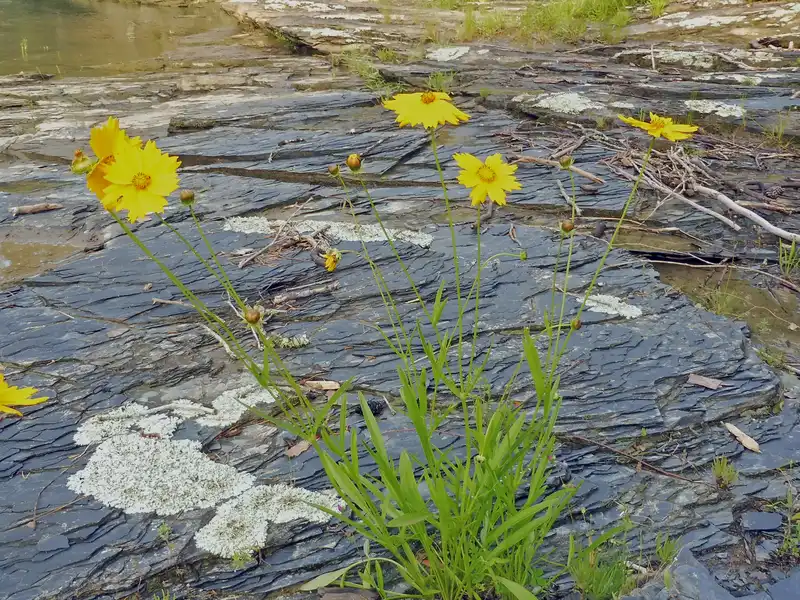
| Lanceleaf coreopsis (C. lanceolata) | Perennial | FL to e. TX and n. NM, north to VA, Ont., MI, WI, MO and CO; naturalized in the Northeast | Narrow, lance-shaped, mostly near the base | Yellow, 1 to 1.5 in; 8 rays with lobed tips | 1 to 2 ft | Apr to Jun | LBJWC; NCSU |
| Threadleaf coreopsis (Anacis verticillata, formerly C. verticillata) | Perennial; spreads by rhizomes | Eastern US and Canada, south to GA | Thread-like, split into 3, in whorls | Yellow, 1 to 2 in; 8 rays, not notched | 2.5 to 3 ft (‘Moonbeam’ 12 to 18 in) | May to Jul | NCSU |
| Large-flowered coreopsis (C. grandiflora) | Perennial, often short-lived; reseeds | Southeastern US, inland to MO, e. KS, OK and TX | Upper leaves deeply lobed, lower ones narrow | Yellow, about 2.5 in; 6 to 12 rays, each with 4 to 5 notches | 1 to 3 ft | May to Jun | LBJWC; NCSU |
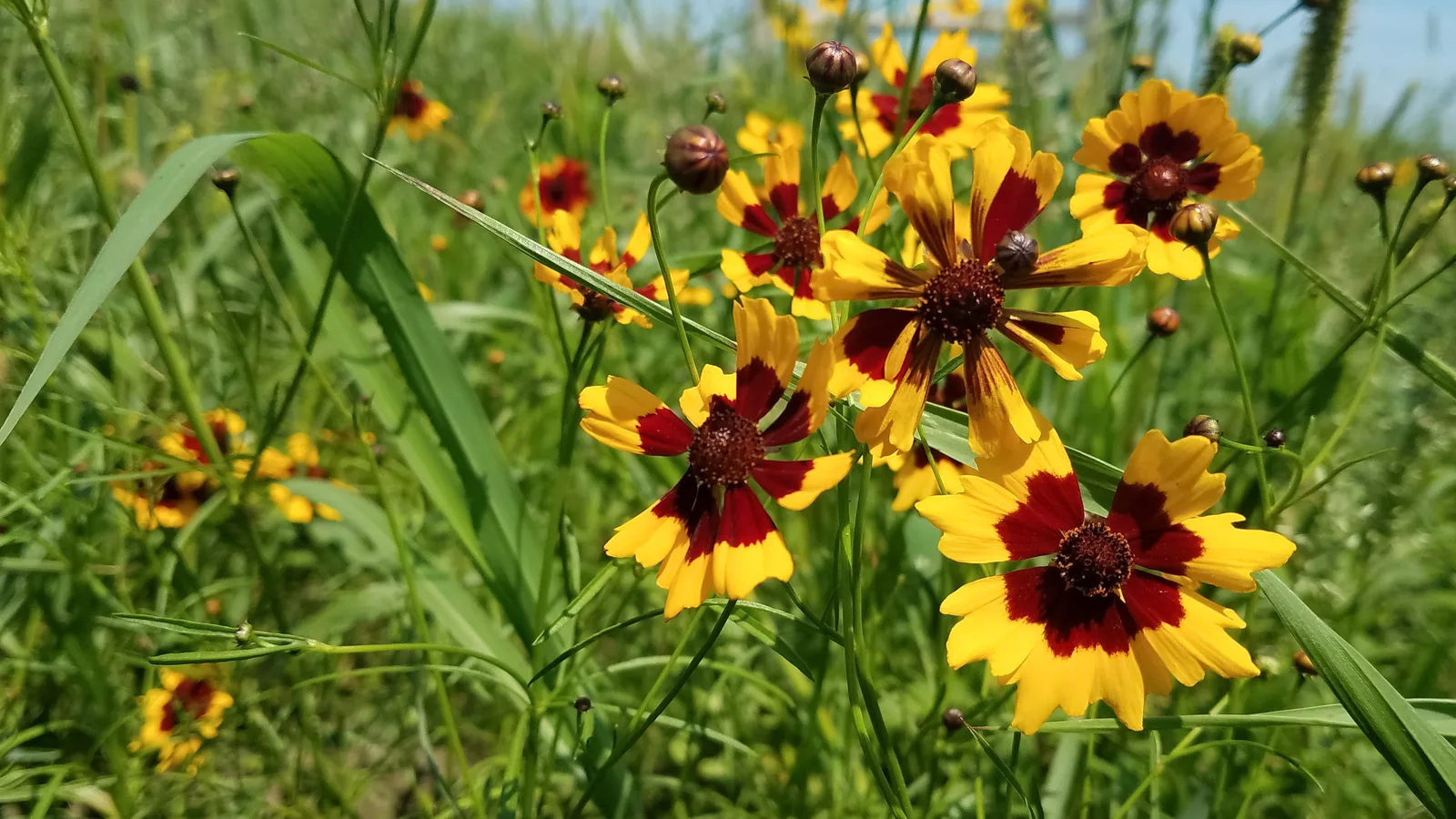
| Plains coreopsis (C. tinctoria) | Annual | Plains of the central US; naturalized elsewhere | Finely divided into narrow segments | Yellow rays with a red-brown base, red-purple center | 2 to 4 ft | Apr to Jun | LBJWC; NCSU |
| Ear-leaved tickseed (C. auriculata) | Perennial | VA and KY to GA and LA | Hairy, oval, with two small “ear” lobes at the base | Yellow, up to 2 in; 8 rays with 3-lobed tips | Flower stalks to about 18 in | Mar to May | LBJWC; NCSU |
| Pink tickseed (C. rosea) | Perennial; creeping rhizomes | Nova Scotia and e. MA to Long Island and NJ | Narrow, linear | Pink or white rays, yellow center, about 1 in | 9 in to 2 ft | Jul to Sep | LBJWC |
Is coreopsis a perennial or an annual?
Most are perennials. Plains coreopsis is the main annual, sometimes sold as “calliopsis” (LBJWC). NC State Extension says large-flowered coreopsis “may not always be reliably perennial but will reseed itself,” and Illinois Extension calls it short-lived without good drainage. Cultivars such as ‘Moonbeam’ and ‘Zagreb’ come from threadleaf coreopsis. ‘Moonbeam’ has sterile seeds but spreads by rhizomes (NCSU), and it was the Perennial Plant Association’s 1992 Perennial Plant of the Year.
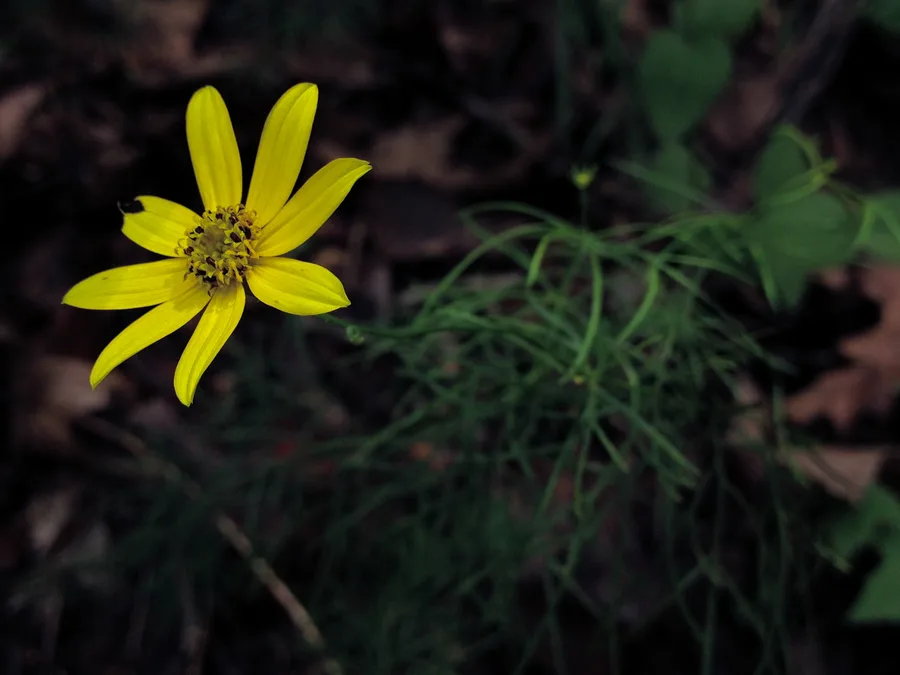
Is Coreopsis Native?
Yes, to the Americas, but “native” depends on your state. Illinois Wildflowers treats large-flowered coreopsis as non-native in Illinois. NC State Extension says lanceleaf is “probably not native” to North Carolina, while Clemson Extension counts it among South Carolina’s native tickseeds. The LBJWC also notes lanceleaf is listed as invasive in Japan. The safest pick is a species native to your own state. For more ideas, see our list of the best US native plants for pollinators.
“Disregarding its unfortunate name, tickseed is a fantastic native pollinator plant for our area.”
Do Bees Like Coreopsis?
Yes, mostly small native bees. We pulled every US iNaturalist record of an insect tagged as visiting a coreopsis or Anacis flower: 1,728 research-grade records. Lanceleaf (972) and threadleaf (447) account for most, so the chart compares those two.
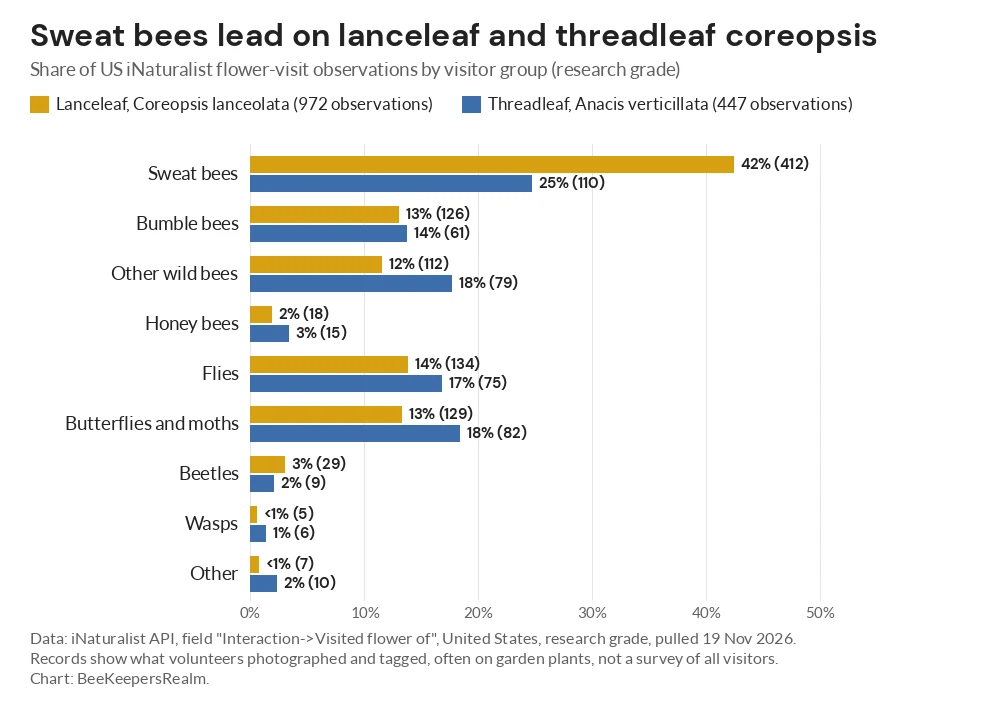
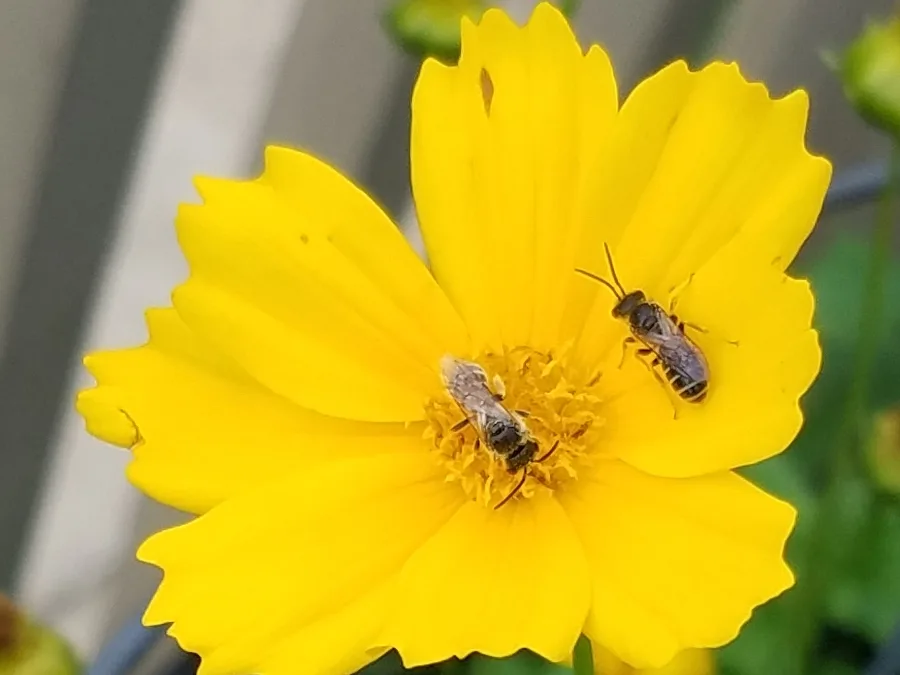
On lanceleaf, bees made up 69% of records and sweat bees 42%. One sweat bee, the ligated furrow bee (Halictus ligatus), appeared in 295 records. Bumble bees made up 13%, and honey bees just 18 records. Hover flies and butterflies were the main non-bee visitors.
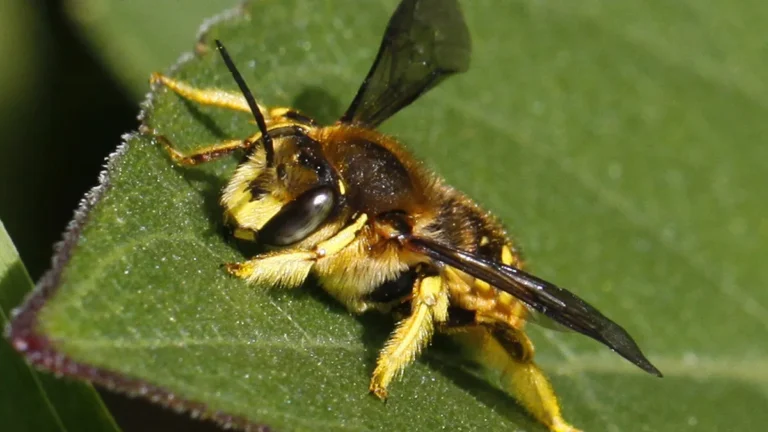
Threadleaf had a broader mix: sweat bees 25%, bumble bees 14%, other wild bees 18% and honey bees 3%. The other wild bees include 29 records from the leafcutter family, among them the alfalfa leafcutter bee. Other species had small counts: 63 records on plains coreopsis and 34 on large-flowered. These records show what volunteers photographed, not a full survey.
What research says about cultivars
A two-year University of Georgia study at Griffin counted 6,911 pollinator visits to cultivars of coreopsis, salvia and asters (Braman, Pennisi, Fair and Quick, Frontiers in Sustainable Cities, 2022). Its coreopsis result matches the iNaturalist pattern:
“The most frequent visitors to coreopsis were the small bees with over 77% of visitors falling into this category.”
Of five cultivars, ‘Hot Paprika’ drew the most bees. Bees netted from coreopsis included Halictus and Lasioglossum sweat bees, three small carpenter bee species and Holcopasites calliopsidis, a tiny cuckoo bee. The study did not compare cultivars with wild plants. A 2014 University of Delaware study at Mt. Cuba Center did, testing 5 wild species and 20 cultivars. Mt. Cuba’s Melissa Starkey, quoted by Weavers Way Co-op, said it recorded mostly bumble bees, so results vary by site.
Specialist bees
Jarrod Fowler and Sam Droege’s 2020 list of pollen-specialist bees of the eastern US names Coreopsis as a host for 17 species. Fowler’s central US list names 29. Most also use other aster-family plants. They include long-horned bees (Melissodes) and the pugnacious leafcutter. One rare Florida bee, Perdita foveata, is listed with coreopsis as its only host. Planting native coreopsis in drifts helps these bees.
When Does Coreopsis Bloom?
Mostly mid-spring to midsummer. Of 5,575 US iNaturalist research-grade records of Coreopsis marked as flowering, 70% fall between April and July. The chart shows three garden species as a share of each species’ records.
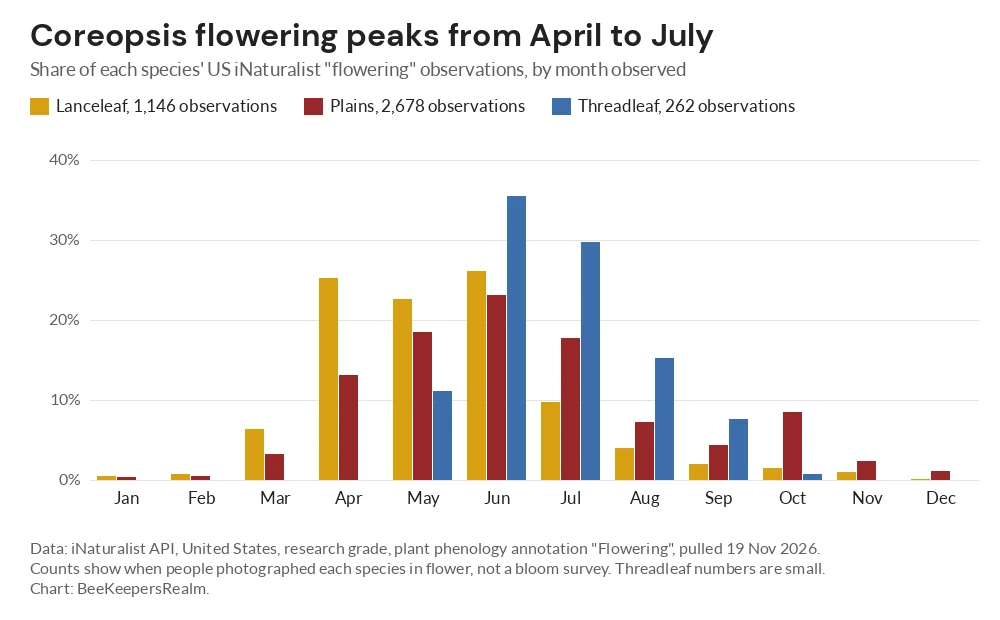
Lanceleaf comes first, with 74% of its 1,146 records in April to June. Plains coreopsis peaks in June, with a smaller bump in October. Threadleaf comes later, with 65% of its 262 records, a small sample, in June and July. Clemson Extension notes scattered blooms until the first frost. For later flowers, see our guide to fall-blooming flowers for bees.
How to Grow Coreopsis
These steps come from Clemson, NC State and Illinois Extension.
- Sun: full sun, at least 6 hours a day. Clemson lists native tickseeds as hardy in USDA zones 4a to 9b.
- Soil: well-drained. Lanceleaf thrives in sandy and rocky soils but can sprawl in rich soil (NCSU). Do not over-fertilize (Clemson).
- Water: water deeply the first year. After that, Clemson calls coreopsis extremely drought-tolerant, and it is on our list of drought-resistant flowers for bees.
- Deadheading: removing spent flowers brings more blooms and limits self-seeding. Illinois Extension says deadheaded large-flowered coreopsis can bloom almost all season. Shearing threadleaf after bloom sometimes brings fall flowers (NCSU).
- Dividing: divide lanceleaf every 2 to 3 years, and cut it back hard if it flops (NCSU).
- Seed heads: Clemson notes that songbirds eat the seeds, so leave a few.

Coreopsis vs Black-Eyed Susan, Cosmos and Blanket Flower
All four are daisy-like aster-family flowers. Petals and center usually settle it. Traits are from NC State Extension.
| Feature | Coreopsis | Black-eyed Susan | Cosmos (C. bipinnatus) | Blanket flower (G. pulchella) |
|---|---|---|---|---|
| Petals | Usually 8, yellow, often notched or lobed at the tip | 10 to 20, orange-yellow | Pink, white or maroon | Orange-red with 3-toothed yellow tips |
| Center | Flat, yellow (red-purple in plains coreopsis) | Dark purple-brown dome | Yellow | Purple-brown |
| Leaves | Narrow, lance-shaped, lobed or thread-like | Hairy, with hairy stems | Lacy, finely cut | Gray-green, hairy, toothed or smooth-edged |
| Origin | Americas; many US natives | Eastern US | Mexico and the Southwest | Central and southern US to northern Mexico |
Frequently Asked Questions
Why is coreopsis called tickseed?
NC State Extension says the small, flat seeds look like ticks, and the genus name means “bug-like.” Clemson Extension adds that the lobed petal tips make each petal resemble a tick.
Is coreopsis toxic to dogs and cats?
The ASPCA lists tickseed (coreopsis) as non-toxic to dogs, cats and horses, though its entry names a western species, Coreopsis californica. NC State Extension also tags lanceleaf as non-toxic. If a pet shows symptoms after eating any plant, call your vet or the ASPCA Animal Poison Control Center.
Does coreopsis spread?
Yes. Lanceleaf and plains coreopsis reseed, Clemson calls lanceleaf an aggressive self-seeder, and threadleaf and pink tickseed spread by rhizomes. Deadheading before seeds ripen limits reseeding.
Is coreopsis deer resistant?
Somewhat. Clemson calls coreopsis mildly tolerant of deer and rabbits, depending on the species, and NC State lists lanceleaf as deer resistant.
Can coreopsis grow in shade?
Not well. Clemson says it needs at least 6 hours of sun, though the dwarf ear-leaved tickseed ‘Nana’ can tolerate partial shade.
Why is my coreopsis not blooming?
Check the basics: 6 or more hours of sun, drained soil and no heavy fertilizing. Old clumps lose vigor, so NC State suggests dividing every 2 to 3 years. Large-flowered coreopsis is often short-lived, so an old plant may simply be fading.
The Bottom Line
Coreopsis is a tough, sunny plant that feeds small native bees, especially sweat bees. Choose a species native to your state, give it sun and drainage, and deadhead for more flowers. Lanceleaf blooms first, threadleaf follows, and plains coreopsis is an easy annual. More plant profiles are in our pollinator gardening and native bees section.
This article is for general information. Ask your local extension office for planting advice in your area, and your veterinarian if you think a pet has eaten something harmful.
Image credits: featured photo of plains coreopsis at Lake Andes Wetland Management District, South Dakota, by Marcie Hebert, U.S. Fish and Wildlife Service, public domain, via Wikimedia Commons, cropped and resized. Other photos are credited in their captions. Charts by BeeKeepersRealm.