Reviewed by Elena P. · How we review
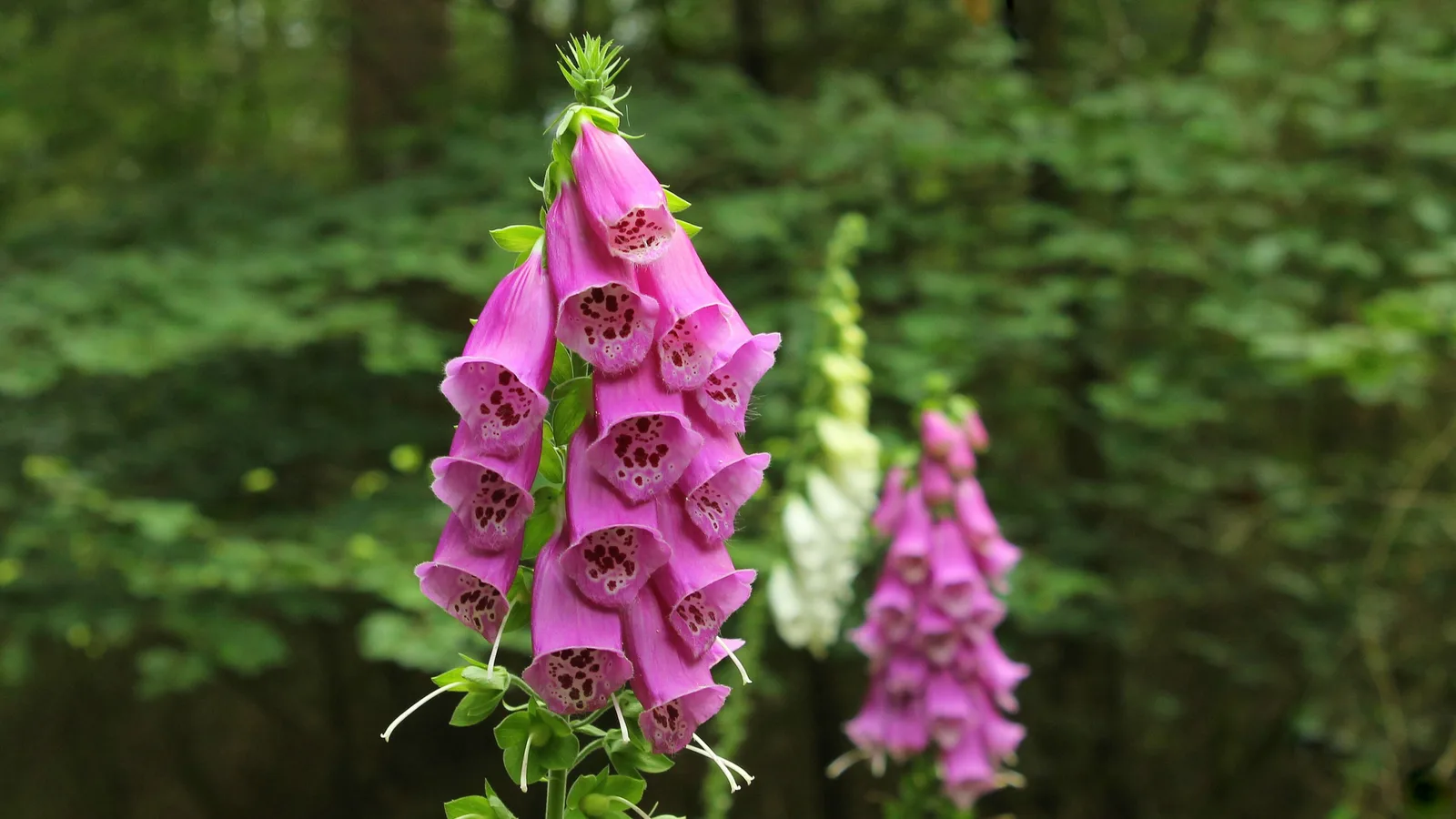
Foxglove (Digitalis purpurea) is a tall garden flower from western Europe and Morocco that is grown across the US and now grows wild in many states, especially the Pacific Northwest. Every part of the plant is poisonous to people, dogs, cats and horses, because it contains cardiac glycosides, the heart-acting compounds behind the drug digoxin. It is a biennial: a low rosette of soft, hairy leaves in the first year, then a 2- to 5-foot spike of spotted, bell-shaped flowers in purple, pink or white, mostly in June. Bumble bees are its main pollinators.
This guide covers identification, bees, toxicity, invasive status and safe growing. The bloom, bee and state figures include our own counts of US iNaturalist records, pulled in November 2026. It is educational information, not medical or veterinary advice.
Key Takeaways
- Foxglove is not native to the US. NC State Extension gives its home as western Europe and Morocco, and New England’s Go Botany flora lists it as non-native and naturalized.
- All parts are poisonous if swallowed. Poison Control advises against planting it where children or pets play, and the ASPCA lists it as toxic to dogs, cats and horses.
- Its first-year leaves can be mistaken for comfrey or borage. People have been hospitalized after making tea or sauce from them.
- Bumble bees are its main pollinators. Of 74 US iNaturalist records of animals visiting foxglove flowers, 39 were bumble bees and 3 were honey bees.
- Washington, Oregon and California hold 77% of US research-grade iNaturalist records of purple foxglove. The California Invasive Plant Council rates it “Limited.”
- For a native, non-toxic substitute, plant foxglove beardtongue (Penstemon digitalis). It flowers at the same time and feeds the same bumble bees.
Table of Contents
- What Is Foxglove?
- How to Identify a Foxglove Plant
- Foxglove Species and a Native Look-Alike Compared
- Why Bumble Bees Work Foxglove Flowers
- When Foxglove Blooms: The Biennial Life Cycle
- Is Foxglove Poisonous?
- From Foxglove to Digoxin: A Short History
- Is Foxglove Invasive in the US?
- How to Grow Foxglove Safely
- Native Alternatives to Foxglove
- Frequently Asked Questions
- The Bottom Line
What Is Foxglove?
Foxglove is the common name for Digitalis, a genus in the plantain family (Plantaginaceae). In the US the word almost always means common or purple foxglove, D. purpurea, which made up 24,383 of the 25,914 research-grade US iNaturalist records of the genus when we checked. Large yellow foxglove (D. grandiflora, 1,039 records), Grecian foxglove (D. lanata, 279) and straw foxglove (D. lutea, 204) are far less common.
Purple foxglove is the plant that gave medicine digitalis. Wikipedia’s species account calls it the original source of the heart drug digoxin, and William Withering introduced it to formal medicine in 1785. It is also a staple of cottage gardens because it brings height to part-shade beds in early summer.
Two plants share the name but are something else. Foxglove beardtongue (Penstemon digitalis) is a native US wildflower in the same family and lacks foxglove’s toxicity. And the NC State Extension Gardener Plant Toolbox lists snapdragon, Agalinis, smooth yellow false foxglove (Aureolaria levigata) and princess tree (Paulownia tomentosa) as plants people often confuse with foxglove.
In this 12 minute 50 second video, Northlawn Flower Farm and Gardens walks through growing foxgloves for cutting. Its official chapters cover the plant’s growth habit, sowing and raising seedlings, care and cutting, choosing varieties, and saving seed. We have checked it only against that chapter list, so rely on this page for toxicity and safe placement.
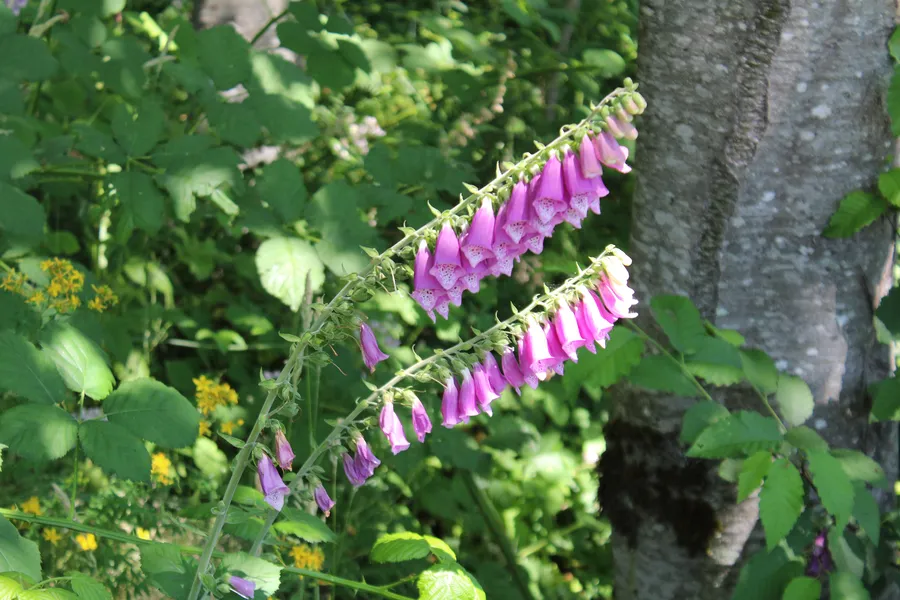
How to Identify a Foxglove Plant
Foxglove looks completely different in its two years, so learn both stages.
- First year (rosette): a low, tight clump of coarse leaves up to a foot long with prominent veins, gray-white hairs on top and a woolly underside, according to NC State Extension. There is no stem and no flower.
- Second year (flower spike): a single upright stem, usually 2 to 5 feet tall, rises from the center of the rosette with smaller leaves along it.
- Flowers: large, nodding tubes about 2 to 3 inches long, packed closely along one side of the spike (some hybrids carry them all the way around). The inside is marked with darker spots, most visibly on the lower lip.
- Colors: usually purple to pale pink, sometimes white; NC State notes mauve or yellowish tones in some hybrids.
- Seed: rounded capsules split open when ripe and release numerous small brown, ridged seeds.
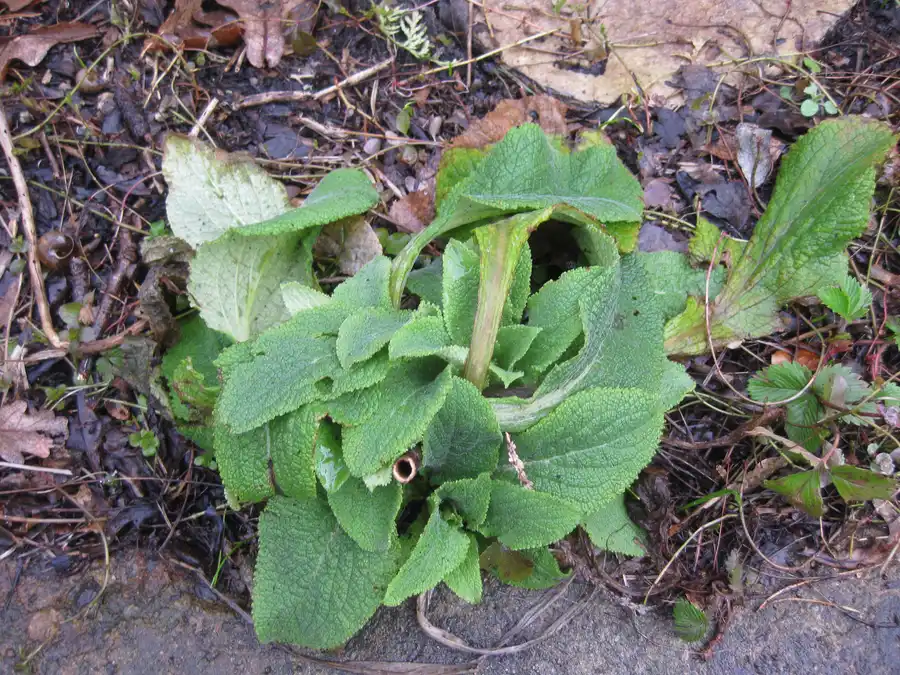
The rosette is the stage that causes poisonings, because there are no flowers to give it away. Its soft, hairy, deeply veined leaves are what people have mistaken for comfrey and borage (see the toxicity section below).
Foxglove Species and a Native Look-Alike Compared
All true foxgloves in US gardens are introduced. The only common native “foxglove” is a penstemon. The last column of the visitor data comes from our iNaturalist pull; small counts are noted.
| Plant | Native or introduced in the US | Flower | Height | Life cycle | Toxicity | Main bee visitors (US iNaturalist records) | Source |
|---|---|---|---|---|---|---|---|
| Purple foxglove (Digitalis purpurea) | Introduced (western Europe, Morocco) | Purple, pink or white tubes, 2–3 in, spotted inside | 2–5 ft | Biennial, sometimes short-lived perennial | All parts toxic to people, dogs, cats and horses | Bumble bees: 20 of 31 records | NC State Extension; ASPCA |
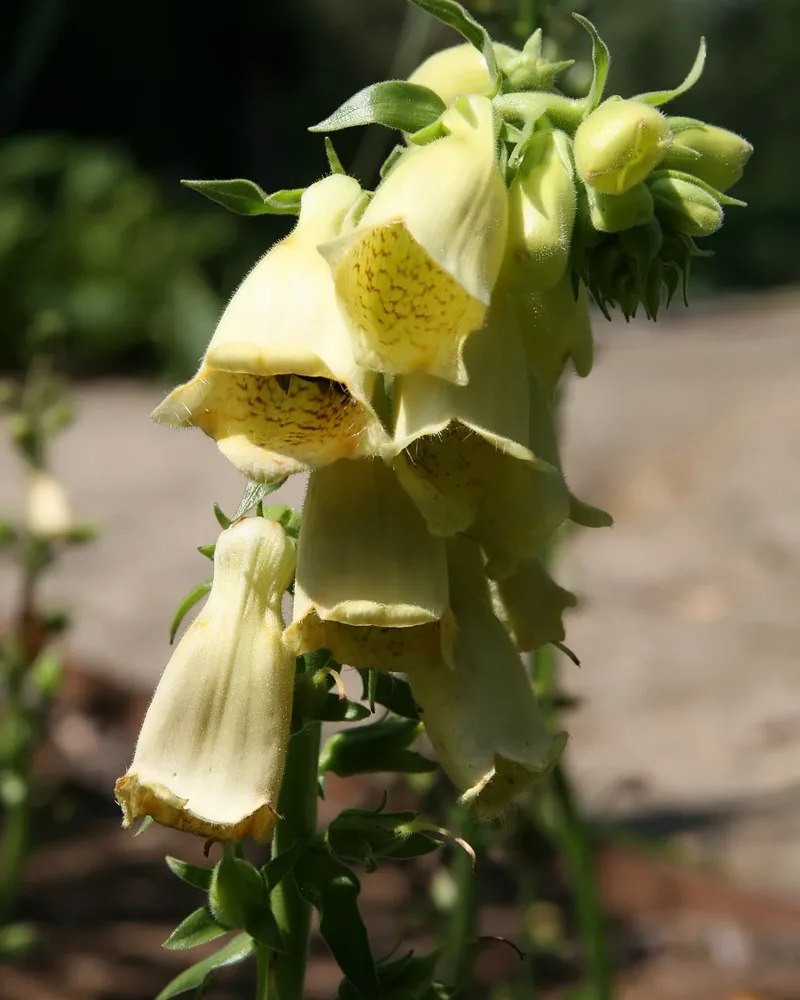
| Large yellow foxglove (D. grandiflora) | Introduced (Europe) | Creamy yellow tubes, 1.5–2 in | About 2.5 ft | Clump-forming perennial | Toxic if eaten, toxic to pets | Bumble bees and wool carder bees (small sample: 14 records) | Royal Horticultural Society |
| Grecian foxglove (D. lanata) | Introduced (Europe); an early-detection noxious weed in Minnesota | Creamy white with brown veins, about 1 in | 1–4 ft | Biennial | High in digitoxin; harmful to livestock and when handled extensively | No US visit records found | Minnesota Wildflowers |
| Foxglove beardtongue (Penstemon digitalis) | Native to the lower 48 states | White tubes with purple lines in the throat, about 1 in | 2–5 ft | Perennial | Not a foxglove; lacks foxglove’s toxicity | Bumble bees: 384 of 766 records | Lady Bird Johnson Wildflower Center; NC State Extension |
Why Bumble Bees Work Foxglove Flowers
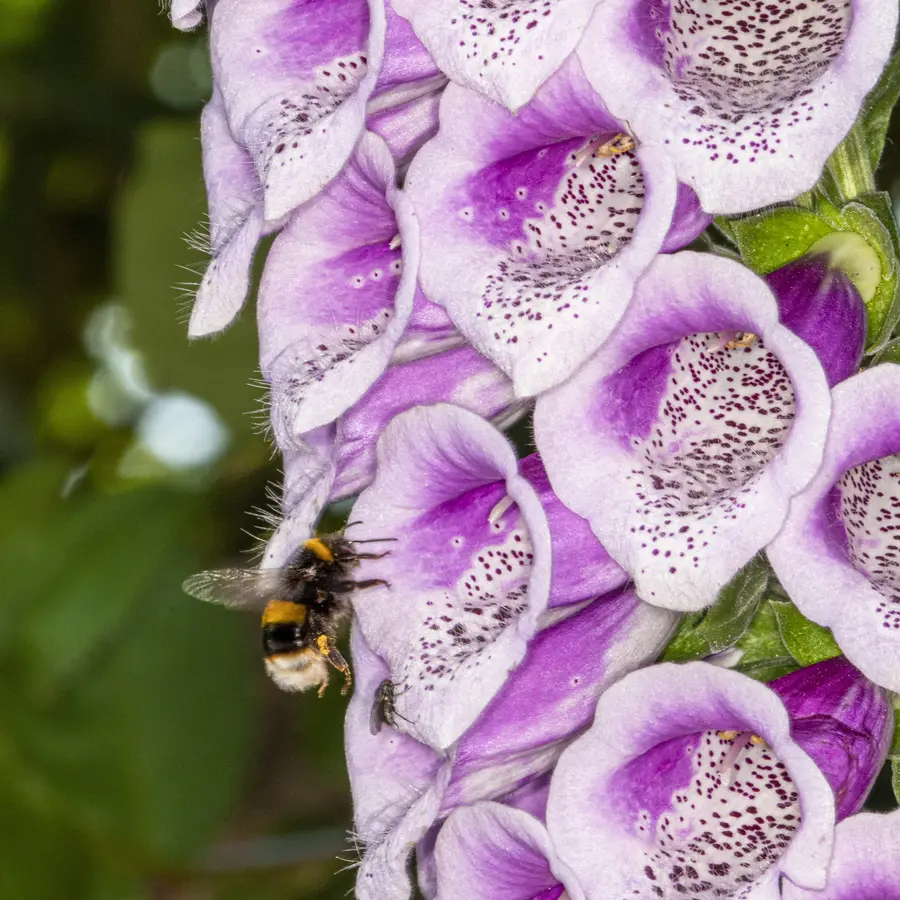
Foxglove is a bumble bee flower. The Woodland Trust explains that the bright flowers and dark spotted lip attract the bee, and the lower lip gives it a place to land before it climbs up the tube, dropping pollen from other foxgloves as it goes. Our guide to pollination syndromes explains how flower shape and color match particular pollinators.
“The species has evolved to be especially attractive to long-tongued bees such as the common carder bee.”
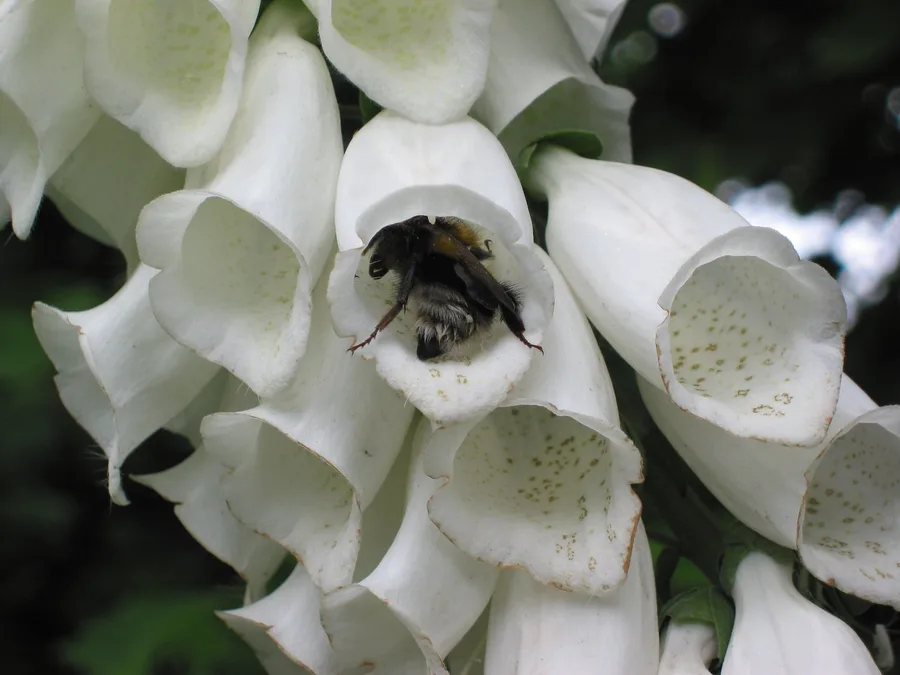
The best field study comes from the plant’s native range. Arthur Broadbent and Andrew Bourke recorded 1,682 insect visits to foxglove patches in North Yorkshire, England, and published the results in the Journal of Pollination Ecology in 2012. The garden bumble bee (Bombus hortorum), a long-tongued species, made 82% to 92% of all visits depending on habitat, and the common carder bee (B. pascuorum) made 3% to 17%. The authors concluded that foxglove reproduction appears to depend on insect pollination.
The way a spike flowers also matters. A 2021 study in Ecology and Evolution by Mackin and colleagues describes foxglove flowers opening in sequence from the bottom of the spike up. Each flower releases its pollen first and becomes receptive to pollen three to five days later, so a spike carries older, receptive flowers below and fresh, pollen-shedding flowers above. Where foxglove has been introduced in Central and South America, the authors note that hummingbirds are also important pollinators, but several bumble bee species remain the most frequent ones.
Which bees visit foxglove in the US
To see what visits foxglove here, we counted research-grade US iNaturalist observations that volunteers tagged as visiting a Digitalis flower. There were only 74, so treat them as a snapshot, not a survey. Bumble bees made up 39 (53%), other wild bees 24 (32%) and honey bees 3 (4%), plus 3 beetles, 2 hummingbirds, 1 fly, 1 butterfly or moth and 1 wasp. The most-recorded visitor was the two-spotted bumble bee (Bombus bimaculatus), with 18 records; next came the European wool carder bee (Anthidium manicatum), with 10. For help telling the bumble bees apart, see our bumble bee identification guide.
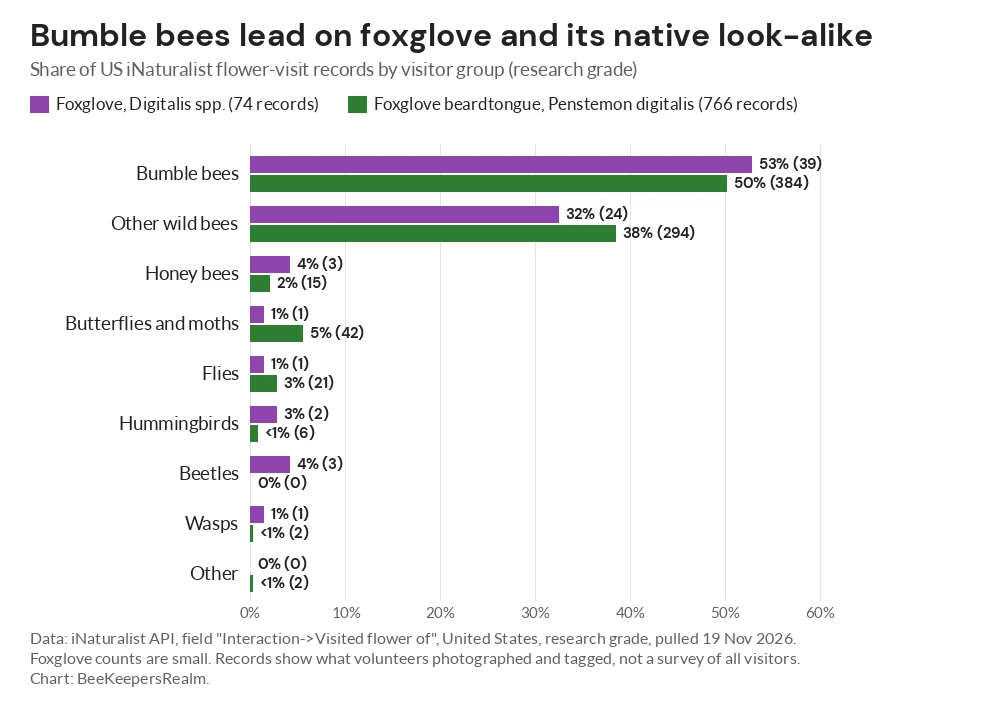
The comparison with native foxglove beardtongue is striking. Both draw mostly bumble bees, but the penstemon had 766 visit records against foxglove’s 74, from 56 visitor species against 14 on purple foxglove, even though purple foxglove itself has more US records (24,383 to 17,717). Part of that gap may come from who photographs what and where, so it is a hint, not proof.
Do honey bees use foxglove?
Rarely, in the records we have: 3 of 74 US visit records, against 39 for bumble bees. The flower’s shape favors long-tongued bumble bees, and none of the sources we reviewed treats foxglove as a honey plant. Beekeepers will get far more from the plants on our list of the best plants for honey production.
When Foxglove Blooms: The Biennial Life Cycle
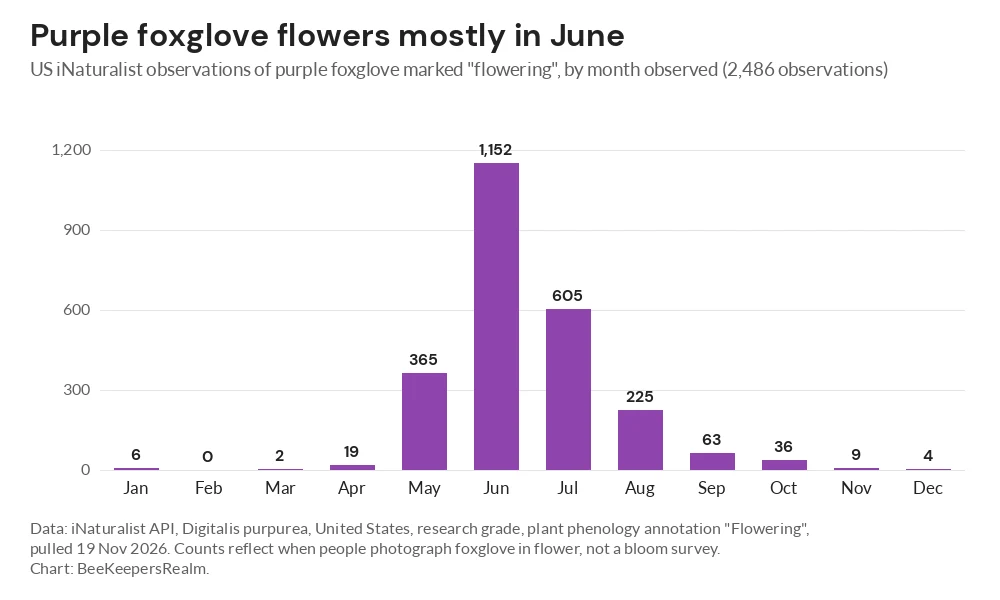
Purple foxglove is a June flower in most of the US. Of 2,486 research-grade US iNaturalist observations marked as flowering, 1,152 (46%) were made in June, and May through July held 85%. Each spike opens from the bottom up, so a plant stays in flower for a while, and scattered flowering records run into September and October.
The life cycle runs over two seasons:
- Year 1: the seedling grows into a low rosette of leaves and does not flower.
- Year 2: a tall flower spike rises from the center of the rosette, blooms, and sets seed.
- After seeding: the plant usually dies. Wikipedia describes it as monocarpic, meaning it flowers once and then dies, but it seeds so freely that new rosettes keep a patch going.
Some garden strains break the rule. NC State Extension notes that ‘Foxy’ blooms reliably from seed in its first year, at 2 to 3 feet.
Is Foxglove Poisonous?
Yes, to people and to pets. This section is educational, not medical or veterinary advice. If someone may have eaten foxglove, contact Poison Control; for an animal, call your veterinarian or an animal poison hotline.
All parts of the plant are poisonous if swallowed, and can be deadly, according to Poison Control (the National Capital Poison Center). The toxins are cardiac glycosides. NC State Extension rates the poison severity as high and lists nausea, vomiting, diarrhea, stomach pain, severe headache, a slow or irregular pulse, tremors, unusual color vision, convulsions, heart rhythm problems and death as possible effects.
“People who eat any part of the plant or make tea from the leaves are, in essence, taking an unregulated dose of heart medicine.”
Poison Control’s advice: do not make someone vomit. If you are sure foxglove was swallowed, go to the emergency room. If you are not sure, call 1-800-222-1222, which is staffed 24 hours a day.
Dogs, cats and horses: the ASPCA lists foxglove as toxic to all three, with signs that include heart arrhythmias, vomiting, diarrhea, weakness, heart failure and death. It directs owners to ASPCA Animal Poison Control at (888) 426-4435 or a local veterinarian.
Touching it: NC State Extension does not list foxglove as a cause of contact dermatitis. The Royal Horticultural Society’s profile of large yellow foxglove still advises wearing gloves when handling it, and Minnesota Wildflowers warns that Grecian foxglove can be harmful when handled extensively, as in hand pulling.
Look-alikes: comfrey and borage
Most adult poisonings involve leaves picked by mistake. Poison Control describes a man who picked about 12 young foxglove leaves he believed were borage and cooked them into a sauce; he and his wife both needed the digoxin antidote and spent two nights in the hospital. In Taiwan, Chun-Chi Lin and colleagues reported an outbreak in which nine people were poisoned by foxglove leaves after drinking a herbal tea believed to be comfrey (Journal of the Chinese Medical Association, 2010). Three developed significant heart toxicity, and all recovered. The authors note that comfrey leaves resemble foxglove leaves when the plant is not in bloom. Never brew tea or cook from a leaf you cannot identify with certainty, and do not grow comfrey or borage next to foxglove.
Is foxglove harmful to bees?
Bees visit foxglove freely, and none of the sources we reviewed reports harm to bees or poisonous foxglove honey. If you want to know which plants really do hurt bees, see our guide to plants toxic to bees.
From Foxglove to Digoxin: A Short History
English physician William Withering published An Account of the Foxglove, and Some of Its Medical Uses in 1785, describing 163 medical cases treated with foxglove preparations. He recognized that it reduced dropsy, the fluid swelling of heart failure, and slowed the heartbeat. Wikipedia notes that early foxglove medicine varied greatly in dosage and carried a real risk of poisoning from overdose.
Poison Control explains that the heart medicine digitalis is derived from foxglove, and that blood tests for the drug digoxin are used to detect foxglove poisoning. Modern digoxin is a measured, prescribed drug; Wikipedia’s account of the genus notes it is now obtained from Grecian foxglove, D. lanata. Garden foxglove is not a safe substitute in any form. Cardiac glycosides have a narrow therapeutic window, so a small change in dose can separate an ineffective dose from a fatal one, and there is no way to measure the dose in a homemade leaf or tea.
Is Foxglove Invasive in the US?
Foxglove is introduced and naturalized, and it is a recognized weed in parts of the West, but no federal list treats it as a major invader. The California Invasive Plant Council rates Digitalis purpurea “Limited,” below its Moderate and High categories. Its assessment describes foxglove as common in cool coastal forests, woodlands and scrub of the Pacific Northwest. In Washington, San Juan County’s 2026 noxious weed brochure lists it among its “Unregulated Plants of Concern.” A related species is treated more seriously: Grecian foxglove is an early-detection noxious weed in Minnesota, where it has spread through the St. Croix valley in Washington County since its discovery in 2000.
Where foxglove grows on its own shows up in iNaturalist. Research-grade observations exclude plants flagged as cultivated, so the counts below mostly reflect plants growing wild. Records came from every state except Wyoming, but three Pacific states dominate.
| State | Research-grade purple foxglove records | Share of US total (24,383) |
|---|---|---|
| Washington | 9,107 | 37.3% |
| Oregon | 5,392 | 22.1% |
| California | 4,338 | 17.8% |
| New York | 793 | 3.3% |
| Pennsylvania | 758 | 3.1% |
| Massachusetts | 640 | 2.6% |
| Alaska | 535 | 2.2% |
| North Carolina | 276 | 1.1% |
| Maine | 270 | 1.1% |
| Michigan | 224 | 0.9% |
Observation counts also track where people photograph plants, so read the table as a guide to where wild foxglove is commonly seen, not as a measure of acreage. For another popular non-native garden plant with a mixed invasive record, see our page on butterfly bush.
How to Grow Foxglove Safely
If you grow foxglove, plan where it goes first. These points follow NC State Extension’s plant profile unless noted.
- Placement: keep it out of play areas, away from pet runs and horse pastures, and out of vegetable and herb beds, as Poison Control advises.
- Light: full sun to part shade; it does best with afternoon shade.
- Soil and water: moist, well-drained, acidic soil rich in organic matter. Do not let it dry out, because drought stress cuts flowering.
- Hardiness: USDA zones 4 to 9.
- Sowing: because each plant flowers in its second year, sowing in two consecutive years gives you plants at both stages, so some flower every summer. ‘Foxy’ flowers in its first year from seed.
- Self-seeding: deadhead after flowering to avoid swarms of seedlings, but leave a few spikes if you want the patch to persist. In the Pacific Northwest, where it escapes into woods and clearings, deadheading is the responsible default.
- Pests: fungal diseases, aphids, Japanese beetles and mealybugs. Our guides to aphids and Japanese beetles cover bee-safe control.
- Wildlife: deer and rabbits tend to leave it alone, while bumble bees and hummingbirds visit the flowers.
Native Alternatives to Foxglove
For a tall, tubular, bee-friendly flower without the poison, the closest native match is foxglove beardtongue. The Lady Bird Johnson Wildflower Center lists it as native to the lower 48 states, from Maine to Michigan and South Dakota and south to Virginia, Alabama and east Texas. It grows 2 to 5 feet tall with white flowers from May to July, and the center notes purple lines in the throat “for bees.”
“Despite the specific epithet, this plant is not foxglove (Digitalis spp.) and lacks the toxicity associated with foxglove.”
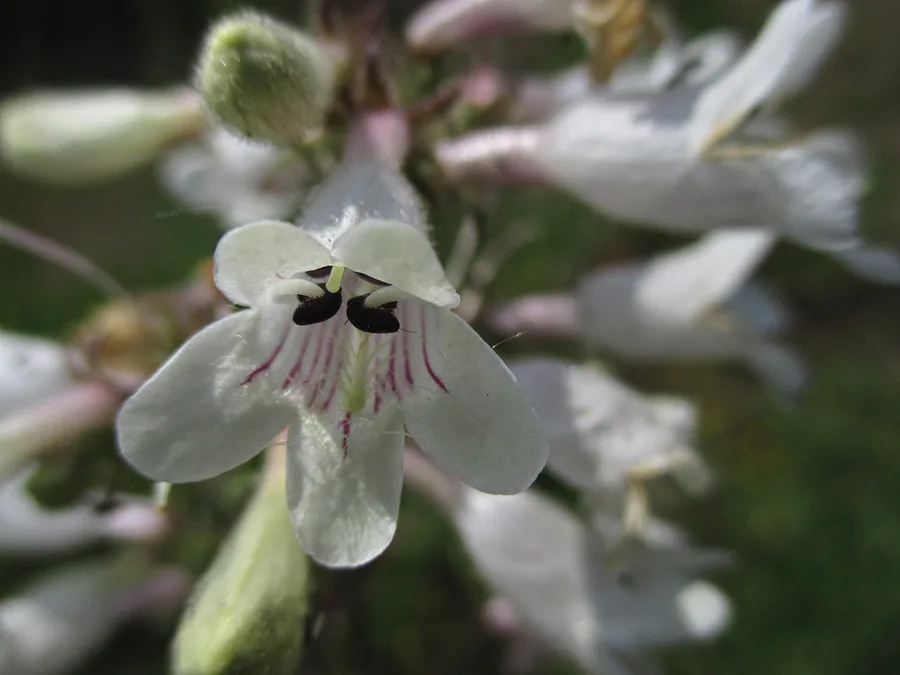
It also performs. In our iNaturalist pull it had 766 research-grade US flower-visit records: 384 bumble bees, 132 orange-tipped wood-digger and other Anthophora bees, 42 butterflies and moths, and 6 hummingbirds. Its flowering records peak in June (70%), so it fills the same slot as foxglove. NC State tags it as a plant for specialized bees and counts it as a native pollinator plant.
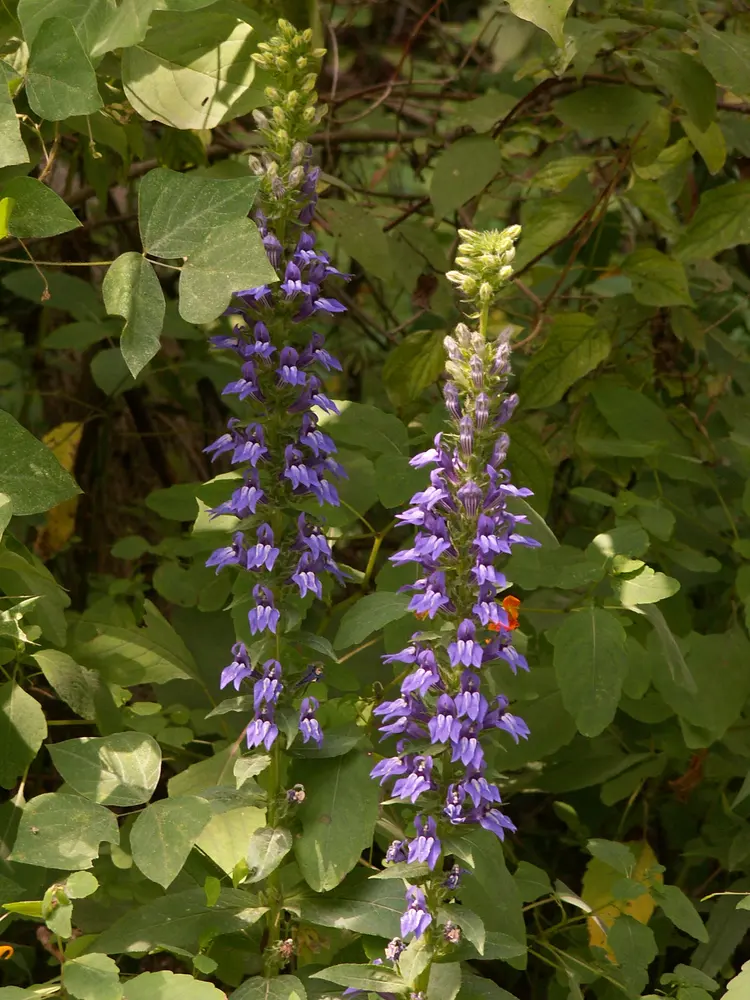
NC State lists two more native alternatives to foxglove: great blue lobelia (Lobelia siphilitica) and lupines (Lupinus). Choose a lupine native to your region, because San Juan County’s brochure lists non-native lupines among its plants of concern too. Other bumble bee favorites such as bee balm and native trumpet honeysuckle are worth a look, and our list of the best US native plants for pollinators has more options by region.
Frequently Asked Questions
Is foxglove a perennial or an annual?
Neither, strictly. Purple foxglove is a biennial: leaves the first year, flowers the second, then it usually dies. Some plants behave as short-lived perennials, and large yellow foxglove is a true perennial.
Do foxgloves come back every year?
The same plant usually does not, but a patch often does, because foxglove produces plenty of seed. Leave a few spikes to set seed, or sow in two consecutive years.
Is foxglove poisonous to touch?
The main danger is swallowing it. NC State Extension does not list it as a skin irritant, but the Royal Horticultural Society advises gloves when handling foxglove, and washing your hands afterward is a sensible habit.
Does foxglove like sun or shade?
It grows in full sun or part shade, and NC State Extension says it does best with afternoon shade. In either spot, keep the soil moist, because drought stress cuts flowering.
Is foxglove deer resistant?
Yes. NC State Extension lists it as resistant to deer and rabbits; it contains a chemical that deer avoid.
Does foxglove attract hummingbirds?
Yes, though bees are its main visitors. NC State notes that the nectar attracts bumble bees and hummingbirds, and our iNaturalist count included Anna’s and ruby-throated hummingbirds.
Is foxglove beardtongue poisonous?
No. Foxglove beardtongue (Penstemon digitalis) is a native penstemon, not a true foxglove, and NC State says it lacks foxglove’s toxicity.
Is digoxin made from foxglove?
Digoxin was first derived from foxglove. Today it is a regulated prescription drug made from Grecian foxglove (Digitalis lanata), and garden foxglove should never be used to make medicine at home.
The Bottom Line
Foxglove is a bumble bee magnet and a genuinely poisonous plant. If you keep it, give it a spot away from children, pets and food plants, and deadhead it where it could spread into wild land. If you want the same tall June spikes without the risk, plant native foxglove beardtongue. For more bee plants, browse our pollinator gardening and native bee guides.
Image credits: featured photo of foxglove spikes by Matthijs van den Berg, via Wikimedia Commons, CC BY-SA 4.0, cropped. Other photos are credited in their captions. Charts by BeeKeepersRealm from iNaturalist data.