Reviewed by Thomas B. · How we review
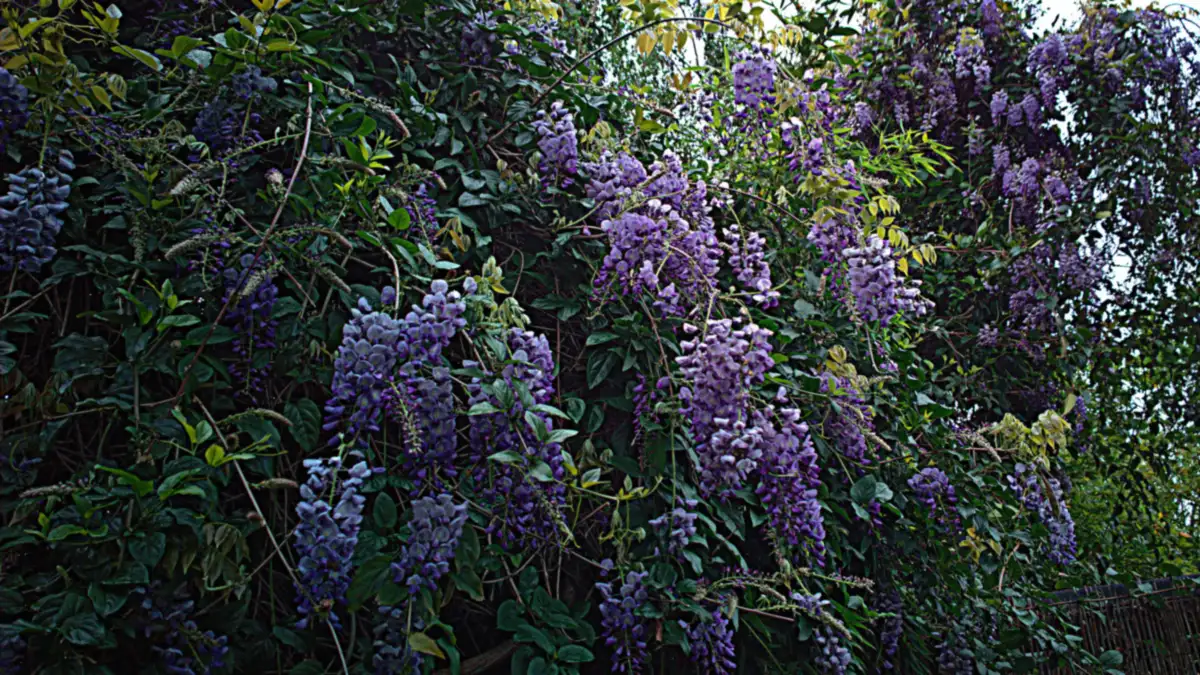
Wisteria is a woody, twining vine in the pea family (Fabaceae) grown for its hanging clusters of fragrant purple, blue or white flowers in spring. US gardeners meet four kinds: two natives, American wisteria (Wisteria frutescens) and Kentucky wisteria (W. macrostachya), and two Asian imports, Chinese (W. sinensis) and Japanese wisteria (W. floribunda), which many eastern states list as invasive. Large carpenter bees and bumble bees are its most recorded visitors. Every part is toxic if eaten, the seeds and pods most of all.
The bee and bloom figures below are our own counts of US iNaturalist observations, pulled November 19, 2026.
Key Takeaways
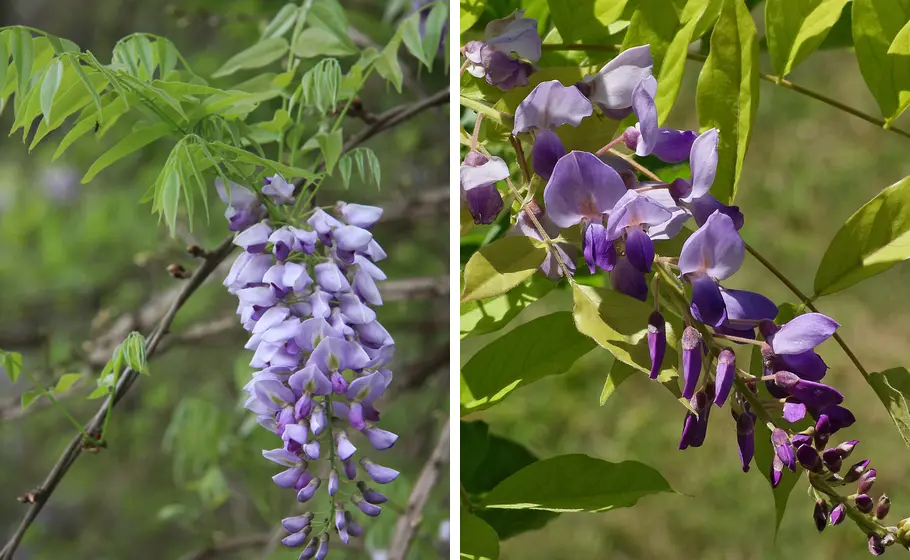
- Native wisterias flower after their leaves open and have short clusters and smooth pods. Asian wisterias flower before or as the leaves open and have longer clusters and velvety pods.
- Chinese wisteria appears on invasive-plant lists or laws in 18 states and Japanese wisteria in 14, according to the EDDMapS database. Most wild “Chinese” wisteria in the Southeast is actually a Chinese-Japanese hybrid.
- In 95 US iNaturalist records of insects on wisteria flowers, large carpenter bees dominated on Asian wisteria and bumble bees on American wisteria. None showed a honey bee.
- The ASPCA lists wisteria as toxic to dogs, cats and horses. Poison Control calls the seeds and pods the most toxic parts.
- No blooms usually means a young plant, too much shade or fertilizer, frost-damaged buds or improper pruning.
- Wisteria is heavy and can pry gaps apart, so keep it off houses.
Table of Contents
- What Is Wisteria?
- How to Tell the Four US Wisterias Apart
- Is Wisteria Invasive?
- Wisteria and Bees
- Is Wisteria Poisonous?
- Growing Wisteria: Bloom Time, Support and Pruning
- Frequently Asked Questions
- The Bottom Line
What Is Wisteria?
Wisteria is a small genus of deciduous climbing vines. Plants of the World Online accepts four species: American wisteria from the eastern US, Chinese wisteria, Japanese wisteria and silky wisteria (W. brachybotrys) from Japan. NC State Extension notes that the genus honors Caspar Wistar (1761–1818), a physician and anatomist at the University of Pennsylvania.
- Kentucky wisteria is sold as W. macrostachya, but the Missouri Botanical Garden notes that some taxonomists treat it as a variety of American wisteria.
- “Wisteria tree” is a vine trained onto a single trunk, which NC State says takes significant pruning.
- A legume. Like clover and honey locust, wisteria belongs to the pea family and bears bean-like pods. The Wisconsin DNR notes that its roots host nitrogen-fixing Rhizobium bacteria.
How to Tell the Four US Wisterias Apart
Check three things in spring: whether the flowers open before or after the leaves, how long the clusters (racemes) are, and whether the pods are velvety or smooth. MBG is the Missouri Botanical Garden; LBJWC is the Lady Bird Johnson Wildflower Center.
| Species | Native range | Invasive status in the US | Bloom time | Raceme length | Blooms before/with leaves | Pods | Source |
|---|---|---|---|---|---|---|---|
| American wisteria (W. frutescens) | Eastern US, Virginia to Illinois, south to Florida and Texas | Native; not invasive | April to June | To about 6 in. | After the leaves emerge | Smooth, narrow, to 5 in. | NC State; LBJWC |
| Kentucky wisteria (W. macrostachya) | South-central US, Louisiana and Texas north to Kentucky, Illinois, Missouri and Oklahoma | Native; not invasive | June; ‘Blue Moon’ may rebloom | 6 to 12 in. | After the leaves (as for the North American species) | Ripen in autumn | MBG; NC State |
| Chinese wisteria (W. sinensis) | China | Invasive; on state lists or laws in 18 states | Spring | 6 to 12 in.; flowers open almost all at once | Before the leaves fully emerge | Velvety, 4 to 6 in. | NC State; EDDMapS |
| Japanese wisteria (W. floribunda) | Japan | Invasive; on state lists or laws in 14 states | Spring | 12 to 18 in.; some cultivars 2 to 4 ft; opens base to tip | As the leaves emerge | Velvety, 2.5 to 6 in. | NC State; EDDMapS |
Twining direction is a poor test
NC State Extension says Japanese wisteria twines clockwise while Chinese and American wisteria twine counterclockwise, and EDDMapS describes Chinese wisteria as counterclockwise “when looking down on the vine.” The USDA Forest Service’s Fire Effects Information System (FEIS) review states the reverse. Because the answer depends on viewpoint and the sources disagree, rely on bloom timing and pods instead.
Most wild “Chinese” wisteria is a hybrid
The Wisconsin DNR reports that two studies in the southeastern US found 82 to 96% of wisteria collections were hybrids of Chinese and Japanese wisteria (W. × formosa). A plant that mixes traits from both columns is probably one of these hybrids.
Backyard Ecology’s video compares them side by side.
What the video covers: According to its chapter list, the video introduces American, Chinese and Japanese wisteria, their ranges and the impact of the invasive species, then compares their seed pods, flower clusters, bloom times and twining direction, and points to where to find information on other invasive vines.
Is Wisteria Invasive?
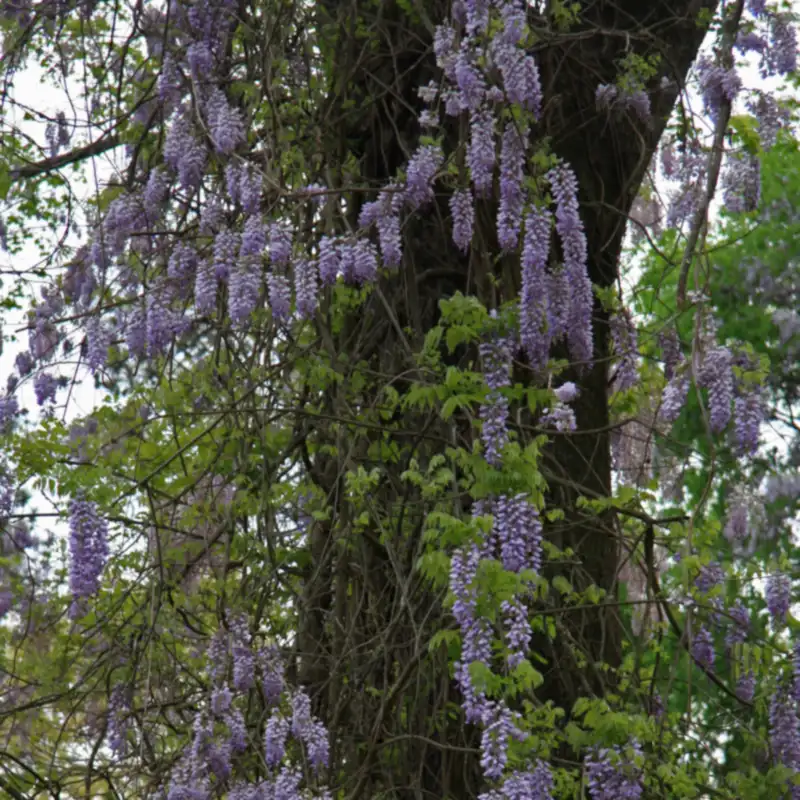
Chinese and Japanese wisteria are. American and Kentucky wisteria are not. According to FEIS, Chinese wisteria arrived in 1816 and Japanese wisteria around 1830, and most wild infestations are escapes from porches, gardens and parks.
“It has been repeatedly noted that infestations of wisteria are so dense that they strangle or shade out existing vegetation and displace native species.”
- How it spreads: mainly by vines and runners (stolons) that root as they grow. Its heavy seeds are carried long distances by water along streams (FEIS).
- What it does: vines have been seen 65 feet up in the canopy. The Wisconsin DNR says they can topple large trees, creating canopy gaps that further favor infestations.
- Where it is listed: EDDMapS shows Chinese wisteria on lists or laws in 18 states, among them Florida (Category II), Georgia (Category 1), Kentucky (moderate threat) and Pennsylvania. Wisconsin classifies both Asian species as prohibited. Rutgers reports that New Jersey’s Invasive Species Management Act, passed January 8, 2026, lists both as prohibited plants, banning their sale and propagation.
What to plant instead
NC State lists these native alternatives for Asian wisteria:
- American wisteria, or Kentucky wisteria in colder areas: MBG rates it hardy in zones 3 to 9.
- Coral honeysuckle (Lonicera sempervirens), a red-flowered vine that Rutgers also recommends. See our native vs invasive honeysuckle guide.
- Crossvine (Bignonia capreolata), Carolina jessamine (Gelsemium sempervirens) and American groundnut (Apios americana).
Note that American wisteria is native to the Southeast; Rutgers points out that it is not native to New Jersey. The same “pretty but invasive” trade-off applies to butterfly bush, and our list of native plants for pollinators has more options.
“The American wisteria (Wisteria frutescens) is much less aggressive and requires less pruning and poses no risk to natural areas.”
Wisteria and Bees
Yes, bees use wisteria, but mostly big ones. We counted every US iNaturalist observation where a volunteer tagged an insect as “Visited flower of” wisteria: 95 records in all, 29 on American wisteria and 66 on Chinese, Japanese or wisteria not named to species.
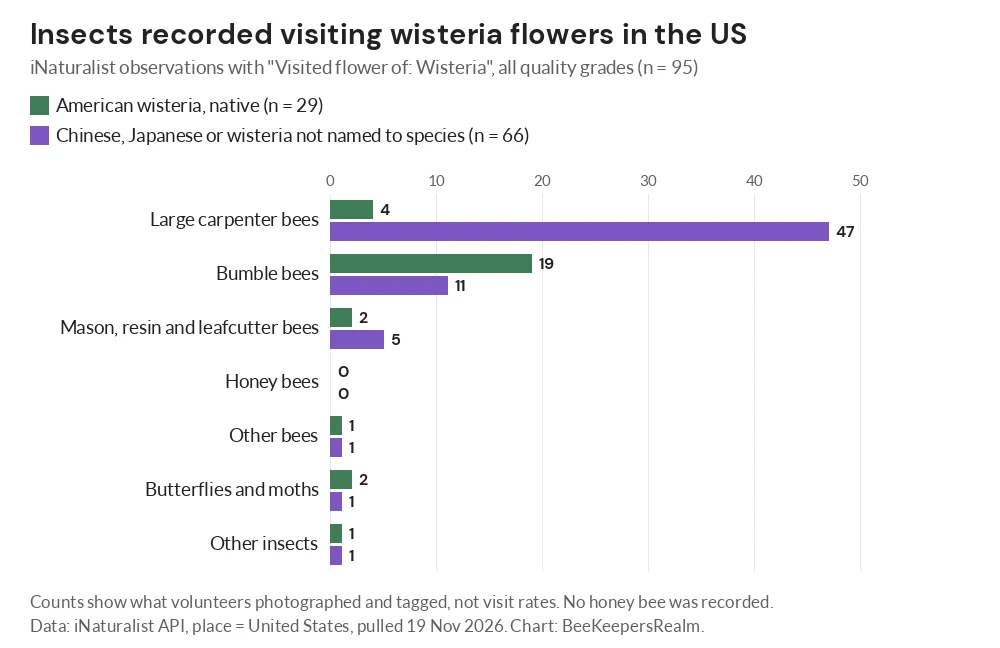
- Asian and unnamed wisteria: 47 of 66 records were large carpenter bees, 37 of them the eastern carpenter bee (Xylocopa virginica). Bumble bees made up 11.
- American wisteria: 19 of 29 records were bumble bees, 13 of them the black-and-gold bumble bee (Bombus auricomus). Carpenter bees made up 4.
- Others: 7 mason, resin and leafcutter bees, 2 other bees, 3 butterflies (including a monarch), a paper wasp and a katydid.
- No honey bees in any record.
These counts are small and show what people photographed, not visit rates, so they cannot prove that honey bees ignore wisteria. They do fit the USDA Forest Service’s point that carpenter bees and bumble bee queens are the largest native bees in the US. FEIS also notes that hummingbirds have been seen visiting Chinese wisteria, and NC State lists American wisteria as a caterpillar host for the zarucco duskywing, long-tailed skipper and marine blue butterflies.
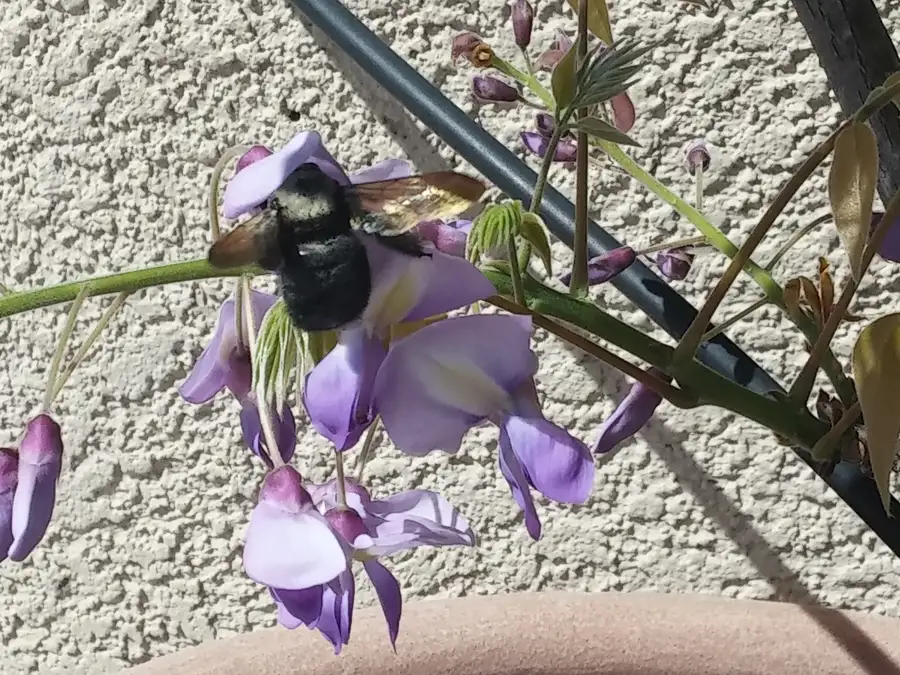
Do carpenter bees rob wisteria nectar?
The Forest Service explains that on salvias, penstemons and other long, tubular flowers, carpenter bees often cut a slit at the base and take the nectar without pollinating. We found no published study documenting nectar robbing on wisteria, so treat claims that carpenter bees “rob” wisteria as unconfirmed.
Will carpenter bees damage my pergola?
They do not harm the vine itself, but the eastern carpenter bee “occasionally” nests in fence posts or structural timbers, the Forest Service says. If you see round holes in an arbor, see our guides to carpenter bee identification and carpenter bee holes.
Is there wisteria honey?
We found no US extension, USDA or honey-industry source describing wisteria honey as a recognized varietal. If you want to feed honey bees, our list of plants for honey production is a better guide.
Is Wisteria Poisonous?
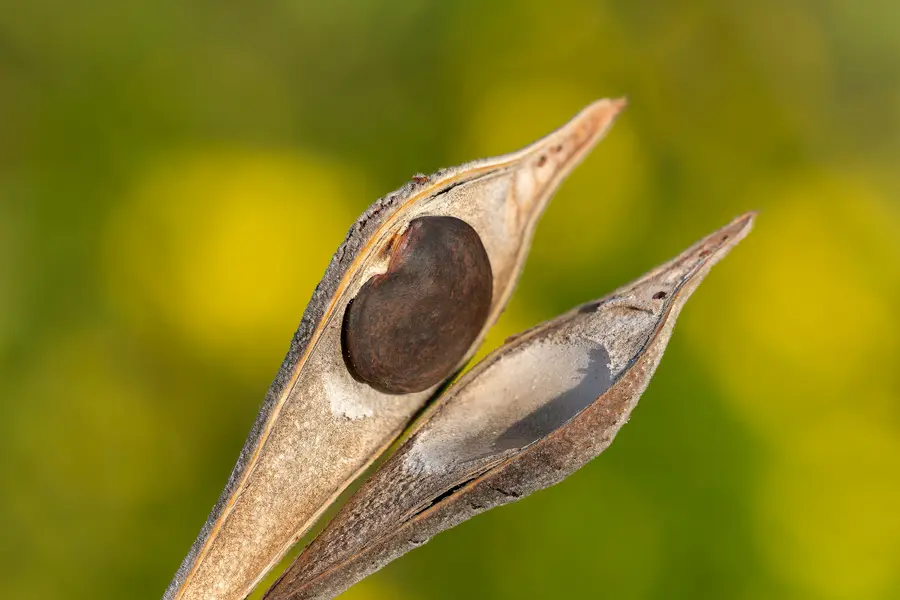
Yes. Poison Control (the National Capital Poison Center) says wisteria seed pods and seeds are the most toxic parts, but all parts contain lectin and wisterin, which can cause a burning mouth, stomach pain, vomiting and diarrhea lasting up to 2 days. In one of its cases, 13-year-old twins who ate wisteria pods, flowers and seeds in a contest were admitted to a hospital and recovered about a day after the exposure.
- Pets and horses: the ASPCA lists wisteria as toxic to dogs, cats and horses, with vomiting (sometimes with blood), diarrhea and depression.
- Native species too: NC State warns that eating one or two American wisteria pods can cause nausea, vomiting, abdominal pain and diarrhea.
- Who to call: Poison Control at 1-800-222-1222, or the ASPCA Animal Poison Control Center at (888) 426-4435 (a fee may apply).
This is general educational information, not medical or veterinary advice. Poison Control’s own tip: teach children that no part of a plant should be eaten.
Growing Wisteria: Bloom Time, Support and Pruning
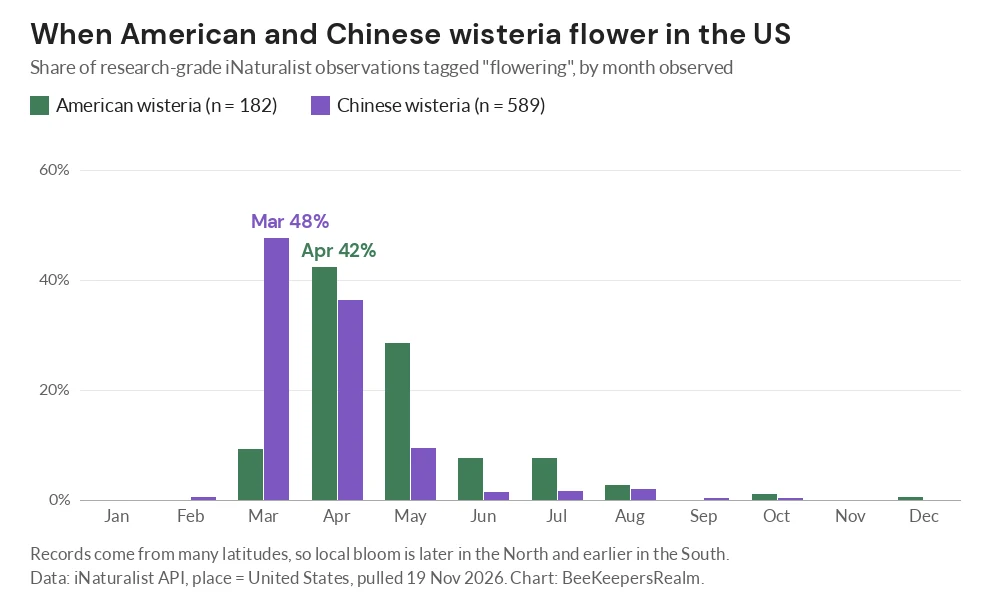
Most US wisteria flowers in spring. In our iNaturalist data, flowering Chinese wisteria peaked in March (48% of records) and American wisteria in April (42%), about a month later. Kentucky wisteria blooms in June, according to MBG.
Sun and support
Plant wisteria in full sun for the best flowering. Give it a strong arbor or pergola, because mature Asian vines become heavy enough to strain or collapse a weak structure.
“Wisteria can grow into small spaces and pry them apart as it grows, so allowing it to climb your home is not advisable.”
NC State adds that American wisteria is less damaging to buildings than the Asian species.
Why is my wisteria not blooming?
- Too young: vines may flower in their second or third year after planting, sometimes later. Seed-grown plants can take many years, so NC State suggests buying a plant already in flower.
- Too much shade, or too much fertilizer, especially nitrogen.
- Frost damage to flower buds in winter. NC State also suggests shelter from cold winds and early morning sun on frosty mornings.
- Improper pruning. See the schedule below.
How and when to prune wisteria
NC State recommends pruning Asian wisteria twice a year:
- Midsummer, after flowering: cut long, whippy shoots back to five or six leaves.
- January or February: shorten those same shoots to two or three buds, remove dead wood, and cut back any whippy shoots you missed.
For American wisteria, NC State advises doing any drastic pruning in spring, right after flowering. For Kentucky wisteria, MBG recommends regular pruning after the summer bloom and structural pruning in winter. Watch for Japanese beetles, which NC State lists among wisteria’s insect pests along with aphids, scale and mealybugs.
Frequently Asked Questions
Is wisteria a tree or a vine?
A woody vine. “Wisteria trees” are vines pruned onto a single trunk.
Is wisteria poisonous to dogs?
Yes. The ASPCA lists it as toxic to dogs, cats and horses. If your dog eats any part, call your vet or the ASPCA Animal Poison Control Center.
When does wisteria bloom?
Asian wisteria blooms in early spring, before or as the leaves open. American wisteria follows a few weeks later, and Kentucky wisteria blooms in June.
How long does it take wisteria to bloom?
NC State says American wisteria vines may flower in their second or third year. Seed-grown plants can take many years, which is why most cultivars are sold grafted.
Is wisteria evergreen?
No. All four US wisterias are deciduous and drop their leaves in fall.
Does wisteria damage your house?
It can. NC State says it can damage gutters, shutters and awnings, so do not let it climb your home.
How fast does wisteria grow?
Fast. NC State rates American, Chinese and Japanese wisteria as rapid growers. Vines can live for more than 100 years, according to the FEIS review.
Can wisteria grow in shade?
Partly. NC State lists partial shade as a possible site, but says American wisteria needs full sun for the best flowering and cannot grow in full shade. Rutgers adds that invasive wisteria only flowers and fruits when it can climb trees or a trellis.
The Bottom Line
If you love wisteria and want to help bees, plant American or Kentucky wisteria on a sturdy arbor away from the house, and remove the pods where children and pets play. If an Asian wisteria is already climbing your trees, treat it as the invasive vine it is. For more bee-friendly ideas, browse our pollinator gardening and native bee guides.
Image credits: featured photo (Chinese wisteria, Berkeley, California) by John Rusk, via Wikimedia Commons, CC BY 2.0, cropped. Other photos are credited in their captions. Charts by BeeKeepersRealm from iNaturalist data.