Reviewed by Sofia T. · How we review
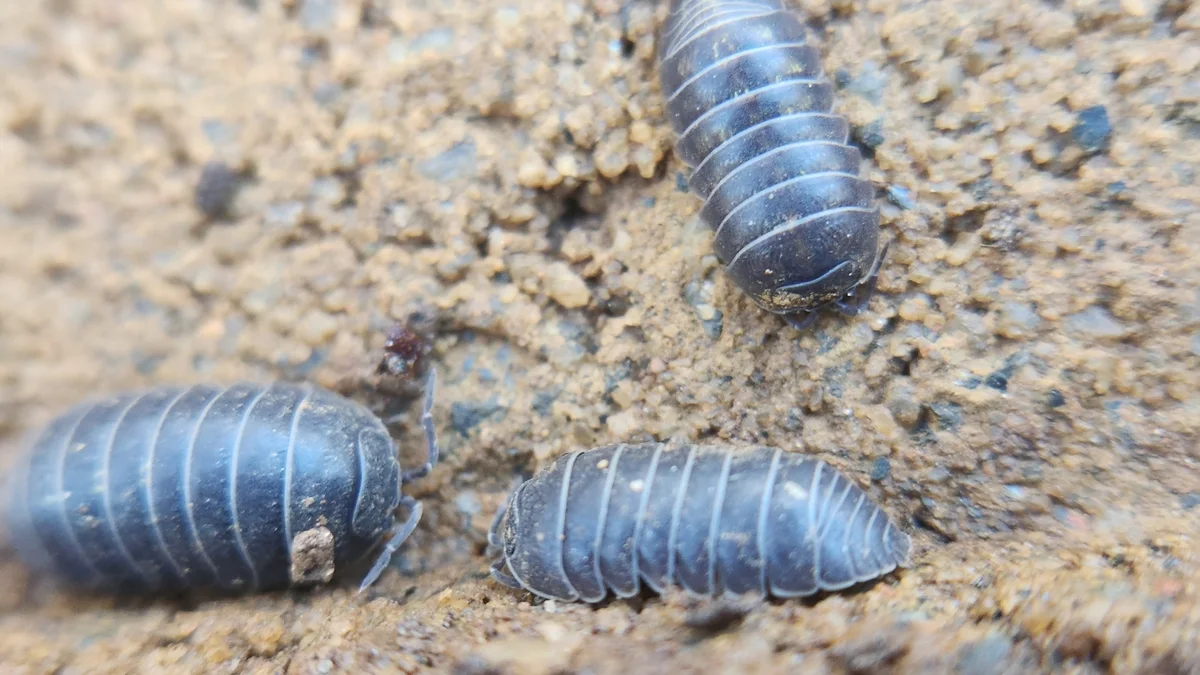
A roly poly, also called a pill bug, is a small, gray, armored land crustacean that rolls into a tight ball when disturbed. The one in most American yards is the common pill bug (Armadillidium vulgare), a woodlouse with seven pairs of legs that breathes through gill-like structures and needs damp shelter to survive. Roly polies do not bite or sting and are harmless to people and pets. They mostly eat decaying leaves and mulch, and only occasionally damage seedlings or soft fruit.
Below: how to tell a roly poly from a sow bug, its life cycle and diet, why it dies indoors, and bee-safe control, plus our count of 202,051 US iNaturalist records showing that which one you find depends on where you live.
Key Takeaways
- Roly polies are crustaceans (isopods), not insects. They are harmless to people and pets, and the University of Kentucky says they will not bite or sting.
- Only pill bugs roll into a ball. Sow bugs look similar but stay flat and have two tail-like points (uropods) at the rear.
- In our iNaturalist count, the common pill bug makes up 47.0% of US woodlouse records, but its share runs from 92.3% in Texas to 6.3% in Maine.
- Roly polies indoors are a moisture sign. Texas A&M says they rarely survive more than a day or two inside, so a broom or vacuum is enough.
- Control means drying things out: less mulch against the house, morning watering, sealed gaps. Skip broad-spectrum sprays near plants bees visit.
Table of Contents
- What a Roly Poly Is, and Why It Is Not an Insect
- How to Identify a Roly Poly
- Pill Bug vs Sow Bug
- Where Americans Find Roly Polies: Our iNaturalist Count
- Roly Poly Life Cycle and Lifespan
- Do Roly Polies Bite? Are They Harmful?
- What Roly Polies Eat and When They Damage Plants
- Why Roly Polies Come Inside and Die There
- How to Get Rid of Roly Polies Without Harming Bees
- Roly Polies in a Pollinator Garden
- Keeping Roly Polies as Pets
- Frequently Asked Questions
What a Roly Poly Is, and Why It Is Not an Insect
Roly polies belong to the isopods, the crustacean order that also includes many marine species. UC IPM’s pest note on pillbugs and sowbugs calls them “soil-dwelling crustaceans” that are not insects or true bugs. Clemson’s Home & Garden Information Center adds that they are closer kin to lobsters and shrimp and breathe with gill-like structures, so they need moist conditions. A honey bee has six legs, as our page on why a bee is an insect but not a bug explains; an adult roly poly has 14.
The common pill bug is not native to North America. The Animal Diversity Web (University of Michigan) says it comes from the edge of the Mediterranean and has been introduced to nearly every land mass.
Roly poly, pill bug, potato bug, doodlebug: one animal, many names
Wikipedia lists pill bug, pill woodlouse, roly-poly, potato bug, slater, doodle bug and carpenter as names for Armadillidium vulgare. “Woodlouse” covers all land isopods, sow bugs included. Careful with “potato bug”: the Colorado potato beetle and the Jerusalem cricket share that name, and both are insects.
What the video covers: KQED’s Deep Look follows a female roly poly as her eggs develop in a fluid-filled pouch called the marsupium, which works like a small private ocean because the eggs would dry out in open air. After 3 to 4 weeks the young hatch, stay in the pouch for about another week, then wriggle out as pale miniature adults that feed on rotting leaves and wood. (Summarized from KQED’s companion article, published May 12, 2026.)
How to Identify a Roly Poly
- Size: about 1/3 to 3/4 inch long as adults, according to UC IPM; Clemson gives 1/4 to 5/8 inch.
- Shape: oval, with a high, domed back and a flat underside.
- Color: slate gray to dark brown. UC IPM notes that a recently molted roly poly can look blue or purplish.
- Body: seven overlapping armored plates over a small head and tail section, with seven pairs of legs and two pairs of antennae, the second pair so small it may not be visible (University of Kentucky).
- Young: pale yellow to whitish and about 1/12 inch long when they leave the mother’s pouch (UC IPM).
- Behavior: curls into a ball when touched, which a sow bug cannot do.
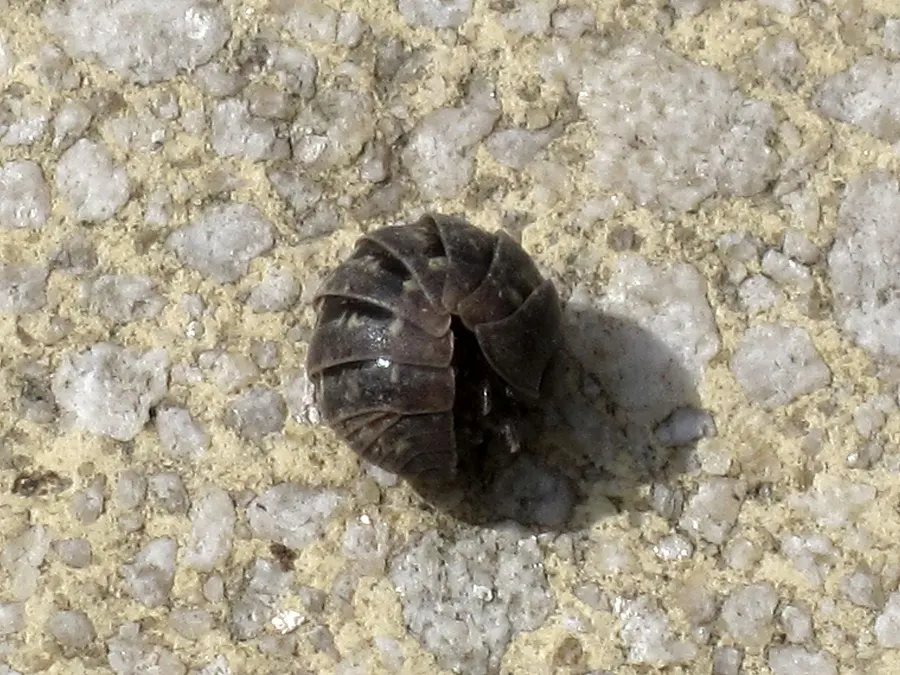
“Pill bug’s rolling into a ball is not only for defense, but to retain water.”
Pill Bug vs Sow Bug
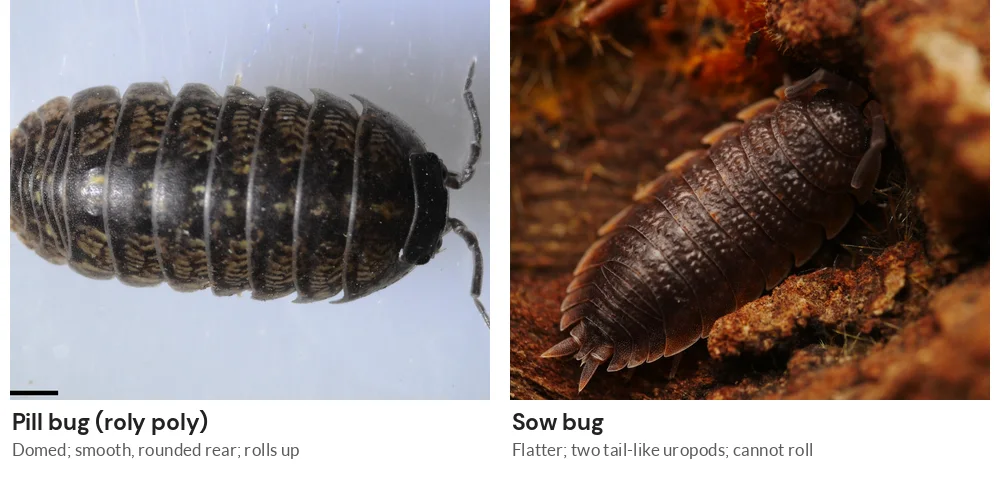
Many people call every gray woodlouse a roly poly; Southern Living notes that pill bugs and sow bugs are both commonly called roly poly bugs. Extension services separate them, and the difference tells you what you have. UC IPM says sow bugs cannot roll into a ball and “commonly scurry away when disturbed.” Look at the rear end: pill bugs are smooth and rounded, sow bugs have two prongs sticking out.
| Feature | Pill bug (roly poly) | Sow bug | Source |
|---|---|---|---|
| Family | Armadillidiidae | Porcellionidae (and other woodlouse families) | UC IPM |
| Rolls into a ball | Yes, when disturbed | No; runs away | UC IPM, Clemson |
| Rear end | Smooth and rounded, no visible appendages | Two tail-like uropods | UC IPM, Univ. of Kentucky |
| Back | High and domed | Flatter | UC IPM |
| Most-recorded US species | Common pill bug, Armadillidium vulgare (94,969 records) | Common rough woodlouse, Porcellio scaber (18,038 records) | Our iNaturalist count |
| Harm to people and pets | None; no bite or sting | None; no bite or sting | Clemson, Univ. of Kentucky |
| Food and plant damage | Same for both: decaying plant matter and fungi; occasionally seedlings, roots and fruit touching damp soil | UC IPM, Clemson | |
Not every ball-roller is the common pill bug. The nosy pill woodlouse (Armadillidium nasatum) is a second pill bug species that is common in the US. Pill millipedes also roll into balls but are unrelated millipedes with many more legs, and the larger millipedes in American yards curl into a flat coil instead; our millipede guide shows the difference.
Where Americans Find Roly Polies: Our iNaturalist Count
None of the top-ranking roly poly pages say how common pill bugs are compared with sow bugs, so we counted. On November 22, 2026 we pulled every research-grade US woodlouse observation (suborder Oniscidea) from the iNaturalist API, where “research grade” means at least two people agreed on the identification: 202,051 records of 95 species.
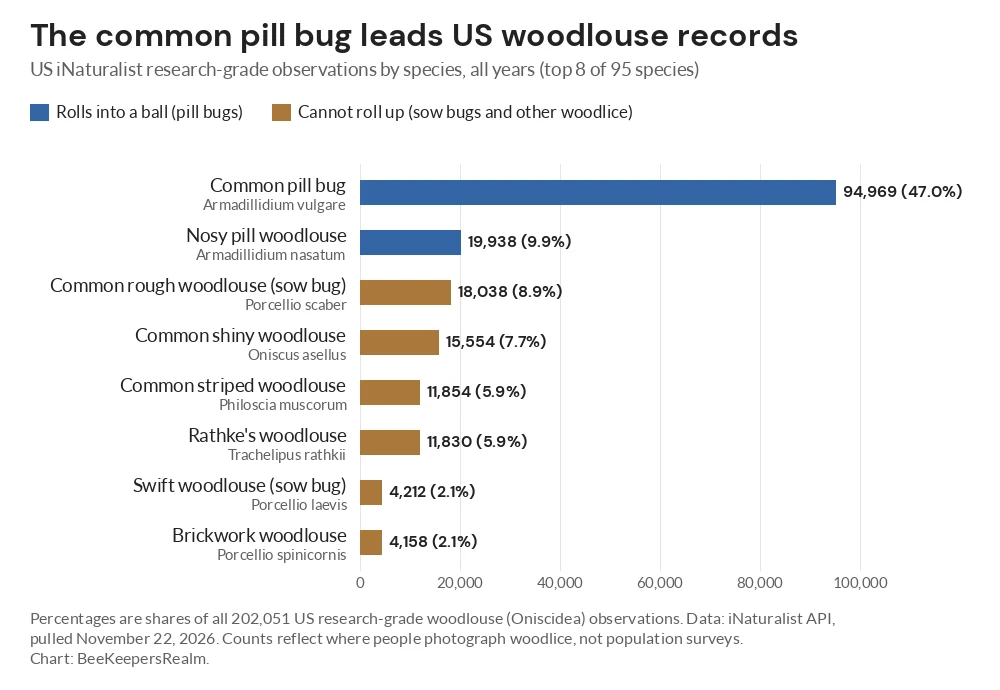
The common pill bug alone accounts for 94,969 records, or 47.0%. Add the nosy pill woodlouse and the pill-bug family reaches 56.9%. The rest are non-rolling woodlice, led by the common rough woodlouse, a sow bug (8.9%), and the common shiny woodlouse (7.7%).
The state-by-state count is where it gets interesting (selected states shown):
| State | Common pill bug records | All woodlouse records | Pill bug share |
|---|---|---|---|
| Texas | 20,530 | 22,238 | 92.3% |
| Utah | 1,825 | 2,079 | 87.8% |
| Oklahoma | 1,538 | 1,829 | 84.1% |
| Colorado | 2,472 | 3,045 | 81.2% |
| California | 26,871 | 41,772 | 64.3% |
| Washington | 3,151 | 7,517 | 41.9% |
| Florida | 1,190 | 4,377 | 27.2% |
| New York | 3,340 | 12,818 | 26.1% |
| Pennsylvania | 1,924 | 8,718 | 22.1% |
| Massachusetts | 1,286 | 7,899 | 16.3% |
| Maine | 117 | 1,863 | 6.3% |
Across the Southern Plains, the Southwest and the Rockies, the gray ball under a flowerpot is almost always a true roly poly. In the Northeast, the Upper Midwest and the Pacific Northwest, most woodlice people photograph are sow bugs and other non-rollers; Minnesota (6.8%) and New Hampshire (7.9%) look like Maine. These are uploaded photos, not population surveys, but a spread from 92% to 6% is far too wide to be chance.
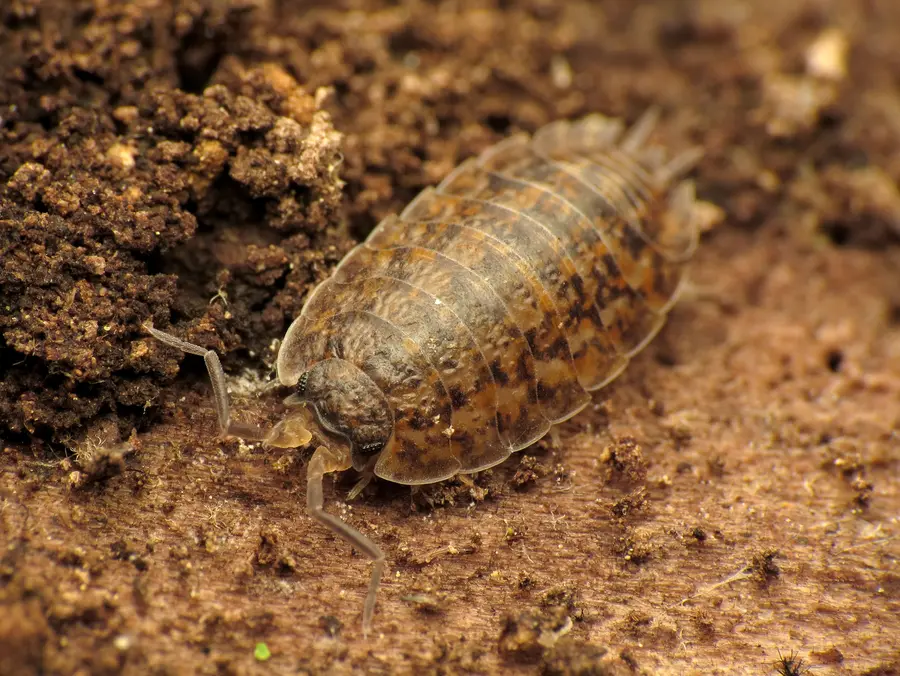
When roly polies are most active
Clemson says pill bugs and sow bugs are nocturnal and hide by day under rocks, boards, mulch and leaf litter. By month, our count peaks in spring.
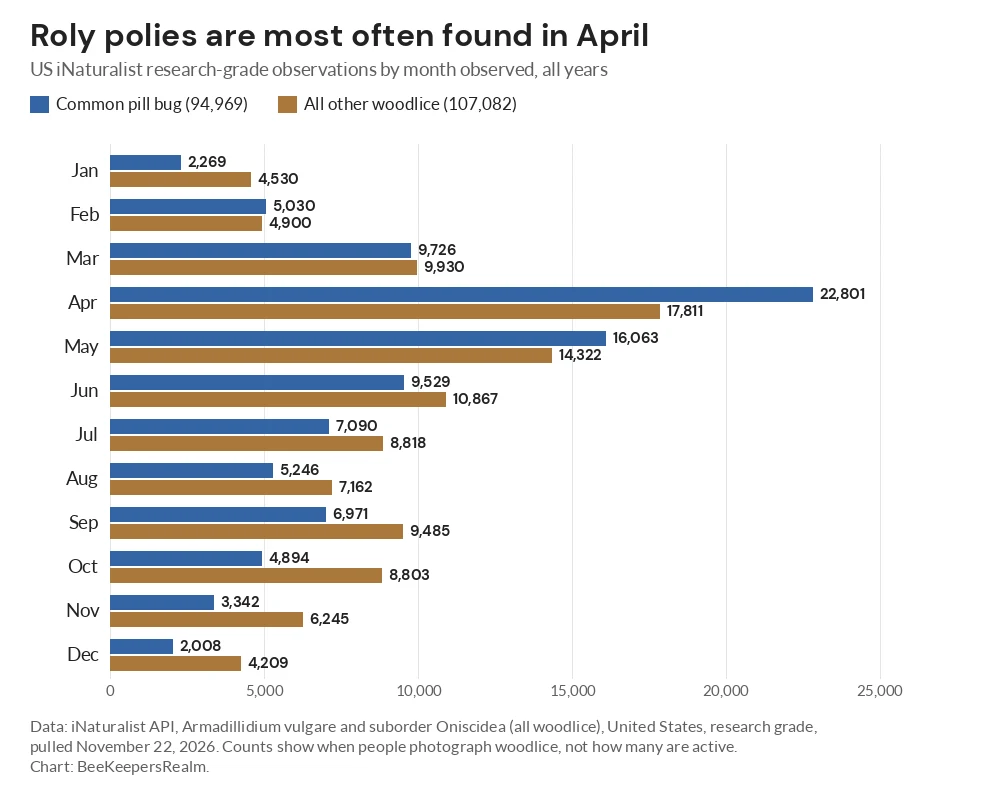
April holds 24.0% of common pill bug records and March to May 51.2%; December and January hold just 4.5%. Other woodlice also peak in April, less sharply (16.6%).
Roly Poly Life Cycle and Lifespan
Female roly polies carry their eggs in a brood pouch on the underside. UC IPM says the eggs hatch about a month after they are produced and the young stay in the pouch for about two more weeks, then molt every one to two weeks for several months as they grow.
| Stage or trait | Figure | Source |
|---|---|---|
| Eggs to hatching | About 1 month in the brood pouch | UC IPM |
| Young in the pouch after hatching | About 2 weeks | UC IPM |
| Hatchling to adult | About 2 to 3 months | Univ. of Kentucky |
| Broods | 1 to 2 a year, about two dozen young each | Univ. of Kentucky |
| Broods in Texas | 30 to 80 young per brood; 2 to 3 generations a year | Texas A&M AgriLife |
| Lifespan | About 3 years | Univ. of Kentucky |
| Lifespan | Adults 2 to 5 years | UC IPM |
| Lifespan, common pill bug | Average 1.5 years; some up to a few years | Animal Diversity Web |
The lifespans differ partly because UC IPM’s figure describes adults, while the Animal Diversity Web gives an average.
Do Roly Polies Bite? Are They Harmful?
No. Clemson says pill bugs and sow bugs “do not bite and are completely harmless to humans and pets,” and the University of Kentucky says they are harmless to people and pets and will not bite or sting. That sets them apart from other creatures of the same damp spots, such as the centipede, whose bite is rare but real, or the earwig, which can nip if trapped in clothing.
What Roly Polies Eat and When They Damage Plants
Roly polies are mainly decomposers. UC IPM says they feed primarily on decaying plant material and are important decomposers of organic matter. The University of Kentucky adds fungi, and Clemson says some species occasionally feed on carrion.
They turn into pests when numbers are high and soil stays wet. UC IPM lists seedlings, new roots, lower leaves, and fruits or vegetables touching the soil. Clemson names strawberries, tomatoes, cucumbers, lettuce and beans. In years of high rainfall, Texas A&M’s Michael Merchant warns, “new transplants can be eaten to the ground overnight,” and lists hosta, pansies, zinnia and verbena among the ornamentals attacked. Because they feed at night, Clemson suggests going out after dark to confirm they are the cause before using any pesticide; other night feeders, such as slugs and earwigs, chew the same kinds of plants.
Why Roly Polies Come Inside and Die There
Unlike silverfish, roly polies cannot live and breed in an ordinary house; the University of Kentucky says that without high moisture they find it almost impossible to survive indoors. They wander in under doors and through foundation cracks while searching for moisture. Clemson notes that this usually follows a long, wet spring and that many indoors means a large population outside. They end up in damp basements and crawl spaces, or in houseplants.
“They rarely survive more than one or two days indoors, due to lack of moisture.”
That is why you find dry, dead roly polies along baseboards. Sweep them up or carry live ones outside; a steady stream points to a damp spot near the house, as with millipedes indoors.
How to Get Rid of Roly Polies Without Harming Bees
Clemson says pill bugs and sow bugs rarely, if ever, require management. If they are chewing seedlings or coming indoors, take away moisture and shelter:
- Water early. UC IPM recommends watering early in the day so surfaces dry by evening, and watering less often where plants allow. Drip irrigation beats sprinklers.
- Pull mulch back. Keep compost, mulch, leaf piles and boards several inches away from the foundation and further from doorways (UC IPM).
- Raise pots and mats. Clemson suggests lifting planters and flowerpots off the ground and checking under thick door mats.
- Protect seedlings. UC IPM says raised beds or planting boxes, plastic mulch instead of organic mulch, and drip or furrow irrigation usually keep roly polies from becoming a serious problem.
- Seal the way in. Weather stripping, door sweeps, caulked foundation cracks and less porch lighting at night (UC IPM).
- Remove by hand. Indoors, a broom, dustpan or vacuum is all you need.
“Insecticides are not recommended for indoor control because sowbugs and pillbugs dry out and die quickly inside a house.”
For heavy outdoor infestations, Clemson and Texas A&M mention permethrin and other pyrethroids. These are broad-spectrum and toxic to bees, as our guide to pollinator-safe pest control products explains, so keep any use to the foundation and bare soil, never flowering plants, and follow the label. Texas A&M also warns that slug and snail baits can harm children and pets if misapplied. This is general educational information, not professional pest-control advice.
Roly Polies in a Pollinator Garden
In a garden managed for bees, roly polies are mostly helpers that recycle dead plant material back into the soil (Clemson). Aim for balance: leave leaf litter under shrubs, and keep seedling beds drier and more open. Not every patch needs a thick layer of mulch, either: mining bees often nest in thin, sparse ground in spring. For a whole-yard plan, see how to create a pollinator-friendly property.
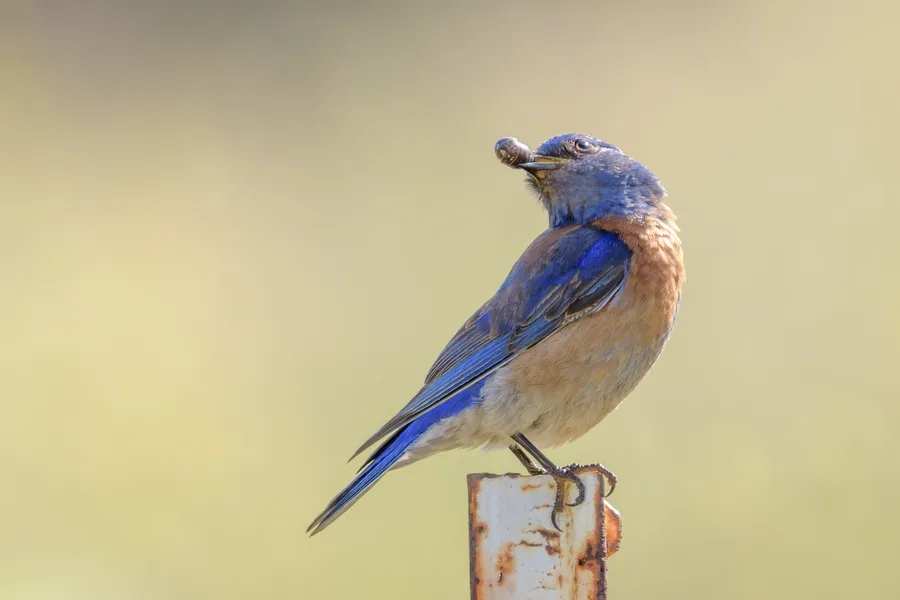
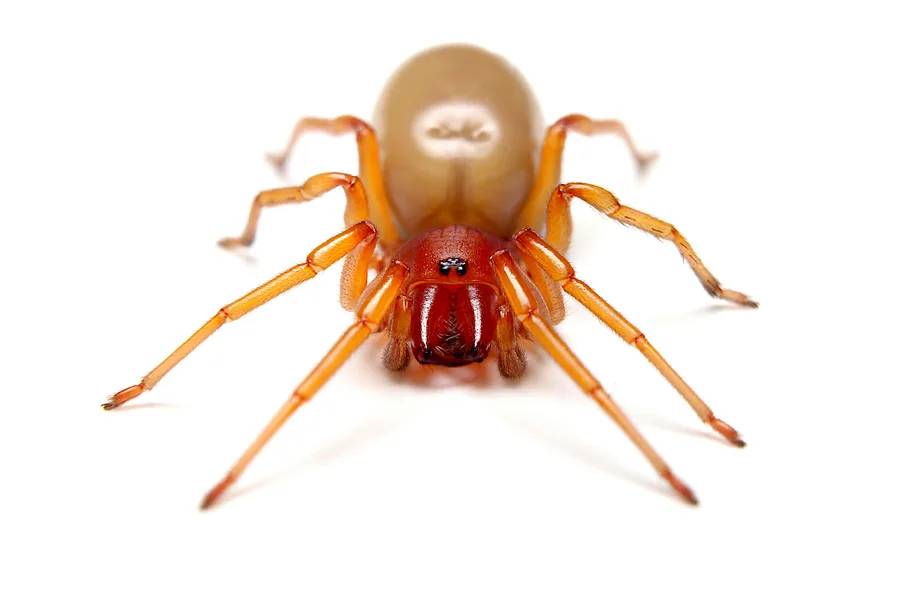
Natural predators help keep numbers in check. The Animal Diversity Web says rolling up is no defense against birds such as the common starling, though few smaller predatory arthropods can overcome it, and it names spiders of the genus Dysdera as some of the few nocturnal, ground-dwelling predators of woodlice. The woodlouse spider (Dysdera crocata), pictured below in the United States, is one of them.
Keeping Roly Polies as Pets
Isopods have become popular pets. The University of Kentucky notes that native species can be collected around the home and kept in terrariums, and tropical ones are sold in pet stores. Its key advice: give them a moisture gradient, a damp end and a drier end, and research each species’ care first. Roly polies caught for children to watch can go back where they were found.
Roly polies share leaf litter and mulch with springtails, tiny jumping recyclers that feed on fungi and decaying plant matter.
The Jerusalem cricket, a large burrowing insect of the West, is the other animal called a potato bug; our Jerusalem cricket guide shows how to identify one.
Frequently Asked Questions
Are roly poly bugs harmful?
No. They do not bite or sting, and Clemson calls them completely harmless to humans and pets. In large numbers they can chew seedlings and soft fruit touching damp soil.
What attracts roly polies into a house?
Moisture. Wet mulch or soggy soil against the foundation builds a large outdoor population, and some wander in under doors, especially after a long, wet spring.
What kills roly polies in a house?
Dry air. Texas A&M says they rarely survive more than a day or two indoors. Extension services do not recommend indoor insecticides; sweep or vacuum them and fix the damp spot outside.
Is it roly poly or rollie pollie?
Dictionaries such as Merriam-Webster spell it roly-poly. Rolly polly and rollie pollie are common informal spellings of the same nickname; Clemson’s fact sheet writes “rolly pollies” and the University of Kentucky’s “roly-pollies.”
What do British people call roly polies?
Woodlice (one woodlouse). The word covers both pill bugs and sow bugs. Slater is another common name for them.
How long do roly polies live?
Usually 1 to 3 years. The University of Kentucky gives about 3 years, UC IPM says adults can live 2 to 5 years, and the Animal Diversity Web gives an average of a year and a half for the common pill bug.
Are roly polies good for the garden?
Mostly yes. They recycle dead leaves into the soil and become pests only in wet years or very damp beds.
What eats roly polies?
Birds such as starlings and bluebirds, and spiders, especially the woodlouse spider (Dysdera crocata), one of the few small night hunters the Animal Diversity Web names as a woodlouse predator.
The Bottom Line
A roly poly is a harmless land crustacean that recycles dead leaves. If it is in your house or seedlings, fix the damp, not with a spray that also reaches bees. More backyard creatures: our garden and household insects guides.
Image credits: Featured photo of common pill bugs: Koby Yen, via Wikimedia Commons, CC BY 4.0, cropped and resized. Pill bug rolled up: Bj.schoenmakers, CC0. Pill bug vs sow bug panel: Don Loarie and Alexis, CC BY 4.0. Woodlouse on soil: Katja Schulz, CC BY 2.0. Western bluebird: Becky Matsubara, CC BY 2.0. Woodlouse spider: Matthew Lindsey, CC BY 4.0. All photos via Wikimedia Commons; links to each file page and licence are in the captions. Charts: BeeKeepersRealm, from iNaturalist API data pulled November 22, 2026.