Reviewed by Sofia T. · How we review
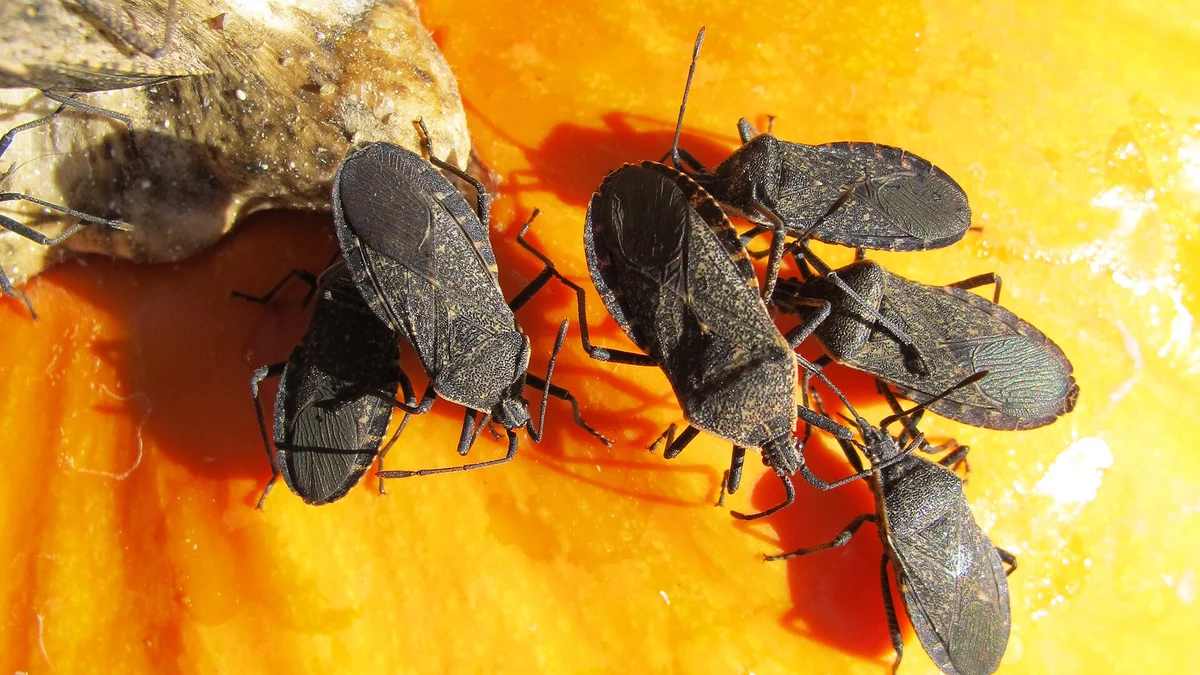
Squash bugs (Anasa tristis) are flat, grayish-brown true bugs about 5/8 inch long that suck sap from squash, pumpkins and other cucurbits, leaving yellow specks, wilted runners and, in the Midwest and East, a bacterial disease called cucurbit yellow vine disease. The best control is mechanical: crush the bronze egg clusters on leaf undersides, trap the adults under boards and clean up vines after harvest. If you do spray, hit young nymphs in the evening, after the flowers have closed, because squash bees pollinate those same flowers from dawn to about midday.
This guide shows how to recognize adults, eggs and nymphs, how to tell a squash bug from the squash bee working the same blossoms, what the damage means, and which control steps university extension services recommend. It also includes our count of 4,115 US research-grade iNaturalist records of squash bugs set against 2,969 records of the pruinose squash bee, so you can see how much their seasons overlap.
Key Takeaways
- Squash bugs are leaf-footed bugs (family Coreidae), not stink bugs. Adults are 1/2 to 3/4 inch long; eggs are bronze to brick red, in clusters of 15 to 40 on leaf undersides (UC IPM, UW-Madison).
- Feeding causes yellow spots and “Anasa wilt.” Overwintering squash bugs also carry the bacterium behind cucurbit yellow vine disease, which Cornell’s fact sheet attributes to Serratia ureilytica and says can cause losses of 5% to 100%.
- Bacterial wilt is a different disease spread by cucumber beetles, not squash bugs. Yellowing of the vine points to yellow vine disease; wilting without yellowing points to bacterial wilt.
- Control that works: scout daily for eggs, set boards and empty them every morning, use row covers until bloom, grow butternut or Royal Acorn types, and remove vines after harvest.
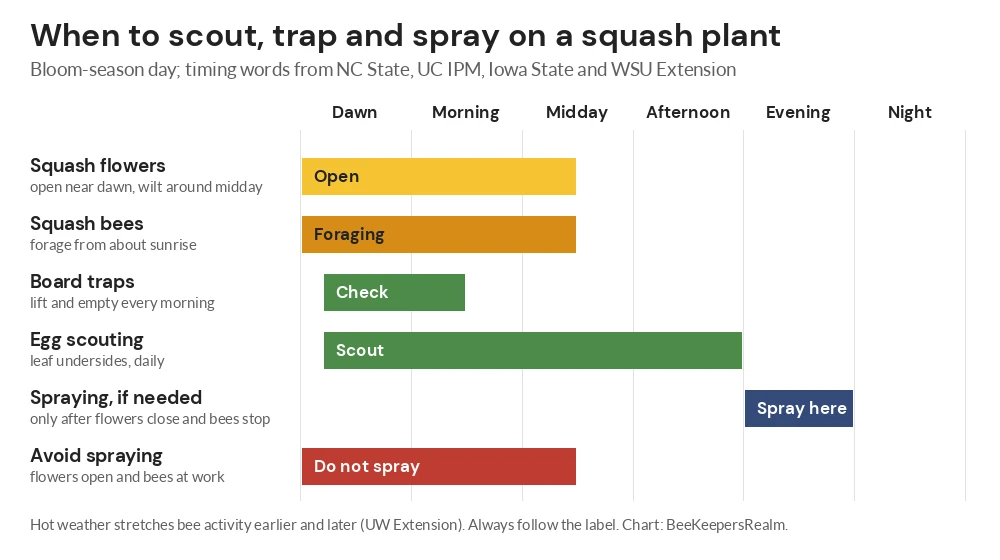
- Squash bees forage from about sunrise until the flowers wilt around midday (NC State). Generic “spray early morning or evening” advice does not fit squash: if a spray is needed, use the evening only.
- In our iNaturalist count, June to September holds 79.7% of US squash bug records and 95.9% of pruinose squash bee records.
Table of Contents
- What Squash Bugs Are
- How to Identify Squash Bugs, Eggs and Nymphs
- Squash Bug Life Cycle and Generations by Region
- Squash Bug Damage, Anasa Wilt and Yellow Vine Disease
- Squash Bugs vs Squash Bees and Other Look-Alikes
- When Squash Bugs and Squash Bees Overlap: Our iNaturalist Count
- How to Get Rid of Squash Bugs Without Sprays
- Treating Squash Bugs Without Harming Squash Bees
- Natural Enemies of the Squash Bug
- Frequently Asked Questions
What Squash Bugs Are
The squash bug is a true bug in the order Hemiptera. Like aphids, cicadas, stink bugs and boxelder bugs, it feeds through a beak of needle-like mouthparts rather than chewing jaws; our page on why a bee is an insect but not a bug explains the difference. The Missouri Department of Conservation places squash bugs in the family Coreidae, the leaf-footed bugs, and notes there are nearly 90 species in that family in its region’s guide. Several relatives in the same genus share the name: in our iNaturalist pull, the horned squash bug (Anasa armigera) has 642 US research-grade records against 4,115 for Anasa tristis.
Squash bugs feed only on cucurbits. UW-Madison entomologists say pumpkins and squash are the preferred hosts, followed by gourds and melons, and Utah State adds that pumpkins, Hubbard and yellow straightneck and crookneck squash are more severely damaged than other varieties. They are not the same insect as a stink bug: UC IPM points out that stink bugs are not considered pests of cucurbits and prefer tomatoes and legumes, while squash bugs are flattened and somewhat oval rather than broad and shield-shaped.
How to Identify Squash Bugs, Eggs and Nymphs
Adults
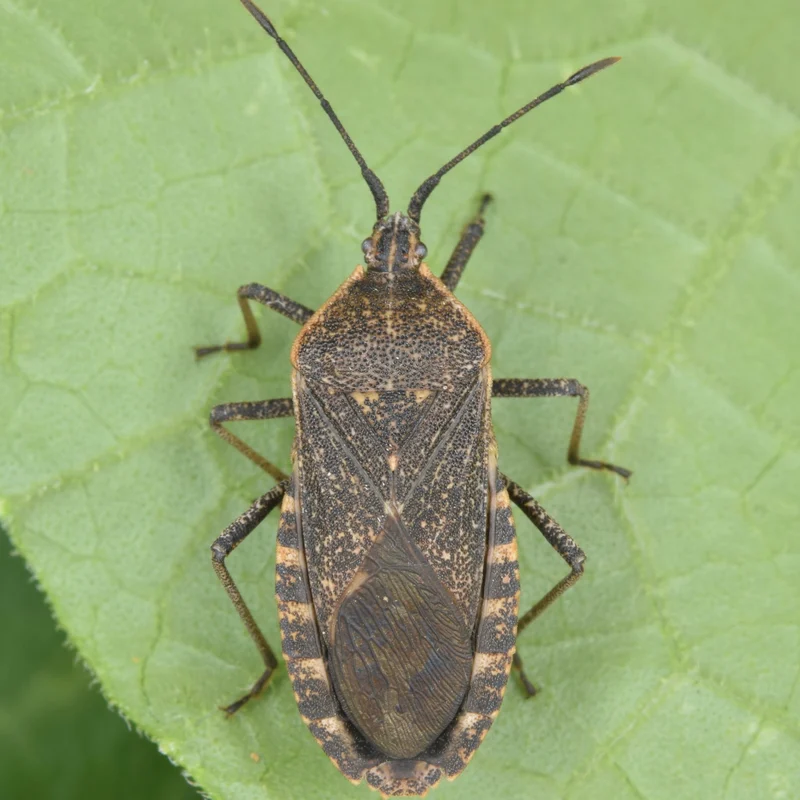
UC IPM puts adults at 5/8 inch long and one third as wide, winged, grayish brown and flat-backed; UW-Madison gives a range of 1/2 to 3/4 inch and calls them mottled brownish-black. Look for alternating light and dark marks along the edge of the abdomen, which the University of Maryland describes, and a narrow head. They give off a strong odor when crushed, and Oregon State notes they actively move away and hide from an approaching person.
Eggs
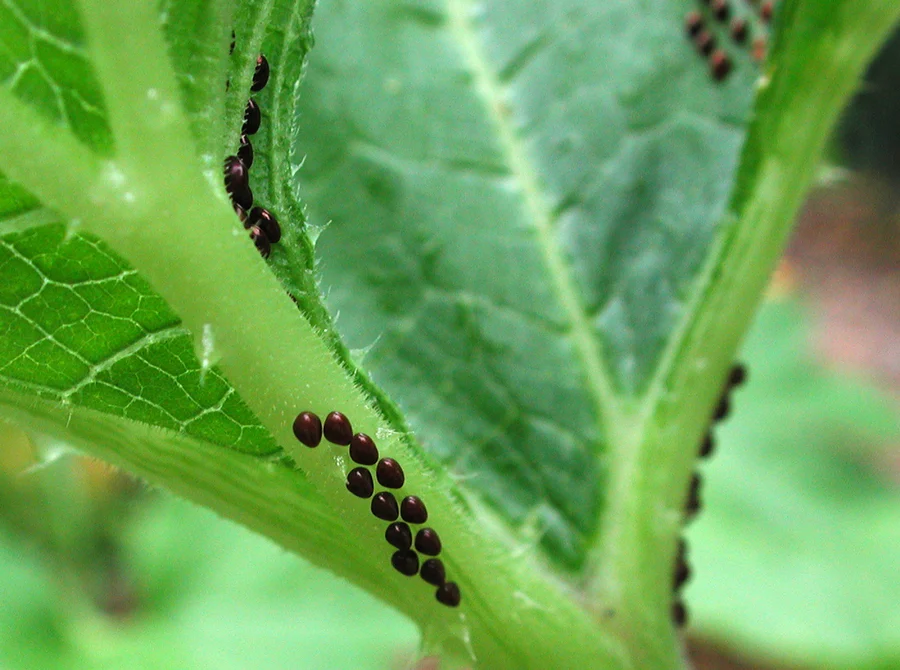
The eggs are the easiest stage to find and the most useful to destroy. UC IPM describes them as 1/16 inch long, bronze to brick red, in groups of 15 to 40 on the undersides of leaves or on stems. Illinois Extension says clusters of about 20 are laid commonly where two veins meet to form a V, and the University of Kentucky notes the eggs are football shaped and lie on their sides. They hatch in about 5 to 14 days, depending on the source and the weather.
Nymphs
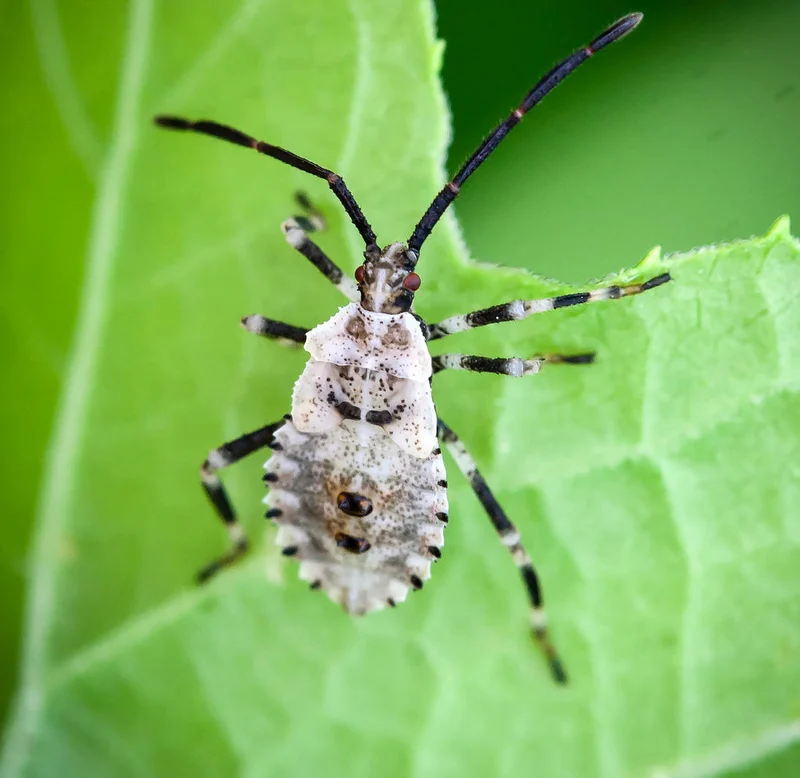
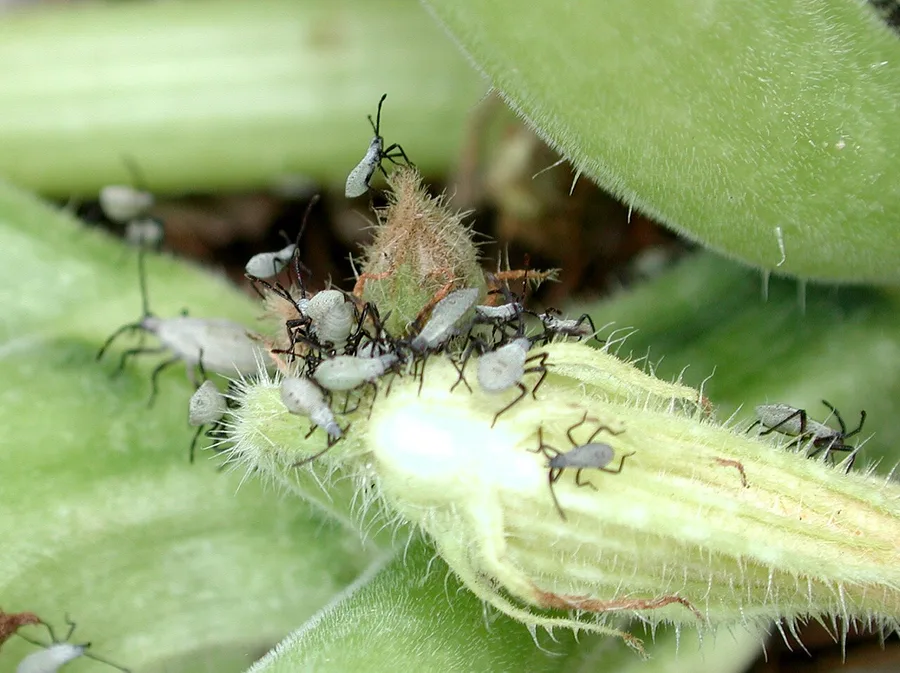
Newly hatched nymphs have a black head and legs and a light green body (Illinois Extension). As they grow they turn gray, often with a whitish, powdery look, and UC IPM sizes them at 3/16 to 1/2 inch. They feed in tight groups, so a leaf covered in small gray insects with black legs is a strong clue. UW-Madison says nymphs go through five molts over four to six weeks.
Squash Bug Life Cycle and Generations by Region
Adults spend the winter under dead leaves, rocks, boards and garden debris, then fly to cucurbits in spring to feed, mate and lay eggs (UC IPM). In Wisconsin, egg-laying starts in late June and early July, when vine crops begin to run, and new adults appear in late July and early August. Because females lay over a long period, eggs, nymphs and adults are often on the same plant at once.
How many generations you get depends on where you garden. These are the counts each extension service gives for its own state:
| State or region | Generations per year | Source |
|---|---|---|
| Wisconsin | 1 | UW-Madison Entomology |
| Oregon | 1 | Oregon State University |
| New York | Usually 1 | Cornell |
| Northern Utah | 1 (a partial second in southern Utah is possible but not documented) | Utah State University |
| Colorado | 2 | Colorado State University |
| California | 2 to 3 | UC IPM |
Our iNaturalist count shows the same arc. Of the US research-grade squash bug records tagged with a life stage, eggs peak in July (35 of 81), nymphs in August (166 of 432) and adults in September (373 of 1,496), when the new generation is fattening up and looking for winter shelter.
Squash Bug Damage, Anasa Wilt and Yellow Vine Disease
Early feeding shows as yellow spotting on the leaves, which can dry and turn brown or black along the edges (UW-Madison). Heavy feeding interrupts the flow of water in the vine so that runners collapse and the point of attack turns black and brittle; UC IPM notes that this symptom is called “Anasa wilt.” Young plants suffer most and can be killed (UC IPM, UW-Madison), and later in the season adults feed on developing fruit, which may stop growing and rot.
Sources disagree on why the wilt happens. WSU and UW-Madison say squash bugs inject a toxin, but Utah State’s squash bug fact sheet says no salivary toxins have been confirmed in squash bugs and points to injured xylem instead. Either way, the wilt is caused by feeding and is not a disease.
Anasa wilt vs bacterial wilt
UC IPM says the wilting resembles bacterial wilt, “a disease spread by another pest of squash, the cucumber beetle.” That matters, because some popular summaries, including Google’s AI Overview for “squash bugs” on November 22, 2026, list bacterial wilt as a squash bug disease. Cornell names the bacterial wilt pathogen as Erwinia tracheiphila, carried by striped and spotted cucumber beetles.
Cucurbit yellow vine disease
Squash bugs do carry a different bacterial disease. Cornell’s vegetable IPM fact sheet says cucurbit yellow vine disease (CYVD) is caused by Serratia ureilytica and transmitted by the squash bug, which keeps the bacterium in its gut through the winter. Cornell reports it was first detected in New York in 2021 and that losses can range from 5% to 100%. Utah State says it has been found from the Midwest to the Northeast but not west of the Rocky Mountains, and UC IPM says its prevalence in California is not well known.
The quickest field check, per Cornell: both diseases wilt and scorch leaf margins, but yellow vine disease turns the leaves and then the whole vine yellow, while bacterial wilt does not. The University of Kentucky stresses keeping squash bugs off young plants early in the season, because early infection causes the worst yield loss.
Squash Bugs vs Squash Bees and Other Look-Alikes
Gardeners who check their squash at sunrise often see two insects on the same plant: squash bugs on the leaves and stems, and squash bees inside the flowers. They share a name and a host plant, but one is a pest and the other is one of the most important pollinators of squash and pumpkins. Our full profile of squash bees, the native specialists that pollinate before sunrise, covers their biology; here is how to tell them apart quickly.
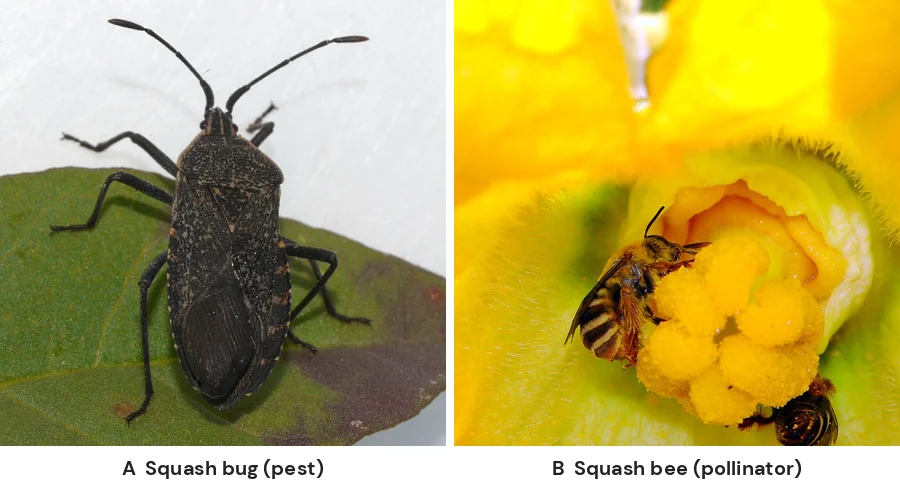
Squash bees belong to the long-horned bee tribe Eucerini, the same group profiled in our guide to long-horned bees. The common species has carried three names: NC State’s 2024 revision calls it Eucera (Peponapis) pruinosa, iNaturalist lists it as Xenoglossa pruinosa, and many older pages use Peponapis pruinosa. All three mean the same bee.
| Insect | What it is | Where you see it | Key marks | Pest or helper? |
|---|---|---|---|---|
| Squash bug (Anasa tristis) | True bug, leaf-footed bug family | Leaf undersides, stems, base of the plant; hides under debris | Flat, 1/2 to 3/4 inch, gray-brown; bronze egg clusters; gray nymphs with black legs | Pest; carries yellow vine disease |
| Squash bee (Eucera or Xenoglossa pruinosa) | Native solitary bee | Inside open squash flowers from about sunrise to midday; nests in the soil below | Larger and bulkier than a honey bee, with longer antennae and a rounder face; females have very fuzzy hind legs dusted with pollen | Pollinator; protect it |
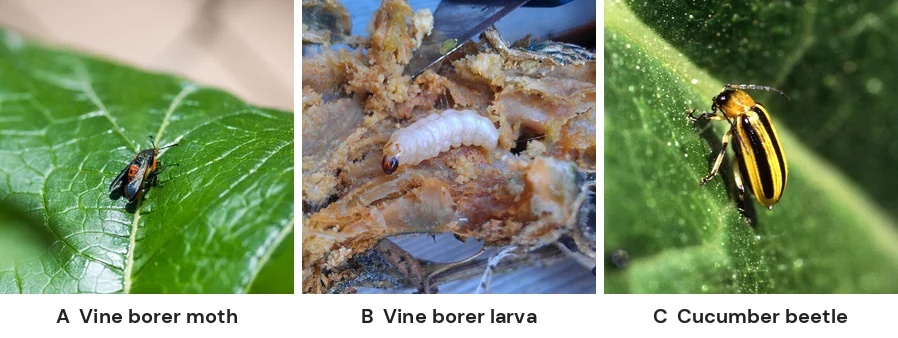
| Squash vine borer (moth) | Day-flying moth; the larva bores into stems | Adults fly around plants by day; larvae inside the stem base | Wasp-like moth with an orange abdomen and hairy red hind legs; sawdust-like frass at the stem base | Pest; whole runners wilt suddenly |
| Striped cucumber beetle (Acalymma vittatum) | Leaf beetle | Leaves, stems and flowers | Small yellow beetle with black stripes | Pest; spreads bacterial wilt |
| Stink bugs (family Pentatomidae) | True bugs | Mostly tomatoes, beans and fruit; rarely a cucurbit pest | Broad shield shape, wider than a squash bug | Not considered a cucurbit pest (UC IPM) |
Sources: UC IPM, UW-Madison, Missouri Department of Conservation, NC State Extension, University of Kentucky (squash vine borer) and Cornell (cucumber beetles).
When Squash Bugs and Squash Bees Overlap: Our iNaturalist Count
To see how much the two seasons collide, we pulled every US research-grade iNaturalist observation of the squash bug (4,115 records) and of the pruinose squash bee (2,969 records) on November 22, 2026, and grouped each by month. Because the totals differ, the chart shows each species’ share of its own records.
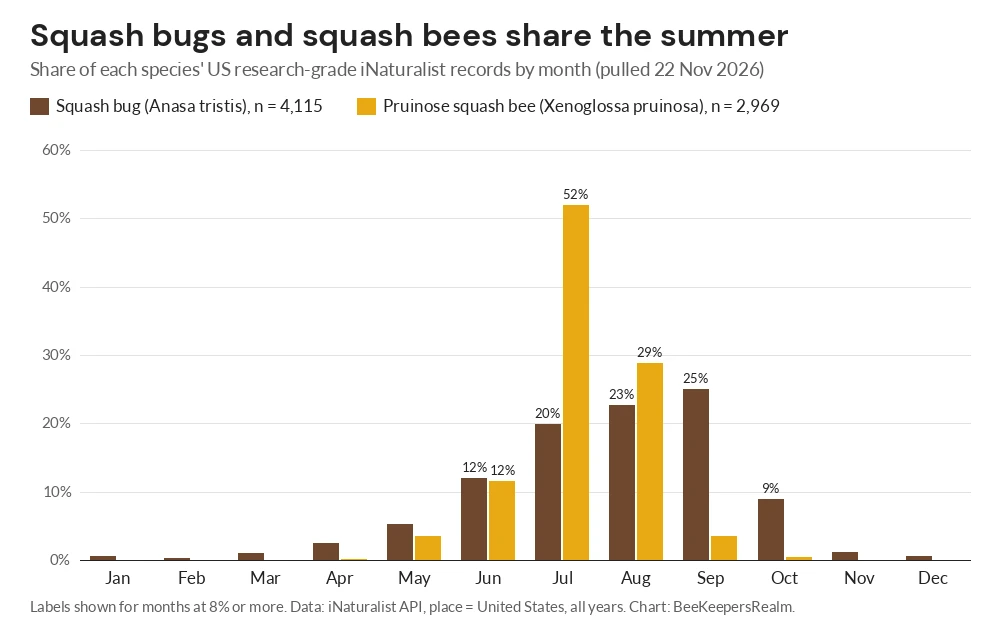
The overlap is heavy. June through September holds 79.7% of squash bug records and 95.9% of squash bee records. July alone holds 52.0% of all squash bee records, the month when squash bugs are laying eggs and the first nymphs hatch. Squash bug records then keep climbing to a September peak (25.0% of the year), when only 3.6% of squash bee records fall. In practice, almost every week you would want to treat squash bugs in midsummer is a week when squash bees are working the flowers every morning.
These are photo records from iNaturalist users, so they track when people garden and take pictures as much as when the insects are active. They are a guide to overlap, not a population survey.
How to Get Rid of Squash Bugs Without Sprays
Every extension source we read leads with the same non-chemical steps. They are also the safest for the bees, because none of them touch the flowers.
Find and destroy the eggs
UC IPM recommends inspecting young plants daily for egg masses and mating adults. The University of Maryland says egg clusters are hard to crush by hand, so tear out that piece of leaf and destroy it; its page also shows duct tape used to lift off young nymphs. UW-Madison suggests scouting leaf undersides from early July into September.
Hand-pick into soapy water
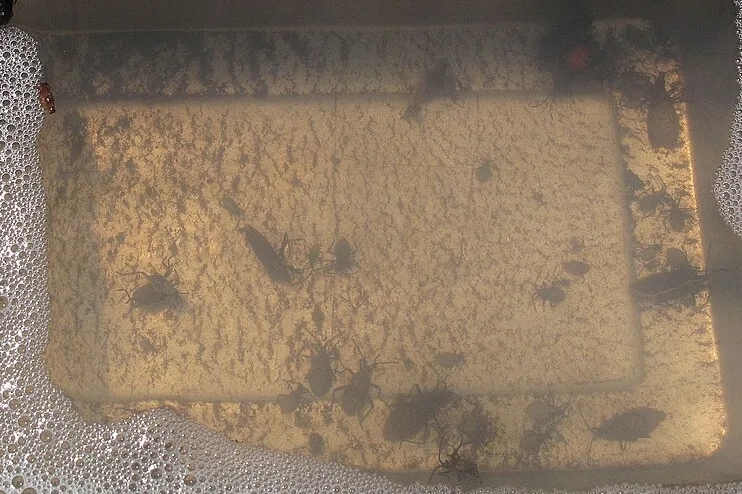
Adults and nymphs can be knocked into a bucket of soapy water, which kills them without crushing, the same method our Japanese beetle guide suggests for beetles. Work fast: Illinois Extension warns that both stages run for cover when disturbed.
Use board traps
Squash bugs gather under flat objects at night. UC IPM says to place wooden boards through the garden and check under them every morning, handpicking or vacuuming the bugs you find; UW-Madison suggests an old shingle works too.
Row covers until bloom
Floating row covers keep overwintered adults off young plants. UC IPM, Utah State and Oregon State all say to remove them when the plants begin to flower so bees can pollinate; Utah State puts it plainly: covers must come off when plants begin to flower for pollination to occur.
Plant choice, trellising and timing
- Varieties: UC IPM names Butternut, Royal Acorn and Sweet Cheese as more resistant. Colorado State ranks Butternut, Royal Acorn, Sweet Cheese, Green Striped Cushaw, Pink Banana and Black Zucchini from least to most susceptible.
- Trellising: UW-Madison says trellised plants are less susceptible.
- Later planting: overwintered adults prefer larger, established plants, so a later sowing can miss the first wave (UW-Madison).
- Trap crops: Utah State cites an Oklahoma State study (Bonjour et al. 1990) in which squash bugs preferred to lay eggs on yellow straightneck and crookneck squash over zucchini, acorn, spaghetti and butternut. A border of the preferred type can draw them away from the main crop if you destroy it before the eggs hatch.
Clean up after harvest
Remove spent vines and garden debris in fall so adults have fewer places to spend the winter. UW-Madison suggests burning, burying or hot composting the material and rotating cucurbits to a new spot.
Treating Squash Bugs Without Harming Squash Bees
“Other more toxic pesticides are also registered for use on squash bugs; however, these materials should be used with caution since they can harm the bees that are required for squash pollination as well as other beneficial insects, such as the predators and parasites that help control other pest insects and mites.”
Each squash flower is open for only part of one day, so a single badly timed spray can hit the bees at work. If the non-chemical steps are not enough, these rules come straight from the extension sources.
Spray only in the evening, never at dawn
NC State’s squash bee fact sheet says squash flowers open near dawn, squash bees begin foraging around the same time, and they keep visiting until the flowers wilt around midday. Oregon State says the flowers close by midmorning once the sun gets hot. Yet several general pest pages advise spraying blooming plants “early in the morning or in the evening,” including Illinois Extension’s squash bug page and NC State’s Wayne County news post. For squash, the morning half of that advice lands on the bees’ busiest hours.
The squash-specific advice is evening only. Iowa State says to spray blooming squash “in the evening after the honey bees have quit foraging for the day,” WSU says the same, and NC State’s bee fact sheet says some insecticides should not be used on flowering squash at all and others only in the evening. Iowa State’s wording names honey bees, but the evening window also clears the squash bees, which have finished by midday. UW-Madison adds that bees stay active later on hot evenings, so wait until the flowers have closed and the bees are gone.
Target the nymphs, not the adults
Adults are hard to kill. Utah State says they are resistant to insecticides and advises starting shortly after egg hatch, and UW-Madison says nymphs are more easily controlled than adults. UC IPM notes that insecticidal soap and neem oil work only on the smallest nymphs and need good coverage under the leaves. A treatment aimed at newly hatched nymphs on leaf undersides, applied in the evening, keeps spray away from open flowers.
Read the bee section of the label
Oregon State tells gardeners to look for pollinator hazards in the ENVIRONMENTAL HAZARDS section of the label. Ohio State’s guide says insecticides highly toxic to bees should not be applied to plants any time during flowering, and that systemic products should not be applied before or during flowering because they can move into pollen and nectar. NC State adds that systemic insecticides applied before flowering can still be present at toxic levels in squash pollen. Our aphid guide, spider mite guide and tomato hornworm guide follow the same bee-safe rules for other garden pests.
Protect the nests under the vines
“Because squash bees nest in the ground, often right under the squash plants, they may be sensitive to soil disturbance.”
The same fact sheet says females usually build nest cells 6 to 12 inches underground and that tilling a squash bed at any time of year can destroy squash bees, although the research is mixed: one survey of 25 farms found three times more squash bees on no-till farms, and a second study of 20 pumpkin farms found no such effect. It also cites a study that found an 89% drop in squash bee reproductive success where squash was treated with imidacloprid as a soil drench. So skip soil-applied insecticides, and if you clean up vines in fall, pull them rather than deep-tilling the bed. Squash bees share this ground-nesting habit with mining bees and many other species in our native bee chart sorted by nesting behavior.
Soap: insecticidal, not dish soap
A bucket of soapy water for drowning hand-picked bugs is fine. A spray is different. Iowa State says dish soap is a detergent, not a replacement for insecticidal soap, and is much more likely to damage the plant. UF/IFAS adds that insecticidal soaps also harm beneficial insects they hit, so keep any spray on the nymphs and off the flowers.
This is educational information, not professional pest-control advice. Pesticide labels are legal documents: read and follow the label of any product, including its bee hazard statements, and ask your county extension office for products registered in your state.
Natural Enemies of the Squash Bug
Oregon State names two main natural enemies: a tiny egg parasitoid wasp, Gryon pennsylvanicum, and the feather-legged tachinid fly Trichopoda pennipes, which lays its eggs on older nymphs and adults. Colorado State says parasitism by the fly can reach up to 100% in some areas and egg parasitism by wasps over 60%, mostly late in the season, so they suppress squash bugs over several years rather than knocking down a heavy infestation. UC IPM adds spiders, ground beetles, big-eyed bugs and lady beetles, which our ladybug guide covers.
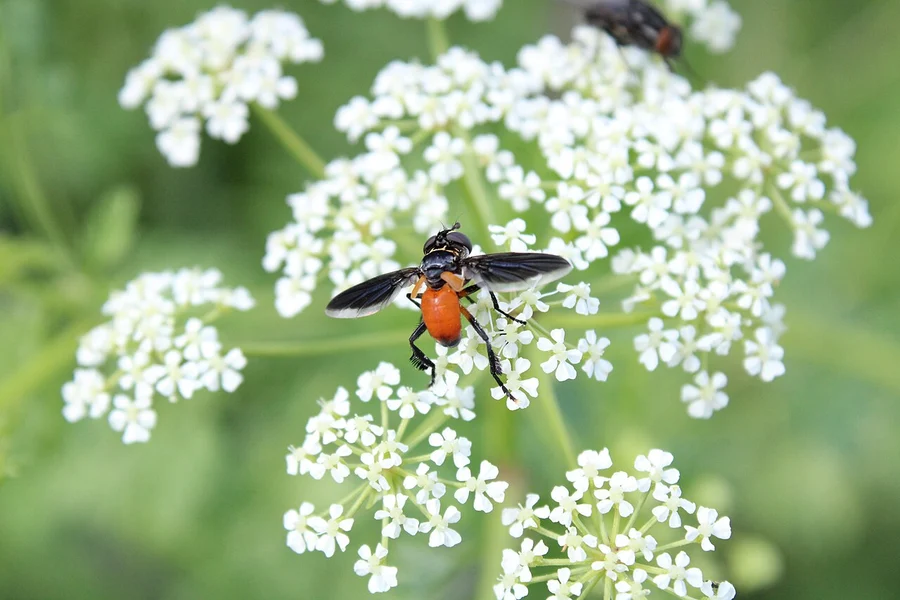
Utah State notes that flowering plants providing nectar and pollen serve as alternative food for these parasitoids, and Colorado State recommends flowering insectary strips or hedgerows near the crop and avoiding overreliance on insecticides. The same plantings feed bees; see our guide to companion planting for pollinators in a vegetable garden.
Frequently Asked Questions
How do you get rid of squash bugs?
Check leaf undersides daily and crush or tear out the egg clusters, knock adults and nymphs into soapy water, set boards and empty them each morning, and pull spent vines after harvest. If a spray is needed, use insecticidal soap or another labeled product on young nymphs in the evening.
Does Dawn dish soap kill squash bugs?
A bucket of soapy water drowns hand-picked bugs. As a spray, Iowa State says dish soap is a detergent, not a replacement for insecticidal soap, and is much more likely to burn the plant. Use a product labeled as insecticidal soap instead.
What do squash bugs hate the most?
No extension source we read names a plant or scent that reliably repels squash bugs. What they demonstrably avoid or struggle with: resistant varieties such as Butternut and Royal Acorn, trellised plants, clean beds with no debris to hide under, and row covers before bloom.
What is the natural enemy of the squash bug?
The feather-legged fly Trichopoda pennipes and tiny egg-parasitizing wasps such as Gryon pennsylvanicum are the main ones, followed by spiders, ground beetles, big-eyed bugs and lady beetles.
What do squash bug eggs look like?
Shiny, bronze to brick-red ovals about 1/16 inch long, laid in neat clusters of roughly 15 to 40 on leaf undersides, often in the V between two veins.
Do squash bugs fly?
Adults do. They have full wings and fly from their winter shelters to cucurbits in spring (UC IPM). Nymphs have no wings and stay on the plant.
Are squash bugs the same as stink bugs?
No. Squash bugs are leaf-footed bugs (Coreidae) and feed only on cucurbits; stink bugs (Pentatomidae) are broader and shield-shaped, and UC IPM says they are not considered cucurbit pests.
Do squash bugs bite people?
None of the extension pages we read reports squash bugs biting people. Their beak is built for plant sap, and the nuisance for gardeners is the strong odor when one is crushed.
The Bottom Line
Squash bugs are beaten with daily egg checks, morning board traps and fall cleanup. Save any spray for young nymphs in the evening, after the flowers close, and leave the soil under the vines alone for the squash bees nesting there.
Image credits: featured photo of squash bugs on a pumpkin in Cross Plains, Wisconsin, by Ilona Loser, via Wikimedia Commons, CC BY-SA 4.0, cropped and resized. Other photos are credited in their captions, with links to each file page and licence. Charts by BeeKeepersRealm from iNaturalist API data pulled November 22, 2026, and from the extension sources cited.