Reviewed by Sofia T. · How we review
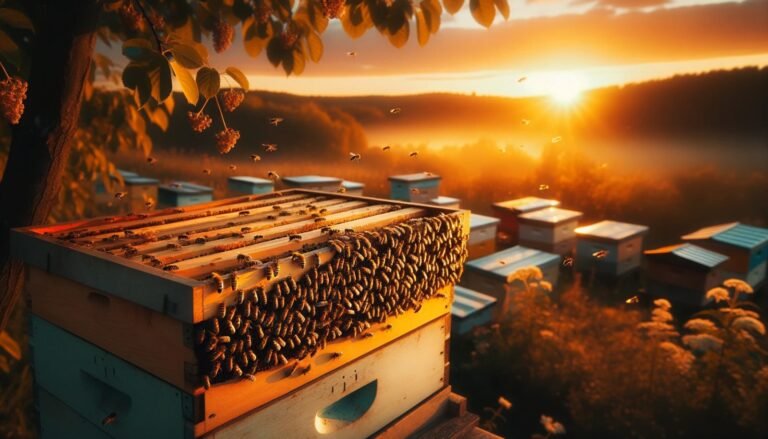
A bee hive is the home of a honey bee colony: a dark, enclosed space where one queen, thousands of workers and a few drones raise young and store honey on hanging wax combs. In the wild that space is a hollow tree or similar cavity; in beekeeping it is a stack of wooden boxes, most often the Langstroth design. The bees build the same thing in both. Only the container changes.
This guide goes through a hive from the outside in: the boxes, the comb, the bees and the climate they keep. For a side-by-side of hive styles, see types of beehives compared.
Key Takeaways
- A hive is a man-made home for a colony; a wild colony in a tree or wall lives in a nest. The bees’ behavior is the same in both.
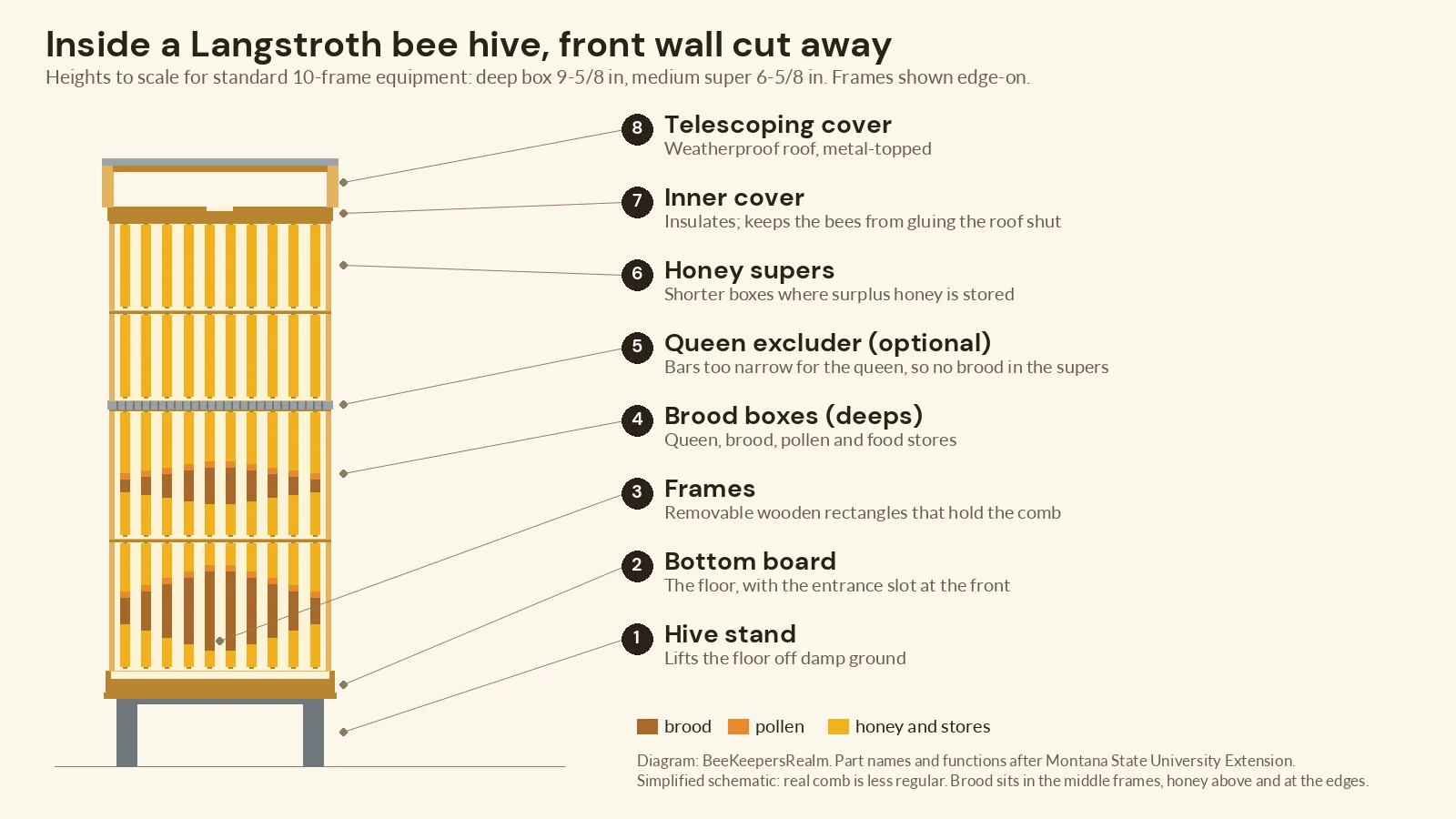
- A standard Langstroth hive stacks, from the ground up: stand, bottom board, brood boxes, optional queen excluder, honey supers, inner cover and a telescoping roof.
- Inside, parallel wax combs hold brood in the middle, a ring of pollen beside it and honey above and at the edges.
- A colony runs from roughly 10,000 to 15,000 bees in a normal winter to about 50,000 at the summer peak, with one queen. One source puts the upper limit at 60,000 workers.
- The nursery stays at about 91 to 97°F, and the bees rarely let it drift more than 2°F in a day.
- By our arithmetic a 10-frame deep box holds about 43 liters, close to the 35 to 40 liter cavity wild colonies choose.
- At Mann Lake on November 2, 2026, a one-box starter kit listed at $162.99 and a two-deep, two-super hive with a stand and queen excluder at $469.99. Bees cost extra.
Table of Contents
- What a Bee Hive Is, and What to Call It
- The Managed Hive: Langstroth Parts From the Ground Up
- The Wild Nest a Hive Box Imitates
- Inside the Comb: Brood, Pollen and Honey
- Who Lives in a Hive, and How Many
- How the Bees Keep the Hive Warm and Moist
- Other Hive Designs in Brief
- What a Bee Hive Costs
- If a Hive Is Somewhere You Did Not Put It
- Frequently Asked Questions
- The Bottom Line
What a Bee Hive Is, and What to Call It
In everyday English “bee hive” covers any place honey bees live. Scientific and professional writing is stricter: Wikipedia’s beehive article notes that literature on bees uses “nest” for colonies that house themselves in natural or artificial cavities, or hang exposed, and reserves “hive” for a structure people build to house a colony. This page uses both words that way.
Spelling is not settled either. Wiktionary has beehive as the main entry and bee-hive as an alternative form; “bee hive” as two words is how many people type the search. Searches for it also pull in a film, a restaurant and video-game wikis, none of which have anything to do with bees. A group of hives in one place is an apiary.
Not every insect home is a bee hive. Bumble bees nest in the ground or in clumps of grass, and wasps build paper nests; see bumble bee nests in the ground and how to identify a wasp nest. Only honey bees keep a perennial colony in a cavity, and only they are housed in the boxes described below.
The Managed Hive: Langstroth Parts From the Ground Up
Most beekeepers use the Langstroth hive, according to Montana State University Extension: stacked boxes holding removable frames. The University of Florida Honey Bee Lab’s Dr. Ellis walks through each part in “The Langstroth Hive and Its Parts,” a 13-minute video from the lab’s Beekeeping Academy series.
What the video covers. Going by its published chapter list, it opens with a short history of the Langstroth hive, then covers lids (telescoping lids, inner covers and migratory lids), boxes and supers (mediums, then deeps), queen excluders and bottom boards. It is a good companion to the list below if you would rather see the pieces than read about them.
The parts and their jobs, bottom to top, follow Montana State University Extension’s guide to housing honey bees:
| Part | What it does |
|---|---|
| Hive stand | Raises the hive two to twelve inches to keep the colony dry. Concrete blocks, scrap wood or pallets work, and the hive should tilt slightly forward so moisture does not pool on the floor. |
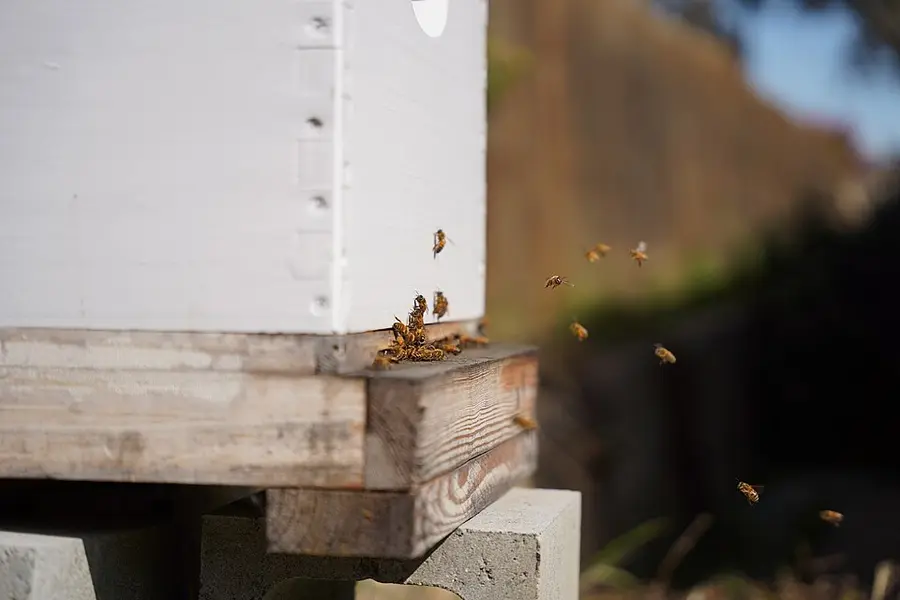
| Bottom board | The floor. Its sides sit about 1/4 inch proud, so when the box goes on top the gap at the front becomes the entrance. Solid and screened versions exist. |
| Brood boxes | The “deep” boxes that house the queen and the developing brood. Each holds ten deep frames fitted with foundation, a sheet stamped with hexagons to guide the comb. A new package goes into one box; a second is added weeks later as the colony grows. |
| Queen excluder | A metal or plastic grid with gaps about 5 millimeters wide, too narrow for the queen but wide enough for workers, so the supers fill with honey rather than brood. |
| Honey supers | Boxes like the brood boxes but shorter, so they are easier to lift. A full medium super can weigh about 50 pounds. |
| Inner cover | A framed board with a central slot. It adds insulation and moisture protection in cold weather and stops the bees gluing the roof down with propolis. |
| Telescoping cover | The roof: a shallow box with overhanging sides, topped with galvanized sheet metal. |
“No fasteners are required to join the components to one another because the bees fasten the seams together with propolis, a sealant made from a mixture of plant resins (from various sources) mixed with beeswax.”
That sealing is why a hive tool is the one essential accessory; see hive tool types. Frames are the parts you will handle most: how to assemble Langstroth frames covers nails, glue and foundation, and Langstroth hive dimensions gives the box and frame sizes. A box of the wider kind holds ten frames, the narrower one eight; 8-frame vs 10-frame hives compares them.
Two choices change the stack. Box depth: a deep is 9-5/8 inches and a medium 6-5/8, and deep vs medium frames for the brood nest weighs the trade-off. The excluder is optional, and beekeepers disagree about it; see when to use a queen excluder. When the supers go on is covered in when to add a honey super.
The Wild Nest a Hive Box Imitates
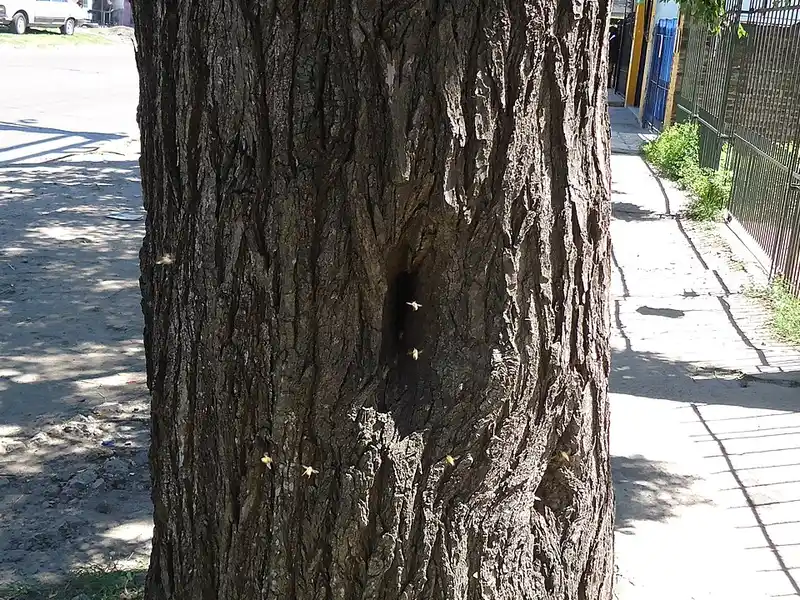
A hive box is a managed version of the home bees already choose for themselves.
“European honey bees prefer to make their nests in dark, empty cavities such as a hollow tree or a wooden box.”
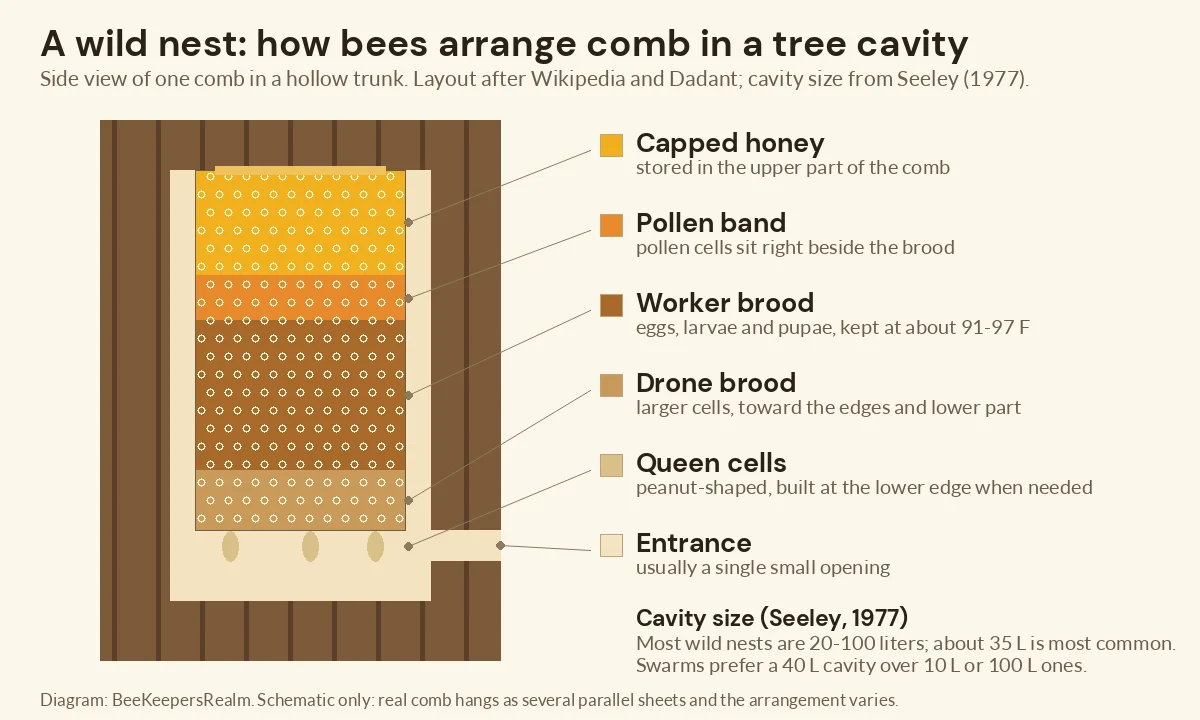
The same Honey Bee Research Centre page explains the frames: bees build several evenly spaced, vertical sheets of comb attached to the top of the cavity, and frames let them use less wax and energy than building from scratch. Wikipedia adds that the combs hang parallel with a fairly uniform bee space between them, that a nest typically has a single entrance, and that the bees coat the cavity walls with propolis and leave passageways along the comb edges. The bee space is the 1/4 to 3/8 inch gap that Langstroth equipment is built around.
How big a cavity bees choose
Thomas Seeley measured it. In a 1977 paper in Behavioral Ecology and Sociobiology (“Measurement of Nest Cavity Volume by the Honey Bee”), he reported natural nests ranging from 12 to 443 liters, most clustered between 20 and 100 liters, with a modal volume of about 35 liters. Given a choice, swarms preferred a 40-liter cavity to 10-liter and 100-liter ones. Seeley found that bees mainly reject undersized cavities but turn down oversized ones as well.
Here is how Langstroth boxes compare. These volumes are our own arithmetic from the inside dimensions in our dimensions guide (18-3/8 inches long; 14-3/4 or 12-1/4 wide; 9-5/8 or 6-5/8 deep), converted at 16.387 milliliters per cubic inch:
| Box or stack | Inside volume | Against Seeley’s wild nests |
|---|---|---|
| 10-frame medium | 29.4 L | Inside the 20 to 100 L range, a little under the common size |
| 8-frame deep | 35.5 L | Matches the most common wild nest, about 35 L |
| 10-frame deep | 42.7 L | Close to the 40 L swarms preferred |
| Two 10-frame deeps | 85.5 L | Still inside the natural range |
| Three 10-frame deeps | 128.2 L | Above the 20 to 100 L band where most nests fall |
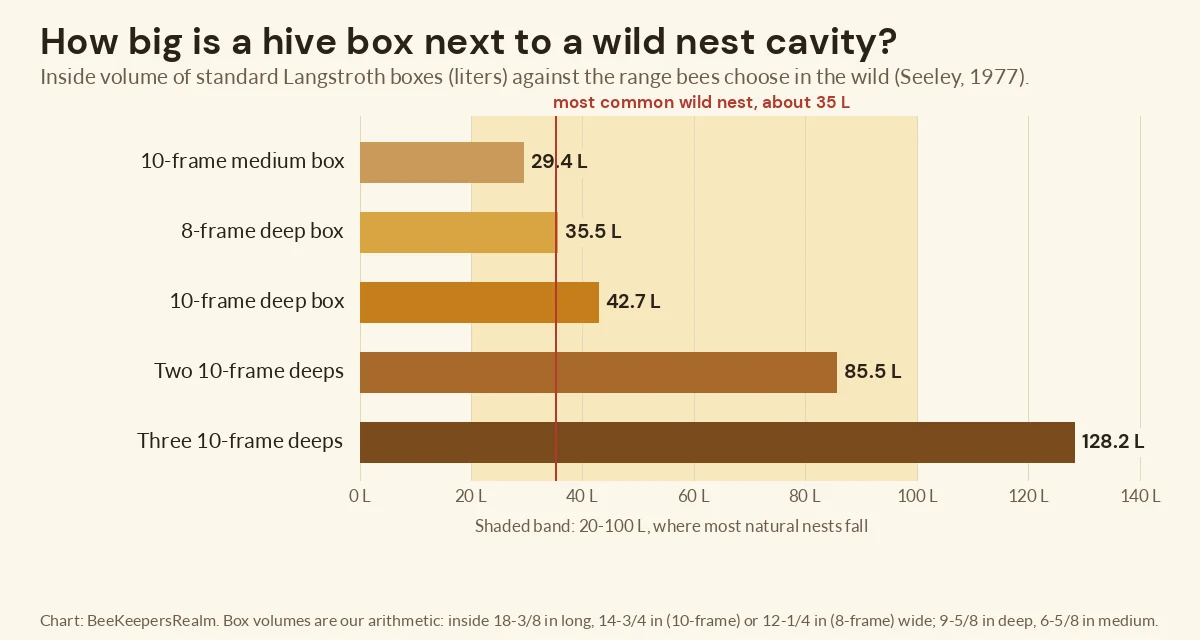
So a single deep is a normal-sized wild nest, and two deeps are a large but natural one. Three deeps pass the 100-liter edge of the band where most natural nests fall, though Seeley recorded nests as large as 443 liters. The comparison is loose: a box has square corners and frames, a tree has neither.
Which hive part copies which nest feature
| In a wild nest | In a Langstroth hive |
|---|---|
| Cavity of about 35 to 40 liters, dark and dry | One deep box, or two stacked |
| Sheets of comb hung from the cavity top, evenly spaced | Frames with foundation, hung from the box rim |
| One small entrance | The slot at the bottom board, often narrowed with a reducer |
| Nest usually between 1 and 5 meters above the ground | The stand, two to twelve inches |
| Propolis on the walls and in every crack | Propolis sealing box seams, lids and frame ends |
| Honey stored in the upper part of the comb | Honey supers stacked on top |
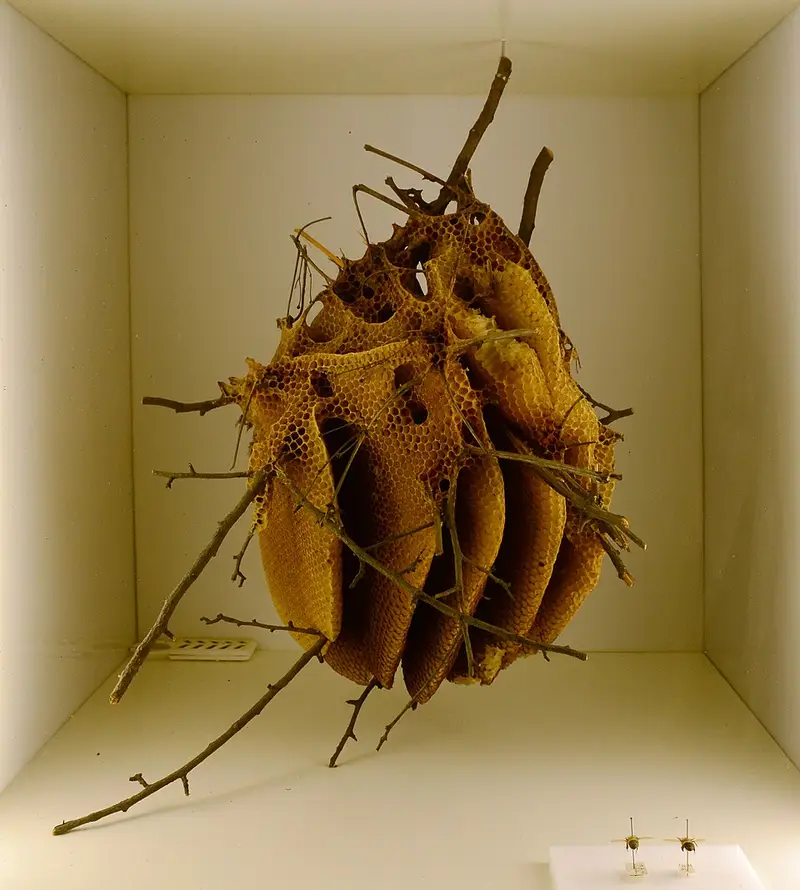
In warm climates honey bees can also build exposed nests that hang in the open, as Wikipedia notes. Cavity nesting is what the hive imitates.
Inside the Comb: Brood, Pollen and Honey
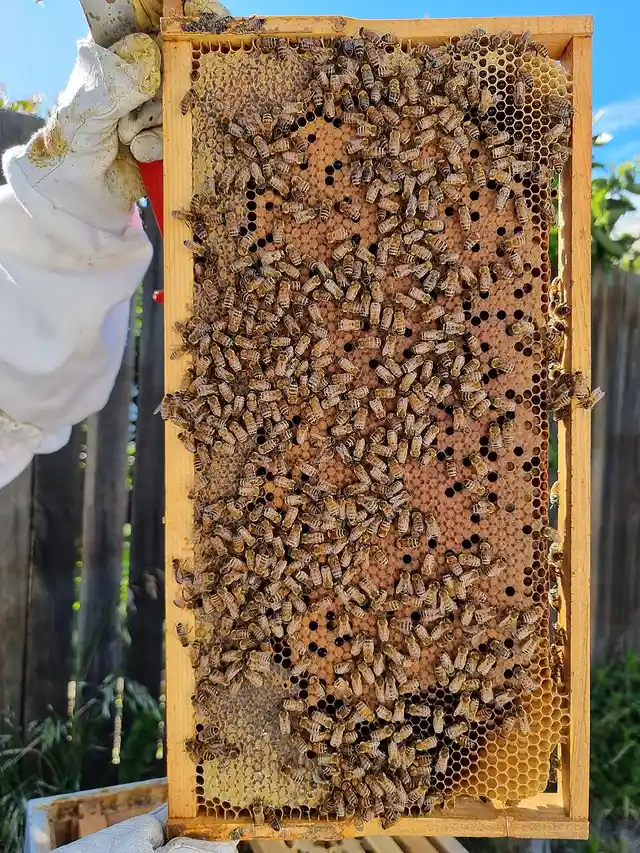
Everything inside the hive is built from wax that workers secrete from glands on the underside of the abdomen. The Honey Bee Research Centre explains that workers shape it into hexagons, which hold the most space for the least wax, and that the same comb stores nectar, honey and pollen and rears brood. Drone comb is built larger, and queen cells hang as downward-facing cups.
The brood nest
Brood is the eggs, larvae and pupae, the colony’s future workforce. Dadant describes the brood nest as roughly football-shaped across several frames, tallest in the middle frame and shorter toward each side. On a single frame the order is brood in the middle, pollen around it, and honey outside the pollen. A queen can lay up to 2,000 eggs in a day, and worker bees place royal jelly, honey and pollen beside the larvae. Capped worker cells sit toward the center of a frame; the larger, higher-domed drone cells sit mostly at the outer rim.
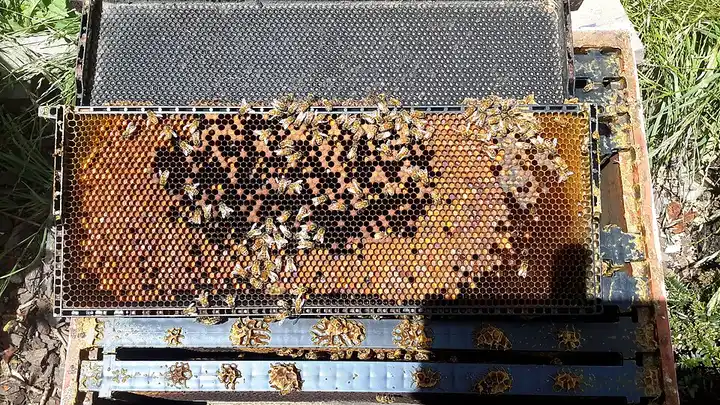
The pattern is the same in a wild nest turned on its side. Wikipedia describes honey in the upper part of the comb, beneath it rows of pollen cells, then worker brood and drone brood, with peanut-shaped queen cells at the lower edge.
Honey stores and backfilling
Not every empty-looking cell in the brood area is a problem. Dadant notes that as winter approaches the bees store excess honey in empty brood cells, which “backfills” the nest and insulates it. For comb honey you can eat, see is honeycomb edible?
You do not have to open a hive to see inside. Observation hives have glass sides, which lets you watch comb without lifting a lid.
Who Lives in a Hive, and How Many
A colony has three kinds of bee. The University of Delaware’s MAAREC site, hosting a text by a research entomologist at the USDA’s Carl Hayden Center for Bee Research, describes it as a cluster of several to 60,000 workers, one queen whose only job is laying eggs, and a few to several hundred drones depending on population and season. The roles are covered in honeybee behavior.
The headcount swings with the year. Published figures differ by source and by region, so the table gives each number with its origin:
| Season or measure | Figure | Source |
|---|---|---|
| “Normal” winter colony | 10,000 to 15,000 bees | Bernhart Möbus, quoted by Randy Oliver |
| Best October size in a Scottish trial | About 13,000 bees (16,000 if infected with nosema) | Jeffree and Allen, via Oliver |
| Peak of summer | Up to 50,000 | Honey Bee Research Centre |
| Upper end of colony size | Up to 60,000 workers | MAAREC / USDA text |
| One fully covered comb in warm weather | 1,800 to 2,400 workers | Randy Oliver |
| One pound of bees | About 4,000 bees | Randy Oliver |
Scale those numbers to boxes. At about 2,000 bees per fully covered comb, a ten-frame deep covered on every frame holds about 20,000 bees, so a 50,000-bee peak is roughly the equivalent of two and a half boxes of covered comb, though not all bees sit on comb at once. Fifty thousand bees weigh about 12.5 pounds at 4,000 to the pound. Oliver’s Scottish figure of 13,000 bees equals 6.5 covered frames, a little over half a box.
The seasons drive this. MAAREC’s account has the population falling through fall as nectar and pollen dwindle, drones evicted when forage runs short, the colony forming a tight cluster once temperatures drop to 57°F, and the queen resuming laying in late December or January. In spring the population expands rapidly; crowding leads to swarming, when the old queen and about half the bees leave to find a new cavity, and the colony peaks in early summer. For a full count-by-count treatment, see how many bees are in a healthy hive.
How the Bees Keep the Hive Warm and Moist
A hive is climate-controlled. PBS NOVA’s “Tales from the Hive” says that from late winter to early autumn the bees hold the nursery between about 91 and 97°F.
“They rarely allow the temperature to vary more than 2°F in the course of a day.”
On hot days they fan their wings and spread water on the comb to cool it by evaporation; MAAREC says the colony holds itself to about 93°F in this way, and NOVA reports that fewer than one percent of foragers collect water. In winter the bees do not go dormant. They cluster, and by NOVA’s account keep the outermost bees above 50°F, the honey bee’s lower lethal limit, by working their wings, sealing cracks with plant resin and eating more than two pounds of honey a week. MAAREC puts the brood area inside the winter cluster near 93°F.
Moisture is the other half. Water carried in is used to thin honey into brood food and to cool the nest, while nectar curing and winter breathing add vapor the bees must get rid of. How that balance works and where it fails are covered in how bees regulate humidity inside the hive, hive temperature control methods and what bees do in winter inside the hive.
Other Hive Designs in Brief
The Langstroth is the most common, not the only one. Montana State’s guide notes the horizontal top-bar hive, where bees draw comb down from bars and the comb is harvested with the honey rather than reused, and the Warré hive, stacked vertically like a Langstroth but with an insulating top box and top bars instead of frames. The Flow Hive is a Langstroth-style box with special honey frames. Each has its own guide:
- Top-bar beehive guide
- Warré beehive guide
- Flow Hive explained
- The Langstroth hive and its history
What a Bee Hive Costs
Prices vary by maker, wood, paint and whether frames and foundation are assembled. We checked one US supplier, Mann Lake, on November 2, 2026. Prices are list prices before shipping, and bees are not included in any of them.
| Mann Lake item | What is in it | Price |
|---|---|---|
| 10 Frame Assembled 9 5/8″ Deep Hive Box | One empty deep box | $39.99 |
| Assembled Telescoping Cover With Inner Cover | Roof and inner cover | $52.99 |
| Traditional Complete Hive Kit | One deep with frames, cover with notched inner cover, bottom board with reducer | From $162.99 |
| 10 Frame Complete Hive Kit Combo | One deep and one medium super, frames, screened bottom board, cover | $226.99 |
| My Next Hive, Assembled | Two deeps, two supers, frames, cover, bottom board, stand, queen excluder | $469.99 |
The pattern is that the first box is cheap and the full stack roughly triples it. Buying a bee package or nucleus colony is a separate cost; see where to buy bees and the broader how to start beekeeping guide.
If a Hive Is Somewhere You Did Not Put It
A colony in a wall or chimney is a wild nest in an unplanned cavity: the same bees and the same comb, with no frames to lift out. Treat it as a job for an experienced beekeeper or removal professional, not a do-it-yourself project. Our guide to the safe way to remove bees from a building explains the steps, and how much it costs to remove a beehive covers pricing. This page is educational and not professional advice.
Frequently Asked Questions
What is inside a beehive?
Wax comb on parallel frames or hanging sheets, filled with brood, pollen and honey, and a colony of one queen, thousands of workers and a few drones. In a managed hive the comb hangs in removable frames inside stacked boxes.
What is a bee hive called?
A hive or beehive. A wild colony’s home is a nest, and a group of hives is an apiary.
How many bees are in a hive?
About 10,000 to 15,000 in a normal winter and up to about 50,000 at the summer peak, with one source quoting up to 60,000 workers; see the table above.
How hot is it inside a beehive?
The nursery is held at about 91 to 97°F from late winter to early autumn. In winter the outer bees of the cluster stay above 50°F.
How many frames are in a bee hive?
A standard Langstroth box takes ten frames, or eight in the narrower version. A hive has one or more boxes.
Can I just buy a bee hive?
Yes. Suppliers sell empty boxes and complete kits, from about $163 for a one-box kit to about $470 for a two-deep, two-super hive with stand and excluder at one US supplier on November 2, 2026. Bees are bought separately, and local rules on keeping bees vary; see urban beekeeping laws in major US cities.
Do all beehives have a queen excluder?
No. It is optional, and many beekeepers run hives without one.
Are bee hives bad for your house?
A managed hive in a yard is separate from the house. A colony inside a wall is a removal job; see the safe way to remove bees from a building.
The Bottom Line
A bee hive is a box built to match the cavity bees already pick: dark, dry, about 35 to 40 liters, with comb hung in parallel sheets. Start with one deep, learn the parts above, and add boxes as the colony grows. Pair this page with beehive types before you buy.
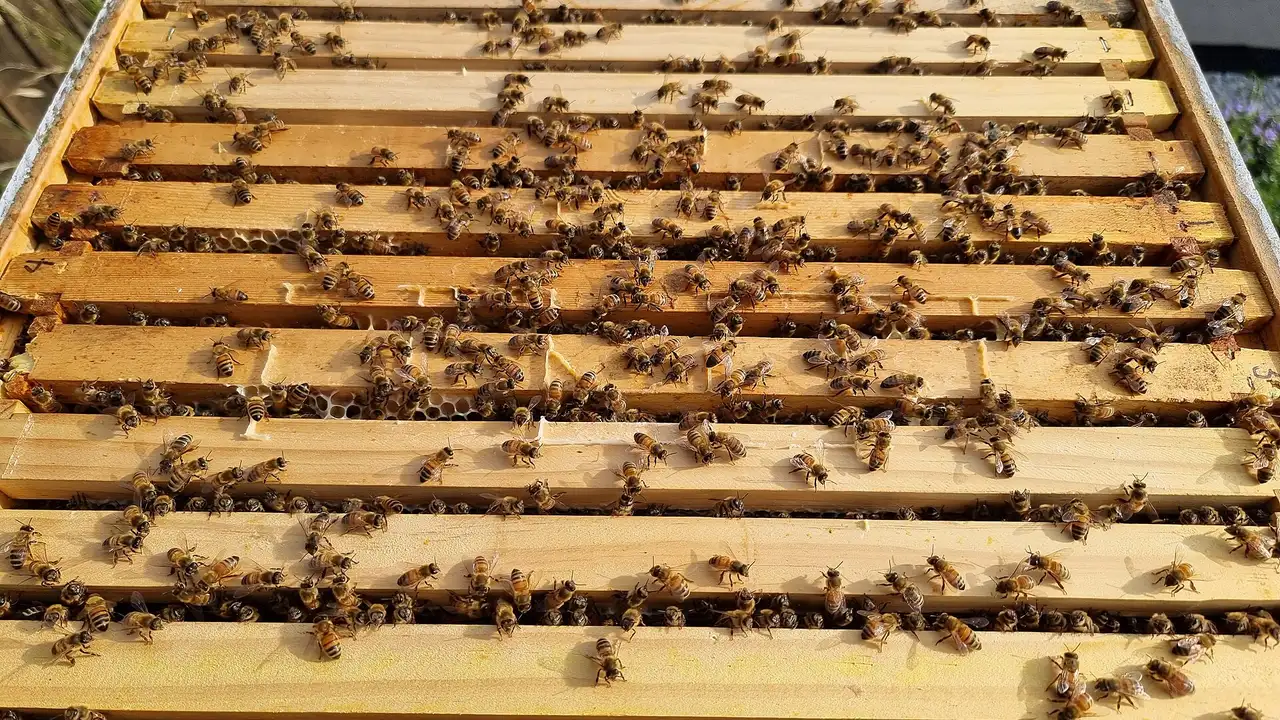
Image credits: featured image, “Open Langstroth hive of Italian honeybees,” photo by Benlisquare via Wikimedia Commons, CC BY-SA 4.0, cropped.