Reviewed by Sofia T. · How we review
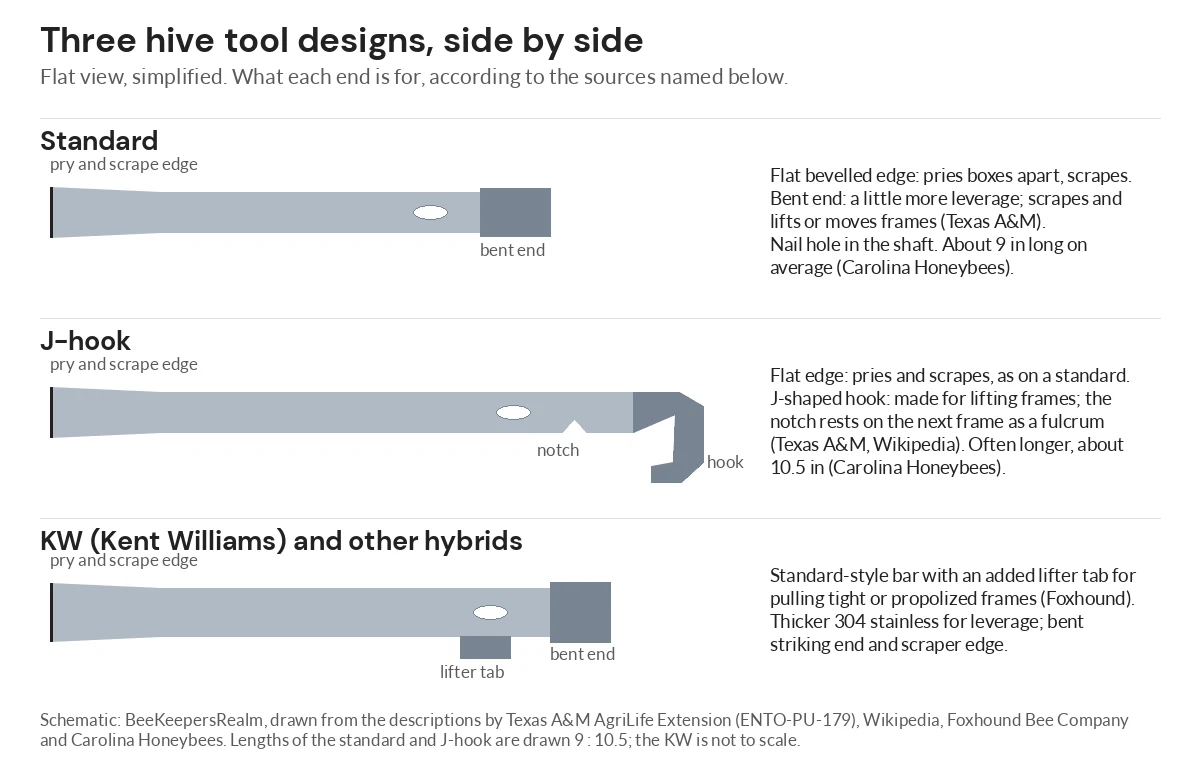
Hive tool types come down to two designs. A standard hive tool is a flat bar with a bevelled scraping edge and a bent end; a J-hook swaps the bent end for a hook that lifts frames. The standard tool is the all-rounder, the J-hook is gentler on stuck frames, and many beekeepers own both. Hybrids such as the Kent Williams (KW) tool add a lifter tab to a standard bar.
Key Takeaways
- Both designs pry boxes apart and scrape; the J-hook adds a hook made for lifting frames, according to Texas A&M AgriLife Extension.
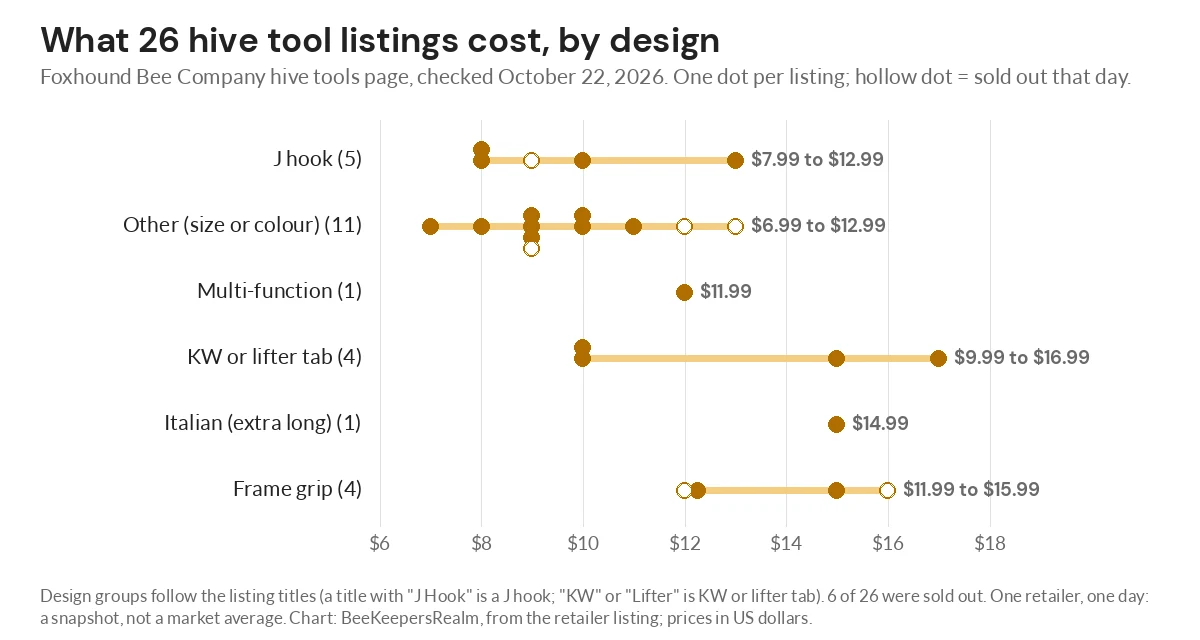
- At one US retailer on October 22, 2026, J-hook listings ran $7.99 to $12.99, overlapping tools listed by size or colour at $6.99 to $12.99. KW and lifter-tab tools ran $9.99 to $16.99.
- Sources disagree on where the hook goes and on what an “Italian” tool is, so check the product photo, not the name.
- Stainless steel outlasts paint and chrome plating, and a spare is cheap insurance.
Standard vs J-Hook at a Glance
| Standard | J-hook | KW and hybrids | |
|---|---|---|---|
| Shape | Flat bevelled edge, bent end | Flat edge, J-shaped hook, notch | Standard bar plus a lifter tab |
| Best at | Prying boxes apart, scraping | Lifting the first frame, tight brood boxes | Pulling propolized frames, leverage |
| Typical length | About 9 in | Often 10.5 in | Varies; thicker steel |
| Watch out for | Feels blunter to some beekeepers | Hook under the frame lugs can break them | Heavier than a standard tool |
| Listing price, Oct 22, 2026 | $6.99 to $12.99 (listed by size or colour) | $7.99 to $12.99 | $9.99 to $16.99 |
Lengths come from Carolina Honeybees, cautions from Wikipedia, Hornsby Beekeeping and Foxhound Bee Company, and prices from the retailer check described below.
In this 18-minute 2021 video, Betterbee’s description says it covers its three favorite hive tools, plus handling frames, boxes and the smoker.
The Standard Hive Tool
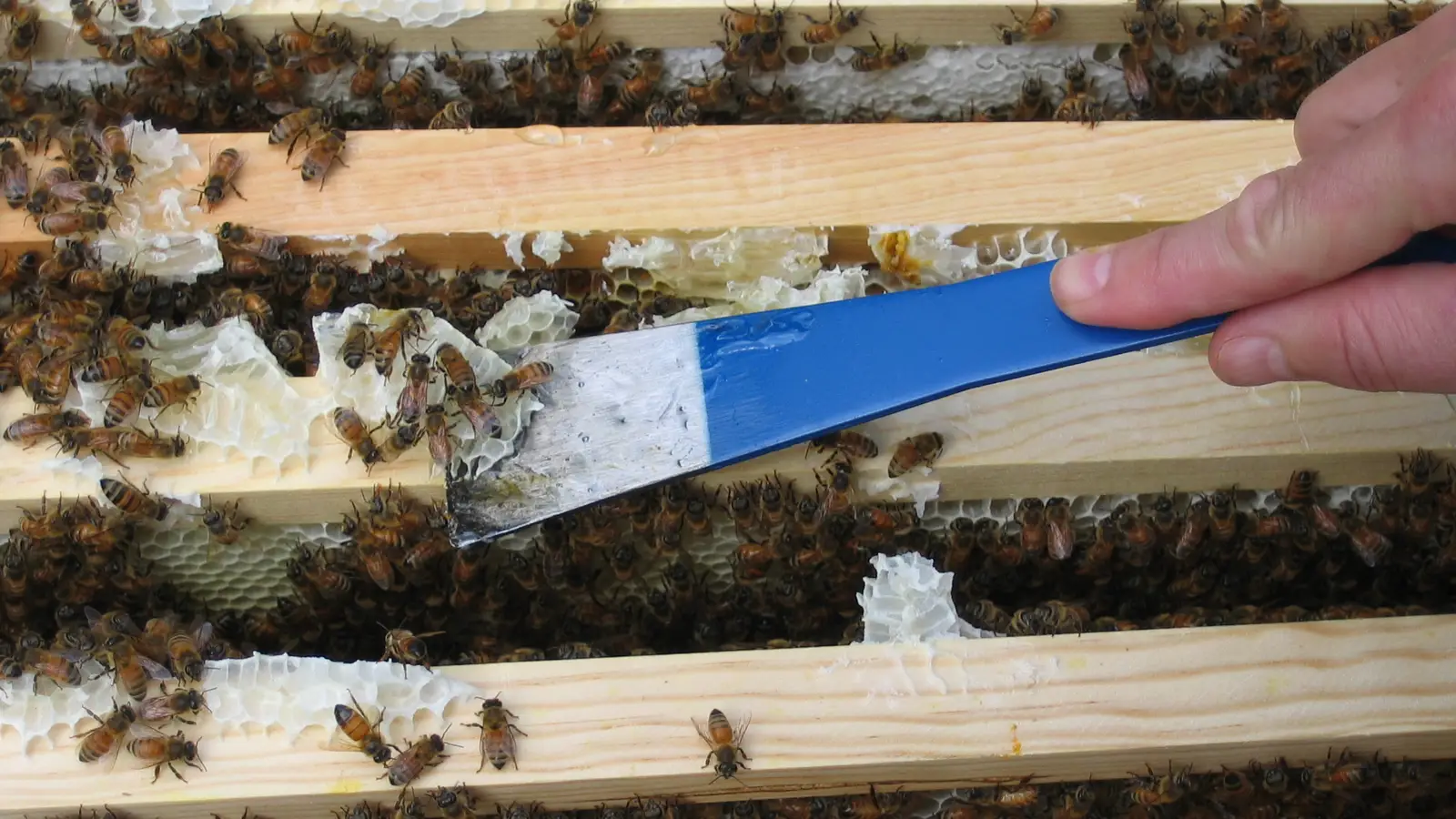
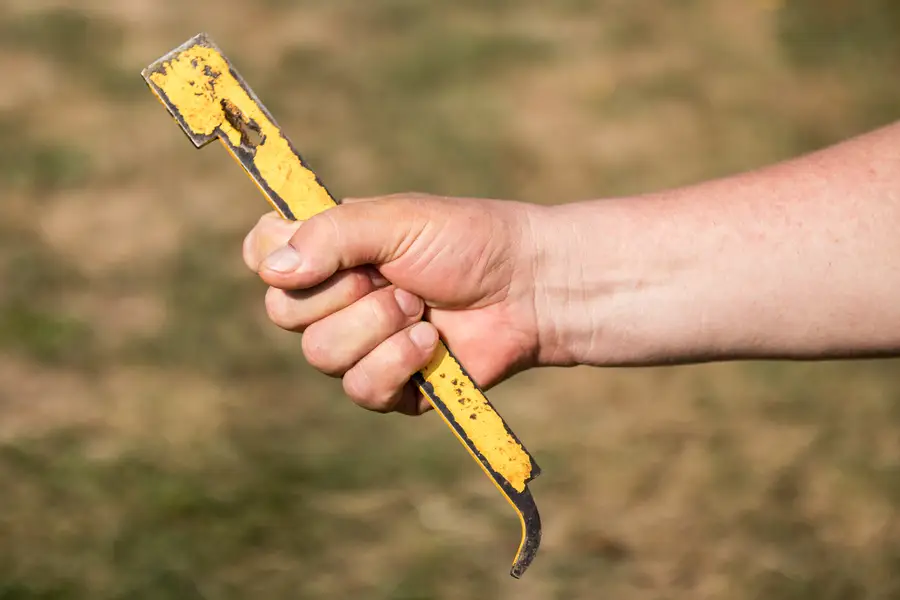
Texas A&M describes the standard tool as a flat, sharpened end for prying between boxes and moving frames, with a curved opposite end for leverage and scraping. Wikipedia says it is made from plate metal bent at 90 degrees. Leverage depends on grip: the Scottish Beekeepers’ Association says most tools give 4 or 5 to 1 leverage if you hold the end of the handle. Carolina Honeybees says it is the one that generally comes in beginner kits; compare kits in our starter kit guide.
The J-Hook Tool, and Where Sources Disagree
“This hook is specially designed for lifting frames. It is slid under the top bar of one frame while the back corner catches and rests on the next frame over to act as a fulcrum.”
Others place the hook differently. Wikipedia warns against using it under the frame lugs, where it will not fit and may break them off; Hornsby Beekeeping, an Australian supplier, says it catches under the lug. Writing about British frames, the Scottish Beekeepers’ Association says the conventional tool suits long-lugged frames, and:
“[T]he J tool is essential for short lugged frames and probably superior even for long lugged frames.”
Practise on a spare frame and keep the hook off the lugs. If grip strength is the problem, a frame grip lifts with one hand; see our frame grip guide and beekeeping with limited mobility.
KW, Italian, Multi-Tool and Maxant Designs
- KW. Foxhound describes it as a standard bar with an added lifter tab, in thick 304 stainless steel. Bee Professor calls it a mix of J-hook and standard.
- Italian. The name is unreliable. The Scottish association uses it for the J type, Bee Professor for an extra-long, thin tool, and Foxhound sells an “Extra Long Italian” at $14.99.
- Multi-tool. Carolina Honeybees lists a nail puller, queen excluder cleaner and detachable hammer, in a thicker tool that is harder to manage.
- Mini. About 6 inches, pocket-sized and easy to lose; it needs more hand strength.
- Maxant. Museum records at Ingenium say hive tools kept a similar design from the late 19th century until Maxant introduced a new one in 1977. William T. Maxant’s design patent D248,086 was filed in August 1976 and granted in June 1978. We could not check a current Maxant listing, so it is not in the price check.
Materials, Size and Price
Hornsby says stainless steel lasts longer, resists rust and handles pressure better than chrome plating. Bee Professor notes that paint wears off, which is why a bright handle fades.
Carolina Honeybees puts common lengths at 8 to 10.5 inches; Bee Professor says pocket tools run about 6 inches and long ones reach 15. We checked prices rather than quoting a guide’s estimate. On October 22, 2026, Foxhound Bee Company’s hive tools page listed 26 tools from $6.99 to $16.99, six of them sold out. The two listings naming stainless steel cost $12.99 and $14.99. Worker and Hive’s 10.5-inch chrome-plated J-hook (workerandhive.com, same day) was $12.99.
How to Choose
- Starting out: buy a standard tool and a spare. Hive tools are easy to lose in grass.
- Tight brood boxes or weak grip: add a J-hook.
- Glued-shut boxes: choose thicker steel, such as a standard or KW.
- Heavy supers: handles matter more than the tool; see hive handle types. Cappings come off with a knife; see uncapping knife types.
Care and Sanitising
Carolina Honeybees advises scraping off wax and propolis after every use, then washing with warm soapy water, with rubbing alcohol for sticky residue. After disease, follow how to disinfect hive tools. Keep your free hand out of the blade’s path when scraping.
Frequently Asked Questions
Is a J-hook better than a standard hive tool?
Not across the board. The J-hook lifts frames more easily; Hornsby Beekeeping says the standard tool gives more leverage on glued-shut boxes.
Which hive tool should a beginner buy?
A standard tool, plus a spare. Add a J-hook once you know whether frame lifting or box prying gives you more trouble.
What is the hole in a hive tool for?
Pulling nails, like a claw hammer, according to Carolina Honeybees and Wikipedia. Bee Professor adds that it works for hanging the tool up.
What is a Kent Williams (KW) hive tool?
A standard-style tool with an added lifter tab, combining the reach of a standard tool with easier frame lifting.
How long should a hive tool be?
Most run 8 to 10.5 inches. Mini tools are about 6 inches; longer ones give more leverage.
Is stainless steel worth paying for?
Usually. Hornsby says it resists rust and lasts longer than chrome plating, and the two stainless listings in our price check both cost more than the average listing ($11.12).
The Bottom Line
Buy a standard tool and a spare, add a J-hook if lifting frames is the hard part, and sort your tools before the first spring inspection.
Image credits: Hero photo: Joe DeLuca, via Wikimedia Commons, CC BY 2.0, cropped; see the file page.