Last Updated September 15, 2026
Every closed-population breeding line and every carefully controlled genetic cross in modern queen breeding – including work like the New World Carniolan breeding program covered elsewhere on this site – depends on a technique that took three named researchers and nearly two decades to perfect: instrumental insemination, the controlled, deliberate fertilization of a queen bee under laboratory conditions rather than during a natural mating flight. Our existing guide to instrumental insemination in queen breeding covers how the modern technique actually works today; this article instead covers the history behind it – the early failed attempts, the researchers who gradually made it reliable, and the specific 1944 anatomical discovery that finally made success repeatable.
Key Takeaways
- Cornell researcher Lloyd R. Watson built the first working insemination device in 1927, proving the concept but not making it reliable.
- USDA researcher Otto Mackensen, working at the Southern States Bee Culture Laboratory in Baton Rouge, refined the equipment through the late 1930s and introduced carbon dioxide anesthesia in 1944.
- Harry Laidlaw’s real breakthrough was anatomical, not mechanical: in 1944 he identified the “valve fold,” a flap of tissue blocking semen from reaching the oviduct, and worked out how to bypass it – the specific discovery that made insemination reliably successful.
- Laidlaw joined UC Davis in 1947 and became known as the “Father of Honey Bee Genetics,” publishing a teachable methodology that let the technique spread beyond a handful of research labs.
Table of Contents
- Key Takeaways
- Why Beekeepers Wanted Controlled Mating
- Lloyd Watson’s 1927 First Attempt
- Otto Mackensen’s Refinements
- Harry Laidlaw and the Valve Fold
- What Actually Changed Once It Worked
- Modern Breeding Applications
- The Genuine Technical Challenge Involved
- This History in the Wider Story of Bee Genetics
- Natural Mating vs. Instrumental Insemination
- Common Misconceptions
- FAQ
Why Beekeepers Wanted Controlled Mating
Queens naturally mate in flight with multiple drones from a wide, largely uncontrollable pool at a drone congregation area, meaning a breeder attempting to select for specific desirable traits has no reliable way to control which drones actually contribute genetics to the next generation under natural conditions. This randomness is a genuine, fundamental obstacle to serious selective breeding – a breeder can carefully select which queen to raise, but without control over mating, half of the resulting colony’s genetics remain essentially unpredictable, undermining the entire premise of a structured breeding program the way it would in almost any other selectively bred animal.
Lloyd Watson’s 1927 First Attempt
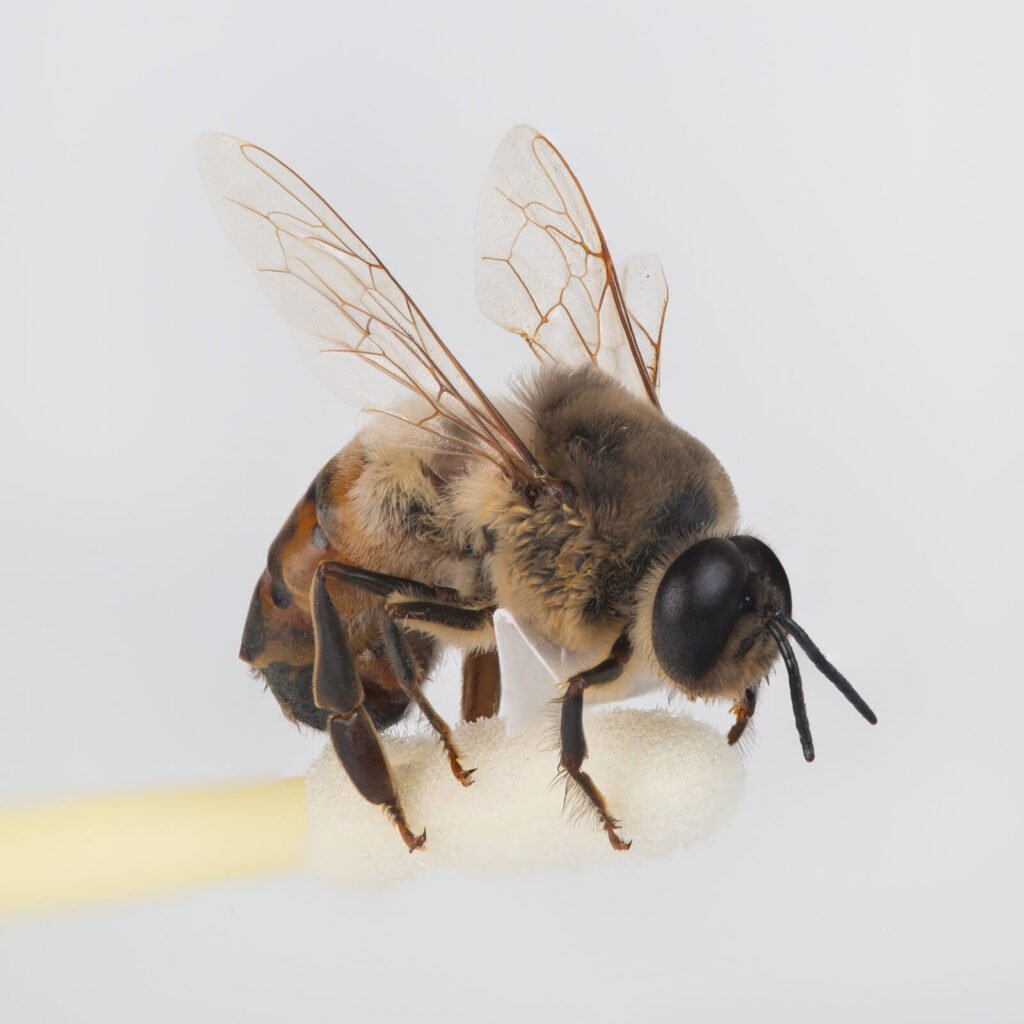
Cornell University researcher Lloyd R. Watson built the first working instrumental insemination device in 1927 and used it to inseminate a small number of queens – the first time it had been done at all. It was a genuine proof of concept, not yet a reliable method: the physical scale involved is extremely small, queen reproductive physiology was not yet well understood, and reliably keeping a queen alive, healthy, and successfully inseminated after the procedure proved considerably harder than the basic concept suggested. Watson’s work, followed by further equipment development from W.J. Nolan in the mid-1930s, established that the idea was viable and identified the specific technical problems later researchers would need to solve – genuinely important groundwork, even though it did not yet produce a technique reliable enough for practical, widespread breeding use.
Otto Mackensen’s Refinements
USDA researcher Otto Mackensen, working at the Southern States Bee Culture Laboratory in Baton Rouge, Louisiana, began improving on Watson’s and Nolan’s equipment starting around 1935. His most significant single refinement came in 1944, when he reported using carbon dioxide to anesthetize queens during the procedure – queens inseminated this way started laying eggs earlier and more reliably than with prior methods. Mackensen later co-authored a detailed USDA manual on the technique with Joseph Roberts in 1948, documenting the method and the results beekeepers could expect. Mackensen’s work represents a genuinely important intermediate stage in this history: real, substantial technical progress building directly on Watson’s proof of concept, refining equipment and procedure in ways that made Laidlaw’s eventual full breakthrough possible.
Harry Laidlaw and the Valve Fold
Harry Hyde Laidlaw Jr. (1907-2003) made the discovery that actually solved the reliability problem, and it was anatomical rather than purely mechanical. In 1944, Laidlaw identified the “valve fold” – an invaginated flap of tissue inside the queen’s reproductive tract that was blocking semen from reaching the oviduct in most insemination attempts, regardless of how good the equipment was. Working out how to bypass the valve fold and place semen where it would actually reach the spermatheca is the specific discovery that turned instrumental insemination from an unreliable, hit-or-miss procedure into a routinely repeatable one. Laidlaw joined the University of California, Davis in 1947 as a professor of apiculture, where he had the sustained institutional research position to document and publish a complete, teachable methodology – work that later earned him recognition as the “Father of Honey Bee Genetics.” That published, replicable methodology, not just the underlying discovery itself, is what let instrumental insemination spread from a handful of pioneering researchers into standard practice at breeding programs and research institutions worldwide.
What Actually Changed Once It Worked
Once instrumental insemination became genuinely reliable, it fundamentally changed what controlled honeybee breeding programs could actually accomplish, allowing breeders to control both parents of a cross with real precision for the first time, rather than controlling only the queen side of a mating while leaving drone contribution essentially random. This capability is what made closed-population breeding lines – maintaining and improving specific genetic lines across many generations without introducing uncontrolled outside genetics – genuinely achievable at scale, a foundational capability for essentially all serious modern honeybee genetic research and selective breeding work.
Modern Breeding Applications
Instrumental insemination remains the essential technical foundation behind modern trait-specific breeding programs, including varroa-resistance breeding covered in our VSH bees genetics guide and closed-population conservation breeding like the New World Carniolan program. Without reliable controlled mating, none of these programs could maintain the genetic precision and consistency they depend on – every time a modern breeder controls a specific genetic cross for a specific trait, they are directly relying on the technique Laidlaw and his predecessors spent nearly two decades developing.
The Genuine Technical Challenge Involved
Successfully inseminating a queen honeybee under laboratory conditions requires precise, careful work at an extremely small physical scale, combined with methods for safely immobilizing the queen (Mackensen’s carbon dioxide anesthesia remains standard) without harming her, and the detailed understanding of queen reproductive anatomy – specifically the valve fold – that Laidlaw’s research finally worked out. This combination of required precision, specialized equipment, and biological knowledge is exactly why the technique took three researchers across nearly two decades to perfect, rather than being something a single motivated individual could work out through trial and error alone in a short period.
This History in the Wider Story of Bee Genetics
The development of instrumental insemination sits alongside Johann Dzierzon’s 19th-century discovery of bee parthenogenesis as one of the genuinely foundational chapters in the scientific understanding and practical control of honeybee reproduction. Dzierzon’s work explained the underlying reproductive biology; instrumental insemination, developed roughly a century later, gave breeders the practical tool to actually act on and control that biology with precision. Together, these two chapters represent a complete arc from scientific understanding to practical application – understanding how bee reproduction actually works, and then developing the technical capability to deliberately direct it toward specific breeding goals.
Natural Mating vs. Instrumental Insemination
| Aspect | Natural Mating Flight | Instrumental Insemination |
|---|---|---|
| Drone selection control | None – open mating with local drone population | Full control over specific drone genetics used |
| Number of drones contributing | Multiple, typically a dozen or more | Precisely controlled by the breeder |
| Breeding program suitability | Limited for precise trait selection | Essential for closed-population and trait-specific breeding |
| Equipment and skill required | None beyond normal queen management | Specialized equipment and trained technique (developed 1927-1947) |
Common Misconceptions
- “Instrumental insemination was invented and perfected all at once.” It developed over roughly two decades, from Watson’s 1927 proof-of-concept device through Mackensen’s late-1930s/1944 refinements to Laidlaw’s 1944 valve-fold discovery and his 1947-onward published methodology at UC Davis.
- “Laidlaw invented the insemination equipment.” The equipment traces back to Watson and Nolan; Laidlaw’s specific breakthrough was anatomical – identifying the valve fold that had been silently sabotaging earlier attempts – and then documenting a complete, teachable procedure around it.
- “Any beekeeper can easily perform instrumental insemination.” It requires specialized equipment and trained technique, which is precisely why Laidlaw’s contribution of a documented, teachable methodology was so significant for wider adoption.
Frequently Asked Questions
Who is credited with developing modern instrumental insemination?
Harry Laidlaw, working at the University of California, Davis from 1947 onward, is credited with the breakthrough that made the technique reliable – identifying the “valve fold” in 1944 and documenting a complete, teachable methodology. He built on earlier work by Cornell’s Lloyd Watson (1927) and USDA researcher Otto Mackensen (refinements through the 1940s).
What was the “valve fold” and why did it matter?
It was a flap of tissue inside the queen’s reproductive tract that blocked semen from reaching the oviduct in most early insemination attempts, regardless of how good the equipment was. Laidlaw identified it in 1944 and worked out how to bypass it – the specific anatomical discovery that turned instrumental insemination from unreliable into routinely repeatable.
Why did beekeepers need instrumental insemination at all?
Natural mating flights involve queens mating with an uncontrollable pool of drones, making precise selective breeding for specific traits essentially impossible without a way to control which drones actually contribute genetics.
Who first attempted instrumental insemination, and did it work?
Cornell researcher Lloyd R. Watson built the first working device in 1927 and inseminated a small number of queens – a genuine proof of concept, but not yet a reliable technique. His work identified the real technical problems later researchers, including Mackensen and Laidlaw, needed to solve.
What did Otto Mackensen actually contribute?
Working at the USDA’s Southern States Bee Culture Laboratory in Baton Rouge from around 1935, Mackensen refined the insemination equipment and, in 1944, introduced carbon dioxide anesthesia for queens – a technique still used today – before co-authoring a detailed USDA manual on the method in 1948.
What modern breeding programs depend on instrumental insemination?
Closed-population conservation breeding lines and trait-specific breeding programs, including varroa-resistance genetics research, depend directly on the precise controlled mating instrumental insemination makes possible.
Is instrumental insemination the same as natural queen mating?
No – it allows breeders to control both the queen and specifically selected drone genetics with precision, unlike natural mating flights, which involve an uncontrollable pool of local drones.
Further Reading
- The History of the Honey Extractor: The Invention That Let Beekeepers Stop Destroying Comb
- Moses Quinby: The Father of Practical American Beekeeping
- New Zealand’s Beekeeping History: From Cotton’s First Hives to the Manuka Boom
For more on this topic, see Washington State University’s apiary program, a leader in queen bee instrumental insemination research and the UC Davis Harry H. Laidlaw Jr. Honey Bee Research Facility’s history page.
Image credits: Photo: Guillaume Pelletier, CC BY-SA 4.0, via Wikimedia Commons; Photo: Pollinator, CC BY-SA 3.0, via Wikimedia Commons.