In 1973, Karl von Frisch won the Nobel Prize for decoding the honeybee’s waggle dance — proof, he argued, that foraging bees communicate the direction and distance of food sources symbolically to their nestmates. Six years earlier, American biologist Adrian Wenner had launched a direct, sustained scientific challenge to that entire interpretation, arguing bees actually find food primarily through odor, not by decoding a symbolic dance at all. The resulting dispute ran for most of a decade, split serious researchers into real camps, and wasn’t conclusively settled in von Frisch’s favor until decades of follow-up work — including, eventually, direct tracking technology neither man had access to.
Key Takeaways
- Starting in 1967, Adrian Wenner argued that recruited honeybees find food primarily by matching remembered or hive-transmitted odors, not by decoding the symbolic distance-and-direction information in a forager’s waggle dance.
- Wenner and collaborators like Dennis Johnson called von Frisch’s dance-language interpretation “anthropomorphic,” accusing it of reading human-style symbolic communication into behavior that odor cues could explain more simply.
- The dispute ran through the late 1960s and into the early 1970s as a genuine, actively contested scientific controversy — not a fringe objection quickly dismissed by the mainstream.
- Von Frisch’s 1973 Nobel Prize in Physiology or Medicine effectively marked the point the dispute’s momentum shifted decisively in his favor, though Wenner continued defending his position for years afterward.
- James Gould’s experiments, in which he manipulated foragers so their dances indicated a site the dancing bee itself had never visited, provided some of the most direct evidence supporting von Frisch; later harmonic-radar tracking technology in the 2000s confirmed recruited bees really do fly toward the location the dance indicates.
Table of Contents
- Von Frisch’s Original Discovery
- Wenner’s Odor-Based Challenge
- How the Dispute Actually Played Out
- How It Was Resolved
- A Word-Choice Fight, Too
- How This Differs From Our Other Waggle Dance Coverage
- What the Controversy Says About How Science Actually Works
- Frequently Asked Questions
Von Frisch’s Original Discovery
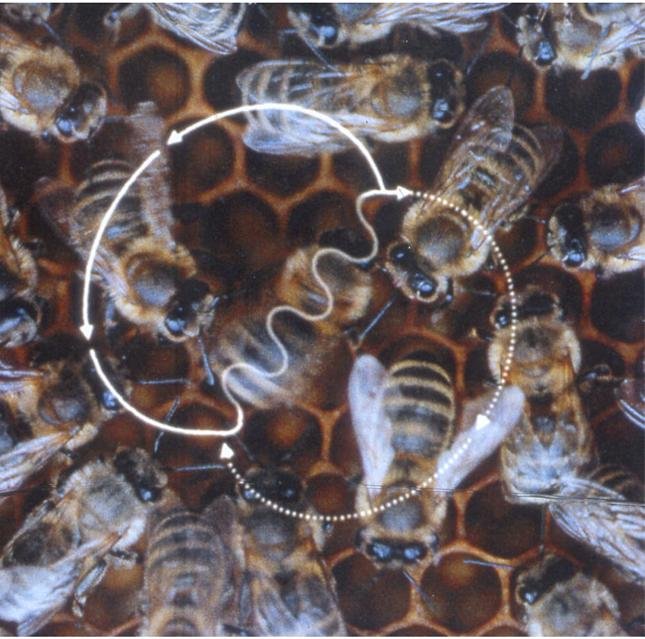
Karl von Frisch, an Austrian-German ethologist, began publishing on honeybee sensory perception and communication in the 1920s, describing his early findings in the 1927 book Aus dem Leben der Bienen (“The Dancing Bees”). He continued refining the work for decades, and by the mid-1940s had concluded that a returning forager’s waggle-dance pattern — the angle of the straight “waggle run” relative to vertical, and its duration — symbolically encodes the direction and distance of a food source relative to the sun, information other foragers could decode and use to fly directly to a site they’d never visited themselves. He published the fuller account in 1946’s Die Tänze der Bienen (“The Dance of the Bees”). Our own dedicated profile of von Frisch covers this original discovery process in full detail.
Wenner’s Odor-Based Challenge
Beginning in 1967, American biologist Adrian Wenner mounted a sustained, serious scientific challenge to von Frisch’s dance-language interpretation. Wenner and collaborators, including Dennis Johnson, proposed that recruited bees weren’t decoding symbolic dance information at all — they argued bees located food primarily by matching odors carried on a successful forager’s body, or transmitted within the hive, against known or actively sought-out floral scents. On this account, the dance itself might be a genuine behavior, but the information actually guiding recruits to a food source was olfactory, not the symbolic distance-and-direction code von Frisch described.
Wenner and Johnson argued that von Frisch’s dance-language interpretation was an “anthropomorphic interpretation” — reading human-style symbolic communication into behavior that a simpler explanation, odor matching, could account for just as well.
This wasn’t a minor academic footnote. Wenner was a credentialed, active researcher making a specific, testable empirical claim, and for a period of years it was a genuinely open scientific question which explanation better fit the evidence — a real, unresolved dispute playing out in peer-reviewed journals, not a fringe theory the field simply ignored.
How the Dispute Actually Played Out
The controversy ran hardest through the late 1960s and into the early 1970s, with both camps publishing experimental results they argued supported their position. Von Frisch, notably, had spent much of his career specifically arguing against anthropomorphizing bee behavior himself — he maintained that the dance’s information content was a sophisticated instinctive behavior, not evidence of bee-level intelligence or human-like symbolic reasoning, which made Wenner’s “anthropomorphic” framing of von Frisch’s own position a particularly pointed line of attack. The historical record of the dispute, documented in detail in Tania Munz’s peer-reviewed history-of-science article “The Bee Battles” (published in the Journal of the History of Biology), describes a genuinely contentious period in which the outcome was not a foregone conclusion to researchers living through it in real time.
How It Was Resolved
The dispute had largely run its course by 1973 — the year von Frisch received the Nobel Prize in Physiology or Medicine for his sensory-physiology discoveries, including the dance-language work. Wenner withdrew from active bee research not long afterward. But the Nobel Prize alone wasn’t the scientific resolution; it reflected the field’s accumulating judgment rather than settling the empirical question by itself. The more direct experimental vindication came from biologist James Gould, whose clever manipulation experiments tricked foragers into performing dances that indicated a location the dancing bee itself had never actually visited — and recruited bees still flew toward the false location the dance indicated, evidence that recruits were following the dance’s symbolic information rather than an odor trail the dancer could never have laid down at a site it hadn’t visited. Decades later, in the 2000s, harmonic radar tracking technology — attaching a small transponder to individual bees and tracking their actual flight paths — gave researchers direct, independent confirmation that recruited bees really do fly toward the location a dance indicates, closing out the empirical question with tracking technology neither von Frisch nor Wenner had access to during the original dispute. JSTOR Daily’s own retrospective on the dispute covers this full arc, from initial challenge to eventual resolution, for readers wanting the broader historical narrative in one place.
A Word-Choice Fight, Too
Part of what made the dispute so contentious wasn’t purely empirical — it was also about terminology and what that terminology implied. Calling the waggle dance a “language,” as popular accounts of von Frisch’s work often did, suggested something closer to genuine symbolic communication with grammar-like structure, an implication that made some scientists (including, at times, von Frisch himself, who was careful about anthropomorphizing) uncomfortable, and gave Wenner’s camp a rhetorical opening: if the phenomenon didn’t require symbolic “language” to explain, simpler mechanisms like odor-matching deserved serious consideration first, on grounds of scientific parsimony. That tension between how a finding gets popularly described and what the underlying data actually supports is a recurring pattern in science communication generally, and the dance-language dispute is a well-documented early example of it playing out in real time within a live research controversy.
How This Differs From Our Other Waggle Dance Coverage
It’s worth being explicit about how this article differs from two other pieces already on this site, since all three cover related but genuinely distinct territory. Karl von Frisch and the Discovery of the Waggle Dance covers the original 1920s–40s discovery process itself. Honeybee Dance Dialects: Why the Waggle Dance Differs covers documented geographic variation in dance “dialects” across honeybee subspecies. This article is specifically about the multi-year scientific controversy over whether the dance conveys real symbolic information at all — a dispute about the discovery’s validity, not about the discovery itself or its regional variants.
This educational video, produced by Georgia Tech’s College of Computing, walks through the mechanics of the dance itself and the evidence for its informational content:
What the Controversy Says About How Science Actually Works
The Wenner–von Frisch dispute is a genuinely useful case study in how contested scientific claims actually get resolved — not by a single decisive experiment or a Nobel committee’s judgment alone, but through years of accumulating, independently replicated evidence from multiple different methods (behavioral manipulation experiments, and eventually direct flight-path tracking) that all converged on the same answer. It’s also a reminder that a serious, credentialed researcher mounting a sustained challenge to an already-celebrated finding isn’t automatically wrong, and isn’t automatically right either — Wenner’s odor hypothesis was a real, testable scientific claim that took real evidence, gathered over real time, to rule out as the primary explanation.
Frequently Asked Questions
Who was Adrian Wenner?
An American biologist who, starting in 1967, argued that honeybees find food primarily through odor cues rather than by decoding symbolic distance-and-direction information from the waggle dance, directly challenging Karl von Frisch’s interpretation.
Was Wenner’s odor hypothesis completely wrong?
Odor does play a real role in how bees locate specific flowers once they’re in the general area a dance indicates — Wenner wasn’t wrong that odor matters. The dispute was over whether odor alone explained recruitment, versus the dance conveying real, usable symbolic information; the evidence ultimately supported the dance carrying genuine directional information beyond what odor alone could account for.
When was the dance-language controversy resolved?
It had largely run its course by 1973, the year von Frisch won the Nobel Prize, though the most direct experimental evidence came somewhat later from James Gould’s manipulation experiments, and definitive tracking confirmation didn’t arrive until harmonic radar studies in the 2000s.
Did Karl von Frisch respond directly to Wenner’s challenge?
Yes — the dispute played out actively in the scientific literature through the late 1960s and early 1970s, with von Frisch and his supporters directly engaging Wenner’s odor-based claims and counter-evidence throughout the period.
What ended Adrian Wenner’s involvement in bee research?
He largely withdrew from active bee research not long after the dispute’s momentum shifted following von Frisch’s 1973 Nobel Prize, though he continued to defend his position in later writing.
Is this the same as the article about waggle dance dialects on this site?
No — that article covers documented regional variation in dance patterns across honeybee subspecies. This one covers the historical scientific dispute over whether the dance conveys real information in the first place.