Medieval bestiaries — illustrated manuscripts describing (and moralizing about) animals — got bees more right than most of their other entries, correctly describing organized colony life, a monarch-led social structure, and industrious cooperation centuries before anyone could explain the biology behind it, while still repeating real errors like the belief that bees were born asexually from nothing and led by a “king” rather than a queen. This is a genuine case where medieval natural history was closer to observation than superstition — mixed with exactly the kind of error you’d expect from an era with no microscope and a habit of treating animals as moral lessons first and biological subjects second.
Bestiaries are usually remembered today for their more fantastical entries — unicorns, basilisks, phoenixes rising from flame. Bees are a quieter but genuinely interesting case: an entry medieval scribes could actually watch happen in a skep in their own garden, which shows in how much closer to reality it gets compared to entries about creatures nobody had ever seen.
Key Takeaways
- Bestiaries drew their animal lore chiefly from the Physiologus, a 2nd-century Greek text, itself compiling earlier observations from Aristotle, Pliny the Elder, and other classical naturalists.
- Medieval bestiary bee entries generally got right: organized colony structure, a single ruling figure, cooperative labor, and defensive behavior — genuinely accurate observations for the era.
- They got wrong: the ruling bee’s sex (described as a “king,” not a queen — a belief that persisted in learned writing until Charles Butler’s 1609 Feminine Monarchie pushed back on it in English, and Jan Swammerdam’s 1670s dissections proved it conclusively), and the belief that bees generated spontaneously rather than being born from eggs.
- Bestiaries were fundamentally moral teaching tools, not natural history in the modern sense — an animal’s behavior was described specifically to illustrate a virtue or vice for the reader, which shaped what got emphasized and what got invented.
- The most famous surviving example, the Aberdeen Bestiary (circa 1200), is a lavishly illuminated 12th-century English manuscript now digitized and viewable online by the University of Aberdeen.
Table of Contents
- Where Bestiary Animal Lore Actually Came From
- What Bestiaries Got Right About Bees
- What Bestiaries Got Wrong
- Why Bestiaries Existed: Moral Instruction, Not Zoology
- Frequently Asked Questions
Where Bestiary Animal Lore Actually Came From
Almost every medieval bestiary traces its core content back to the Physiologus, an anonymous 2nd-century Greek text that was itself a compilation of animal descriptions drawn from earlier classical writers — the Aberdeen Bestiary’s own text explicitly folds in “relevant comments by other ancient authors such as Aristotle, Herodotus, Pliny the Elder, and Aelian.” This matters for bees specifically because Aristotle had actually made careful, largely accurate first-hand observations of hive behavior centuries earlier (a topic covered in depth in our piece on Aristotle’s surprisingly accurate bee observations) — so some of what reads as impressively correct in a 12th-century bestiary is really secondhand Aristotle, filtered through a thousand years of Latin copying and moral reinterpretation.
What Bestiaries Got Right About Bees
Compared to entries for animals no medieval scribe had ever seen, the bee entry benefits enormously from being about a creature anyone could observe in their own garden. Bestiaries correctly described bees as living in organized, cooperative societies under a single ruling figure, engaging in coordinated labor (foraging, building, defending the colony), and exhibiting real discipline and industriousness — the swarm was even described, in one commonly repeated bestiary image, as moving with the orderly formation of “shuttlecocks streaming into their hives,” a comparison that reads as almost comically formal to modern eyes but reflects a real, careful observation of swarm behavior rather than pure invention.
This baseline accuracy is exactly why bees became such a popular moral symbol throughout the medieval period, a theme our broader piece on bee symbolism across cultures traces well beyond the bestiary tradition — a creature genuinely observed to be industrious, cooperative, and orderly made a far more credible teaching example than an imaginary monster.
What Bestiaries Got Wrong
Two errors recur across the bestiary tradition. First, the ruling bee was almost universally described as a “king,” not a queen — a mistake that persisted in learned European writing for centuries after bestiaries fell out of fashion, only seriously challenged in English by Charles Butler’s 1609 The Feminine Monarchie and not conclusively settled until Jan Swammerdam’s microscope dissections in the 1670s proved the ruling bee was anatomically female. Bestiary-era observers had no way to determine this without dissection, so the error is more a limitation of available tools than of careful observation.
This specific error was one Charles Butler’s 1609 The Feminine Monarchie directly challenged in English, based on years of his own hive observation, and Jan Swammerdam’s 1670s dissections eventually confirmed anatomically — a reminder of just how long a bestiary-era error could survive once repeated by enough subsequent authorities.
Second, and more consequential for how bestiaries functioned as texts: bees were frequently described as generated spontaneously — born from nothing, or in some medieval and classical variants, from the decaying carcass of an ox (a belief known as bugonia, inherited from far older Mediterranean tradition and repeated well after any careful beekeeper could have observed brood comb and larvae directly). This wasn’t unique to bees — spontaneous generation was a widely accepted explanation for the origin of many small creatures until well into the early modern period — but it shows how a moral-teaching tradition could preserve an obviously testable error for a very long time simply because nobody with the text’s authority thought to test it.
Why Bestiaries Existed: Moral Instruction, Not Zoology
It’s worth being explicit about what a bestiary actually was, since it explains both the accuracy and the errors: these were didactic Christian teaching texts, using the natural world (real or imagined) as a vehicle for illustrating virtues, vices, and biblical lessons — not an attempt at objective natural history in the modern sense. An animal’s behavior was recorded specifically because of the moral lesson it could support; bees were prized examples of industry, cooperative community, and loyalty to a ruler, which is precisely why their real, observable social behavior got preserved reasonably accurately while their reproduction (harder to observe, and less relevant to the moral lesson being taught) stayed wrong for centuries.
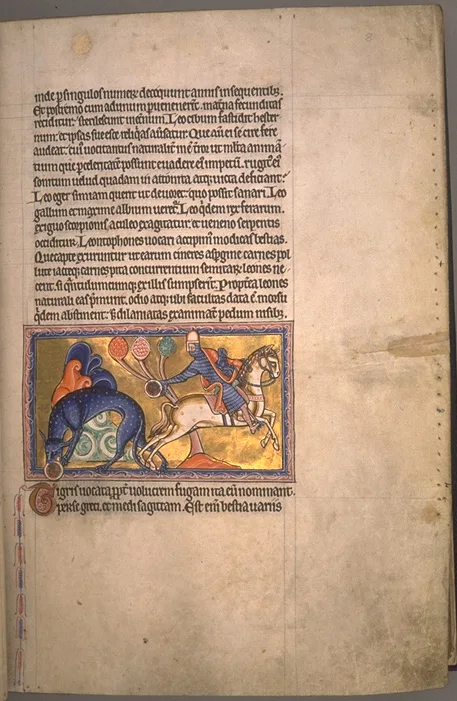
The most celebrated surviving example of the form is the Aberdeen Bestiary, a richly illuminated 12th-century English manuscript (Aberdeen University Library MS 24, dated to around 1200) that was once owned by Henry VIII and is now fully digitized and freely viewable through the University of Aberdeen. Like most surviving bestiaries, it pairs its animal entries with elaborate gold-leaf illustrations — the folio pictured with this article shows the bestiary’s characteristic illuminated style, applied here to one of its many animal entries, as an example of the format’s visual richness rather than the manuscript’s specific bee folio. The full manuscript, including its animal entries, has been digitized and is freely viewable through the University of Aberdeen’s Aberdeen Bestiary project.
Frequently Asked Questions
Did every medieval bestiary include an entry on bees?
Most did, since bees were a well-established moral symbol carried forward from the Physiologus tradition, but exact content, length, and emphasis varied between individual manuscripts, since bestiaries were hand-copied and often edited or reordered by individual scribes and patrons.
When did people stop believing bees had a king rather than a queen?
The belief was seriously challenged in English by Charles Butler’s 1609 The Feminine Monarchie, based on careful observation, but wasn’t proven beyond dispute until Jan Swammerdam’s microscope dissections in the 1670s identified female reproductive anatomy in the ruling bee directly.
Are bestiaries a reliable source for medieval beekeeping practices?
Not really — bestiaries describe bee behavior and symbolism for moral instruction, not practical apiculture. For actual medieval beekeeping practice and records, sources like England’s 1086 Domesday Book (which documented real honey renders and beekeepers) are far more useful primary sources.
Can I view an actual medieval bestiary online today?
Yes — the Aberdeen Bestiary has been fully digitized in high resolution by the University of Aberdeen and is freely viewable online, page by page, including its illuminated animal entries and marginal notes.
The bee entry is one of the better arguments that medieval natural history wasn’t uniformly superstitious nonsense — when scribes could actually watch the animal in question, as they could with bees, the results held up surprisingly well against what modern biology would later confirm.