Published September 3, 2026
Every bumblebee queen most people picture starts her own colony from scratch — finding a nest site, laying eggs, and raising the first generation of workers herself. Cuckoo bumblebees, classified in the subgenus Psithyrus within the genus Bombus, skip that entire process. Instead, they invade an already-established bumblebee colony and hijack its workforce, a genuinely different, more elaborate strategy from the broader cuckoo bee phenomenon covered elsewhere on this site.
Table of Contents
- What Are Cuckoo Bumblebees?
- How This Differs From Other Cuckoo Bees
- Identification: No Pollen Baskets, Thicker Armor
- How a Colony Takeover Actually Happens
- Chemical Camouflage: How She Avoids Detection
- Host Specificity: Not Just Any Bumblebee Will Do
- Why Cuckoo Bumblebees Have No Worker Caste of Their Own
- A Conservation Story Tied to Their Host
- Any Relevance for Honeybee Beekeepers?
- Sting Risk to People and Pets
- Cuckoo Bumblebees vs. True Bumblebees
- Common Identification Mistakes
- Frequently Asked Questions
What Are Cuckoo Bumblebees?
Cuckoo bumblebees are a group of bumblebee species, classified in the subgenus Psithyrus within the broader genus Bombus, that have evolved an obligate social parasite lifestyle: rather than founding and provisioning their own colony, a mated female invades an already-established colony of a host bumblebee species and takes over its reproductive output.
How This Differs From Other Cuckoo Bees
The general cuckoo bee strategy covered elsewhere on this site typically involves a female laying her eggs in the nest of a solitary bee, letting her offspring consume the pollen provisions the host female originally collected for her own young. Cuckoo bumblebees take this same underlying kleptoparasitic concept considerably further: instead of targeting a single-female solitary nest, they target an entire established social colony, complete with a host queen and a functioning worker force, and effectively redirect that whole colony’s labor toward raising the parasite’s own offspring rather than the host’s.
Identification: No Pollen Baskets, Thicker Armor
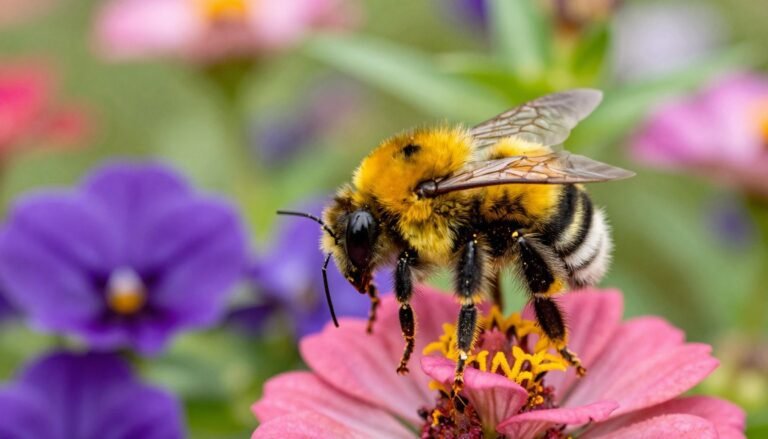
Because cuckoo bumblebees never provision their own nest cells, females lack the concave, hairless pollen-basket structure (corbicula) found on the hind legs of true bumblebee workers and queens, which is one of the more reliable field marks for telling the two apart on close inspection. Cuckoo bumblebees also tend to have noticeably thicker, more heavily sclerotized (hardened) exoskeletons than true bumblebees, an adaptation believed to help them survive stinging and biting attacks from a host colony’s defensive workers during a takeover attempt, along with generally duller, less densely fuzzy coloring than many true bumblebee species.
How a Colony Takeover Actually Happens
A mated cuckoo bumblebee female seeks out an already-established host colony, typically one in its earlier stages of development, and enters it — a genuinely risky act given how defensive an established bumblebee colony can be toward intruders. Once inside, she either kills or subdues the host queen, or in some documented cases coexists alongside her for a period, and begins laying her own eggs, which the host colony’s existing workers then raise and provision as though they were their own queen’s offspring, generally unaware of the substitution.
Chemical Camouflage: How She Avoids Detection
Successfully infiltrating an established colony requires more than physical toughness. Research on cuckoo bumblebees points to chemical camouflage as an important part of the strategy, with an invading female gradually taking on chemical scent cues that help her blend in with the host colony’s own recognition signals, reducing the odds that host workers identify and attack her as an intruder. This chemical mimicry, combined with the thicker exoskeleton already covered, represents a genuinely layered set of adaptations built specifically around infiltrating a hostile, already-established colony rather than founding a new one from a position of safety.
Host Specificity: Not Just Any Bumblebee Will Do
Cuckoo bumblebee species generally show meaningful host specificity, with a given cuckoo species typically parasitizing one or a small number of closely related true bumblebee species rather than targeting bumblebees indiscriminately. This host relationship is tight enough that researchers studying a particular cuckoo bumblebee species often need to understand its specific host’s biology and distribution as well, since the two are ecologically linked in a way that goes well beyond a loose, opportunistic association.
Why Cuckoo Bumblebees Have No Worker Caste of Their Own
Unlike true bumblebee colonies, which include a queen, workers, and eventually new reproductive males and females, cuckoo bumblebees produce only males and new reproductive females — no worker caste at all. This makes evolutionary sense given their lifestyle: since a cuckoo bumblebee never builds or provisions her own colony, there’s no colony-founding labor for a worker caste to perform, and her reproductive strategy depends entirely on borrowing an existing host colony’s workers instead of raising any of her own.
A Conservation Story Tied to Their Host
Because cuckoo bumblebees depend entirely on a specific host species (or small group of host species) to reproduce at all, their own population health is directly and unavoidably tied to their host’s population health, a genuinely important point for conservation-minded readers. Several cuckoo bumblebee species have seen documented population declines that track closely with declines in their specific host bumblebee species, illustrating how a parasite this specialized can be just as vulnerable to broader pollinator decline pressures as the species it depends on, rather than being somehow insulated from them.
Any Relevance for Honeybee Beekeepers?
Cuckoo bumblebees aren’t a concern for managed honeybee colonies. Their entire parasitic strategy is specifically evolved around infiltrating other bumblebee colonies, an entirely different social structure and chemical environment from a honeybee hive, and there’s no documented pattern of this species targeting honeybees at all. Beekeepers who notice one visiting garden flowers near an apiary are simply observing an unrelated wild bumblebee behavior playing out nearby.
Sting Risk to People and Pets
Cuckoo bumblebees can sting, similar to true bumblebees, but they are not considered more aggressive toward people than typical bumblebees are. Most of their defensive behavior is directed at host colony workers during a takeover attempt rather than at people, and unprovoked stings toward humans remain uncommon, consistent with the broader pattern seen across most bumblebees covered on this site.
Cuckoo Bumblebees vs. True Bumblebees
| Feature | Cuckoo Bumblebee (Psithyrus) | True Bumblebee |
|---|---|---|
| Builds own colony | No | Yes |
| Worker caste | None | Yes |
| Pollen baskets | Absent | Present |
| Exoskeleton | Thicker, more armored | Less armored |
| Reproductive strategy | Hijacks host colony | Founds own colony |
Common Identification Mistakes
The most common mistake is assuming any large, fuzzy, bumblebee-shaped insect is automatically a true bumblebee worker or queen, without checking for the absence of pollen baskets that distinguishes a cuckoo bumblebee at a glance. A second common mistake is confusing this species-specific social-parasite strategy with the broader, differently-mechanized cuckoo bee behavior covered in the general cuckoo bee article on this site, when the two involve meaningfully different targets — an entire established social colony versus a single solitary bee’s nest.
What happens to the host colony after a cuckoo bumblebee takeover?
The host colony continues functioning as a labor force, with surviving workers foraging and caring for brood, but the brood they’re now raising consists of the cuckoo bumblebee’s own offspring rather than the original host queen’s, meaning the host colony effectively stops producing its own next generation once a takeover succeeds.
Do cuckoo bumblebees visit flowers the same way true bumblebees do?
Yes, adult cuckoo bumblebees still feed on nectar for their own energy needs and visit flowers regularly, even though they don’t collect pollen to provision a nest, meaning they can still be seen foraging in gardens alongside true bumblebees despite their entirely different reproductive strategy.
How many cuckoo bumblebee species are found in North America?
Several species are documented across North America, each generally associated with one or a small number of specific true bumblebee host species, though exact counts and taxonomic treatment can shift somewhat as research on the group continues, similar to ongoing taxonomic refinement across many native bee groups.
Can a host colony survive a cuckoo bumblebee takeover in the long run?
The host colony as an ongoing lineage does not survive in the reproductive sense, since it stops producing its own new queens and males once the cuckoo bumblebee takes over reproduction, though the existing worker force continues functioning and foraging for the remainder of the season while raising the parasite’s offspring instead.
Do cuckoo bumblebees look similar in size to their host bumblebee species?
Generally yes, since successful infiltration and chemical/physical mimicry tends to work best when a cuckoo bumblebee is broadly comparable in size and general appearance to its host, though exact proportions and coloring still vary meaningfully enough between species to allow for identification with careful observation.
What time of year are cuckoo bumblebee queens most active looking for a host colony?
Timing generally aligns with when host bumblebee colonies have already become established with a functioning worker force, typically later in spring or into early summer depending on region, rather than at the very start of the season when a host colony would still be too small or vulnerable to successfully take over.
Is the cuckoo bumblebee strategy considered rare among insects generally?
Social parasitism of this specific kind — one social insect species hijacking another established social colony’s workforce rather than founding its own — is a genuinely uncommon strategy across the insect world as a whole, making cuckoo bumblebees one of the more striking examples of it documented among North American pollinators.
What should someone do if they think they’ve spotted a cuckoo bumblebee?
No action is needed beyond simple observation; this is a naturally occurring wild behavior that doesn’t require any intervention, and a photograph noting the absence of pollen baskets or unusual body proportions can be a genuinely useful way to document the sighting for anyone interested in tracking local bumblebee diversity.
Do male cuckoo bumblebees help defend or take over the host colony?
No, males play no role in the takeover process itself; that task falls entirely to mated females, while males emerge later from the hijacked colony’s brood and focus on seeking out mates rather than participating in any aspect of colony infiltration.
Are cuckoo bumblebees found throughout the United States or only in certain regions?
They are found across a broad range of the United States and Canada, generally tracking wherever their specific true bumblebee host species also occur, since a cuckoo bumblebee cannot establish or persist in an area lacking a suitable host population to exploit.
Is it possible for a cuckoo bumblebee infiltration attempt to fail?
Yes, infiltration is genuinely risky and not guaranteed to succeed; a host colony’s workers or queen can successfully repel or kill an invading female, particularly if she’s detected before her chemical camouflage takes effect, meaning this strategy carries real costs and failure risk rather than being a simple guaranteed shortcut to reproduction.
Do cuckoo bumblebees have any natural predators of their own?
Specific documented predators aren’t extensively cataloged for this group, but as with most bumblebees, birds and other generalist predators likely take occasional individuals, and the greater practical danger to an individual cuckoo bumblebee is more often the host colony’s own defensive workers during an infiltration attempt than any external predator.
Frequently Asked Questions
Are cuckoo bumblebees dangerous to people?
No more so than true bumblebees. They can sting but aren’t considered unusually aggressive toward people, and most of their defensive behavior targets host colony workers rather than humans.
How can I tell a cuckoo bumblebee from a regular bumblebee?
Check the hind legs for pollen baskets — true bumblebees have them, cuckoo bumblebees don’t, since cuckoo females never collect and carry pollen to provision their own nest.
Do cuckoo bumblebees kill the host queen every time they take over a colony?
Not always; while killing or subduing the host queen is common, some documented cases show temporary coexistence before the host queen is eventually displaced, so the exact outcome can vary by species and situation.
Should gardeners try to control or remove cuckoo bumblebees?
No, no control measures are recommended. Cuckoo bumblebees are a naturally occurring part of bumblebee ecology, and given that several species are themselves a conservation concern tied to host decline, control efforts would be counterproductive rather than helpful.