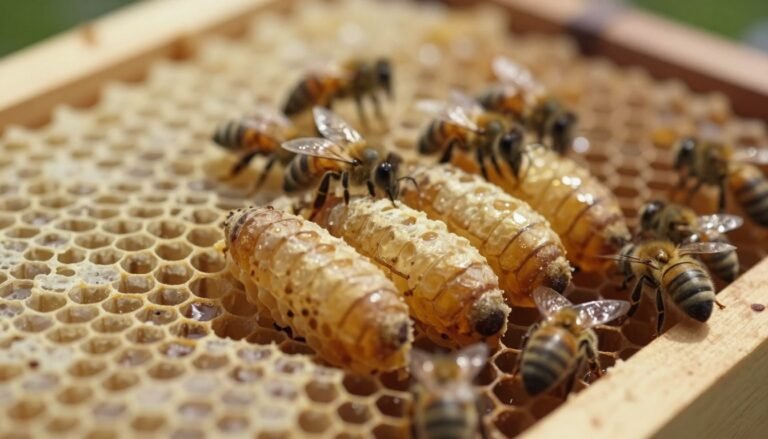
Bees have moved from hobby plots to visible city projects. Rooftops, museums, hospitals, hotels and airports now host thriving hives. Programs like Detroit Hives, Brooklyn Grange, Chicago Honey Coop and Best Bees show how varied these efforts are.
Many colonies do well here because flower diversity is steady and pesticide exposure can be lower than on farms. That mix supports pollinator health and local ecosystem resilience.
These apiaries serve many goals: community wellness, STEM classes, local food links and neighborhood renewal. They also boost environmental literacy for students and visitors.
National Urban Beekeeping Day on July 19 highlights care and ethical practice. Over time, such projects tie city infrastructure to living systems, turning odd spaces into places that support bees and people.
Key Takeaways
- Major programs now partner with institutions to host hives across the city.
- Flower variety and lower pesticides help bees thrive year-round.
- Projects support health, education and local food systems.
- Sites include museums, hospitals, airports and hotels.
- National Urban Beekeeping Day (July 19) raises public awareness.
Why urban beekeeping is thriving now in the United States
In many neighborhoods, a patchwork of parks and planters creates reliable forage for hives. Beekeepers at Brooklyn Grange report that lower pesticide exposure and greater plant diversity often help colonies perform better than on some farmland.
The city offers staggered blooms from street trees, medians, and rooftop gardens. That variety fills seasonal gaps and gives honey bees steady access to nectar across the year.
“Urban pollution concerns are often overstated relative to agricultural pollution,” — Hilary Kearney.
Compare that to monocrop fields where nutrition can vanish between blooms and pesticide use is higher. Rooftops and compact lots make hives accessible without large land needs.
- Stable forage: mixed plantings extend foraging windows.
- Fewer pesticides: lower chemical pressure than some agricultural areas.
- Myth busting: contamination and constant swarming are rare with proper management.
Beyond honey, this practice builds public awareness about pesticides and nature, improving community health and stewardship. For practical planting guidance, see best plants for honey bees.
Standout examples of 11. urban beekeeping in American cities
From museum roofs to hospital terraces, several initiatives show how hives can fit cleanly into city life.
Detroit Hives
Detroit Hives turns vacant lots into educational apiaries and founded National Urban Beekeeping Day (July 19) to raise awareness.
Astor Apiaries, Queens
Astor runs 50+ hives across New York, offers classes, and bottles neighborhood-specific raw honey that highlights local terroir.
Brooklyn Grange
Brooklyn Grange manages rooftop farms in LIC and Brooklyn Navy Yard and hosts a season-long beekeeping program tied to sales at weekly stands.
Chicago Honey Coop & Best Bees
Chicago Honey Coop grew from youth jobs to 50+ hives, including City Hall’s green roof. Best Bees manages institutional hives and the HoneyDNA research project.
Other sites
- Harlem’s Honey Parlor: rooftop hives serving uptown communities.
- Sea-Tac & Portland airports: large-scale refuges (Sea-Tac runs 24 hives).
- Hospitals: Overlook Medical Center and partner facilities host rooftop beehives for wellness and sustainability.
- Culture & hospitality: Whitney, NYC zoos, Waldorf Astoria, and FIT link guests and students to pollinator work.
| Project | Sites | Focus |
|---|---|---|
| Detroit Hives | Vacant lots | Education, community outreach, National Day |
| Astor Apiaries | Queens rooftops & yards | Classes, neighborhood honey |
| Brooklyn Grange | LIC, Navy Yard rooftops | Training program, market sales |
| Sea-Tac / Hospitals | Airport campuses / hospital roofs | Large-scale habitat, wellness |
“Small plots, repeated and networked, become meaningful habitat for pollinators and people.”
For related policy context and research, see policy perspectives.
Urban beekeeping benefits, myths, and the city ecosystem
Where streets, parks, and gardens overlap, honey bees can find steady nectar and pollen all season. Practitioners like Brooklyn Grange and researcher Hilary Kearney report colonies often outperform rural counterparts thanks to diverse, season-long forage and lower agricultural pesticide loads.
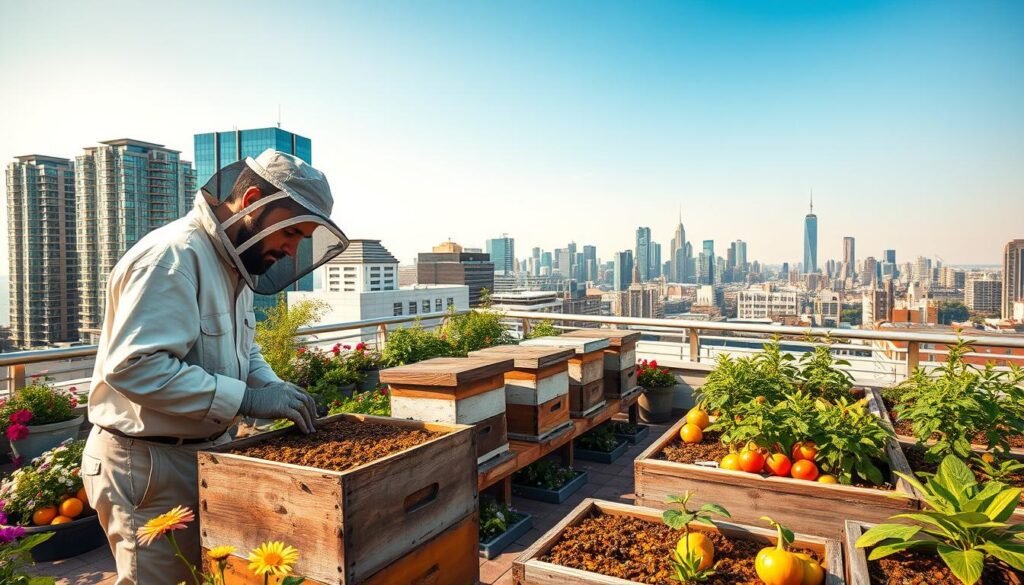
Bees often fare better: Diverse blooms and reduced pesticide exposure
Evidence shows mixed plantings extend foraging windows and reduce chemical stress. That helps colony growth and overwinter survival.
Rooftops, backyards, and gardens: Small-space hives with big pollinator impact
Balconies, rooftops, and pocket gardens create meaningful habitat from modest space. Small hives boost local pollination and serve as teaching sites for residents and visitors.
Honey flavor maps the city: Neighborhood botanicals shape taste year-round
Local plants give jars distinct flavors. Urban jars become edible maps, reflecting seasonal blooms from maples to field flowers.
- Urban colonies benefit from continuous forage and fewer farm chemicals.
- Common myths about polluted honey and constant swarming are overblown; both are manageable with sound practice.
- Design small supports—containers, native perennials, and shallow water—to help bees and wild pollinators.
For an introductory overview see the urban beekeeping primer, and for planting and management tips consult this beekeeping benefits guide.
Institutions and infrastructure powering urban apiaries
Large campuses — from airports to museums — now act as scalable hubs for pollinators across a city. Airports create green corridors that link runways, medians, and nearby parks. These corridors widen forage and provide refuge; Sea-Tac hosts 24 hives while Portland International runs a related initiative on its grounds.
Airports and green corridors: Scaling habitat
Terminals and adjacent open space let small sites add up. When planners coordinate plantings, corridors help bees move between sites and boost forage continuity for pollinators.
Hospitals and health: Rooftop hives for wellness
Hospitals are placing rooftop units as part of sustainability and health programs. Overlook Medical Center runs six rooftop hives of roughly 30,000 bees each, engaging patients and staff through on-site education and honey sales that support recovery gardens.
Museums, zoos, and hotels: Education and guest experiences
Cultural venues like the Whitney and zoo campuses use apiaries to teach ecology and offer tangible products. Hotels and businesses turn beehives into memorable guest experiences, branded honey, and culinary collaborations.
Operational best practices — site safety, seasonal management, and data monitoring such as HoneyDNA — help these programs succeed. Coordinated city programs then knit institutions together, improving habitat continuity and long-term planning. For related policy and program models see urban agriculture initiatives.
Community engagement, equity, and policy insights shaping urban beekeeping
Local trust and clear goals often shape whether a hive project wins public support. A Taino survey near Milan found 60% of residents would contribute funds to build a city beehive, with an average willingness to pay of €22. That amount covers construction but not ongoing maintenance.
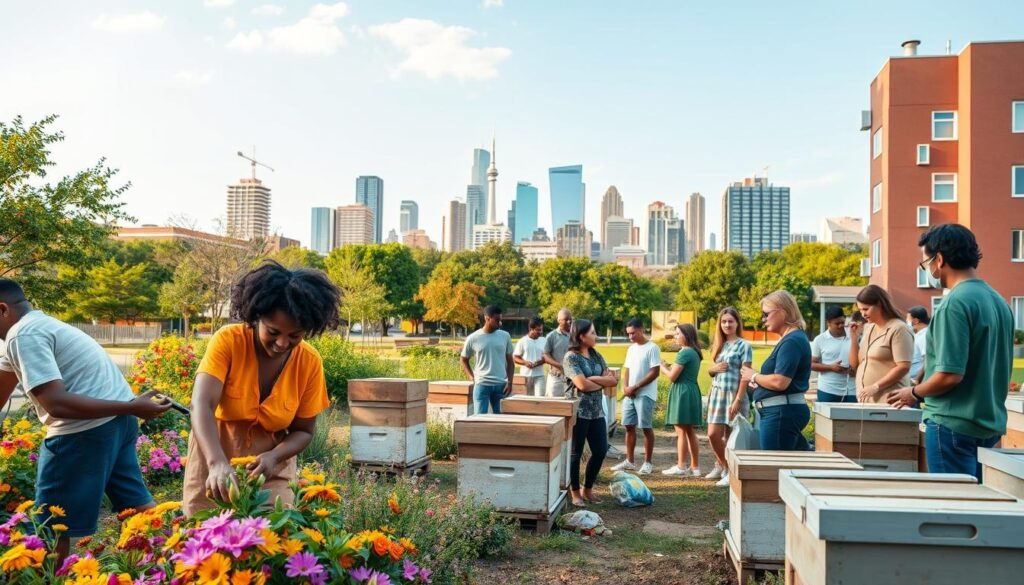
This finding shows that people back visible, well‑explained plans. When a program is framed as a shared public good and results are reported openly, more community groups join.
Awareness and willingness to pay: What citizen surveys reveal about support
Perceived value and political views shape support. Clear budgets, one‑time fundraising for build costs, and volunteer roles increase early buy‑in.
Balancing honey bees with wild pollinators: Programs, pathways, and native plants
Policy insight: introducing honey bees should pair with habitat work for wild pollinators to reduce competition. Municipal initiatives can coordinate residents, nonprofits, and institutions to streamline permits, site access, and stewardship.
- Equity and representation among beekeepers expand who gets involved and build trust.
- Use simple metrics—volunteer hours, school visits, forage checks—to show impact.
- Over years, steady communication and local data normalize hives and lower perceived risk.
How to support urban beekeepers and pollinators in your city today
Small acts — a balcony planter or a weekend class — make a measurable difference for pollinators and the people who care for them. Local groups such as Detroit Hives, Astor Apiaries, Brooklyn Grange, and Hell’s Kitchen Farm Project offer clear pathways: volunteer shifts, classes, CSA shares, and product purchases.
Get involved: join or sponsor a beekeeping program by taking a class, volunteering at a rooftop apiary, or underwriting a school or museum hive. FIT’s Bee Sanctuary shows how academic partnerships create tangible products like branded lip balm.
Plant and protect: add native flowers and plants to yards, balconies, and shared courtyards to extend forage where space is limited. Provide shallow water, avoid pesticides, and stagger blooms so bees find steady food all season.
- Buy local honey, subscribe to CSAs, and attend tours to support urban apiaries directly.
- Work with faith groups, block associations, or campus clubs to host talks and recruit volunteers.
- Advocate for institutional sponsors — airports, hospitals, museums, and hotels can host and fund beehives.
For research on how hive projects affect native pollinators, see this detailed review of impact studies: impact of hive projects on native.
Conclusion
From museum roofs to airport refuges, managed hives show how institutions can weave pollinator habitat into city design.
Urban beekeeping now threads rooftops, gardens, hospitals, and campuses with everyday life. Projects from Detroit Hives to Sea‑Tac and New York examples prove how people and institutions align around living infrastructure.
These efforts bring clear benefits: more local honey, hands‑on education, stress‑reducing green space, and stronger community ties. Sustainable growth must balance honey bees with habitat for wild pollinators and fund long‑term maintenance.
Support local beekeepers, back workplace or campus programs, and learn more via our beekeeping resources and books. Small hives and steady partnerships will scale impact while keeping safety and trust.
FAQ
What is driving the recent rise of rooftop and community hives in U.S. cities?
A mix of factors fuels growth: interest in local food and sustainability, demand for pollinator-friendly green space, and programs run by nonprofits, universities, and businesses. Cities often offer diverse floral resources and fewer agricultural pesticides, which helps colonies thrive. Funding and public education from groups like Brooklyn Grange, Best Bees, and local extension services also make starting and maintaining hives more feasible.
Are hives safe to have on rooftops, balconies, or small backyards?
Yes, when managed by trained keepers and placed with care. Proper siting, regular inspections, swarm prevention, and neighbor communication minimize risk. Many urban apiaries follow best practices established by state beekeeping associations and municipal guidelines to ensure bees forage away from high-traffic human areas.
Do city bees compete with native pollinators and harm biodiversity?
Responsible programs balance honey bee numbers with native pollinator needs. Effective initiatives incorporate native plantings, habitat creation, and seasonal limits on hive density. Partnerships between beekeepers and conservation groups help protect wild pollinators while supporting apiculture.
Will honey from city hives be safe to eat?
Yes. Urban honey is generally safe and often reflects local floral variety, giving each batch a unique flavor. Honey should be properly harvested, filtered, and stored. Some programs test for contaminants and pollen composition to ensure quality, especially for museum or hospital rooftop harvests.
How do rooftop apiaries affect building operations and maintenance?
Rooftop hives require minimal infrastructure: stable platforms, wind protection, and clear access for beekeepers. Building managers coordinate with licensed apiarists to schedule maintenance and ensure compliance with safety and zoning rules. Many hotels and institutions report benefits like guest engagement and sustainability recognition.
What permits or regulations apply to urban hives?
Rules vary by city and state. Some municipalities require registration, hive setbacks, or limits per parcel. Prospective keepers should consult local health departments, zoning offices, and state apiculture laws. Joining established community programs or working with experienced keepers simplifies compliance.
How can community organizations support pollinator health besides hosting hives?
Groups can plant native flowers and trees, create pocket meadows, reduce pesticide use, install nesting sites for native bees, and run education programs. Supporting food security projects and school gardens ties pollinator work to broader community benefits.
What educational or job-training opportunities come from city beekeeping programs?
Programs often include workshops, internships, and youth employment that teach hive management, honey processing, and ecological literacy. Initiatives in cities like Detroit and Chicago have combined beekeeping with workforce development and urban agriculture training.
How do institutions like airports, hospitals, and museums use hives?
Airports, hospitals, and museums deploy hives to expand habitat, support research, and engage the public. Airports create pollinator refuges on lands, hospitals integrate rooftop gardens for wellness, and museums use hives for education and citizen science partnerships.
How can a resident get involved if they want to help or learn?
Join a local beekeeping club, volunteer with community apiaries, take classes offered by extension services or organizations like Pollinator Partnership, or sponsor a hive. Planting native blooms and avoiding pesticides also provides immediate support for all pollinators.