The National Weather Service’s average tornado warning lead time is just 13 minutes — nowhere near enough time to run out and strap down hives once a warning is issued. That single fact changes the entire approach to tornado preparedness for beekeepers compared to a hurricane, where days of advance notice make last-minute securing genuinely possible. Tornado readiness has to be a year-round, always-on posture, not something you scramble to do when a storm is announced.
This guide covers why tornado preparedness fundamentally differs from hurricane preparedness, the always-ready approach to securing hives before any warning is ever issued, what’s realistically worth doing in the minutes you actually have during an active warning, the honest limits of what any preparation can prevent, and how to recover an apiary after a tornado passes through. Tornadoes are also genuinely unpredictable in scope compared to hurricanes: a hurricane’s landfall region is forecast days in advance with real geographic precision, while a tornado can touch down and lift within minutes along a path only a few hundred yards wide, meaning a beekeeper a mile from a tornado’s actual track may see nothing more than a strong thunderstorm while a neighboring apiary is destroyed.
Key Takeaways
- The average tornado warning lead time is about 13 minutes, according to NOAA — far too little time to secure hives after a warning is issued, unlike hurricane preparation which typically has days of notice.
- Tornado-prone apiaries need permanent, year-round hive security (straps, anchors, weighted lids) maintained at all times, not preparation triggered by an approaching storm.
- During an active tornado warning, human safety takes absolute priority — there is no scenario where running outside to secure hives is worth the risk once a warning has been issued.
- No realistic preparation protects a hive from a direct hit by a strong tornado; securing measures are about surviving nearby high winds and flying debris, not a direct strike from an EF3 or stronger tornado.
- Tornado Alley — eastern South Dakota, Nebraska, Kansas, Oklahoma, northern Texas, and eastern Colorado — sees the most frequent strong and violent tornadoes in the US, making year-round readiness especially important for beekeepers in these states.
Table of Contents
- Why Tornado Prep Is Fundamentally Different From Hurricane Prep
- Year-Round Hive Security: The Always-Ready Approach
- During an Active Warning: What’s Actually Worth Doing
- The Direct-Hit Reality: What Preparation Can’t Prevent
- Recovering an Apiary After a Tornado
- Siting Apiaries in Tornado Alley
- Frequently Asked Questions
Why Tornado Prep Is Fundamentally Different From Hurricane Prep
According to NOAA, the current average lead time for a tornado warning is 13 minutes — the time between when a tornado has actually been sighted or indicated by radar and when it may strike. About 1,200 tornadoes hit the United States each year, and they can occur in every state, on any day, at any hour, whenever conditions are right. This stands in sharp contrast to hurricane preparedness, where beekeepers typically have several days of advance forecasting to strap down hives, secure lids, and relocate equipment before landfall. A tornado offers no such window. Any beekeeping disaster-prep approach borrowed directly from hurricane guidance — “secure your hives when a storm is approaching” — simply doesn’t work for tornadoes, because by the time a warning arrives, there usually isn’t time left to act on it.
Year-Round Hive Security: The Always-Ready Approach
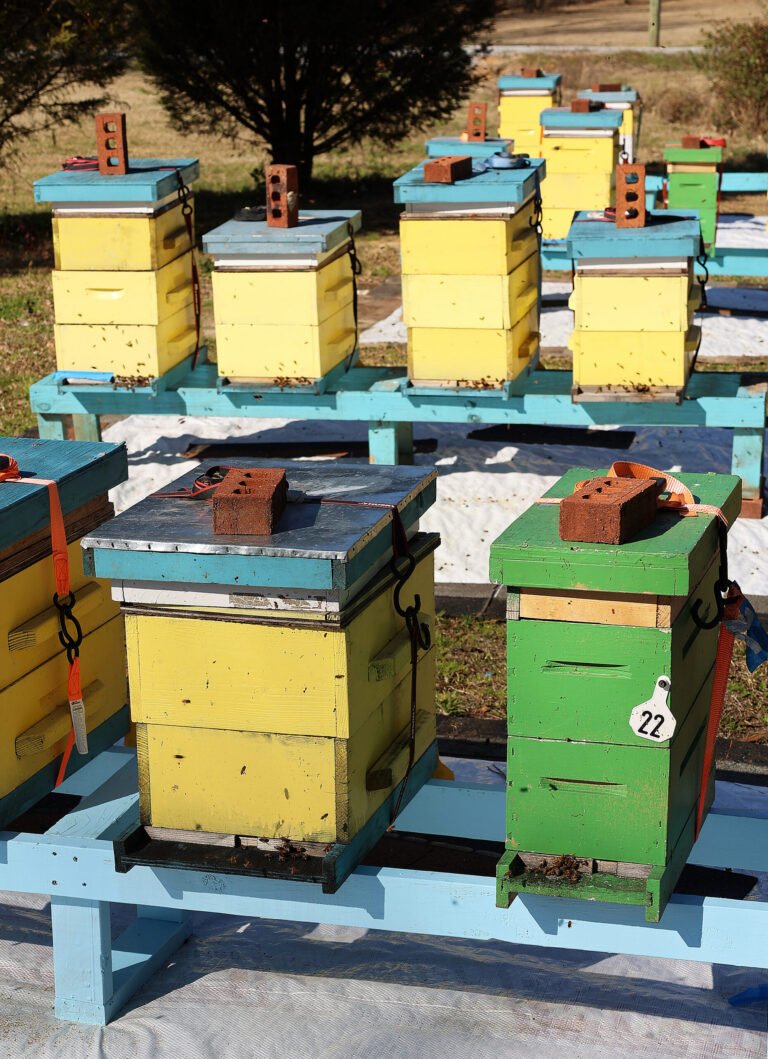
Because there’s no realistic window to react once a tornado warning is issued, hives in tornado-prone areas need to be secured as a standing, permanent practice rather than a storm-triggered one. This means keeping hives strapped or anchored to their stands continuously, not just during storm season, using the same ratchet-strap-and-ground-anchor methods beekeepers use for hurricane prep — but treating them as the default year-round setup rather than an emergency measure. Weighing down or securing hive lids, keeping hive stands low and stable rather than tall and top-heavy, and removing genuinely unnecessary top-heavy equipment like extra supers during off-season storage all help reduce vulnerability at all times, since there’s no way to know which ordinary spring or summer afternoon might turn into a tornado warning with almost no notice.
During an Active Warning: What’s Actually Worth Doing
If a tornado warning is issued while you’re near your apiary, human safety comes first, without exception — a Tornado Warning means a tornado has already been sighted or detected by radar, and NOAA’s own guidance is to seek safety immediately: go to a basement or an interior room on the lowest floor, away from windows, and get under sturdy furniture. There is no version of tornado response where going back outside to strap down hives is a reasonable trade-off once a warning has been issued; the 13-minute average lead time simply doesn’t leave room for both personal safety and last-minute hive securing, and personal safety wins every time. If you happen to have advance notice from a Tornado Watch — meaning tornadoes are merely possible in your area, not yet confirmed — a quick check that existing straps and anchors are intact is reasonable, but this is verification of your always-ready setup, not a substitute for having it already in place.
The Direct-Hit Reality: What Preparation Can’t Prevent
It’s worth being honest about what tornado preparation can and can’t actually accomplish. The Enhanced Fujita Scale rates tornadoes from EF0 to EF5 based on the damage they cause, and a hive directly in the path of an EF3 or stronger tornado — capable of leveling well-built houses — will not survive intact regardless of how well it was strapped down beforehand. What preparation genuinely protects against is the more common scenario: a hive located near a tornado’s path, exposed to strong straight-line winds, debris, and pressure changes without taking a direct hit. Most tornado-related deaths come from flying or falling debris, which is exactly the kind of secondary damage that securing your equipment, keeping the surrounding area clear of loose materials, and choosing a wind-sheltered apiary site can meaningfully reduce, even though none of it guarantees survival of a truly direct strike.
Recovering an Apiary After a Tornado
Once it’s safe to return to your property, approach recovery methodically rather than rushing straight to the hives. Check for downed power lines, damaged trees, and structural hazards in the surrounding area before walking through debris toward your apiary. Hive components are frequently scattered rather than simply toppled — boxes, frames, and lids can end up considerable distances from their original stands, so a careful, wide-radius search of the area is often necessary to recover displaced equipment rather than assuming a missing box is destroyed. For colonies that survived, check for queen presence and brood pattern as soon as it’s practical, since a colony that lost its queen during the chaos may need requeening or combining with a surviving queenright colony to avoid slowly dwindling. Colonies found queenless with no way to requeen quickly are often better combined with a nearby surviving colony than left to struggle alone, using the same newspaper-combine method beekeepers use after any other queen loss.
Siting Apiaries in Tornado Alley
NOAA identifies Tornado Alley as covering eastern South Dakota, Nebraska, Kansas, Oklahoma, northern Texas, and eastern Colorado — the region seeing the most frequent strong and violent tornadoes in the country. Beekeepers in these states should factor tornado exposure directly into apiary site selection, not just general wind considerations: natural windbreaks like tree lines or structures on the side of prevailing severe-weather approach can provide meaningful protection against the straight-line winds and debris that accompany a nearby tornado, even though nothing can fully protect against a direct hit. An apiary sited in a fully open field, with no windbreak in any direction, faces meaningfully more wind exposure during any severe thunderstorm — tornado-producing or not — than one with even partial natural shelter. Beekeepers in these states should also treat their own state’s weather-alert systems as a standing part of their beekeeping routine rather than a general household precaution only — a weather radio or smartphone alert app set specifically to notify for tornado warnings gives every extra minute of the roughly 13-minute average lead time to actually reach shelter, which matters more for someone who might otherwise be out working an apiary when a warning is issued than for someone already indoors.
Frequently Asked Questions
How much warning do I actually get before a tornado hits?
NOAA’s average tornado warning lead time is about 13 minutes — not enough time to secure hives after a warning is issued.
Should I go outside to strap down my hives during a tornado warning?
No, personal safety comes first; hives should already be secured year-round rather than during an active warning.
Can any preparation save a hive hit directly by a strong tornado?
No, an EF3 or stronger direct hit will destroy a hive regardless of preparation; securing measures protect against nearby high winds and debris instead.
What should I check first when returning to my apiary after a tornado?
Check for hazards like downed power lines first, then search a wide area for scattered hive components before assessing colony survival.
Which states see the most tornadoes?
NOAA’s Tornado Alley includes eastern South Dakota, Nebraska, Kansas, Oklahoma, northern Texas, and eastern Colorado.
FAQ
How much warning do I actually get before a tornado hits?
About 13 minutes on average, per NOAA.
Should I go outside to strap down my hives during a tornado warning?
No, hives should already be secured; personal safety comes first.
Can any preparation save a hive hit directly by a strong tornado?
No, a direct EF3+ hit will destroy a hive regardless.
What should I check first when returning to my apiary after a tornado?
Hazards first, then a wide search for scattered equipment.
Which states see the most tornadoes?
NOAA’s Tornado Alley: SD, NE, KS, OK, northern TX, eastern CO.