Published September 1, 2026
Every spring, homeowners across the country spot large, fuzzy black-and-yellow bees hovering aggressively around their deck railings, eaves, or fence posts and assume the worst. Carpenter bees are genuinely one of the most misunderstood bees people encounter, routinely confused with bumblebees, wrongly blamed for wasp-level aggression they simply don’t display, and frequently overestimated as a serious structural threat to an otherwise sound home. This guide covers how to actually identify a carpenter bee, what the wood-damage risk really looks like, why the males hovering at your face are all bluff, and how carpenter bees differ from bumblebees, the species they’re most often mistaken for.
Table of Contents
- What Carpenter Bees Actually Are
- Carpenter Bees vs. Bumblebees: The Fast Way to Tell Them Apart
- The Wood Damage Question: Myth vs. Reality
- Why the “Aggressive” Bee Dive-Bombing You Is Harmless
- Nesting Behavior and Lifecycle
- Managing Carpenter Bees Without Overreacting
- The Pollination Value People Overlook
- Small Carpenter Bees: A Different, Less Noticed Group
- Common Mistakes
- Natural Deterrents and Preventive Wood Treatment
- Frequently Asked Questions
What Carpenter Bees Actually Are
Carpenter bees belong to the genus Xylocopa, with several species found across the United States, most commonly the eastern carpenter bee (Xylocopa virginica) in the eastern half of the country and various western species elsewhere. They’re large bees, typically 12 to 25 mm long, roughly the same size range as a bumblebee, which is precisely why the two get confused so often. Like other solitary bees covered on this site, carpenter bees have no queen, no worker caste, and no colony in the honeybee sense; each female excavates and provisions her own nest, generally with minimal cooperation from other females beyond sometimes sharing the same piece of wood.

Carpenter Bees vs. Bumblebees: The Fast Way to Tell Them Apart
One single visual detail resolves almost every case of mistaken identity: the abdomen. A bumblebee’s abdomen is densely covered in fuzzy hair, matching the fuzzy thorax, giving the whole body a uniformly soft, rounded look. A carpenter bee’s abdomen, by contrast, is shiny, smooth, and largely hairless, almost polished-looking, while only its thorax (the segment just behind the head) carries the yellow or pale fuzz. Look at the back half of the bee: fuzzy all the way down means bumblebee, shiny and bare means carpenter bee. Behaviorally, carpenter bees are also far more often seen hovering stationary near wood surfaces, eaves, or structures, while bumblebees are almost always seen actively working flowers rather than patrolling a building.
The Wood Damage Question: Myth vs. Reality
This is where carpenter bees get their reputation, and it’s considerably more nuanced than the panic online often suggests. Carpenter bees genuinely do bore into wood, but a critical fact gets left out of most alarmed conversations: they do not eat wood the way termites do. A female excavates a tunnel purely to create a nesting cavity, chewing out wood fragments and pushing them out of the entrance rather than consuming them, and feeds entirely on nectar and pollen like any other bee. A single season’s tunnel from one female is typically shallow, confined to just the surface layer of wood, and causes cosmetic rather than structural harm to most sound lumber.
The real risk builds cumulatively rather than from any single bee. Carpenter bees tend to reuse and expand existing tunnels year after year, and successive generations branching new galleries off an established tunnel can, over several years in the same piece of untreated, unpainted wood, genuinely weaken a board, particularly softer woods like cedar, redwood, and pine that are common in decks, eaves, and fascia boards. Woodpeckers drawn to the sound of larvae inside the tunnels can compound this by pecking open the wood further while foraging for the larvae themselves. So the accurate summary is: one bee, one season, isn’t a structural threat, but an established, unaddressed nesting site reused for several consecutive years genuinely can become one.
Why the “Aggressive” Bee Dive-Bombing You Is Harmless
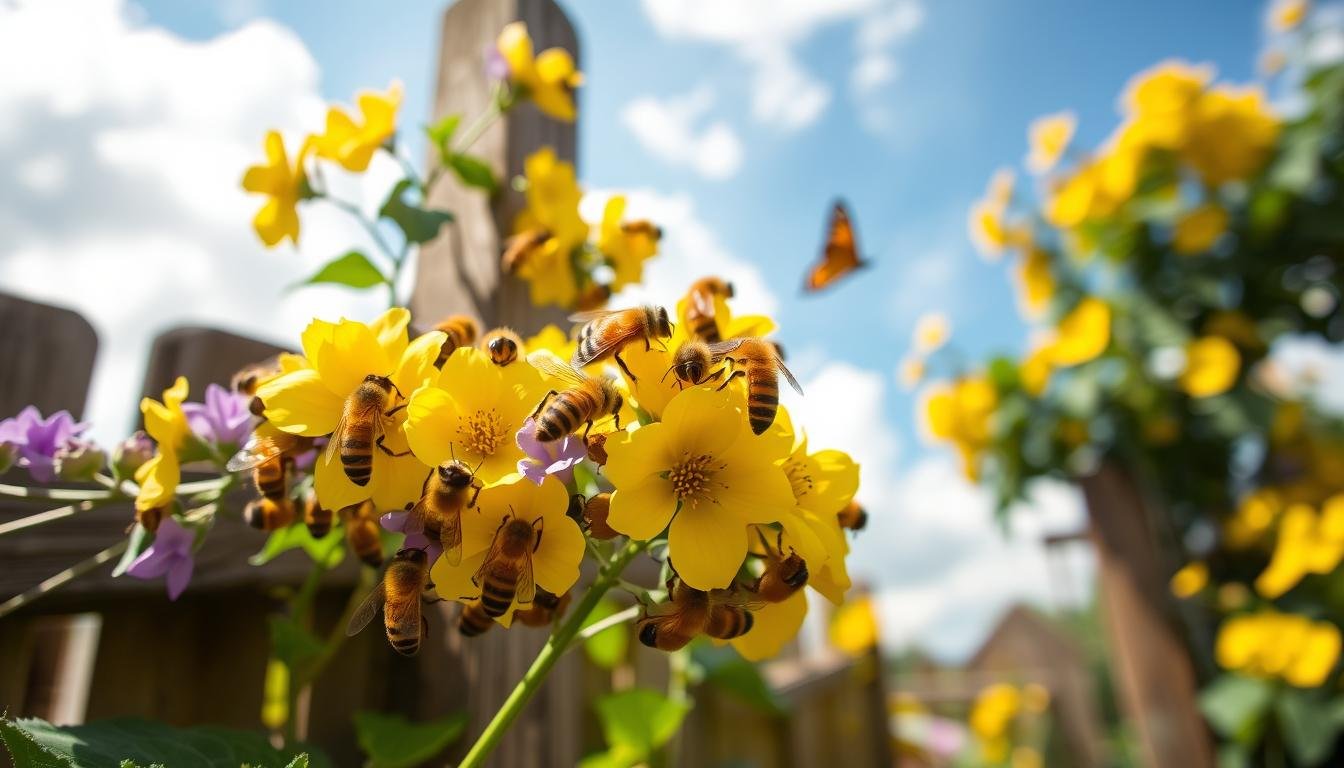
The single most common carpenter bee complaint isn’t actually about wood damage at all; it’s about the large bee that hovers aggressively near a person’s head, darts at them, and seems determined to attack. This is almost always a male carpenter bee, and the reality is genuinely reassuring: male bees, across every bee species without exception, cannot sting. Male carpenter bees are territorial and will investigate, hover near, and even bump into anything, human or otherwise, that enters the airspace around their nesting site, a defensive display meant to intimidate rather than an actual threat. Female carpenter bees can sting but are markedly docile and rarely do so unless directly grabbed or trapped; they’re typically the ones actually inside the wood tunnel and far less visible than the patrolling males.
Nesting Behavior and Lifecycle
A female carpenter bee excavates a nearly perfectly round entrance hole, roughly 1/2 inch in diameter, characteristically bored straight into the wood grain before turning 90 degrees to tunnel along the grain itself. Inside, she provisions a series of individual brood cells with a ball of pollen and nectar, lays an egg on each, and seals it off with chewed wood pulp before moving to the next, working down the tunnel in a manner conceptually similar to how mason and leafcutter bees provision cells with mud or leaves, just carved directly into solid wood instead of using a pre-existing cavity. Depending on species and region, adults may overwinter in the tunnel itself, emerging in spring to mate and begin the next generation, which is part of why the same nesting site is so often reused repeatedly.
Do carpenter bees return to the same nest site every year?
Often, yes, which is exactly why an unaddressed nesting site tends to see cumulative damage over time; adults may overwinter in the same tunnel, and subsequent generations frequently reuse and extend galleries excavated by previous years’ bees rather than starting entirely fresh each season.
Managing Carpenter Bees Without Overreacting
For homeowners genuinely concerned about long-term wood damage rather than simply startled by a hovering male, painted or stained wood is meaningfully less attractive to nesting females than bare, unfinished wood, since the smell and texture of raw wood appears to be part of what draws them in. Filling and sealing old, abandoned tunnel entrances after bees have finished using them for the season prevents the same tunnel from being reused and expanded the following year. Because carpenter bees are valuable pollinators and the actual damage risk from occasional, isolated nesting is genuinely low, most extension entomologists recommend proactive wood maintenance and exclusion over insecticide treatment as the first line of response, reserving more aggressive control only for structures with a genuinely established, visibly worsening infestation year over year.
The Pollination Value People Overlook
Lost in most of the anxious conversation about wood damage is the fact that carpenter bees are genuinely effective pollinators, visiting a wide range of garden and wild flowers throughout spring and summer. Like bumblebees, large carpenter bees are capable of buzz pollination on flowers that require it, and their large body size and long flight range make them efficient, high-volume pollinators for many native and cultivated plants. Some species are also known to engage in “nectar robbing,” biting a small hole at the base of a deep flower to reach nectar without properly pollinating it, a behavior that occasionally frustrates gardeners growing certain deep-throated flowers but doesn’t diminish their broader value as pollinators across the rest of a typical garden.
Small Carpenter Bees: A Different, Less Noticed Group
Most conversation about carpenter bees, including the wood damage and hovering-male concerns discussed above, is really about the large carpenter bees in genus Xylocopa. There’s also a separate, much smaller and far less noticed group informally called small carpenter bees, in the genus Ceratina, which nest not in solid structural lumber but inside the soft pith of broken or pruned plant stems, things like raspberry canes, sumac, or elderberry. These are tiny, often overlooked entirely, cause no structural concern whatsoever, and are yet another example of how much native bee diversity exists quietly in an average yard, entirely separate from the large, conspicuous species most people picture when they hear the words “carpenter bee.”
How many carpenter bee species are there in the United States?
Several, with regional variation across the country; Xylocopa virginica, the eastern carpenter bee, dominates east of the Rockies, while a handful of other Xylocopa species, along with the smaller Ceratina genus, are found in various combinations across the western and southern states.
Common Mistakes
The most common mistake is treating every large fuzzy bee near a house as a carpenter bee threat without actually checking the telltale shiny abdomen, when it may well be a harmless bumblebee simply passing through. Another frequent mistake is panicking over a hovering male and assuming an imminent sting risk, when male bees are physically incapable of stinging at all. People also sometimes reach immediately for broad insecticide spraying at the first sign of a single carpenter bee, when the actual risk from one or two nesting bees in a season is minor and a more measured, maintenance-focused response is usually sufficient.
Do carpenter bee holes always face upward or downward?
Entrance holes themselves are round and don’t point in a particular direction, but they’re most commonly found on the underside of horizontal surfaces, like the bottom of a deck railing, fascia board, or eave, since females appear to favor the added shelter that orientation provides from rain and direct sun.
Natural Deterrents and Preventive Wood Treatment
Beyond painting or staining exposed wood, a few low-intervention approaches can meaningfully reduce carpenter bee nesting activity without resorting to insecticide. Citrus oil sprays and almond oil are commonly cited as mild natural deterrents, since carpenter bees appear to dislike the scent, though reapplication after rain is generally necessary for any lasting effect. Physically covering vulnerable, unfinished wood surfaces, such as the underside of a deck railing or eave, with metal flashing or wire mesh removes the soft, exposed wood surface a female needs to begin excavating in the first place. Filling old, vacated tunnel entrances with wood putty or a wooden dowel and matching wood glue, then painting over the repair, both prevents reuse of that specific tunnel by future generations and restores some of the wood’s original structural integrity where a tunnel already exists.
Frequently Asked Questions
Is sawdust below a hole a reliable sign of an active carpenter bee nest?
Yes, fresh, fine sawdust directly beneath a round entrance hole is one of the most reliable visual signs of current excavation activity, and checking for it periodically through spring is a simple way to tell a genuinely active nest from an old, already-vacated one.
Do carpenter bees prefer certain types of wood over others?
Yes, softer, unfinished woods like cedar, redwood, cypress, and pine are consistently more attractive to nesting females than hardwoods, which is one practical reason pressure-treated or hardwood decking and trim sees noticeably less carpenter bee activity than a comparable structure built from bare softwood.
Is it legal or advisable to kill carpenter bees?
Carpenter bees aren’t a protected species, so there’s no legal barrier to control measures, but given their real pollination value and the generally overstated structural risk from a small number of nests, most extension entomologists recommend exclusion and wood maintenance over insecticide as the more proportionate first response, reserving chemical treatment for genuinely established, worsening infestations.
Can male carpenter bees sting?
No. Like all male bees, male carpenter bees lack a stinger entirely; the hovering, dive-bombing behavior people find alarming is purely a territorial bluff display.
Do carpenter bees eat the wood they tunnel into?
No. They excavate wood only to create a nesting cavity and push the debris out of the hole; their actual diet is nectar and pollen, the same as any other bee.
Will a few carpenter bee holes actually weaken my deck or house?
A single season’s tunneling from one or two bees is typically cosmetic and superficial. The real risk comes from the same tunnels being reused and expanded by successive generations over multiple years without any maintenance or intervention.