Published August 27, 2026
Table of Contents
- What Apiguard Is
- A Gel, Not a Strip or Vapor Cloud
- Equipment Needed: Why You Need a Spacer
- Dosing: Full Tray vs. Half Dose
- Step-by-Step Application
- Treatment Duration: About 6 Weeks Total
- Temperature: 60°F and Rising
- The Honey-Taint Problem
- Best Timing: After Harvest
- Bulk Tubs vs. Pre-Filled Trays
- Apiguard vs. Formic Acid vs. Apivar vs. OAV
- Organic Certification Considerations
- Signs the Treatment Is Working
- Colony Strength and Apiguard
- The Smell: What to Expect
- Rotating Apiguard Into a Broader IPM Plan
- Common Mistakes
- FAQ

What Apiguard Is
Apiguard is a varroa mite treatment built around thymol — a natural compound derived from thyme — suspended in a slow-release gel matrix, typically supplied as 25% thymol gel in pre-portioned trays. Rather than being absorbed by direct contact (like Apivar) or dispersing purely as vapor from a saturated pad (like formic acid strips), Apiguard’s gel slowly releases thymol vapor over an extended period as bees interact with and gradually consume the gel itself.
A Gel, Not a Strip or Vapor Cloud
This physical form is worth understanding because it changes practical handling in ways the other treatments covered on this site don’t share. The gel sits in an open tray placed directly on top of the brood frames, rather than being hung between frames (Apivar) or laid across the top bars as a saturated pad (formic acid). Bees actively interact with the gel over time — walking across it, and in some accounts gradually removing and relocating portions of it within the hive — which is part of the mechanism by which thymol vapor and residue spread through the colony.
Equipment Needed: Why You Need a Spacer
Because the tray sits directly on the brood frames and needs enough vertical clearance for bees to actually access and work the gel, an empty spacer box (called an “eke” in UK beekeeping terminology) or an empty super placed above the brood chamber is typically required — without this extra space, the inner cover would sit too close to the tray for bees to reach it properly. You’ll also want the hive’s entrances fully open during treatment, since adequate airflow is part of how thymol vapor circulates and reaches the colony effectively.
- Apiguard trays (pre-portioned) or a bulk tub with a dosing syringe/tray for larger operations
- An eke, spacer, or empty super to create clearance above the brood chamber
- Basic hive tools for the application and removal visits
Dosing: Full Tray vs. Half Dose
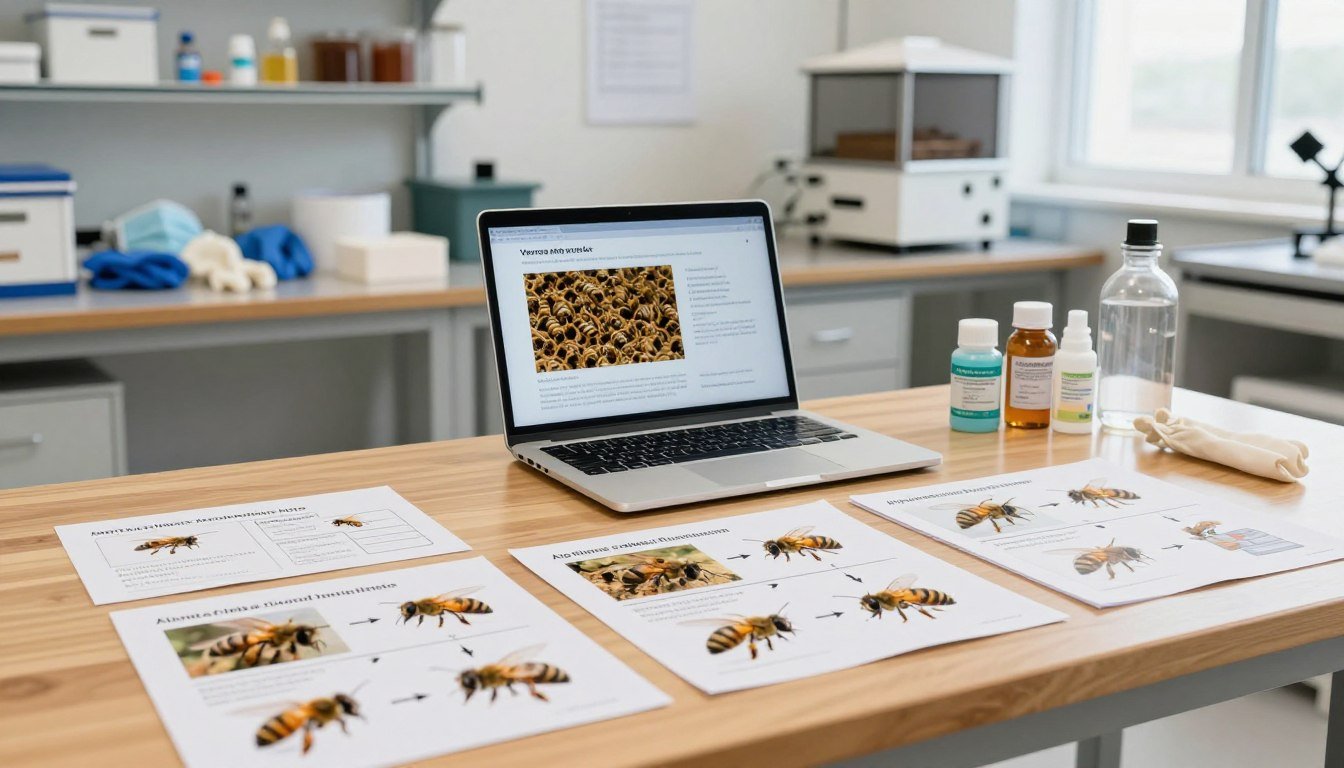
Standard dosing for a pre-filled tray is one full 50g tray placed gel-side-up directly on the brood frames, with two trays typically required to complete a full treatment for one hive. Some beekeepers use an alternative half-dose approach instead — applying 25g on a piece of cardboard placed over the brood frames, then repeating after roughly 7 days — which some find gives more granular control over dosing, particularly in smaller colonies or in warmer conditions where a full-strength dose might be more aggressive than needed. Either approach follows the same underlying total-thymol-exposure logic; check your specific product packaging for the currently labeled guidance.
Step-by-Step Application
- Confirm outdoor temperatures are consistently above roughly 60°F, since thymol’s vapor release depends on adequate warmth.
- Peel back the tray lid (for pre-filled trays) and place the tray gel-side-up directly on top of the brood frames.
- Add an eke or empty super above the brood box to create clearance for the tray and bee access.
- Close up the hive, ensuring entrances remain fully open for airflow.
- Leave the first tray in place for about 2 weeks, checking that the gel is being actively consumed/reduced during this period.
- Replace with a second tray once the first is largely consumed, and leave the second tray in place for an additional 2-4 weeks depending on your specific product’s labeled guidance.
Treatment Duration: About 6 Weeks Total
Combining both tray applications, a full Apiguard treatment cycle commonly runs around 6 weeks total — meaningfully longer than formic acid’s 10-20 days, though generally comparable to or somewhat shorter than Apivar’s 6-8 week window. This extended timeline reflects thymol’s own slow-release mechanism and the two-tray dosing structure most labels call for.
Temperature: 60°F and Rising
Apiguard needs consistently warm conditions to work well — generally cited as requiring outdoor temperatures above 60°F, higher than the lower bounds for both formic acid and Apivar. Below this threshold, thymol’s vapor release from the gel slows significantly, reducing the treatment’s practical effectiveness even if the gel itself remains physically in place. This makes Apiguard more of a late-summer/early-fall treatment in many temperate climates, once temperatures are reliably warm but before the season turns cold.
The Honey-Taint Problem
Thymol has a strong, distinctive minty-herbal aroma and flavor, and it’s genuinely capable of tainting the flavor of honey stored in the same hive during treatment if supers are still in place — this is a real practical reason Apiguard, like Apivar, isn’t approved for use during an active honey flow with supers on. Beyond the regulatory restriction, there’s a straightforward flavor-quality reason to keep this treatment strictly to a post-harvest window: honey that’s absorbed noticeable thymol character is a genuinely different, less marketable product than honey harvested before treatment began.
Best Timing: After Harvest
Apiguard is most commonly used after the main honey harvest, once supers have been removed and only the brood boxes remain on the hive — this timing naturally satisfies both the regulatory restriction and the honey-flavor concern in one step, while also lining up with late-summer/early-fall temperatures that tend to be warm enough for effective thymol release in many regions.
Bulk Tubs vs. Pre-Filled Trays
For beekeepers treating only a hive or two, pre-portioned trays are the simplest option — no measuring, no separate dosing tray needed. Larger operations treating many colonies often find a bulk tub more economical, using a provided syringe or dosing tool to portion 50g doses onto separate dosing trays for each hive. The active ingredient and mechanism are identical either way; the choice is purely about convenience and cost at your specific scale. Neither format offers a treatment-quality advantage over the other.
Apiguard vs. Formic Acid vs. Apivar vs. OAV
| Apiguard | Formic Acid | Apivar | OA Vaporization | |
|---|---|---|---|---|
| Form | Slow-release gel | Saturated pad | Contact strip | Vapor (single session) |
| Honey flow safe? | No | Yes | No | Typically outside flow |
| Min. temperature | ~60°F | ~50°F | ~45°F | Less critical to the process |
| Duration | ~6 weeks | 10-20 days | 6-8 weeks | Single session, repeatable |
| Capped brood penetration | Limited | Yes | No (contact-based) | No |
Organic Certification Considerations
Because thymol is a naturally derived compound rather than a synthetic acaricide like amitraz, Apiguard is often categorized alongside formic and oxalic acid as an option more compatible with organic or “natural” beekeeping approaches, in contrast to Apivar’s synthetic classification. If organic certification or a natural-treatment-only philosophy matters for your operation, confirm the current specific certification standards you’re working under, since exact allowed-substances lists can vary by certifying body and region.
Signs the Treatment Is Working
Watch for steady, visible consumption or reduction of the gel in the tray during each 2-week check — a tray that still looks nearly full well into its treatment window can indicate temperatures aren’t warm enough for the bees to be actively working it, or that colony strength is too low to be interacting with the treatment area as expected. As with the other treatments covered on this site, a mite count before treatment begins and again after the full 6-week cycle completes is the most reliable way to confirm real effectiveness, since gel consumption alone tells you bees are interacting with it but doesn’t directly measure mite mortality. Standard alcohol wash or sugar roll sampling techniques both work fine for this before-and-after comparison, whichever method you already use for routine monitoring.
Colony Strength and Apiguard
Apiguard performs best on colonies that are genuinely strong going into treatment, both because a robust population is more likely to actively work the gel at the rate the treatment schedule assumes, and because the extended 6-week duration is a real commitment of hive space and beekeeper attention that pays off better on a colony worth that investment. A weak or struggling colony heading into fall, the season most Apiguard treatment typically happens, may be better served addressing the underlying weakness first (feeding, requeening, combining with another colony) rather than adding an extended thymol treatment on top of an already precarious situation. A treatment isn’t a substitute for basic colony health, and applying one to a colony that’s struggling for unrelated reasons rarely produces the result you’re hoping for.
Common Mistakes
| Mistake | Why it matters |
|---|---|
| Applying without adequate clearance above the tray | Bees can’t properly access and work the gel without an eke or empty super creating that space |
| Treating with honey supers still on | Risks both a labeling violation and genuine thymol taint in honey intended for harvest |
| Applying below 60°F | Thymol vapor release slows significantly in cool conditions, reducing effectiveness even with the gel correctly placed |
| Not replacing the first tray with a second at the right interval | The full 6-week treatment relies on both tray applications completing in sequence, not just the first |
The Smell: What to Expect
Thymol has a strong, distinctly minty-herbal smell that’s noticeable both around the hive during treatment and, briefly, on bees themselves — this is completely normal and expected, not a sign of a problem. Some beekeepers report their bees seeming mildly more active or agitated at the entrance during the first few days of a fresh application, generally settling down as the colony adjusts to the treatment’s presence. This initial reaction typically fades within the first week and shouldn’t be confused with a genuine adverse response requiring intervention. If you’re treating multiple hives close together, be aware the smell can be noticeable across a fairly wide area of the apiary, which is worth mentioning to neighbors if your hives are anywhere near a shared property line. A brief heads-up before treatment starts is a small courtesy that can prevent an unnecessary complaint from someone unfamiliar with what a normal beekeeping treatment cycle looks and smells like.
Rotating Apiguard Into a Broader IPM Plan
Like the other treatments covered on this site, Apiguard works best as one component of a rotating, integrated approach rather than a sole year-round treatment — pairing a post-harvest Apiguard cycle with oxalic acid vaporization during a broodless winter window is a common seasonal pattern, since the two work at different points in the year and through different mechanisms. Consistent mite monitoring across the season, rather than treating purely on a fixed calendar, remains the foundation that makes any of these treatment choices actually effective rather than just routine. Keeping a simple written record of which treatment was used on which colony and when, across a full season, makes it much easier to spot patterns (a colony that never seems to fully recover from mite pressure regardless of treatment, for instance) that a single season’s memory alone tends to miss.
Sources
Dosing, application requirements, and temperature guidance reflect published manufacturer labeling and beekeeping equipment supplier documentation for Apiguard, consistent with current thymol-based varroa treatment label instructions.
FAQ
Why does Apiguard need an eke or spacer above the brood box?
The gel tray sits directly on the brood frames and needs vertical clearance for bees to physically access and work the gel — without an eke, empty super, or similar spacer, there isn’t enough room.
Can Apiguard taint honey flavor?
Yes, genuinely — thymol has a strong minty-herbal aroma that can transfer into honey stored in the same hive during treatment, which is why it’s used after harvest with supers removed, not during an active honey flow.
What temperature does Apiguard need to work?
Consistently above roughly 60°F — higher than the minimum for formic acid or Apivar. Below this, thymol vapor release from the gel slows significantly.
How long does a full Apiguard treatment take?
About 6 weeks total across two sequential tray applications — the first tray for roughly 2 weeks, then a second tray for another 2-4 weeks.