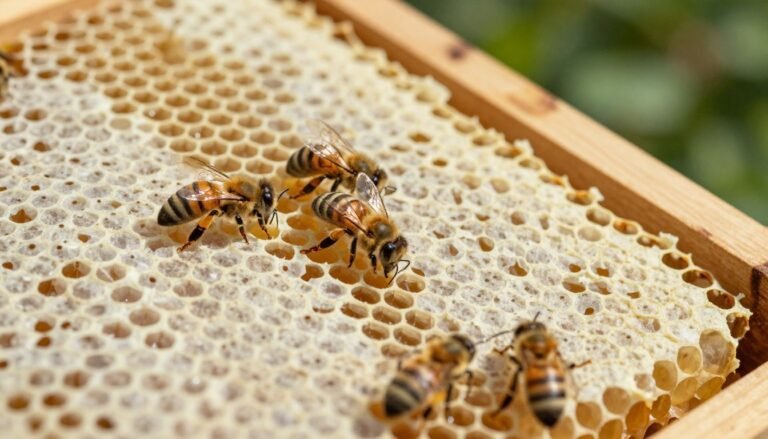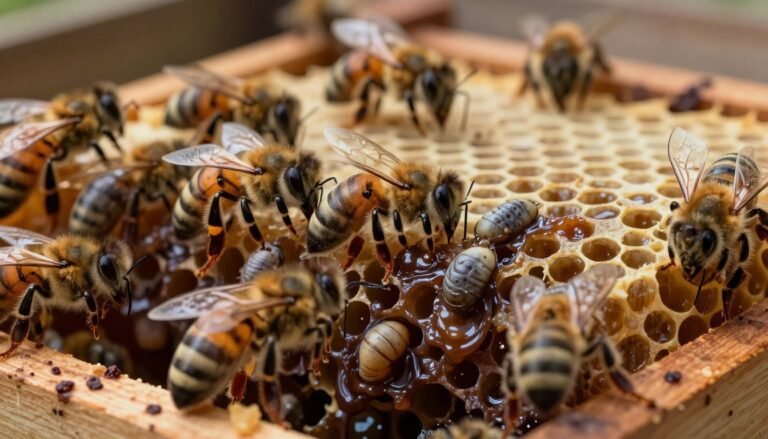
Beekeepers often spot a scattered, uneven layout across the comb that raises alarm for colony health. This odd coverage signals gaps in developing bees and can point to a failing queen, worker laying, or mating issues that reduce hive continuity.
Research by Marla Spivak and colleagues in Insects (2019) shows that a poor brood layout is not always a reliable single indicator of queen quality. Inspecting the comb for empty cells, multiple eggs per cell, and unusual drone presence helps separate queen failure from other hive issues.
Practical checks include assessing frames for spotty coverage, looking for worker brood and any queen cell development, and confirming that mated queens are active. Commercial operations can also use equipment and tools from HONESTBEE to improve hive management and reduce the risk of poor brood.
Key Takeaways
- Scattered comb coverage often signals trouble with the queen or mating quality.
- Marla Spivak’s research warns against using a single brood snapshot to judge queen health.
- Look for empty cells, multiple eggs, and drone brood in worker zones as key signs.
- Early detection lets beekeepers act—replace queens or adjust management.
- Commercial tools and careful mating strategies help prevent recurring issues.
- For guidance on genetic diversity and queen breeding, see queen breeding diversity.
Defining the Shotgun Brood Pattern
Healthy queens usually deposit eggs in concentric rings, producing a tightly packed center of sealed cells.
What to expect on a solid frame: a well-performing queen fills the center area with capped cells, giving about 90% coverage in the middle of the frame. Worker cells remain capped for roughly 12 days, which creates a uniform look across the core.
Inspectors assess the layout by checking how continuous the sealed area is. A strong colony shows wall-to-wall capped brood in the center and newer eggs toward the edges.
If you need troubleshooting help, consult a disease diagnostic guide or read about identifying chilled brood.
| Condition | Visual cue | Action |
|---|---|---|
| Healthy | ~90% center coverage; sealed cells continuous | Monitor; support with space for honey storage |
| Spotty | Mixed sealed and empty cells across frame | Check queen laying, hive stress, and workers |
| Declining | Irregular rings, many open cells at center | Inspect eggs, consider requeening or management changes |
Visual Indicators of Shotgun Brood Pattern Causes
A close look at cell cappings and egg placement can quickly highlight erratic laying or disease within the hive. Use a calm inspection and good light to spot key visual signs that tell you whether the queen is healthy or if workers are compensating.

Capping Abnormalities
Domed or bullet-shaped cappings in worker areas are a clear sign of a drone-laying queen or active laying workers. These raised caps differ from the flat, rounded seals of healthy worker cells.
Sunken, perforated, or discolored cappings point to diseased or dead larvae beneath. When you see those, treat the frame as suspect and isolate it for closer diagnosis.
“Domed cappings and sunken seals are visual alarms—inspect frames immediately.”
Egg Placement Patterns
Eggs glued to the cell wall instead of the center bottom are a definitive sign of erratic laying by a failing queen or laying workers. Multiple eggs per cell further confirm worker laying activity and reproductive disorder.
Empty cells scattered across a frame create a spotty brood look and reduce cluster efficiency and honey production. A queen cell in the middle of the frame often signals the colony plans to supersede.
- Look for drone brood in worker zones as an indicator of trouble.
- Check for multiple eggs and wall-mounted eggs to confirm signs of laying workers.
- Ensure larvae get proper royal jelly and nutrition to support a solid brood center.
For visual guides and practical checks, review the visual signs guide and tips to boost colony population naturally.
The Role of Queen Quality and Mating
Queen mating success and the hive environment often interact to shape how eggs appear across a frame. Good mating can support steady laying, but the colony’s condition also affects visible coverage.
Studies found that many queens from strong and weak colonies were similar in sperm counts, viability, and size. Earlier research used 3 million sperm as a threshold to spot poorly mated queens, but that number alone does not always predict a poor brood pattern.
When a seemingly poor frame improves after moving the queen to a new hive, the environment is likely influencing results. A failing queen will keep producing spotty brood despite extra royal jelly or resources.
“Look for drone presence in worker cells and multiple eggs per cell as reliable signs that queen function has declined.”
- Check for multiple eggs and worker-laying behavior.
- Consider requeening if drone brood appears in worker zones.
- Remember that moving a queen can raise a colony’s brood coverage by over 11% in some cases.
Environmental Factors and Hive Management
When the colony lacks space, honey ends up filling the brood area and the queen may have nowhere to lay.
Insufficient storage during a strong nectar flow is a common, fixable management issue. Bees will backfill the brood box with honey, which makes the central cells look empty or patchy.
Quick fixes include adding one or two supers to give bees room for honey. Placing a fresh frame of drawn comb into the brood nest is a simple test; if the queen is laying, she will fill it with eggs quickly.
Environmental stress can also reduce royal jelly production. Workers may cannibalize young larvae when space or food is limited, creating empty cells that mimic a poor brood pattern.
Practical checklist
- Add supers early during big flows to prevent backfilling.
- Insert a drawn comb frame to verify the queen’s laying rate.
- Monitor frames regularly to tell a true queen problem from a storage issue.
- Keep space for honey to protect larvae and maintain healthy workers.
| Issue | Sign | Action |
|---|---|---|
| Backfilled brood nest | Honey in central frames; empty cells | Add supers; move honey frames up |
| Questionable laying | Queen not seen on new frame | Insert drawn comb; watch for eggs in 3–5 days |
| Larval loss | Sunken or missing brood; reduced royal jelly | Improve space and nutrition; reassess colony health |
For timing and swarm signs while managing space, review guidance on preparing to swarm.
Impact of Pests and Parasites
Parasitic pressure often forces worker bees to remove infected larvae, leaving many empty cells. Varroa mite infestations are a primary trigger for a spotty brood pattern because bees pull out diseased pupae to protect the hive.
Testing for Varroa levels is critical when you see gaps on a frame. Regular monitoring helps determine whether mites or another stressor is the main problem.
Left untreated, high mite loads reduce queen performance and can lead to laying workers, which makes diagnosis harder. A struggling queen also invites more pest pressure, creating a downward cycle.
- Carry out regular Varroa tests in spring and fall to catch infestations early.
- Treat promptly with approved methods to protect the colony and honey stores.
- Watch frames for missing larvae, unusual cappings, or multiple eggs as a sign laying workers may be active.
“Removing infected larvae is a natural defense, but it leaves empty cells that mimic a poor laying layout.”
Act quickly: timely Varroa control and careful frame checks are essential to stop decline and save the hive. For genetic and hygienic behavior guidance, review predisposition to hygienic behavior.
Disease and Fungal Infections
Diseases and fungal infections can degrade a healthy frame fast. The signs show up in the developing larvae and the surrounding cells.
Chalkbrood Symptoms
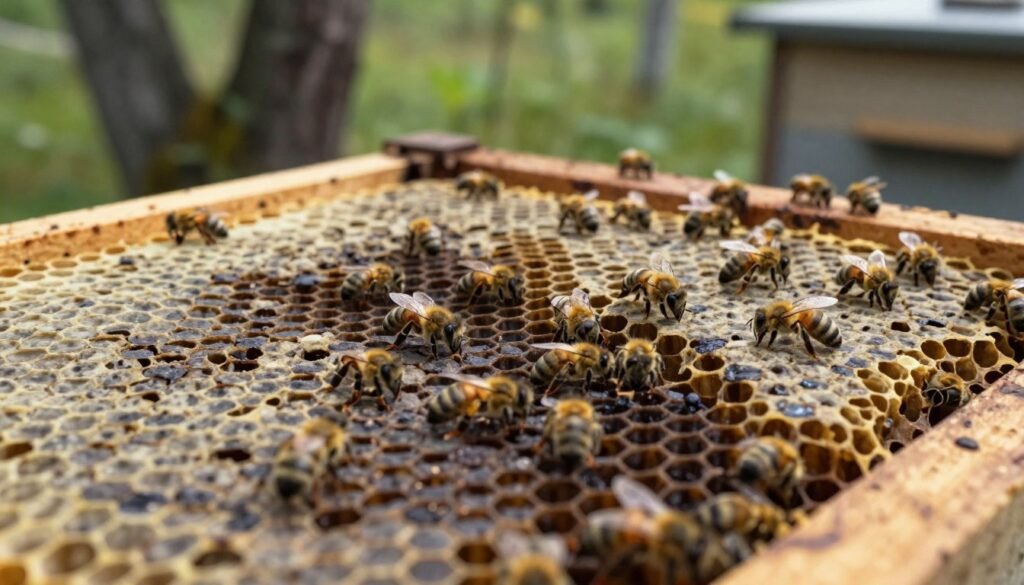
Chalkbrood is a fungal problem that kills larvae and leaves hard, white or gray mummified remains on the frame. This leads to a spotty brood look, often in cool, wet spring weather.
Inspect frames for scattered dead larvae, sunken cappings, and increased removal activity by workers. Acting quickly reduces spread and helps the queen regain normal laying.
European Foulbrood Identification
European Foulbrood shows as yellow, twisted, or melted larvae that slump in the cell. Affected combs smell sour and the hive can decline fast in spring.
Treatments include feeding to boost nurse bee care, warming and drying the hive, and using probiotics to support larval gut health. In severe cases, requeening is often the best option to restore brood production.
“Early detection and targeted management are the best defenses against colony decline from infectious disease.”
| Infection | Key signs on frame | Recommended action |
|---|---|---|
| Chalkbrood | White/gray mummies; spotty brood; wet springs | Improve ventilation; remove infected comb; monitor queen laying |
| European Foulbrood | Yellow/melted larvae; sour odor; sunken cappings | Feed pollen substitute; warm hive; consider requeening |
| Secondary impact | Workers remove larvae; empty cells; reduced honey stores | Isolate affected hives; boost nutrition; check for laying workers |
For deeper guidance on disease identification and treatment, see disease identification and treatment.
Diagnostic Testing and Verification
Confirming a queen’s performance needs planned checks, not a single snapshot of comb.
Begin with a baseline: mark the date you exchange or introduce a queen. Monitor the hive 21 days after that move to see a full cycle of eggs to capped cells.
Use a frame of drawn comb to test laying ability. If the queen lays consistently on fresh comb, that is a strong sign of proper function.
Look for the presence of multiple eggs or drone brood in worker zones to confirm laying workers. Those visual signs indicate worker reproduction rather than immediate queen failure.
Remember Marla Spivak’s work: a poor visual layout alone is not a reliable indicator queen quality has failed. Combine inspections with targeted testing where needed.
“Accurate diagnosis requires both visual checks and, when needed, scientific tests to protect hive productivity.”
- Monitor 21 days after requeening to verify improvement.
- Check multiple frames—consistent poor results across frames suggest a failing queen.
- Consider sperm-count thresholds when suspecting poorly mated queens; 3 million sperm is a research benchmark.
| Test | What to check | Interpretation |
|---|---|---|
| 21-day post-exchange | New eggs, sealed cells on drawn comb | Improvement → new queen effective; no change → further diagnosis |
| Frame of drawn comb | Egg presence, even spacing | Filling comb quickly → queen laying well; empty → queen or space issue |
| Visual scan for multiple eggs/drone brood | Eggs on walls, drone in worker zone | Indicates laying workers or poor mating; act accordingly |
For more on underlying colony issues tied to poor coverage, see common colony issues and diagnostics.
Practical Steps for Colony Recovery
When a hive shows persistent gaps and decline, prompt intervention is the best way to protect stock and honey yields.
Requeening Strategies
Requeening is the primary remedy when a queen consistently produces a poor frame layout. Replace a failing queen with a reliably mated one from a trusted source to restore even laying and boost colony health.
Introduce the new queen using a cage or release method and watch the hive for acceptance over 3–7 days. Ensure gentle handling so workers do not reject her.

If laying workers are present, reset the colony first: combine with a strong nucleus, or remove offending frames and temporarily confine the workers before introducing the new queen.
- Inspect frames regularly to spot recurring empty cells or multiple eggs early.
- Provide supplemental feed and extra space so the hive can support new brood and build honey stores.
- Act early: a weakened colony risks robbing and can lose productivity fast.
“Rapid requeening paired with supportive management often prevents colony collapse.”
For a wider view on collapse dynamics and recovery priorities, see the model of colony collapse.
Conclusion
Restoring a weakened hive depends on diagnosing issues and applying targeted fixes. Identifying a spotty brood layout is the first step toward protecting colony health and productivity. Look closely for signs that point to a failing queen, pests, disease, or management gaps, and act quickly.
Regular inspections, timely interventions, and good space management keep colonies strong through seasonal shifts. When a queen is failing, replacing her with a reliably mated, high-quality queen often returns steady laying and improves coverage.
By learning the visual indicators and combining observation with practical fixes, beekeepers can prevent collapse and help bees thrive while maximizing honey stores across the year.
FAQ
What causes the shotgun brood pattern in a honey bee colony?
A diffuse, spotty brood arrangement often stems from problems with the queen, poor mating, or worker-related laying. Environmental stress, limited food stores, or disease can worsen the issue. Inspect comb, egg placement, and adult behavior to narrow the cause.
How do you define a shotgun brood pattern?
This term describes scattered cells of healthy larvae interspersed with empty or capped cells, creating a dotted look on a frame. It signals inconsistent egg laying or brood survival rather than a uniform, dense cluster of developing bees.
What visual signs point to capping abnormalities?
Look for uneven, sunken, or perforated cell caps. Healthy cappings are slightly domed and consistent. Irregular capping can indicate disease, parasitism, or insufficient nurse behavior that affects brood development.
How does egg placement reveal underlying issues?
Queens normally lay a single egg centered on the cell floor. Multiple eggs in one cell, off-center eggs, or many empty cells near laying areas suggest a poorly mated or failing queen, or that workers are laying eggs in the absence of a viable queen.
When should I suspect queen quality or mating problems?
Suspect poor queen quality if egg patterns are spotty, eggs are missing, or drone brood appears where worker brood should be. A queen that’s poorly mated may produce mostly drones and inconsistent worker production. Consider queen age and mating conditions.
Can environmental factors and hive management create this pattern?
Yes. Cold snaps, insufficient forage, or cramped space disrupt laying and brood care. Poorly drawn comb or overcrowded frames can limit where the queen lays, producing a scattered look across the brood area.
How does insufficient storage space affect brood layout?
If the colony lacks honey or pollen storage nearby, nurse bees must work farther from the brood, reducing feeding efficiency. The queen may avoid areas with inadequate resources, creating empty cells mixed among developing larvae.
What pests and parasites contribute to an irregular brood layout?
Varroa mites and small hive beetles reduce brood health and survival. High varroa loads can lead to punctured or collapsed cells and increased dead brood, producing a spotty appearance across frames.
What signs point to chalkbrood infection?
Chalkbrood produces mummified, white or gray larvae in cells and a brittle feel when removed. Affected cells may be capped normally, but the presence of multiple mummies near healthy larvae indicates a fungal issue reducing brood success.
How do I recognize European foulbrood in a hive?
European foulbrood causes twisted, discolored larvae and rotten-smelling brood that may appear sunken or deflated. A foul odor, discolored dead brood, and scattered healthy brood are common indicators requiring prompt action.
What diagnostic tests verify the underlying problem?
Inspect frames for eggs, larvae, and signs of disease. Send samples to a bee diagnostic lab for varroa counts or pathogen identification. Use alcohol wash for varroa and laboratory assays for bacterial or fungal agents when needed.
What practical steps help a colony recover from a poor brood pattern?
Improve forage and feed pollen substitute if needed, reduce stressors, re-space frames, and treat for varroa and pests. Monitor food stores and ensure adequate ventilation and space to encourage normal laying and brood care.
When should I consider requeening the hive?
Requeen if the existing queen is old, poorly mated, or producing mostly drones. Introduce a healthy, mated queen or use nucleus colonies for replacement. Prompt requeening often restores consistent egg laying and a solid brood area.