Commercial and migratory beekeepers put hives on pallets for one reason: so machines, not backs, can move them. Once colonies are palletized, the question is which machine to use. A pallet jack is the cheapest option, but it only works in some parts of a beekeeping operation. It is excellent on a honey-house floor and close to useless in a grassy bee yard.
This guide explains how hive pallets are built, where a pallet jack fits alongside forklifts and skid steers, what to check before buying one, and how to move bee-occupied pallets without losing colonies.
Key Takeaways
- A beekeeping “four-way” pallet usually means a pallet that holds four hives, not a pallet with fork entry from four sides.
- Standard pallet jacks need hard, smooth, level floors: honey houses, warehouses, loading docks and wintering buildings.
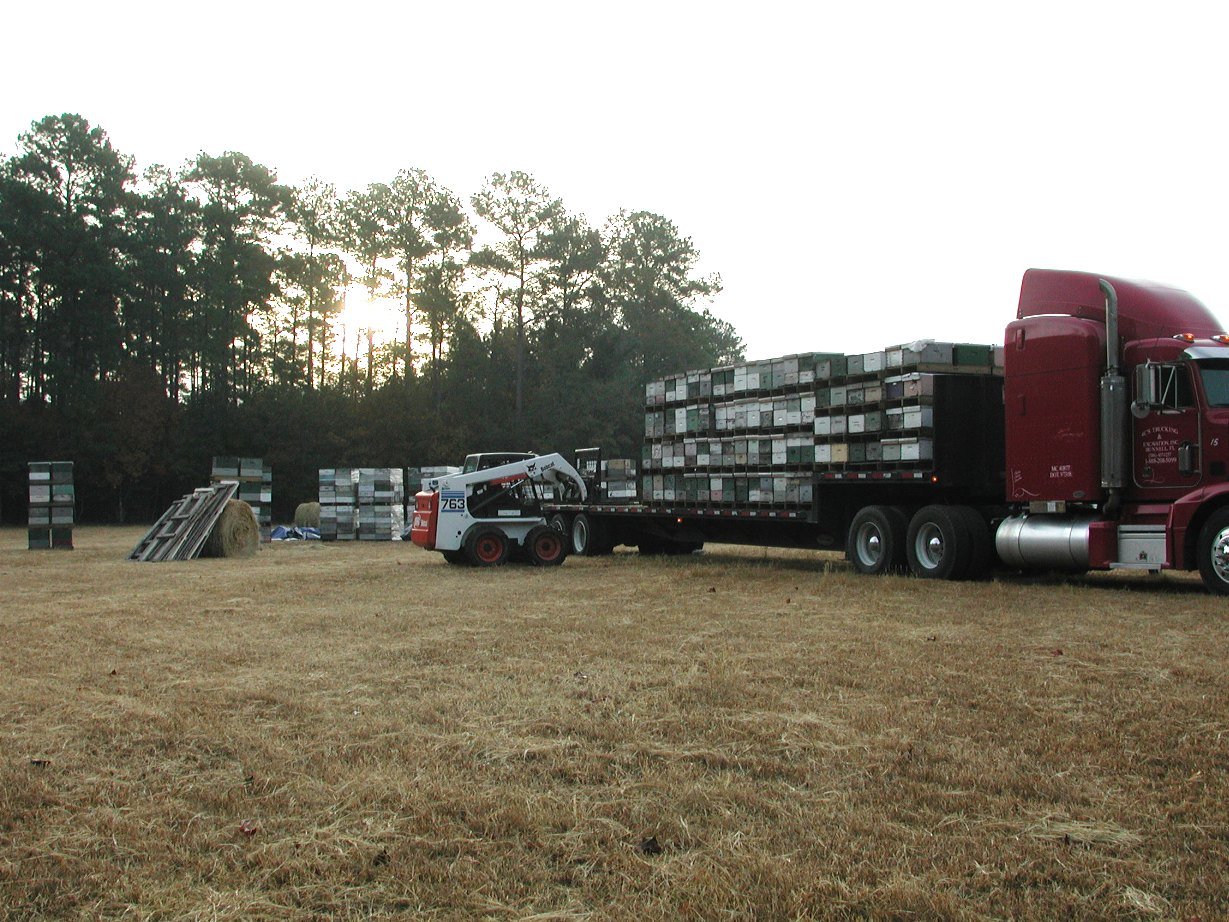
- In the bee yard, forklifts and skid steers with forks do the loading, including stacking pallets on trailers.
- Check that your pallet design leaves room for a jack’s forks and load wheels before you buy one.
- Weigh representative loaded pallets instead of guessing, and keep within the jack’s rated capacity.
- Move occupied hives at dusk or night, strapped and ventilated, and avoid jolting the load.
Table of Contents
- How Commercial Hive Pallets Are Built
- Pallet Jack, Forklift or Skid Steer?
- Where a Pallet Jack Earns Its Keep
- Check That Your Pallets Fit a Jack
- Know the Weight Before You Lift
- Moving Bee-Occupied Pallets Safely
- Buying Checklist
- Conclusion
- FAQ
How Commercial Hive Pallets Are Built
Hive pallets hold a set number of colonies on one base so they can be picked up as a unit. Lappe’s Bee Supply describes its 4-way bee pallets as built to support four colonies at a time, for use with forklifts and other material-handling equipment (Lappe’s Bee Supply: Migratory Bee Pallets).
A detailed build write-up from the DC Honeybees blog describes a common commercial design (DC Honeybees: Commercial Migratory Pallet Design):
- It holds four hives (a “four-way” pallet) or six hives (a “six-way” pallet).
- The pallet measures 33 by 47 inches, so two fit side by side across a standard 8.5-foot-wide flatbed.
- Commercial beekeepers use a forklift to stack these pallets three high on a flatbed trailer. The author estimates about 408 hives on a 48-foot trailer.
- The empty pallet weighs a little more than 50 pounds, before any hives go on it.
That last point matters when choosing equipment. The pallet alone is heavy. Loaded with four colonies, possibly with honey supers, it is a serious load with a high, top-heavy center of gravity. For more on pallet layouts, see Hive Pallet or Individual Stand: Which Is Right?
Pallet Jack, Forklift or Skid Steer?
Each machine suits a different part of the operation:
| Machine | Where it works | Limits |
|---|---|---|
| Manual pallet jack | Honey house, warehouse, concrete pads, loading docks, indoor wintering buildings | Small hard wheels need smooth, level floors; lifts a pallet only a few inches, so it cannot stack or load trailers from the ground |
| Electric (walkie) pallet jack | Same surfaces as a manual jack, with longer runs and more trips per day | Needs charging and maintenance; still a floor machine |
| Rough-terrain pallet jack | Firm, fairly level gravel or packed yards | Larger tires help, but it still lifts only a few inches and struggles in soft or sloping ground |
| Forklift or skid steer with forks | Bee yards, fields, staging sites, loading and unloading flatbeds | Much higher cost and operator training needed, but it can lift, carry and stack pallets on uneven ground |
In practice, most migratory outfits use a forklift or skid steer at the yard and trailer, and a pallet jack indoors. Forklift vs Hand-Loading for Pollination compares the loading side in more detail.
Where a Pallet Jack Earns Its Keep
- Honey house and extraction: moving pallets of full supers from the dock to the extraction area and empty supers back out.
- Storage: shifting pallets of boxes, frames, feed and supplies around a shed or warehouse.
- Indoor overwintering: operations that winter colonies in buildings often move palletized hives across concrete floors. See Indoor Overwintering: Why Some Beekeepers Move Colonies Into Buildings for Winter.
- Loading docks: rolling pallets onto a truck bed that sits level with the dock.
Check That Your Pallets Fit a Jack
Hive pallets are built for forklifts, and some designs are awkward for pallet jacks. Before you buy, take a tape measure to your pallets and to the jack you’re considering:
- Fork openings: the gaps between the pallet’s runners must be wide and tall enough for the jack’s forks when they are fully lowered.
- Load wheels: a pallet jack lifts by pushing small wheels near the fork tips down to the floor. If bottom boards sit where those wheels come down, the jack can’t lift, or may damage the pallet.
- Entry sides: many hive pallets can only be picked up from certain sides. Plan storage rows so the open sides face the aisle.
- Fork length: forks should support the pallet’s full depth without sticking out far enough to hit the next pallet.
Know the Weight Before You Lift
Colony weight varies hugely with the number of boxes, the time of year and honey stores, so a published “typical hive weight” is little help. Weigh a few representative loaded pallets on a platform or livestock scale. Compare that figure, plus a safety margin, with the capacity on the jack’s data plate. Weight planning matters even more on the road. See Truck Weight Planning for Migrating Hives.
Remember that a pallet of stacked hive boxes is tall and top-heavy. Even within the rated capacity, a sudden stop or a crack in the floor can tip it. Move slowly and keep the load as low as possible.
Moving Bee-Occupied Pallets Safely
Moving empty equipment is simple. Moving live colonies adds the needs of the bees. Betterbee’s guidance on moving hives covers the essentials (Betterbee: Moving Bee Hives Short or Long Distances):
- Timing: move at dusk or at night, when foragers are home, in temperatures of 50°F or above but not so hot that bees overheat.
- Ventilation: a sealed colony can overheat and die quickly, particularly once it is no longer cooled by the airflow of a moving trailer. Use screens or other breathable closures rather than airtight ones.
- Securing: strap each hive together from top to bottom with ratchet straps so boxes can’t shift during the move.
- Reopening: in warm weather, open hives promptly at the new site to avoid overheating.
For a pallet jack in particular, add these precautions:
- Avoid bumps, thresholds and expansion joints that jolt the load. Sharp jolts can break comb and set off defensive behavior.
- Wear full protective gear, including when moving closed hives.
- Keep a clear path and a second person to watch the load and the entrances.
For the full loading sequence, see Overnight Pollination Moves: Loading Hives Right.
Buying Checklist
- List where the jack will be used and confirm every surface is hard, smooth and level.
- Measure your hive pallets’ fork openings, bottom board positions and entry sides.
- Weigh representative loaded pallets and compare them with the rated capacity, leaving a margin.
- Choose manual or electric based on how many pallets you move per day and how far.
- Check wheel material for your floor and whether parts and service are available locally.
- Confirm the fork length suits your pallet depth and storage layout.
- Train everyone who will use it, including how to lower and park it safely.
Conclusion
For a commercial beekeeper, the best pallet jack is one bought for the right job. It is an inexpensive, reliable way to move palletized hives and equipment across hard, level floors in the honey house, warehouse and wintering building. It does not replace a forklift or skid steer in the bee yard or at the trailer. Make sure your pallets fit it, know your loads by weighing them, and handle occupied hives the way the bees need: at night, strapped, ventilated and without jolts.
FAQ
Can I use a pallet jack to move hives in the bee yard?
Usually not. Standard pallet jacks have small, hard wheels designed for smooth, level floors, and they sink or stall on grass, soil and gravel. In the field, beekeepers use forklifts or skid steers with forks. Rough-terrain pallet jacks help on firm, level ground but still lift only a few inches.
What does “four-way” mean for a bee pallet?
In beekeeping it usually means the pallet holds four hives. Six-way pallets hold six. This differs from general warehouse usage, where “four-way” describes a pallet that forks can enter from all four sides.
How heavy is a pallet of hives?
It varies widely with the number of boxes and the honey stores. The DC Honeybees pallet design weighs a little more than 50 pounds empty, before any colonies are added. Weigh a few representative loaded pallets on a scale rather than guessing, and stay within your equipment’s rated capacity.
Should I choose a manual or electric pallet jack?
A manual jack suits occasional, short moves on smooth floors. An electric walkie jack reduces effort when you move many pallets a day or cover longer distances, but it needs charging and maintenance. Both are indoor or hard-surface machines.
When is the best time to move pallets of live hives?
At dusk or at night, when the foragers are home. Betterbee recommends temperatures of 50°F or above but not so hot that colonies overheat. Strap each hive, use ventilated closures, and open hives promptly at the destination in warm weather.
Related Reading
Image credits: Photo: Pollinator, CC BY 2.5, via Wikimedia Commons.