Reviewed by Daniel M. · Last Updated October 13, 2026 · How we review
Dadant, Mann Lake and Betterbee price basic woodenware within a few dollars of each other, so the real differences are shipping rules, live bees and where you can shop in person. Mann Lake and Dadant both list free shipping on most orders over $150; Betterbee charges freight on every order and sells package bees and nucs for pickup only at its New York store. We checked all three on October 12, 2026.
For what to buy first, see our beekeeping equipment checklist and costs.
Key Takeaways
- On three identical items, a commercial-grade deep box, a 10-pack of deep frames and a 4 x 7 inch smoker, Betterbee came to $76.37, Mann Lake $83.97 and Dadant $97.85 on October 12, 2026.
- Mann Lake ships most orders over $150 free in the lower 48 states and adds a $10 handling fee below that. Dadant also advertises free shipping over $150. Betterbee’s terms say the customer pays all freight.
- Mann Lake ships package bees by USPS ($199.95 in 2026) or sells them for store pickup ($169.95). Betterbee sells packages and nucs for pickup only.
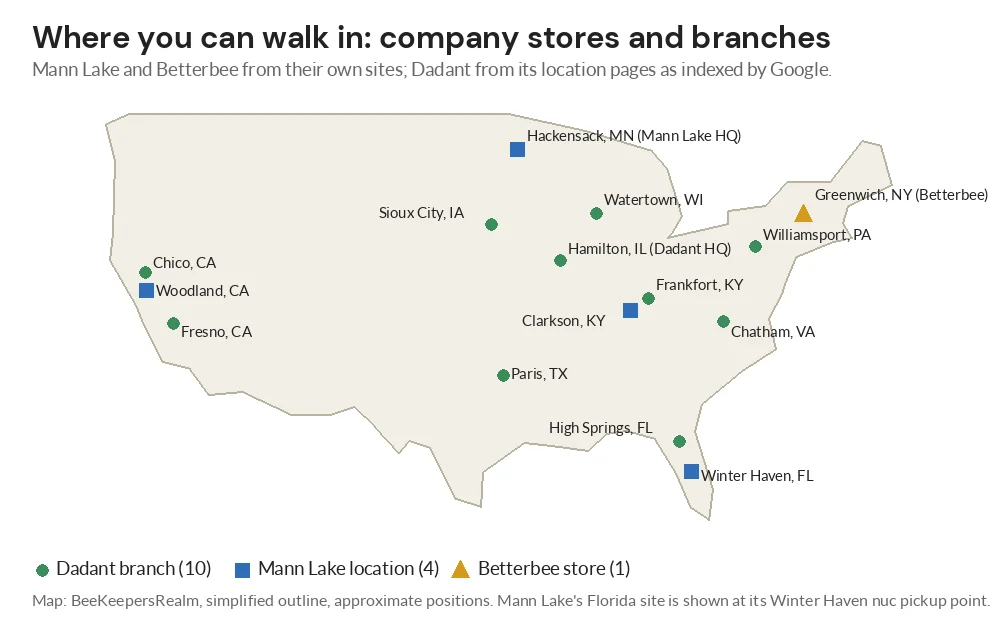
- Dadant lists 10 branches, Mann Lake 4 stores, Betterbee 1. Mann Lake closed its Pennsylvania and Texas locations in June 2025.
- Mann Lake changed owners in March 2025. Dadant has been family-run since 1863, and Betterbee has three owner-partners.
Table of Contents
- The Three Suppliers Side by Side
- Same Items, Three Price Tags
- Shipping Rules and Free-Shipping Thresholds
- Package Bees and Nucs: Shipped or Picked Up
- Who Owns Each Company Today
- Beginner Kits: What Is Actually in the Box
- Mixing Boxes and Frames Between Brands
- Which Supplier Fits Which Beekeeper
- Frequently Asked Questions
- The Bottom Line
The Three Suppliers Side by Side
All three sell full lines of Langstroth hives, protective gear and tools. They differ in history, locations and policy.
| Dadant & Sons | Mann Lake | Betterbee | |
|---|---|---|---|
| Founded | 1863, Hamilton, Illinois | 1983, Minnesota | 1979, Greenwich, New York |
| Ownership now | Dadant family | Coalition of families, since March 21, 2025 | Three partners: Christopher Cripps, Neal Kober, John Rath |
| Walk-in locations | 10 branches in CA (2), FL, IA, IL, KY, PA, TX, VA, WI | 4 stores: Hackensack, MN (HQ); Woodland, CA; Clarkson, KY; Florida | 1 store: Greenwich, NY |
| Free shipping | Most orders over $150* | Most orders over $150, lower 48, ground; $10 handling fee under $150 | None; customer pays freight |
| Package bees | 3 lb Italian, shipped to your post office or picked up; from $184.95* | 3 lb, shipped by USPS or picked up at a store; $169.95 to $199.95 | 3 lb Italian, pickup only in Greenwich; sold out for 2026 |
| Wood grades sold | Select, commercial, economy | Select, commercial, budget | Select, commercial |
| Also owns or publishes | American Bee Journal | Kelley Beekeeping, Pierce, Apis Biologix, Stromberg’s Chickens | Humble Abodes woodenware |
Sources: company pages, product listings and Business Wire releases, read October 12, 2026. *Dadant’s site blocked our access, so its figures come from dadant.com pages as indexed by Google that day.
Same Items, Three Price Tags
Prices on each supplier’s site on October 12, 2026, before shipping and tax. They change often.
| Item | Dadant* | Mann Lake | Betterbee |
|---|---|---|---|
| 10-frame deep box (9-5/8 in), commercial grade, unassembled | $20.95 (B50270) | $23.99 (Z800) | $22.19 (BOXDU10K) |
| Deep frames (9-1/8 in), 10-pack, unassembled | $20.95, select grade, nails included (B75110) | $23.99, wedge top (FR901) | $19.49, nails not included (DWF10) |
| 4 x 7 in stainless smoker with heat shield | $55.95, US-made (M00927) | $35.99, economy model | $34.69 on sale, regularly $39.89 |
| 3 lb package of bees, 2026 season | From $184.95 | $169.95 pickup, $199.95 shipped | Price not shown; sold out |
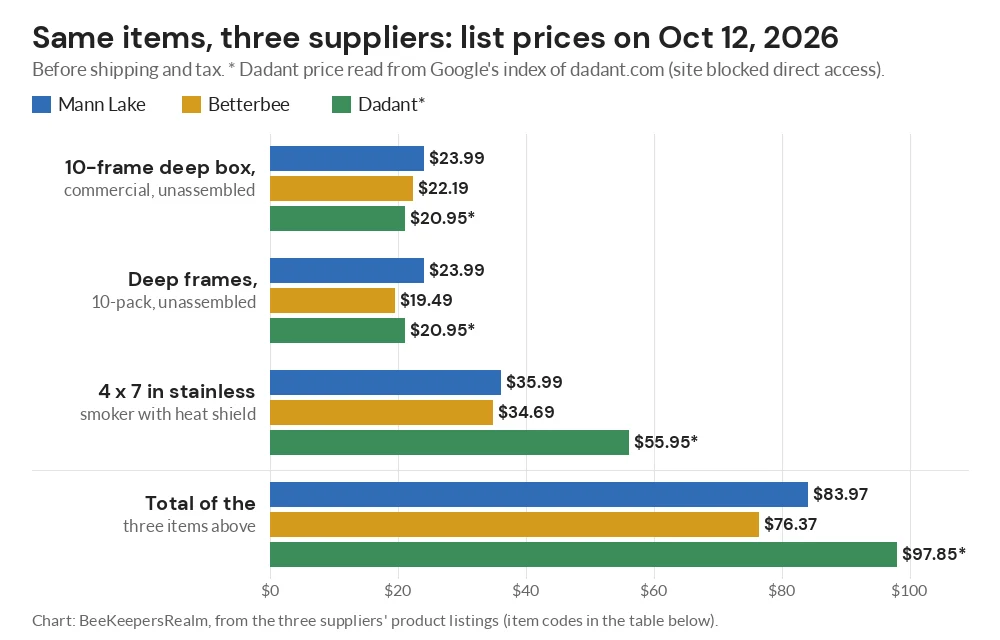
Boxes and frames are within about $4 of each other, so shipping decides most woodenware orders. The smoker gap is real: Dadant’s US-made model costs about $20 more. Our bee smoker buying guide covers what else differs.
Shipping Rules and Free-Shipping Thresholds
Mann Lake’s shipping terms give free standard ground shipping on most orders over $150 within the lower 48 states. Live bees do not count toward the $150, ineligible items and freight ship at the buyer’s cost, and most orders ship within 1 to 2 business days. Its contact page adds a $10 handling fee under $150.
Dadant advertises free shipping on most orders over $150 too, and flags some items as not eligible.
Betterbee’s terms and conditions state that the customer pays all freight. Everything ships from Greenwich, New York, so transit time depends on your distance from the Northeast.
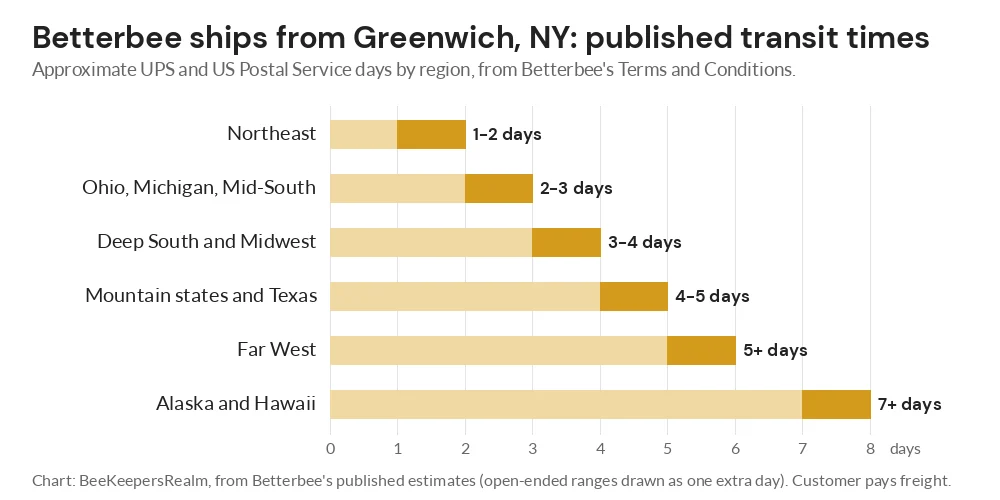
A New England beekeeper can get a Betterbee order in a day or two. A western beekeeper will usually pay less with Mann Lake or Dadant once an order clears $150.
Here is how that plays out on a typical spring order of five deep boxes and five 10-packs of deep frames, at the October 12 prices above. Dadant comes to $209.50 and Mann Lake to $239.90, and both clear the $150 free-shipping line if every item is eligible. Betterbee comes to $208.40 before freight, so its lower sticker price only wins if your freight bill stays small.
Package Bees and Nucs: Shipped or Picked Up
This is the biggest practical difference. Mann Lake’s 2026 Italian packages, about 3 pounds of bees with a laying, open-air mated queen, cost $169.95 picked up at its Clarkson, Hackensack or Woodland stores, or $199.95 shipped by USPS, on dates from April 4 to May 16. It also lists 5-frame nucs for pickup in seven states.
Dadant’s 3 lb Italian packages ship to your local post office or can be picked up at a branch, from $184.95. Betterbee does not ship bees at all:
“Please note that Package bees and nucs are available for customer pickup only.”
Betterbee’s packages come by truck from Wilbanks Apiaries in Claxton, Georgia; in October its package page read “sold out for the season.” Our guides to package bees vs nucs and how bees travel by mail explain the trade-offs.
Who Owns Each Company Today
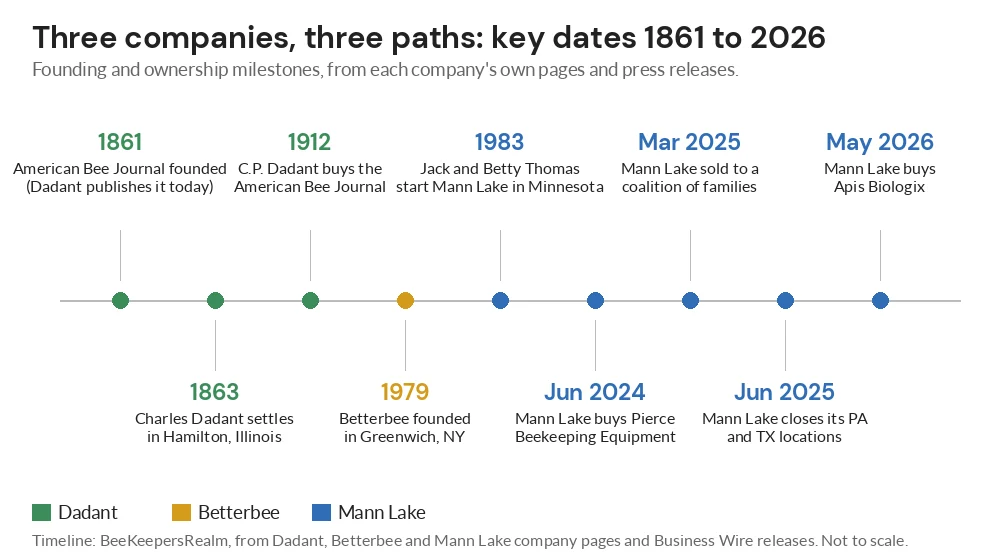
Dadant & Sons traces to Charles Dadant, who settled in Hamilton, Illinois, in 1863. The company says it is still family-run, with four manufacturing facilities near Hamilton, including a stainless steel plant in Dallas City, Illinois, that builds its extractors. It publishes the American Bee Journal, founded in 1861 and bought by C.P. Dadant in 1912.
Mann Lake began in 1983, when Jack and Betty Thomas sold supplies from their garage, and grew into what it calls the world’s largest beekeeping supplier. It bought Pierce Beekeeping Equipment in 2024, and on March 21, 2025, it was acquired by a group of families, among them an olive farmer and beekeepers.
“Mann Lake was started as a family-owned business in 1983, and it’s incredibly exciting for us to return to those roots.”
In June 2025 Mann Lake closed its Wilkes-Barre, Pennsylvania, and Marshall, Texas, locations and moved that stock to Clarkson, Kentucky. In May 2026 it bought Apis Biologix, maker of the Bio-Activator in its Ultra Bee Rocket Fuel patties.
Betterbee was founded in 1979 by Bob Stevens, a former educator who ran it for 27 years and helped Cornell build its master beekeeper program. It is now owned by veterinarian Christopher Cripps, contractor Neal Kober and mechanical engineer John Rath.
Beginner Kits: What Is Actually in the Box
Mann Lake’s New-Bee kit (HK121, $229.99) and Betterbee’s Basic Beginner Kit (BBK10A, $259) each give you one assembled 10-frame deep with covers and a bottom board. The extras differ:
- Mann Lake HK121: frames with beeswax-coated plastic foundation, economy smoker, hive tool, 1-gallon frame feeder, smoker fuel and one Ultra Bee patty. No veil, gloves or book.
- Betterbee BBK10A: 10 plastic frames, stainless smoker, hive tool, leather gloves, helmet and veil, and a beginner book. No feeder. Dropping the book takes $24.95 off.
Dadant sells beginner kits with a veil and gloves, but we could not load its kit prices. Compare more options in our starter kit guide.
Mixing Boxes and Frames Between Brands
All three sell 9-1/8 inch deep frames for 9-5/8 inch deep boxes, so frames generally swap. Small differences remain: Betterbee lists its deep box as 9-1/2 inches tall, and Mann Lake sizes shallow frames for 5-5/8 inch supers rather than the more common 5-11/16. See frame and box sizes by maker and 8-frame vs 10-frame hives.
Reports of Dadant and Mann Lake parts not fitting come from a 2013 Beesource forum thread, where one beekeeper found Dadant’s grooved bottom bars too thick for Mann Lake’s notched end bars. Several posters rated both brands’ commercial frames highly. Those reports are old, so dry-fit one frame before mixing parts, or buy assembled frames from the maker of your boxes.
Which Supplier Fits Which Beekeeper
- Northeast beekeepers and beginners: Betterbee, for short transit times, classes and kits with a veil and gloves.
- Bees shipped to your door: Mann Lake or Dadant.
- Orders over $150 from the South or West: Mann Lake or Dadant, for free ground shipping.
- Shopping in person: Dadant’s 10 branches cover the most states.
- US-made extractors: Dadant builds them in Illinois.
For which pollen substitutes each supplier sells and how they compare, see pollen substitute patties compared.
Frequently Asked Questions
Which is cheaper, Dadant, Mann Lake or Betterbee?
For our three test items on October 12, 2026, Betterbee was cheapest at $76.37, then Mann Lake at $83.97 and Dadant at $97.85. Shipping can reverse that.
Does Betterbee ship package bees?
No. Betterbee sells packages and nucs for pickup only at its store in Greenwich, New York.
Who owns Mann Lake now?
A group of families, including farmers and beekeepers, bought Mann Lake on March 21, 2025.
Is Dadant still family-owned?
Yes. Dadant says it is still run by the family that founded it in Hamilton, Illinois, in 1863.
Where are Mann Lake bee hives made?
Mann Lake is based in Hackensack, Minnesota, and describes its products as USA-made. It does not say which plant makes each item.
Can I mix Dadant and Mann Lake frames?
Usually, since the frame sizes match, but test one frame first. Beekeepers have reported minor fit differences between the two brands’ parts.
The Bottom Line
Woodenware prices are close, so choose by shipping rules and bee pickup options. Check prices at checkout, and use our beekeeping cost breakdown to budget the first year.
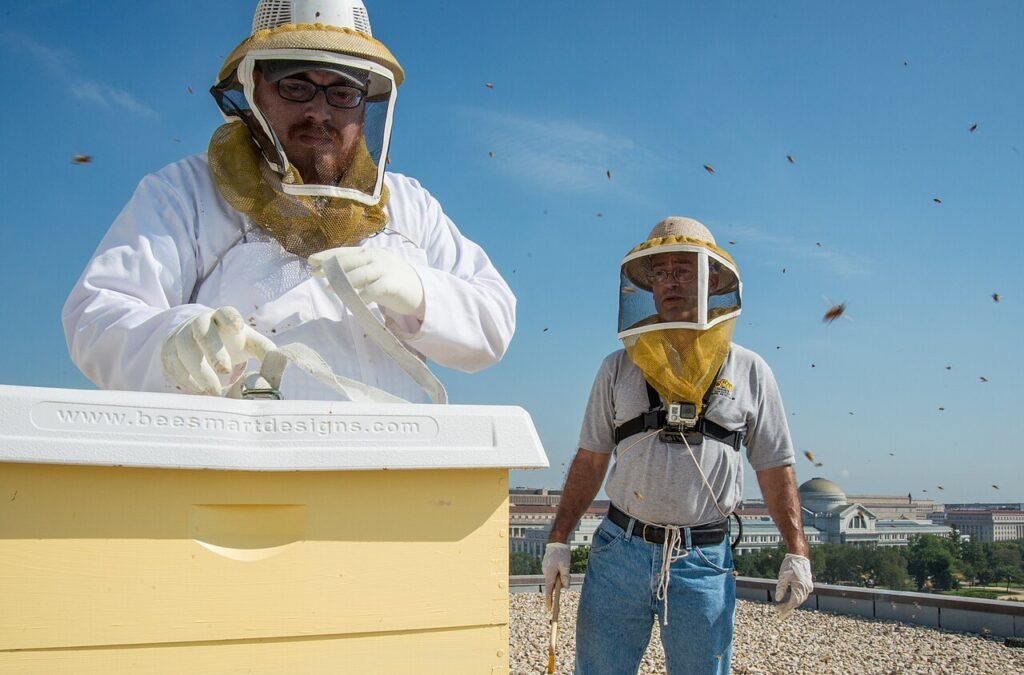
Image credits: Photo: Robert Engelhardt, licensed CC BY-SA 3.0, via Wikimedia Commons.