Last Updated September 15, 2026
A genuinely significant share of the foundational American beekeeping infrastructure still recognizably in use today — from a genuinely still-operating supply company to a widely referenced hive design to the country’s most historically important beekeeping periodical — traces back to a French immigrant who arrived in rural Illinois in 1863 with more curiosity about bees than money in his pocket. Charles Dadant’s story stands as a genuine American-immigrant-success narrative built on real, lasting, still-verifiable beekeeping infrastructure rather than resting on any single invention alone.
Key Takeaways
- Charles Dadant (May 20, 1817 – July 26, 1902) emigrated from Vaux-sous-Aubigny, France, to Hamilton, Illinois, in 1863 at age 46, after an earlier attempt at grape-growing there failed.
- He redesigned Langstroth’s hive with a deeper, wider single brood chamber to give the queen more uninterrupted laying space — still sold today as the Dadant (or Dadant-Blatt) hive, standardized in Europe by Swiss beekeeper Blatt.
- Dadant & Sons, the company he founded, is still an operating beekeeping supply business in Hamilton, Illinois, more than 160 years later.
- Factual correction: Charles Dadant himself was a regular contributor to the American Bee Journal starting in 1867, but he never owned it. His son, C.P. Dadant, bought the Journal in 1912 — a decade after Charles’s 1902 death — and Dadant & Sons has published it ever since.
- A direct 1869 quote from Dadant survives in the American Bee Journal’s own archives, showing his actual hive-capacity calculations in his own words (see below).
Table of Contents
- Who Was Charles Dadant?
- Emigrating to Illinois in 1863
- His Life in France Before Emigrating
- The Dadant Hive: A Deeper Brood Chamber
- Founding Dadant & Sons
- His Role in American Foundation Manufacturing
- Shaping the American Bee Journal
- His Lasting Influence on American Beekeeping Practice
- A Business That Outlasted Its Founder
- Dadant Hive vs. Standard Langstroth Hive
- Common Misconceptions
- Frequently Asked Questions
Who Was Charles Dadant?
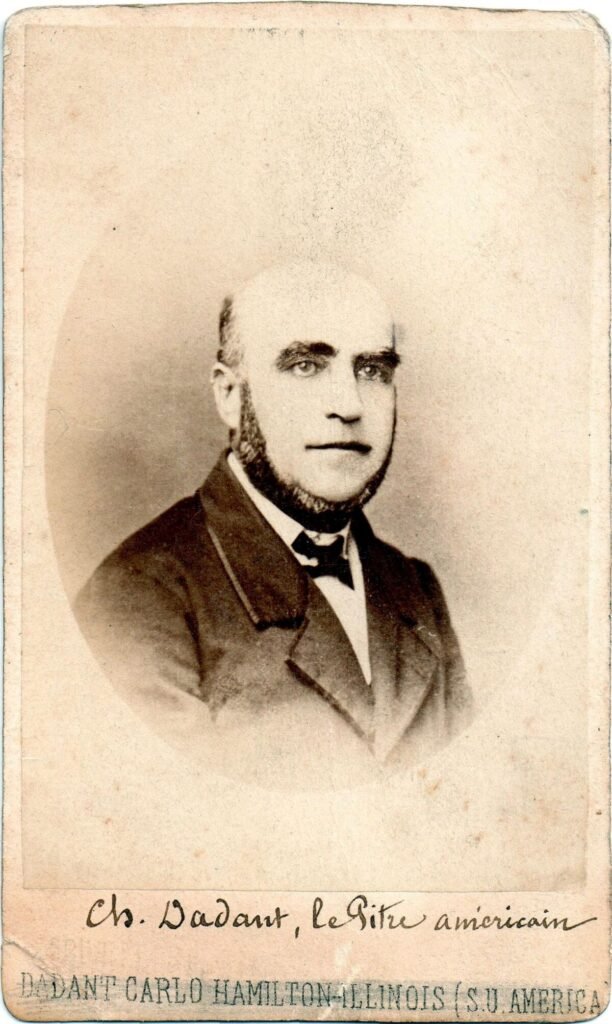
Charles Dadant (born May 20, 1817, in Vaux-sous-Aubigny, in France’s Haute-Marne department; died July 26, 1902, in Hamilton, Illinois) was a French-born beekeeper who became one of the most influential figures in 19th-century American beekeeping after emigrating to the United States in 1863. Settling in Hamilton, Illinois, he built a body of work spanning practical hive design, commercial equipment manufacturing, and beekeeping journalism that collectively shaped how American beekeepers practiced and learned the trade for generations after his own lifetime.
Emigrating to Illinois in 1863
Dadant’s move from France to rural Illinois in 1863, at age 46, placed him in the United States during a genuinely pivotal period for beekeeping technology, just over a decade after Lorenzo Langstroth’s movable-frame hive patent had begun reshaping how American beekeepers managed their colonies. His first venture in Illinois was actually grape-growing, not bees — it didn’t prove profitable, and he turned to the beekeeping he’d already practiced in France instead. Rather than simply adopting Langstroth’s new methods passively, Dadant became an active, hands-on contributor to refining the equipment and knowledge base American beekeepers relied on, publishing his first American Bee Journal article within a few years of arriving.
His Life in France Before Emigrating
Before his move to the United States, Dadant had already developed a serious interest in beekeeping and natural history while living in France, giving him a foundation of practical knowledge and genuine curiosity he carried with him across the Atlantic rather than starting entirely from scratch upon arrival. This existing grounding in the subject helps explain how quickly he was able to begin meaningfully contributing to American beekeeping practice and equipment development after settling in Illinois, rather than needing years to first learn the basics of the craft.
The Dadant Hive: A Deeper Brood Chamber
After examining Langstroth hives in use in America, Dadant concluded the standard brood chamber didn’t give a productive queen enough uninterrupted room to lay to her full capacity. His response, developed through the late 1860s and 1870s, deepened the brood-chamber body and widened the frame dimensions while deliberately preserving Langstroth’s original “bee space” principle — the precise gap between combs that keeps bees from gluing frames together with propolis or burr comb. This approach, still recognized today as the Dadant hive or Modified Dadant hive, reflected his own practical beekeeping philosophy: a single large brood chamber to reduce swarming pressure and simplify colony management, with shallower supers reserved purely for honey storage.
Dadant explained his own reasoning directly in print. In an August 1869 American Bee Journal article laying out his hive-capacity math, he wrote:
“But there is, besides, some room required in the combs for the provisions—honey and beebread; and if we allow 20,000 cells for this purpose, we shall have the area of 84,000 cells as the necessary room inside of the frames in movable comb hives.”
His design drew directly on the earlier writing of both Langstroth and Moses Quinby, and Dadant’s own defense of Langstroth’s patent claims in the Journal’s pages later played a real part in the historical record crediting Langstroth as the movable-frame hive’s originator. The design was later standardized with small revisions by the Swiss beekeeper Blatt — sold since as the Dadant-Blatt hive — and became one of the standard commercial hive models across parts of Europe as well as America.
Founding Dadant & Sons
Dadant founded what became Dadant & Sons, a beekeeping supply company that has continued operating for well over 160 years since its founding, making it one of the longest continuously operating beekeeping supply businesses in American history. By the end of the Civil War he kept nine colonies of bees and, with his young son C.P. Dadant, crossed the Mississippi River to sell honey and beeswax in a neighboring town — the modest, literal beginning of what grew into a national supply company. This isn’t simply a historical footnote: the company’s sustained operation across multiple generations represents a genuine, verifiable, ongoing piece of Dadant’s legacy rather than a business that folded shortly after its founder’s death, as happened to many contemporaneous ventures.
His Role in American Foundation Manufacturing
Dadant played a significant role in American commercial wax foundation manufacturing, helping bring Johannes Mehring’s original European foundation-press innovation into wider practical, commercial availability for American beekeepers. This is a genuinely important connective thread in American beekeeping history: Dadant didn’t invent foundation, but his manufacturing and distribution work helped transform it from a specialist European innovation into a standard, accessible piece of American beekeeping equipment.
Shaping the American Bee Journal
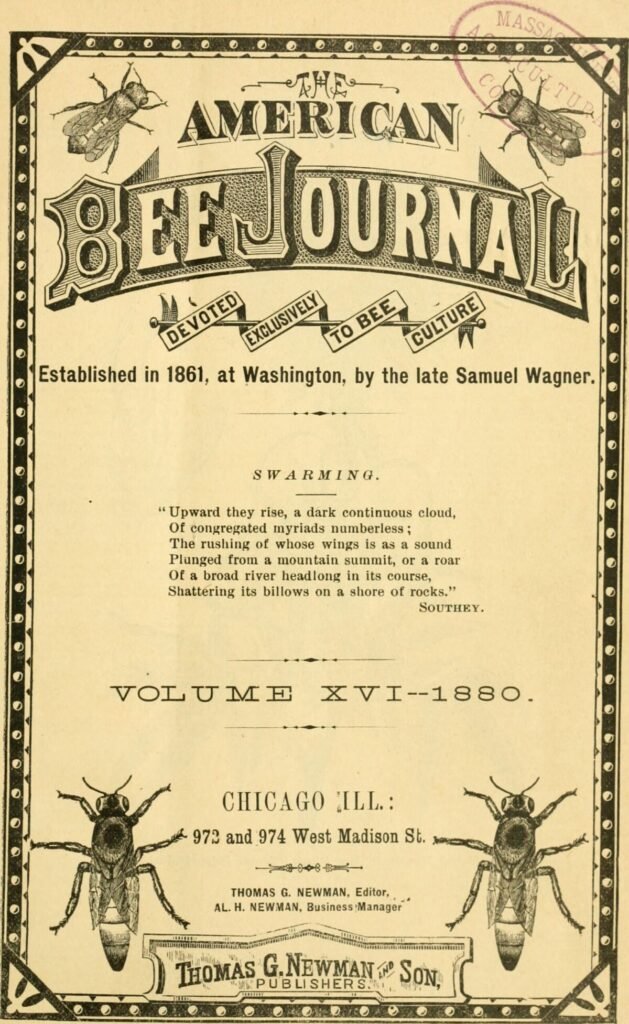
Dadant became a regular American Bee Journal contributor within a few years of settling in Illinois, and his writing on hive design and beekeeping practice helped shape how a rapidly growing base of American beekeepers learned the trade during a period when reliable, centralized information was genuinely scarce. It’s worth correcting a detail that’s easy to blur: Charles Dadant himself never owned or published the Journal. That happened after his death — his son C.P. Dadant bought the American Bee Journal in April 1912 from George W. York, and Dadant & Sons has published it continuously out of Hamilton, Illinois, ever since. Charles’s real, verifiable contribution during his own lifetime was as one of its most influential regular contributors, not its owner.
His Lasting Influence on American Beekeeping Practice
Beyond any single piece of equipment or publication, Dadant’s broader influence on American beekeeping lies in the methodical, well-documented approach he brought to the practice, treating beekeeping as a subject worth rigorous study, careful record-keeping, and continuous improvement rather than purely inherited folk tradition. Langstroth himself later entrusted revisions of his own book, “The Hive and the Honey-Bee,” to the Dadant family, and four revised editions appeared under the Dadant name between 1889 and 1899 — a genuine, documented vote of confidence from the hive’s original inventor in the family’s grasp of the subject.
A Business That Outlasted Its Founder
Following Charles Dadant’s death in 1902, his son Camille Pierre “C.P.” Dadant (1851-1938) continued both the business and his father’s broader advocacy for methodical, well-documented beekeeping practice, going on to buy the American Bee Journal in 1912. This multi-generational continuity is a genuinely notable feature of Charles Dadant’s legacy, distinguishing his story from beekeeping innovators whose contributions, however significant, weren’t sustained by an ongoing family or institutional structure after their own lifetime.
Dadant Hive vs. Standard Langstroth Hive
| Feature | Dadant Hive | Standard Langstroth Hive |
|---|---|---|
| Brood chamber depth | Deeper, single large chamber | Shallower, often multi-box |
| Design goal | Reduce swarming pressure via more queen-laying space | Modular, standardized box system |
| Origin | Charles Dadant, Illinois, developed 1860s-70s | Lorenzo Langstroth, patented 1852 |
| European standardization | Dadant-Blatt hive (Swiss beekeeper Blatt) | Not separately standardized in Europe under this name |
| Still in use today | Yes, by some beekeepers, especially parts of Europe | Yes, the dominant global standard |
Common Misconceptions
The most common misconception is assuming the Dadant hive is a completely separate hive system unrelated to Langstroth’s design, when it’s more accurately understood as a genuine, thoughtful modification of the same underlying movable-frame concept, specifically altering brood chamber depth and width rather than reinventing the whole system. A second common misconception — and a real error worth correcting directly — is assuming Charles Dadant personally owned or ran the American Bee Journal during his lifetime. He was one of its most important regular contributors, but the Journal wasn’t acquired by the Dadant family until his son C.P. Dadant bought it in 1912, a decade after Charles’s death.
For the company today, see how Dadant & Sons compares with Mann Lake and Betterbee.
Frequently Asked Questions
Is Dadant & Sons still operating as a beekeeping supply company today?
Yes, the company Charles Dadant founded has continued operating for well over 160 years, making it one of the longest-running beekeeping supply businesses in American history.
Why did Dadant design a deeper brood chamber instead of using the standard Langstroth box depth?
He believed giving the queen a larger, uninterrupted single laying space could help reduce swarming pressure and simplify colony management compared to a multi-box brood arrangement — a genuine design philosophy difference he explained himself in an 1869 American Bee Journal article, not a random variation.
Did Charles Dadant own the American Bee Journal?
No. Charles Dadant was a prolific contributor to the Journal starting in the late 1860s, but his son C.P. Dadant didn’t purchase the publication until 1912 — ten years after Charles’s death in 1902. Dadant & Sons has published it continuously ever since.
Is the Dadant hive commonly used by beekeepers today, or mostly a historical curiosity?
It remains in genuine, if more limited, active use among some beekeepers who specifically prefer its deeper single-chamber brood arrangement, and it was formally standardized in Europe as the Dadant-Blatt hive — it isn’t purely a historical artifact no longer used in practice.
Did Dadant’s foundation manufacturing operation compete directly with A.I. Root’s company?
Both companies were significant players in early American beekeeping equipment manufacturing during an overlapping period, and while some degree of competition would be a reasonably expected feature of a growing commercial market, both businesses, including A.I. Root’s, ultimately contributed to the broader shared goal of making standardized beekeeping equipment more widely available across the country.
Are there any surviving original writings from Charles Dadant available to read today?
Yes — his contributions to the American Bee Journal from the 1860s onward, including his own published hive-capacity calculations, survive in the Journal’s archives and represent a genuine, primary-source window into his practical beekeeping philosophy, rather than a secondhand summary of his views.
How does Charles Dadant’s story compare to Petro Prokopovych’s in terms of lasting institutional legacy?
Both men left genuine, lasting contributions to beekeeping education and practice within their respective countries, though Dadant’s legacy is distinguished by a still-operating commercial business bearing his family name, while Prokopovych’s influence lives on more through his role in founding an early beekeeping school and his broader recognition within Ukrainian beekeeping heritage specifically.
Sources and further reading: Charles Dadant biographical overview, Wikipedia; The Digital Research Library of Illinois History Journal, on Dadant and the American Bee Journal in Hamilton, Illinois; the American Bee Journal’s own history page.