Published September 9, 2026
New York regulates beekeeping at two separate levels, and mixing them up is the single most common mistake new beekeepers in the state make. Every beekeeper, anywhere in New York, must register with the state Department of Agriculture and Markets. If you keep bees inside New York City specifically, you also need a second, completely separate registration with the NYC Department of Health and Mental Hygiene — and the two systems don’t talk to each other.
This guide covers the state-level registration requirement that applies no matter where you live in New York, then walks through NYC’s additional registration and nuisance rules, since beekeeping in the five boroughs works differently from beekeeping in Buffalo, Rochester, or rural Upstate counties. Understanding which layer of rules applies to you before you order your first package is the difference between a smooth first season and an avoidable compliance headache later.
Key Takeaways
- Every beekeeper in New York State must register annually with the Department of Agriculture and Markets — registration is free and required regardless of colony count.
- New York City beekeepers must also register separately with the NYC Department of Health and Mental Hygiene, a completely different system from state registration.
- Honeybees were removed from NYC’s list of prohibited animals in 2010, ending a long period where beekeeping was technically illegal in the city.
- NYC has no fixed setback distance but enforces strict nuisance standards around aggressive behavior, flight paths, and neglected hives.
- Outside NYC, beekeeping is generally governed by state law alone, with far fewer municipal-level restrictions than in the city.
Table of Contents
- Does New York State Require Beekeepers to Register?
- What State Registration Actually Covers
- Why Beekeeping Was Once Illegal in New York City
- NYC’s Separate Beekeeping Registration
- NYC Setback and Nuisance Rules
- Rules Across the Five Boroughs
- Beekeeping Outside New York City: Buffalo, Rochester, and Upstate Counties
- Mandatory Disease and Pest Reporting
- Selling Honey Legally in New York
- What Happens If You Skip Registration
- Frequently Asked Questions
Does New York State Require Beekeepers to Register?
Yes. Every beekeeper in New York State — whether you have one hive or a hundred — must register their apiaries annually with the Department of Agriculture and Markets. This requirement was reinstated in December 2021 through an amendment to Article 15 of the state Agriculture and Markets Law, after a period where mandatory registration had lapsed. Registration is free and, outside of the connectivity issues that have affected the department’s own registration subdomain at times, is designed to be completed online in a single sitting. If the online form is temporarily unreachable, the Department of Agriculture and Markets’ apiculture staff can also process registration by phone, so a technical hiccup doesn’t need to delay you past the point of being able to legally keep bees.
What State Registration Actually Covers
When you register, you’ll report the number of managed colonies you keep, the county where those colonies are located, your current contact information, and whether you intend to sell nucleus colonies. The state uses this data to track the health of New York’s more than 60,000 registered bee colonies, and — critically — to reach beekeepers quickly when a disease outbreak or pesticide risk is identified nearby. As of 2026, registration has become more actively enforced and, in some cases, tied to eligibility for certain state agricultural programs, so treating it as optional paperwork is a riskier bet than it used to be. Beekeepers who plan to apply for state agricultural grants, participate in pollinator-habitat programs, or sell nucleus colonies commercially should expect current registration to be checked as a prerequisite rather than a formality.
Why Beekeeping Was Once Illegal in New York City
Until 2010, honeybees were officially classified in New York City’s health code alongside venomous and wild animals, which made keeping them technically prohibited within city limits. That changed after years of advocacy from local beekeepers, who made the case — successfully — that honeybees were meaningfully different from the animals they’d been grouped with, and that they provided real value to community gardens, backyard fruit trees, and the city’s broader green spaces. The 2010 change removed honeybees from the prohibited list entirely, opening the door to the registered, regulated beekeeping scene NYC has today. In the years since, NYC has developed one of the more visible urban beekeeping cultures in the country, with rooftop apiaries at hotels, restaurants, and community gardens becoming a fairly normal sight across the city rather than a novelty.
NYC’s Separate Beekeeping Registration
If you keep bees anywhere in the five boroughs, state registration with the Department of Agriculture and Markets is not enough on its own. NYC requires a second registration with the NYC Department of Health and Mental Hygiene, and this system treats each hive as its own registration, not just each apiary location. New beekeepers must submit a registration form within 30 days of setting up a hive, and every registered hive must be renewed by May 31 each year. There’s no fee, which makes skipping it purely a matter of oversight rather than cost — but oversight is exactly what tends to happen to beekeepers who assume their state registration already covers city requirements.
NYC Setback and Nuisance Rules
Unlike many states, New York City does not set a single fixed setback distance in its health code. Instead, the standard is built around nuisance: hives must be located so that the movement of bees doesn’t become a nuisance to occupants of nearby property, pedestrians, or the general public. In practice, many beekeepers and beekeeping associations in the city still recommend keeping a working buffer — commonly cited as at least 10 feet from a property line, screened by a fence, hedge, or flyway barrier at least 6 feet tall — since that buffer makes it much easier to stay clearly on the right side of the nuisance standard rather than testing where the line actually falls. The city’s nuisance definition specifically calls out aggressive or objectionable bee behavior, flight paths that interfere with pedestrians or neighboring residents, and neglected, overcrowded, or abandoned hives as the kinds of problems that trigger enforcement.
Rules Across the Five Boroughs
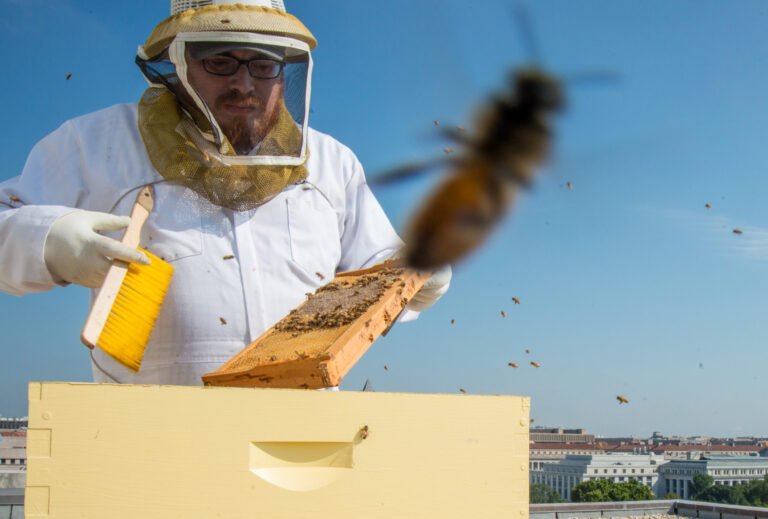
The registration and nuisance rules described above apply uniformly across Manhattan, Brooklyn, Queens, the Bronx, and Staten Island — NYC doesn’t currently run separate borough-specific beekeeping ordinances on top of the citywide health code. What does vary in practice is density and neighbor proximity: a rooftop apiary in a commercial or light-industrial stretch of Brooklyn or Queens tends to draw far less nuisance scrutiny than an identical setup in a tightly packed residential block, simply because there are fewer neighbors close enough to notice or complain. Rooftop placement has become the de facto standard for a large share of NYC beekeepers for exactly this reason, alongside the added benefit of putting the hive’s flight path well above street level, out of the way of both pedestrians and any downstairs neighbors who might otherwise notice the hive at all.
Beekeeping Outside New York City: Buffalo, Rochester, and Upstate Counties
Outside the five boroughs, New York beekeeping is governed almost entirely by the state-level registration requirement, without the second layer of city-specific rules that NYC imposes. Cities like Buffalo, Rochester, Syracuse, and Albany, along with the state’s many rural counties, generally don’t run their own separate beekeeper registration systems — state registration through the Department of Agriculture and Markets is the primary compliance step. That said, individual municipalities can still pass their own zoning restrictions on livestock and agricultural uses that beekeeping might get swept into, so it’s worth a quick check of local zoning code, especially in denser Upstate suburbs, before assuming state registration is the only box to check.
Mandatory Disease and Pest Reporting
Under Article 15 of the state Agriculture and Markets Law, every beekeeper in New York — regardless of which municipality they’re in — is required to report outbreaks of bee disease and pests to the state. This obligation exists separately from annual registration and applies the moment you notice a problem, not just at renewal time. Prompt reporting is part of what keeps New York’s apiary inspection program able to respond to regional outbreaks of American foulbrood and other serious colony diseases before they spread across county lines.
Selling Honey Legally in New York
Registering your bees and selling your honey are separate legal questions in New York, just as in most states. New York’s food-safety rules allow home producers to sell certain foods, including honey, under specific labeling and, in some cases, permitting requirements that sit outside your beekeeping registration entirely. If you’re planning to sell beyond a small honor-system stand, our guide to starting a honey business in the United States covers labeling and permitting basics that apply on top of New York’s own specific rules.
What Happens If You Skip Registration
Failing to register with the state is a violation of Article 15 of the Agriculture and Markets Law, and as enforcement has tightened since the 2021 reinstatement, unregistered apiaries are increasingly likely to be flagged during regional disease-response efforts even if no one ever inspects your property directly. In New York City, skipping the separate DOHMH registration or violating the nuisance standard is typically complaint-driven — a neighbor report about aggressive bees or an overcrowded, poorly maintained hive is usually what triggers a health department response, and repeated violations can lead to fines or an order to relocate or remove the hive. Registering at both the state and (if applicable) city level from day one is the simplest way to avoid ever finding out how that process works firsthand.
Frequently Asked Questions
Do I need to register with both the state and New York City?
Yes, if you keep bees inside NYC. State registration with the Department of Agriculture and Markets is required everywhere in New York, and NYC adds a completely separate registration requirement with the Department of Health and Mental Hygiene on top of that.
Is beekeeping legal in New York City?
Yes. Honeybees were removed from NYC’s list of prohibited animals in 2010, and beekeeping is now legal citywide subject to registration and nuisance rules.
How far do hives need to be from a property line in NYC?
NYC’s health code doesn’t set one fixed distance — it’s governed by a nuisance standard instead. Many beekeepers still keep at least a 10-foot buffer with a 6-foot flyway barrier as a practical safety margin against nuisance complaints.
Do I still need to register if I keep bees outside New York City?
Yes. State registration with the Department of Agriculture and Markets applies to every beekeeper in New York regardless of location; only the additional city-specific registration is unique to NYC.
What happens if my bees get sick — am I required to report it?
Yes. Under Article 15 of the state Agriculture and Markets Law, all New York beekeepers must report outbreaks of bee disease and pests to the state, separately from annual registration.
FAQ
Do I need to register with both the state and New York City?
Yes, if you keep bees inside NYC. State registration with the Department of Agriculture and Markets is required everywhere in New York, and NYC adds a completely separate registration requirement with the Department of Health and Mental Hygiene on top of that.
Is beekeeping legal in New York City?
Yes. Honeybees were removed from NYC’s list of prohibited animals in 2010, and beekeeping is now legal citywide subject to registration and nuisance rules.
How far do hives need to be from a property line in NYC?
NYC’s health code does not set one fixed distance; it is governed by a nuisance standard instead. Many beekeepers keep at least a 10-foot buffer with a 6-foot flyway barrier as a practical safety margin.
Do I still need to register if I keep bees outside New York City?
Yes. State registration with the Department of Agriculture and Markets applies to every beekeeper in New York regardless of location.
What happens if my bees get sick, am I required to report it?
Yes. Under Article 15 of the state Agriculture and Markets Law, all New York beekeepers must report outbreaks of bee disease and pests to the state.