Published September 2, 2026
Most insects covered on this site get confused with bees or wasps because they look harmless and happen to share a color pattern. Robber flies are the opposite case: a genuine aerial predator, capable of taking down bees, wasps, and other flying insects in mid-air, that beekeepers and gardeners are more likely to underestimate than fear. Understanding what they actually are — and what they aren’t — matters for anyone trying to make sense of predator activity around a hive or garden.
Table of Contents
- What Are Robber Flies?
- Fly, Not Wasp: How to Tell the Difference
- Ambush Hunting: How Robber Flies Catch Prey
- A Genuinely Diverse Family, Including Dedicated “Bee Killers”
- Do Robber Flies Actually Prey on Honeybees?
- The Robber Flies That Mimic Bumblebees
- Robber Flies vs. Hover Flies: Two Very Different Bee Look-Alikes
- What Robber Fly Larvae Do Underground
- Are Robber Flies Good or Bad to Have in a Garden?
- Bite Risk to People and Pets
- Robber Flies vs. Other Bee-Adjacent Insects
- Common Identification Mistakes
- Frequently Asked Questions
What Are Robber Flies?
Robber flies belong to the family Asilidae, a large family of true flies (order Diptera) found worldwide, with hundreds of species documented across North America alone. Despite the intimidating common name and often wasp-like coloring, robber flies are true flies, not wasps or bees, and their entire biology reflects that: as adults, they are aggressive, opportunistic predators that hunt other flying insects, while their larvae live in soil or decaying wood and are themselves predatory on other insect larvae and grubs.
Fly, Not Wasp: How to Tell the Difference
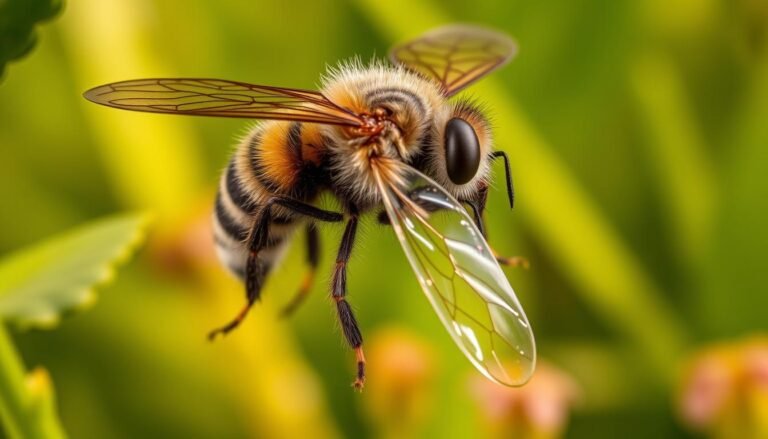
Robber flies frequently get mistaken for wasps because several species have slender, tapering abdomens and yellow-and-black or brown banding that superficially resembles wasp coloring. The reliable distinction is the same one used throughout the bee vs. wasp identification guide on this site: flies have only two wings, using a pair of small club-shaped structures called halteres in place of hind wings, while wasps and bees have four wings. Robber flies also have a distinctive bearded, bristly face (called a mystax) and unusually large, widely separated eyes relative to their head size, both of which are visible with a reasonably close look or photograph.
Ambush Hunting: How Robber Flies Catch Prey
Robber flies are ambush predators. A typical hunting robber fly perches on a stem, fence post, or other elevated vantage point, watching for passing flying insects, then launches in a fast, direct aerial attack timed to intercept prey precisely in flight, often within a fraction of a second of takeoff. Once prey is caught, the robber fly uses a short, hardened, needle-like mouthpart (a proboscis) to pierce the victim and inject saliva containing neurotoxic and enzyme compounds that immobilize the prey and begin breaking down its internal tissue, which the robber fly then consumes by suction — a genuinely effective, if unsettling, predation strategy that lets a robber fly successfully tackle prey close to its own size or larger.
A Genuinely Diverse Family, Including Dedicated “Bee Killers”
Asilidae is a large, diverse family, and North America alone hosts hundreds of described species ranging from small, genuinely easy-to-overlook flies to some of the largest and most conspicuous robber flies found anywhere in the world. One genus in particular, Promachus, includes species commonly nicknamed “bee killers” or “hanging thieves” specifically because of their documented habit of targeting bees and large wasps as prey, hunting from a perch and then consuming captured prey while hanging from vegetation. This genus represents the most bee-focused end of robber fly predation, distinct from the more general, opportunistic prey range typical of most other robber fly species.
Do Robber Flies Actually Prey on Honeybees?
Yes — this is real, documented behavior rather than exaggeration. Robber flies are recognized as one of several genuine natural predators of honeybees, capturing foraging workers in flight near flowering plants or occasionally near hive entrances. That said, robber fly predation is not typically considered a major colony-level threat the way something like a bear or a heavy varroa infestation is; losses tend to be limited to individual foraging bees rather than posing a real risk to overall colony strength, which is worth knowing before assuming a spotted robber fly near the hive signals a bigger problem.
The Robber Flies That Mimic Bumblebees
Certain robber fly species, most notably those in the genus Laphria, take wasp-like coloring a step further and closely mimic the size, fuzziness, and coloring of bumblebees specifically, a textbook example of what biologists call Batesian mimicry — a harmless-to-predators-appearing species gaining protection by resembling a species that predators tend to avoid, even though in this case the “harmless-appearing” mimic is itself a predator of other insects. Distinguishing a bumblebee-mimicking robber fly from an actual bumblebee usually comes down to behavior and mouthpart structure rather than color alone: a true bumblebee is methodically visiting flowers for nectar and pollen, while a Laphria robber fly is perched and watching for prey, or already flying with a captured insect.
Robber Flies vs. Hover Flies: Two Very Different Bee Look-Alikes
It’s worth directly contrasting robber flies with hover flies, another fly family covered on this site that also gets mistaken for bees. The two could hardly be more different in practice: hover flies are genuinely harmless mimics that feed on nectar and pollen as adults and whose larvae are frequently beneficial aphid predators, while robber flies are active aerial predators of other adult insects, sometimes including bees themselves. Both are flies rather than bees or wasps, both benefit from looking like something stingers-equipped, but only one of them is actually dangerous to the insects it resembles.
What Robber Fly Larvae Do Underground
While adult robber flies hunt in the air, their larvae live a very different life below ground or inside decaying wood and plant matter, where they act as predators of other soil-dwelling insect larvae, including some genuine agricultural pest species such as certain beetle grubs. This underground predatory role means robber flies contribute to natural pest control at two separate life stages, in two separate habitats, which is a more complete ecological picture than the adult aerial-hunting behavior alone suggests.
Are Robber Flies Good or Bad to Have in a Garden?
Taken as a whole, robber flies are generally considered beneficial in a garden or landscape context. As generalist predators, they help control populations of grasshoppers, other flies, beetles, and various other insects that can become genuine garden pests, and their larvae add a second layer of pest control underground. The occasional predation on a foraging honeybee is a real but minor tradeoff against this broader pest-control benefit, and it does not change the general recommendation that robber flies are worth tolerating rather than removing, the same way beekeepers are generally encouraged to tolerate most naturally occurring predator activity that isn’t causing measurable colony-level harm.
Bite Risk to People and Pets
Robber flies have no stinger and pose no venomous sting risk the way a wasp or bee does. That said, unlike most of the genuinely harmless insects covered elsewhere on this site, a robber fly handled directly can deliver a defensive bite with its piercing mouthpart, which can be sharply painful, though it is not dangerous or medically significant for most people. In practice, robber flies are not aggressive toward people and bites are essentially limited to cases of someone picking one up or handling it carelessly.
Robber Flies vs. Other Bee-Adjacent Insects
| Feature | Robber Flies | Hover Flies | Honeybees |
|---|---|---|---|
| Order | Diptera (true fly) | Diptera (true fly) | Hymenoptera |
| Wing count | 2 | 2 | 4 |
| Adult diet | Other insects (predator) | Nectar/pollen | Nectar/pollen |
| Danger | Painful bite if handled, no sting | Harmless | Genuine sting risk |
| Relationship to bees | Occasional predator | Harmless mimic | N/A |
Common Identification Mistakes
The most common mistake is assuming any large, hairy, buzzing insect near flowers must be a bumblebee, when a bumblebee-mimicking Laphria robber fly can look remarkably similar at a glance. A second common mistake is assuming wasp-like coloring on a slender insect automatically means a wasp, rather than checking wing count or watching its behavior for the perch-and-dart ambush pattern distinctive to robber flies. Finally, some people assume any predatory insect near a hive represents a meaningful colony threat, when in the case of robber flies the realistic impact is limited to occasional individual foragers rather than the colony as a whole.
Do robber flies build nests the way bees and wasps do?
No, robber flies don’t build nests at all. Adults are free-flying hunters that don’t construct or provision a nest structure, and females simply lay eggs in soil, plant debris, or crevices near where larvae will develop, a very different reproductive strategy from the nest-building behavior common across bees and wasps.
Can robber flies catch and eat wasps as well as bees?
Yes, robber flies are opportunistic predators and will readily take wasps, other flies, beetles, grasshoppers, and various other flying or perched insects in addition to bees, with prey choice generally driven more by what’s available and catchable near a given hunting perch than by any strong preference for one insect group over another.
Is it possible to reduce robber fly predation near beehives without harming other beneficial insects?
Because robber flies are only a minor, individual-forager-level predator rather than a colony threat, most experienced beekeepers don’t take any specific action against them; broad-spectrum insecticide use to target robber flies would risk harming honeybees and other beneficial insects far more than the robber flies themselves are harming the colony, making tolerance the generally recommended approach.
What time of year and day are robber flies most commonly seen?
Robber flies are most active during the warmer months, generally from late spring through late summer depending on region and species, and most commonly seen hunting during the warmest, sunniest parts of the day when flying prey insects are themselves most active — the same conditions that also tend to bring foraging honeybees out in force.
Do robber flies pose any risk to other pollinators besides honeybees, such as native bees or butterflies?
Yes, robber flies are opportunistic and will take native bees, butterflies, and other pollinating insects when the opportunity arises, not just honeybees specifically; this fits the broader pattern already described of robber flies preying on whatever suitable flying insects cross their hunting perch, rather than any particular focus on managed honeybee colonies.
How big do robber flies typically get compared to a honeybee?
Size varies considerably by species, but many of the larger robber flies, including several Promachus “bee killer” species, are comparable to or noticeably larger than a honeybee, which is part of what makes them physically capable of successfully capturing and subduing bee-sized prey in flight.
Are robber flies found throughout the United States, or only in certain regions?
Robber flies as a family are found throughout the United States and across most of the world, though specific species distributions vary regionally, meaning most beekeepers and gardeners anywhere in the country have at least some chance of encountering one during the warmer months.
Do robber flies migrate or overwinter, or do they only live for one season?
Most robber fly species complete their life cycle within a single year, with adults active during the warmer months and the species overwintering in an immature stage, typically as larvae in soil or decaying wood, rather than as adults or through any long-distance migration.
Frequently Asked Questions
Are robber flies dangerous to people?
Not in any serious sense. They have no stinger, though a defensive bite from careless handling can be painful, similar to a bee sting in intensity but without venom.
Should I be worried if I see robber flies near my hives?
Generally no. Robber flies are a documented but minor predator of individual foraging bees, not a colony-level threat, and no control measures are typically needed or recommended.
How can I tell a robber fly apart from a wasp?
Count the wings if you can get a clear look — two wings means a fly, four means a wasp or bee — and watch behavior, since robber flies perch and dart after prey rather than visiting flowers methodically.
Do robber flies help control garden pests?
Yes, both as adults hunting flying insects and as larvae preying on soil-dwelling grubs, robber flies contribute meaningfully to natural pest control across two different life stages.