Published September 1, 2026
Every alfalfa hay farmer growing alfalfa for seed, rather than for hay, depends on a bee that most gardeners have never heard of: the alfalfa leafcutter bee. Value of this single species to North American agriculture is surpassed only by the honeybee among managed pollinators, and it’s directly responsible for tripling North American alfalfa seed production since its accidental introduction in the 1940s. This guide covers what leafcutter bees actually are, the distinctive leaf-cutting nesting behavior that gives them their name, why one particular species became a commercial pollination powerhouse, and how leafcutter bees differ from the mason bees they’re often confused with.
Table of Contents
- What Leafcutter Bees Actually Are
- The Distinctive Leaf-Cutting Nesting Behavior
- How One Accidental Import Transformed Alfalfa Seed Farming
- Beyond Alfalfa: Blueberries and Other Crops
- The Loose Cell Management System, Explained
- Chalkbrood and Parasite Pressure in Managed Populations
- Leafcutter Bees vs. Mason Bees
- Why Canada Became a Global Leafcutter Bee Hub
- Common Mistakes
- Frequently Asked Questions
What Leafcutter Bees Actually Are
Leafcutter bees belong to the genus Megachile, part of the same family (Megachilidae) as mason bees, and there are hundreds of native Megachile species found across North America, most of which are wild, unmanaged, and go entirely unnoticed by most gardeners. The species responsible for the commercial pollination story that makes leafcutter bees economically significant is a single one: the alfalfa leafcutter bee, Megachile rotundata. Unlike the native blue orchard mason bee, this specific species isn’t native to North America at all; it was accidentally introduced from Europe sometime before the 1940s, likely arriving in imported nesting materials or shipping cargo, and was only later recognized and deliberately cultivated for its exceptional value as an alfalfa pollinator, a rare case of an unintentionally introduced insect becoming a genuine agricultural asset rather than a pest.

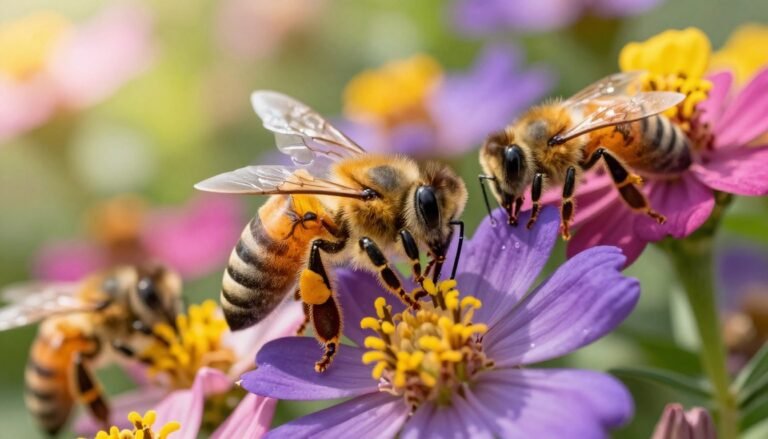
Like mason bees, leafcutter bees are solitary; there’s no queen, no worker caste, and no colony structure. Every female works alone, and the species is univoltine in most of its commercial range, completing one generation per year. Adult leafcutter bees are roughly honeybee-sized, generally dark-bodied with pale hair bands across the abdomen, and, like other megachilid bees, they carry pollen dry on a dense scopa located on the underside of the abdomen rather than in leg baskets the way honeybees do.
The Distinctive Leaf-Cutting Nesting Behavior
The name comes directly from an easily observed behavior: females use their mandibles to cut precise, nearly circular or oval pieces from the leaves of roses, ash trees, redbud, and various other broad-leaved plants, and carry these leaf discs back to a nesting cavity one at a time. Inside a hollow tunnel, whether a naturally occurring reed, an insect borehole, or a commercially provided nesting tube, the female uses these leaf pieces to construct individual thimble-shaped brood cells, layering them like tiny cigar wrappers to form a sealed chamber. She provisions each cell with a mixture of pollen and nectar, lays a single egg on top, and seals the cell before starting the next one, working down the length of the tunnel exactly the way mason bees do with mud instead of leaves, a shared strategy that reflects the two groups’ close evolutionary relationship within the same bee family.
Gardeners frequently notice this leaf-cutting activity on rose bushes and mistake the neat, circular holes left behind for disease or pest damage. In reality, the leaf loss is entirely cosmetic; a leafcutter bee removes only a small, specific portion of leaf tissue, causes no lasting harm to a healthy plant, and the activity is a reliable visual sign of a beneficial native pollinator actively nesting nearby rather than any kind of plant health problem.
How One Accidental Import Transformed Alfalfa Seed Farming
Alfalfa flowers have an unusual mechanical quirk: the flower’s reproductive structures are held under spring-loaded tension and need to be “tripped” by a visiting insect with enough force to release pollen, a process many bees, including honeybees, actively avoid because the mechanism can strike and injure them. Megachile rotundata tolerates this tripping mechanism far better than honeybees do and forages on alfalfa far more readily and efficiently as a result, making it dramatically more effective at pollinating alfalfa grown specifically for seed production (as opposed to alfalfa grown for hay, which doesn’t need to set seed at all). A single alfalfa leafcutter bee visits far more flowers per minute than a honeybee does on the same crop, partly because it isn’t deterred by the tripping mechanism that makes many other bees cautious around alfalfa blooms, which compounds its per-bee pollination advantage on this specific crop well beyond what raw numbers alone would suggest.
Once agricultural researchers recognized this species’ value in the mid-20th century, alfalfa seed growers across North America began deliberately managing populations using the “loose cell system,” in which cocooned bees are harvested from nesting boards at the end of the season, cleaned, incubated, and released the following spring in carefully timed numbers to match alfalfa bloom. The results were dramatic: North American alfalfa seed production roughly tripled after widespread adoption of managed leafcutter bee pollination, and by the mid-2000s, leafcutter-bee-pollinated alfalfa fields in North America were producing roughly two-thirds of the entire world’s alfalfa seed supply.
Beyond Alfalfa: Blueberries and Other Crops
While alfalfa seed remains the species’ signature crop, managed alfalfa leafcutter bees are also increasingly used to supplement honeybee pollination in blueberry, canola, and some other legume seed crops, particularly where growers want additional pollination pressure during a narrow bloom window or in situations where honeybee colonies alone haven’t produced consistent yields. Native, wild Megachile species, meanwhile, contribute unmanaged but genuinely meaningful pollination to a huge range of garden and native flowering plants across the country, entirely outside of any commercial management program.
The Loose Cell Management System, Explained
Commercial alfalfa leafcutter bee management relies almost entirely on a technique called the loose cell system, and understanding it explains why this particular species became commercially viable in a way most other native solitary bees never have. Growers provide large boards or blocks drilled with thousands of nesting holes, positioned in shelters near alfalfa fields at the start of the bloom period. At the end of the season, once brood cells are fully formed and cocooned, the entire mass of individual cells is mechanically removed from the nesting holes rather than left in place, a process that would be impractical with most other solitary bee species but works because Megachile rotundata readily accepts artificial nesting material and produces tightly packed, easily separable cells.
The harvested cells are then cleaned to remove debris and parasites, sorted, and placed into cold storage over winter to hold the bees in dormancy until the following spring, when growers can precisely time their release to match the start of alfalfa bloom. This level of control, timing exactly when bees emerge and how many are released per acre, is simply not possible with wild, unmanaged pollinator populations, and it’s the core reason alfalfa seed growers can rely on leafcutter bees as a genuinely predictable input rather than a variable, uncontrollable one.
Chalkbrood and Parasite Pressure in Managed Populations
Concentrating huge numbers of a single solitary bee species into small nesting areas year after year, exactly what commercial leafcutter bee management does, comes with a real cost: elevated disease and parasite pressure compared to what the same species would experience at low density in the wild. Chalkbrood, a fungal disease that kills developing larvae and leaves them mummified and chalky white inside the cell, is the most economically significant disease affecting managed leafcutter bee populations, and outbreaks can meaningfully reduce the number of viable bees available for the following season if left unmanaged. Parasitic wasps and mites, similar in concept to those affecting mason bee populations, also build up over successive seasons in reused nesting material. Growers manage this risk primarily through the same cell-cleaning process used in the loose cell system, since removing and inspecting cells each season, rather than leaving nesting material in place indefinitely, is the single most effective control measure available.
Leafcutter Bees vs. Mason Bees
The two groups are close relatives and are frequently confused, but a few reliable differences separate them. Mason bees are active in early spring and use mud to build brood cell partitions; leafcutter bees are active later, generally through summer, and use cut leaf pieces instead of mud. Visually, leafcutter bees tend to have a flatter, more elongated abdomen shape and carry pollen on a scopa that’s often visibly bright yellow or orange when loaded, compared to a mason bee’s rounder body. Readers who want the fuller picture of how mason bees compare to honeybees, including their own commercially significant pollination story, can see this site’s guide to mason bee biology and pollination efficiency.
Why Canada Became a Global Leafcutter Bee Hub
Western Canada, particularly Alberta and Saskatchewan, has emerged as one of the largest producers of managed leafcutter bee stock in the world, a fact that surprises most people outside the alfalfa seed industry. The cold winters that make the region challenging for many crops turn out to work in the leafcutter bee’s favor for a specific reason: reliably cold, consistent winter storage conditions make it easier to hold dormant bee cells in a stable state until precisely the right spring release timing, without the unpredictable warm spells that can cause premature emergence in milder climates. Combined with large-scale alfalfa seed acreage already established in the region, this has made prairie Canada a major exporter of leafcutter bee cocoons to alfalfa seed operations elsewhere in North America, a genuinely unusual example of a solitary, non-honey-producing bee species supporting an international agricultural trade.
Common Mistakes
The most common mistake is panicking over leaf damage on roses or other ornamentals, assuming it signals disease or a pest infestation, when circular leaf-cutting is actually a sign of a beneficial pollinator at work and causes no meaningful harm to an established, healthy plant. Another mistake is assuming all leafcutter bees are the same managed species discussed in agricultural contexts; the vast majority of leafcutter bees encountered in a typical garden are unmanaged native Megachile species entirely unrelated to commercial alfalfa pollination programs. Gardeners sometimes also try to eliminate leafcutter bee nesting sites out of an unfounded fear of stings; like mason bees, leafcutter bees are non-aggressive and rarely sting unless directly and firmly handled.
Frequently Asked Questions
Do leafcutter bees overwinter as adults like some other native bees?
No, they overwinter as fully formed adults inside their sealed leaf cocoons rather than as free-flying adults, remaining dormant through the cold months and only breaking dormancy and chewing their way out once spring temperatures and day length trigger emergence.
Should I try to buy managed leafcutter bees for my home garden?
Probably not necessary for most home gardens. Commercial leafcutter bee stock is bred and managed specifically for large-scale alfalfa seed pollination; a home gardener is generally better served by simply providing nesting habitat and pesticide-free forage and letting local wild Megachile species move in naturally, the same approach that already works well for attracting mason bees to a home orchard or garden setting.
Why doesn’t alfalfa grown for hay need leafcutter bees?
Because alfalfa grown for hay is cut and baled before it flowers and sets seed, pollination is irrelevant to that crop entirely; leafcutter bees only matter for the separate, smaller subset of alfalfa acreage specifically grown to produce seed for the following year’s planting.
Are leafcutter bees dangerous or aggressive?
No. They’re solitary, have no hive or honey stores to defend, and are considered gentle bees that rarely sting unless directly handled.
Do leafcutter bees hurt the plants they cut leaves from?
No meaningfully lasting harm. The leaf loss is cosmetic, a small, precisely cut section removed from otherwise healthy leaves, and established plants tolerate it without any real impact on the plant’s overall growth, flowering, or long-term health.
Can I attract leafcutter bees to my garden the way I would mason bees?
Yes, similar nesting tubes and blocks work for both groups, though leafcutter bees are active later in the season than mason bees and specifically need access to soft, pliable leaves like rose or redbud nearby for nest construction material.