Reviewed by Thomas B. · How we review
A tablespoon of honey (21 g) has about 64 calories and 17 grams of carbohydrate, almost all of it sugar. A teaspoon has about 21 calories, a cup about 1,031, and 100 grams 304, according to USDA FoodData Central. Raw and processed honey are effectively the same; water content, not processing, nudges the number.
This is educational nutrition information, not medical or dietary advice. If you count carbohydrates for diabetes or another condition, follow your care team’s guidance. Figures come from USDA FoodData Central (FDC IDs listed below), checked November 4, 2026.
Key Takeaways
- USDA lists honey at 304 calories, 82.4 g carbohydrate and 82.1 g sugars per 100 g; it is about 17% water.
- One tablespoon is 64 calories, one teaspoon 21, a quarter cup 258 and a cup 1,031.
- Gram for gram, honey has fewer calories than table sugar (304 vs 387), but a tablespoon of honey weighs much more, so it carries about 15 more calories.
- Labels often read 60 because FDA rules round calories above 50 to the nearest 10.
- No source we found shows raw honey or any floral type having meaningfully fewer calories.
Calories in Honey by Serving Size
All rows use USDA’s SR Legacy entry for honey (FDC 169640): 304 kcal, 82.4 g carbohydrate and 82.12 g total sugars per 100 g, with portion weights of 21 g per tablespoon, 14 g per 0.5-ounce packet and 339 g per cup.
| Amount | Weight | Calories | Carbohydrate | Sugars |
|---|---|---|---|---|
| 1 teaspoon | 7 g | 21 | 5.8 g | 5.7 g |
| 1 restaurant packet | 14 g | 43 | 11.5 g | 11.5 g |
| 1 tablespoon | 21 g | 64 | 17.3 g | 17.2 g |
| 2 tablespoons | 42 g | 128 | 34.6 g | 34.5 g |
| 1/4 cup | 85 g | 258 | 69.8 g | 69.6 g |
| 1 cup | 339 g | 1,031 | 279.3 g | 278.4 g |
| 100 g | 100 g | 304 | 82.4 g | 82.1 g |
Our arithmetic: grams × 304 ÷ 100. A tablespoon is 21 × 3.04 = 63.8 calories. USDA gives no teaspoon weight, so we used a third of a tablespoon (7 g × 3.04 = 21.3). A quarter cup is 339 ÷ 4 = 84.75 g, or 257.6 calories. With no fat and 0.3 g protein per 100 g, nearly every calorie comes from sugars, mainly fructose (40.9 g) and glucose (35.8 g). A drizzled spoon is rarely exactly 21 g, so weigh when precision matters.
Why Labels Say 60, Apps Say 64 and Some Say 70
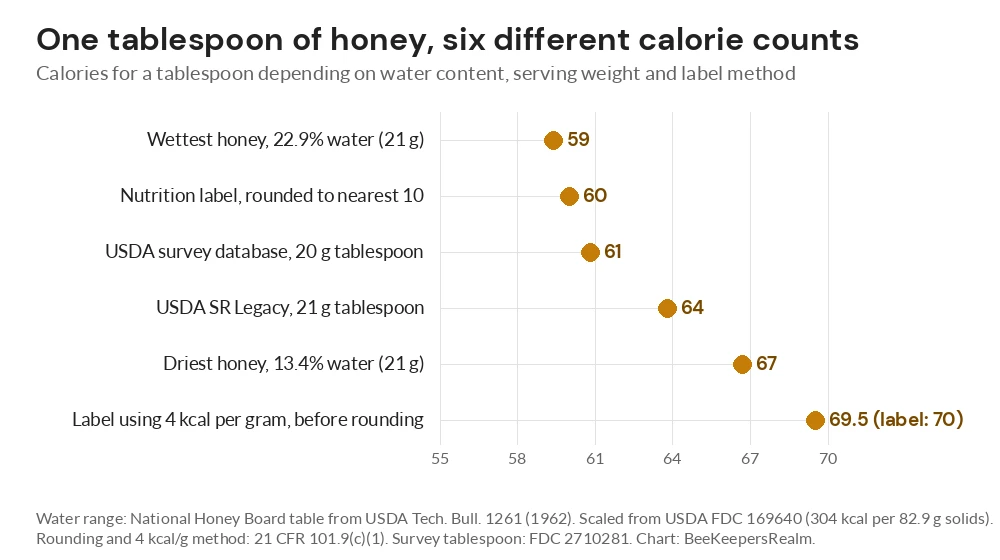
Search results and jars put a tablespoon anywhere from 60 to 70 calories. We traced the spread to four documented causes:
- Label rounding. Under 21 CFR 101.9(c)(1), calories above 50 are declared to the nearest 10, so 63.8 becomes 60. Sioux Honey’s panel, for example, lists 60 calories per 1 Tbsp (21 g).
- Two USDA tablespoons. USDA’s survey database (FNDDS, FDC 2710281) uses the same 304 kcal per 100 g but a 20 g tablespoon and 320 g cup: 61 and 973 calories.
- Calorie factors. USDA uses 3.68 calories per gram of honey carbohydrate. The same regulation allows a general 4 per gram: (17.3 g + 0.06 g protein) × 4 = 69.5, which rounds to 70.
- Water content. Wetter honey has fewer calories per gram (see below).
Honey vs Sugar, Maple Syrup and Agave
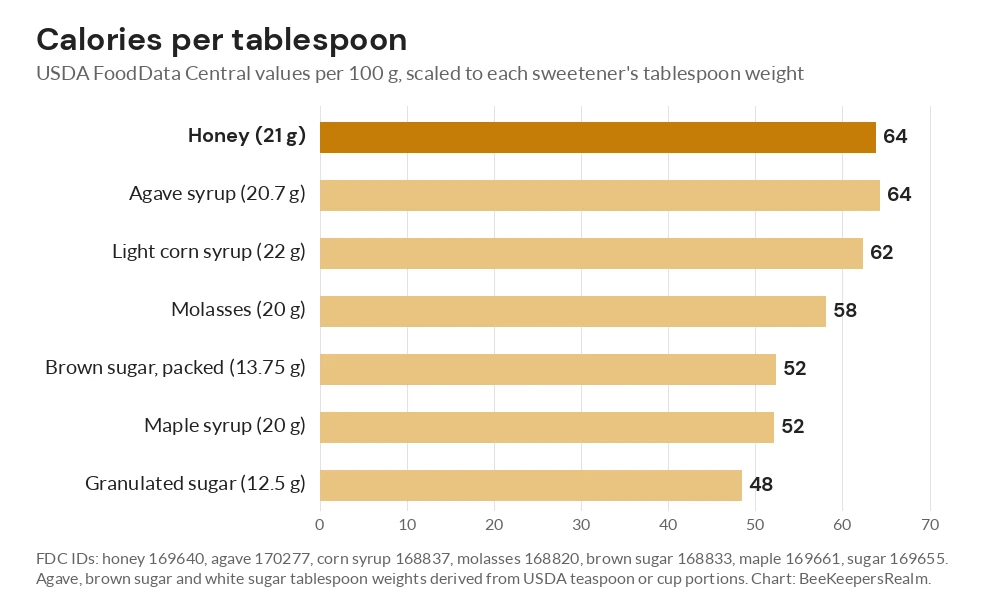
Per 100 g, honey is lighter than granulated sugar because about a sixth of it is water. Per spoonful it is heavier, because honey is dense: a tablespoon weighs 21 g, against 12.5 g for sugar (USDA’s 200 g cup ÷ 16).
| Sweetener (FDC ID) | Per 100 g | 1 tbsp weight | Calories per tbsp | Carbs per tbsp |
|---|---|---|---|---|
| Honey (169640) | 304 | 21 g | 64 | 17.3 g |
| Agave syrup (170277) | 310 | 20.7 g* | 64 | 15.8 g |
| Light corn syrup (168837) | 283 | 22 g | 62 | 16.9 g |
| Molasses (168820) | 290 | 20 g | 58 | 14.9 g |
| Brown sugar, packed (168833) | 380 | 13.75 g* | 52 | 13.5 g |
| Maple syrup (169661) | 260 | 20 g | 52 | 13.4 g |
| Granulated sugar (169655) | 387 | 12.5 g* | 48 | 12.5 g |
*Our conversions from USDA portions: agave 3 × its 6.9 g teaspoon; brown sugar 220 g cup ÷ 16; white sugar 200 g cup ÷ 16. A teaspoon of granulated sugar (4.2 g) is 16 calories, five fewer than honey.
The Arkansas Cooperative Extension Service notes that honey tastes sweeter than sugar, so people tend to use less; that is the only way it saves calories. Our guide to substituting honey for sugar in baking starts with less honey than the sugar it replaces.
Do Raw Honey or Different Floral Types Have Fewer Calories?
Not in any way that matters. USDA has no raw, clover or wildflower entry; both its reference records (SR Legacy and the survey database) are simply “Honey.” Verywell Fit’s dietitian-reviewed guide states that raw honey calories are the same as pasteurized varieties. The National Honey Board’s FAQ cites its 2012 study, which found processing reduced pollen but did not affect nutrient content:
“The amount of pollen in honey is minuscule and not enough to impact the nutrient value of honey.”
Our guide to raw vs processed honey covers what heating and filtering do change.
What varies between floral sources and harvests is water. A National Honey Board composition table, drawn from USDA Technical Bulletin 1261, Composition of American Honeys (1962), gives moisture averaging 17.2%, ranging from 13.4% to 22.9%, with a standard deviation of 1.46. Calories come from the dry solids, so we scaled USDA’s figure (304 kcal in 82.9 g of solids, 3.67 per gram):
- Driest, 13.4% water: about 318 calories per 100 g, or 67 per 21 g.
- Wettest, 22.9% water: about 283 per 100 g, or 59 per 21 g.
Even the extremes are only about 7 calories per tablespoon apart, and with that small standard deviation most honey sits close to USDA’s 64. Beekeepers measure water before harvest; see the target moisture content for ripe honey.
How Honey Fits Daily Added-Sugar Limits
The FDA counts the sugars in honey as added sugars.
“The Daily Value for added sugars is 50 grams per day based on a 2,000 calorie daily diet.”
A tablespoon’s 17.2 g of sugars is about 34% of that. Pure honey labels show the added-sugars %DV but, under FDA’s 2019 guidance, need not print “Includes Xg Added Sugars.” The American Heart Association advises most women to keep added sugar under 100 calories a day and most men under 150: about 4.7 and 7 teaspoons of honey.
For blood sugar, see whether honey is good for diabetics; for what honey offers besides calories, see the health benefits of honey, claim by claim.
For one premium varietal, see tupelo honey nutrition per tablespoon.
Frequently Asked Questions
How many calories are in 1 spoon of honey?
About 21 in a level teaspoon (7 g) and 64 in a level tablespoon (21 g).
Is 1 teaspoon of honey the same as 1 teaspoon of sugar?
No. A teaspoon of honey is 21 calories and 5.7 g sugars; a teaspoon of granulated sugar is 16 calories and 4.2 g.
Is a teaspoon of honey a lot of sugar?
It is 5.7 g, about 11% of the FDA’s 50 g Daily Value for added sugars.
Is honey considered high in calories?
Per 100 g it sits with other syrups (260 to 310 in our table), and nearly all of it is sugar.
Is honey better than sugar for dieting?
Only if you use less of it. Spoon for spoon, honey has more calories than white sugar.
Is it okay to have a teaspoon of honey every day?
For most healthy adults one teaspoon fits within the American Heart Association’s limits, if counted with other added sugar. Never give honey to babies under 12 months.
The Bottom Line
Use 64 calories per tablespoon and 21 per teaspoon, and weigh if precision matters. For single servings, see our guide to honey sticks and their calories.
Image credits: Featured photo: Matankic, via Wikimedia Commons, CC0 public domain dedication, cropped.