Reviewed by Sofia T. · How we review
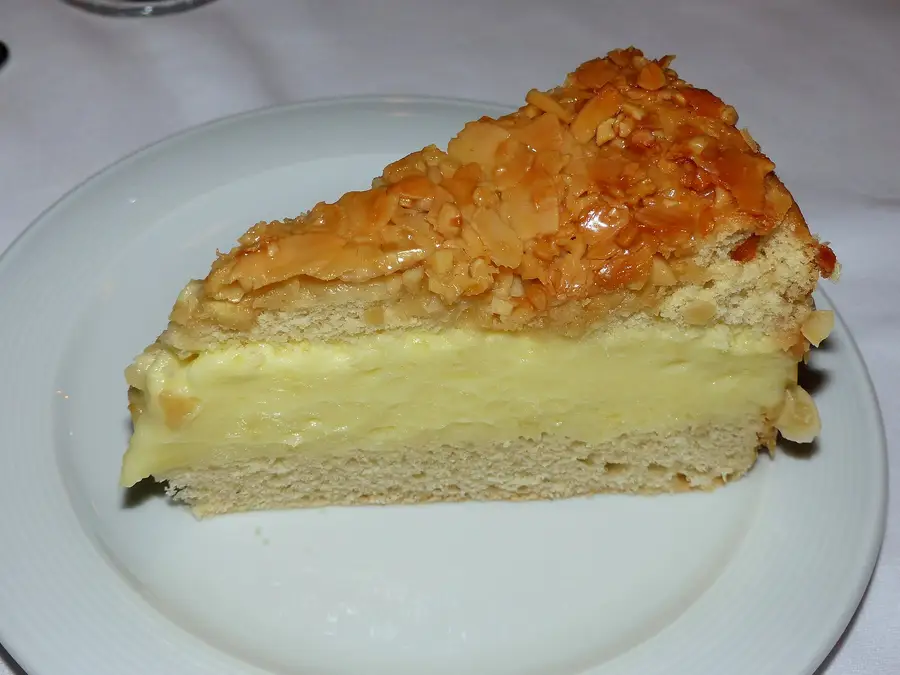
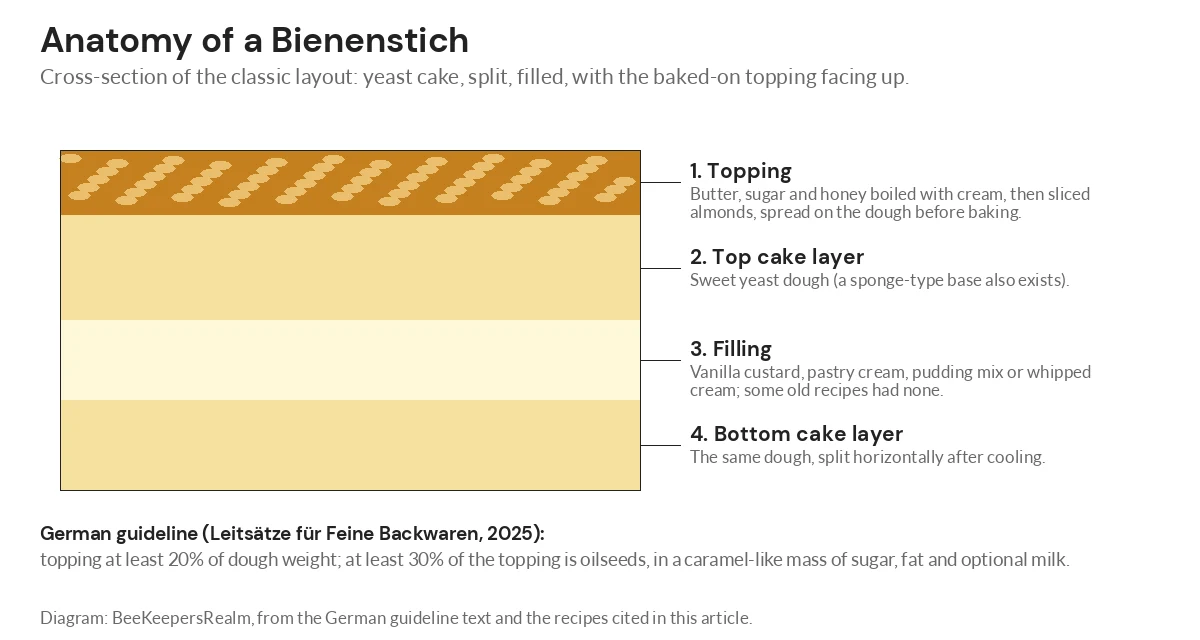
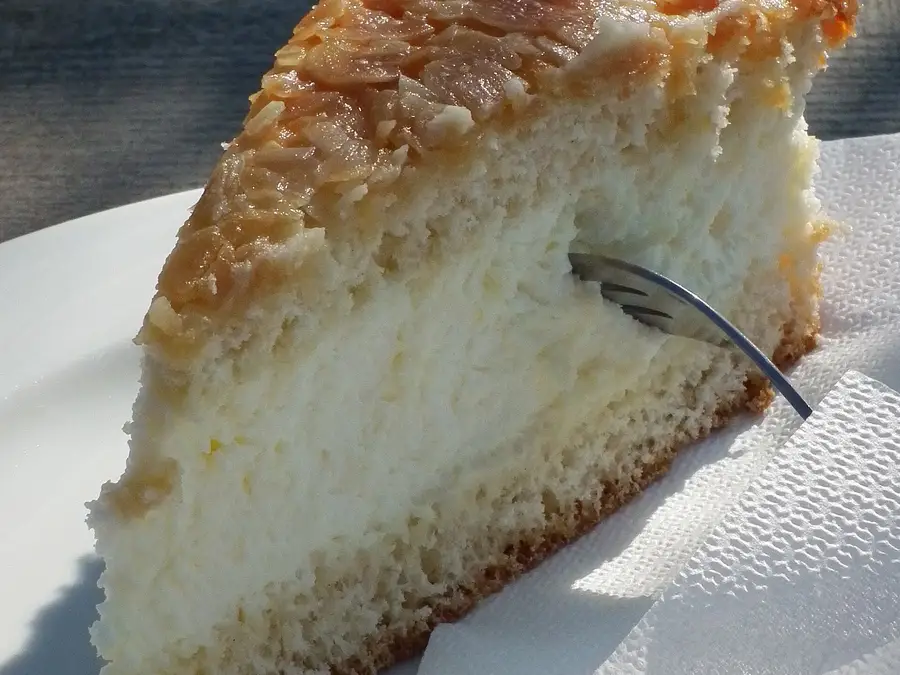
Bee sting cake, or Bienenstich, is a German yeast cake topped with a baked-on caramel of butter, sugar, honey and sliced almonds, then split and filled with vanilla custard or cream. The name points to the honey topping, not to a sting. If you arrived after being stung, see our bee sting treatment guide instead.
Key Takeaways
- Bienenstich has three parts: a sweet yeast cake, a filling and a baked-on almond caramel. Germany’s 2025 guidelines for fine baked goods require the topping to be at least 20% of the dough weight and at least 30% oilseeds, bound in a caramel of sugar, fat and optional milk. Honey is not named.
- In ten published recipes, almonds are 21% to 42% of the topping weight (our arithmetic): five clear the German 30% floor, one sits at 29.7% and four fall short.
- The 1474 beehive story is a legend. Surviving German documents about the cake start around 1913.
- The National Honey Board says honey speeds browning, so bakers should lower the oven temperature or shorten the bake. None of the ten recipes names a honey variety.
- The cream filling is perishable. The CDC says refrigerate perishable food within 2 hours, or 1 hour above 90°F.
Table of Contents
- What Bee Sting Cake Is
- What the German Guidelines Say Bienenstich Is
- Where the Name Comes From: Legend Versus Paper Trail
- How the Honey Topping Works and Why It Burns
- Ten Topping Recipes Compared
- Which Honey to Use
- The Filling and Food Safety
- The Standard Method in Brief
- Bee Sting Cake in Australia
- Frequently Asked Questions
- The Bottom Line
What Bee Sting Cake Is
King Arthur Baking’s test kitchen describes it plainly:
“a yeasted, buttery pastry dough, German in origin, filled with a rich vanilla custard cream, and topped with honey-glazed sliced almonds.”
Two variants are worth knowing. Some German bakers use a sponge base instead of yeast dough; the video channel All Tastes German calls yeast and sponge the two traditional versions. The crunchy lid is baked on with the cake, and the cake is split and filled afterward.
In this 7 minute 54 second video, the channel Bite and Chiu makes a brioche-style Bienenstich. Its official chapter list runs from preparing the dough and a window-pane gluten test to the almond layer, shaping the cake in rings, making and tempering the pastry cream, and assembly. We have not watched it for accuracy beyond that chapter list.
What the German Guidelines Say Bienenstich Is
Germany’s Deutsche Lebensmittelbuch-Kommission publishes guidelines, not laws, that describe what bakeries mean by a product name. The current Leitsätze für Feine Backwaren, revised on 9 January 2025, define it in section 2.2.3.6. Our translation of the key points:
| Element | What the guideline says |
|---|---|
| Base | Traditionally a yeast cake; batter-type bases are also possible |
| Filling | Filled or unfilled |
| Topping share | At least 20% of the dough weight |
| Oilseed share | At least 30% of the topping mass |
| Binder | A caramel-like mass of sugar, fat and, if used, milk |
| Other nuts | Seeds other than walnuts, hazelnuts and almonds must be labeled; “Mandel-Bienenstich” contains only almonds |
Two details stand out. The guideline never mentions honey. By contrast, the same document says a “Honigkuchen” (honey cake) takes at least 50% of its added sugar from honey. And filling is optional, which matches the early record below. Our reading is that honey is customary for the flavor and the name, not a legal requirement; American recipes are not bound by this guideline either way.
Where the Name Comes From: Legend Versus Paper Trail
The popular story dates the cake to 1474. As Wikipedia tells it, people of Linz am Rhein planned to attack neighboring Andernach, but two baker’s apprentices on the town wall threw bee nests at the raiders, and a cake was baked to celebrate. Other accounts have a baker stung by a bee drawn to his honey topping. Smitten Kitchen‘s author called the premise “awfully thin.”
The documents point elsewhere. English Wikipedia says the earliest German and Swiss recipes date to the beginning of the 20th century, and that the saga was being linked to the cake by at least 1962:
“The saga is probably a much later origin legend.”
German Wikipedia adds the primary references, summarized below. In 1913 the Baden Women’s Association cookbook still used “Bienenstich” for the roasted almond mixture itself, which fits the idea that the name first described the topping.
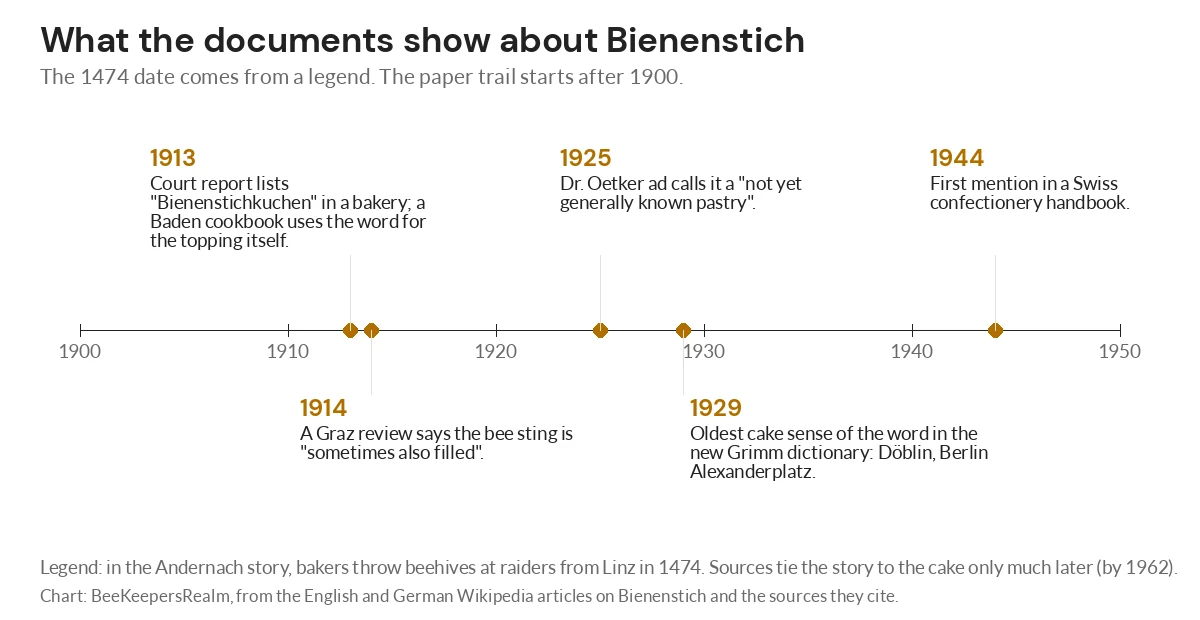
A practical point supports a 20th-century date. German Wikipedia notes that cream-filled cakes need cool storage, which few households had before the 19th century.
How the Honey Topping Works and Why It Burns
America’s Test Kitchen says a topping of honey, sugar, butter and almonds “bakes up into a crunchy, browned brittle” in the oven. The honey matters for browning. The National Honey Board’s marketing vice president, Catherine Barry, wrote in Bake magazine:
“Similar to all sugar compounds, honey caramelizes during baking and contributes a desirable golden color to products.”
She adds that because honey’s main sugars are glucose and fructose, the Maillard reaction is sped up. That lets bakers lower the oven temperature or bake time and keep the color, and she cautions that temperatures should be adjusted slightly to avoid over-browning. Our guide to swapping honey for sugar gives the same advice of about 25°F lower for honey cakes. The same article says honey is hygroscopic and has an average pH of 3.91; see how floral source affects honey pH. The topping is also a cooked sugar syrup, closer to the caramel in our cinder toffee guide than to a glaze.
Ten Topping Recipes Compared
We pulled the topping from ten popular recipes and converted spoons and cups to grams using King Arthur’s published weights (honey 21 g per tablespoon, sugar 12.5 g, butter 14.2 g, cream 17.5 g, sliced almonds 86 g per cup). The figures are our arithmetic, not lab results, and a few points either way are within the error of cup measures.
| Recipe | Honey | Honey share of honey + sugar | Almonds, share of topping | Topping on the stove | Oven |
|---|---|---|---|---|---|
| America’s Test Kitchen | 1/4 cup | 77% | 26% | Boil, then stir in almonds | 350°F, 30 to 40 min |
| Flavour Network | 3 tbsp | 48% | 32% | Simmer 4 to 5 min | 350°F, 20 to 25 min, then broil |
| Itsy-Bitsy Kitchen | 2 tbsp | 46% | 28% | Boil 2 to 3 min | 350°F, 20 to 25 min |
| King Arthur Baking | 3 tbsp | 48% | 34% | Boil 3 to 5 min | 350°F, 25 to 28 min |
| Mashed | 3 tbsp | 50% | 29.7% | Simmer 2 min | 350°F, 25 to 30 min |
| Our Gabled Home | None | 0% | 42% | Boil, cook 1 min | 400°F, 18 to 20 min |
| Supergolden Bakes | 3 tbsp, plus 1/4 cup in the dough | 46% | 28% | Simmer 5 min | 350°F, 35 to 45 min |
| Taste of Home | 3 tbsp | 72% | 37% | Melt until sugar dissolves | 350°F, 25 to 30 min |
| Tasting Table | 2 tbsp | 46% | 21% | Simmer until golden | 375°F, 25 to 30 min |
| Bite and Chiu (video) | 60 g | 50% | 36% | Not in chapter list | Not stated |
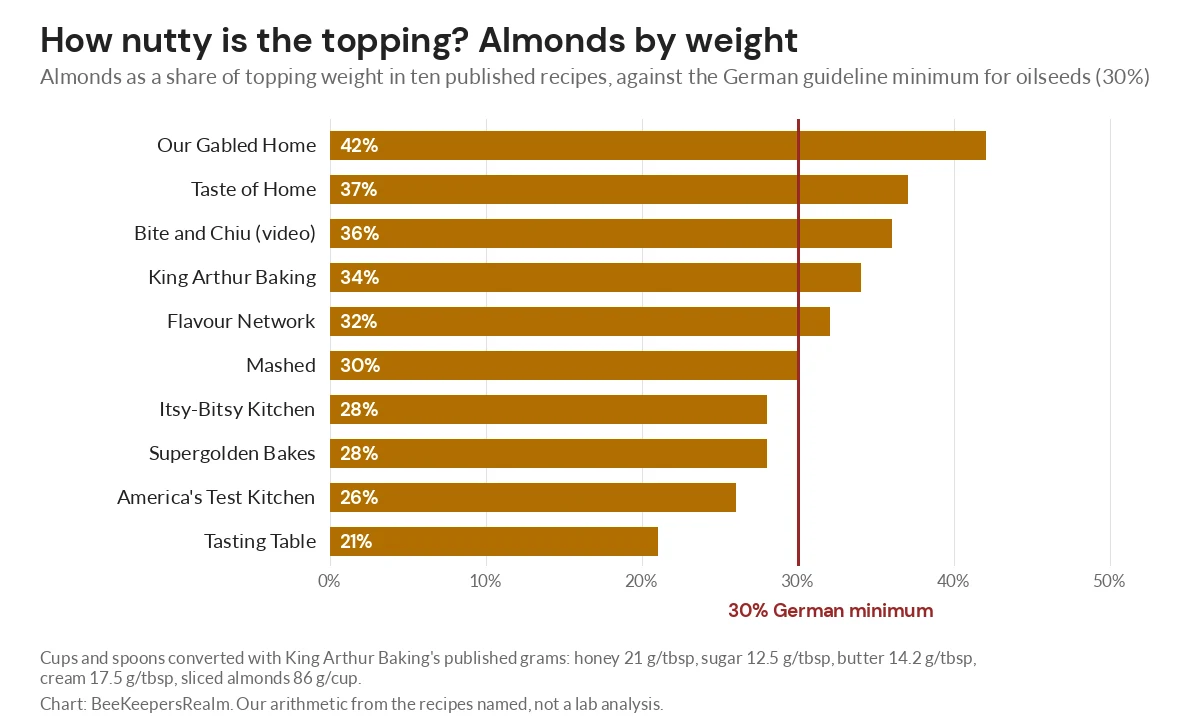
Three patterns emerge. Seven of the nine recipes with honey in the topping use roughly equal weights of honey and sugar. Only Our Gabled Home, written by a German-born baker, leaves honey out of the topping entirely, which the German guideline allows. And the almond share ranges widely, from 21% to 42%, so the German 30% floor is a real constraint on authentic bakery versions rather than a description of home recipes.
Which Honey to Use
None of the ten recipes names a honey variety, and we found no published test of varieties in bee sting cake, so there is no tested answer. The National Honey Board’s Bake magazine piece offers general guidance: clover honey adds delicate sweetness to cakes, while buckwheat lends a bold, molasses-like taste to breads and spice cookies. By that logic a mild clover or orange blossom honey keeps the almonds in front, and buckwheat honey would be a stronger choice; our guide to US honey varieties compares them. Because the honey is boiled, flavor is the reason to choose, and a crystallized jar is fine once gently reliquefied.
King Arthur also suggests adding a tablespoon of honey to the dough, or making the pastry cream with 1/3 cup of honey instead of sugar, plus 2 teaspoons of gelatin.
The Filling and Food Safety
Three fillings dominate. America’s Test Kitchen and Taste of Home cook pastry cream from egg yolks and cornstarch, and Taste of Home folds in whipped cream. Mashed and Flavour Network combine instant pudding with cream. King Arthur uses pudding, whipped cream and gelatin, saying the gelatin keeps the filling firm for days without weeping. America’s Test Kitchen also stabilizes with gelatin, which let it layer nearly double the filling, and both it and Itsy-Bitsy Kitchen cut the top layer into wedges before assembling so the cream does not squeeze out.
The filling is the perishable part. The CDC advises refrigerating perishable food, including dairy and cooked leftovers, within 2 hours, or within 1 hour if the food is above 90°F, and keeping the refrigerator at 40°F or below. For Bienenstich that means filling it, then chilling it, rather than leaving it on the counter all afternoon. German Wikipedia adds that because the filling is not heated all the way through, the cake is considered prone to germs. This is educational information, not professional advice; see the CDC’s food safety guidance.
For storage, Our Gabled Home and Taste of Home both say 3 days in the refrigerator at most, and Our Gabled Home freezes it for up to 6 months. Honey in a baked cake does not make it safe for babies; see why honey is unsafe under age 1.
The Standard Method in Brief
This is the method the published recipes share, attributed to them. We have not baked it.
- Mix and knead a sweet yeast dough and let it rise, then press it into a pan and let it rise again.
- Boil butter, sugar, honey and cream for a few minutes, then stir in the almonds and cool slightly. Flavour Network warns that a topping that is too hot can make the almonds sink.
- Spread it on the dough and bake at about 350°F. King Arthur bakes 25 to 28 minutes, until the topping is bubbling, then cools the cake in the pan for 30 minutes so the topping firms up.
- Cool completely, split horizontally with a serrated knife, fill and reassemble.
On color, America’s Test Kitchen says to check a cake in a dark pan after 25 minutes, and Mashed says to cover the top loosely with foil if the almonds brown too quickly. In her first trial the Smitten Kitchen author found the topping “sad and pale,” too sweet and short of salt.
Bee Sting Cake in Australia
We looked for a distinct Australian bee sting cake and found the German cake under its German name. The trade site Baking Business says the Barossa Valley welcomed many German settlers in the 19th century and that its bakeries still sell bienenstich, vollkorn bread and kranskys, and it describes Apex Bakery as operating since 1924. We found no source on when the cake reached South Australia, so treat anything more specific as unverified. Read the Barossa Valley feature for the bakeries it names.
Frequently Asked Questions
Why is it called bee sting cake?
Nobody knows for sure. The 1474 story of bakers throwing beehives is a legend, and the name may simply have described the sticky honey and almond topping, which a 1913 cookbook called “Bienenstich.”
Is bee sting cake made with honey?
Most American recipes use honey, but the German guideline requires only a caramel-like mass of sugar, fat and optional milk. One of the ten recipes we compared has none.
What does bee sting cake taste like?
Chowhound calls it sweet but not cloying, and Supergolden Bakes says the cake itself is not particularly sweet, with the filling and topping balancing it.
Does bee sting cake need to be refrigerated?
Yes. The filling is custard or cream, and the CDC says to refrigerate perishable food within 2 hours. Recipes keep it about 3 days.
Can you freeze bee sting cake?
Our Gabled Home says wrapped tightly, it keeps in the freezer for up to 6 months, thawed at room temperature on the day you serve it.
Is bee sting cake safe for babies?
No. It contains honey, and honey is not safe for children under 1 year old, even baked.
Does bee sting cake contain bee stings or venom?
No. The name comes from legends and the honey topping. For an actual sting, read our bee sting treatment guide.
The Bottom Line
Treat Bienenstich as a yeast cake with a nutty caramel lid, watch the oven when honey is in it, and chill the filled cake.
Featured image: Alice Wiegand, via Wikimedia Commons, CC BY-SA 4.0, resized.