
Last Updated September 15, 2026
Most honey bee content available anywhere online, including much of what’s covered elsewhere on this site, revolves around a small handful of well-known, commercially significant species — Western honey bees, the giant and dwarf Asian species, and Apis cerana. Apis nigrocincta, sometimes called the black-banded honey bee, is a genuine, notable outlier: a distinct honey bee species that remains confined to a narrow geographic range across Sulawesi and parts of the Philippines, and genuinely one of the least-studied, least publicly known members of the entire genus.
Key Takeaways
- What it is: A cavity-nesting honey bee species, first described by Frederick Smith in 1861, native only to Sulawesi, Sangihe Island, and Mindanao in the Philippines.
- Relationship to Apis cerana: Extremely close — the two species’ drones have identical genitalia — but morphometric and molecular research established A. nigrocincta as a distinct species rather than a regional form.
- Elevation niche: In southern Sulawesi, most colonies nest above 400 meters elevation, while Apis cerana in the same area stays mostly below that line — a real ecological separation between two otherwise similar species.
- Size and cells: A mid-sized Apis species — smaller than the giant honey bee, larger than the dwarf honey bee — with worker comb cells averaging about 4.5 mm.
- Not managed commercially: No established beekeeping industry uses this species; it remains a wild, unmanaged part of its native ecosystem.
Table of Contents
- What Is Apis Nigrocincta?
- A Genuinely Narrow Geographic Range
- Its Close, Complicated Relationship to Apis Cerana
- A Long, Uneven Taxonomic History
- Cavity-Nesting Behavior
- Where It Fits in the Honey Bee Size Range
- General Foraging and Colony Behavior
- Why This Species Matters to Researchers
- Not a Commercially Managed Species
- A Species Vulnerable Simply Because of Its Range
- Apis Nigrocincta vs. Other Asian Honey Bee Species
- Common Misconceptions
- Frequently Asked Questions
What Is Apis Nigrocincta?
Apis nigrocincta is a species of honey bee native to a limited part of Southeast Asia, first formally described by entomologist Frederick Smith in 1861. Once sometimes treated as a regional form of the more widespread Apis cerana, it is now generally recognized in the scientific literature as its own distinct species, with its own evolutionary lineage separate from its better-known relatives.

A Genuinely Narrow Geographic Range
Unlike Western honey bees, which have been introduced across much of the world, or Apis cerana, which is native across a broad swath of Asia, Apis nigrocincta is confined to the island of Sulawesi and nearby Sangihe Island in Indonesia, plus parts of Mindanao in the Philippines. In southern Sulawesi, most colonies nest at elevations above 400 meters — a real, measured ecological difference from Apis cerana colonies in the same region, which stay mostly below that elevation. This genuinely limited natural range is one of the single most defining features of the species, and it stands as a major reason this honey bee remains far less studied, and far less publicly recognized, than species with broader continental distributions.
Its Close, Complicated Relationship to Apis Cerana
Because Apis nigrocincta and Apis cerana are closely related and were historically sometimes classified together, the boundary between the two species has been an active area of taxonomic and genetic research. The relationship is genuinely close at the anatomical level — the two species’ drones have identical genitalia — which is exactly why distinguishing them required careful morphometric measurement and molecular (mitochondrial DNA) analysis rather than a simple visual check. In regions where their ranges come into contact, documented hybridization between the two species adds further complexity to understanding exactly how distinct the two lineages remain, making this relationship a genuinely active rather than fully settled area of honey bee taxonomy.
A Long, Uneven Taxonomic History
Apis nigrocincta was formally described in the scientific literature by Frederick Smith in 1861, but for much of the time since, it was frequently treated as a subspecies or regional form of Apis cerana rather than as a fully independent species in its own right. It wasn’t until more recent genetic and morphometric research clarified the degree of distinction between the two — despite their drones sharing identical genitalia — that Apis nigrocincta gained broader acceptance as its own species, illustrating how honey bee taxonomy, even for a genus as economically important as Apis, has continued to be actively revised well into the modern era. A peer-reviewed mitochondrial DNA study published via PubMed Central found high intraspecific genetic diversity within Apis nigrocincta populations across Sulawesi, consistent with its status as a genuinely distinct, if still actively studied, lineage.
Cavity-Nesting Behavior
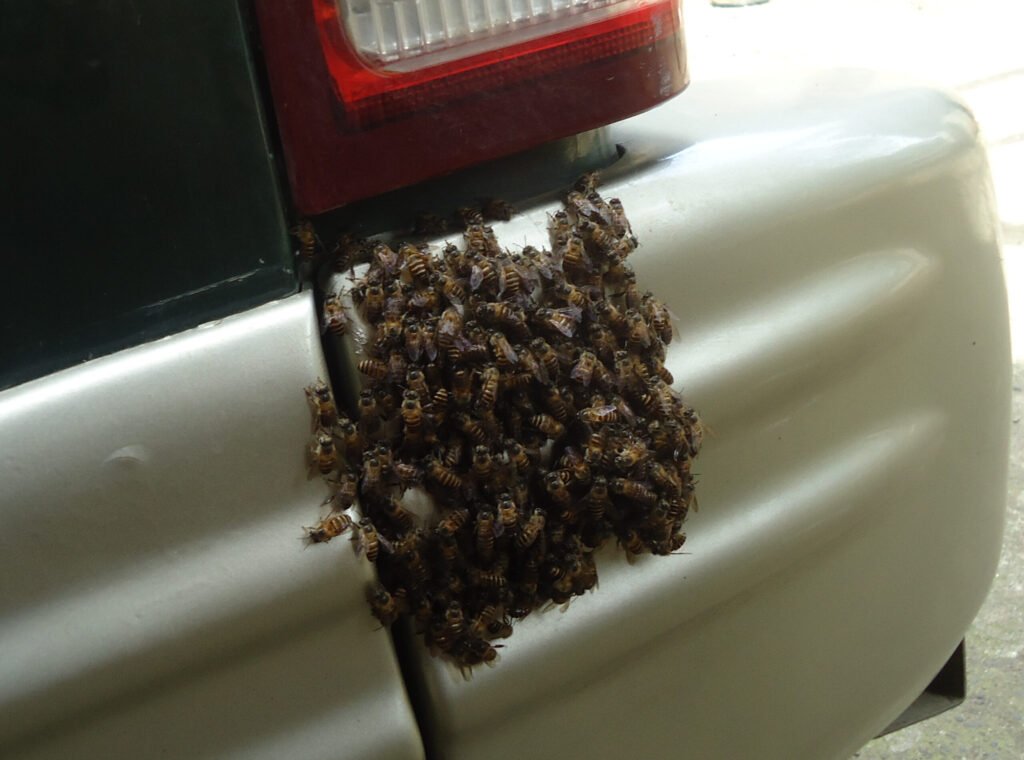
Like Apis cerana and the Western honey bee, Apis nigrocincta is a cavity-nesting species, building multiple parallel wax combs — spaced at a consistent “bee space” — inside an enclosed space such as a tree hollow, and documented nest sites include hollows in living or dead tree trunks, spaces underneath roofs, and even large water jars. Nests are typically found several meters off the ground, and colonies are permanent, reproducing through fission (a portion of the colony splitting off to found a new nest) rather than only through new queen mating. This places it in a meaningfully different nesting category from open-nesting Asian species like the giant honey bee and dwarf honey bee already covered on this site, both of which build a single exposed comb rather than nesting inside a cavity.

Where It Fits in the Honey Bee Size Range
Apis nigrocincta falls into a similar general size class as Apis cerana, considerably smaller than the giant honey bee but larger than the dwarf honey bee, both already covered on this site. Worker comb cells average around 4.5 mm across, a fairly typical measurement for a mid-sized cavity-nesting Apis species. This size positioning is consistent with its close evolutionary relationship to Apis cerana rather than to either of the size extremes found elsewhere in the genus.
General Foraging and Colony Behavior
Detailed, widely published behavioral research specific to Apis nigrocincta remains limited compared to what exists for commercially significant honey bee species, but as a cavity-nesting Apis species closely related to Apis cerana, it’s generally understood to follow broadly similar foraging and colony organization patterns — a queen, workers, and drones cooperating within an enclosed multi-comb nest — rather than displaying any radically different social structure from its better-studied relatives. One genuine research finding worth noting: the species may have colonized its current range from Borneo during Quaternary-era glaciation, when lower sea levels would have altered island connectivity across the region.
Why This Species Matters to Researchers
Despite its obscurity to most beekeepers and the general public, Apis nigrocincta holds genuine scientific value precisely because of its close-but-distinct relationship to Apis cerana. Researchers studying honey bee speciation, hybridization, and genetic divergence use comparisons between the two species as a real, documented case study in how honey bee lineages can separate — down to nesting elevation preference — while still remaining capable of interbreeding where their ranges overlap and even sharing identical drone genitalia, a genuinely useful natural experiment for understanding honey bee evolution more broadly.
Not a Commercially Managed Species
Unlike the Western honey bee or, to a lesser extent, Apis cerana, Apis nigrocincta is not managed commercially or kept by beekeepers in any significant, widespread way. Its narrow native range, combined with the dominance of introduced Western honey bees and locally-adapted Apis cerana in regional beekeeping practices, means this species remains almost entirely a wild, unmanaged part of its native ecosystem rather than a beekeeping resource.
A Species Vulnerable Simply Because of Its Range
Because Apis nigrocincta occupies such a limited geographic area, it is inherently more vulnerable to habitat loss and other localized pressures than honey bee species with continent-spanning ranges, simply as a function of geography rather than any documented population crisis specific to the species. This is a genuinely useful illustration of a broader conservation principle worth stating honestly: range size alone shapes vulnerability, independent of how healthy a given population happens to be at any particular moment.
Apis Nigrocincta vs. Other Asian Honey Bee Species
| Feature | Apis Nigrocincta | Apis Cerana | Apis Dorsata |
|---|---|---|---|
| Range | Sulawesi, Sangihe, Mindanao (narrow) | Broad across Asia | Broad across Asia |
| Nesting style | Cavity, multiple combs | Cavity, multiple combs | Open, single comb |
| Managed by beekeepers | No | Yes, regionally | No |
| Size | Similar to Apis cerana | Medium | Largest Apis species |
Common Misconceptions
The most common misconception is treating Apis nigrocincta as simply a regional variant of Apis cerana rather than the currently recognized distinct species it is, a framing that was more historically accurate before genetic and morphometric research clarified the two as separate lineages despite their drones’ identical genitalia. A second common misconception is assuming every honey bee species is, or could realistically become, a managed beekeeping resource the way Western honey bees and Apis cerana are, when a narrow-range species like this one remains almost entirely outside that context.
Frequently Asked Questions
Is Apis nigrocincta dangerous to people?
There’s no documented evidence that this species is unusually aggressive or dangerous compared to other Asian honey bee species, though limited research means detailed temperament data isn’t as extensively documented as it is for more widely studied species.
Can Apis nigrocincta be kept by beekeepers outside its native range?
This isn’t a realistic or documented practice; the species isn’t commercially available or established in beekeeping outside its narrow native range the way Apis cerana or Western honey bees are.
Why is Apis nigrocincta considered scientifically interesting despite being obscure?
Its close evolutionary relationship to, and documented hybridization with, Apis cerana — including sharing identical drone genitalia despite being separate species — makes it a genuinely useful case study for researchers studying how honey bee species diverge while still remaining capable of interbreeding in areas of range overlap.
Does Apis nigrocincta produce honey the way other Apis species do?
Yes, as a member of the genus Apis, it produces and stores honey within its comb structure the same general way other honey bee species do, though because it isn’t commercially managed, there’s no established honey industry built around this species the way there is for Apis mellifera or, regionally, Apis cerana.
Why do beekeepers outside Southeast Asia rarely hear about Apis nigrocincta?
Its narrow native range, lack of commercial management, and limited research output compared to species like Apis mellifera and Apis cerana mean it simply doesn’t appear in mainstream beekeeping education, equipment marketing, or general pollinator content the way more economically significant honey bee species do.
What does the species name “nigrocincta” mean?
The name derives from Latin roots referring to a dark or black band, likely describing the coloring or banding feature — consistent with the informal common name “black-banded honey bee” — used in the original scientific description by Frederick Smith, consistent with the Latin-based naming convention used across the genus Apis and much of formal biological taxonomy generally.
Are there other honey bee species with similarly narrow, island-limited ranges?
Yes, several Apis species and subspecies documented across Southeast Asia occupy comparatively narrow island or regional ranges, reflecting the genus’s broader evolutionary history across a geographically fragmented, island-rich part of the world rather than Apis nigrocincta being a completely unique case in that respect.
Further Reading
For more on this topic, see the taxonomic reference on Apis nigrocincta, which cites the original morphometric and molecular research distinguishing it from Apis cerana.