Last Updated September 16, 2026
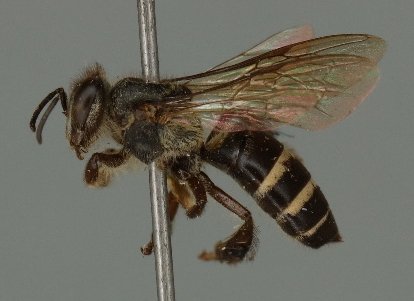
Apis andreniformis, the black dwarf honey bee, is one of the two smallest honey bee species on Earth, native to the forests of South and Southeast Asia, where it builds a single exposed comb on a branch rather than the enclosed cavity nest most beekeepers picture. It’s never been domesticated for commercial beekeeping and almost certainly never will be, but it’s a genuinely useful species to understand for what it reveals about how much variation exists inside the genus Apis beyond the one species — Apis mellifera — that dominates Western beekeeping.
Key Takeaways
- Apis andreniformis and its close relative Apis florea make up the subgenus Micrapis, the two smallest and most primitive-featured living honey bee species, both native to tropical and subtropical Asia.
- A. andreniformis is confirmed present in Vietnam, Thailand, Laos, China, India, and the islands of Borneo, Indonesia, and Palawan — a narrower range than its sister species A. florea, which extends further west.
- It nests in a single, open, exposed comb built on a branch or in dense shrubs, typically in shaded forest with only 25–30% of full sunlight — nothing like the enclosed cavity nest Apis mellifera and Apis cerana use.
- Despite its small size, A. andreniformis is considered more defensive than its sister species A. florea and is known to respond to disturbances from several meters away from the nest.
- Genome sequencing published in 2025 confirmed A. andreniformis and A. florea retain more ancestral (plesiomorphic) traits than any other living honey bee species, making them a genuine window into early honey bee evolution.
Table of Contents
- Size, Range, and Basic Identification
- A Single Exposed Comb, Not a Cavity
- Defensiveness and Foraging
- What Genome Research Reveals
- How It Compares to the Bees Beekeepers Actually Keep
- Apis Andreniformis vs. Apis Florea at a Glance
- Frequently Asked Questions
Size, Range, and Basic Identification
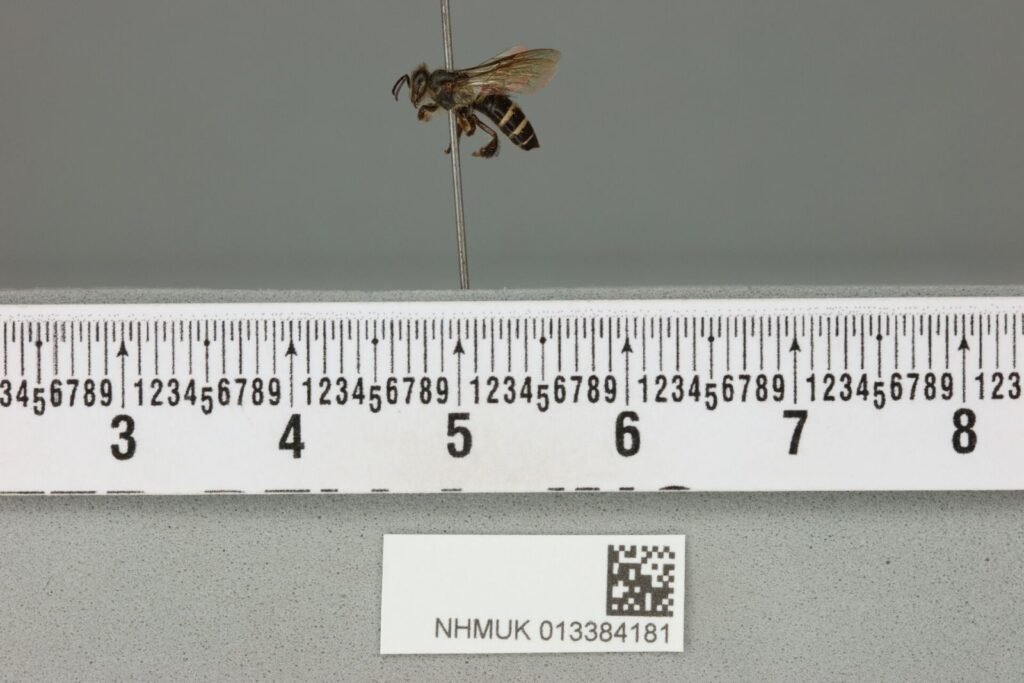
Apis andreniformis, commonly called the black dwarf honey bee, is one of just two species in the honey bee subgenus Micrapis — the dwarf honey bees — the other being the slightly larger and more widely distributed Apis florea. Workers measure roughly 6.5 to just under 10 millimeters, making them the smallest members of the genus Apis. Confirmed range for A. andreniformis specifically covers Vietnam, Thailand, Laos, southern China, and India, along with the islands of Borneo, Indonesia, and Palawan in the Philippines — a somewhat narrower distribution than A. florea, which extends further west into parts of the Middle East. The two species can be difficult to distinguish without close inspection: one reliable measured difference is proboscis (tongue) length, at roughly 2.80 millimeters in A. andreniformis versus about 3.27 millimeters in A. florea, alongside subtle differences in wing venation and coloration that entomologists use for confirmed identification.
A Single Exposed Comb, Not a Cavity
Nothing about how A. andreniformis builds its home resembles the enclosed, multi-comb cavity nest that defines beekeeping with Apis mellifera or Apis cerana. Instead, the species builds a single, exposed, roughly fist-to-dinner-plate-sized comb, typically wrapped around a branch, stem, or dense shrub rather than tucked inside a hollow. Documented nest sites include the branches of bamboo and banana plants and the dense growth of shrubs such as coffee and tea, almost always chosen in shaded forest interior where only about 25 to 30 percent of full sunlight reaches the ground. That preference for deep shade and a single vulnerable comb — rather than the defensible enclosed cavity most honey bee species use — shapes nearly everything else about how the species survives, from its colony size to its defensive behavior.
Defensiveness and Foraging
An open, unprotected comb with no walls or cavity to retreat into leaves a colony with far fewer options for defense than a cavity-nesting species has, and A. andreniformis compensates with heightened vigilance rather than a fortified nest. The species is documented as generally more defensive than its sister species A. florea, known to respond aggressively to disturbances occurring three to four meters away from the nest — a wide alert radius for such a small insect. Foraging behavior, by contrast, is unremarkable by honey bee standards: like every other species in the genus Apis, A. andreniformis is a generalist forager, visiting a broad range of available flowering plants for nectar and pollen rather than specializing on particular species, and contributing meaningfully to pollination across the forest habitats where it lives.
What Genome Research Reveals
Beyond natural history, A. andreniformis matters to bee science for what its genetics reveal about the deeper evolutionary history of honey bees generally. Along with A. florea, it’s recognized as retaining the most plesiomorphic — ancestral, least evolutionarily modified — traits of any living honey bee species, effectively a closer approximation of what early Apis ancestors may have looked like before the lineage split into today’s cavity-nesting, multi-comb species. A 2025 genome-sequencing study produced full de novo genome assemblies for both A. andreniformis and A. florea specifically to give researchers a clearer comparative baseline for tracing how the genus Apis diversified, since comparing a genuinely ancestral-trait species against the more derived cavity-nesters used in commercial beekeeping gives evolutionary biologists a reference point that a single well-studied species like Apis mellifera can’t provide on its own.
How It Compares to the Bees Beekeepers Actually Keep
Nothing about A. andreniformis’s biology — its single exposed comb, its narrow tropical forest range, its heightened defensiveness relative to its own small size — makes it a candidate for hive-based beekeeping the way Apis mellifera or Apis cerana are kept worldwide. It sits at one extreme of a genus that this site has covered across most of its range: the giant honey bee Apis dorsata at the opposite size extreme, the two species most beekeepers actually manage compared directly in this site’s Apis cerana vs. Apis mellifera guide, and another little-studied Asian species profiled in the Apis nigrocincta guide. Seen together, they make the point that “honey bee” is a far more diverse category worldwide than the single managed species most beekeeping content — including most of this site — focuses on by necessity.
Apis Andreniformis vs. Apis Florea at a Glance
The comparison matters beyond taxonomy. Because both species build the same vulnerable single-comb nest in shaded forest, researchers studying either one are effectively studying a shared survival strategy against the same pressures — predation, weather exposure, and the total absence of a defensible cavity — which is part of why the two are almost always discussed and sampled together in the field rather than as fully separate research subjects.
That shared reference point has practical value beyond pure taxonomy, too: because Apis mellifera dominates commercial beekeeping so completely, a genuinely primitive-trait species like A. andreniformis gives breeders and evolutionary biologists a comparison point outside the narrow genetic bottleneck of managed Western honey bee stock — a reminder that everything most beekeepers know about “the honey bee” describes one species out of several very different ones living across the wider genus Apis.
| Trait | Apis andreniformis | Apis florea |
|---|---|---|
| Common name | Black dwarf honey bee | Red dwarf honey bee |
| Proboscis length | ~2.80 mm | ~3.27 mm |
| Confirmed range | Vietnam, Thailand, Laos, S. China, India, Borneo, Palawan | Wider range, extending further west |
| Defensiveness | More defensive; reacts several meters from nest | Comparatively less defensive |
| Nest style | Single exposed comb on a branch | Single exposed comb on a branch |
Both species matter to researchers for the same underlying reason. A 2025 genome-sequencing study producing the first full assemblies for both species put it plainly:
“The Micrapis subgenus remains underrepresented in genomic studies despite its ecological significance.”
From the study’s introduction, De novo genome assemblies of the dwarf honey bee subgenus Micrapis
For readers who want the full taxonomic picture, Wikipedia’s entry on Apis andreniformis and the species’ GBIF taxonomic record both track ongoing classification work on this species.
Frequently Asked Questions
Can Apis andreniformis be kept in a hive like Apis mellifera?
No. It builds a single exposed comb on a branch rather than nesting in an enclosed cavity, and it has no history of successful hive-based management the way Apis mellifera and Apis cerana do.
How is Apis andreniformis different from Apis florea?
The two dwarf honey bee species are similar in size and nest style but differ in range, proboscis length (shorter in A. andreniformis), and defensive behavior, with A. andreniformis generally considered the more defensive of the two.
Where does Apis andreniformis live?
Confirmed range covers Vietnam, Thailand, Laos, southern China, and India, along with Borneo, parts of Indonesia, and Palawan in the Philippines.
Does Apis andreniformis produce honey people harvest?
Wild honey from dwarf honey bee nests is harvested opportunistically in parts of its range, but the species isn’t commercially managed for honey production the way larger Apis species are.
Why do scientists study such an obscure honey bee species?
Because A. andreniformis and A. florea retain more ancestral traits than any other living honey bee species, making them a valuable reference point for understanding how the genus Apis evolved into its more familiar cavity-nesting members.