Table of Contents
- What a Double Nuc Is
- Why Two Small Colonies Winter Better Than One
- Where the Technique Comes From
- Box Construction and the Center Divider
- Entrance Configuration
- Setting Up for Fall
- Feeding Through Fall and Winter
- Spring Management and Splitting the Nucs
- Why Beekeepers Do This Instead of a Single Full Colony
- Double Nuc vs. Wintering Full-Size Colonies
- Signs Both Colonies Are Wintering Well
- Regional Climate Considerations
- Equipment Cost vs. Nuc Value
- Deep vs. Medium Frame Configurations
- Common Mistakes
- FAQ
What a Double Nuc Is
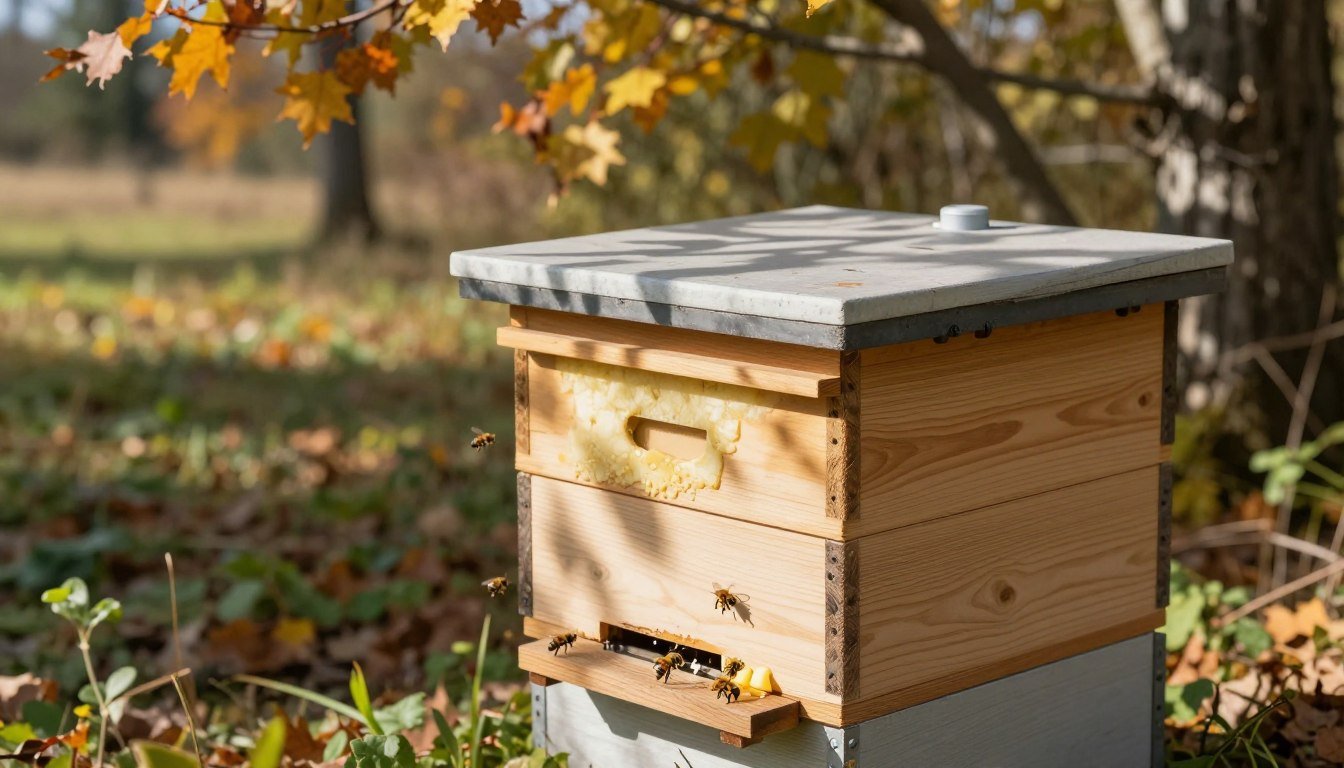
A double nuc is a single hive box, roughly the footprint of a standard 10-frame deep, split lengthwise by a solid center divider into two independent 4-frame compartments — each housing its own small colony with its own queen, its own frames, and its own entrance, but sharing the same outer box, insulation, and roof. The two colonies never mix (the divider is solid, not screened), but they benefit from being physically adjacent through the coldest months, which is the entire point of the setup.
Why Two Small Colonies Winter Better Than One
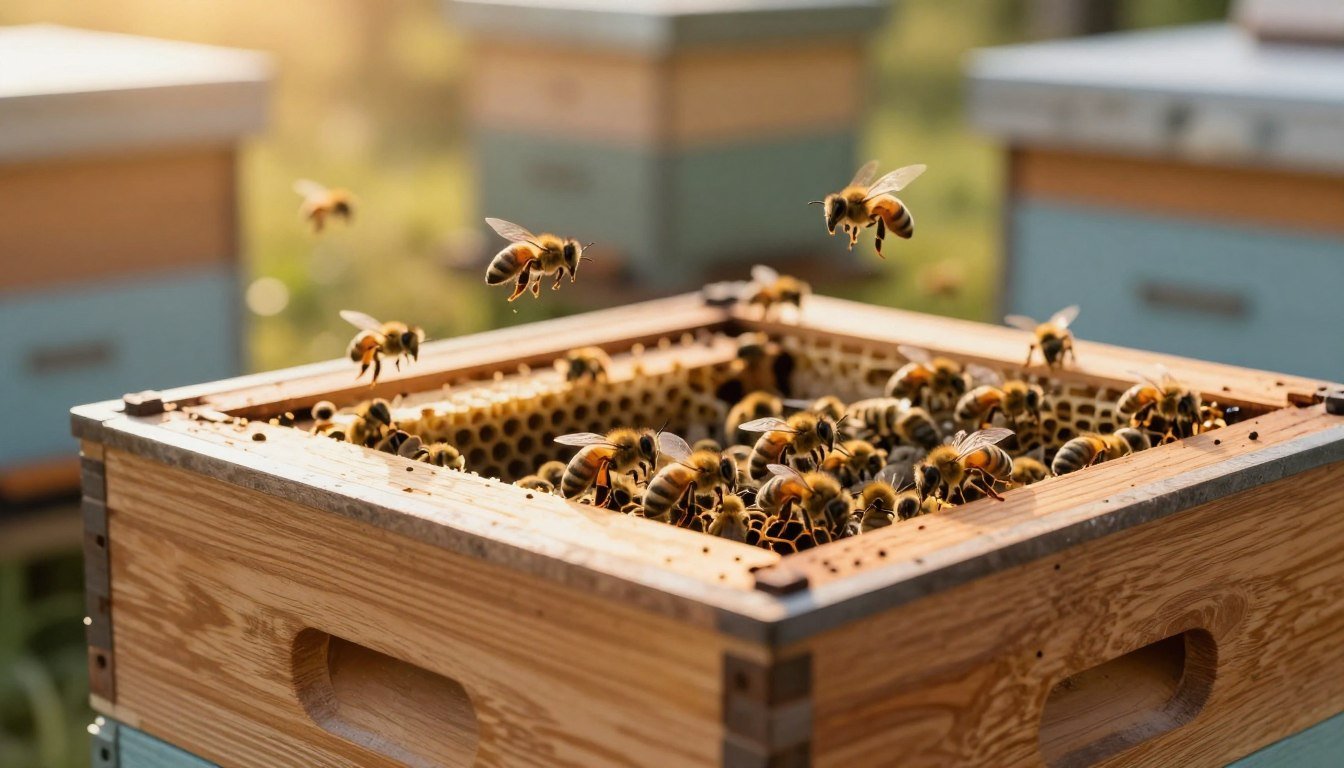
A small colony wintering entirely alone has a harder time than a large one, since it has less collective body mass to generate and retain cluster warmth, and proportionally more surface area exposed to cold relative to its size. A double nuc addresses this without requiring either colony to actually be large: heat generated by each cluster passes through the shared center divider, so both small colonies benefit from something close to the thermal advantage of a much bigger single cluster, without merging the bees or queens together. In winter, bees on each side cluster right up against the dividing wall, and the overall heat pattern looks remarkably similar to what a single large cluster split down the middle would look like — except it’s genuinely two independent colonies the whole time.
Where the Technique Comes From
The double nuc method is closely associated with Michael Palmer, a well-known Vermont commercial beekeeper who popularized this specific box design and approach for producing overwintered nucleus colonies at scale, and the “Palmer-style” double nuc box remains the common reference point when beekeepers and suppliers discuss the design. It’s now a widely available commercial product from established beekeeping suppliers, not just a DIY concept, reflecting how thoroughly the design has been adopted since Palmer’s original demonstrations of the method.
Box Construction and the Center Divider
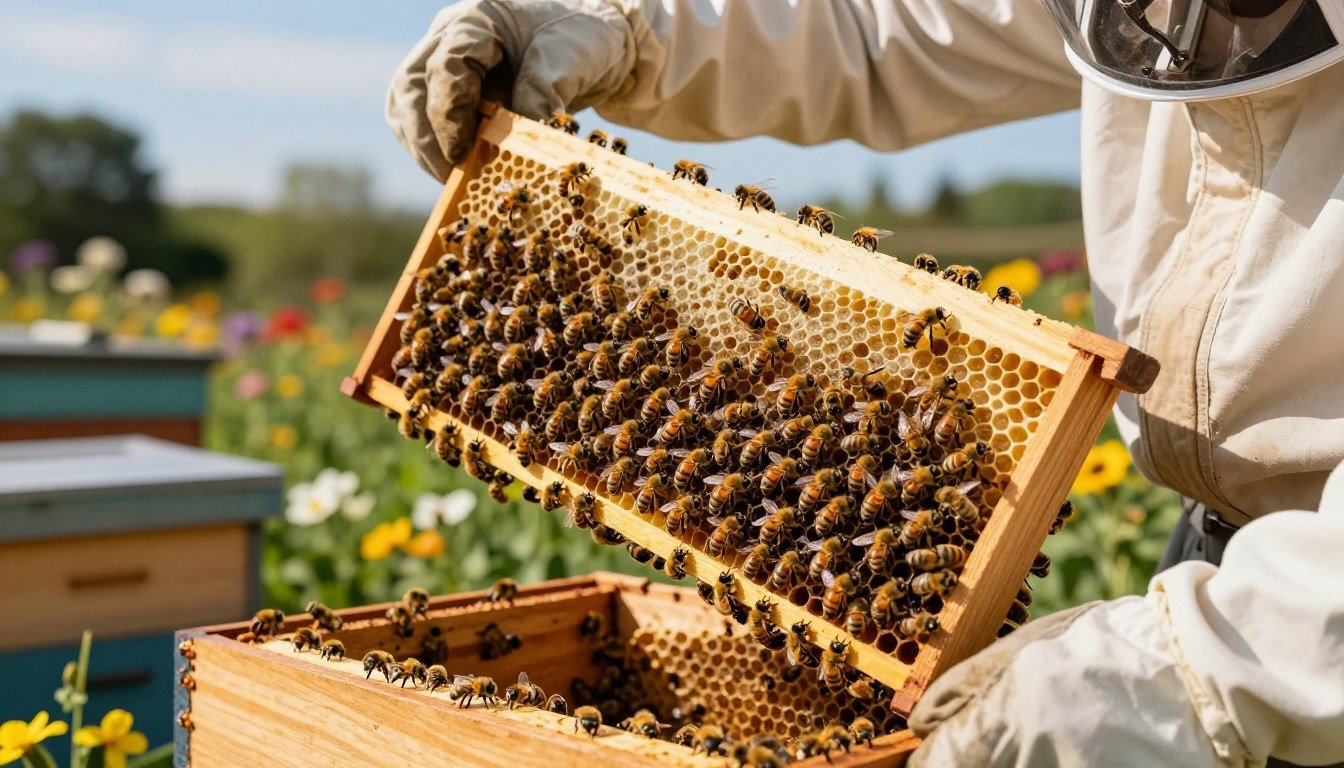
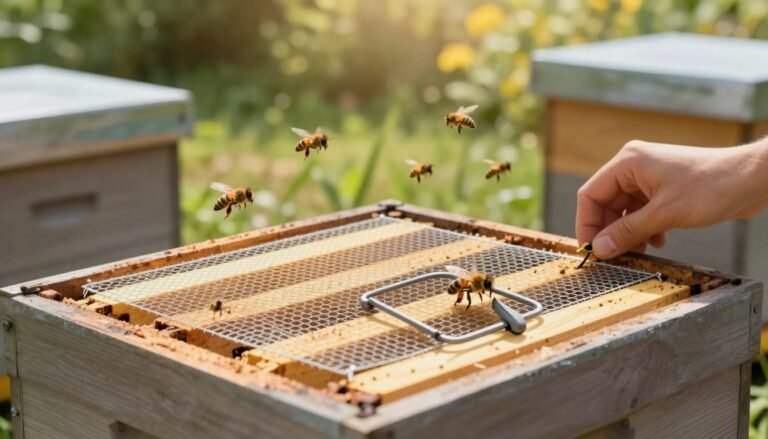
A standard double nuc box is built to roughly 10-frame-deep external dimensions, with a solid wooden divider running down the center of the box lengthwise. Because the divider itself takes up meaningful width, each side typically holds only 4 frames rather than the 5 you might expect from simply halving a 10-frame box. The two compartments share a single outer cover and a layer of insulation across the top, but each side gets its own narrow inner cover, keeping the moisture and thermal management of each colony largely independent even while they share the outer shell.
Entrance Configuration
Entrances are cut at two opposite corners of the box, one for each side, so foragers from each colony have a clear, separate point of access that doesn’t put them in each other’s flight path at the entrance. This corner placement, rather than centering both entrances on the same face, helps minimize drifting between the two colonies during the season when both are actively flying and foraging.
Setting Up for Fall
- Build up each side to a reasonably strong 4-frame nuc during the growing season, with a mated, laying queen established in each compartment.
- Confirm both sides have adequate stores heading into fall — a double nuc doesn’t reduce each colony’s actual food requirement, only its heat-retention burden.
- Ensure the center divider is solid and properly seated, with no gaps that would let bees from one side reach the other.
- Add or confirm insulation on top before the coldest weather sets in, since the shared top cover is doing double duty for both colonies.
Feeding Through Fall and Winter
Division board feeders, positioned within each side’s own compartment, are commonly used both earlier in the season (to help each nuc draw out comb on fresh frames) and again in early fall specifically to make sure each nuc goes into winter heavy with stores (see how to build up colony strength before winter from a nuc for the general principles this applies to on each side) — the same fall feeding logic that applies to any colony, just executed independently on each side of the divider. Because each compartment is functionally a separate colony, don’t assume feeding one side adequately addresses the other; check and feed both sides on their own merits.
Spring Management and Splitting the Nucs
As temperatures warm and both colonies begin spring buildup, many beekeepers gradually reposition the box so the two entrances point in increasingly different directions, which helps reduce drifting between the colonies as their populations grow and forager traffic increases. From there, each side can be built up independently — adding a 4-frame super above each compartment to go double-high, or two supers to go triple-high, as each colony’s population and stores demand — eventually splitting the box into two fully independent hives once each side is strong enough to stand on its own, or selling one or both sides as established overwintered nucs, which typically command a premium price in spring compared to package bees, given they’re already a proven, laying, overwintered colony rather than a freshly installed one. If you’d rather feed with dry sugar than syrup during the coldest stretch, see the Mountain Camp method for an approach that works well on each side of a double nuc too.
Why Beekeepers Do This Instead of a Single Full Colony
Beyond the winter survival advantage, the double nuc approach lets a beekeeper produce two independent, sellable overwintered nucs from roughly the footprint and equipment cost of one full-size hive, which is a meaningful efficiency gain for anyone selling nucs commercially or simply wanting to expand their own colony count without doubling their apiary footprint. See can you split a first-year nuc for related guidance on timing colony increase from a nuc, whether or not you use a double nuc setup to get there. It’s also a useful way to winter a genuine backup queen or a smaller breeding-stock colony alongside a production colony, sharing warmth without merging them. This second use case is easy to overlook but genuinely practical for anyone maintaining more than one queen line.
Double Nuc vs. Wintering Full-Size Colonies
| Double Nuc | Standard Full-Size Colony | |
|---|---|---|
| Colonies per box | Two independent 4-frame colonies | One colony, typically 8-10+ frames |
| Footprint efficiency | Two colonies in roughly one box’s footprint | One colony per full box |
| Spring outcome options | Two independent colonies or nucs to sell | One larger colony |
| Management complexity | Two compartments to check and feed independently | Single colony to manage |
Signs Both Colonies Are Wintering Well
On mild winter days when a brief check is safe, a few signs indicate both sides of a double nuc are coming through winter successfully: light tapping or listening at each entrance should produce an audible buzz response from both compartments, not just one; dead bees accumulating at each entrance in modest numbers is normal winter attrition, while a large pile at one entrance specifically can indicate that side is struggling; and by late winter, each side should still show some weight and resistance when the box is gently hefted, rather than feeling suspiciously light (a sign of dwindling stores on that particular side). Because the two colonies are fully independent, it’s entirely possible for one side to be thriving while the other struggles — don’t assume that because one compartment sounds strong, both are, and check each side on its own terms during any winter assessment.
Regional Climate Considerations
The double nuc method’s core advantage — shared warmth between two small colonies — matters most in regions with genuinely cold, long winters, where a small colony wintering entirely alone faces real survival risk. In milder climates, where overwintering small nucs alone is already fairly reliable, the shared-heat benefit is less critical, though the footprint and equipment efficiency of housing two colonies in one box’s space can still be a worthwhile reason to use the design regardless of climate. Beekeepers in the coldest regions sometimes add extra insulation wraps or windbreaks around the whole double nuc box during the most severe stretches of winter, treating the box’s built-in shared-heat advantage as a strong foundation to build additional cold protection on top of, not a complete solution on its own.
Common Mistakes
| Mistake | Why it matters |
|---|---|
| Assuming shared heat means less food is needed per colony | Each side still needs adequate individual stores — shared heat helps survival odds, it doesn’t replace food requirements |
| A gapped or poorly seated center divider | Allows bees or robbing activity to cross between the two supposedly separate colonies |
| Feeding only one side and assuming both are covered | The two compartments are fully independent colonies — check and feed each on its own |
| Keeping both entrances facing the same direction into spring | Increases drifting between colonies as forager traffic ramps up — gradually diverging the entrances helps reduce this |
Equipment Cost vs. Overwintered Nuc Value
A purpose-built double nuc box costs more upfront than two plain single nuc boxes would, largely due to the divider construction and shared insulated cover, but the comparison isn’t quite apples-to-apples — a double nuc also takes up roughly half the apiary footprint of two separate boxes and delivers the winter-survival benefit neither separate box provides on its own. For beekeepers planning to sell the resulting overwintered nucs in spring, the calculation tends to favor the double nuc clearly: an established, already-laying, overwintered nuc typically sells for more than a package of bees, and successfully wintering more of your nucs through to spring (thanks to the shared-heat advantage) directly increases how many you actually have available to sell or use for your own expansion, rather than losing a chunk of them to winter attrition. Factor in that a double nuc box also needs to be replaced or repaired less often per colony housed than two separate single-nuc boxes of similar quality, since you’re maintaining one structure instead of two, which further favors the economics over a multi-season ownership period rather than just a single winter. Beekeepers new to the design sometimes hesitate over the higher single-purchase price compared to a basic single nuc box, without weighing that a double nuc is functionally replacing two boxes at once, not competing directly against the price of just one. Framed against the correct comparison, the per-colony cost is usually favorable.
Deep vs. Medium Frame Configurations
Double nuc boxes are available in both deep and medium frame configurations, matching whichever frame depth you already standardize on elsewhere in your apiary — there’s no inherent advantage to one depth over the other specifically for this method, so consistency with your existing equipment is generally the deciding factor rather than any performance difference tied to frame size. A beekeeper running all-medium equipment for weight-management reasons (lighter boxes to lift) can get a medium double nuc just as easily as a deep one, and the winter heat-sharing mechanism works the same way regardless of which depth you choose. Mixing depths across your own apiary (mediums for supers, deeps for brood, for instance) is common enough that suppliers generally stock both double nuc versions without treating either as a niche or discontinued option.
Sources
Box design, entrance configuration, and feeding/spring-management practices reflect the Palmer-style double nuc method as documented by established beekeeping equipment suppliers and widely referenced beekeeping community discussion of Michael Palmer’s original technique. See University of Florida IFAS Extension’s Swarm Control for Managed Beehives guide for additional authoritative detail.
FAQ
What is a double nuc box?
A single hive box divided lengthwise into two independent 4-frame compartments, each housing its own colony and queen, sharing an outer shell and insulation so both colonies benefit from shared warmth through winter.
Do the two colonies in a double nuc mix together?
No — a solid center divider keeps them fully separate. They share heat through the divider but never physically mix bees, brood, or queens.
How many frames fit on each side of a double nuc?
Typically 4 frames per side, since the center divider takes up some of the width a standard 10-frame box would otherwise hold.
What happens to a double nuc in spring?
Each side is built up independently, often with the entrances gradually angled apart to reduce drifting, and the two colonies can eventually be split into fully separate hives or sold as established overwintered nucs.