Table of Contents
- What a Cut-Down Split Is
- Why Sending the Queen Away Maximizes Honey
- The Opposite of Pagden: A Useful Way to Understand It
- When to Do a Cut-Down Split
- Equipment Needed
- Step-by-Step Process
- What Happens to the Queenless Colony
- Managing the New Queen-and-Brood Colony
- What Results to Expect
- Who Should Use This Method
- Signs the Split Is Delivering the Honey Benefit
- Mite and Disease Considerations
- Reading Your Local Nectar Flow First
- Common Mistakes
- FAQ
What a Cut-Down Split Is
A cut-down split is a splitting technique that sends the queen, along with most open brood and nurse bees, to a brand-new location, while the bulk of the colony’s foragers and sealed (capped) brood remain behind at the original hive location. It’s specifically designed around a honey-production goal: the colony left behind ends up with a huge forager workforce and very little young brood left to feed, so instead of spending resources on rearing more bees, it pours nearly everything into collecting and processing nectar into honey during whatever flow is underway at the time.
Why Sending the Queen Away Maximizes Honey
A colony’s foraging effort is always balanced against its brood-rearing needs — nectar and pollen get split between what’s stored as honey and what’s consumed feeding larvae, and a colony with a lot of open brood to feed simply can’t dedicate everything to storage. By moving the queen and open brood elsewhere, the original location is left with mostly capped brood (which needs no further feeding, just time to emerge) and a full complement of foragers with essentially nothing else to do but bring in nectar. As those capped bees emerge over the following days and weeks, they join an already honey-focused workforce rather than requiring feeding themselves, compounding the effect rather than diluting it.
The Opposite of Pagden: A Useful Way to Understand It
If you’re already familiar with the Pagden method, the cut-down split is easiest to understand as its mirror image. Pagden keeps the queen at the original location specifically so returning foragers rejoin her colony, boosting it with field bees while the brood-heavy hive moves elsewhere. A cut-down split does the reverse: the queen and brood move away, and the foragers — who return to the location they remember, not to wherever the queen currently is — end up staying at the original site with nothing but capped brood and honey work. Both methods rely on the same underlying fact about forager behavior (they return to a remembered location, not to the queen specifically), just pointed toward different priorities: Pagden toward balanced swarm prevention and increase, cut-down splits toward maximizing honey yield from the location that keeps the foragers.
When to Do a Cut-Down Split
Timing is the single most important factor in whether a cut-down split delivers on its honey-production promise. It should be done just before or right at the start of your area’s strongest nectar flow of the season — doing it too early, before a real flow is underway, leaves the forager-heavy colony with plenty of workers but not much to actually forage on, wasting the effect. Doing it too late, after the main flow has already peaked or is winding down, means the colony misses the window the whole technique is built around. It’s also generally done on a colony that’s already strong and either showing swarm preparation signs or simply large enough that you’d want to split it anyway — a genuinely weak colony doesn’t have the forager surplus to make the honey-maximization effect meaningful.
Equipment Needed
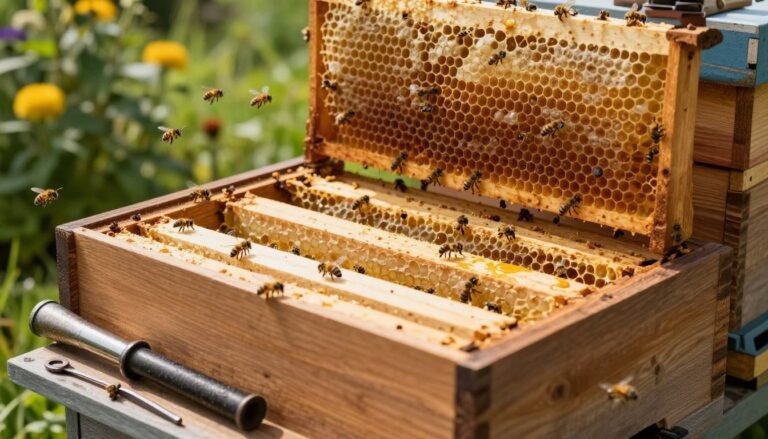
- A complete second hive setup for the queen’s new colony (floor, brood box with foundation and/or drawn comb, roof)
- A location for the new colony at least a few miles away, or far enough that returning foragers genuinely can’t find their way back — a short move within the same yard won’t produce the intended separation
- Standard hive tools for the split itself
Step-by-Step Process
- Destroy any existing queen cells in the colony before starting, since you’re managing this split deliberately rather than reacting to an already-advanced swarm impulse.
- Find the queen and set her aside on her frame.
- Select frames of open brood and nurse bees to go with her — enough to give the new colony a real start, but leaving the bulk of sealed brood behind.
- Transfer the queen, open brood, and nurse bees into the new hive box, and move this box to its new, distant location.
- Leave the original hive at its original location, now holding mostly capped brood, stores, and the full forager population.
- Give the original hive a frame of eggs or very young larvae if it doesn’t already have some among the remaining brood, so it can raise an emergency queen.
What Happens to the Queenless Colony
The colony left behind at the original location raises its own replacement queen from eggs or very young larvae present on the capped brood frames — an emergency queen-rearing process the colony handles on its own, the same way it would after losing a queen unexpectedly. This takes roughly the standard queen development timeline (about 16 days from egg to emergence) plus additional time for mating and the start of laying, during which the colony continues its honey-focused work uninterrupted, since brood-rearing demands stay minimal until the new queen is established and laying again.
Managing the New Queen-and-Brood Colony
The relocated colony, holding the original queen plus open brood and nurse bees but comparatively few foragers, needs standard new-colony management: monitor stores and feed if the location doesn’t have strong local forage of its own, and expect it to rebuild its own forager population gradually as the transferred brood matures and as nurse bees eventually transition to foraging duty. This colony won’t be honey-focused the way the one left behind is — its priority is rebuilding a balanced population, similar to any new split or nuc. See can you split a first-year nuc for related guidance on managing a newly split colony’s growth timeline.
What Results to Expect
Done with good timing against a real nectar flow, beekeepers report a cut-down split can produce a substantial honey crop from the original location within a relatively short window — sometimes described as comparable to what a single strong, unsplit colony might produce, since the labor that would otherwise go toward feeding a large brood nest gets redirected almost entirely into honey processing instead. The tradeoff is that this is very timing-dependent: a cut-down split performed against a weak or unpredictable flow won’t deliver the same dramatic result, since there’s nothing extra for the freed-up forager capacity to actually go collect.
Who Should Use This Method
Cut-down splits suit beekeepers managing a strong colony ahead of a known, reliable nectar flow who want both an increase in colony count and a strong honey harvest from the same event, rather than treating those as separate goals. It requires reasonably precise timing knowledge of your local flow, which usually comes from a season or more of your own notes or a mentor’s guidance on when your specific area’s main flow typically starts — beekeepers newer to an area without that local knowledge yet may get more consistent results from a simpler split timed less critically. There’s no shame in defaulting to a plain walk-away split for a season or two while building that local knowledge before attempting the more timing-sensitive version.
Signs the Split Is Delivering the Honey Benefit
Within a couple of weeks of a well-timed cut-down split, the original location should show visibly rapid honey-super filling compared to what the same colony was doing before the split — a clear sign the freed-up forager capacity is translating into storage rather than just maintaining the status quo. You should also see the colony’s brood nest contract sharply for a period while it’s queenless and waiting on the new queen to mate and begin laying, which is expected and not a cause for concern on its own. If honey accumulation doesn’t noticeably pick up within the first couple of weeks, that’s usually a sign the local flow wasn’t as strong as hoped at the time of the split, rather than a sign the technique itself failed — check actual nectar flow conditions before assuming something went wrong with the split mechanics. A brief comparison against a nearby unsplit colony, if you have one, can help distinguish a genuinely weak flow from an issue specific to the split itself.
Mite and Disease Considerations
Like other splitting techniques, a cut-down split divides a colony’s existing mite and pathogen load between the two resulting populations rather than reducing it, so both the honey-focused original colony and the newly relocated queen’s colony deserve independent monitoring. The original colony’s natural brood break, while it waits for its new queen to mate and begin laying, is a genuinely useful side benefit here too — a period with little to no capped brood is exactly the kind of window where certain varroa treatments work best, similar to the timing advantage covered in oxalic acid vaporization for varroa mites. Consider using this natural brood break productively rather than letting it pass without any mite management action.
Common Mistakes
| Mistake | Why it matters |
|---|---|
| Timing it too early or too late relative to the local nectar flow | The entire honey-maximization benefit depends on a real flow being underway right as the forager-heavy colony is created |
| Moving the new colony too close to the original | Foragers may drift back to the original location instead of staying with the queen, undermining the new colony’s buildup |
| Leaving too little open brood for the original colony to raise a new queen from | Without young enough larvae or eggs present, the colony can’t produce a viable emergency queen |
| Treating this as a simple split without the timing precision it needs | Without a genuine, well-timed nectar flow, the technique offers little advantage over a plain walk-away split |
Reading Your Local Nectar Flow Before Committing
Because timing against a real flow is the single biggest factor in whether a cut-down split delivers its promised honey benefit, it’s worth building genuine confidence in your local flow timing before relying on this technique for an important harvest. Local beekeeping association records, a mentor’s season-to-season notes, and your own hive weight or honey-super-filling observations from prior years are all more reliable guides than a generic regional calendar, since flow timing can vary meaningfully even between apiaries a few miles apart depending on local forage availability, elevation, and microclimate. A beekeeper attempting this technique for the first time without solid local flow knowledge is better served spending a season simply observing and recording when their own colonies show the clearest signs of a strong flow, then applying that specific knowledge to a cut-down split the following year, rather than guessing based on a general “usually happens around this time” assumption.
Sources
Method mechanics and honey-yield reasoning reflect widely documented beekeeping community discussion and practical technique-sharing on cut-down splits, consistent with published guidance on timing splits around nectar flow for honey production. For current, authoritative detail, see University of Florida IFAS Extension’s Swarm Control for Managed Beehives guide.
FAQ
What is a cut-down split?
A split that sends the queen and open brood to a new location while foragers and capped brood remain at the original site, maximizing honey production there since the remaining colony has little brood left to feed.
How is a cut-down split different from the Pagden method?
They’re essentially opposites. Pagden keeps the queen at the original location so returning foragers rejoin her colony. A cut-down split moves the queen away, so foragers stay at the original site with capped brood and nothing but honey work.
When should I do a cut-down split?
Just before or at the start of your area’s strongest nectar flow — timing is the most critical factor in whether the honey-production benefit actually materializes.
Does the original colony need a new queen after a cut-down split?
Yes — it raises its own emergency queen from eggs or young larvae left on the capped brood frames, the same natural process a colony uses after unexpectedly losing its queen.