The Smithsonian’s National Museum of Natural History holds one of the largest insect collections on Earth — more than 35 million specimens overall, housed in over 5,200 cabinets — with bees forming a major part of its Hymenoptera holdings, a collection that traces back to a single 1898 acquisition of roughly 60,000 specimens and only became freely browsable by the public worldwide after a 2020 open-access initiative. This is a genuinely different kind of institutional story than a research lab or a government agency’s field program — it’s the century-plus history of how you build, and eventually open up, one of the largest reference collections of a single insect group in the world.
Most of this site’s institutional-history coverage focuses on agencies and labs actively researching living bee populations. The Smithsonian’s collection is a different kind of institution entirely: a physical, permanent, ever-growing reference archive of preserved specimens, existing specifically so that a researcher anywhere in the world can eventually compare a newly collected bee against a verified historical example.
Key Takeaways
- The Smithsonian’s Department of Entomology, part of the National Museum of Natural History, houses one of the world’s largest insect collections: more than 35 million specimens across 132,354 drawers, 33,000 jars or vials, and 23,000 slides in over 5,200 cabinets.
- The Hymenoptera collection (the insect order that includes bees, wasps, and ants) first became a genuinely major holding with the 1898 acquisition of the Ashmead collection, roughly 60,000 specimens.
- Early foundational work on the collection came from Smithsonian- and USDA-associated researchers including C.V. Riley, T. Pergande, E.A. Schwarz, and L.O. Howard, reflecting the close historical entanglement between the Smithsonian and USDA entomology in the late 19th century.
- In February 2020, the Smithsonian made its collections broadly open-access, and a dedicated digitization effort photographed and cataloged over 30,000 bee specimens within an eight-week period, including most of its bumble bee holdings.
- Today, almost 2.8 million items from the museum’s broader collections are freely downloadable online, letting researchers anywhere examine specimen photos and data without visiting Washington, D.C. in person.
Table of Contents
- How a National Insect Collection Actually Gets Built
- A Different Kind of Institution Than a Field Research Lab
- Going Digital: The 2020 Open-Access Shift
- Why a Specimen Archive Like This Matters for Bee Science
- Frequently Asked Questions
How a National Insect Collection Actually Gets Built
The Smithsonian’s own national insect collection has a more complicated origin than a simple institutional purchase. The United States National Museum was established in 1842, but insufficient funding in its early decades meant the young insect collection was actually distributed out to collaborating scientists rather than centralized — a pragmatic, if fragmented, solution common to underfunded 19th-century scientific institutions. In the 1870s, the USDA became the effective repository for the growing collection, folding it into USDA’s own holdings at a time when federal entomology work was closely shared between the Smithsonian and the Department of Agriculture rather than cleanly separated the way it might be organized today.
The collection’s Hymenoptera holdings — the order containing bees, along with wasps and ants — were built up by early researchers including C.V. Riley, T. Pergande, E.A. Schwarz, and L.O. Howard, names that also appear across the broader history of American economic entomology in this period. The collection reached the scale of a genuinely major holding with the 1898 acquisition of the Ashmead collection, adding roughly 60,000 specimens in a single acquisition — a scale of growth that turned a working research collection into a serious national reference archive almost overnight.
A Different Kind of Institution Than a Field Research Lab
It’s worth being explicit about how this differs from an active field-research institution like the USDA Bee Research Laboratory in Beltsville, Maryland, which studies living bee populations, disease, and management practices. The Smithsonian’s collection is fundamentally a taxonomic reference archive: preserved specimens, pinned and labeled with collection date and location, that let a researcher decades or even a century later verify exactly what species was present where and when. A live research lab answers “what’s happening to bees right now”; a specimen collection like the Smithsonian’s answers “what species existed, where, and how has that changed” — a slower but in some ways more permanent kind of scientific record. The same distinction separates the Smithsonian’s holdings from an explorer-driven program like Frank Benton’s USDA bee-importation work, which was about bringing new living stock into the country rather than archiving specimens of what already existed.
Going Digital: The 2020 Open-Access Shift
For most of its history, meaningfully using the Smithsonian’s bee collection required physically visiting the museum’s entomology department in Washington, D.C. — a real barrier for researchers, students, and citizen scientists anywhere else in the world. That changed substantially in February 2020, when the Smithsonian Institution moved to broad open access, making the majority of its collections data and specimen photography freely downloadable rather than restricted to in-person or special-request access.
The bee-specific digitization push was notably fast once undertaken: a dedicated team photographed and cataloged more than 30,000 bee specimens within an eight-week sprint, including the bulk of the museum’s bumble bee holdings — a genuinely large increase in freely available reference imagery for a single insect group in a very short window. Museum-wide, the open-access shift made nearly 2.8 million items across all collections freely downloadable, letting a researcher, student, or simply a curious member of the public examine specimen photographs and associated collection data without ever visiting the museum’s fifth-floor entomology cabinets in person.
Why a Specimen Archive Like This Matters for Bee Science
A collection this size and this old has value that active field research alone can’t replicate: it’s a physical time capsule of what bee populations actually looked like at specific places and specific moments going back well over a century, which is exactly the kind of historical baseline modern researchers need when trying to measure how species ranges, population sizes, or even physical characteristics have shifted over time — the same underlying scientific need that motivates newer efforts like the National Park Service’s own multi-park native bee surveys, which are, in effect, building tomorrow’s version of exactly this kind of historical reference archive.
Frequently Asked Questions
Can the public actually visit the Smithsonian’s bee collection in person?
The working specimen collection itself is a research archive, not a public exhibit, and isn’t open for casual walk-in browsing the way museum galleries are — but researchers, students, and qualified visitors can typically arrange access, and since 2020 the vast majority of specimen data and photography is freely viewable online without needing to visit in person at all.
How does the Smithsonian’s bee collection compare in size to other major insect collections worldwide?
At more than 35 million specimens across its full insect holdings, the Smithsonian’s collection ranks among the largest in the world, alongside a small number of other major national and university entomological collections globally — exact rankings shift somewhat depending on how different institutions count specimens versus species versus drawers.
Are new specimens still being added to the collection today?
Yes — national reference collections like this one are actively maintained and grown, incorporating new specimens from ongoing research, field surveys, and occasional acquired private collections, rather than being a fixed historical archive frozen at some past date.
What’s the difference between this collection and the USGS Native Bee Inventory and Monitoring Lab?
The USGS lab, based in Beltsville, Maryland, focuses specifically on native bee identification, survey design, and building species baselines from active federal land surveys; the Smithsonian’s collection is a much older, broader insect archive spanning far more than bees alone, with historical specimens going back well over a century rather than being built primarily from recent survey work.
A pinned specimen from an 1890s acquisition and a 2024 field survey answer the same basic question — what species was where, and when — and it’s that century-spanning continuity, now freely searchable online, that makes a collection like this valuable well beyond its home museum.
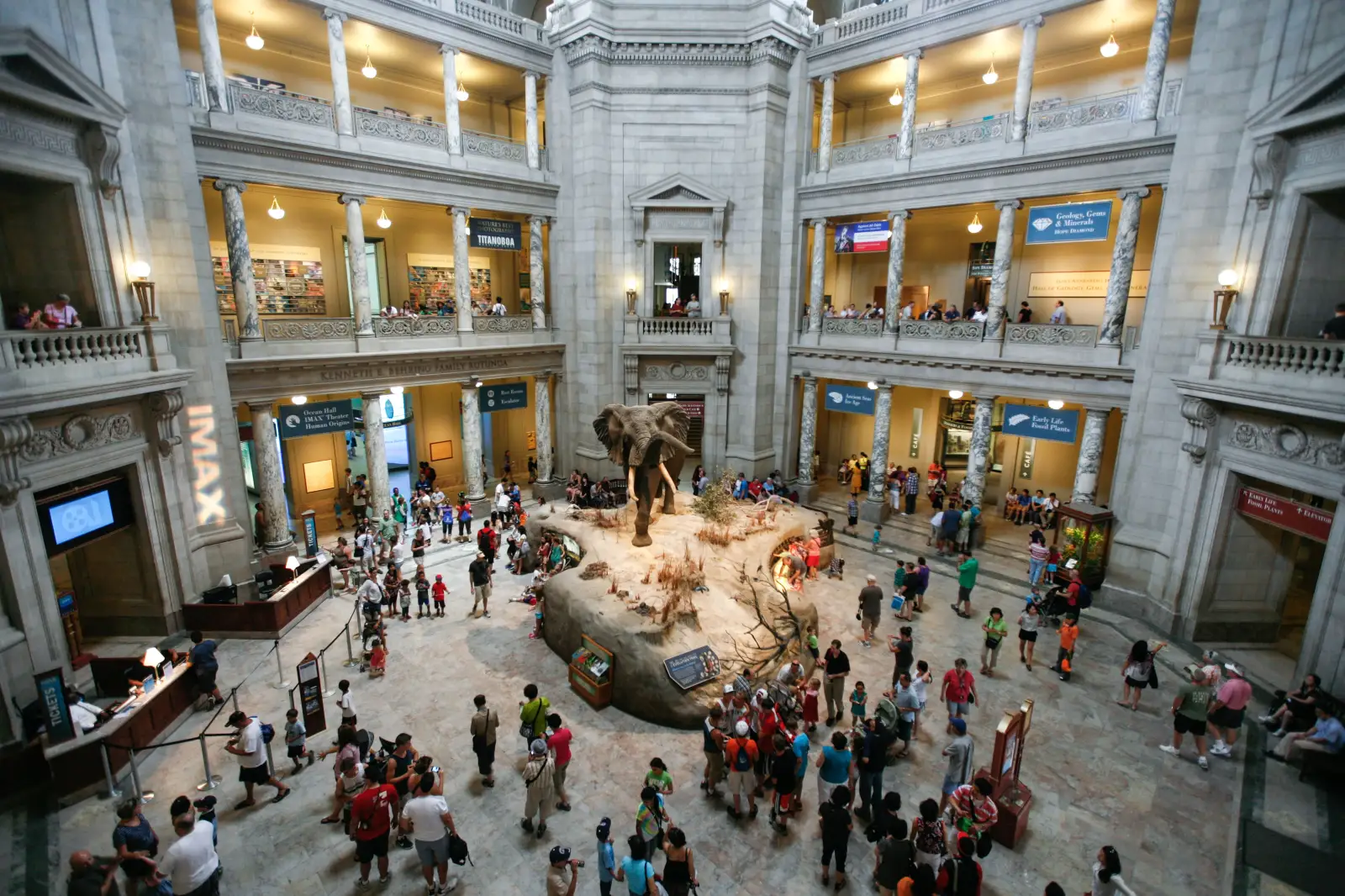
Image credits: Photo: Smithsonian Institution National Museum of Natural History by Alex Proimos, licensed CC BY 2.0, via Wikimedia Commons.